

I got a call from my brother-in-law last month asking me a question I’ve heard dozens of times over the years: “They want to patch my tire again — is that even safe?”
He’d already had the same rear tire repaired once before, and now a roofing nail had found its way into the tread on his daily commute through a construction zone outside Austin. It’s the kind of situation millions of American drivers face every year, and the answer isn’t as simple as most tire shops make it sound.
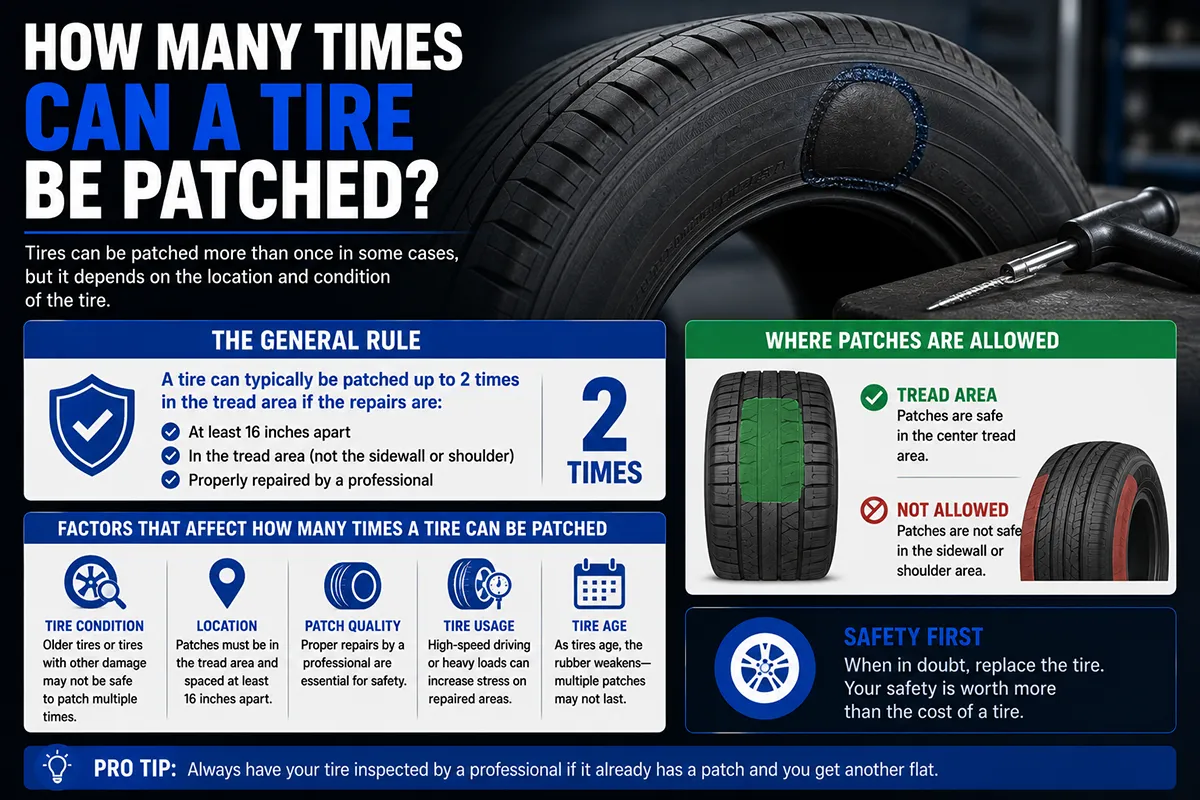
- Most tire industry guidelines allow a maximum of two puncture repairs per tire, assuming proper placement and technique.
- Repairs must be in the tread area only — never the sidewall, shoulder, or bead.
- A combination plug-patch (not a plug alone) is the only repair method I trust for long-term safety.
- Patches should be at least 16 inches apart from each other on the tire’s surface.
- If a tire has been driven on while flat (even briefly), it may not be safe to patch at all.
- When in doubt, replacing the tire is always the safer and smarter investment.
Liked this article?
Add TireAdvise as a preferred source so you see more of our tire reviews and guides on Google.
The Short Answer: Two Patches Is the General Limit
In my years of reviewing tires and working with shops across the country, the consensus I’ve seen lines up with what the Rubber Manufacturers Association (now the U.S. Tire Manufacturers Association) recommends: a tire can be repaired a maximum of two times.
But here’s the catch — that number comes with a long list of conditions. Not every puncture qualifies for a repair, and not every repair is done correctly. I’ve seen tires come into shops with three or four plugs jammed into them, still rolling down the highway at 70 mph. That’s not safe. That’s a blowout waiting to happen.
The “two-patch” rule assumes that each repair is performed correctly using a combination plug-patch, that the punctures are in the repairable tread area, and that the two repair sites are far enough apart from each other. Let me break down every one of those conditions, because they matter more than the number itself.
Why the Number of Patches Matters Less Than You Think
I know that sounds contradictory after I just gave you a number, but hear me out. I’ve inspected tires that had a single botched repair that made them more dangerous than a tire with two properly executed patches.
The quality and location of each repair is what determines whether your tire is still structurally sound. A tire is an engineered product with steel belts, polyester body plies, and a carefully designed inner liner. Every time you puncture it and repair it, you’re compromising that engineering to some degree.
So while two is the general maximum, a single repair done poorly — or in the wrong location — means you should replace the tire immediately. Context is everything.
Where on the Tire the Puncture Is Located Changes Everything
This is the single most important factor in determining whether a tire can be patched, and I can’t stress it enough.
The Repairable Zone: Center Tread Area
The only area of a tire that’s considered safely repairable is the central tread area — roughly the middle three-quarters of the tread face. If you look at your tire head-on, imagine drawing a line about half an inch inward from each tread shoulder. Everything between those lines is fair game for a proper repair.
I’ve personally had punctures repaired in this zone on multiple test tires over the years, and when done correctly with a combination patch, they’ve held up perfectly over extended driving periods with zero air loss.
The No-Go Zones: Sidewall, Shoulder, and Bead
If the puncture is in the sidewall, the shoulder (where the tread curves into the sidewall), or near the bead (where the tire seats against the rim), the tire cannot be safely repaired. Period.
I’ve had shop technicians tell customers they can “plug a sidewall puncture real quick” — and every time, I cringe. The sidewall flexes constantly during driving. It doesn’t have the rigid steel belt structure that the tread area has. A repair there will fail, and when it does, it can fail catastrophically at highway speed.
If anyone tells you they can patch a sidewall, find a different shop.
Plug vs. Patch vs. Combination Repair: What I Actually Trust
Not all tire repairs are created equal, and this is where I’ve seen the most confusion among everyday drivers. Let me walk you through the three main methods and tell you which one I recommend based on my firsthand experience.
The Rope Plug (Temporary at Best)
This is the sticky, worm-looking piece of rubber that gets shoved into the puncture hole from the outside of the tire. You’ve probably seen the plug kits at Walmart or AutoZone for about $8 to $12.
I’ll be honest — I’ve used these in emergency situations on the side of the road, and they can get you to a shop. But I would never consider a rope plug a permanent repair. It doesn’t seal the inner liner, which means air can migrate into the tire’s body plies and cause separation over time. I’ve seen this happen on tires after just a few weeks of driving on a plug-only repair.
The Internal Patch
This is applied from inside the tire after removing it from the rim. The technician buffs the inner liner and applies a vulcanizing patch over the puncture. It’s better than a plug because it seals the inner liner, but it doesn’t fill the puncture channel itself.
Some shops still use patch-only repairs, and while they’re more reliable than plugs alone, they’re not the gold standard.
The Combination Plug-Patch (The Only Method I Recommend)
This is sometimes called a “mushroom patch” or “one-piece repair unit.” It combines a rubber stem that fills the puncture channel with a flat patch that seals the inner liner from the inside. The tire must be removed from the rim to install it properly.
In my experience, this is the only repair method that provides a lasting, safe seal. It addresses both the outer puncture hole and the inner liner integrity. Every reputable tire shop I’ve worked with — from Discount Tire to local independents — uses this method for permanent repairs.
| Repair Method | Cost (Typical US Price) | Seals Inner Liner? | Fills Puncture Channel? | My Recommendation |
|---|---|---|---|---|
| Rope Plug (External) | $0–$15 (DIY kit) | No | Yes | Emergency only — not permanent |
| Internal Patch Only | $15–$30 | Yes | No | Acceptable but not ideal |
| Combination Plug-Patch | $20–$40 | Yes | Yes | Best option — always choose this |
The 16-Inch Rule: How Close Is Too Close?
Here’s a detail that most drivers don’t know about, and most tire shops don’t bother to explain. If you already have one repair in your tire and you get a second puncture, the two repair sites must be at least 16 inches apart.
Why? Because each repair slightly weakens the structure around it. When two repairs are too close together, the overlapping zones of compromised material create a larger weak point than either repair alone. I’ve seen tire failures that traced back to two repairs that were only a few inches apart.
If your second puncture lands within 16 inches of the first repair, most reputable shops will — and should — recommend replacing the tire rather than patching it again.
Puncture Size Limits: Not Every Hole Can Be Fixed
Even if the puncture is in the perfect spot on the tread, it still has to be small enough to repair safely. The U.S. Tire Manufacturers Association guidelines state that punctures larger than 1/4 inch (6mm) in diameter are not repairable.
In practical terms, this means most nails and screws are repairable, but larger objects — like a bolt, a piece of rebar, or a jagged piece of metal — often create punctures that are too large or irregularly shaped to seal properly.
I once pulled a 3-inch lag bolt out of a test tire’s tread. The hole it left was oblong and nearly half an inch wide. No patch in the world was going to make that tire safe again. It went straight to the recycler.
Run-Flat Damage: When You Drove on It Flat Without Knowing
This is a scenario I encounter constantly, and it’s one of the biggest reasons a patchable-looking tire actually needs to be replaced.
If you drove on a tire while it was flat or severely underinflated — even for a short distance — the internal structure can be damaged in ways you can’t see from the outside. The sidewall gets pinched between the rim and the road, and the inner liner can develop micro-tears and heat damage.
I’ve cut open tires that looked perfectly fine on the outside but had shredded inner liners from being driven flat for less than a mile. If your TPMS light came on and you kept driving for a while before checking the pressure, tell the shop. An honest technician will inspect the inner liner before deciding whether to patch, and if there’s any sign of run-flat damage, they’ll recommend replacement.
Many modern vehicles come with tire pressure monitoring systems, but I’ve talked to plenty of drivers who admitted they ignored the warning for days. By the time they got to a shop, the tire was toast internally — even though the tread still looked brand new.
What About Tire Age? Can You Patch an Old Tire?
Absolutely — tire age plays a role in whether a repair makes financial and safety sense. Even if a tire is within its legal tread depth, rubber degrades over time due to UV exposure, heat cycling, and oxidation.
Most tire manufacturers and safety organizations recommend replacing tires that are six to ten years old, regardless of remaining tread. If your tire is already approaching that age window and picks up a nail, I’d strongly recommend putting that $30 repair cost toward a new tire instead.
I’ve reviewed tires that had plenty of tread left but were seven or eight years old based on the DOT date code. Patching a tire that’s already nearing the end of its safe lifespan just doesn’t make sense to me. You’re spending money to extend the life of something that should be retired soon anyway.
You can check your tire’s age by reading the last four digits of the DOT code on the sidewall. For example, “2319” means the tire was manufactured in the 23rd week of 2019.
My Real-World Experience With Multiple Tire Patches
I want to share a few specific situations from my own driving and testing experience because I think they illustrate the nuances better than any rule sheet can.
The Two-Patch Success Story
I had a set of Continental DWS 06 Plus tires on my daily driver a while back. During my time with them, I picked up a small screw in the left rear tire’s center tread. I had it repaired with a combination plug-patch at a local Discount Tire. Cost me nothing — they do it free.
Several weeks later, the same tire picked up a finish nail near the opposite edge of the tread, well within the repairable zone and more than 16 inches from the first repair. Discount Tire inspected the first repair, confirmed it was holding perfectly, and installed a second combination patch.
That tire continued to perform flawlessly for the rest of its service life. No air loss, no vibration, no issues at all. Two properly done repairs, good locations, adequate spacing — textbook case.
The One-Patch Failure
On the flip side, I once had a budget tire on a test vehicle that caught a drywall screw. A quick-lube shop nearby offered to plug it for free while I waited. I was in a hurry, so I let them do it — just a rope plug, no patch, tire never came off the rim.
Within a few days of driving, my TPMS light came on. The plug was leaking slowly. I took it to a proper tire shop, and when they pulled the tire off the rim, they found the inner liner was starting to show signs of air migration around the plug site. They did a proper combination repair, and it held fine after that.
But that experience reinforced what I already knew: the repair method matters just as much as the number of repairs.
When You Should Skip the Patch and Buy a New Tire
Based on everything I’ve covered — and drawing on years of hands-on tire testing — here’s my straightforward list of situations where I’d tell you to skip the repair and invest in a replacement tire:
- The puncture is in the sidewall, shoulder, or bead area. No repair is safe here.
- The puncture is larger than 1/4 inch in diameter. The hole is too big to seal reliably.
- The tire already has two previous repairs. You’ve hit the maximum.
- The new puncture is within 16 inches of an existing repair. The structural overlap is too risky.
- The tire was driven while flat or severely underinflated. Hidden internal damage is likely.
- The tire is six or more years old. The rubber is degrading regardless of tread depth.
- The tread depth is at or near 2/32 of an inch. You’re at the legal minimum and need new tires anyway.
- There’s visible sidewall bulging, cracking, or irregular wear. These are signs of existing structural compromise.
- The previous repair was a plug-only job. This counts as a compromised repair, and adding another repair on top of it is risky.
If even one of these conditions applies, I recommend replacing the tire. A new tire in a popular size like 225/65R17 can cost anywhere from $80 to $180 depending on the brand. That’s a small price for the safety of you and your passengers.
Can You Patch a Tire More Than Twice? What If a Shop Says Yes?
I’ve walked into shops that will happily patch a tire for a third or fourth time. Some of them are doing it because they genuinely believe it’s fine. Others are doing it because a $25 repair is easy money.
Here’s my honest take: I would not drive on a tire with more than two repairs, even if a shop says it’s okay. The U.S. Tire Manufacturers Association guidelines exist for a reason, and they’re based on extensive testing and engineering analysis.
Every additional puncture and repair introduces another potential failure point. Tires operate under extreme stress — they support thousands of pounds of vehicle weight, absorb road impacts, and withstand heat buildup at highway speeds. The margin for error is smaller than most people realize.
If a shop wants to repair your tire for a third time, get a second opinion. And if that second opinion comes from a shop that also wants to sell you a new tire, don’t automatically assume they’re trying to upsell you. They might be the ones giving you the safer advice.
How to Make Your Tire Repair Last
If you do get a patch — whether it’s your first or second — here are the steps I take to make sure it holds up:
- Check your tire pressure weekly for the first few weeks after the repair. I use a simple digital gauge (I like the Accutire MS-4021B — it’s about $8 and dead accurate). Any slow leak will show up as a gradual pressure drop.
- Drive normally for the first day after the repair. Avoid hard cornering or sustained high-speed driving while the patch fully cures and bonds.
- Visually inspect the repair area periodically. If you see the plug stem protruding or any signs of bubbling, get it re-examined immediately.
- Maintain proper tire pressure at all times. Underinflation puts extra stress on the tire’s structure, including repaired areas. Your vehicle’s recommended pressure is on the driver’s door jamb sticker — not on the tire sidewall.
- Keep up with regular tire rotations. Moving the repaired tire to different positions on the vehicle helps distribute wear evenly and reduces the chance of the repaired tire bearing excessive load in one position for too long.
Free Tire Repair: Where to Get Patched Without Paying
One of the best-kept secrets in the US tire market is that several major retailers will repair your tire for free — even if you didn’t buy the tire from them.
- Discount Tire / America’s Tire: Free flat repairs on any tire, any brand, regardless of where you purchased it. I’ve used this service at least a dozen times over the years and the quality has always been excellent. They use combination plug-patches as standard.
- Costco Tire Center: Free repairs for members, but only on tires purchased at Costco.
- Sam’s Club Tire Center: Free repairs for members on tires purchased there.
- Belle Tire (Midwest): Free flat repair regardless of where the tire was purchased.
Knowing these options means there’s no excuse to settle for a cheap rope plug from a gas station. If there’s a Discount Tire anywhere near you — and there are over 1,100 locations across the US — you can get a proper combination repair done right, at no cost.
Understanding Tire Warranties and How Repairs Affect Them
This is something I get asked about a lot, and the answer varies by manufacturer and retailer.
Most tire manufacturer warranties (like Michelin’s, Bridgestone’s, or Goodyear’s) cover defects in materials and workmanship but do not cover road hazard damage like nail punctures. That means the cost of repair or replacement after a puncture typically falls on you.
However, many retailers sell optional road hazard warranties at the time of purchase — usually $15 to $25 per tire. These typically cover free repairs and prorated replacement if the tire is damaged beyond repair. In my experience, these warranties are often worth the money, especially if you drive through construction zones or in areas with a lot of road debris.
One important note: some road hazard warranties become void if the tire has been improperly repaired (like with a plug-only method). Always ask your warranty provider what repair methods they accept to keep your coverage intact.
The Bottom Line: Be Smart, Not Cheap
I understand the temptation to patch a tire one more time instead of shelling out for a replacement. Tires are expensive, budgets are tight, and it’s hard to justify spending $150 on something you can’t even see working.
But I’ve been in this industry long enough to know that tires are the single most important safety component on your vehicle. They’re the only thing connecting your car to the road. Every braking, steering, and acceleration input you make goes through those four contact patches.
Two properly executed combination plug-patch repairs in the tread area, spaced at least 16 inches apart, on a tire that’s in otherwise good condition? That’s perfectly safe, and I’d drive on it without hesitation.
Anything beyond that — a third repair, repairs in questionable locations, plug-only fixes, repairs on aged or damaged tires — and I’d be shopping for a replacement.
Your tires are not the place to cut corners. Trust me on that one.
Frequently Asked Questions
How many times can a tire be patched before it needs to be replaced?
Most tire industry experts and the U.S. Tire Manufacturers Association recommend patching a tire no more than two times over its lifetime. Each repair weakens the tire’s internal structure slightly, and exceeding two patches increases the risk of blowouts, especially at highway speeds common on US interstates. If your tire has already been patched twice, I’d strongly recommend shopping for a replacement rather than risking another repair.
Can you patch a tire in the same spot twice?
No, you should never patch a tire in the same spot or place a new patch overlapping a previous repair. The rubber and steel cords in that area are already compromised, and a second repair won’t bond properly or restore structural integrity. If the new damage is within a couple of inches of an existing patch, most reputable tire shops in the US will advise you to replace the tire entirely.
Is it safe to drive on a tire that has been patched multiple times?
Driving on a tire with one proper patch-plug combo repair is generally safe, but multiple patches raise serious safety concerns. Each repair creates a potential failure point, particularly during high-speed driving, heavy braking, or in extreme summer heat common across the southern US. I always recommend having a certified technician inspect a multi-patched tire and replacing it if there’s any doubt about its integrity.
How much does it cost to patch a tire vs. buying a replacement?
A professional tire patch-plug repair typically costs between $20 and $45 at most US tire shops, while chains like Discount Tire often repair tires for free if you purchased from them. A new replacement tire ranges from $60 to $200 or more depending on size and brand, so one or two patches can save you real money. However, once you’re looking at a third repair, investing in a new tire from a trusted brand like Goodyear, Michelin, or Cooper is almost always the smarter financial and safety decision.
Where on a tire can a patch be safely applied?
A tire can only be safely patched in the tread area, specifically the center portion of the tread that contacts the road. Punctures in the sidewall, shoulder, or within one inch of the sidewall edge cannot be safely repaired and require immediate tire replacement. This is a standard guideline followed by tire shops across the US and is based on recommendations from the Rubber Manufacturers Association.
Does patching a tire void the manufacturer’s warranty?
A single properly performed patch-plug repair typically does not void most US tire manufacturer warranties, but multiple repairs or improper repairs can. Brands like Bridgestone, Michelin, and Goodyear generally require that repairs follow industry-standard methods, meaning a combination patch-plug applied from the inside of the tire. I always recommend keeping your repair receipts and checking your specific warranty terms, as exceeding the recommended number of patches could disqualify you from mileage warranty claims.
Should I patch my tire or just buy a new one?
If your tire has good remaining tread depth (above 4/32″), the puncture is in the repairable tread zone, and it hasn’t been patched more than once before, a professional repair is a cost-effective and safe choice. However, if the tire is already worn, has been patched twice, or the damage is larger than a quarter inch in diameter, replacing it is the better move. With affordable options from US-favorite brands like General Tire and Falken starting around $70 to $100, a new tire gives you peace of mind that a third patch simply can’t.
