

I got a call from my cousin last month asking me a question I hear all the time: “How much should I actually be paying for rims?” He’d been quoted everything from $200 for a full set to over $3,000 for a single wheel, and he had no idea what was reasonable.
The truth is, the rim market is one of the most confusing spaces in the automotive world. Pricing swings wildly based on material, brand, size, and whether you’re buying new or used — and most buyers end up either overpaying for something they don’t need or buying cheap rims that cause real problems down the road.
After spending over a decade reviewing tires and wheels for everyday drivers, I’ve bought, tested, and recommended more rim setups than I can count. In this guide, I’m going to break down exactly what rims cost in 2024, what drives those prices, and how to make a smart purchasing decision without blowing your budget.
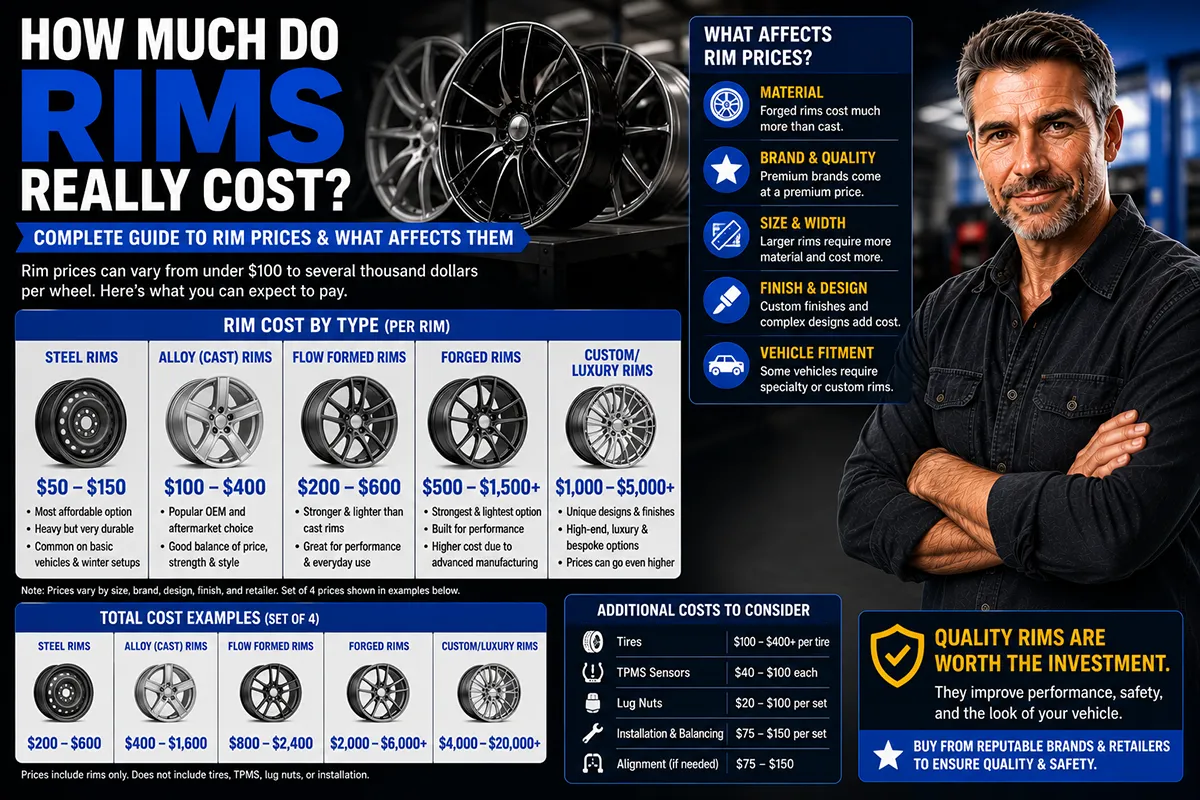
- Steel rims typically cost $50–$150 each; alloy rims range from $100–$500+ each; forged and carbon fiber rims can exceed $1,000–$5,000 per wheel.
- OEM replacement rims usually cost $150–$400 each depending on your vehicle.
- A full set of quality aftermarket alloy rims for most sedans and SUVs runs $400–$1,200 total.
- Used and refurbished rims can save you 40–60%, but inspect carefully for cracks and bends.
- Don’t forget to budget for new tires, TPMS sensors, mounting, and balancing — these extras add $200–$600+ to your total cost.
- For most everyday drivers, mid-range alloy rims from reputable brands offer the best balance of looks, durability, and price.
Liked this article?
Add TireAdvise as a preferred source so you see more of our tire reviews and guides on Google.
Why Rim Prices Vary So Much
Before I get into specific numbers, it’s important to understand why there’s such an enormous price range. Rims aren’t a one-size-fits-all product, and the factors that influence cost are more nuanced than most people realize.
Material Makes the Biggest Difference
The single biggest factor in rim pricing is what the wheel is made from. Steel, cast aluminum alloy, flow-formed alloy, forged aluminum, and even carbon fiber all occupy completely different price tiers.
I’ve personally run steel wheels on a winter beater and forged wheels on a performance build, and the difference in weight, feel, and durability is genuinely significant. But for the average driver replacing rims on a daily commuter? The material conversation is usually between steel and cast alloy.
Size Drives Cost Up Quickly
A 16-inch alloy rim might cost $120, while the same brand’s 20-inch version could be $350 or more. Every inch of diameter increase adds material, manufacturing complexity, and shipping weight.
I’ve seen customers upgrade from 17-inch to 20-inch rims purely for aesthetics and get sticker shock when they realize the tires for those larger rims also cost significantly more. It’s a compounding expense that catches people off guard.
Brand Reputation and Quality Control
Just like tires, rim brands range from budget imports to premium manufacturers with decades of engineering behind them. A no-name rim from an overseas seller might look similar to a branded one, but in my experience, the quality control difference shows up in fitment precision, weight consistency, and long-term durability.
I’ve seen cheap rims develop hairline cracks after just a few months of daily driving on rough roads. That’s not a risk worth taking when your wheels are literally the connection between your car and the pavement.
Rim Cost Breakdown by Type
Let me walk you through what you can realistically expect to pay for each type of rim in the current US market. These prices reflect what I’ve seen from major retailers like Tire Rack, Discount Tire, Walmart Auto, and various online sellers throughout 2024.
Steel Rims: $50–$150 Each
Steel rims are the workhorses of the wheel world. They’re heavy, they’re plain, and they get the job done without any fuss.
I recommend steel rims primarily for winter tire setups and for drivers who genuinely don’t care about aesthetics. When I set up a dedicated winter wheel-and-tire package for my wife’s SUV, I went with a set of 16-inch steel rims at about $65 each. They’ve survived multiple harsh Northeast winters without a single issue.
Best for: Winter setups, budget-conscious buyers, fleet vehicles, and beaters.
Cast Alloy Rims: $100–$350 Each
This is where the vast majority of everyday drivers land. Cast alloy rims (often just called “alloy wheels”) are lighter than steel, available in hundreds of designs, and reasonably durable for normal driving conditions.
In my experience, the sweet spot for most sedans and crossovers is the $150–$250 per wheel range. At this price point, you’re getting decent quality from reputable brands without paying a premium for exotic construction methods.
I recently helped a friend pick out a set of 17-inch alloy wheels from Motegi Racing for his Honda Accord. He paid about $160 per rim, and after several weeks of driving, he’s been thrilled with the look and ride quality.
Best for: Most daily drivers, anyone upgrading from stock steel wheels, drivers wanting better aesthetics without breaking the bank.
Flow-Formed (Rotary Forged) Rims: $200–$600 Each
Flow-forming is a manufacturing process that starts with a cast wheel and then uses high-pressure rollers to stretch and compress the barrel while it’s spinning. The result is a rim that’s lighter and stronger than a standard cast wheel but significantly cheaper than a fully forged one.
I’ve run flow-formed wheels from Konig and Enkei on my personal vehicles, and I genuinely think they represent the best value in the aftermarket wheel space right now. You get noticeable weight savings and improved durability at a price that doesn’t sting too badly.
Best for: Enthusiast daily drivers, anyone wanting performance benefits without full forged pricing, spirited weekend drivers.
Forged Alloy Rims: $500–$3,000+ Each
Forged rims are carved or pressed from a single billet of aluminum, creating an incredibly strong and light wheel. Brands like BBS, HRE, Vossen, and American Racing’s higher-end lines operate in this space.
I’ve tested forged wheels on track days, and the difference in unsprung weight is something you can actually feel — especially in braking and turn-in response. But for daily commuting? Honestly, most drivers won’t notice enough of a difference to justify the cost.
Best for: Track enthusiasts, performance car owners, luxury and exotic vehicle builds.
Carbon Fiber and Exotic Rims: $2,000–$10,000+ Each
These exist at the extreme end of the market. Carbon fiber rims from companies like Carbon Revolution are phenomenally light and strong, but they’re priced for supercar owners, not daily drivers.
I’ve only handled these at auto shows and industry events. For the TireAdvise audience, I mention them purely for context — they’re fascinating engineering but irrelevant to most real-world purchasing decisions.
Rim Cost Comparison Table
Here’s a quick-reference table I put together based on current US retail pricing. All prices are per wheel and reflect typical sizes for sedans and mid-size SUVs (16–20 inches).
| Rim Type | Price Per Wheel | Full Set of 4 | Weight | Best For |
|---|---|---|---|---|
| Steel | $50–$150 | $200–$600 | Heavy | Winter setups, budget builds |
| Cast Alloy | $100–$350 | $400–$1,400 | Moderate | Most daily drivers |
| Flow-Formed | $200–$600 | $800–$2,400 | Light-Moderate | Enthusiast daily drivers |
| Forged Alloy | $500–$3,000+ | $2,000–$12,000+ | Very Light | Performance and luxury builds |
| Carbon Fiber | $2,000–$10,000+ | $8,000–$40,000+ | Ultralight | Exotic and supercar applications |
OEM Replacement Rims: What the Dealer Charges vs. Aftermarket
If you’ve damaged a factory rim and need an exact replacement, the cost depends heavily on your vehicle. I’ve seen this firsthand more times than I’d like.
Dealer OEM Pricing
Going directly through a dealership for a factory replacement rim is almost always the most expensive option. For a basic 16-inch steel or alloy wheel on a Honda Civic or Toyota Corolla, expect to pay $150–$300 through the dealer. For a premium alloy wheel on a BMW 3 Series, Audi Q5, or similar, you’re looking at $400–$800 per wheel — and I’ve seen quotes as high as $1,200 for specialty finishes.
I personally cracked a factory 18-inch alloy on my test vehicle after hitting a nasty pothole in downtown Chicago. The dealer quoted me $650 for a single replacement. That’s when I started exploring alternatives.
OEM-Equivalent Aftermarket Options
Companies like Road Ready Wheels, Dorman, and Replacement Wheel sell OEM-style rims that match your factory specs at 30–50% less than dealer pricing. I ended up buying a Dorman replacement for that cracked wheel at around $280, and it was visually indistinguishable from the original.
The key is ensuring the replacement matches your bolt pattern, offset, center bore, and load rating. I always double-check these specs before purchasing, and I’d strongly recommend you do the same.
Used and Refurbished Rims: Are They Worth It?
Buying used rims is a legitimate way to save money, but it comes with risks I’ve learned about the hard way.
Where to Find Used Rims
- Facebook Marketplace and Craigslist: Huge selection, but buyer beware. I’ve found excellent deals here, but I’ve also encountered bent wheels sold as “perfect condition.”
- eBay: Decent buyer protection, and you can often find complete OEM takeoff sets from people who upgraded their new car’s wheels immediately.
- Local salvage yards and LKQ: Great for OEM replacements. Prices are typically 50–70% less than dealer pricing.
- Specialty wheel resellers: Companies like WheelHero and OEWheelsLLC sell inspected used and refurbished OEM wheels.
What I Look For When Buying Used
Over the years, I’ve developed a checklist that’s saved me from buying problem wheels:
- Run your finger along the inner lip: Bends and cracks often hide on the backside where you can’t see them in photos.
- Check for lateral runout: A bent rim will cause vibration that no amount of balancing can fix. If you can, spin the wheel before buying.
- Look for repair welds: A previously cracked and welded rim is structurally compromised. I pass on these every time.
- Inspect the bead seat area: Corrosion here can cause slow air leaks that are maddening to diagnose.
- Verify the specs match your vehicle: Bolt pattern, offset, center bore, and diameter must all be correct.
I bought a set of used OEM 17-inch alloy wheels for a test vehicle a while back — paid $300 for all four on Facebook Marketplace. After a careful inspection and a quick clean, they looked and performed great. That’s the upside of buying used. But I’ve also walked away from at least a dozen deals where something didn’t look right.
Refurbished Rim Pricing
Having a damaged rim professionally refinished typically costs $75–$200 per wheel, depending on the severity of damage and the finish type. Powder coating runs $100–$200 per wheel, while a full chrome re-plate can be $250–$500 per wheel.
In some cases, refinishing your existing rims is cheaper than buying new ones, especially if the structural integrity is still sound.
The Hidden Costs Most People Forget
Here’s where I see the most budget blowouts. Buying rims is not just about the price of the wheels themselves. There are real additional costs that you need to factor in.
New Tires
If you’re changing rim sizes — going from 17-inch to 19-inch, for example — your existing tires won’t fit. You’ll need a new set, and that can easily add $400–$1,000+ depending on the tire brand and size.
Even if you’re keeping the same diameter, a different rim width might require a different tire width. I always recommend checking tire compatibility before committing to a new rim size.
TPMS Sensors
Most vehicles sold in the US since 2008 require tire pressure monitoring system (TPMS) sensors. If your new rims don’t come with them, you’ll need to either transfer your existing sensors (which can require a rebuild kit at $5–$15 each) or buy new ones at $30–$80 per sensor.
A full set of new TPMS sensors adds $120–$320 to your total cost. I’ve been bitten by this expense before when I forgot to budget for it, so I always mention it now.
Mounting and Balancing
Expect to pay $15–$45 per tire for mounting and balancing. For a full set of four, that’s $60–$180. Some shops include this service when you buy tires from them, but if you’re bringing in wheels and tires you purchased elsewhere, expect to pay the full rate.
Hub Rings and Lug Hardware
Aftermarket rims often have a larger center bore than your vehicle’s hub. In that case, you’ll need hub-centric rings to ensure a vibration-free fit. These are inexpensive ($10–$30 for a set of four), but forgetting them can lead to annoying vibrations that you’ll spend time and money trying to diagnose.
Some aftermarket rims also require different lug nuts or bolts than your factory hardware. A set of quality lug nuts runs $30–$80.
Alignment
Anytime you change wheel size or offset, I strongly recommend getting an alignment check. This typically costs $80–$150 and can prevent uneven tire wear that would negate any savings you achieved on the rims themselves.
What I Recommend for Different Budgets
Based on everything I’ve learned, here’s my honest guidance for US drivers at various budget levels.
Under $400 Total (Set of 4)
At this price point, you’re looking at steel rims or used OEM alloy wheels. This is a perfectly fine option for winter setups, beaters, or anyone who just needs functional wheels without visual flair.
I’d point you toward new steel rims from brands like Dorman or Pacer, or hunt for a clean set of used OEM alloys on Facebook Marketplace or eBay. Just do your due diligence on used wheels.
$400–$1,000 Total (Set of 4)
This is the sweet spot for most daily drivers who want a nice-looking wheel upgrade. You can get a set of quality cast alloy wheels from brands like Konig, Motegi, Enkei, Voxx, or Vision in this range.
I personally think this budget offers the best bang for the buck. You’ll get wheels that look significantly better than stock steel, weigh less, and come with manufacturer warranties.
$1,000–$2,500 Total (Set of 4)
Now you’re entering flow-formed territory, or you can opt for premium cast alloy wheels from higher-end brands. TSW, Niche, Fuel Off-Road (for trucks), and Enkei’s performance lines all have excellent options here.
If I were building a sporty daily driver, this is where I’d spend. The weight savings from flow-formed construction translates to slightly better handling, braking, and even a marginal improvement in fuel economy.
$2,500+ Total (Set of 4)
At this level, you’re into entry-level forged wheels or top-tier flow-formed options. This is enthusiast territory — track day cars, show cars, or just drivers who want the absolute best.
I reserve this recommendation for people who genuinely appreciate the performance difference or who are building something special. For everyday commuting, you won’t get proportional returns on this investment.
Where to Buy Rims in the US
Over the years, I’ve purchased rims from just about every major retailer. Here’s my honest take on the best options.
Online Retailers
- Tire Rack: My go-to for selection, fitment accuracy, and customer service. Their wheel-and-tire packages are convenient and often competitively priced. I’ve ordered from them many times with consistently good experiences.
- Discount Tire / America’s Tire (online): Great pricing and the benefit of local stores for installation and any warranty issues.
- Custom Offsets / Fitment Industries: Excellent for truck and SUV owners looking for lifted or flush setups. Their gallery of real customer vehicles is incredibly helpful for visualizing how wheels will look on your specific truck.
- Amazon: Competitive pricing on some brands, but be cautious about third-party sellers. I’ve seen counterfeit wheels sold on Amazon, so stick to listings fulfilled by reputable sellers.
Brick-and-Mortar Stores
- Discount Tire: The largest independent tire and wheel retailer in the US. I’ve had consistently good experiences at their locations — fair pricing, professional installation, and solid warranty support.
- Costco: Limited rim selection, but they occasionally have deals on wheel-and-tire packages for popular vehicles.
- Local tire shops: Often have access to wholesale wheel distributors and can offer competitive pricing. I’ve gotten some of my best deals through relationships with local shops.
Common Mistakes I’ve Seen (and Made)
Let me save you from some expensive lessons I’ve either experienced personally or watched other drivers go through.
Buying the Wrong Offset
Offset determines how far the wheel sits in or out from the hub mounting surface. Too much positive offset and the wheel tucks too far in. Too much negative offset and the wheel sticks out past the fender.
I once ordered a set of wheels with an offset that was 15mm off from factory spec. The result? The tires rubbed the inner fender liner every time I turned. I had to sell those wheels at a loss and start over. Always verify offset compatibility.
Going Too Big on Diameter
Upsizing rims looks great, but there are practical limits. Going more than two inches above your factory rim size usually requires lower-profile tires that ride harshly and are more vulnerable to pothole damage.
In my experience, a one-inch increase (say, from 17 to 18 inches) is the sweet spot for improved looks without significant ride quality compromise.
Skipping Load Ratings
Every rim has a load rating, and it needs to be equal to or greater than what your vehicle requires. This is especially critical for trucks and SUVs that carry heavy loads. I’ve seen bargain wheels fail under load, and it’s not something you want to experience at highway speed.
Ignoring Finish Durability
Chrome looks stunning when it’s new, but it’s expensive to maintain and prone to peeling in harsh climates. I’ve seen chrome rims look terrible after just one winter of salt exposure.
For drivers in the northern US, I recommend painted, machined, or powder-coated finishes. They hold up dramatically better in cold-weather conditions and are far cheaper to refinish if needed.
My Bottom Line on Rim Pricing
After all the sets I’ve bought, tested, and recommended over the years, here’s what I genuinely believe: most everyday drivers will be perfectly served by a quality set of cast alloy rims in the $150–$250 per wheel range.
That puts your full set at $600–$1,000 before installation and accessories, which is a reasonable investment for wheels that look good, perform well, and last for years.
If you’re on a tight budget, don’t be ashamed of steel rims or used OEM alloys. They’ll keep you safe and get you where you need to go. And if you’ve got money to spend and you appreciate the engineering, flow-formed and forged wheels are genuinely impressive products that deliver real-world benefits.
The most important thing is to buy from reputable brands, verify your fitment specs, budget for the hidden costs, and inspect carefully if you’re going the used route. Do those things, and you’ll end up with rims you’re happy with at a price you can live with.
Whatever you decide, just make sure you’re pairing those new rims with quality tires — because at the end of the day, it’s the rubber that actually grips the road. The rims just hold it all together.
Frequently Asked Questions
How much do rims cost on average in the US?
For most passenger cars and sedans, a single rim typically costs between $90 and $300 for a standard steel or alloy wheel. If you’re upgrading to premium forged or custom rims, expect to pay $500 to $2,000+ per wheel. The total cost for a full set of four rims generally ranges from $400 to $1,200 for mid-range options, making it one of the bigger investments outside of tires themselves.
Are aftermarket rims cheaper than OEM replacement wheels?
Yes, aftermarket rims are usually 20–50% cheaper than OEM replacements, which is why many US drivers choose them when replacing damaged wheels. A factory OEM rim for a popular model like a Honda Civic or Toyota Camry can run $150–$400 per wheel, while a comparable aftermarket alloy rim from brands like Motegi or American Racing may cost $80–$200. Just make sure the bolt pattern, offset, and load rating match your vehicle’s specifications.
How much does it cost to replace all 4 rims on a truck or SUV?
Replacing all four rims on a truck or SUV typically costs between $600 and $2,400 depending on size and material. Larger 18–22 inch wheels common on vehicles like the Ford F-150 or Chevy Silverado cost more due to the extra material and reinforced construction needed for heavier loads. If you frequently drive on rough US roads or off-road trails, investing in durable steel or cast alloy rims can save you money on replacements long-term.
Does rim size affect the overall cost of tires and wheels together?
Absolutely — upsizing your rims from 16 to 18 or 20 inches doesn’t just increase the rim cost, it also raises your tire cost because low-profile tires in larger sizes are more expensive. For example, going from a 16-inch to a 20-inch setup could add $400–$800 to the total package price for all four corners. I always recommend factoring in both rim and tire costs together before deciding on an upgrade to avoid sticker shock at the shop.
Is it worth buying used rims to save money?
Buying used rims can save you 40–60% off retail prices, and it’s a solid option if you inspect them carefully for cracks, bends, and curb damage. Marketplaces like Facebook Marketplace, Craigslist, and salvage yards across the US are common sources, with used OEM rims often going for $50–$150 each. However, I’d avoid used rims that have been repaired or welded, as they may fail under the stress of highway driving or harsh winter road conditions.
How much does rim installation and balancing cost at a tire shop?
Most US tire shops charge between $25 and $75 per wheel for mounting, balancing, and installing rims with new or existing tires. If you’re also swapping out tires at the same time, many shops offer bundled deals that can bring the per-wheel cost down. Retailers like Discount Tire, Tire Rack, and Costco often include free installation when you purchase wheels and tires together, which can save you $100–$300 on the full set.
Do alloy rims cost more than steel rims, and which is better for daily driving?
Alloy rims generally cost $50–$150 more per wheel than steel rims, with steel wheels starting around $50–$100 each and alloy wheels ranging from $100–$300 each. For most US daily drivers, alloy rims offer a better balance of weight savings, fuel efficiency, and appearance. Steel rims are a great budget-friendly choice if you need a dedicated winter wheel set or drive frequently on pothole-heavy roads where cosmetic damage is likely.
