

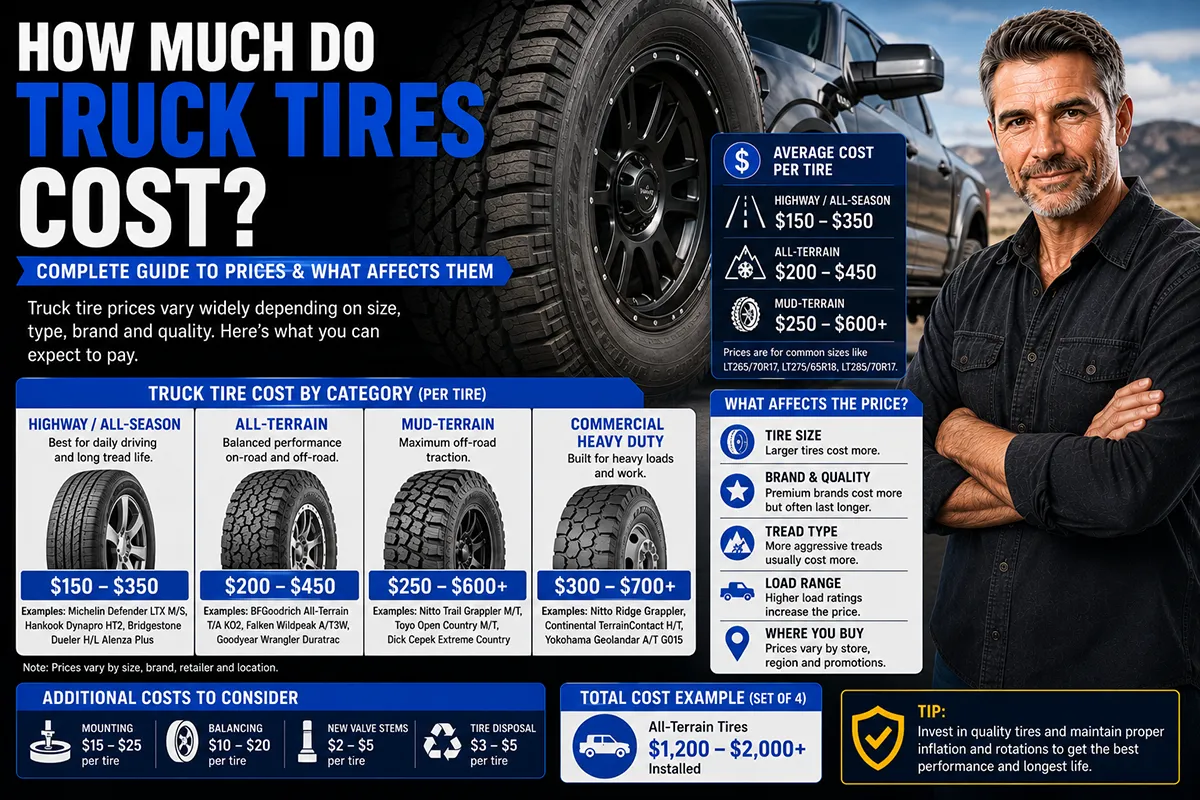
If you’ve ever walked into a tire shop expecting to spend a few hundred bucks and walked out $1,500 lighter, you’re not alone.
Truck tires are one of those things most people don’t think about until they absolutely have to — and when that moment comes, the sticker shock can be brutal.
I’ve been reviewing and buying truck tires for over a decade now, and I can tell you that most drivers overpay simply because they don’t know what’s reasonable. Let me break down exactly what truck tires should cost, what drives those prices up and down, and where your money actually goes.
- Light truck (half-ton) tires typically cost $150–$300 each; heavy-duty truck tires run $200–$400+ each
- The biggest price factors are tire size, brand, tread type, and load rating
- Budget tires aren’t always a bad deal — I’ve had great results with mid-range options
- Expect to pay $600–$1,600+ for a full set of four, installed
- Buying during holiday sales, rebate seasons, or online can save you $100–$300 per set
- Don’t forget installation, balancing, alignment, and disposal fees — they add $80–$160 to your total
Liked this article?
Add TireAdvise as a preferred source so you see more of our tire reviews and guides on Google.
What I Mean by “Truck Tires” — Let’s Get Specific
Before I throw a bunch of numbers at you, I want to clarify something important. When most people search for “truck tire costs,” they’re talking about light trucks — think Ford F-150, Chevy Silverado 1500, Ram 1500, Toyota Tundra, and similar half-ton pickups.
That’s what I’ll focus on primarily in this guide, since those are the most popular trucks on American roads by a wide margin. However, I’ll also cover pricing for heavy-duty trucks (F-250, F-350, Ram 2500/3500) and midsize trucks (Tacoma, Colorado, Ranger) because the price differences between them are significant.
I won’t be covering semi-truck or commercial tires — that’s a different world entirely.
The Real Cost of Truck Tires in 2024: A Full Breakdown
Let me give you the straightforward answer first. Based on my experience buying and testing truck tires across dozens of brands and retailers, here’s what you should expect to pay per tire:
| Truck Category | Common Sizes | Budget (per tire) | Mid-Range (per tire) | Premium (per tire) |
|---|---|---|---|---|
| Midsize Truck (Tacoma, Ranger) | 245/75R16, 265/70R16 | $100–$150 | $150–$220 | $220–$300 |
| Half-Ton Truck (F-150, Silverado 1500) | 265/70R17, 275/60R20 | $140–$200 | $200–$300 | $300–$400+ |
| Heavy-Duty Truck (F-250, Ram 2500) | 275/70R18, LT285/75R16 | $180–$250 | $250–$350 | $350–$500+ |
| Lifted Truck (Oversized) | 35×12.50R20, 37×13.50R22 | $250–$350 | $350–$450 | $450–$700+ |
These are per-tire prices before installation. For a full set of four, you’re looking at a total range from roughly $560 on the low end (midsize truck, budget tires) to $2,000+ on the high end (heavy-duty or lifted truck, premium tires).
In my experience, the sweet spot for most half-ton truck owners lands around $200–$280 per tire. That’s where you get the best balance of quality, longevity, and value.
What Actually Drives Truck Tire Prices Up (and Down)
I’ve seen identical-looking tires priced $100 apart, and it’s not always obvious why. After years of comparing, testing, and researching, here are the seven factors that have the biggest impact on what you’ll pay.
1. Tire Size — The Number One Price Driver
This is the single biggest factor. A 265/70R17 tire (standard on many F-150s) will almost always cost less than a 275/60R20 or 285/55R22 tire, even from the same brand and product line.
The reason is simple: bigger tires use more materials, require more engineering, and have a smaller production volume for specialty sizes. I’ve seen the exact same tire model cost $170 in a 17-inch size and $290 in a 22-inch size.
If your truck came with 17-inch wheels from the factory and you upgraded to 20s for looks, you’ve permanently increased your tire costs by 30–50%. Something to keep in mind.
2. Brand Reputation
Premium brands like Michelin, BFGoodrich, Goodyear, and Bridgestone command higher prices — often 20–40% more than comparable tires from brands like Falken, Hankook, Cooper, or General Tire.
In my testing, the premium brands usually (but not always) deliver better ride quality, lower road noise, and more consistent wear patterns. But I’ve been genuinely impressed by several mid-range brands that perform within striking distance of the big names at a significantly lower cost.
3. Tire Type and Tread Pattern
The type of tire you choose has a huge impact on price:
- Highway/All-Season (H/T): The most affordable option, typically $130–$250 per tire. Great for daily driving and commuting.
- All-Terrain (A/T): The most popular choice for truck owners. Usually $170–$350 per tire. Offers a balance between on-road comfort and off-road capability.
- Mud-Terrain (M/T): The most expensive category, running $220–$450+ per tire. Aggressive tread, louder on pavement, but outstanding in mud and rocks.
- Winter/Snow Tires: Typically $180–$350 per tire for truck sizes. Essential if you live in the northern states.
I personally run all-terrain tires on my daily driver truck because I like having the option to hit gravel roads and light trails on weekends without sacrificing too much highway comfort. For strictly highway driving, though, an H/T tire will save you money and last longer.
4. Load Rating and Construction
Truck tires come with different load ratings — typically labeled SL (Standard Load), XL (Extra Load), C, D, or E. Higher load ratings mean thicker sidewalls and more durable construction, which translates to higher prices.
An E-rated tire in the same size as an SL-rated tire can cost $50–$80 more. If you don’t tow heavy loads regularly, you probably don’t need an E-rated tire on a half-ton truck. I’ve seen too many F-150 owners buying 10-ply E-rated tires when a standard SL or 4-ply would serve them perfectly fine — and ride much more comfortably.
5. Speed Rating
This is a factor most truck owners overlook. Higher speed ratings (S, T, H, V) generally cost more because the tire’s internal construction has to handle higher sustained speeds safely. Most truck tires carry S or T ratings, which are plenty for legal US highway speeds.
6. Technology and Features
Modern truck tires often include features like foam noise-reduction linings (Michelin’s Acoustic Technology, Continental’s ContiSilent), run-flat construction, or advanced silica compounds for better wet traction. These features add $20–$60 per tire versus comparable models without them.
7. Market Demand and Seasonality
Tire prices fluctuate throughout the year. I’ve consistently found the best deals during major holiday sales (Memorial Day, Black Friday, Labor Day) and during manufacturer rebate seasons, which usually happen in spring and fall. Buying four tires during a $100 rebate promotion effectively drops your per-tire cost by $25 — not life-changing, but it adds up.
Hidden Costs Most People Forget About
The price tag on the tire itself is only part of the equation. Here’s what else I factor into my total cost whenever I’m shopping for a new set.
Installation and Mounting
Most shops charge $15–$30 per tire for mounting and balancing. Some online retailers include free installation at partner locations (Tire Rack’s network, for example), which can save you $60–$120 on a set of four.
Tire Disposal Fees
Every state requires proper disposal of old tires, and shops pass this cost on to you. Expect $3–$5 per tire — it’s small, but it’s there.
Valve Stems and TPMS Sensors
If your truck has a tire pressure monitoring system (and virtually all modern trucks do), you may need new TPMS sensor rebuild kits or entirely new sensors. Rebuild kits run $5–$10 per wheel; full replacement sensors can cost $30–$80 each.
I always ask the shop to inspect my existing sensors before authorizing new ones. Half the time, the originals are perfectly fine.
Wheel Alignment
I recommend getting an alignment every time you install new tires. This typically costs $80–$120 and ensures even wear across all four tires. Skipping this step to save money is penny-wise and pound-foolish — I’ve seen uneven wear ruin a set of tires in a fraction of their expected life.
Road Hazard Protection
Most tire shops will offer a road hazard warranty for $15–$30 per tire. I personally think this is worth it, especially if you drive on construction-heavy roads or in areas with lots of debris. I’ve used mine twice over the years, and both times it covered a full replacement that would have cost me over $200 out of pocket.
Total Add-On Costs Summary
When I add everything up, here’s what the extra fees look like for a typical set of four truck tires:
- Mounting and balancing: $60–$120
- Tire disposal: $12–$20
- TPMS service/sensors: $20–$80
- Alignment: $80–$120
- Road hazard warranty (optional): $60–$120
That’s an additional $232–$460 on top of the tires themselves. Most people budget only for the rubber and then get frustrated at checkout. Don’t be that person.
Budget vs. Mid-Range vs. Premium: What’s the Real Difference?
I get asked this constantly, so let me give you my honest opinion based on testing tires across all price ranges.
Budget Truck Tires ($100–$200 per tire)
Brands in this range include Westlake, Crosswind, Sailun, Thunderer, Achilles, and some lesser-known house brands.
I’ve tested several budget truck tires, and here’s what I’ve found: they work fine for basic transportation. They’ll grip dry pavement adequately, they’ll get you through a rainstorm, and they’ll roll down the highway without falling apart.
Where they fall short is in the details. Road noise tends to be noticeably louder. Wet braking distances are typically longer. Tread life is generally shorter. And ride comfort is usually harsher.
If you’re on a tight budget, need tires now, and drive primarily in good weather on well-maintained roads, budget tires are a reasonable choice. I just wouldn’t rely on them for heavy towing or harsh winter conditions.
Mid-Range Truck Tires ($200–$300 per tire)
This is where I think most truck owners should be shopping. Brands like Cooper, Falken, Hankook, General Tire, Toyo, Kumho, and Yokohama live in this space, and they consistently deliver excellent value.
In my testing, mid-range tires typically offer 85–90% of the performance of premium tires at 60–70% of the price. The Cooper Discoverer AT3 series, for example, has been one of my all-time favorites for daily-driven trucks. It’s quiet, capable off-road, and wears evenly over a long period.
The Falken Wildpeak AT3W is another standout I’ve tested extensively. It carries the three-peak mountain snowflake rating, which means it’s certified for severe snow conditions — a nice bonus in the mid-range price bracket.
Premium Truck Tires ($300–$500+ per tire)
Premium options include Michelin LTX Trail, BFGoodrich KO2, Goodyear Wrangler DuraTrac, Bridgestone Dueler, and Continental TerrainContact A/T.
When I put premium tires on a truck, I notice the difference immediately. The ride is smoother. The cabin is quieter. Steering response feels sharper. And in rain or snow, the grip difference versus budget tires is dramatic.
The BFGoodrich KO2, which I’ve run on multiple trucks, is arguably the gold standard for all-terrain truck tires. It handles everything from daily commuting to rocky trails with confidence. But at $280–$380 per tire depending on size, it’s a serious investment.
Are premium tires worth the extra money? If you drive a lot, tow regularly, or live in an area with harsh weather, absolutely. If your truck is a weekend errand runner, mid-range tires will serve you just as well.
Where to Buy Truck Tires — And Where I’ve Found the Best Deals
The buying landscape has changed dramatically in recent years, and I’ve purchased tires from almost every type of retailer. Here’s my honest assessment.
Online Retailers
Tire Rack, SimpleTire, Discount Tire Direct — These are my go-to sources for comparison shopping. Online prices are almost always lower than brick-and-mortar shops, sometimes by $20–$50 per tire.
Tire Rack, in particular, has an excellent network of installation partners. I’ve ordered from them multiple times, had the tires shipped directly to a local shop, and had them installed within a day or two. The process is seamless.
SimpleTire is another great option with competitive pricing and frequent coupon codes.
Warehouse Clubs
Costco and Sam’s Club — I love buying tires at Costco. Their prices are competitive, installation is included in the price, and they include lifetime balancing, rotations, and flat repairs. The Costco tire center is one of the best overall values in the tire business.
The downside is limited selection. Costco carries a curated range of brands (Michelin, Bridgestone, and a few others), so if you want a specific tire they don’t stock, you’re out of luck.
Chain Tire Shops
Discount Tire, Les Schwab, Firestone, Goodyear — These shops are convenient and often run their own promotions. Discount Tire is my favorite among chain retailers — their price-match policy is genuine, and their customer service has been consistently excellent in my experience.
Les Schwab, for my Pacific Northwest readers, is a regional gem with legendary service and a strong warranty program.
Dealerships
I almost never buy tires from dealerships. They’re typically the most expensive option, often marking up tires 15–30% over retail. The only exception is when the dealership runs a genuine tire promotion or price-match guarantee.
My Best Money-Saving Tips
- Stack manufacturer rebates with retailer sales. During rebate season, you can often combine a $75 Goodyear rebate with a retailer’s own promotion for significant savings.
- Use a credit card with rotating 5% cashback categories. Some cards offer 5% back at warehouse clubs or gas stations seasonally — time your purchase accordingly.
- Don’t overlook last year’s models. When a tire manufacturer releases a new version of a tire, the previous model often gets clearanced at 20–30% off. I’ve gotten excellent tires this way.
- Buy all four at once. Most promotions require a set of four, and it ensures even wear and handling.
- Ask about price matching. Most major retailers will match online prices if you show them a competitor’s listing.
How Long Should Truck Tires Last?
This directly affects the cost equation, so it’s worth discussing. A tire that costs $300 but lasts twice as long as a $175 tire is actually the cheaper option over time.
In my experience, here’s what to expect by category:
- Budget tires: Tend to show significant wear within a couple of years of regular driving. Tread compounds are typically softer or less sophisticated.
- Mid-range tires: Usually hold up well for several years of daily driving with proper maintenance. Many come with treadwear warranties in the 50,000–65,000 range.
- Premium tires: Often the longest-lasting, with some carrying warranties up to 70,000 or more. I’ve had premium tires that still looked healthy after years of regular use.
The key variables are your driving habits, whether you rotate regularly (I recommend every oil change), whether your alignment is correct, and what kind of surfaces you drive on. A set of all-terrain tires driven exclusively on smooth highways will last dramatically longer than the same set used on gravel roads and trails.
Do You Really Need “LT” Tires on Your Truck?
This is a question I see debated constantly, and I think it’s worth addressing because it directly affects your wallet.
LT (Light Truck) tires are built with stronger sidewalls and heavier-duty construction than P (Passenger) metric tires. They’re designed for trucks that tow, haul heavy loads, or go off-road regularly.
Here’s my take: if you drive a half-ton truck as a commuter vehicle and never tow more than a small trailer, P-metric tires are perfectly fine and will save you $30–$80 per tire. They also ride more comfortably because the sidewalls are more flexible.
However, if you tow a boat, RV, or heavy trailer even occasionally, LT tires are the safer choice. The stiffer sidewalls resist deformation under load, which improves stability and reduces the risk of a blowout.
I’ve run both types on my F-150, and the P-metric tires were noticeably more comfortable for daily driving. But when I hooked up a 6,000-pound travel trailer, the LT tires inspired far more confidence.
Real-World Examples: What I’ve Actually Paid
Let me share some specific purchases I’ve made over the years to give you a grounded sense of real-world costs.
2019 Toyota Tacoma (265/70R16): I installed a set of Falken Wildpeak AT3W tires for about $165 per tire. With mounting, balancing, alignment, and disposal, the total was around $820. These tires performed brilliantly in rain, light snow, and on forest service roads.
2021 Ford F-150 (275/65R18): I went with Cooper Discoverer AT3 4S tires at roughly $210 per tire. Total installed cost with alignment and TPMS service came to about $1,050. Outstanding value and a very quiet ride for an all-terrain tire.
2022 Ram 2500 (285/60R20): I tested a set of BFGoodrich KO2 tires that ran about $340 per tire. Fully installed with everything, I was looking at approximately $1,600. Expensive, but the KO2’s reputation is well-earned — it’s a tank of a tire that handles heavy loads and tough terrain without flinching.
2020 Chevy Colorado (255/65R17): I put budget-friendly General Grabber HTS 60 tires on this truck at about $140 per tire. The total installed was around $700. For a highway-focused tire at this price, I was genuinely impressed with the ride quality and tread life during my extended test period.
When to Replace Your Truck Tires
Knowing when to replace saves you from both overspending (replacing too early) and risking safety (waiting too long).
Here’s what I look for:
- Tread depth below 4/32″: The legal minimum is 2/32″, but I replace at 4/32″ because wet traction drops off dramatically below this point. Use the quarter test — insert a quarter into the tread with Washington’s head down. If you can see the top of his head, it’s time.
- Uneven wear patterns: This usually indicates an alignment or suspension issue. Fix the root cause before mounting new tires, or you’ll burn through the next set too.
- Age over 6 years: Even if tread looks fine, rubber compounds degrade over time. I check the DOT date code on the sidewall — four digits indicating the week and year of manufacture.
- Visible damage: Bulges, cracks, cuts in the sidewall, or exposed cords mean immediate replacement. No exceptions.
Should You Buy Used Truck Tires?
I’ve been asked about this enough times that I want to address it directly: I don’t recommend buying used truck tires.
Yes, they’re cheaper — sometimes dramatically so, at $50–$100 per tire. But you have no idea what that tire has been through. It could have been run severely underinflated, damaging the internal structure in ways that aren’t visible. It could have been patched improperly. It could be older than it appears.
The risk-to-savings ratio just doesn’t make sense to me. If budget is a serious concern, I’d rather see you buy a new set of budget tires from a reputable brand than gamble on used rubber.
The one exception: I’ve purchased “take-offs” — tires removed from new vehicles by owners upgrading to aftermarket wheels and tires. These are essentially new tires with minimal use. If you can verify the DOT date code and inspect them thoroughly, take-offs can be a legitimate deal.
How to Get the Most Life Out of Your Investment
Once you’ve spent $700–$1,500 on a new set of truck tires, you want them to last. Here’s what I do to maximize the lifespan of every set I install:
- Check tire pressure monthly. I keep a good digital gauge in my truck. Underinflation is the number one tire killer — it increases wear, heat buildup, and fuel consumption.
- Rotate every other oil change. Moving tires between positions ensures even wear. I follow the pattern recommended in my truck’s owner’s manual.
- Get an alignment annually. Even if the truck doesn’t pull, slight misalignment causes gradual uneven wear that you won’t notice until it’s too late.
- Avoid harsh driving habits. Hard acceleration, aggressive cornering, and late braking all accelerate tread wear. Smooth driving extends tire life noticeably.
- Don’t overload your truck. Exceeding your tire’s load rating — even occasionally — stresses the tire structure and can lead to premature failure.
My Bottom Line on Truck Tire Costs
After years of buying, testing, and reviewing truck tires, here’s what I tell friends and family when they ask what to spend:
For a typical half-ton truck driven daily, budget $800–$1,200 for a quality set of four all-terrain or highway tires, fully installed. This gets you into the mid-range sweet spot where you’re not overpaying for a brand name but you’re not compromising on safety or longevity.
If you tow regularly, drive in harsh weather, or need aggressive off-road capability, plan on spending $1,200–$1,800 for a premium set that can handle the demands.
And if money is extremely tight, a set of budget tires in the $600–$800 range (installed) will keep you safe and rolling while you save up for something better next time.
The most important thing is that you’re running tires in good condition with adequate tread. No amount of money saved is worth the risk of driving on worn-out, damaged, or improperly sized tires.
Take your time, compare prices across at least three retailers, time your purchase around rebate seasons when possible, and don’t forget to factor in those hidden costs. Your truck — and your wallet — will thank you.
Frequently Asked Questions
How much do truck tires cost on average in 2026?
For light-duty pickup trucks like the Ford F-150 or RAM 1500, you can expect to pay between $150 and $350 per tire for a quality all-season option. Heavy-duty truck tires for 3/4-ton and 1-ton trucks typically range from $250 to $600 per tire, depending on the brand, size, and tread type. A full set of four tires will generally cost most truck owners between $600 and $1,400 before installation.
Why are truck tires so much more expensive than car tires?
Truck tires cost more because they use significantly more rubber, reinforced sidewalls, and heavier-duty internal construction to handle greater vehicle weight, towing loads, and rougher terrain. The larger rim sizes common on modern trucks, such as 18- to 22-inch wheels, also drive up the price. I always remind shoppers that you’re paying for the extra load rating and durability that keeps you safe when hauling or driving in demanding US road conditions.
How much does it cost to replace all four tires on a pickup truck including installation?
When you factor in mounting, balancing, valve stems, tire disposal fees, and any alignment work, you should budget an additional $60 to $120 on top of the tire price for each tire. For a typical half-ton pickup, a full set of four mid-range all-terrain tires installed will run between $800 and $1,600 total. I recommend calling local shops and comparing quotes from retailers like Discount Tire, Costco, and Walmart to find the best all-in price.
What is the price difference between all-season, all-terrain, and mud-terrain truck tires?
All-season highway truck tires are the most affordable, typically costing $120 to $250 per tire for popular sizes. All-terrain tires, which are the most versatile choice for US drivers who mix highway commuting with occasional off-road use, usually run $175 to $400 per tire. Mud-terrain tires are the most expensive category, ranging from $250 to $500+ per tire, because of their aggressive tread compounds and reinforced construction designed for serious off-road conditions.
Are cheap truck tires worth buying, or should I spend more on a premium brand?
Budget truck tires from brands like Westlake, Thunderer, or Milestar can work well for light daily driving and typically cost $100 to $180 per tire, but they often sacrifice tread life, wet traction, and road noise performance. Premium brands like Michelin, BFGoodrich, and Goodyear cost more upfront but tend to last 20,000 to 30,000 miles longer and offer better warranties. In my experience, mid-tier brands like Falken, Cooper, and Hankook deliver the best value for most US truck owners who want strong performance without the top-shelf price tag.
How often do truck tires need to be replaced, and how does that affect long-term cost?
Most truck tires last between 40,000 and 70,000 miles depending on your driving habits, tire type, and whether you keep up with rotations every 5,000 to 7,500 miles. If you drive 15,000 miles per year, you’ll likely replace your tires every three to five years, meaning your annual tire cost works out to roughly $200 to $450 per year for a full set. Investing in tires with a longer treadwear warranty from brands like Michelin Defender LTX can significantly lower your cost per mile over time.
Do bigger truck tire sizes cost more, and how much does upsizing add to the price?
Yes, moving to a larger tire size can dramatically increase the cost per tire. For example, upgrading from a stock 265/70R17 to a 285/70R17 or 33-inch tire on the same truck can add $30 to $80 per tire, while jumping to 35-inch or larger off-road tires can push prices above $400 each. Beyond the tire cost, upsizing may also require new wheels, a leveling kit, and regearing, which can add $1,000 to $3,000 to the total project cost.
