

If you’ve ever been cruising down the highway and that little horseshoe-shaped warning light suddenly popped up on your dashboard, you know the instant wave of anxiety it brings.
Is the tire flat? Is something seriously wrong? Or is it just the sensor acting up again?
I’ve dealt with faulty tire pressure monitoring system (TPMS) sensors on multiple vehicles over the years — from my daily driver to test cars I’ve evaluated for this site. And I can tell you that the cost of replacing these tiny sensors catches a lot of people off guard. So let me break down exactly what you should expect to pay, what your options are, and how to avoid getting overcharged.
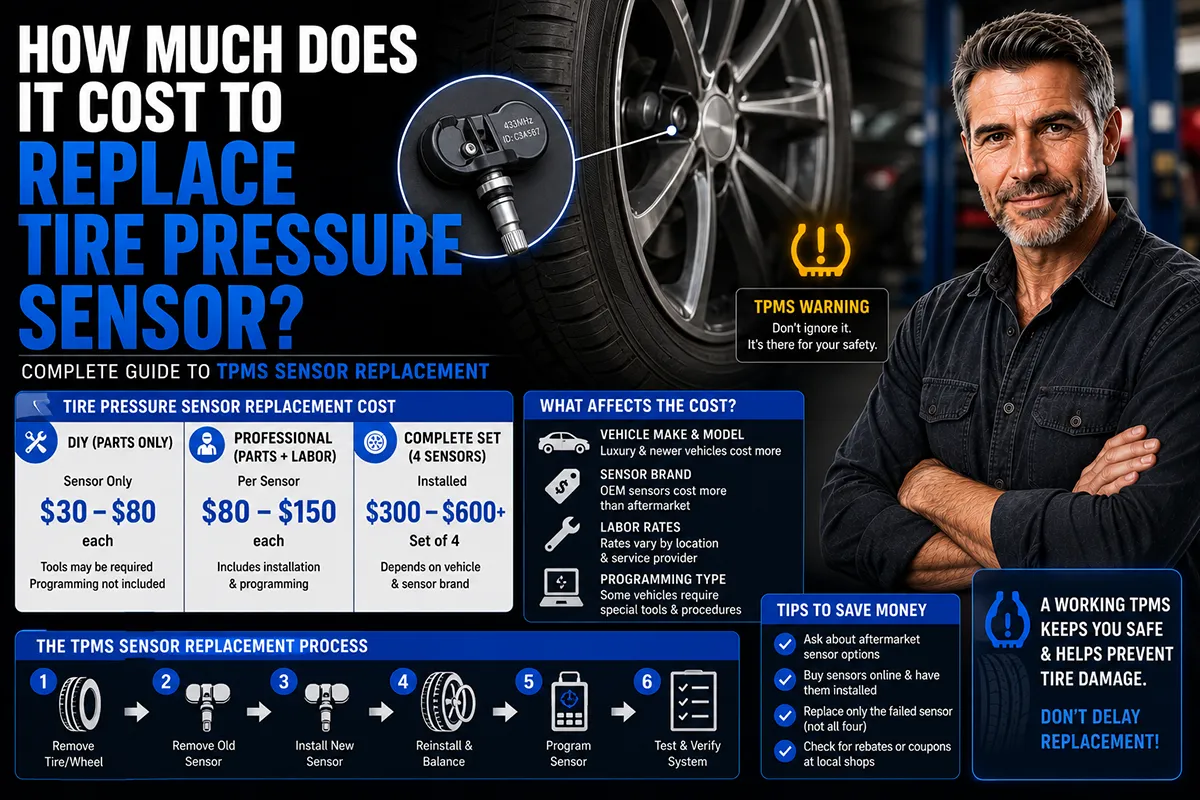
- Replacing a single TPMS sensor typically costs between $50 and $250, depending on the sensor type and where you get it done.
- OEM sensors cost more ($40–$150 each) while aftermarket universal sensors run $20–$60 each.
- Labor usually adds $20–$60 per sensor since the tire must be dismounted.
- Dealerships charge the most; independent tire shops and chains like Discount Tire or Tire Rack offer better deals.
- Replacing all four sensors at once during a tire swap is the most cost-effective strategy.
- DIY replacement is possible but requires a TPMS relearn tool and tire dismounting equipment.
Liked this article?
Add TireAdvise as a preferred source so you see more of our tire reviews and guides on Google.
What Exactly Is a Tire Pressure Sensor?
Before I get into costs, let me quickly explain what we’re dealing with. A tire pressure monitoring system (TPMS) sensor is a small electronic device mounted inside each tire that constantly monitors the air pressure and transmits that data to your vehicle’s onboard computer.
Since 2007, every new passenger vehicle sold in the United States has been required by federal law (the TREAD Act) to include TPMS. So if you’re driving anything built in the last 17+ years, you’ve got these sensors in your wheels.
There are two types of TPMS systems: direct and indirect. Direct TPMS uses physical sensors inside each tire — these are the ones that wear out and need replacing. Indirect TPMS relies on your vehicle’s ABS wheel speed sensors to estimate pressure differences, and those rarely need standalone replacement.
In my experience, the vast majority of vehicles on US roads today use direct TPMS, which means at some point, you will need to replace at least one sensor. It’s not a matter of if — it’s when.
How Much Does a Single TPMS Sensor Replacement Cost?
Let me give you the straightforward answer first, then I’ll break it all down.
For a single TPMS sensor replacement at a typical tire shop or dealership, you’re looking at anywhere from $50 to $250 total — parts and labor included. That’s a wide range, I know, so let me explain what drives the price up or down.
The Cost of the Sensor Itself
The sensor is the biggest variable. Here’s what I’ve seen across dozens of replacements and shop visits:
- OEM (Original Equipment Manufacturer) sensors: $40–$150 per sensor. These are the exact sensors your car came with, often branded by companies like Schrader, Continental, or Pacific Industries. Luxury vehicles and European brands tend to sit at the higher end.
- Aftermarket universal/programmable sensors: $20–$60 per sensor. Brands like ATEQ, Autel, or Dorman make sensors that can be programmed to match your vehicle’s specifications. I’ve had great luck with these in most applications.
- Aftermarket vehicle-specific sensors: $25–$80 per sensor. These are pre-programmed for your specific make and model, splitting the difference between OEM and universal options.
Labor Costs
Here’s what a lot of people don’t realize: replacing a TPMS sensor isn’t like swapping a light bulb. The tire has to be dismounted from the rim, the old sensor removed, the new one installed, and then the tire remounted and balanced.
In my experience, labor typically runs:
- Independent tire shop: $15–$40 per sensor
- National chain (Discount Tire, Firestone, etc.): $20–$50 per sensor
- Dealership: $40–$80 per sensor
Some shops bundle the TPMS sensor replacement into a flat tire installation fee, which can actually save you money if you’re already getting new tires mounted.
TPMS Relearn/Reprogramming Fee
After installing a new sensor, it needs to be “paired” with your vehicle’s computer. This process is called a TPMS relearn, and some shops charge separately for it.
I’ve seen relearn fees range from $10 to $40, though many shops include it in their labor charge. Always ask upfront whether this is included. I once got hit with an unexpected $35 reprogramming fee at a dealership, and it felt like a slap in the face on top of an already pricey bill.
Total Cost Breakdown: Replacing All Four Sensors
If one sensor has died, there’s a decent chance the others aren’t far behind, especially if your vehicle is the same age across all four. Batteries in TPMS sensors typically last 5 to 10 years, so they often fail in clusters.
Here’s what I’ve found the total cost looks like for replacing all four sensors:
| Service Location | Sensor Cost (×4) | Labor (×4) | Relearn Fee | Total Estimate |
|---|---|---|---|---|
| Dealership (OEM sensors) | $160–$600 | $160–$320 | $0–$40 | $320–$960 |
| National Tire Chain (aftermarket) | $80–$240 | $80–$200 | $0–$20 | $160–$460 |
| Independent Tire Shop (aftermarket) | $80–$200 | $60–$160 | $0–$20 | $140–$380 |
| DIY (aftermarket sensors + tool) | $80–$200 | $0 | $0 (tool cost: $30–$150) | $110–$350 |
As you can see, the difference between a dealership with OEM parts and an independent shop with aftermarket sensors is massive. I’ve personally saved over $400 by choosing the latter, and I’ve never had a reliability issue with quality aftermarket sensors.
What Makes TPMS Sensor Replacement More Expensive?
Not all replacement jobs are created equal. Over the years, I’ve noticed several factors that can push the price higher than average.
Vehicle Make and Model
Luxury and European vehicles almost always cost more. Replacing TPMS sensors on a BMW, Mercedes, Audi, or Land Rover can easily hit the top of the price range because these vehicles often require brand-specific sensors with unique protocols.
I replaced sensors on a friend’s 2018 BMW X3 at a dealership, and the bill came to over $200 per sensor installed. The same job on my Honda Accord with aftermarket sensors at a local shop cost me about $65 per sensor, fully installed.
Sensor Type and Availability
Some older or less common vehicles use TPMS sensors that have been discontinued or are harder to source. When supply is limited, the price goes up. I ran into this issue with a 2008 Dodge vehicle where the original sensor was no longer manufactured by the OEM supplier, and the aftermarket options were limited.
Corrosion and Seized Components
If you live in the Rust Belt or any area where road salt is common, the aluminum valve stems on TPMS sensors can corrode and seize to the wheel. When this happens, extraction takes longer, and there’s a risk of wheel damage, which drives labor costs up.
I’ve seen shops charge an additional $15–$30 per wheel for “corrosion removal” or “difficult extraction” in states like Michigan, Ohio, and Pennsylvania. It’s frustrating but understandable.
Needing a Full TPMS Service Kit
Every time a TPMS sensor is serviced, the valve stem components should also be replaced. This includes the valve core, cap, nut, and sealing grommet or washer. A TPMS service kit typically costs $2–$8 per sensor — cheap, but some shops mark it up or charge separately for it.
I always ask whether the service kit is included in the quoted price. It should be, but don’t assume.
Can You Replace TPMS Sensors Yourself?
The short answer is: technically yes, but practically it’s complicated for most people.
Here’s the reality check. To replace a direct TPMS sensor, you need to:
- Remove the tire from the vehicle
- Break the tire bead from the rim
- Dismount the tire from the wheel
- Remove the old sensor and install the new one
- Remount and balance the tire
- Use a TPMS programming/relearn tool to pair the new sensor with the car
Unless you have access to a tire machine and wheel balancer (most home mechanics don’t), you’re going to need professional help for steps 2 through 5 anyway. And at that point, you might as well have the shop install the sensor while they’re at it.
Where DIY Does Make Sense
Where I’ve saved money on the DIY route is by buying my own sensors and bringing them to the shop. Many tire shops will install customer-supplied sensors — some charge a small premium for it, but you still come out ahead.
I’ve ordered Autel MX-Sensor programmable sensors from Amazon for about $25 each, programmed them myself with an Autel TS508 tool (which I bought for around $120), and then had my local shop install them during a tire rotation. The shop charged me $15 per sensor for the install since the tires were already coming off. Total cost for all four sensors: about $160 plus the one-time tool investment.
If you own multiple vehicles or plan to keep your car for years, investing in a TPMS programming tool pays for itself quickly.
When Should You Replace Your TPMS Sensors?
Knowing when to replace your sensors can save you from an unexpected bill. Here are the situations where I recommend replacing them:
The TPMS Warning Light Stays On
If your TPMS light is on and all four tires are properly inflated, a sensor has likely failed. I always verify tire pressures with a handheld gauge first, because sometimes a slow leak or temperature change is the real culprit.
If the pressures are correct and the light persists, or if the light flashes for about 60–90 seconds when you start the car and then stays solid, that’s the classic sign of a dead sensor or a communication error.
During a New Tire Installation
This is hands down the best time to replace TPMS sensors, and I tell every reader this whenever I get the chance. If you’re already buying new tires, the tires are coming off the rims anyway. Adding TPMS sensor replacement at this point adds minimal extra labor cost.
I’ve seen shops charge as little as $5–$10 extra per sensor for installation when it’s bundled with a new tire mount and balance. Compare that to the $30–$60 they’d charge if you come back later just for the sensors.
When Your Vehicle Is 5+ Years Old
TPMS sensor batteries are not replaceable — when the battery dies, the whole sensor must be replaced. Most batteries last 5 to 10 years, with 7 years being a rough average based on what I’ve observed.
If your car is approaching that age range, I recommend proactively replacing all four sensors during your next tire purchase rather than waiting for them to die one by one.
OEM vs. Aftermarket TPMS Sensors: Which Should You Choose?
This is one of the most common questions I get, and my answer might surprise you: aftermarket sensors are perfectly fine for the vast majority of vehicles.
OEM Sensors
OEM sensors are the exact same sensors that came installed on your vehicle from the factory. They’re pre-programmed for your specific make, model, and year, and they require no additional programming after installation (in most cases).
Pros:
- Guaranteed compatibility
- No programming needed
- May be required for warranty claims on very new vehicles
Cons:
- Significantly more expensive
- Sometimes discontinued for older vehicles
- Must be ordered for your exact vehicle — less flexibility
Aftermarket Programmable Sensors
Aftermarket universal sensors like the Autel MX-Sensor, Dorman DiRECT-FIT, or ATEQ Quicksens can be programmed to work with virtually any vehicle that uses direct TPMS. I’ve used these on Hondas, Toyotas, Fords, and Chevrolets without a single issue.
Pros:
- Much cheaper ($20–$60 per sensor)
- Widely available at auto parts stores and online
- One sensor SKU covers hundreds of vehicle applications
- Quality brands offer solid reliability
Cons:
- Requires a TPMS programming tool to set up
- Cheap no-name sensors can be unreliable
- Some newer vehicles with advanced TPMS features may not work with all aftermarket options
In my experience, I lean toward aftermarket sensors for any vehicle that’s out of the factory warranty period. The savings are substantial, and the performance has been indistinguishable from OEM in every case I’ve tested.
Where to Get the Best Deal on TPMS Sensor Replacement
I’ve had TPMS sensors replaced at dealerships, national chains, independent shops, and even through online tire retailers. Here’s my honest assessment of each option.
Dealerships
Dealerships are the most expensive option, full stop. They use OEM parts (which are marked up), charge premium labor rates, and sometimes add diagnostic fees on top. I only recommend dealerships if your vehicle is under warranty or if you drive something exotic where aftermarket sensors aren’t available.
National Tire Chains
Places like Discount Tire, Firestone Complete Auto Care, Pep Boys, and Tire Kingdom offer competitive pricing on TPMS sensor replacement. Discount Tire, in particular, has been my go-to for years. They often offer bundled pricing when you’re buying tires, and their technicians are experienced with TPMS systems across all major brands.
I recently had all four sensors replaced at a Discount Tire location while getting a new set of tires installed, and the total TPMS-related cost was about $180 for all four sensors plus installation. That’s hard to beat.
Independent Tire Shops
Local independent shops can be hit or miss. The best ones offer excellent service at the lowest prices because they have lower overhead. I’ve found some local shops that charge only $50–$60 per sensor installed with quality aftermarket parts.
The key is finding a shop that has a good TPMS programming tool and technicians who are comfortable working with various sensor brands. Ask around, check Google Reviews, and don’t be afraid to call multiple shops for quotes.
Online Purchase + Local Installation
This is my preferred strategy for maximum savings. I order sensors online from Amazon, TireRack.com, or RockAuto.com, where prices are the lowest, and then bring them to a local shop for installation.
Tire Rack even lets you ship tires and sensors directly to a partner installer near you, which streamlines the whole process. I’ve done this three times now and saved at least $100–$150 compared to buying sensors at the shop.
Hidden Costs and Gotchas to Watch For
Let me share some of the sneaky charges and pitfalls I’ve encountered over the years so you can avoid them.
The “Diagnostic Fee” Trap
Some dealerships and shops will charge a $50–$100 diagnostic fee just to confirm that a TPMS sensor is faulty. In my opinion, this is often unnecessary. If you’ve already verified that all four tires are properly inflated and the TPMS light is still on, the diagnosis is straightforward.
I always ask upfront: “Will the diagnostic fee be waived if I proceed with the repair?” Most reputable shops will say yes.
Being Charged for All Four When Only One Is Bad
I’ve heard from readers who were told they “need to replace all four sensors” when only one had failed. While there are times when replacing all four makes sense (as I discussed above), it’s not always necessary.
If your vehicle is relatively new and only one sensor has failed — perhaps due to physical damage or a defect — replacing just that one is perfectly fine. Don’t let a shop pressure you into an unnecessary quadruple replacement.
Valve Stem Damage During Tire Service
Here’s one that has personally frustrated me. When a tire technician uses a machine to dismount or mount a tire, there’s a risk of damaging the TPMS sensor’s valve stem if they’re not careful. I’ve had a sensor broken during a routine tire rotation, and the shop tried to charge me for the replacement.
Always make sure the shop knows your vehicle has TPMS sensors (most do, but it doesn’t hurt to mention it), and inspect the valve stems after any tire service. If the shop damages a sensor during their work, they should cover the replacement cost.
Does Insurance or Warranty Cover TPMS Sensor Replacement?
This depends on the situation.
Factory Warranty
Most factory warranties cover TPMS sensors for the duration of the basic warranty — typically 3 years/36,000 miles for most US brands. If your sensors fail within that window, the dealership should replace them at no cost to you.
Extended Warranty / Vehicle Service Contract
Some extended warranties cover electronic components including TPMS sensors. I recommend checking your contract’s fine print. In my experience, this is a 50/50 shot — some plans cover it, others explicitly exclude TPMS as a “wear item.”
Tire Road Hazard Warranty
If a TPMS sensor is damaged due to a road hazard (pothole, debris, etc.), some tire road hazard warranties may cover it. However, most tire warranties only cover the tire itself, not the sensor. It’s worth asking, but don’t count on it.
Auto Insurance
Standard auto insurance does not cover TPMS sensor replacement due to wear or battery failure. If the sensor was damaged in a covered accident, your collision or comprehensive coverage might cover it as part of the overall wheel/tire repair.
How to Extend the Life of Your TPMS Sensors
While you can’t replace the battery inside a TPMS sensor, there are steps you can take to maximize their lifespan.
- Always replace the TPMS service kit (valve core, cap, nut, seal) whenever tires are mounted or dismounted. This prevents air leaks and corrosion that can cause premature failure.
- Use metal or quality plastic valve caps. Cheap caps can crack or corrode, exposing the valve core to the elements.
- Avoid aftermarket valve stem accessories like decorative caps that add weight or put stress on the sensor stem.
- Choose shops that are careful with TPMS. Rough handling during tire mounting is a leading cause of sensor damage. I’ve seen technicians crack sensor housings by not properly positioning them before mounting the tire.
- Keep your tires properly inflated. While this doesn’t directly affect sensor life, consistently underinflated tires cause the TPMS system to transmit warnings more frequently, which can drain the battery slightly faster.
Real-World Cost Examples From My Experience
Let me share some specific examples from replacements I’ve handled or supervised. These are real numbers, not estimates from a pricing guide.
2019 Honda CR-V — Single sensor replacement at Discount Tire:
Aftermarket sensor ($35) + labor ($20) + TPMS service kit (included) = $55 total
2016 Toyota Camry — All four sensors during new tire installation at independent shop:
Four aftermarket sensors ($25 each = $100) + labor ($10 each = $40) + relearn (included) = $140 total
2018 BMW X3 — Single sensor at BMW dealership:
OEM sensor ($125) + labor ($75) + diagnostic fee ($0, waived with repair) = $200 total
2015 Ford F-150 — All four sensors, DIY sensors + shop install:
Four Autel MX-Sensors from Amazon ($22 each = $88) + shop installation during tire rotation ($15 each = $60) + self-programmed with my own tool = $148 total
As you can see, the range is dramatic. The same basic job can cost you $55 or $200 depending on where you go and what parts you choose.
Should You Just Ignore the TPMS Light?
I get this question a lot, and I understand the temptation. If the tires are fine and it’s just the sensor, why bother, right?
Here’s why I don’t recommend ignoring it. First, in many states, a functioning TPMS system is required to pass a safety inspection. If you live in a state with annual inspections (Virginia, New York, Texas, etc.), a faulty sensor means a failed inspection.
Second, if one sensor is dead and another tire actually loses pressure, you won’t get an accurate warning. The TPMS system is genuinely a safety feature — it has prevented blowouts and accidents by alerting drivers to slow leaks they wouldn’t have otherwise noticed.
Third, if you ever try to sell or trade in your vehicle, a glowing TPMS warning light on the dashboard is a red flag for buyers and reduces your vehicle’s value. I’ve seen dealerships deduct $200–$400 from trade-in offers for unresolved TPMS issues.
In my opinion, the cost of replacing a TPMS sensor is a worthwhile investment in safety and peace of mind. It’s one of those repairs that’s easy to put off but smart to take care of promptly.
Final Thoughts: Getting the Best Value on TPMS Replacement
After dealing with TPMS sensor replacements on more vehicles than I can count, here’s my bottom-line advice for anyone facing this repair:
Time it with your next tire purchase. This is the single biggest money-saving move. Since the tires have to come off the rims anyway, the labor cost for sensor replacement drops dramatically.
Go aftermarket unless you have a specific reason not to. Quality aftermarket sensors from reputable brands work just as well as OEM in the vast majority of vehicles, and they cost a fraction of the price.
Get multiple quotes. Call at least three shops — a dealership, a national chain, and a local independent shop. The price differences will surprise you.
Buy sensors online if possible. The markup at physical shops is real. Ordering from Amazon, Tire Rack, or RockAuto and bringing sensors to the shop can save you $15–$50 per sensor.
Don’t ignore the light. It’s a safety feature, it affects inspections and resale value, and the longer you wait, the more likely you are to need multiple sensors replaced.
Replacing tire pressure sensors isn’t the most exciting car maintenance topic, but it’s one that every US driver will face at some point. Armed with the information in this guide, you’ll be able to make a smart, informed decision and avoid paying more than you should.
Frequently Asked Questions
How much does it cost to replace a tire pressure sensor (TPMS)?
Replacing a single tire pressure monitoring sensor typically costs between $50 and $250, depending on your vehicle make and model. The sensor itself usually runs $30 to $100, while labor adds another $20 to $150 at most tire shops or dealerships. If you’re replacing all four TPMS sensors at once—which many mechanics recommend—expect to pay $200 to $800 total.
Can I replace a tire pressure sensor myself to save money?
While it’s technically possible to replace a TPMS sensor yourself, it requires removing the tire from the rim, which means you’ll need a tire machine or a trip to a shop anyway. You also need a TPMS relearn tool or scan tool to reprogram the new sensor to your vehicle’s computer. For most US drivers, having a tire shop handle the replacement during a tire change or rotation is the most practical and cost-effective approach.
Does Walmart, Discount Tire, or Costco replace TPMS sensors, and what do they charge?
Yes, major US tire retailers like Walmart, Discount Tire, and Costco all replace TPMS sensors. Walmart typically charges $10 to $30 for labor per sensor plus the cost of the part, while Discount Tire often includes TPMS service when you purchase tires from them. Costco replaces TPMS sensors during tire installation, usually charging $40 to $100 per sensor depending on the type your vehicle requires.
How do I know if my tire pressure sensor is bad and needs replacement?
The most common sign is a TPMS warning light on your dashboard that stays on even after you’ve inflated all tires to the correct pressure. You might also see the light flash for 60 to 90 seconds when you start your car and then stay solid, which specifically indicates a sensor malfunction rather than low tire pressure. If your vehicle shows incorrect pressure readings or no reading at all for one or more tires, the sensor battery has likely died or the sensor itself is damaged.
How long do tire pressure sensors last before they need replacing?
Most TPMS sensors have a battery life of 5 to 10 years or roughly 60,000 to 100,000 miles, depending on driving conditions and climate. Extreme temperatures common in states like Arizona or Minnesota can shorten battery life. Since the batteries are sealed inside the sensor and can’t be replaced separately, you’ll need to replace the entire sensor unit once the battery dies.
Should I replace all 4 TPMS sensors at once or just the one that failed?
If only one sensor has failed and the others are relatively new, replacing just the faulty one is perfectly fine. However, if your vehicle is 7 or more years old and one sensor dies, the others are likely close behind, so replacing all four at once saves you repeat labor costs. Many tire shops offer a discount when you replace all four sensors during a tire purchase, which can save you $50 to $100 compared to replacing them individually over time.
Are aftermarket TPMS sensors cheaper than OEM, and do they work just as well?
Aftermarket TPMS sensors typically cost $15 to $50 each compared to $40 to $150 for OEM sensors, making them a popular budget-friendly option for US drivers. Reputable brands like ATEQ, Schrader, and Dorman make universal programmable sensors that are compatible with most vehicle makes and models. In my experience, quality aftermarket sensors perform just as reliably as OEM units, but make sure the shop programs them correctly to your vehicle’s system to avoid warning light issues.
