

If you’ve ever walked into a tire shop expecting to pay one simple price for rim installation and walked out confused by a bill twice what you expected, you’re not alone.
I’ve been there — staring at an invoice with line items for mounting, balancing, TPMS resets, hub-centric rings, and “shop supplies” that nobody mentioned upfront.
After years of reviewing tires and helping everyday drivers navigate the tire-buying process, I’ve had rims installed on dozens of vehicles at shops across the country. Today, I’m breaking down exactly what you should expect to pay — and how to avoid getting overcharged.
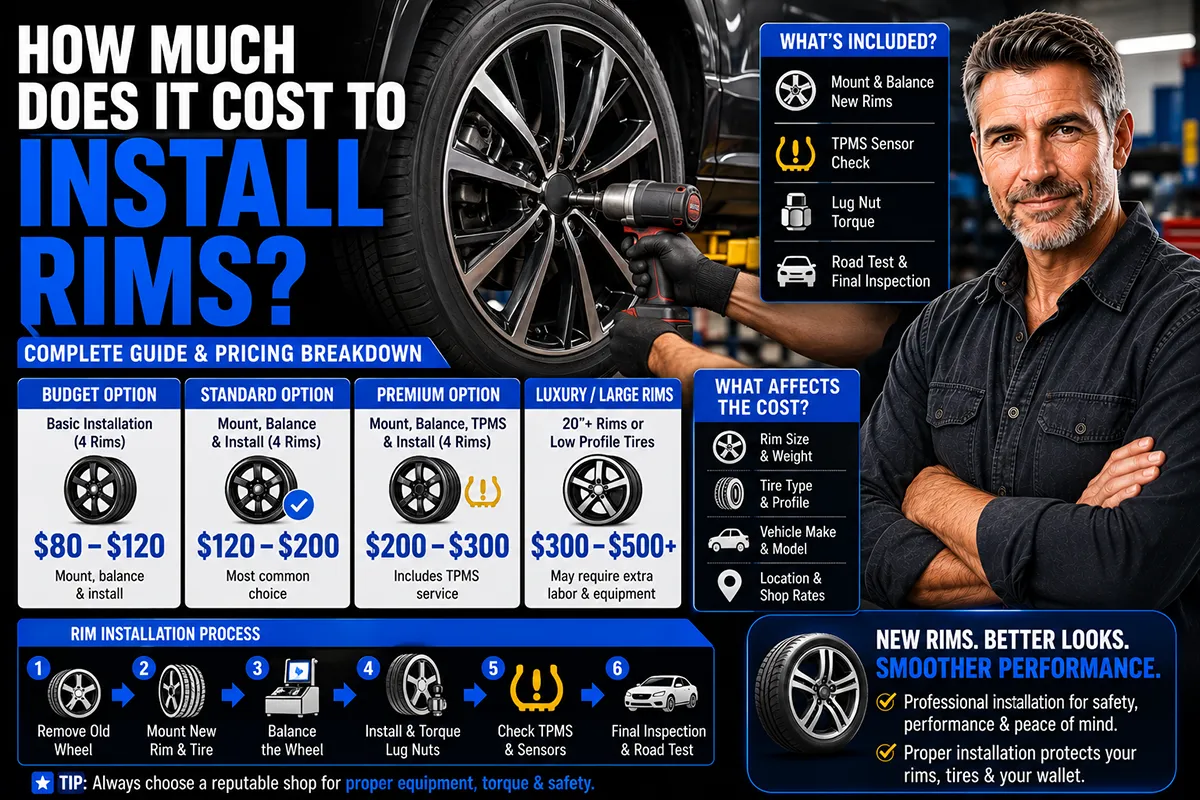
- Basic rim installation typically costs $25–$50 per wheel at most US tire shops
- Total cost for all four wheels ranges from $100–$800+ depending on rim type, vehicle, and additional services
- Aftermarket rims almost always cost more to install than OEM replacements
- TPMS sensor transfer or replacement adds $10–$75 per wheel
- Big-box stores like Discount Tire, Costco, and Walmart offer the most affordable installation
- Always ask for a full breakdown before authorizing work — hidden fees are common
Liked this article?
Add TireAdvise as a preferred source so you see more of our tire reviews and guides on Google.
What Exactly Does “Rim Installation” Include?
Before I talk dollars and cents, let me clarify what rim installation actually involves. In my experience, there’s a lot of confusion here because different shops bundle different services under the same label.
At its most basic, rim installation means removing your old wheels, mounting your existing tires onto the new rims, balancing the assemblies, and bolting them onto your vehicle. But that “basic” description hides several individual steps that shops love to charge for separately.
The Core Services in Rim Installation
Here’s what a complete rim installation typically includes:
- Tire dismounting: Removing tires from your old rims
- Tire mounting: Fitting tires onto your new rims
- Wheel balancing: Adding weights to ensure smooth rotation
- Valve stem replacement or transfer: Installing new rubber or metal valve stems
- TPMS sensor transfer: Moving your tire pressure monitoring system sensors to the new rims
- Hub-centric ring installation: If your aftermarket rims require them
- Torquing lug nuts to spec: Tightening everything to manufacturer specifications
When a shop quotes you a single price “per wheel,” I always ask which of these services are included. I’ve seen shops quote $25 per wheel for mounting only, then tack on $15 for balancing, $10 for valve stems, and $40 for TPMS work. That $25 quote suddenly becomes $90 per wheel.
Average Rim Installation Costs Across the US
I’ve collected pricing from shops I’ve personally visited or contacted in multiple states. Here’s a realistic breakdown of what you’ll pay in 2026.
Cost Per Wheel Breakdown
| Service | Low End (per wheel) | Average (per wheel) | High End (per wheel) |
|---|---|---|---|
| Tire mounting | $15 | $25 | $45 |
| Wheel balancing | $10 | $15 | $30 |
| TPMS sensor transfer | $10 | $25 | $75 |
| Valve stem replacement | $3 | $8 | $15 |
| Hub-centric rings | $5 | $10 | $20 |
| Total per wheel | $43 | $83 | $185 |
| Total for all 4 wheels | $172 | $332 | $740 |
In my experience, most everyday drivers with standard sedans or crossovers pay between $200 and $400 total for a complete four-wheel rim swap with all services included. If you’re running low-profile tires on large aftermarket wheels, expect to push into the $500–$800 range.
What Affects the Cost of Rim Installation?
Not all rim installations are created equal. I’ve paid as little as $80 total for a simple OEM rim swap and as much as $650 for a custom aftermarket setup. Here are the factors that drive the price up or down.
1. Rim Size and Type
This is the biggest cost factor I’ve encountered. Installing 16-inch OEM steel wheels is fast and easy — most shops charge their base rate. But when you move into 20-inch or larger aftermarket alloy wheels, the price jumps significantly.
Larger rims require more care during mounting to avoid scratching. They’re heavier, which means more effort and sometimes specialized equipment. I’ve seen shops charge a $10–$30 upsize fee per wheel for anything over 18 inches.
2. OEM vs. Aftermarket Rims
OEM rims are designed to be a direct bolt-on replacement for your vehicle. They have the correct bolt pattern, offset, and hub bore right out of the box. This means installation is straightforward and fast.
Aftermarket rims often need hub-centric rings, longer or different lug bolts, and sometimes spacers to fit properly. Each of these extras adds cost — both in parts and labor. In my experience, aftermarket rim installation costs 30–50% more than OEM on average.
3. TPMS Sensor Situation
This one catches a lot of people off guard. Since 2008, all vehicles sold in the US are required to have tire pressure monitoring systems. When you swap rims, those sensors need to come along.
If your new rims are compatible with your existing sensors, the shop simply transfers them — usually $10–$25 per wheel. But if your sensors are old, corroded, or incompatible with the new rims, you’ll need new ones. Aftermarket TPMS sensors run $25–$75 each, and OEM sensors from the dealership can cost $50–$150 per wheel.
I always recommend checking your TPMS sensor age before committing to a rim swap. If they’re more than five years old, budget for replacements.
4. Run-Flat Tires
If your vehicle came with run-flat tires — common on BMWs, some Mercedes models, and select Lexus vehicles — expect to pay more for mounting. Run-flat tires have reinforced sidewalls that are stiffer and more difficult to work with.
I’ve seen shops charge an additional $15–$25 per wheel for run-flat mounting. Some smaller independent shops won’t even touch them because they don’t have the right equipment.
5. Where You Go
The type of shop you choose has a massive impact on your final bill. Let me walk you through the options I’ve personally used.
Rim Installation Costs by Shop Type
Big-Box Tire Retailers
Places like Discount Tire, Tire Rack (with installer network), Costco, Sam’s Club, and Walmart tend to offer the most competitive installation pricing. They benefit from high volume and standardized pricing.
Discount Tire has been my go-to for years. They typically charge $20–$30 per wheel for mounting and balancing, and they’ll often do it free if you purchased the tires or wheels from them. Their service has been consistently good across multiple locations I’ve visited.
Costco Tire Center charges around $18–$25 per wheel for members, and installation is included with tire purchases. The downside is they can be slow — I’ve waited over two hours during busy weekends.
Walmart Auto Care is the budget option at $15–$25 per wheel. I’ve had mixed experiences with their service quality, but the price is hard to beat if you’re on a tight budget.
Independent Tire Shops
Local tire shops vary widely in pricing. I’ve found some that match big-box prices to stay competitive, and others that charge premium rates for the personal service.
Expect to pay $25–$50 per wheel at most independent shops. The advantage here is flexibility — independent shops are more likely to accommodate unusual rim sizes, custom fitments, or same-day appointments. Several of the best installs I’ve ever had were at small local shops where the owner took personal pride in the work.
Dealerships
Unless you’re installing OEM rims and want factory-level documentation for warranty purposes, I generally don’t recommend going to a dealership for rim installation. They charge $50–$100+ per wheel, and the work is usually outsourced to the same type of technician you’d find at an independent shop.
The one exception is if you have a specialty vehicle with unique TPMS programming requirements. Some luxury and European vehicles need dealer-specific scan tools to reprogram TPMS sensors after a rim swap.
Mobile Tire Services
Services like Treads, InstaTire, and various local mobile tire companies will come to your home or workplace to install your rims. Convenience is the selling point, and it’s genuinely nice to have the work done in your driveway.
I’ve used mobile tire services a few times during my test periods, and prices typically run $30–$60 per wheel. You’ll pay a premium for the convenience, but the time savings can be worth it if your schedule is packed.
Cost Comparison Table: Shop Types
| Shop Type | Cost Per Wheel | Total (4 Wheels) | Best For |
|---|---|---|---|
| Discount Tire | $20–$30 | $80–$120 | Best overall value |
| Costco | $18–$25 | $72–$100 | Budget-conscious members |
| Walmart | $15–$25 | $60–$100 | Lowest price possible |
| Independent Shop | $25–$50 | $100–$200 | Custom or oversized rims |
| Dealership | $50–$100+ | $200–$400+ | Warranty or specialty vehicles |
| Mobile Service | $30–$60 | $120–$240 | Convenience seekers |
Hidden Costs I’ve Encountered During Rim Installation
Over the years, I’ve been hit with surprise charges that weren’t mentioned in the initial quote. Here are the most common hidden costs to watch for.
Shop Supply Fees
Many shops add a “shop supplies” or “environmental fee” of $2–$10 to every service ticket. This covers things like tire lubricant, wheel weights, and waste disposal. It’s usually small, but it’s annoying when it’s not mentioned upfront.
I always ask about this before authorizing work. Some shops will waive it if you push back, but most consider it standard.
Corroded or Seized Lug Nuts
If your existing lug nuts are corroded and break during removal — which happens more often than you’d think, especially in rust belt states — you’ll need replacements. A set of lug nuts typically runs $20–$60, but specialty lug nuts for certain vehicles can cost $100 or more.
I’ve had this happen on a vehicle I was testing after several winters of road salt exposure. The shop had to use an extractor, and the replacement lug nuts added $45 to my bill.
Wheel Lock Key Issues
If your vehicle has wheel locks (anti-theft lug nuts), you need the key to remove them. Forgetting your wheel lock key at home means the shop either has to wait for you to retrieve it or use a universal removal tool — which they may charge you for.
I keep my wheel lock keys in my glove box at all times for this exact reason. If you’ve lost yours, a dealership can typically provide a replacement for $20–$40.
Alignment After Installation
Technically, a rim swap alone shouldn’t require an alignment. But if you’re changing rim sizes or offsets, an alignment is strongly recommended. Expect to pay $75–$120 for a four-wheel alignment.
In my experience, shops love to upsell alignments during rim installations. If you’re doing a straight size-for-size OEM replacement, you almost certainly don’t need one. But if you’re going from 17-inch to 20-inch rims, budget for it.
Tire Replacement
Here’s something many first-time rim buyers don’t consider: if your new rims are a different size than your originals, your existing tires probably won’t fit. You’ll need new tires too, which is an entirely separate cost.
I always remind readers to confirm tire compatibility before purchasing rims. A set of four new tires can add $400–$1,200+ to your total project cost, depending on the size and brand.
Can You Install Rims Yourself to Save Money?
I get this question a lot, and the answer depends on what type of rim installation we’re talking about.
Swapping Pre-Mounted Wheel/Tire Assemblies
If you purchased rims that already have tires mounted and balanced — common when buying from Tire Rack or a previous owner — then yes, you can absolutely install them yourself. All you need is a jack, a lug wrench, and some basic mechanical know-how.
I’ve done this more times than I can count, and it takes about 30–45 minutes for all four wheels. This saves you the entire installation cost. Just make sure you torque the lug nuts to your vehicle’s specification with a torque wrench — this is not optional.
Mounting Tires on Rims at Home
This is where I draw the line. Mounting tires onto rims requires a tire mounting machine and a wheel balancer. Without these tools, you risk damaging the tire bead, scratching the rims, or creating an unsafe imbalance.
I’ve seen DIY attempts go wrong — bent rims, damaged bead seats, and tires that won’t hold air. Unless you have professional equipment in your garage, pay a shop to handle the mounting and balancing.
Real-World Examples: What I’ve Actually Paid
Let me share some specific experiences from my own rim installations over the years. These are real prices I’ve paid at real shops.
Example 1: OEM Replacement on a Honda Accord
I replaced a damaged 17-inch OEM alloy wheel with an identical factory replacement. The shop dismounted the tire from the damaged rim, mounted it on the new one, balanced it, and put it back on the car.
Total cost: $45 at a local independent shop. This was about as straightforward and inexpensive as rim installation gets.
Example 2: Full Aftermarket Upgrade on a Ford F-150
I helped a friend install 20-inch aftermarket wheels on his F-150, replacing the stock 18-inch rims. This required dismounting tires from the old rims, purchasing new tires for the larger wheels, mounting and balancing everything, transferring TPMS sensors, and installing hub-centric rings.
Installation cost only: $320 at Discount Tire. New tires were an additional $880. The hub-centric rings were $40 for the set.
Example 3: Winter Wheel Set on a Subaru Outback
I purchased a set of 17-inch steel wheels with winter tires already mounted from Tire Rack. Since the assemblies arrived ready to bolt on, I did the swap myself in my garage.
Installation cost: $0. I spent about 40 minutes with a jack and torque wrench. The TPMS sensors were purchased separately and already installed in the new wheels by Tire Rack for $25 each.
Tips to Save Money on Rim Installation
After years of doing this, I’ve figured out several ways to keep installation costs down without sacrificing quality or safety.
Buy Rims and Tires as a Package
Retailers like Tire Rack, Discount Tire Direct, and SimpleTire often offer free or discounted mounting and balancing when you buy wheels and tires together. Tire Rack will even ship the assembled package to your door or to a local installer.
I’ve saved hundreds of dollars this way. The convenience of receiving pre-mounted, pre-balanced wheel and tire packages is hard to beat.
Get Multiple Quotes
Don’t just walk into the first shop you see. I call at least three shops for quotes before committing. Prices vary dramatically — I’ve seen a $100 difference in total cost for the exact same service between shops less than a mile apart.
When calling, be specific: tell them the rim size, whether they’re OEM or aftermarket, and ask for a fully itemized quote including TPMS, balancing, and any fees.
Ask About Bundle Deals
Many shops offer discounts when you’re having all four wheels done at once. Some include free balancing with mounting, or waive the TPMS transfer fee if you’re also buying tires. It never hurts to ask.
I’ve been surprised by how many shops will knock $20–$40 off the total just because I asked if they had any specials.
Time It Right
Tire shops have slow seasons — typically late winter and mid-summer. During these periods, they’re more likely to offer deals and more willing to negotiate on installation prices. I’ve gotten my best deals in January and July.
Avoid late fall when everyone is rushing to get winter tires, and early spring when the all-season crowd shows up. Wait times are longer and shops have less incentive to discount.
Consider Buying Pre-Mounted Assemblies
If you’re comfortable swapping wheels yourself, buying pre-mounted wheel and tire packages eliminates shop installation costs entirely. Companies like Tire Rack charge $0 for mounting and balancing when you purchase both components from them.
This is my top recommendation for anyone who wants to save maximum money and isn’t intimidated by a jack and a torque wrench.
When to Spend More on Professional Installation
While I’m all about saving money, there are situations where paying more for professional installation is the smart move.
Low-Profile Tires on Expensive Rims
If you’re installing $2,000+ forged wheels with low-profile tires, find a shop that specializes in high-end wheel installations. A careless technician with a tire machine can scratch or gouge an expensive rim in seconds. I’ve seen it happen.
Premium shops may charge more, but they typically use protective jaw covers on their machines and take extra care with high-value wheels. That $50 premium per wheel is cheap insurance on a $500 rim.
Complex Fitments
Aggressive offsets, stretched tires, or staggered setups (different front and rear sizes) require a technician who knows what they’re doing. If you’re into the enthusiast scene, find a shop that caters to the performance and show-car community.
I’ve worked with specialty shops that charge $60–$80 per wheel for these services, and the expertise is absolutely worth it.
Vehicles with Advanced TPMS
Some newer vehicles — particularly luxury European brands — have TPMS systems that need to be reprogrammed with manufacturer-specific tools after a wheel swap. Independent shops may not have these tools.
In these cases, a dealership visit for the TPMS programming (even if you have the physical installation done elsewhere) may be necessary. Budget $50–$150 for TPMS reprogramming at a dealership.
What About Rim-Only Swaps (No Tire Change)?
Sometimes you’re not changing tire sizes at all — you’re just upgrading the look of your wheels while keeping the same tires. In this case, the shop removes your tires from the old rims and mounts them on the new ones.
This is the most common type of rim installation, and it’s what most pricing is based on. If your new rims are the same size as your old ones and accept the same tires, this is the way to go.
However, I want to emphasize something I’ve learned through experience: tire bead condition matters. If your tires have been on the old rims for a long time, the beads can become seated in a way that makes them reluctant to seal properly on new rims. A competent shop will clean the bead area and use fresh sealant, but cheaper shops sometimes skip this step.
After several days of driving on newly swapped rims, I always check tire pressures to make sure everything is sealing properly. A slow leak from a poorly seated bead is more common than most people realize.
The Bottom Line: What Should You Budget?
Based on everything I’ve experienced and all the prices I’ve gathered, here’s my straightforward advice for budgeting your rim installation:
- Simple OEM replacement (1 wheel): Budget $40–$60
- OEM rim swap (4 wheels, same size): Budget $150–$250
- Aftermarket rim upgrade (4 wheels, new size): Budget $250–$500 for installation alone
- Full custom setup (large rims, new tires, TPMS, alignment): Budget $500–$800+ for installation and related services
These numbers don’t include the cost of the rims or tires themselves — just the labor and service charges to get them on your car. Always add a 15–20% cushion to your budget for unexpected issues like corroded hardware, sensor replacements, or necessary alignment work.
My strongest recommendation? Call three shops, get itemized quotes in writing, and don’t be afraid to ask questions. The best shops will happily explain every line item and won’t pressure you into unnecessary add-ons.
At the end of the day, rim installation is a routine service that any competent tire shop can handle. The key is knowing what to expect going in so you don’t get blindsided by the final bill. I hope this guide helps you walk into the shop with confidence — and drive out with a great set of wheels without breaking the bank.
Frequently Asked Questions
How much does it cost to install rims on a car?
The average cost to mount and install rims ranges from $20 to $50 per wheel at most US tire shops, bringing the total to $80–$200 for all four. If your new rims require new tires, tire pressure monitoring system (TPMS) sensor transfers, or hub-centric rings, expect to pay $150–$400 or more for the complete installation. Shops like Discount Tire, Tire Rack, and Les Schwab often include free mounting when you purchase wheels and tires together.
Does Walmart install rims and how much do they charge?
Yes, Walmart Auto Care Centers can mount and balance tires onto rims for about $15–$25 per tire, which includes valve stems and TPMS reset. However, Walmart generally does not install aftermarket rims that require modifications or adapters. If you’re simply swapping tires onto new wheels that are a direct fit for your vehicle, Walmart is one of the most affordable options in the US market.
Is it cheaper to install rims yourself or go to a shop?
Installing rims yourself can save you $80–$200 in labor, but you’ll still need a tire mounting machine and balancer to properly seat the tires, which most DIYers don’t have at home. If you’re only swapping pre-mounted wheel-and-tire assemblies—like switching between summer and winter setups—you can do it at home with a jack, lug wrench, and torque wrench for zero labor cost. For first-time rim installations that require tire mounting and balancing, I’d recommend going to a professional shop to avoid damage and safety issues.
How much does it cost to mount and balance tires on new rims?
Mounting and balancing tires on new rims typically costs $25–$45 per wheel, or $100–$180 for a full set of four at most US tire shops. Some retailers like Discount Tire and Costco offer free or discounted mounting and balancing when you buy wheels and tires from them. The price can increase by $10–$30 per wheel if TPMS sensors need to be transferred or replaced, so always ask for an all-inclusive quote before committing.
Are there extra costs when upgrading to bigger aftermarket rims?
Yes, upsizing to larger aftermarket rims often comes with hidden costs beyond the wheels themselves. You may need new tires sized to fit the bigger rims ($400–$1,200+ for a set of four), hub-centric rings ($10–$30), longer lug bolts or new lug nuts ($30–$80), and possibly fender rolling or suspension modifications ($200–$500) if the wheels cause rubbing. A proper wheel alignment after installation, which runs $80–$150, is also strongly recommended to prevent uneven tire wear.
How much does it cost to transfer TPMS sensors to new rims?
Transferring existing TPMS sensors from your old rims to new ones typically costs $5–$15 per sensor for labor, plus $2–$5 each for new TPMS service kits (valve cores, seals, and nuts). If your sensors are old or damaged and need full replacement, new TPMS sensors run $30–$80 each depending on your vehicle, bringing the total to $120–$320 for all four. Since TPMS sensors are federally required on all US vehicles made after 2007, this is not an optional cost you can skip.
Does Discount Tire install rims for free?
Discount Tire offers free mounting, balancing, and TPMS service when you purchase both wheels and tires from them, making it one of the best deals for rim installation in the US. If you bring in wheels or tires purchased elsewhere, they charge a per-tire installation fee that typically ranges from $18–$35 per wheel. They also provide free lifetime tire rotation and balancing on any tires they install, which adds significant long-term value and is worth factoring into your total cost comparison.
