

I’ll be honest — I used to be the driver who only checked tire pressure when the TPMS light popped up on the dashboard. Then one morning, I walked out to a completely flat rear tire that had been slowly leaking for weeks without triggering any warning.
That single experience cost me a perfectly good tire and a frustrating morning. It also taught me a lesson I now share with every driver I talk to: checking tire pressure is the single easiest thing you can do to extend tire life, improve fuel economy, and keep your family safe.
Yet most people almost never do it.
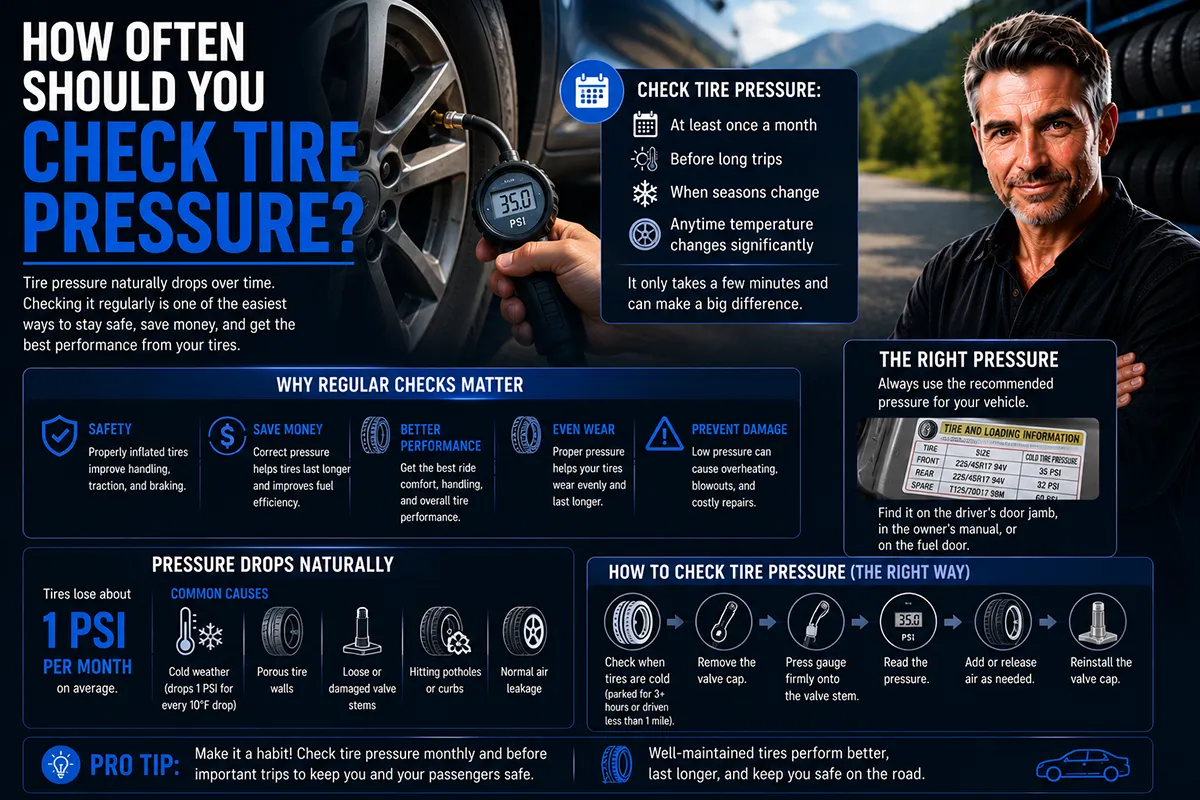
- Check tire pressure at least once a month — I personally recommend every week or two
- Always measure when tires are cold (before driving or after sitting for 3+ hours)
- Don’t rely solely on your TPMS — it only alerts you when pressure is already dangerously low
- Temperature swings cause pressure changes of about 1 PSI per 10°F, so seasonal checks are critical
- A good digital gauge costs under $15 and takes less than 2 minutes to use
- Proper tire pressure improves fuel economy, extends tread life, and dramatically reduces blowout risk
Liked this article?
Add TireAdvise as a preferred source so you see more of our tire reviews and guides on Google.
The Short Answer: At Least Once a Month (But I Do It More Often)
The National Highway Traffic Safety Administration (NHTSA) recommends checking your tire pressure at least once a month and before any long road trip. That’s the bare minimum, and it’s solid advice for most drivers.
But in my years of testing tires and driving across every type of road condition the US has to offer, I’ve found that once a month isn’t always enough. I personally check my tire pressure every one to two weeks, and I’ll explain exactly why below.
The thing is, tires naturally lose air over time — typically 1 to 2 PSI per month just through the rubber itself. That means if you only check once a month, you could already be driving on underinflated tires for weeks without knowing it.
Why Your TPMS Light Isn’t Enough
Let me clear up one of the biggest misconceptions I encounter. Many drivers believe that because their car has a Tire Pressure Monitoring System (TPMS), they don’t need to manually check pressure. I used to think the same thing.
Here’s the problem: federal regulations only require your TPMS to trigger a warning when tire pressure drops to 25% below the manufacturer’s recommended level. For a tire that should be at 35 PSI, that means the light won’t come on until pressure hits about 26 PSI.
That’s dangerously low.
At 26 PSI, you’re already experiencing reduced handling, increased stopping distances, excessive heat buildup, and accelerated tread wear. I’ve seen tires that were run at low pressure for extended periods develop irreversible sidewall damage — damage that no amount of reinflation can fix.
In my testing, I’ve watched tires lose 4 to 5 PSI over the course of a few weeks during a cold snap, and the TPMS light never triggered. The car felt slightly different — a little more sluggish, a bit more wandering in the lane — but nothing dramatic enough that most drivers would notice.
That’s why I always tell people: your TPMS is a last-resort safety net, not a tire pressure management system. Treat it like a smoke alarm — you don’t want it to be the first thing that tells you there’s a problem.
What Happens When You Drive on Incorrect Tire Pressure
I’ve tested dozens of tires over the years at various inflation levels to understand how pressure affects real-world performance. The differences are not subtle.
Underinflated Tires
When I’ve deliberately driven on tires that were 5 to 8 PSI below the recommended pressure, the changes were immediately noticeable. The steering felt heavier and less responsive. The car took longer to stop in both wet and dry braking tests.
Fuel economy dropped noticeably too. The US Department of Energy estimates that for every 1 PSI drop below proper inflation, fuel economy decreases by about 0.2%. That doesn’t sound like much, but when you’re 6 or 8 PSI low across all four tires, you’re burning real money at the pump.
The biggest concern with underinflation, though, is heat. An underinflated tire flexes more than it’s designed to, which generates excessive heat in the sidewall. Over time — sometimes in as little as a few days of highway driving — that heat can cause internal structural failure. I’ve personally inspected tires that experienced catastrophic blowouts, and the root cause was almost always chronic underinflation.
Overinflated Tires
On the flip side, I’ve also tested tires inflated 8 to 10 PSI above the recommended pressure. The ride became noticeably harsher — every bump and crack in the road transmitted directly into the cabin.
More importantly, the contact patch shrinks when a tire is overinflated. Instead of the full tread width gripping the road, only the center strip makes solid contact. This reduces traction in cornering and braking, and it causes the center of the tread to wear out much faster than the edges.
I’ve seen tires that still had plenty of edge tread but were completely bald down the center — all because someone inflated them to the maximum pressure listed on the sidewall instead of the vehicle’s recommended pressure.
Quick Comparison: Underinflated vs. Properly Inflated vs. Overinflated
| Factor | Underinflated (5+ PSI Low) | Properly Inflated | Overinflated (5+ PSI High) |
|---|---|---|---|
| Tread Wear Pattern | Edges wear faster | Even wear across tread | Center wears faster |
| Fuel Economy | Decreased (higher rolling resistance) | Optimal | Slightly improved but not worth it |
| Ride Comfort | Mushy, vague steering | Balanced and predictable | Harsh, bumpy ride |
| Braking Distance | Increased | Optimal | Increased (less contact) |
| Blowout Risk | Significantly higher | Minimal | Slightly elevated |
| Tire Lifespan | Reduced by up to 25% | Full rated life | Reduced by up to 15% |
When to Check More Often Than Once a Month
While monthly checks are the baseline, there are specific situations where I increase my checking frequency. Based on my experience, here’s when you should be checking more often.
During Major Temperature Swings
This is a big one, especially if you live anywhere that experiences real seasons. Tire pressure changes by approximately 1 PSI for every 10°F change in ambient temperature. I live in a part of the country where we can see 30-degree temperature swings between day and night in the fall and spring.
During those transitional seasons, I check my pressure every few days. I’ve measured differences of 3 to 4 PSI between a cold morning and a warm afternoon during the same week. If you set your tires on a warm day and then temperatures plummet overnight, you could wake up significantly underinflated.
Before Long Road Trips
I never leave for a road trip without checking all four tires plus the spare. Highway driving at sustained speeds generates more heat and stress on your tires than city driving. Starting a long trip with correct pressure is non-negotiable in my book.
I also recheck pressure each morning during multi-day trips, especially if I’m crossing through different climate zones. A drive from Arizona to Colorado, for example, can involve massive elevation and temperature changes that directly affect tire pressure.
After Hitting a Pothole or Curb
If you’ve had a significant impact — a deep pothole, a curb strike, or even a piece of road debris — check your pressure as soon as possible. I’ve seen slow leaks develop from minor rim damage that wasn’t visible to the naked eye.
After one particularly nasty pothole hit on an interstate in Pennsylvania, I pulled over at the next rest stop and found I’d already lost 3 PSI in that tire. It would have kept leaking if I hadn’t caught it.
When Tires Are New
Whenever I install a new set of tires — whether for testing or personal use — I check pressure more frequently during the first couple of weeks. New tires and new valve stems sometimes need a break-in period, and I want to make sure everything is sealing properly.
How to Check Tire Pressure the Right Way
I know this seems basic, but I’ve watched enough people at gas stations to know that many drivers don’t do this correctly. Here’s my step-by-step process.
Step 1: Check When Tires Are Cold
“Cold” means the car has been parked for at least three hours, or you’ve driven less than a mile at low speed. Driving heats up the air inside your tires and temporarily raises the pressure reading by 3 to 5 PSI, which gives you a false number.
I always check first thing in the morning before I go anywhere. If you must drive to a gas station to use their air compressor, keep the trip as short as possible — ideally under a mile.
Step 2: Find Your Recommended Pressure
This is where I see the most common mistake. The correct tire pressure for your vehicle is listed on the driver’s side door jamb sticker or in your owner’s manual. It is NOT the number on the tire sidewall.
The number on the sidewall (usually something like “Max 51 PSI”) is the maximum pressure the tire can safely hold — not the pressure it should be run at. The manufacturer’s recommended pressure is calculated based on your vehicle’s weight, suspension, and handling characteristics. For most passenger cars in the US, this falls somewhere between 30 and 36 PSI.
Step 3: Remove the Valve Cap and Press the Gauge Firmly
Unscrew the valve cap, press your gauge onto the valve stem firmly and quickly, and read the measurement. If you hear a hissing sound, the gauge isn’t seated properly — pull it off and try again.
I like to take two readings per tire to make sure I’m getting a consistent number. If the two readings differ by more than 1 PSI, I do a third.
Step 4: Add or Release Air as Needed
If pressure is low, add air in short bursts and recheck. If it’s too high, press the small pin inside the valve stem briefly to release air, then recheck.
I always aim for exactly the recommended pressure, not a couple of PSI over “just to be safe.” The engineers who designed your vehicle chose that number for a reason.
Step 5: Don’t Forget the Spare
This one gets overlooked constantly. Your spare tire loses air just like your regular tires. I check my spare every time I check my other four. There’s nothing worse than getting a flat and discovering your spare is also flat.
Most full-size spares should match your other tires’ recommended pressure. Compact temporary spares (donuts) typically need 60 PSI — check the label on the spare itself.
The Best Tire Pressure Gauges I’ve Actually Used
Over the years, I’ve used everything from pencil gauges to high-end digital units. Here’s what I’ve found actually works well for everyday drivers.
Digital Gauges (My Top Recommendation)
I recommend a digital tire pressure gauge for most people. They’re easy to read, accurate, and widely available. I’ve had great results with gauges from brands like AstroAI, Jaco ElitePro, and TireTek. Most of these run between $8 and $15 on Amazon, and they’re accurate to within 0.5 PSI.
The one I keep in my glovebox cost about $12 and has been reliable for over two years. It reads quickly, the display is backlit for nighttime use, and it auto-shuts off to save battery.
Pencil Gauges (Budget Option)
The classic stick-type gauge with the sliding ruler has been around forever. They’re cheap — usually $3 to $5 — and they don’t need batteries. However, in my experience, they’re less accurate and harder to read, especially in low light.
I keep one as a backup in my trunk, but it’s not my go-to.
Dial Gauges (The Middle Ground)
Analog dial gauges offer a nice balance of accuracy and ease of reading. They’re typically $10 to $20 and don’t require batteries. The Intercomp brand is well-regarded, and I’ve used several that held their calibration well over time.
The downside is they’re a bit bulkier than digital or pencil gauges, but that’s a minor trade-off.
Seasonal Tire Pressure Tips for US Drivers
The US is massive, and driving conditions vary wildly depending on where you live. Here’s what I’ve learned about managing tire pressure through the seasons in different parts of the country.
Fall and Winter (Cold Weather)
As temperatures drop, so does your tire pressure. This is the season when I get the most messages from readers asking why their TPMS light came on. In most cases, the answer is simple: it got cold overnight.
If you live in the northern states — anywhere from the Midwest to New England — expect to add air to your tires multiple times between October and March. I usually see a cumulative drop of 5 to 7 PSI from late summer to mid-winter, between natural air loss and temperature-related changes.
I recommend checking pressure every two weeks during this period. On mornings after a particularly sharp cold front, I’ll check before I leave the driveway.
Spring and Summer (Warm Weather)
Rising temperatures mean rising tire pressure. If you topped off your tires during winter and then temperatures climb 40 or 50 degrees by summer, you could easily be overinflated by 4 to 5 PSI without realizing it.
I always recheck and adjust pressure as we transition into warmer months. In the hottest parts of summer — especially in the South and Southwest — I pay close attention because hot pavement combined with high ambient temperatures push tire operating temperatures to their upper limits.
Regional Considerations
If you drive in mountainous areas, keep in mind that altitude changes also affect tire pressure. Driving from sea level up to a pass at 10,000 feet will cause your tires to read higher pressure at altitude due to reduced atmospheric pressure. I’ve measured differences of 1 to 2 PSI on mountain drives in Colorado.
Desert drivers face another unique challenge: extreme temperature swings between day and night. In places like Nevada, Arizona, and west Texas, I’ve seen 40-degree temperature differentials within a single day. That’s a 4 PSI swing just from temperature alone.
How Tire Pressure Affects Your New Tires
Since many of our readers at TireAdvise.com are actively shopping for replacement tires, I want to emphasize how proper pressure directly impacts the investment you’re making in new rubber.
Tread Life
Running new tires at incorrect pressure is one of the fastest ways to void their treadwear warranty and cut their lifespan short. I’ve tested identical tires side by side — one set maintained at the correct pressure, the other allowed to run 5 PSI low.
After several months of similar driving, the underinflated tires showed noticeably more shoulder wear. Projected out over the life of the tire, that pattern would have cut tread life by roughly 20 to 25%. On a set of tires that cost $600 to $800 installed, that’s $150 to $200 worth of tread life you’re throwing away.
Warranty Implications
Most major tire manufacturers — Michelin, Bridgestone, Goodyear, Continental, and others — include a clause in their treadwear warranties stating that the tires must be maintained at the vehicle manufacturer’s recommended inflation pressure. If you file a warranty claim and the wear pattern suggests chronic under or overinflation, they can deny it.
I’ve heard from readers who learned this the hard way. Don’t let it happen to you.
Performance Consistency
When I test a tire and report on its wet traction, dry handling, or road noise, those results assume the tire is running at the correct pressure. If you buy a tire based on my review and then run it 6 PSI low, you won’t get the performance I described.
Proper pressure is the foundation that every other tire characteristic builds upon.
Building a Tire Pressure Routine That Actually Sticks
I know from years of giving this advice that most people have good intentions but struggle with consistency. Here’s the routine I use and recommend — it takes less than five minutes.
Pick a Regular Day
I check my tire pressure every Sunday morning before I go anywhere. Picking a consistent day makes it a habit instead of something you have to remember.
Some people prefer the first of each month. That’s fine too — the important thing is that you have a trigger that reminds you.
Keep a Gauge Accessible
I keep my digital gauge in the center console, not buried in the trunk. If checking pressure requires digging through your car, you won’t do it. Make it easy.
I also keep a small portable air compressor (about $35 from brands like EPAuto or Viair) in my trunk. Being able to inflate tires at home instead of driving to a gas station removes a major barrier to actually maintaining correct pressure.
Use a Tire Pressure Log (Optional but Helpful)
For the first few months, I kept a simple note on my phone recording the date, temperature, and pressure of each tire. This helped me understand how my specific tires and driving conditions affected pressure loss.
After a while, I developed an intuitive sense for when my tires would need attention. You will too.
Set a Phone Reminder
If you’re not confident you’ll remember, set a recurring calendar reminder. No shame in that. I’d rather you check because your phone told you to than not check at all.
Common Tire Pressure Myths I Want to Debunk
In my experience talking with hundreds of drivers, these myths keep coming up.
Myth: “The Number on the Tire Sidewall Is the Right Pressure”
I’ve already touched on this, but it bears repeating because it’s the most common mistake I see. The sidewall number is the maximum pressure — not the target. Always use the number on your door jamb sticker.
Myth: “You Should Overinflate a Little for Better Gas Mileage”
Yes, higher pressure slightly reduces rolling resistance. But the trade-off is reduced traction, a harsher ride, and uneven tread wear. In my testing, the fuel economy gains from overinflating by a few PSI were negligible — we’re talking pennies per tank. It’s not worth the safety compromise.
Myth: “Nitrogen-Filled Tires Don’t Need Pressure Checks”
Nitrogen does leak more slowly than regular air because the molecules are slightly larger. But it still leaks. I’ve tested nitrogen-filled tires and still found pressure drops over time, just at a marginally slower rate.
Nitrogen is not a substitute for regular pressure checks. And at many tire shops, nitrogen fills cost $5 to $10 per tire — money that could buy you a perfectly good gauge instead.
Myth: “If the Tire Looks Fine, the Pressure Is Fine”
Modern radial tires are designed to look normal even when significantly underinflated. I’ve placed tires side by side at 35 PSI and 25 PSI, and most people couldn’t tell the difference visually. By the time a tire looks visibly low, it’s often dangerously low.
Never trust your eyes. Always use a gauge.
What About Tire Pressure for Different Vehicle Types?
The recommended pressure varies significantly depending on what you drive.
Sedans and Compact Cars
Most passenger cars I’ve tested call for somewhere between 30 and 36 PSI. These are the most straightforward — just follow the door sticker and you’re set.
SUVs and Crossovers
SUVs and crossovers tend to require slightly higher pressures — often 33 to 38 PSI — to support their heavier curb weight. Some larger SUVs like the Chevrolet Tahoe or Ford Expedition may call for different front and rear pressures due to weight distribution.
Always check both the front and rear specifications on your door sticker. Don’t assume they’re the same.
Pickup Trucks
Trucks are where it gets more interesting. Many half-ton and three-quarter-ton trucks have different recommended pressures depending on load. The door sticker often shows separate pressures for “normal” and “full load” conditions.
When I test tires on trucks, I adjust pressure based on whether the bed is loaded or empty. If you regularly haul heavy loads, you should be increasing rear tire pressure accordingly and then reducing it when the load is removed.
Performance Vehicles
Some performance cars and sport-tuned vehicles have specific pressure recommendations for street driving versus track use. If you drive something like a Ford Mustang GT, Chevrolet Corvette, or similar, consult your owner’s manual for the specific street pressure recommendation.
My Final Recommendation
After years of testing tires, writing reviews, and maintaining vehicles across every season and region in the US, here’s my honest recommendation.
Check your tire pressure every two weeks. It takes less than five minutes, costs nothing, and it’s the single most effective thing you can do to get the most life, performance, and safety out of your tires.
If you’re shopping for new tires — whether it’s an all-season set for your family sedan, winter tires for your northern commute, or all-terrain tires for your truck — proper inflation is what makes or breaks the experience. No tire, no matter how highly rated or expensive, will perform as designed if you neglect pressure maintenance.
Buy a $12 digital gauge. Set a recurring reminder. Make it part of your routine. Your tires, your wallet, and your family will thank you.
Frequently Asked Questions
How often should you check tire pressure on your car?
I recommend checking your tire pressure at least once a month and before any long road trips. Tire pressure can drop about 1-2 PSI per month naturally, and temperature swings common across the US can cause even faster fluctuations. A monthly check takes less than five minutes and can prevent uneven tire wear, blowouts, and poor fuel economy.
What is the correct tire pressure for most passenger cars in the US?
Most US passenger cars, trucks, and SUVs call for tire pressure between 30 and 35 PSI, but you should always follow the exact number listed on the placard inside your driver-side door jamb or in your owner’s manual. Never rely on the number molded into the tire sidewall, as that indicates the maximum pressure the tire can handle, not the recommended inflation for your vehicle.
Does cold weather affect tire pressure, and how often should I check in winter?
Yes, tire pressure drops roughly 1 PSI for every 10°F decrease in ambient temperature, which is a big deal for drivers in northern states where winter temps can swing 40-50 degrees overnight. During the colder months from November through March, I check my tires every two weeks to stay ahead of pressure loss. Underinflated tires in winter reduce traction on icy and wet roads and wear out faster, costing you more money on early replacements.
Can I rely on my TPMS light instead of manually checking tire pressure?
Your tire pressure monitoring system is a useful safety backup, but it should not replace manual checks. TPMS alerts typically don’t trigger until pressure drops 25% below the recommended level, which means your tires could already be significantly underinflated and wearing unevenly before the dashboard light turns on. A simple digital tire pressure gauge costs $5-$15 at any AutoZone or Walmart and gives you a far more accurate reading.
Should I check tire pressure when tires are hot or cold?
Always check tire pressure when your tires are cold, meaning the car has been parked for at least three hours or driven less than a mile. Driving heats up the air inside your tires and can inflate readings by 3-5 PSI above the true baseline pressure. The recommended PSI on your door placard is calibrated for cold tires, so checking them warm can lead to underinflation if you mistakenly release air.
Does incorrect tire pressure void my tire warranty or affect tire lifespan?
Running tires consistently overinflated or underinflated can absolutely void the treadwear warranty offered by major US brands like Goodyear, Michelin, and Bridgestone. Most manufacturer warranties require proof of proper maintenance, including correct inflation, regular rotations, and alignment checks. Underinflated tires can reduce tread life by 25% or more, meaning a set of tires that should last 60,000 miles could wear out closer to 45,000, costing you hundreds of dollars in premature replacements.
How much money can proper tire pressure save on gas and tire replacement costs?
According to the US Department of Energy, properly inflated tires can improve your fuel economy by up to 3%, which saves roughly $0.06-$0.12 per gallon at current US gas prices. Over a year of average American driving at about 13,500 miles, that adds up to $100-$200 in fuel savings alone. When you factor in extended tire life and avoiding premature replacement costs of $500-$800 for a new set, a monthly pressure check is one of the easiest ways to protect your wallet.
