

Most drivers don’t think about their tires until something goes wrong — a blowout on the highway, a failed inspection, or a terrifying slide through a rainy intersection.
I’ve been there myself. Years ago, I drove on a set of tires far longer than I should have, convinced they “still looked fine.” It wasn’t until I hydroplaned making a routine left turn that I realized how dangerously wrong I was.
After spending years testing and reviewing tires for everyday drivers across the US, I’ve learned that knowing when to replace your tires isn’t just about saving money — it’s genuinely a life-or-death decision. And the answer isn’t as simple as most people think.
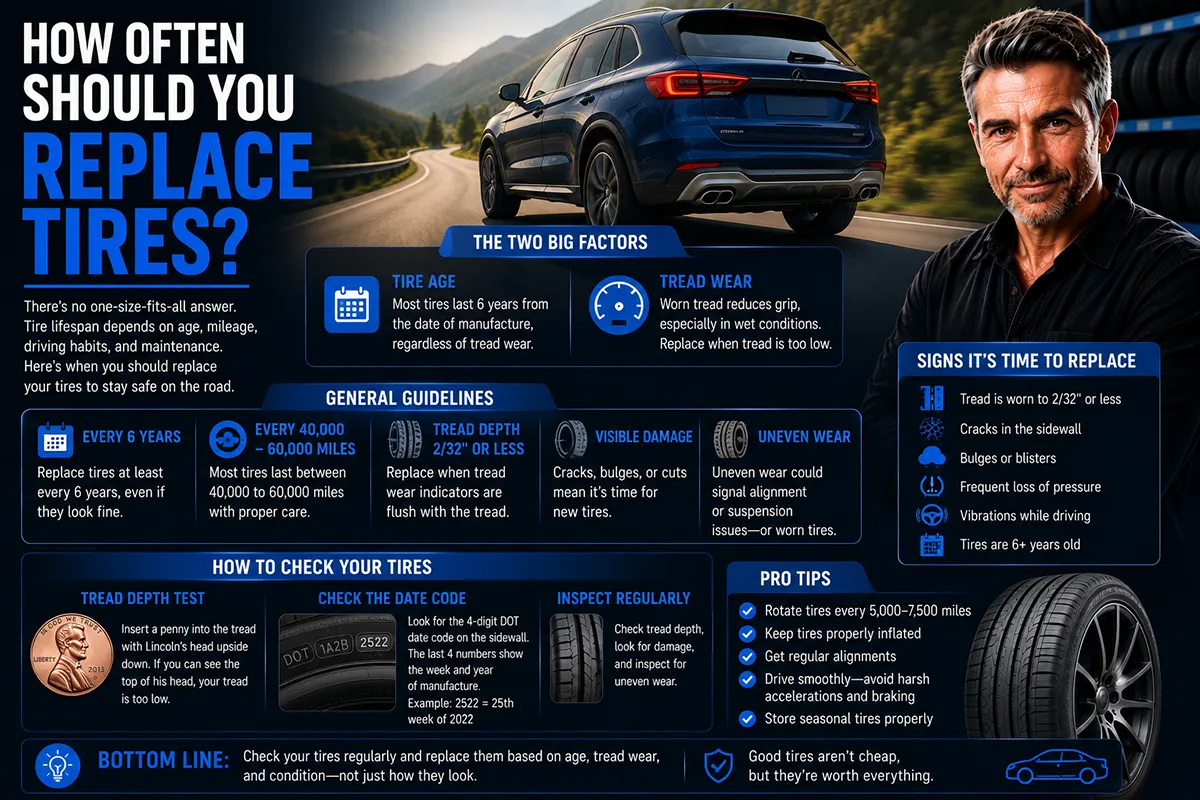
- Replace tires when tread depth reaches 2/32″ — but I recommend swapping at 4/32″ for better wet and winter traction.
- Even tires with good tread should be replaced after 6 years from the manufacture date, and absolutely by 10 years.
- Check for uneven wear, sidewall cracks, bulges, and vibrations as early warning signs.
- Driving habits, climate, and tire quality all affect how quickly your tires wear out.
- Regular rotation, proper inflation, and alignment checks can significantly extend tire life.
- Don’t wait for a catastrophic failure — inspect your tires at least once a month.
Liked this article?
Add TireAdvise as a preferred source so you see more of our tire reviews and guides on Google.
Why Tire Replacement Timing Matters More Than You Think
Your tires are the only part of your car that actually touches the road. That’s a fact I repeat constantly because it’s easy to forget when you’re focused on engines, brakes, and all the flashy tech in modern vehicles.
I’ve tested dozens of tire sets over the years, and the performance difference between a fresh set and a worn set is staggering. Stopping distances can increase dramatically, wet traction plummets, and the risk of a blowout climbs with every week you delay replacement.
According to the National Highway Traffic Safety Administration (NHTSA), tire-related crashes cause hundreds of fatalities in the US every year. Many of these are entirely preventable with timely tire replacement.
The Two Main Factors That Determine When to Replace Tires
In my experience, tire replacement timing comes down to two critical factors: tread depth and tire age. Most drivers only think about one or the other, but you need to monitor both.
Let me break each one down based on what I’ve learned through years of hands-on testing and research.
Factor 1: Tread Depth — Your Tire’s Lifeline
Tread depth is the single most important measurement when it comes to tire performance. The grooves in your tire channel water away from the contact patch, grip loose surfaces, and give the rubber something to “bite” with.
New tires typically start with 10/32″ to 11/32″ of tread depth. The legal minimum across most US states is 2/32″. But here’s what I always tell readers: legal doesn’t mean safe.
I’ve tested tires at various stages of wear, and the performance drop-off between 4/32″ and 2/32″ is alarming — especially in wet conditions. Braking distances on wet pavement can nearly double when you go from healthy tread to the legal minimum. That’s why I personally recommend replacing tires at 4/32″ rather than waiting until they’re completely bald.
How to Check Your Tread Depth at Home
You don’t need fancy equipment to check your tread depth. Here are three methods I use regularly:
- The Penny Test: Insert a penny into the tread groove with Lincoln’s head facing down. If you can see the top of Lincoln’s head, your tread is at or below 2/32″ — replace immediately.
- The Quarter Test: This is what I actually prefer. Insert a quarter with Washington’s head down. If you can see the top of his head, you’re at about 4/32″ — my recommended replacement threshold.
- A Tread Depth Gauge: These cost about $5 at any auto parts store and give you an exact measurement. I keep one in my glove box at all times. It’s the most precise method and takes about ten seconds per tire.
I check my tread depth at least once a month. It takes less than five minutes for all four tires, and it’s given me early warning of uneven wear patterns that pointed to alignment issues I wouldn’t have noticed otherwise.
Factor 2: Tire Age — The Silent Killer
This is the one that catches most people off guard. Even if your tires have plenty of tread left, the rubber compound degrades over time due to UV exposure, temperature fluctuations, and chemical oxidation.
I’ve personally seen tires with decent tread that were dangerously compromised because they were simply too old. The rubber was hard, the sidewalls had fine cracks, and the overall grip was noticeably worse than it should have been.
Most tire manufacturers and the NHTSA recommend replacing tires after 6 years from the date of manufacture, regardless of tread depth. The absolute maximum is 10 years, after which tires should be replaced no matter what they look like.
This is particularly relevant if you drive a second car, a classic vehicle, or a trailer that doesn’t see daily use. Low-mileage tires age just as fast as high-mileage ones in many cases.
How to Find Your Tire’s Age
Every tire sold in the US has a DOT code stamped on the sidewall. The last four digits tell you the week and year of manufacture.
For example, if the code ends in 2319, that tire was made in the 23rd week of 2019. I always check this when I buy tires — even new ones — because some tires sit in warehouses or on shop shelves for a year or more before being sold.
If you’re buying tires and the manufacture date is more than a year old, I’d either negotiate a discount or ask for a fresher set. I’ve encountered this more often than you’d expect, especially with less popular tire sizes.
Warning Signs Your Tires Need Replacing Now
Beyond tread depth and age, there are several physical warning signs I’ve learned to watch for over the years. If you notice any of these, don’t wait — get your tires inspected or replaced as soon as possible.
1. Uneven Tread Wear
If one side of the tire is more worn than the other, or if the center is worn but the edges aren’t (or vice versa), something is off. In my experience, this usually points to improper inflation, worn suspension components, or a misaligned vehicle.
I once noticed the inside edges of my front tires wearing significantly faster than the rest. A quick alignment check revealed my toe was off, and catching it early saved me from having to replace those tires months sooner than necessary.
2. Sidewall Cracks and Dry Rot
Small cracks in the sidewall are a sign that the rubber is breaking down. I see this most often on tires that spend a lot of time in direct sunlight or extreme heat — a common issue in the southern US states like Texas, Arizona, and Florida.
If the cracks are visible to the naked eye, the structural integrity of the tire is compromised. I never recommend continuing to drive on tires with significant sidewall cracking.
3. Bulges or Blisters
A bulge on the sidewall means the internal structure of the tire has been damaged — usually from hitting a pothole or curb. This is a ticking time bomb. I’ve seen bulging tires fail suddenly, and it’s one of the most dangerous tire conditions you can drive on.
If you spot a bulge, replace that tire immediately. Don’t drive on it to “get through the week.” It’s not worth the risk.
4. Vibration While Driving
Some vibration is normal, especially on rough roads. But if you notice a new or worsening vibration — particularly at highway speeds — it could indicate internal tire damage, a separated belt, or an out-of-balance tire.
During one of my test periods, I noticed a rhythmic thumping that got worse over several days of driving. It turned out to be a belt separation in a rear tire that wasn’t visible from the outside. If the vibration feels unusual, get it checked out.
5. Tread Wear Indicators Are Flush
Modern tires have built-in tread wear indicators — small raised bars that sit in the grooves at 2/32″ height. When the surrounding tread wears down to the level of these bars, the tire is at the legal minimum.
I use these as a quick visual check during my monthly inspections. If the bars are starting to become flush with the tread surface, it’s time to start shopping for replacements.
How US Driving Conditions Affect Tire Lifespan
One thing I’ve learned through testing tires in different parts of the country is that where and how you drive has an enormous impact on how quickly your tires wear out.
Climate and Temperature
If you live in the Sun Belt — think Phoenix, Dallas, or Miami — your tires face brutal heat that accelerates rubber degradation. I’ve noticed tires aging visibly faster in hot climates compared to cooler northern states.
Conversely, if you’re in the upper Midwest or Northeast, freeze-thaw cycles and road salt create their own challenges. Cold temperatures make rubber harder, and salt can contribute to sidewall deterioration over time.
Road Conditions
Potholes, rough pavement, gravel roads, and construction zones all take a toll. After testing tires on poorly maintained roads over extended periods, I’ve seen significantly accelerated wear compared to the same tires driven on smooth highways.
If your daily commute involves rough roads, expect to replace your tires sooner. It’s just the reality of the conditions.
Driving Style
Hard acceleration, aggressive cornering, and late braking all increase tire wear. I’ll admit that during some of my performance testing sessions, I’ve chewed through tread far faster than normal — and the same applies to everyday driving habits.
If you’re a spirited driver, keep a closer eye on your tread depth. You may need replacements sooner than the conservative estimates suggest.
Highway vs. City Driving
City driving with frequent stops, starts, and turns tends to wear tires faster than steady highway cruising. The constant low-speed maneuvering — especially parking lot turns — puts a lot of stress on the front tires in particular.
In my experience, drivers who primarily commute in stop-and-go city traffic should check their tires more frequently than those who mostly drive on highways.
Tire Replacement Timing by Tire Type
Not all tires wear at the same rate. The type of tire you buy significantly affects how long it will last. Here’s a comparison based on my testing experience:
| Tire Type | Typical Lifespan | Key Characteristics | Best For |
|---|---|---|---|
| All-Season | 3–5 years for most drivers | Balanced performance, harder compound, slower wear | Year-round daily driving in moderate climates |
| Performance / Summer | 2–4 years for most drivers | Softer compound, superior grip, faster wear | Warm-weather performance driving |
| Winter / Snow | 3–4 seasons (used seasonally) | Soft compound designed for cold, wears fast in warm temps | Cold climates below 45°F |
| All-Terrain (Truck/SUV) | 3–5 years for most drivers | Aggressive tread, durable construction | Mixed on-road/off-road use |
| Touring | 4–6 years for most drivers | Optimized for long life, comfort, and fuel efficiency | Highway commuters who prioritize longevity |
In my testing, touring tires like the Michelin Defender and Continental TrueContact have consistently delivered the longest tread life among the categories. Performance tires like the Michelin Pilot Sport 4S deliver incredible grip but wear noticeably faster — a trade-off most enthusiasts accept willingly.
Should You Replace All Four Tires at Once?
This is one of the most common questions I get, and the answer depends on your vehicle and drivetrain.
All-Wheel Drive (AWD) Vehicles
If you drive an AWD car, truck, or SUV, I strongly recommend replacing all four tires at the same time. AWD systems rely on all four tires having similar diameters and traction levels. Mismatched tires can cause premature wear on the differential and transfer case — repairs that cost significantly more than a set of tires.
I learned this lesson when a technician showed me the wear on a friend’s Subaru differential after they ran mismatched tires for an extended period. It was an expensive lesson.
Front-Wheel Drive (FWD) and Rear-Wheel Drive (RWD) Vehicles
For two-wheel-drive vehicles, you can get away with replacing tires in pairs — but always replace them on the same axle. And here’s a tip that surprises many people: the newer tires should go on the rear axle, regardless of whether your car is FWD or RWD.
This reduces the risk of oversteer (the rear end sliding out) in wet conditions. I’ve tested this myself, and the difference in stability during wet emergency maneuvers is remarkable. It feels counterintuitive for FWD drivers, but it’s the safer setup.
How to Extend the Life of Your Tires
Over the years, I’ve developed a maintenance routine that consistently helps me get the most life out of every set of tires I test. Here’s what works:
1. Check Tire Pressure Monthly
Under-inflated tires wear faster on the edges. Over-inflated tires wear faster in the center. Either way, you’re leaving tire life — and money — on the table.
I check my tire pressure at least once a month and always before long road trips. The correct pressure for your vehicle is listed on the driver’s door jamb sticker, not on the tire sidewall (that number is the maximum, not the recommended pressure).
A simple digital tire pressure gauge costs about $10 and is one of the best investments you can make. I keep one in every vehicle I drive.
2. Rotate Your Tires Regularly
Tire rotation is the single most effective maintenance step for even tread wear. I follow the general guideline of rotating tires every time I get an oil change — typically every few months or at each service interval.
Front tires wear faster on FWD vehicles due to steering and braking loads. Regular rotation spreads that wear across all four tires so they wear out together rather than in pairs.
Most tire shops include free lifetime rotations when you purchase a set of tires. I always take advantage of this — it’s one of the best perks in the tire-buying world.
3. Get Your Alignment Checked Annually
A misaligned vehicle can destroy a set of tires in a shockingly short time. I’ve seen tires that should have lasted years get chewed up in a matter of months because of a bad alignment.
I recommend getting an alignment check at least once a year, or anytime you hit a significant pothole, replace suspension components, or notice the car pulling to one side. An alignment typically costs $75–$120 at most US shops, and it can save you hundreds in premature tire replacement costs.
4. Balance Your Tires When Needed
Unbalanced tires cause vibration and uneven wear. I get my tires balanced whenever they’re rotated, whenever I mount new tires, and anytime I notice vibration at highway speeds.
Most shops charge $15–$25 per tire for balancing, or include it free with a tire purchase. It’s a small cost for a big benefit.
5. Avoid Overloading Your Vehicle
Every tire has a load rating, and exceeding it accelerates wear and increases the risk of failure. I see this most often with pickup truck owners who load their beds to maximum capacity regularly.
Check your vehicle’s load capacity on the door jamb sticker and stay within it. If you frequently haul heavy loads, consider tires with a higher load rating — many light truck tires are available in Load Range E for this purpose.
How Much Does Tire Replacement Cost in the US?
Budget is always a factor, so let me share some realistic pricing based on current US market conditions.
- Budget tires: $60–$100 per tire — Brands like Hankook Kinergy, Cooper CS5, and Falken Sincera offer decent value at this price point. I’ve tested several budget options that perform surprisingly well for daily driving.
- Mid-range tires: $100–$175 per tire — This is the sweet spot for most drivers. Continental, General, and Yokohama all have strong options here. In my experience, mid-range tires offer the best balance of performance, longevity, and value.
- Premium tires: $175–$300+ per tire — Michelin, Bridgestone, and Pirelli dominate this segment. You’re paying for superior wet grip, longer tread life, better ride comfort, and often excellent manufacturer warranties.
Don’t forget to factor in installation costs, which typically run $15–$30 per tire at most US shops. Many online retailers like Tire Rack, Discount Tire, and SimpleTire offer free or discounted mounting and balancing when you ship to a partner installer.
In my experience, paying a little more upfront for a quality mid-range or premium tire almost always saves money in the long run. They last longer, perform better, and often come with better mileage warranties and road hazard protection.
What About Tire Warranties and Tread Life Guarantees?
Many tire manufacturers offer treadwear warranties — sometimes called mileage warranties — that promise a certain level of tread life. If the tire wears out before the warranty period, you can get a prorated credit toward a replacement.
I’ve used these warranties twice over the years, and they’re legitimate — though the process requires you to have proof of regular rotations and proper maintenance. Keep your service receipts.
Here’s what to keep in mind:
- Warranties vary widely: Some touring tires are warranted for much longer than performance tires. Always check before you buy.
- Conditions apply: You typically need to show records of regular rotation and proper inflation. If you can’t prove you maintained the tires, the claim may be denied.
- Prorated credit, not full replacement: The credit is based on the remaining tread life percentage. You’ll still pay something out of pocket.
I always register my tires with the manufacturer after purchase and keep digital copies of all service records. It takes a few minutes and can save you significant money down the road.
A Real-World Replacement Schedule I Follow
Based on everything I’ve learned from testing tires professionally, here’s the practical schedule I follow and recommend to other US drivers:
- Monthly: Visual inspection and tire pressure check. I look for obvious damage, check tread depth at multiple points, and top off pressure as needed.
- Every oil change: Tire rotation. I never skip this. It’s the easiest way to extend tire life.
- Annually: Alignment check. Especially important after winter in states with potholes and rough roads.
- At 4/32″ tread depth: Start shopping for replacements. I use this as my personal threshold, even though the legal minimum is 2/32″.
- At 6 years from manufacture date: Replace regardless of tread depth. Rubber degrades with time, and no amount of remaining tread compensates for aged rubber.
- Immediately: Replace if you spot bulges, deep sidewall cracks, exposed cords, or belt separation.
This schedule has served me well over years of driving and testing. It’s not overly aggressive or wasteful — it’s simply the right balance of safety and value that I’ve found through experience.
Common Myths About Tire Replacement
Let me clear up a few misconceptions I hear all the time:
“If the tread looks fine, the tire is fine.”
Not true. Age-related degradation happens regardless of tread wear. I’ve handled tires with plenty of tread that were rock-hard and covered in micro-cracks. They were unsafe to drive on despite looking “good enough” at a glance.
“Tires only need to be replaced when they fail inspection.”
State inspections in the US (where they exist) typically only check for the 2/32″ legal minimum. By that point, your tires have already lost a significant portion of their wet-weather capability. I don’t use state inspection as my replacement trigger — and I don’t think you should either.
“All four tires wear at the same rate.”
They rarely do, even with regular rotation. Front tires bear more weight, handle steering forces, and do most of the braking on FWD vehicles. I always measure all four tires individually because I’ve often found differences that changed my replacement timeline.
“You can just replace the one tire that’s worn.”
On AWD vehicles, this can damage your drivetrain. Even on two-wheel-drive cars, replacing a single tire creates a traction imbalance. At minimum, replace tires in pairs on the same axle with tires of the same brand, model, and size.
When I’ve Replaced Tires Earlier Than Expected
I want to share a few real scenarios from my own experience where tires needed replacement sooner than I anticipated:
After several days of driving a new set of all-season tires on a test vehicle, I noticed a nail embedded in the sidewall. Sidewall punctures can’t be safely repaired, so that tire had to be replaced right away — even though it was practically brand new.
On another occasion, I was testing a set of performance tires during summer, and after a few weeks, I moved the car to winter duty without swapping to winter tires. The performance compound got dangerously hard in cold temperatures, and I could feel the lack of grip during my first drive in near-freezing conditions. I replaced them with proper winter tires the next day.
These experiences reinforced an important lesson: replacement timing isn’t always about wear — it’s about safety in your specific driving conditions.
My Final Advice on Tire Replacement Timing
After years of testing, reviewing, and living with dozens of different tire sets across sedans, SUVs, trucks, and performance cars, here’s what I want every driver to take away from this guide:
Don’t wait for your tires to tell you they’re done — stay ahead of the problem.
A monthly five-minute inspection is all it takes. A $5 tread depth gauge and a $10 tire pressure gauge are the only tools you need. And when it’s time to replace, invest in quality tires that match your driving conditions and vehicle type.
Your tires are your car’s most critical safety component. They determine how quickly you stop, how well you turn, and whether you stay on the road in bad weather. Treating tire replacement as a proactive maintenance item rather than an emergency repair is the smartest thing any driver can do.
I’ve seen the difference firsthand — in testing, in real-world emergencies, and in the data. Fresh, properly maintained tires can be the difference between a close call and a catastrophe.
Stay safe out there. And if you’re shopping for your next set, check out my latest reviews here on TireAdvise.com — I test every tire myself so you don’t have to guess.
Frequently Asked Questions
How often should you replace your tires in miles?
Most tires should be replaced every 50,000 to 70,000 miles, though this varies significantly by tire brand, type, and driving habits. Premium all-season tires from brands like Michelin or Continental often last closer to 70,000–80,000 miles, while budget tires may wear out by 40,000 miles. I always recommend checking your tread depth every 5,000 miles rather than relying solely on mileage estimates.
How do I know when my tires need to be replaced?
The easiest method is the penny test — insert a penny into your tread groove with Lincoln’s head facing down, and if you can see the top of his head, your tread is below 2/32 of an inch and the tire needs immediate replacement. You should also look for uneven wear patterns, sidewall cracks, bulges, or vibrations while driving. Most tire shops across the US will inspect your tread depth for free, so take advantage of that if you’re unsure.
Should I replace all 4 tires at once or can I replace just 2?
For all-wheel-drive vehicles, you should almost always replace all four tires at once because mismatched tread depths can damage the drivetrain, potentially costing you $1,000+ in repairs. On front-wheel or rear-wheel-drive vehicles, replacing tires in pairs is acceptable as long as you mount the newer tires on the rear axle for better wet-weather stability. If your remaining tires have more than 50% tread life left, replacing just two is a reasonable way to save money.
Do tires need to be replaced after a certain number of years even if they look fine?
Yes — tire manufacturers and the National Highway Traffic Safety Administration recommend replacing tires that are 6 to 10 years old regardless of tread depth or appearance. Rubber compounds degrade over time due to UV exposure, heat, and oxidation, which can lead to sudden blowouts even on tires with plenty of tread. You can find the manufacture date on the sidewall as a four-digit DOT code — for example, “2219” means the tire was made in week 22 of 2019.
How much does it cost to replace 4 tires in the US?
A full set of four tires typically costs between $400 and $1,200 for most passenger cars and SUVs in the US, including mounting and balancing. Budget options like Westlake or Cooper start around $80–$100 per tire, while premium brands like Michelin Defender or Bridgestone Turanza run $150–$250+ per tire. I recommend factoring in alignment ($75–$120) when budgeting for new tires, since worn tires often indicate alignment issues that will chew through your new set prematurely.
Do I need to replace my tires sooner if I drive in extreme heat or harsh winters?
Absolutely — extreme US driving conditions accelerate tire wear significantly. Drivers in states like Arizona or Texas may see 10–20% faster tread wear due to hot asphalt temperatures, while harsh winters in the Midwest and Northeast cause rubber to harden and crack faster. If you regularly drive in snow and ice, running a dedicated set of winter tires and swapping them seasonally actually extends the life of both sets compared to using all-season tires year-round.
Does rotating your tires extend how long they last before replacement?
Regular tire rotation every 5,000 to 7,500 miles can extend your total tire life by 10,000–20,000 miles by ensuring even wear across all four tires. Front tires on FWD vehicles wear significantly faster due to steering and braking forces, so skipping rotations often means replacing front tires years before the rears. Most tire shops like Discount Tire and Costco offer free lifetime rotations when you purchase tires from them, making it an easy habit to maintain.
