

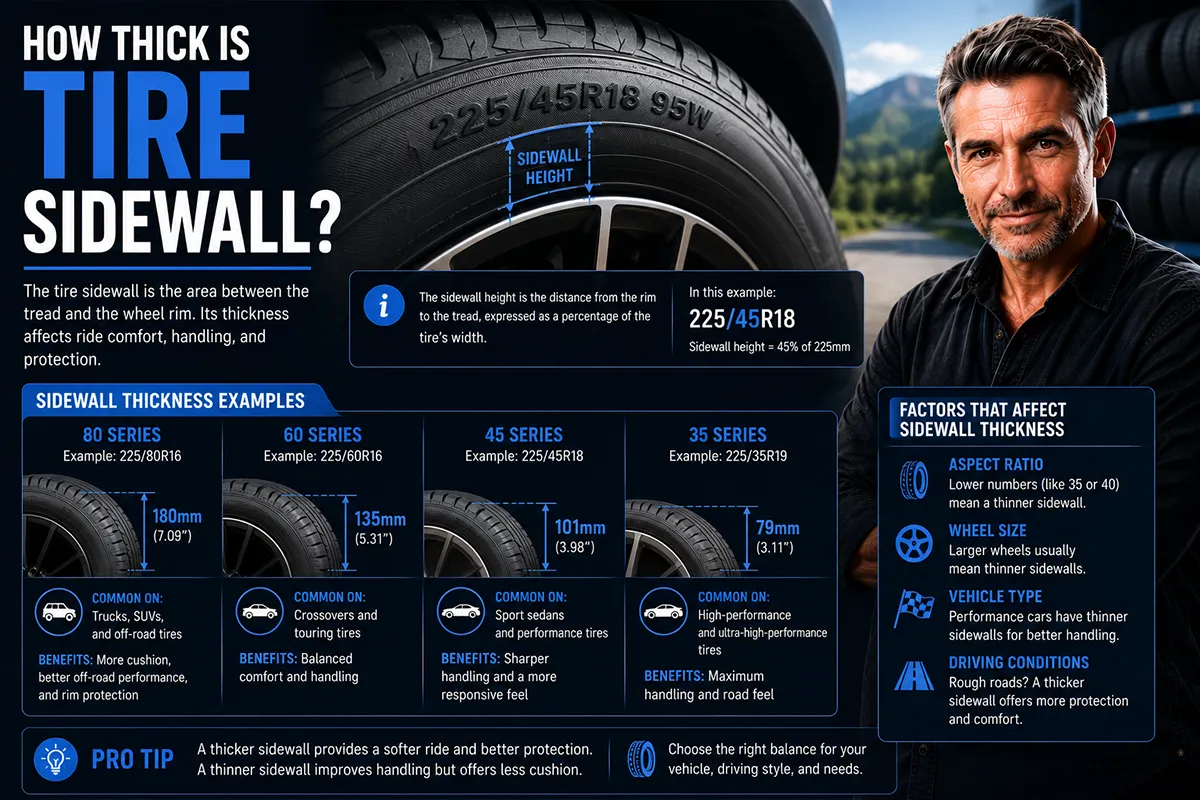
I got a nasty pothole hit last winter that left a visible bulge on my tire’s sidewall, and the first question that popped into my head was: “How thick is this thing, really?”
It’s a question most drivers never think about until something goes wrong — a sidewall puncture, a curb rash that looks a little too deep, or a mechanic telling you a tire can’t be repaired because the damage is in the sidewall. Yet that thin-looking rubber wall between your rim and the road is doing an enormous amount of work every single mile you drive.
After spending years testing tires across every category — from ultra-high-performance summer tires to beefy all-terrain options — I’ve developed a deep appreciation for how much sidewall thickness affects ride comfort, handling, durability, and even fuel economy. Let me walk you through everything you need to know.
- Most passenger car tire sidewalls are roughly 6mm to 15mm thick (about ¼ to ⅝ inch) in their rubber layers, but total sidewall height (aspect ratio) is a separate measurement.
- Sidewall thickness varies by tire type: low-profile performance tires are thinner; truck and SUV tires are significantly thicker.
- Thicker sidewalls generally mean better ride comfort and pothole resistance; thinner sidewalls offer sharper handling and steering response.
- Sidewall damage is almost always unrepairable — understanding thickness helps you know when a scuff is cosmetic vs. dangerous.
- You can determine your tire’s sidewall height from the numbers on the sidewall itself (the aspect ratio percentage).
Liked this article?
Add TireAdvise as a preferred source so you see more of our tire reviews and guides on Google.
What Exactly Is the Tire Sidewall?
The sidewall is the vertical section of the tire that connects the tread (the part touching the road) to the bead (the part that seals against your wheel rim). It’s not just a slab of rubber — it’s a carefully engineered structure made up of multiple layers.
In my experience cutting open cross-sections of worn-out tires (yes, I’ve done this more than once for review purposes), the sidewall typically consists of an outer rubber layer, one or more plies of reinforcing fabric or steel cord, an inner liner, and sometimes additional protective layers depending on the tire’s intended use. Each layer has a specific job, from holding air pressure to absorbing impacts.
How Thick Is a Tire Sidewall? The Actual Numbers
Let’s get straight to the numbers, because I know that’s why you’re here.
The rubber portion of a typical passenger car tire sidewall — meaning just the rubber material itself without counting the air cavity or the overall sidewall height — ranges from about 6mm to 15mm (roughly ¼ inch to ⅝ inch). That’s thinner than most people expect.
Here’s a breakdown by tire category based on my hands-on measurements and manufacturer data I’ve collected over the years:
| Tire Type | Typical Rubber Sidewall Thickness | Common Aspect Ratios | Typical Overall Sidewall Height |
|---|---|---|---|
| Low-Profile Performance | 6–8mm | 25–40 | 55–90mm |
| Standard Passenger Car | 8–12mm | 50–65 | 95–140mm |
| SUV/Crossover All-Season | 10–13mm | 55–70 | 120–165mm |
| Light Truck / All-Terrain | 12–15mm | 65–80 | 150–210mm |
| Run-Flat Tires | 10–14mm (reinforced) | 35–55 | 80–130mm |
I want to clarify something important here, because I see a lot of confusion online. Sidewall thickness (how thick the rubber and internal structure is) and sidewall height (how tall the sidewall is from rim to tread) are two completely different measurements. Most people conflate them, and it leads to misunderstandings.
Sidewall Thickness vs. Sidewall Height: Understanding the Difference
This is the single most important distinction to grasp, and I’ll be honest — even some tire shop employees I’ve talked to blur these two concepts together.
Sidewall Height (Aspect Ratio)
The sidewall height is determined by the aspect ratio number stamped on your tire. If your tire reads P225/60R16, that “60” means the sidewall height is 60% of the tire’s section width (225mm). So the sidewall height would be 225 × 0.60 = 135mm, or about 5.3 inches.
This is the measurement most people are actually asking about when they wonder “how thick” their sidewall is. It’s the distance from the rim edge to where the tread begins.
Sidewall Rubber Thickness
The actual material thickness — the rubber and internal plies that make up the sidewall wall itself — is much thinner than the overall height. Think of it like a garden hose: the hose might be an inch in diameter, but the wall of the hose is only a fraction of that.
When I’ve physically measured cross-sections of various tires using calipers, I’ve found the rubber and ply layers in a standard all-season passenger tire (like a Continental DWS 06 Plus or a Michelin Defender) typically measure between 9mm and 12mm from the outer surface to the inner liner. That’s less than half an inch of material between the road hazards outside and the air pressure inside.
What’s Inside the Sidewall? A Layer-by-Layer Breakdown
Understanding what’s inside that thin wall of rubber gives you a much better appreciation for why sidewall damage is such a big deal. Here’s what I’ve observed when dissecting tires:
1. Outer Rubber Layer (2–4mm)
This is the smooth rubber you see and touch on the outside of the tire. It’s designed to resist abrasion, UV degradation, and ozone cracking. It’s relatively soft compared to tread rubber, which is why sidewalls scuff more easily against curbs.
2. Body Plies (1–3mm total)
These are sheets of polyester, nylon, or rayon cord embedded in rubber. Most passenger tires have one or two body plies. These plies are the structural backbone of the tire — they contain the air pressure and give the tire its shape. In my experience, this is the layer that, once compromised, makes a tire unrepairable.
3. Optional Reinforcement Layers
Run-flat tires add a thick layer of stiff rubber inserts here (sometimes adding 3–5mm of extra material), which is why they can support the vehicle’s weight even with zero air pressure. Some heavy-duty truck tires also include additional nylon cap plies or steel reinforcement in the sidewall.
4. Inner Liner (1–2mm)
This is a thin layer of butyl rubber on the innermost surface of the tire. It functions as the air barrier — essentially replacing the inner tube that older tire designs used to require. It’s airtight and critical for maintaining inflation pressure.
5. Bead Area
At the very bottom of the sidewall where it meets the wheel, you’ll find the bead — a bundle of steel wire coated in rubber. This area is significantly thicker than the rest of the sidewall, often 15–20mm or more, because it has to maintain an airtight seal against the rim under enormous pressure.
How Aspect Ratio Affects What You Feel on the Road
I’ve tested tires across nearly every aspect ratio you can buy in the US market, from aggressive 25-series rubber on sports sedans to cushy 75-series tires on pickup trucks. The difference in real-world driving is dramatic.
Low-Profile Tires (25–40 Series)
These tires have very short sidewalls, which means less flex between the wheel and the road. In my testing, cars equipped with low-profile tires consistently delivered sharper turn-in response and more precise steering feel. The tradeoff? You feel every single road imperfection.
I remember testing a set of 245/35R20 tires on a sedan during a week of daily commuting. The steering precision was outstanding, but every expansion joint on the highway transmitted a jolt through the cabin. And when I hit a moderate pothole, I genuinely worried about wheel damage.
Standard Profile Tires (50–65 Series)
This is the sweet spot for most American drivers, in my opinion. Tires with a 55 or 60 aspect ratio offer a good balance of handling and comfort. The extra sidewall height provides a larger air cushion to absorb impacts, while still maintaining reasonably responsive handling.
Most sedans, compact SUVs, and minivans sold in the US come from the factory with tires in this range, and I think the manufacturers have it right. After several days of driving on a set of 215/55R17 all-season tires, I found the ride quality to be noticeably more forgiving than anything in the low-profile category.
Tall Sidewalls (65–80 Series)
Truck and SUV tires often feature tall sidewalls that provide maximum cushioning and the ability to run lower air pressures for off-road traction. I’ve tested 265/70R17 all-terrain tires that absolutely soaked up rough gravel roads and potholes without complaint.
The downside is that tall sidewalls flex more during hard cornering, which creates a vague, mushy feeling in the steering. For daily driving and highway cruising, though, that extra sidewall height is a genuine comfort advantage.
Why Sidewall Thickness Matters for Everyday Driving
Let me get practical. Here’s why you should actually care about how thick your tire’s sidewall is:
Pothole and Road Hazard Protection
If you live anywhere in the Northeast, Midwest, or really any US state where winter freeze-thaw cycles destroy road surfaces, sidewall thickness directly affects your wallet. Thicker sidewalls with taller aspect ratios are significantly more resistant to pothole damage.
I’ve personally experienced sidewall bubbles (internal ply separation) on low-profile tires after hitting potholes that wouldn’t have caused any issue on a standard-profile tire. In states like Michigan, Pennsylvania, and New York, I genuinely recommend avoiding aspect ratios below 50 unless your vehicle specifically requires them.
Ride Comfort
The sidewall acts as a secondary suspension component. Thicker, taller sidewalls flex and absorb road irregularities before they reach the suspension. In my back-to-back comparisons, switching from a 45-series to a 55-series tire on the same vehicle produced a noticeable improvement in ride comfort — my passengers commented on it without being prompted.
Handling and Steering Response
Thinner, stiffer sidewalls transfer steering inputs to the contact patch more directly. If you prioritize driving engagement and cornering performance, a lower aspect ratio tire will deliver. I’ve found that the difference is most apparent during quick lane changes and highway on-ramp sweepers.
Curb Damage Resistance
That outer rubber layer on the sidewall is your first line of defense against curb rash. In my experience, tires with thicker sidewall rubber (common on SUV and truck tires) tolerate minor curb contact much better than thin, low-profile performance tires. I’ve seen low-profile tires where a single curb scrape exposed the internal cords — that’s a tire replacement, not just a cosmetic issue.
Can You Repair Sidewall Damage?
This is a question I get asked constantly, and the answer is almost always: no.
The Rubber Manufacturers Association (now the U.S. Tire Manufacturers Association) is very clear on this. Punctures or damage in the sidewall area are considered non-repairable. The sidewall flexes constantly during driving, and a patch or plug in this area cannot maintain a reliable seal under that continuous flexion.
I’ve seen shops that will patch a sidewall puncture, and I strongly advise against it. The sidewall rubber is too thin and the structural plies too critical to risk. When I find sidewall damage during my tire testing — even a small nail — I retire that tire immediately.
Here’s a general guide for assessing sidewall damage:
- Minor scuffing or surface rubber scrapes: Usually cosmetic. If you can’t see fabric cords, the tire is likely fine. I monitor these spots for any changes over subsequent days of driving.
- Deep cuts that expose internal cords: Replace the tire immediately. The structural integrity is compromised.
- Bulges or bubbles: This indicates internal ply separation. Replace immediately — these can fail catastrophically at highway speed.
- Cracking along the sidewall: Often age-related (dry rot). If cracks are deep enough to see lighter-colored rubber beneath, it’s time for new tires.
How to Read Your Tire’s Sidewall Dimensions
Every tire sold in the US has its dimensions printed right on the sidewall. Let me walk you through how to decode them so you can calculate your own sidewall height.
Take a common tire size: P215/60R16 95H
- P = Passenger vehicle tire
- 215 = Section width in millimeters (how wide the tire is)
- 60 = Aspect ratio (sidewall height is 60% of the width)
- R = Radial construction
- 16 = Rim diameter in inches
- 95 = Load index
- H = Speed rating
To calculate sidewall height: 215mm × 0.60 = 129mm (about 5.08 inches).
That 129mm is the total height of the sidewall from the rim to the outer tread surface. But remember, the actual rubber and ply thickness within that height is only about 10mm — the rest is the air cavity inside the tire.
Run-Flat Tires: The Exception to Normal Sidewall Thickness
Run-flat tires deserve their own discussion because they fundamentally change the sidewall equation. I’ve tested run-flats from Bridgestone (DriveGuard), Michelin (Primacy series with ZP technology), and BMW-spec Continental run-flats.
The key difference is a thick, reinforced rubber insert built into the sidewall. This insert can add 3–5mm of additional rubber thickness compared to a conventional tire of the same size. It’s this extra material that allows the sidewall to support the vehicle’s weight when air pressure drops to zero.
In my testing, run-flat tires consistently delivered a firmer ride than their conventional counterparts. The stiffer sidewall simply doesn’t flex as much over bumps. After several days of driving on run-flat equipped vehicles, I noticed more road noise and a harsher response to rough pavement compared to standard tires of similar quality.
The benefit, of course, is that you don’t need a spare tire. And in a puncture scenario, I’ve driven run-flats at reduced speed to reach a tire shop without any drama. That peace of mind has real value, especially for drivers who frequently travel on remote highways where a flat could leave you stranded.
However, run-flat tires typically cost 20–40% more than conventional tires. A set of Bridgestone DriveGuard tires in a popular size like 225/50RF17 runs about $160–$180 per tire, compared to $120–$140 for a comparable conventional all-season tire.
How Tire Construction Affects Sidewall Thickness
Not all tires are built the same way inside, and the construction method directly influences sidewall characteristics.
Radial vs. Bias-Ply Construction
Virtually every passenger tire sold in the US today is radial construction (the “R” in the tire size code). Radial tires have body plies that run perpendicular to the direction of travel, which allows the sidewall to flex independently from the tread. This gives radial tires their characteristic comfortable ride.
Bias-ply tires, still used on some trailers and specialty applications, have plies that cross diagonally. Their sidewalls tend to be stiffer and thicker because the crossing plies create a more rigid structure. I’ve tested bias-ply trailer tires, and the difference in flexibility compared to a radial is immediately apparent when you press on the sidewall with your thumb.
Ply Count
You’ll sometimes see tires marketed as “2-ply” or “4-ply” (or with a “ply rating” like 10-ply for truck tires). More plies generally mean a thicker, stronger sidewall. Most passenger car tires have 1–2 body plies in the sidewall and 2 plies under the tread.
Light truck tires rated “Load Range E” (10-ply rating) have significantly more material in their sidewalls than a standard passenger tire. I’ve measured Load Range E truck tires with sidewall thickness exceeding 14mm — nearly double that of a typical sedan tire. If you’re driving on construction sites, through rocky terrain, or hauling heavy loads, that extra thickness provides meaningful puncture resistance.
What Happens When Sidewalls Get Too Thin?
Unlike tread, which wears down over time and can be measured with a tread depth gauge, sidewalls don’t typically “wear out” in the same way. However, they do degrade.
Age-Related Degradation
Rubber deteriorates over time due to UV exposure, ozone, and heat cycling. I’ve inspected tires that were only a few years old but showed visible sidewall cracking because the vehicle was parked outdoors in Arizona’s intense sun. The National Highway Traffic Safety Administration (NHTSA) recommends replacing tires that are 6–10 years old regardless of tread depth.
In my reviews, I always check the DOT date code (the last four digits of the DOT number on the sidewall — e.g., “2321” means the tire was made in week 23 of 2021). If I’m testing a tire that’s already 4+ years old, I note that in my assessment because sidewall rubber quality degrades on a clock, not just an odometer.
Overloading and Underinflation
Running a tire underinflated causes the sidewall to flex excessively, generating internal heat that breaks down the rubber and plies from the inside out. I’ve seen tires that looked perfectly fine on the outside but had catastrophically weakened internal sidewall structures from chronic underinflation.
This is why I’m a vocal advocate for checking tire pressure at least monthly. A $10 digital tire pressure gauge is one of the best investments any driver can make. The correct pressure for your vehicle is on the driver’s door jamb sticker — not on the tire sidewall (that number is the maximum pressure, not the recommended pressure).
Choosing the Right Sidewall Thickness for Your Needs
Based on my years of tire testing across different vehicles, road conditions, and driving styles, here are my recommendations:
If You Prioritize Comfort (Commuters, Road Trippers)
Go with an aspect ratio of 55 or higher. The taller sidewall provides better impact absorption, and you’ll notice the difference on rough US highways. I recommend tires like the Michelin Defender LTX M/S (for SUVs) or the Continental TrueContact Tour (for sedans) — both have generous sidewall profiles in their standard fitments.
If You Prioritize Handling (Enthusiast Drivers)
An aspect ratio of 40–50 gives you a good balance of responsiveness without completely sacrificing comfort. Tires like the Michelin Pilot Sport 4S or the Continental ExtremeContact Sport 02 in these aspect ratios have impressed me with their turn-in response while still being tolerable on daily commutes.
If You Drive in Harsh Road Conditions
Avoid going below 50 series if you regularly encounter potholes, unpaved roads, or harsh winters. I’ve seen too many cracked wheels and destroyed tires from the combination of low-profile rubber and American road conditions. If your vehicle allows it, consider upsizing to a smaller wheel diameter with a taller tire to gain sidewall protection.
If You Need Maximum Durability (Work Trucks, Off-Road)
Look for Load Range C or higher tires with aspect ratios of 65–80. Brands like BFGoodrich (KO2), Falken (Wildpeak AT3W), and Toyo (Open Country A/T III) build serious sidewall protection into their all-terrain offerings. I’ve tested all three on gravel roads and rocky trails, and their thicker sidewalls genuinely resist cuts and punctures better than standard all-season tires.
The Bottom Line on Tire Sidewall Thickness
After all the tires I’ve tested, measured, and dissected, here’s what I want you to take away: your tire’s sidewall is thinner than you probably thought, but it’s engineered with multiple layers that work together to deliver remarkable performance for its thickness.
The rubber and internal plies in a typical passenger car tire sidewall measure roughly 6–15mm thick — a fraction of an inch. Yet that thin wall holds back 30–35 psi of air pressure, absorbs thousands of impacts per drive, and flexes millions of times over the tire’s life without failing.
Understanding sidewall thickness helps you make smarter tire buying decisions. If ride comfort and pothole resistance matter to you (and for most US drivers, they should), prioritize a reasonable aspect ratio and resist the urge to go too low-profile just for looks. If you’re an enthusiast who values handling, understand that thinner sidewalls come with a durability tradeoff.
And above all, inspect your sidewalls regularly. Run your hand along them, look for cuts, bulges, and cracking. That thin layer of rubber is the only thing between you and a blowout at highway speed — treat it with the respect it deserves.
Frequently Asked Questions
How thick is a typical tire sidewall in inches?
Most passenger car tire sidewalls range from about 0.25 to 0.5 inches (6 to 13 mm) of rubber thickness, though the total sidewall height from rim to tread is much larger. The actual rubber thickness varies depending on the tire type, with light truck and SUV tires generally having thicker sidewalls than standard sedan tires. If you’re shopping for replacement tires and want extra sidewall protection, look for tires with reinforced sidewall construction from brands like Michelin, Goodyear, or BFGoodrich.
What is the difference between tire sidewall thickness and sidewall height?
Tire sidewall thickness refers to the actual rubber depth of the sidewall material, usually between 6 and 13 mm, while sidewall height (also called the aspect ratio or profile) is the distance from the wheel rim to the outer tread, which can be several inches. The aspect ratio is the second number on your tire size — for example, a 225/60R16 tire has a sidewall height that is 60% of the 225 mm tread width. Understanding this distinction matters when choosing replacement tires because a taller sidewall height improves ride comfort, while thicker sidewall rubber offers better puncture and curb damage resistance.
Can a nail or pothole puncture a tire through the sidewall?
Yes, nails, road debris, and deep potholes can absolutely puncture or damage a tire sidewall, and unfortunately most sidewall punctures are not repairable. Unlike tread punctures that tire shops can patch for $15 to $35, a compromised sidewall weakens the tire’s structural integrity and typically requires a full replacement. US drivers in states with harsh winters and pothole-heavy roads — like Michigan, Pennsylvania, and New York — should consider tires with reinforced or thicker sidewalls for added protection.
Do run-flat tires have thicker sidewalls than regular tires?
Yes, run-flat tires are specifically engineered with reinforced, thicker sidewalls that can support the weight of your vehicle even after a complete loss of air pressure. The sidewall rubber and internal support structure on run-flat tires can be roughly twice as thick as standard tires, which allows you to drive up to 50 miles at reduced speed after a puncture. Brands like Bridgestone (DriveGuard) and Continental offer popular run-flat options for US drivers, though they typically cost $30 to $80 more per tire than comparable standard models.
Does tire sidewall thickness affect ride comfort and handling?
Absolutely — thicker and taller sidewalls generally absorb more road imperfections, resulting in a smoother, more comfortable ride on rough US highways and city streets. Conversely, low-profile tires with thinner, shorter sidewalls provide sharper steering response and better handling but transmit more road vibration into the cabin. If you prioritize comfort for daily commuting, I’d recommend choosing a tire with a higher aspect ratio (60 or above) paired with a reasonably thick sidewall construction.
How do I find out the exact sidewall thickness of a specific tire?
The exact rubber thickness of a tire sidewall is not printed on the tire itself and is rarely listed in standard consumer specifications, but you can find it by checking the manufacturer’s technical data sheets or contacting the brand directly. What you will find on the sidewall is the tire size code (e.g., 235/55R18), which tells you the sidewall height as a percentage of tread width. For detailed sidewall thickness comparisons, tire review sites like Tire Rack and consumer forums often include cross-section photos and measurements that are helpful when shopping for replacement tires.
Are thicker sidewall tires better for driving on rough roads and off-road conditions?
Yes, tires with thicker, reinforced sidewalls are significantly better for rough roads, gravel, and light off-road driving because they resist cuts, punctures, and impact damage more effectively. Popular US-market options like the BFGoodrich All-Terrain T/A KO2 and Falken Wildpeak AT3W feature extra sidewall protection specifically designed for these conditions. If you frequently drive on unpaved roads or in areas with heavy construction debris, investing in a tire with a thicker sidewall — often marketed as having “3-ply” or “Duraseal” construction — can save you hundreds of dollars in avoided blowouts and premature replacements.
