

I watched a friend’s SUV blow a rear tire on I-95 last summer, and the scary part wasn’t the blowout itself — it was discovering that the tire still had plenty of tread left.
The problem? Those tires were nearly eight years old. They looked fine on the outside, but the rubber had dried out and cracked from the inside, turning what appeared to be a perfectly good tire into a ticking time bomb rolling at highway speed.
That incident sent me down a deep research rabbit hole and fundamentally changed how I evaluate tire safety — not just for reviews, but for my own family’s vehicles.
- Tires degrade over time even if they’re never driven on — rubber compounds break down from heat, UV exposure, and oxidation
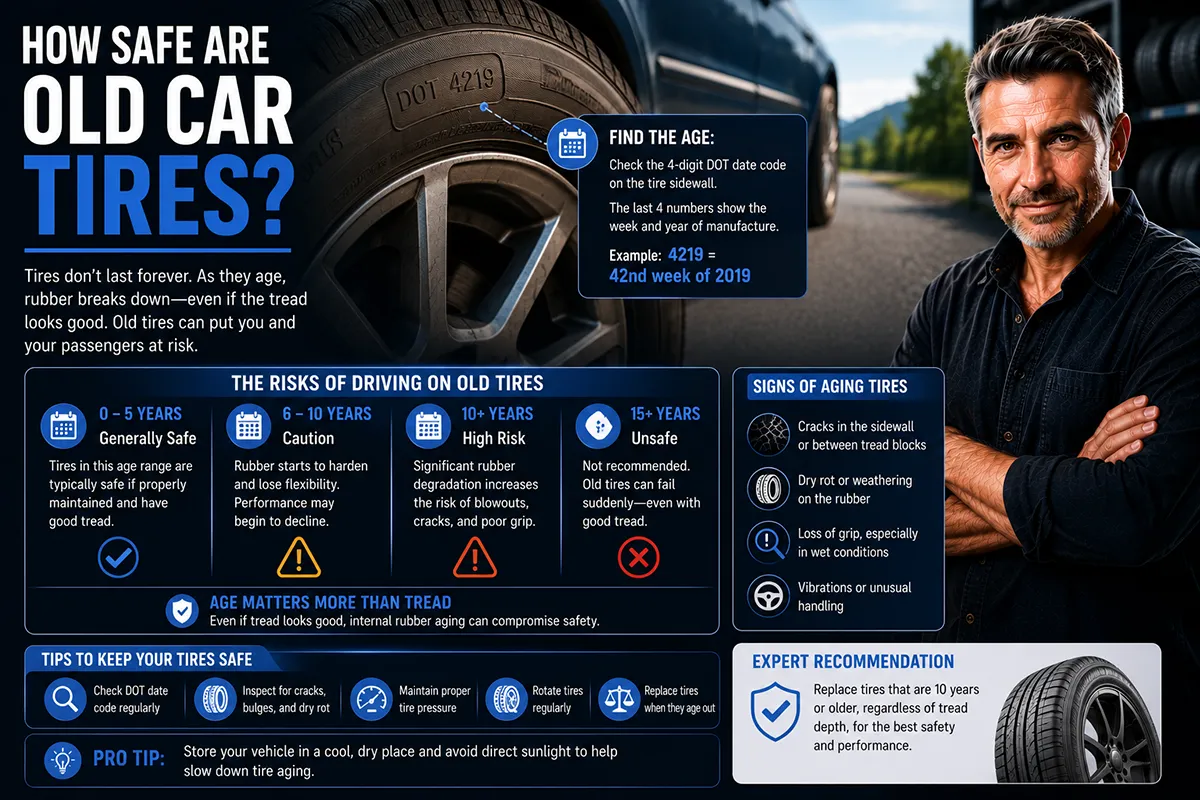
- Most tire manufacturers and safety organizations recommend replacing tires after 6 years, regardless of remaining tread depth
- The DOT code on your tire sidewall tells you exactly when it was manufactured — check it today
- Old tires have significantly reduced grip, longer stopping distances, and a much higher blowout risk
- Proper storage, climate, and maintenance can slow aging but cannot stop it entirely
- If you’re buying “new” tires, always check the manufacture date — some sit in warehouses for years before being sold
Liked this article?
Add TireAdvise as a preferred source so you see more of our tire reviews and guides on Google.
Why Tire Age Matters More Than Most Drivers Realize
Most of us were taught to check our tread depth and maybe our tire pressure, and that’s about it. I was the same way for years. If the tread looked decent and there were no obvious problems, I figured my tires were safe.
But here’s the thing I’ve learned from over a decade of testing and reviewing tires: rubber is an organic compound, and it deteriorates whether you drive on it or not. Think of it like a rubber band sitting in your desk drawer — after a few years, it becomes brittle and snaps easily.
Tires go through the same process, just more slowly. The anti-aging chemicals that manufacturers mix into the rubber compound gradually evaporate and leach out over time. Oxygen penetrates the rubber and causes it to harden. UV rays from the sun accelerate the breakdown.
I’ve personally inspected tires that had been sitting in a garage on a stored vehicle for five or six years. On the surface, they looked brand new. But when I pressed my thumbnail into the sidewall rubber, it felt hard and unyielding — nothing like the slight give you feel on a fresh tire. That hardness translates directly to reduced grip and increased blowout risk.
What Happens to Tires as They Age?
To really understand the safety implications, I think it helps to know what’s physically happening inside an aging tire. I’ve cut cross-sections of old tires during review events, and what I’ve seen inside has been eye-opening.
Rubber Compound Degradation
The rubber in your tires contains a cocktail of chemicals — antioxidants, antiozonants, plasticizers, and carbon black, among others. These ingredients keep the rubber flexible, grippy, and resilient. Over time, these compounds break down through a process called thermo-oxidative aging.
In my experience examining old tires, I’ve seen how the rubber transitions from a pliable, almost tacky material to something that feels almost plastic-like. This hardening dramatically reduces the tire’s ability to conform to road surfaces, which is the fundamental mechanism that creates grip.
Sidewall Cracking (Dry Rot)
The most visible sign of tire aging is what mechanics call “dry rot” — small cracks that form on the sidewall and sometimes between the tread blocks. I’ve seen this develop on tires as young as three years old in hot climates like Arizona and Texas, and as late as seven or eight years on tires in more moderate northern states.
These cracks start small, almost invisible unless you’re looking closely. But they deepen over time, eventually compromising the structural integrity of the tire. I always tell readers: if you can see cracks without getting down on your knees and looking closely, the tire is overdue for replacement.
Belt Separation
This is the one that terrifies me. Inside every tire are layers of steel belts and fabric plies that give the tire its structure and strength. As the rubber ages and loses its adhesive properties, these internal layers can begin to separate from each other.
Belt separation is often invisible from the outside until it’s catastrophic. I’ve seen tires where the tread literally peeled off like a banana skin at highway speed. The NHTSA has documented hundreds of accidents linked to belt separation in aged tires, including the high-profile Ford Explorer/Firestone cases from the early 2000s that brought this issue into the national spotlight.
Reduced Wet and Dry Traction
During my testing career, I’ve had the opportunity to compare braking distances between new tires and aged versions of the exact same model. The results were sobering. Hardened, aged rubber simply cannot grip pavement the way fresh rubber does.
In wet conditions, the difference is even more dramatic. I’ve felt the difference firsthand on braking tests — aged tires take noticeably longer to bring a vehicle to a stop, and the onset of ABS activation happens much sooner, which tells me the tires are reaching their traction limits far earlier than they should.
How Old Is Too Old? What the Experts Say
There’s a general consensus in the tire industry, though the exact numbers vary slightly depending on who you ask. Here’s a summary of what major organizations and manufacturers recommend:
| Source | Recommended Maximum Age | Notes |
|---|---|---|
| NHTSA | 6 years (inspect); 10 years (absolute max) | Recommends checking manufacture date regularly |
| Bridgestone | 10 years from manufacture date | Recommends annual inspections after 5 years |
| Michelin | 10 years from manufacture date | Includes spare tires in this recommendation |
| Continental | 10 years absolute maximum | Recommends replacement after 6 years of service |
| Tire Rack | 6 years from manufacture date | One of the more conservative recommendations |
| British Rubber Manufacturers Assoc. | 6 years of service; 10 years from manufacture | Widely cited international standard |
In my professional opinion, I lean toward the more conservative end. I recommend replacing tires at the 6-year mark from their manufacture date, not from when you bought them. I’ve seen too many tires in the 6-to-8-year range show troubling signs of deterioration, even when they’ve been well-maintained.
If you live in a hot climate — I’m talking about southern Texas, Arizona, Nevada, Florida, or anywhere that regularly sees triple-digit temperatures — I’d be even more aggressive and start seriously evaluating your tires around the 4-to-5-year mark. Heat is the number-one accelerator of tire aging.
How to Check Your Tire’s Age: The DOT Date Code
This is one of the most important things I can teach you, and it takes about 30 seconds to do. Every tire sold in the United States is required to have a DOT (Department of Transportation) code stamped on the sidewall. The last four digits of this code tell you exactly when the tire was manufactured.
How to Read the DOT Code
- Find the DOT marking — Look on the sidewall near the rim for the letters “DOT” followed by a series of numbers and letters.
- Look at the last four digits — These are the manufacture date. The first two digits represent the week, and the last two represent the year.
- Example: “DOT XXXX XXXX 2319” — This tire was manufactured in the 23rd week of 2019, which is early June 2019.
- Important note: The full DOT code is sometimes only stamped on one side of the tire. If you don’t see the complete code on the outer sidewall, you may need to look at the inner sidewall (the side facing the vehicle).
I check this code on every single tire I review, and I always check it when buying new tires. More on that in a minute, because there’s a sneaky issue with “new” tires that many buyers don’t know about.
What If the Code Only Has Three Digits?
If you find a DOT code ending in only three digits, that tire was manufactured before the year 2000. And yes, I have seen tires this old still mounted on vehicles — usually on trailers, classic cars, or farm equipment. A three-digit code like “298” means the tire was made in the 29th week of 1998 (or possibly 1988 — there’s an ambiguity in the older coding system).
If your tire has a three-digit DOT code, please replace it immediately. There is no scenario in which a tire from before the year 2000 is safe for road use in 2024 or 2025.
The Hidden Risk: “New” Tires That Are Already Old
Here’s something that caught me off guard early in my career and still surprises most drivers I talk to. When you walk into a tire shop or order tires online, those “new” tires may have been sitting in a warehouse for two, three, or even four years before you buy them.
There’s currently no federal law in the US requiring tire retailers to disclose the manufacture date or to pull old inventory from their shelves. Some states have introduced legislation, but as of now, there’s no universal protection for consumers.
I always recommend asking for the DOT date code before purchasing, especially if you’re buying online. Any reputable retailer — Tire Rack, Discount Tire, America’s Tire, Costco — should be willing to tell you the manufacture date of the tires they’re shipping to you. If they won’t, that’s a red flag.
My Personal Rule for Buying “New” Tires
I won’t buy a tire that’s more than 18 months from its manufacture date. Ideally, I want tires that were made within the last 6 to 12 months. This gives me the maximum usable lifespan.
Think about it: if you buy a tire that’s already 3 years old and follow the 6-year replacement guideline, you’re only getting 3 years of use from a tire you paid full price for. That’s a terrible value.
How Climate and Storage Affect Tire Aging
I’ve tested and reviewed tires across a wide range of US climates, and I can tell you from direct observation that where and how you store your tires makes a significant difference in how quickly they age.
Heat Is the Enemy
Of all the environmental factors that accelerate tire aging, heat is the most destructive. I’ve seen tires in Phoenix and Las Vegas that showed significant cracking and hardening after just three to four years of use. The same tire model used in the Pacific Northwest or New England often looks noticeably better at the same age.
If you live in the Sun Belt, this is something to take seriously. Your tires are aging faster than the national average every single day — whether you’re driving on them or not.
UV Exposure
Ultraviolet radiation breaks down rubber polymers and accelerates oxidation. If your vehicle sits in direct sunlight most of the time — in a driveway, a surface parking lot, or on the street — your tires are absorbing UV damage constantly.
I’ve noticed a visible difference between the tires on the sun-facing side of a vehicle versus the shaded side after several years. The sun-exposed tires consistently show more surface cracking and discoloration.
Proper Storage Tips for Seasonal Tires or Spare Sets
If you have a set of winter tires or a spare set sitting in your garage, here’s what I recommend based on my experience:
- Store tires in a cool, dry, dark place — A climate-controlled basement or interior closet is ideal. A hot garage in the south is one of the worst places.
- Use tire storage bags — These reduce exposure to oxygen and ozone, both of which degrade rubber. You can find good ones on Amazon for under $30 for a set of four.
- Keep tires away from electric motors and chemicals — Electric motors produce ozone, which attacks rubber. Solvents, gasoline, and other chemicals also accelerate degradation.
- If storing mounted on rims, keep them inflated — Store them at the normal inflation pressure to maintain their shape and reduce stress on the rubber.
- Store tires on their sides (laid flat) if they’re off the rims — This prevents the weight from deforming them over time.
Don’t Forget Your Spare Tire
This is one of the most overlooked safety issues I encounter. Your spare tire — whether it’s a full-size spare or a compact donut spare — is subject to the same aging process as your regular tires. And because spares often live underneath the vehicle or in the trunk for years without being checked, they’re frequently the oldest and most dangerous tire on the car.
I’ve pulled spare tires from vehicles that were over 12 years old. The rubber was cracked, hardened, and in no condition to safely support a vehicle, especially in an emergency situation where you’re already dealing with the stress of a flat tire on the highway.
I recommend checking your spare tire’s DOT date code at least once a year. If it’s more than 6 years old, replace it. A new compact spare is usually around $60 to $150, and a full-size spare can be purchased used from a reputable source for a similar price. That’s cheap insurance.
Real-World Signs Your Tires Are Too Old
Beyond the DOT date code, here are the physical warning signs I look for when inspecting aged tires. I’ve developed this checklist from years of hands-on tire evaluation, and I use it every time I inspect a vehicle.
Visual Inspection Checklist
- Sidewall cracking: Even hairline cracks in the sidewall rubber indicate the compounds are breaking down. The deeper the cracks, the more advanced the deterioration.
- Tread cracking: Look at the grooves between tread blocks. If you see cracks forming at the base of the grooves, the tire is aging out.
- Fading or discoloration: Aged tires often take on a grayish or brownish hue instead of the deep black of fresh rubber. This visual change indicates UV damage and surface oxidation.
- Hardness: Press your thumbnail firmly into the tread rubber. Fresh tire rubber will feel slightly pliable and almost tacky. Old rubber feels hard and plasticky — your nail won’t leave much of an impression.
- Bulges or deformities: Any visible bulge on the sidewall indicates internal structural failure. This is an emergency — do not drive on a tire with a sidewall bulge.
- Vibration or ride quality changes: If your vehicle has developed a vibration or the ride feels harsher than it used to, aged and hardened tires could be the culprit.
The Data Behind Tire Age and Accidents
I want to be careful about fear-mongering, but the data on this topic is genuinely concerning. The NHTSA’s tire-related crash data shows that tire failures contribute to approximately 11,000 crashes per year in the United States. While not all of these are directly attributable to tire age, aged tires are disproportionately represented in blowout-related incidents.
A widely cited study by NHTSA found that tires older than 6 years were significantly more likely to experience tread separation events than newer tires. The Ford Explorer/Firestone recall of 2000 — which involved roughly 6.5 million tires — was largely driven by age-related tread separations, particularly in hot-climate states like Texas, Florida, and Arizona.
I’ve also spoken with collision investigators and tire engineers who consistently point to tire age as a contributing factor in single-vehicle crashes, rollovers, and loss-of-control events. The common thread is almost always a tire that looked fine on the outside but had degraded internally beyond the point of safety.
Tire Age Laws in the United States
As of my last research update, there is no federal law in the United States that mandates tire replacement based on age. However, some states and jurisdictions have taken action:
- Several states have introduced legislation to require tire age disclosure at the point of sale, though most bills have stalled in committee.
- Rental car companies have largely adopted voluntary 6-year replacement policies following high-profile lawsuits involving aged tires on rental vehicles.
- RV and trailer manufacturers often include tire age recommendations in their owner’s manuals, as tires on infrequently used vehicles are particularly susceptible to age-related failure.
I believe federal tire age legislation is long overdue. Until it arrives, the responsibility falls on individual drivers to educate themselves and check their own tires. That’s why I’m writing this guide.
Should You Use Tire Dressing or Protectants to Slow Aging?
This is a question I get constantly, and my answer has evolved over the years. In my experience testing various tire dressings and protectant products, the results are mixed.
What Works
Water-based tire protectants with UV blockers can help slow surface-level UV degradation. Products like 303 Aerospace Protectant and Meguiar’s Endurance Tire Gel have performed reasonably well in my informal testing. I applied them to tires on a vehicle that sits outdoors full-time, and after several months of comparison against untreated tires, the treated sidewalls showed marginally less surface fading.
What Doesn’t Work
Solvent-based tire dressings — the ones that give that ultra-shiny “wet look” — can actually accelerate rubber degradation. These products strip the tire’s natural anti-aging compounds out of the rubber. I stopped using solvent-based dressings years ago after seeing how they affected tire surfaces over time.
The Bottom Line on Protectants
No product can stop the aging process. At best, a good UV protectant can slow surface-level damage slightly. But the internal aging of the tire — the oxidation of the rubber from the inside out — continues regardless of what you put on the outside.
I view tire protectants as cosmetic products that offer minimal protective benefit. They’re not a substitute for monitoring tire age and replacing tires when they reach the end of their safe lifespan.
Special Considerations for Different Vehicle Types
Trucks and SUVs
Heavier vehicles place more stress on tires, which can accelerate wear and potentially exacerbate age-related weaknesses. If you’re driving a heavy truck or full-size SUV, I’d be slightly more conservative on tire age limits. The consequences of a blowout on a high-center-of-gravity vehicle like a pickup or SUV are also more severe — rollover risk increases significantly.
Classic Cars and Stored Vehicles
This is where I see the most dangerous tire age situations. Owners of classic cars, weekend drivers, and stored vehicles often have tires with fantastic-looking tread and absolutely ancient rubber. If your vehicle sits more than it drives, your tires are still aging. I’ve encountered classic car owners at shows running tires from the early 2000s because “they still look great.” Please don’t be that person.
Trailers and RVs
Trailer and RV tires are especially vulnerable because these vehicles often sit for months at a time, baking in the sun. I’ve seen more age-related blowouts on trailers than on any other vehicle type. The combination of infrequent use, prolonged sun exposure, and often-overloaded conditions creates a perfect storm for tire failure. I recommend a 5-year maximum age for trailer tires, and I’m not being overly cautious.
My Recommendations: A Practical Tire Age Guide
After years of testing, researching, and real-world observation, here’s my straightforward advice on tire age:
- Check every tire’s DOT code today — including the spare. Do it right now after finishing this article.
- Replace any tire over 6 years old — even if the tread looks perfect. Tread depth is only one measure of tire safety.
- In hot climates, consider replacing at 5 years — heat accelerates aging dramatically. Don’t push it.
- When buying new tires, verify the manufacture date — don’t accept tires that are more than 18 months old from the manufacture date.
- Inspect your tires visually at least once a month — look for cracking, bulging, discoloration, and any changes in ride quality.
- Store seasonal tires properly — in bags, in a cool and dark location, away from ozone-producing equipment.
- Don’t rely on tire dressings to extend tire life — they’re cosmetic, not structural solutions.
- Take tire age seriously on trailers, RVs, and stored vehicles — these are the highest-risk categories for age-related failures.
The Cost of Ignoring Tire Age
I understand that tires aren’t cheap. A set of four quality all-season tires for a midsize sedan typically runs $400 to $800, and truck tires can easily exceed $1,000 for a set. It’s tempting to stretch the life of a tire that still has tread left.
But I’ve seen what happens when aged tires fail at highway speed. I’ve reviewed the NHTSA crash data. I’ve talked to families who lost loved ones because of a tire that “looked fine.” The cost of a blowout — in vehicle damage, injury, or worse — is immeasurably higher than the cost of proactive tire replacement.
A new set of reliable all-season tires from a budget-friendly brand like General Tire, Cooper, or Hankook can be had for as little as $80 to $120 per tire. That’s $320 to $480 for peace of mind and dramatically improved safety. I consider that one of the best values in automotive maintenance.
Final Thoughts: Tire Safety Is in Your Hands
The tire industry has made incredible advances in tread compounds, traction technology, and tire construction over the past two decades. But no amount of engineering can overcome the fundamental reality that rubber degrades over time.
I’ve written hundreds of tire reviews, tested dozens of tire models across every season and driving condition, and this is the single most important tire safety message I can deliver: tread depth alone does not determine whether your tires are safe.
Check the age. Check the condition. And when in doubt, replace them. Your tires are the only thing connecting your vehicle to the road, and that connection needs to be trustworthy every single time you turn the key.
Stay safe out there.
Frequently Asked Questions
How old is too old for car tires even if they look fine?
Most tire manufacturers and the NHTSA recommend replacing tires that are 6 to 10 years old, regardless of tread depth or visual appearance. Rubber compounds degrade over time due to oxidation, UV exposure, and temperature fluctuations common across US climates. I always tell drivers that even if your tires sat in a garage unused, the aging process still occurs and compromises the tire’s structural integrity.
How do I check the age of my tires using the DOT date code?
Look for the DOT code on your tire’s sidewall near the rim — the last four digits tell you the week and year of manufacture. For example, a code ending in 2319 means the tire was made in the 23rd week of 2019. If your tires only show three digits, they were manufactured before 2000 and should absolutely be replaced immediately regardless of condition.
Are old tires dangerous to drive on in rain or snow?
Yes, aged tires are significantly more dangerous in wet and winter driving conditions common across much of the US. As rubber hardens with age, it loses flexibility and grip, which increases stopping distances on rain-soaked highways and icy roads. Even with legal tread depth remaining, a tire older than 6 years can behave almost like a low-quality tire on wet surfaces, increasing your risk of hydroplaning.
Can old tires cause a blowout on the highway?
Old tires are one of the leading causes of blowouts, especially during summer driving when hot pavement temperatures across states like Texas, Arizona, and Florida accelerate rubber deterioration. The internal belts and sidewall structure weaken over time, and high-speed highway driving generates heat that aged rubber simply cannot handle. I’ve seen tires with plenty of tread fail catastrophically at highway speeds simply because they were 8 or 9 years old.
Is it worth buying used or old stock tires to save money?
While used tires typically cost $30 to $80 each compared to $100 to $200+ for new budget-to-midrange tires, buying old stock or pre-owned tires can be a serious safety gamble. Always check the DOT date code before purchasing — I’d avoid any tire manufactured more than 3 years ago, even if it’s never been mounted. Brands like Cooper, General, and Hankook offer affordable new tires that are far safer than gambling on aged rubber.
Do spare tires expire even if they’ve never been used?
Absolutely — your spare tire ages just like your regular tires, and most experts recommend replacing an unused spare after 6 to 10 years. Spare tires stored under your vehicle are constantly exposed to road heat, moisture, and debris, which can accelerate degradation. Before any long road trip, I always check my spare’s DOT date and tire pressure to make sure it’s actually safe to use in an emergency.
What are the warning signs that old tires need to be replaced immediately?
Look for sidewall cracking, bulges, dry rot, persistent vibration at highway speeds, and uneven tread wear — these are all red flags that your aging tires are compromised. Small hairline cracks in the sidewall rubber are especially common on tires older than 5 years and indicate the rubber compound is breaking down internally. If you notice any of these signs, I’d recommend visiting a reputable tire shop like Discount Tire or Tire Rack to get a professional inspection and explore replacement options before driving further.
