

Ever driven a brand-new car off the lot and thought it was whisper-quiet — only to notice a low hum creeping in after swapping to a different set of tires? That’s not your imagination, and it’s not your car falling apart.
The truth is, your tires are often the single largest contributor to interior cabin noise at highway speeds. I’ve tested dozens of tire sets over the years, and the difference between a loud tire and a quiet one is genuinely shocking — sometimes it feels like an entirely different vehicle.
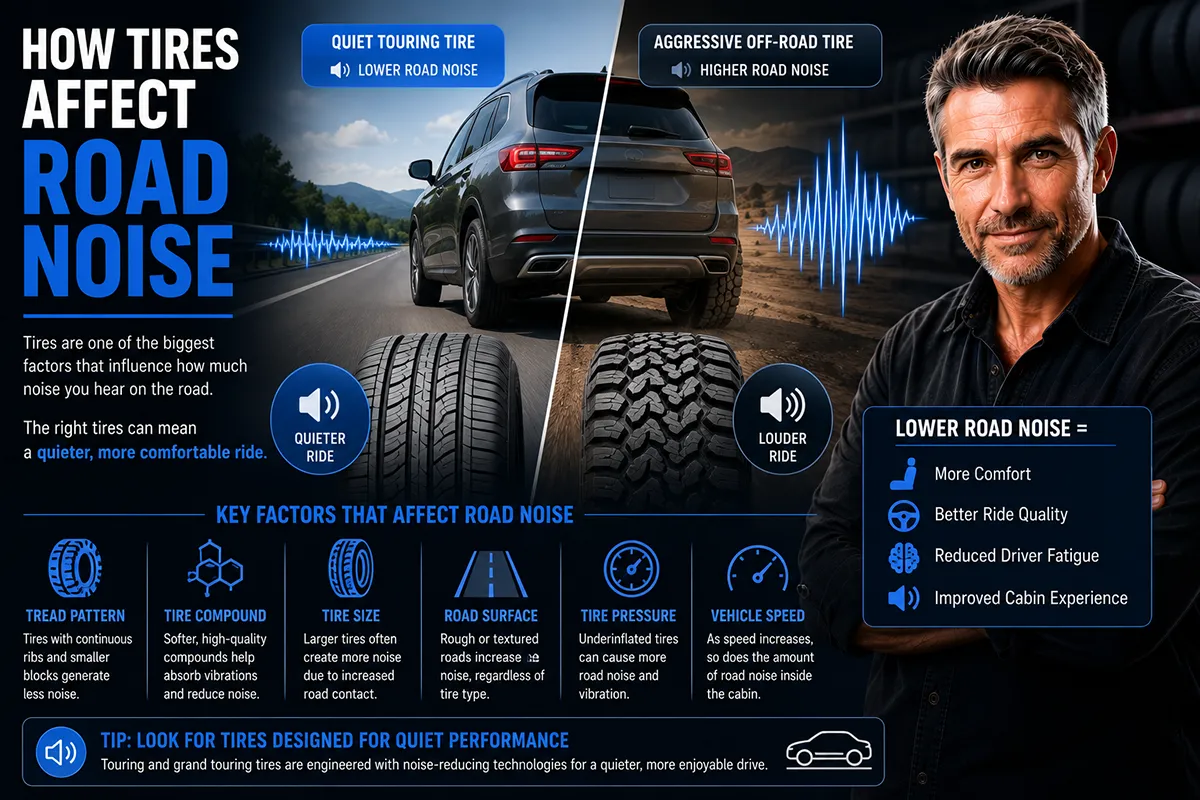
- Tires are the #1 source of road noise at speeds above 40 mph — more than wind or engine noise in most modern cars.
- Tread pattern, rubber compound, tire width, and internal construction all play major roles in how much noise reaches your ears.
- Touring and grand touring tires are specifically engineered to minimize cabin noise.
- Aggressive all-terrain and mud-terrain tires are the loudest categories by a significant margin.
- Simple choices — like picking the right tire category, maintaining proper inflation, and rotating on schedule — can dramatically reduce road noise.
- Foam-lined tires (like those from Continental and Pirelli) offer measurable noise reduction for noise-sensitive drivers.
Liked this article?
Add TireAdvise as a preferred source so you see more of our tire reviews and guides on Google.
Why Tires Are the Biggest Source of Road Noise
Most people assume engine noise or wind is what they’re hearing inside the cabin. And at low speeds or in older vehicles, that might be true. But in any modern car built after 2010 or so, manufacturers have done an excellent job isolating engine vibrations and sealing wind leaks.
That leaves your tires as the dominant noise source once you hit highway speeds. I’ve confirmed this repeatedly — swap a set of quiet touring tires for a set of aggressive all-terrains on the same car, and the difference is immediately obvious from the first on-ramp.
There are actually several distinct types of noise your tires generate. Understanding them helps you make smarter buying decisions.
Tread Pattern Noise (Air Pumping)
This is the big one. As your tire rolls, the tread blocks compress against the road and then spring back. Each time a tread block lifts off the pavement, it releases a tiny pocket of trapped air. Multiply that by thousands of tread blocks hitting the road every second, and you get a constant drone.
I like to think of it as a tiny air pump running under each corner of your car. The larger and more aggressive the tread blocks, the louder that pumping action becomes. This is exactly why mud-terrain tires with huge, chunky lugs are so noisy — they’re displacing enormous volumes of air with every revolution.
Road Surface Interaction
The texture of the road itself plays a huge role. I’ve noticed that the same tire can sound noticeably different on fresh asphalt versus old, rough concrete. Grooved concrete highways — the kind with longitudinal lines cut into the surface — are especially notorious for amplifying tire noise.
This means that if you live in a state with lots of concrete highways (looking at you, Texas and California), tire noise may bother you more than someone who primarily drives on smooth asphalt roads in the Southeast.
Harmonic Resonance and Cavity Noise
Here’s one most people don’t know about. The air cavity inside your tire — that hollow donut of air between the rim and the tread — has a natural resonant frequency, usually somewhere around 200-250 Hz. When road vibrations excite that frequency, the tire acts like a drum.
This low-frequency hum is one of the most annoying types of tire noise because it’s hard to block with traditional sound deadening. It’s also why some manufacturers have started putting foam liners inside their tires — more on that later.
Structural Vibration
The tire’s internal construction — belts, plies, bead wires — can also transmit vibrations directly through the wheel, hub, and suspension into the cabin. This is less about “noise” in the traditional sense and more about a felt vibration that your brain interprets as roughness or drone.
I’ve driven on tires that were objectively quiet in terms of tread noise but still felt “busy” because of how they transmitted every tiny road imperfection. Construction quality matters more than most shoppers realize.
The 5 Tire Factors That Control Road Noise
Now that you understand where tire noise comes from, let’s break down the specific tire characteristics that determine whether you’ll enjoy a quiet ride or reach for the volume knob on every highway trip.
1. Tread Pattern Design
This is the single most influential factor. Tire engineers spend enormous amounts of time and computing power optimizing tread patterns for noise, and the differences between designs are dramatic.
Symmetrical tread patterns tend to be the quietest. These are the patterns you’ll find on most touring tires — uniform, repeating blocks that distribute noise energy evenly. The key trick engineers use is called variable pitch sequencing, where the tread blocks are slightly different sizes arranged in a calculated sequence. Instead of all blocks hitting the road at the same frequency (which creates a distinct tone), the varied sizes spread the noise across a wider frequency range, turning a whine into a softer whoosh.
Asymmetric patterns can also be very quiet. These have different tread designs on the inner and outer shoulders, allowing engineers to optimize the outer blocks for cornering grip while keeping the inner section smooth and quiet.
Directional (V-shaped) patterns are a mixed bag. They’re excellent at channeling water but can sometimes create a noticeable hum at highway speeds, depending on the specific design.
Aggressive open-lug patterns (mud-terrains, rugged all-terrains) are consistently the loudest. The large gaps between tread blocks create massive air-pumping noise that no amount of engineering trickery can fully eliminate.
2. Rubber Compound
Softer rubber compounds generally produce less road noise than harder ones. The softer rubber conforms to road surface irregularities rather than bouncing off them, which reduces both the impact noise and the vibration transmitted into the cabin.
This is one reason premium touring tires from brands like Michelin and Continental tend to be quieter than budget options — they use more sophisticated compound blends that balance softness (for comfort and quiet) with durability (so the tire doesn’t wear out in a few months).
In my experience, I’ve noticed that tires with harder compounds tend to get louder faster as they wear, while softer-compound tires maintain their quiet character longer into their lifespan.
3. Tire Width
Wider tires are louder. It’s simple physics — a wider contact patch means more rubber hitting the road at any given moment, which means more air pumping and more surface interaction noise.
I tested this directly when I drove the same sedan with 205mm-wide tires and then switched to 225mm-wide tires of the same brand and model. The wider set was noticeably louder on the highway — not dramatically so, but enough that I could tell the difference within the first few minutes of driving.
If noise reduction is a priority for you, resist the temptation to upsize your tire width beyond what your vehicle manufacturer recommends. Those plus-size setups look great but come with a measurable noise penalty.
4. Tire Construction and Internal Features
The number of plies, the type of belt material, and the overall stiffness of the tire sidewall all affect how vibrations travel from the road surface into your car.
Tires with stiffer sidewalls (like many performance and run-flat tires) tend to transmit more road harshness and noise. They can’t flex and absorb impacts the way a more compliant touring tire can. This is the single biggest complaint I hear about run-flat tires — they’re just louder and harsher than their standard counterparts.
Some premium tires now include polyurethane foam liners bonded to the inside of the tread area. Continental calls this ContiSilent, Pirelli calls it PNCS (Pirelli Noise Cancelling System), and Michelin has its Acoustic Technology. These foam liners specifically target that cavity resonance noise I mentioned earlier, and in my testing, they genuinely work — I’d estimate a noticeable reduction in the low-frequency hum that’s hardest to block otherwise.
5. Tire Age and Wear Condition
Brand-new tires are almost always at their quietest. As tires wear, the tread pattern changes shape, the remaining tread blocks become stiffer (less rubber to flex), and the noise profile shifts.
I’ve noticed that many tires actually get louder as they approach the halfway point of their tread life. Some tires also develop irregular wear patterns — cupping, feathering, or heel-toe wear — that create very specific and annoying noise signatures. A cupped tire produces a rhythmic wub-wub-wub that sounds almost like a bad wheel bearing.
Keeping up with regular tire rotations and maintaining proper alignment goes a long way toward preventing the kind of irregular wear that turns a quiet tire into a noisy one.
Tire Categories Ranked by Road Noise: Quietest to Loudest
Based on my years of testing tires across every major category, here’s how they stack up in terms of cabin noise. I’m ranking these from quietest to loudest as a general guideline — individual tire models within each category will vary.
| Tire Category | Noise Level | Typical Use Case | Notes |
|---|---|---|---|
| Grand Touring All-Season | Very Quiet | Sedans, crossovers, daily commuting | Engineered specifically for comfort and low noise. Best category for noise-sensitive drivers. |
| Standard Touring All-Season | Quiet | Sedans, compacts, minivans | Prioritize comfort and longevity. Usually very acceptable noise levels. |
| Highway All-Season (Truck/SUV) | Quiet to Moderate | Trucks, SUVs, highway driving | Larger tires mean more noise potential, but good highway tires keep it well-controlled. |
| Ultra-High Performance All-Season | Moderate | Sport sedans, performance cars | Stiffer construction and wider widths add noise. Trade-off for grip. |
| Max Performance Summer | Moderate to Loud | Sports cars, enthusiast driving | Wide, sticky, and stiff. Noise is not a design priority. |
| All-Terrain (Truck/SUV) | Moderate to Loud | Trucks, SUVs, mixed on/off-road | Huge variation in this category. Some modern A/Ts are surprisingly quiet; others are not. |
| Winter / Snow Tires | Moderate to Loud | Cold-climate winter driving | Aggressive siping and softer compounds create noticeable tread noise, especially on dry pavement. |
| Mud-Terrain (Truck/SUV) | Loud to Very Loud | Off-road, rock crawling, mud | The loudest category by far. Massive lugs and open voids create unavoidable drone. |
Real-World Noise Differences I’ve Experienced
Let me share some specific examples from my testing to illustrate just how much tire choice matters.
Sedan Test: Budget All-Season vs. Premium Grand Touring
I drove the same mid-size sedan with a set of budget all-season tires and then swapped to a set of Michelin Primacy MXM4 tires (a grand touring tire). The difference was apparent within the first few minutes of highway driving. The Michelins smoothed out the road noise to the point where I could comfortably hold a phone conversation on speaker at 70 mph — something that was genuinely difficult with the budget set.
It wasn’t just quieter in volume. The character of the noise changed. The budget tires had a prominent droning tone at certain speeds, while the Michelins produced a more even, white-noise-like sound that was much less fatiguing over long drives.
Truck Test: Highway Tire vs. All-Terrain
On a half-ton pickup, I compared a set of Michelin Defender LTX M/S (highway all-season) against a set of BFGoodrich All-Terrain T/A KO2. Both are well-respected tires in their respective categories.
The KO2s were noticeably louder — I’d estimate the noise increase was enough to make me turn up the radio by several notches. Over a long highway road trip, the extra noise became genuinely fatiguing. The Defenders, by comparison, were so quiet I sometimes forgot I was driving a truck.
That said, the KO2 is one of the quieter all-terrain options available. I’ve tested other all-terrains that were significantly worse.
The Foam-Liner Difference
I had the opportunity to compare a Continental PremiumContact 6 in its standard version against the ContiSilent version (with the polyurethane foam liner). Same exact tire, same car, same roads. The foam-lined version reduced a specific low-frequency hum that I could feel as much as hear. It didn’t eliminate all tire noise — you’ll still hear tread pattern noise — but it took the edge off the most annoying component.
If your car is already well-insulated and you’re chasing the last bit of quietness, foam-lined tires are worth the small price premium.
How to Choose Quieter Tires: My Practical Guide
Based on everything I’ve learned through testing, here’s my step-by-step approach to picking the quietest tires for your needs.
Step 1: Start with the Right Category
Your tire category choice matters more than any individual tire feature. If you’re driving a sedan or crossover and noise bothers you, start your search in the grand touring all-season category. Period. These tires are designed from the ground up with noise reduction as a primary engineering goal.
If you drive a truck or SUV and don’t need off-road capability, highway all-season tires will be dramatically quieter than any all-terrain option.
Step 2: Read Reviews with Noise Specifically in Mind
When I evaluate tires for noise, I pay attention to what reviewers say about highway drone specifically. A tire that’s “quiet around town” might still drone at 65-75 mph. Highway noise is what matters most for daily-driving comfort in the US, where most of us spend significant time on interstates and freeways.
Look for reviews that mention specific driving conditions — long highway stretches, concrete vs. asphalt performance, and noise changes over time as the tire wears.
Step 3: Stick with Your OEM Tire Size
I know it’s tempting to go wider for the look, but every millimeter of extra width adds to your noise floor. Your vehicle manufacturer chose the original tire size with NVH (Noise, Vibration, and Harshness) targets in mind. Sticking with that size gives you the best chance at a quiet ride.
If you absolutely must change sizes, go narrower rather than wider if noise is your priority.
Step 4: Consider Foam-Lined Options
If your vehicle has specific tire sizes that are available in foam-lined versions, they’re worth the upgrade. Continental’s ContiSilent technology, Pirelli’s PNCS, and Michelin’s Acoustic Technology are all legitimate noise-reduction features — not just marketing.
The catch is that foam-lined tires are only available in certain sizes, often those fitted to luxury or premium vehicles. Check availability for your specific fitment before getting your hopes up.
Step 5: Don’t Cheap Out (But You Don’t Need the Most Expensive Option Either)
In my experience, there’s a meaningful noise difference between budget tires in the $80-100 per tire range and mid-tier tires in the $130-170 range. The jump from mid-tier to premium ($180-250+) offers diminishing returns on noise alone, though premium tires typically excel in other areas like wet grip and treadwear.
My sweet spot recommendation for most drivers is the mid-tier range from a major brand. Think Continental TrueContact Tour, Michelin Defender T+H, or Bridgestone Turanza QuietTrack. These all deliver excellent noise performance without breaking the bank.
Maintenance Habits That Keep Tires Quiet
Even the quietest tire in the world will get noisy if you neglect basic maintenance. Here’s what I do to keep my test tires performing at their best.
Maintain Proper Tire Pressure
Both over-inflation and under-inflation affect noise. Over-inflated tires have a smaller contact patch, which concentrates the load on the center of the tread and can create a higher-pitched noise. Under-inflated tires cause the shoulders to bear more load, leading to faster shoulder wear and increased noise over time.
I check my tire pressure every two weeks and always before long road trips. The correct pressure is on the driver’s door jamb sticker — not the number on the tire sidewall (that’s the maximum, not the recommended pressure).
Rotate Tires on Schedule
Regular rotation prevents the uneven wear patterns that cause the most annoying types of tire noise. I rotate every time I get an oil change, which keeps things simple. Front tires on a front-wheel-drive car wear faster on the outer edges, and if you let that go too long, you’ll develop a noise that rotation alone can’t fix.
Get an Alignment Check Annually
Bad alignment causes tires to scrub sideways slightly with every revolution, creating a feathered wear pattern that’s both noisy and irreversible. I get my alignment checked once a year or whenever I hit a significant pothole. In states with rough roads — Michigan, Pennsylvania, Louisiana — you might want to check more often.
Listen for Changes
If your tires suddenly get louder, don’t ignore it. A sudden noise increase can indicate a tire problem (like a shifted belt), a suspension issue (worn strut or shock), or a wheel bearing beginning to fail. I always investigate noise changes promptly because they rarely improve on their own.
Other Ways to Reduce Road Noise Beyond Tires
While tires are the biggest factor, they’re not the only thing you can address. Here are some complementary steps I’ve seen make a real difference.
Sound Deadening Material
Adding mass-loaded vinyl (MLV) or butyl-based sound deadening mats to your wheel wells, floor panels, and trunk area can reduce the noise that reaches the cabin. Products like Dynamat, Noico, and Kilmat are popular options in the US market, and I’ve used Noico on a personal project car with good results.
This is a bigger project, though — we’re talking about pulling up carpet and interior panels. It’s most practical if you’re already doing interior work for another reason.
Acoustic Windshield Glass
Some vehicles come with acoustic laminated glass from the factory. If yours doesn’t, aftermarket acoustic windshields are available for certain models. This primarily addresses wind noise, but it can make the overall cabin quieter, which makes tire noise less prominent by comparison.
Wheel Well Liners
If your vehicle is missing its wheel well liners (or they’ve been damaged), replacing them can make a surprising difference. These plastic liners act as a barrier between your tires and the cabin, and I’ve noticed a clear improvement after replacing a torn liner on a test vehicle.
Common Myths About Tire Noise
Let me clear up a few misconceptions I see repeated online and in tire shop conversations.
Myth: “All expensive tires are quiet”
Not true. A $300 max-performance summer tire is designed for grip, not comfort. It will likely be louder than a $130 touring tire. Price doesn’t correlate directly with noise — category and design intent do.
Myth: “Nitrogen inflation reduces tire noise”
I’ve seen this claim at tire shops, and it’s nonsense. Nitrogen vs. regular air makes zero measurable difference in tire noise. The air cavity resonance is determined by the tire’s physical dimensions and inflation pressure, not the gas composition.
Myth: “Run-flat tires are just as quiet as regular tires now”
They’ve gotten better, but in my testing, run-flat tires are still consistently louder and harsher than their standard counterparts. The reinforced sidewalls required for run-flat capability transmit more vibration. If you can switch to standard tires (and carry a repair kit or spare), you’ll likely notice a quieter ride.
Myth: “Brand new tires are always the loudest and need to ‘break in'”
There is a brief break-in period where the mold release compound wears off and the tire surface scuffs in, but this primarily affects grip, not noise. In my experience, brand-new tires are typically at or near their quietest. They generally get louder as they wear, not quieter.
My Top Picks for Quiet Tires in 2024
I want to share the specific tires that have impressed me most for low road noise across different vehicle categories. These are tires I’ve personally driven on and evaluated.
For Sedans and Compact Cars
- Michelin Primacy Tour A/S — This is my go-to recommendation for noise-sensitive sedan drivers. It’s exceptionally quiet, rides beautifully, and offers strong wet and dry grip. Available with Michelin’s Acoustic Technology in select sizes.
- Continental PureContact LS — Another outstanding choice. Continental’s EcoPlus Technology gives it long tread life without sacrificing comfort. Very well-rounded tire.
- Bridgestone Turanza QuietTrack — The name says it all. Bridgestone specifically engineered this one to be one of the quietest tires in its class, and in my testing, it delivered on that promise.
For SUVs and Crossovers
- Michelin Defender LTX M/S 2 — The follow-up to one of the best-selling highway tires in America, and it’s even quieter than its predecessor. Incredible ride comfort for a tire in this class.
- Continental CrossContact LX25 — Very smooth, very quiet, and it handles well in the rain. An excellent choice for crossover owners who want a refined driving experience.
For Trucks (When You Need Some Off-Road Capability)
- Toyo Open Country A/T III — This is the quietest all-terrain I’ve tested. It has legitimate off-road grip but manages to keep highway noise remarkably well-controlled. If you need an A/T tire and hate noise, start here.
- Falken Wildpeak A/T3W — A close second. Slightly more affordable than the Toyo and still impressively quiet for an all-terrain. It’s become hugely popular in the US market for good reason.
The Bottom Line: Your Tire Choice Matters More Than You Think
After years of testing and reviewing tires, I can tell you with absolute confidence that tire selection is the most impactful single change you can make to your vehicle’s interior noise levels. More impactful than sound deadening. More impactful than upgrading your suspension. More impactful than almost anything short of buying a different car.
The good news is that today’s tire market gives you excellent quiet options at every price point and in every category. You don’t have to sacrifice grip, safety, or treadwear to get a quiet ride — you just have to choose deliberately.
Start by picking the right tire category for your actual driving needs (not your aspirational ones). Read noise-specific reviews. Stick with your OEM tire size. Maintain proper inflation and rotation schedules. And if you’re truly noise-sensitive, consider a premium touring tire with foam-liner technology.
Your ears — and your passengers — will thank you on the next road trip.
Frequently Asked Questions
Why do my tires make so much road noise?
Tire road noise is primarily caused by air getting trapped and released between the tread pattern and the pavement, a phenomenon called air pumping. Larger, more aggressive tread blocks—like those on all-terrain or performance tires—tend to generate more noise because they displace more air with each rotation. Road surface also matters; coarse chip-seal highways common in states like Texas and Arizona will amplify tire noise compared to smooth asphalt. If your tires have worn unevenly or are under-inflated, that can make the problem noticeably worse.
What type of tire is the quietest for daily driving?
Touring tires are generally the quietest option for everyday commuting and highway driving in the US. Models like the Continental PureContact LS, Michelin Defender 2, and Bridgestone Turanza QuietTrack are specifically engineered with variable-pitch tread patterns and noise-reducing foam liners to minimize cabin sound. I’d recommend looking for tires marketed as ‘grand touring’ or ‘comfort touring’ in the $120–$200 per tire range, as these prioritize a quiet, smooth ride over sporty handling.
Do wider tires cause more road noise than narrower ones?
Yes, wider tires typically produce more road noise because a larger contact patch means more rubber meeting the road surface, which increases air pumping and vibration. For example, upgrading from a 215mm to a 265mm tire on the same vehicle can add a noticeable 2–4 dB of cabin noise. If keeping your ride quiet is a priority, I’d suggest sticking close to your vehicle’s original tire width rather than upsizing for aesthetics.
How does tire tread pattern affect road noise levels?
Tread pattern has a huge impact on how loud your tires sound on the highway. Symmetric and asymmetric tread designs with smaller, tightly packed tread blocks produce less noise because they distribute air displacement more evenly. In contrast, aggressive directional patterns and large lug designs—common on mud-terrain tires like the BFGoodrich KM3—can be significantly louder on pavement. Many modern quiet tires use variable-pitch sequencing, where tread blocks are slightly different sizes to break up repetitive sound waves and reduce that droning hum.
Can I reduce tire road noise without buying new tires?
There are a few things you can do before spending $400–$800 on a new set of tires. First, make sure your tires are inflated to the pressure listed on your driver’s door jamb, since under-inflated tires flex more and create extra noise. Regular tire rotations every 5,000–7,500 miles prevent uneven wear patterns that cause cupping and humming sounds. You can also add sound-deadening material like Dynamat or Kilmat to your wheel wells and floor pans, which can reduce road noise by a few decibels for around $50–$150 in materials.
Are all-season tires quieter than all-terrain tires on highways?
In almost every case, all-season tires are significantly quieter on highways than all-terrain tires. All-terrain tires like the Falken Wildpeak AT3W or Toyo Open Country AT3 have wider tread grooves and larger block spacing designed for off-road grip, which creates substantially more noise on pavement—often 5–10 dB louder. If you drive a truck or SUV primarily on paved roads in the US and rarely go off-road, switching from an all-terrain to a highway all-season tire like the Michelin Defender LTX M/S can make a dramatic difference in cabin comfort.
Do tires with foam inserts really reduce road noise?
Yes, tires with built-in sound-absorbing foam inserts can reduce interior road noise by roughly 1–2 dB, which is a perceptible difference during highway cruising. Brands like Continental (ContiSilent), Pirelli (PNCS), and Michelin (Acoustic Technology) offer foam-lined versions of their popular touring and EV tires, typically costing $10–$25 more per tire than the standard version. I’ve found them most effective on quieter vehicles like EVs and luxury sedans where engine noise doesn’t mask tire sound, making the foam upgrade well worth the small price increase.
