

Most people blame their car’s suspension when the ride feels harsh, noisy, or just plain uncomfortable. I used to think the same thing — until I swapped out a set of worn all-season tires for a fresh set of touring tires on my daily driver and felt like I was driving an entirely different vehicle.
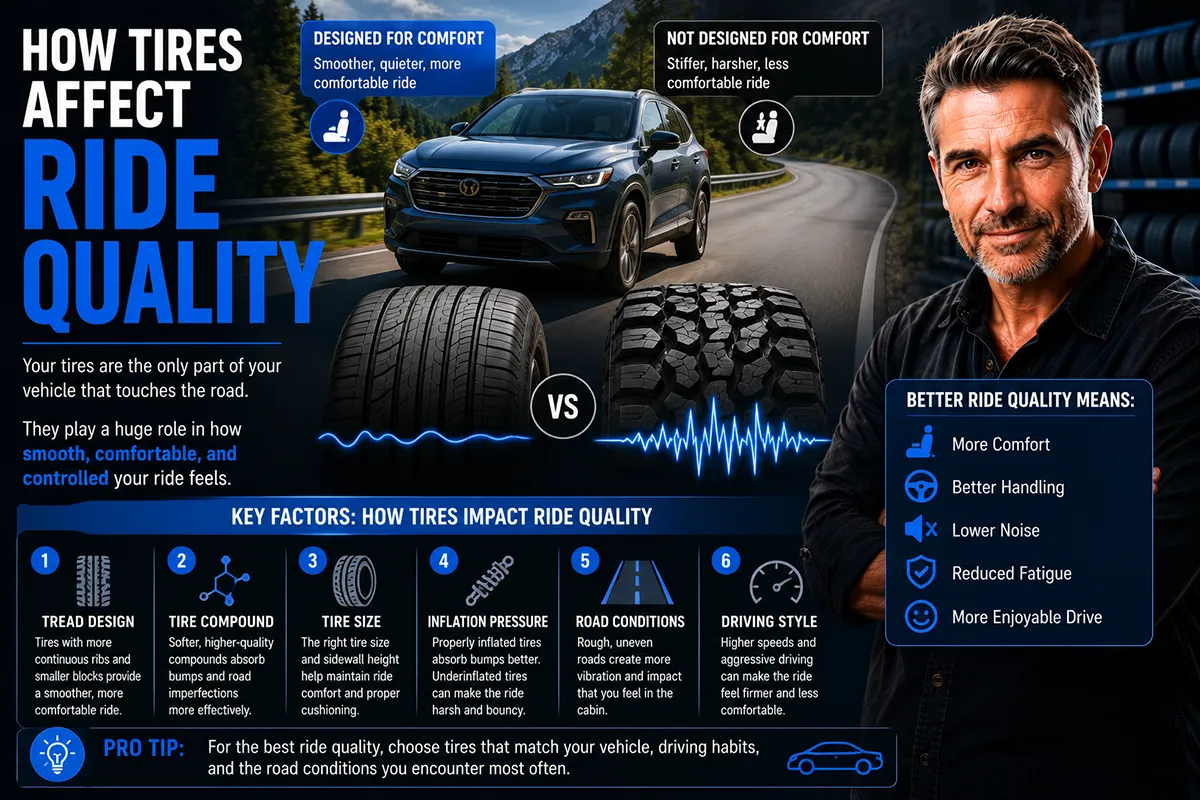
The truth is, your tires are the single biggest factor you can control when it comes to ride quality. They’re the only part of your car that actually touches the road, and they act as the first line of defense between you and every crack, pothole, and expansion joint on the highway.
- Tires affect ride quality more than most drivers realize — sometimes more than your suspension setup.
- Tire size, construction, tread design, inflation pressure, and rubber compound all play a role in comfort.
- Touring tires and grand touring tires generally deliver the smoothest ride for everyday driving.
- Bigger wheels with lower-profile tires almost always make the ride harsher.
- Proper inflation and regular rotation are the cheapest ways to improve ride comfort immediately.
- I break down exactly what to look for when shopping for a comfortable replacement tire.
Liked this article?
Add TireAdvise as a preferred source so you see more of our tire reviews and guides on Google.
Why Your Tires Matter More Than You Think
I’ve been testing and reviewing tires for years, and one thing I tell every driver who asks me for advice is this: your tires are the most underrated component of your car’s comfort system. People spend thousands on aftermarket suspension upgrades, but a $600 set of tires can transform the ride just as dramatically.
Think of it this way. Your car’s ride quality is a chain — springs, shocks, bushings, seats, and tires all work together. But tires are the first link in that chain. They absorb road imperfections before your suspension even gets a chance to react.
When I’ve driven back-to-back on the same car with different tires, the differences are immediately noticeable. I’m not talking about subtle changes that only a professional could detect. I’m talking about differences that my passengers comment on without being prompted.
The Anatomy of a Comfortable Tire
To understand how tires affect ride quality, it helps to know what’s actually going on inside that black rubber circle. There are several key elements at play, and each one influences how the tire absorbs (or transmits) road impacts.
Rubber Compound
The rubber compound is the material that makes up the tread and sidewalls. Softer compounds tend to absorb vibrations better, which is why touring tires — designed for comfort — use softer, more pliable rubber formulations.
In my experience, tires with harder compounds (like many budget tires or ultra-high-performance summer tires) tend to transmit more road texture into the cabin. You’ll feel every little pebble and tar strip. Softer compounds, on the other hand, act like a cushion between the road and your wheel.
Sidewall Construction and Height
The sidewall is arguably the most important factor in ride comfort. A taller sidewall has more room to flex and absorb impacts, while a shorter sidewall is stiffer and transmits more shock directly to the wheel and suspension.
This is why I always tell people: if you’re chasing comfort, don’t upsize your wheels. Going from 16-inch wheels with 65-series tires to 18-inch wheels with 40-series tires will make your car ride noticeably worse. I’ve done this swap on my own sedan, and the difference was dramatic — the 16-inch setup felt like floating while the 18-inch setup felt like every road seam was a speed bump.
Internal Construction (Ply Layers and Belt Design)
Inside every tire, there are layers of fabric (usually polyester) and steel belts that give the tire its structure. The number of plies, the materials used, and how they’re arranged all affect how the tire responds to bumps.
Tires built with more polyester body plies and less rigid belt packages tend to ride softer. This is a design choice that manufacturers make intentionally — touring tires are engineered with comfort-oriented internal structures, while performance tires prioritize stiffness for handling precision.
I’ve noticed this firsthand when comparing tires in the same size. For example, swapping from a stiff performance all-season to a standard touring all-season on the same car completely changed the character of the ride — same size, same pressure, totally different feel.
Tread Pattern and Block Design
The tread pattern affects ride quality in two main ways: noise and vibration. Tires with aggressive, blocky tread patterns (like all-terrain truck tires) generate more road noise, which is a huge component of perceived ride quality.
Conversely, tires with continuous ribs and smaller tread blocks tend to be quieter and feel smoother. Many premium touring tires also use variable pitch tread designs, where the tread blocks are slightly different sizes to break up the harmonic frequencies that create that droning sound on the highway.
I once put a set of all-terrain tires on my SUV for a camping trip and left them on for daily driving afterward. After several days of commuting, I couldn’t take the constant hum anymore. Switching back to highway tires was like putting noise-canceling headphones on the entire car.
The Five Factors That Directly Impact Your Ride
Let me break this down into the five controllable factors that I’ve found make the biggest difference in real-world driving.
1. Tire Size (Aspect Ratio Is Everything)
The aspect ratio — the middle number in your tire size — tells you how tall the sidewall is as a percentage of the tire’s width. A 225/60R16 tire has a sidewall that’s 60% of 225mm, which is a pretty generous cushion of rubber.
In my testing, I’ve found that every 10-point drop in aspect ratio produces a noticeable change in ride comfort. Going from a 60-series to a 50-series is detectable. Going from a 60-series to a 35-series is dramatic.
If your car came with 16-inch wheels and you’re considering upgrading to 18s or 19s for the look, just know what you’re giving up. I’m not saying don’t do it — I’m saying go in with your eyes open.
2. Tire Inflation Pressure
This is the easiest and cheapest way to affect ride quality, and most people get it wrong. I see drivers running their tires at the maximum pressure listed on the sidewall (often 44 or 51 psi) instead of the recommended pressure listed on the driver’s door jamb (usually 32-36 psi for passenger cars).
Overinflated tires ride harder because the air pressure makes the tire more rigid, reducing its ability to conform to road imperfections. Underinflated tires can feel mushy and vague, and they wear unevenly.
I always run my tires at the manufacturer’s recommended pressure and check them every two weeks with a quality digital gauge. It takes 60 seconds and makes a real difference. During a test period last year, I intentionally ran one set of tires at 5 psi over the recommendation, and the ride was noticeably firmer and less forgiving over expansion joints.
3. Tire Type and Category
Not all tires are created equal, and the category of tire you choose has a massive impact on comfort. Here’s how the main categories stack up based on my experience:
| Tire Category | Ride Comfort | Noise Level | Best For | Typical Price (per tire) |
|---|---|---|---|---|
| Grand Touring All-Season | ⭐⭐⭐⭐⭐ | Very Quiet | Sedans, daily commuters | $120–$200 |
| Standard Touring All-Season | ⭐⭐⭐⭐ | Quiet | Budget-conscious commuters | $80–$140 |
| Highway All-Season (SUV/Truck) | ⭐⭐⭐⭐ | Moderate | SUVs, crossovers, light trucks | $130–$220 |
| Performance All-Season | ⭐⭐⭐ | Moderate | Sport sedans, enthusiasts | $140–$250 |
| Ultra-High Performance Summer | ⭐⭐ | Moderate-Loud | Sports cars, track days | $150–$350 |
| All-Terrain (AT) | ⭐⭐ | Loud | Trucks, off-road use | $150–$300 |
| Mud-Terrain (MT) | ⭐ | Very Loud | Serious off-road vehicles | $200–$400 |
As you can see, grand touring all-season tires sit at the top of the comfort hierarchy. These are specifically engineered to deliver the smoothest, quietest ride possible while maintaining year-round capability. If comfort is your priority, this is where you should start your search.
4. Tread Depth (Worn vs. Fresh Tires)
Here’s something that surprised me early on in my tire testing: brand new tires don’t always ride better than slightly worn ones. When tires are fresh, the tread blocks are tall and can squirm a bit, sometimes creating a slightly less planted feel.
After a few days of driving, the tread surface smooths out slightly and the ride often improves. But as tires wear significantly — past the halfway point of their tread life — you start losing the cushioning effect of that rubber between you and the road.
I’ve driven on tires that were approaching the wear bars, and the difference compared to fresh rubber of the same model was stark. The worn tires transmitted every little road texture, and road noise increased significantly. If your tires are getting thin and your ride feels harsh, it’s probably time for a new set.
5. Tire Age and Condition
Even if your tires have plenty of tread left, old rubber gets hard. The plasticizers in the rubber compound evaporate over time, and the tire becomes less flexible and less capable of absorbing impacts.
I generally recommend replacing tires that are more than six years old regardless of tread depth. You can check the age of your tires by looking at the DOT code on the sidewall — the last four digits tell you the week and year of manufacture. A code reading “2219” means the tire was made in the 22nd week of 2019.
I once inherited a car that had sat in a garage with low-mileage tires that were over eight years old. They looked fine visually, but the ride was terrible — every bump felt sharp and jarring. Fresh tires completely transformed it.
My Real-World Experience: How Different Tires Changed the Same Car
I want to share a specific example that really drove this point home for me. I’ve been using my mid-size sedan as a test platform for various tire types, and the results speak for themselves.
Test 1: Factory-Equipped All-Season Tires
The car came with a set of OEM standard all-season tires. They were decent — nothing to complain about, nothing to celebrate. The ride was acceptable on smooth highways, but I could feel every expansion joint and rough patch on city streets. Road noise was moderate.
Test 2: Grand Touring All-Season Tires
I replaced them with a set of premium grand touring all-seasons. The difference was immediate. After a few days of driving, I was genuinely impressed by how much quieter the cabin was. Highway road noise dropped noticeably, and the way the tires absorbed sharp pavement cracks was dramatically better.
My wife, who doesn’t care about cars or tires at all, got in and said, “Did you do something to the car? It feels smoother.” That’s the kind of validation that matters.
Test 3: Performance All-Season Tires
Later, I fitted a set of performance all-season tires for testing. The handling improved — sharper turn-in, more grip in corners, better feedback through the steering wheel. But the ride got firmer. The stiffer sidewalls and harder compound meant I felt more road texture, and the noise level went up slightly.
It wasn’t uncomfortable by any means, but it was a clear trade-off. More performance, less comfort.
The Takeaway
Same car, same wheels, same inflation pressure, three completely different ride experiences. The tires were the only variable, and they changed the entire character of the vehicle.
Road Noise: The Hidden Comfort Killer
When people talk about ride quality, they usually mean bump absorption. But in my experience, road noise is equally important — maybe even more important on long highway drives.
I’ve driven tires that absorbed bumps beautifully but droned endlessly on concrete highways. That constant low-frequency hum is exhausting over long distances. It raises your stress level, makes conversations difficult, and forces you to crank the radio louder.
What Makes a Tire Quiet?
Several design features contribute to a quiet tire:
- Continuous center ribs: These create a smooth, uninterrupted contact patch that generates less pattern noise than blocky designs.
- Variable pitch tread blocks: By varying the size of tread blocks, manufacturers break up the repeating frequencies that cause harmonic drone.
- Foam liners: Some premium tires (like certain Continental and Pirelli models) include a polyurethane foam layer inside the tire that absorbs cavity noise — the hollow resonance inside the tire itself.
- Optimized groove geometry: The shape and angle of the grooves affect how air flows through them, which impacts noise generation at speed.
- Softer rubber compounds: Softer rubber conforms to the road surface rather than slapping against it, reducing impact noise.
I’ve tested tires with foam liners, and they genuinely make a difference — especially on coarse-chip asphalt surfaces that tend to be noisy with any tire. If road noise drives you crazy, look for tires that advertise noise-reduction technology.
How US Road Conditions Affect Your Tire Choice
Driving conditions in the US vary dramatically depending on where you live, and this should influence your tire buying decision.
Northeast and Midwest: Potholes and Frost Heaves
If you live in states like Michigan, Pennsylvania, Ohio, or anywhere in New England, your roads are probably riddled with potholes and frost heaves. I’ve driven extensively in these conditions, and I can tell you that sidewall height is your best friend here.
I recommend sticking with your car’s original wheel size (or even downsizing if possible) and choosing tires with the tallest sidewall your car can accommodate. That extra rubber between the rim and the road is literally the cushion that saves your back — and your wheels — from pothole damage.
Sun Belt: Heat and Long Highway Stretches
If you’re in Texas, Arizona, Florida, or other hot-weather states, ride comfort on the highway is probably your top priority. Long, straight, hot roads demand a tire that’s quiet and smooth at sustained speeds.
Grand touring all-season tires excel here. They’re designed for exactly this type of driving. Just make sure you’re choosing tires rated for high temperatures — look for an A or B temperature rating on the UTQG (Uniform Tire Quality Grading) system printed on the sidewall.
Pacific Northwest: Wet Roads Year-Round
In Oregon and Washington, you’re dealing with rain more often than not. Comfort is still important, but don’t sacrifice wet traction for a softer ride. The good news is that many premium touring tires offer excellent wet performance alongside their comfort-oriented design.
Common Mistakes That Ruin Ride Quality
Over the years, I’ve seen drivers make the same mistakes over and over again. Here are the most common ride-quality killers I encounter:
Mistake 1: Upsizing Wheels Without Understanding the Trade-Off
I mentioned this earlier, but it deserves its own section. The allure of big wheels is strong — they look great. But every inch of extra wheel diameter means less sidewall, and less sidewall means a harsher ride.
If you absolutely want larger wheels, try to keep the overall tire diameter as close to stock as possible and accept the comfort compromise. Or better yet, keep a set of stock-size wheels with comfort-oriented tires for daily driving.
Mistake 2: Overinflating Tires
I can’t stress this enough. The number on the tire sidewall is the maximum pressure, not the target pressure. Your car’s recommended pressure is on the placard inside the driver’s door jamb.
I’ve met drivers running 44 psi in tires on a car that calls for 33 psi because “they thought higher was better for gas mileage.” Yes, overinflation can marginally improve fuel economy, but it destroys ride comfort and causes the center of the tread to wear faster. It’s not worth it.
Mistake 3: Choosing the Cheapest Tire Available
I understand budgets are real, and I’m not here to shame anyone for buying affordable tires. But I’ve tested enough budget tires to know that the cheapest option usually rides the worst.
Budget tires often use harder rubber compounds (for longer tread life), simpler internal constructions, and less sophisticated tread designs. All of these translate to a firmer, noisier ride. If you can stretch your budget even slightly, the mid-range options from brands like General, Cooper, or Hankook often deliver dramatically better comfort for only $15-25 more per tire.
Mistake 4: Ignoring Tire Maintenance
Even the best tires in the world will ride poorly if they’re not maintained. Unbalanced tires cause vibrations. Misaligned tires cause uneven wear that creates noise and handling problems. Under-rotated tires develop irregular wear patterns that create a choppy, uncomfortable ride.
I rotate my tires every time I change my oil, and I get an alignment check at least once a year. These small investments pay massive dividends in ride quality and tire longevity.
Mistake 5: Mixing Tires of Different Types or Brands
Running different tires on the same axle — or wildly different tire types front to rear — creates an inconsistent ride feel. The car might feel smooth over one kind of bump and harsh over another, or the handling might feel unpredictable.
Always replace tires in pairs at minimum (both fronts or both rears), and ideally replace all four at once with the same make and model.
What to Look for When Shopping for Comfortable Tires
If you’re actively shopping for replacement tires and ride quality is a priority, here’s my practical shopping checklist:
- Look for “touring” or “grand touring” in the tire name or category. These are explicitly designed for comfort. Examples include the Continental PureContact LS, Michelin Defender, and Bridgestone Turanza QuietTrack.
- Check the speed rating. Tires with S, T, or H speed ratings tend to ride softer than those with V, W, or Y ratings. Higher speed ratings require stiffer construction.
- Read real user reviews and focus on comfort comments. Aggregate ratings are helpful, but I always filter for reviews that specifically mention ride quality and noise. One person’s “firm but acceptable” is another person’s “way too harsh.”
- Prioritize sidewall height. If you have a choice between tire sizes, go with the one that has the taller sidewall (higher aspect ratio) for a more comfortable ride.
- Look for noise-reduction technology. Foam liners, variable pitch tread, and sound-absorbing features are increasingly common in the $120+ per-tire price range.
- Don’t ignore the warranty. A longer tread life warranty often (though not always) indicates a harder compound, which can mean a firmer ride. Tires with moderate warranties (50,000-65,000 miles) sometimes offer a better balance of comfort and longevity than those promising 80,000+ miles.
My Top Recommendations for Ride Comfort (By Vehicle Type)
Based on my testing and experience, here are the tires I’d point you toward if ride quality is your number-one priority:
For Sedans and Compact Cars
The Continental PureContact LS has consistently impressed me with its blend of comfort, quietness, and wet traction. It’s one of the smoothest-riding tires I’ve tested in this category. The Michelin Defender series is another strong choice — Michelin’s Comfort Control technology is the real deal, and during my test period, the cabin was noticeably hushed on rough pavement.
For a more affordable option, I’ve been pleasantly surprised by the General AltiMAX RT45. It doesn’t match the premium options in outright refinement, but it punches above its weight for the price.
For SUVs and Crossovers
The Michelin Defender LTX M/S remains my go-to recommendation for crossovers and SUVs. It rides like a touring tire but handles the extra weight of larger vehicles with confidence. During my test period on a mid-size SUV, the ride was composed and quiet even on some truly rough county roads.
The Continental CrossContact LX25 is another excellent option. It uses Continental’s foam-damping technology (EcoPlus+), and I could genuinely hear the difference compared to the non-foam-equipped tires it replaced.
For Trucks
Truck owners often feel like they have to choose between comfort and capability, but the Michelin Defender LTX M/S works here too if you don’t need aggressive off-road traction. For those who want a bit more all-terrain capability without sacrificing too much comfort, the Toyo Open Country A/T III has been one of the quietest all-terrain tires I’ve tested. It’s not as smooth as a highway tire, but it’s remarkably civilized for an AT.
The Bottom Line: Your Tires Are Worth Investing In
After years of testing tires across dozens of vehicles, I’ve come to a firm conclusion: no single upgrade improves daily driving comfort more than choosing the right set of tires. Not a suspension swap, not new seats, not sound deadening — tires.
They’re also the most replaced component on your car, which means you get a fresh opportunity every few years to make a different choice. If your current ride feels harsh, noisy, or just “off,” don’t assume it’s the car. Look at your tires first.
Check the tread depth. Check the age. Check the inflation pressure. And when it’s time to replace them, invest in a set that’s designed for the kind of driving you actually do — not the kind of driving you wish you did.
I’ve seen $500-700 tire purchases completely transform vehicles that owners were considering trading in because the ride had become intolerable. That’s the kind of value we’re talking about.
Your tires are the foundation of every single drive you take. Make sure that foundation is working for you, not against you.
Frequently Asked Questions
How do tires affect ride quality and comfort on the road?
Tires are the only contact point between your vehicle and the road, so they directly influence how smooth or harsh every bump feels. Tires with taller sidewalls and softer rubber compounds absorb more road imperfections, while low-profile or performance-oriented tires transmit more vibration into the cabin. When I switched from run-flat tires to standard touring tires on my sedan, the improvement in ride comfort was immediately noticeable. Choosing the right tire type is one of the most cost-effective ways to improve your daily driving experience.
What type of tire gives the smoothest ride for everyday driving?
Grand touring and standard touring tires are specifically engineered to deliver the smoothest ride for daily commuting and highway driving in the US. Brands like Michelin Defender, Continental TrueContact, and Bridgestone Turanza prioritize comfort by using noise-reducing tread patterns and flexible sidewall construction. These tires typically range from $120 to $200 each and strike an excellent balance between ride quality, tread life, and wet-weather grip.
Does tire size and sidewall height make a difference in ride comfort?
Absolutely — tire size has a huge impact on how comfortable your ride feels. A taller sidewall acts like an extra cushion between the wheel and the road, absorbing potholes, expansion joints, and rough pavement much better than a low-profile tire. If you’re driving on worn US city roads and prioritize comfort, I’d recommend sticking with your vehicle’s original tire size rather than upsizing to larger wheels with thinner sidewalls. Going from a 45-series to a 55-series sidewall on the same wheel can transform the ride.
Can worn or old tires make my car ride rough and vibrate?
Yes, worn, unevenly worn, or aged tires are one of the most common causes of a rough or vibrating ride. Flat spots from sitting too long, cupping from worn suspension components, and tread separation on tires older than 6 years can all create noticeable vibrations and road noise. If your car suddenly feels rougher than usual, I’d recommend having a tire shop inspect your tread wear pattern and check the DOT date code on the sidewall before assuming it’s a suspension problem. Replacing aging tires often costs $400–$800 for a set and can make the car feel brand new.
Are expensive tires actually worth it for a better ride quality?
In my experience, mid-range to premium tires from brands like Michelin, Continental, and Goodyear genuinely deliver a noticeable improvement in ride comfort, noise reduction, and handling compared to budget options. Premium tires use advanced rubber compounds and construction techniques that better absorb road imperfections and last significantly longer. That said, a $150-per-tire touring tire often rides just as comfortably as a $200 option, so you don’t always need to buy the most expensive tire — just avoid the cheapest no-name brands if ride quality matters to you.
How does tire pressure affect ride quality and should I adjust it for comfort?
Tire pressure has a direct and immediate effect on ride quality — overinflated tires feel harsh and bouncy, while underinflated tires feel sluggish and can wear unevenly. I always recommend sticking to the pressure listed on your driver’s door jamb sticker, not the maximum PSI printed on the tire sidewall. Dropping pressure a few PSI below the recommended number might feel slightly softer, but it increases tire wear, reduces fuel economy, and can be unsafe, especially during hot US summer driving conditions.
Do all-season tires ride better than all-terrain or winter tires on pavement?
For on-road comfort, all-season and grand touring tires provide a significantly smoother and quieter ride than all-terrain or winter tires on regular US highways and city streets. All-terrain tires have aggressive tread blocks that generate more road noise and vibration on pavement, while winter tires use softer compounds that feel mushy and wear quickly in warm weather. If you don’t regularly drive off-road or in heavy snow, a quality set of all-season tires like the Michelin CrossClimate2 will give you the best year-round ride quality for typical US driving conditions.
