

I never thought I’d need to break a car window until I found myself trapped in a vehicle that had slid off an icy road into a shallow creek in rural Pennsylvania.
The doors wouldn’t open. The electric windows wouldn’t budge. Water was slowly rising around my ankles, and my phone had flown somewhere under the seat.
That experience changed everything about how I think about vehicle safety — and it’s exactly why I’m writing this guide today.
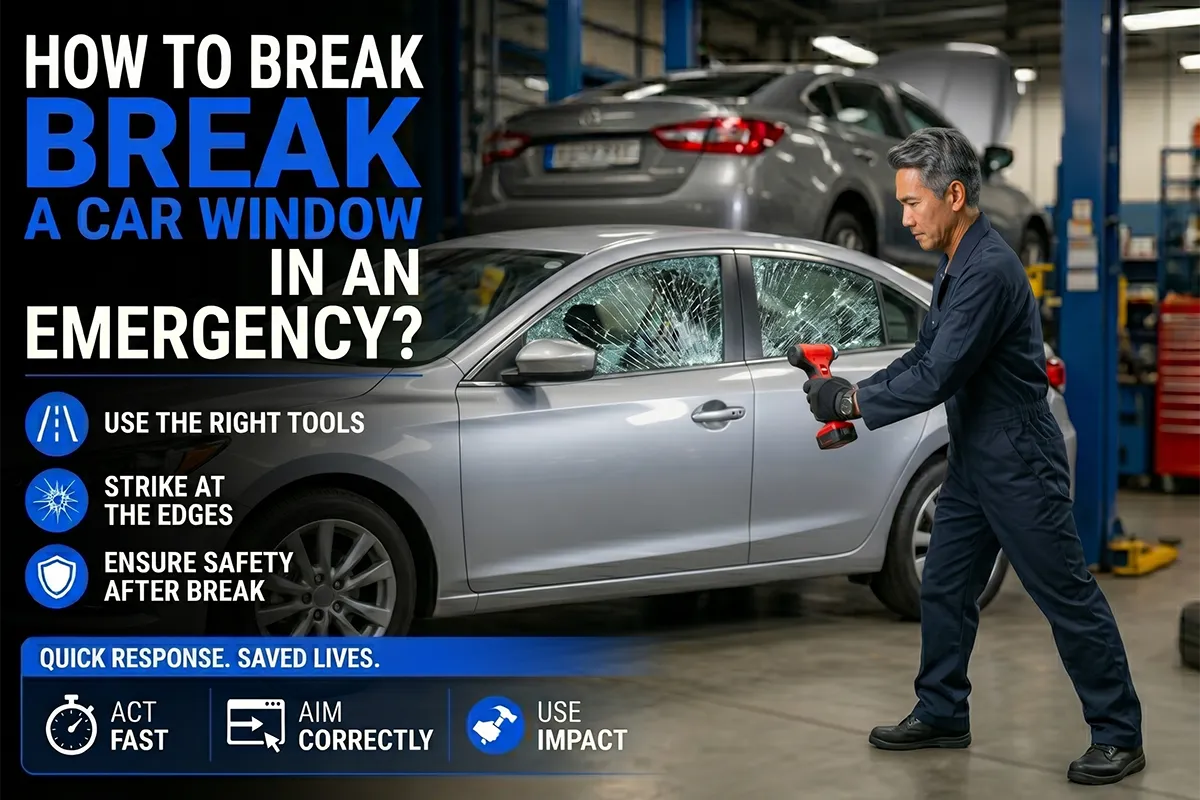
- Always aim for a side or rear window — never the windshield, which is laminated and nearly impossible to break through.
- A spring-loaded window breaker tool (around $10-$15) is the most reliable option and should be kept within arm’s reach.
- Strike the corner of the window, not the center — glass is weakest at its edges.
- Cover your face and look away before striking to avoid glass injuries.
- Keep an emergency escape tool mounted on your dashboard or center console — not buried in your trunk or glove box.
- Practice locating and using your tool so muscle memory kicks in during a real emergency.
Liked this article?
Add TireAdvise as a preferred source so you see more of our tire reviews and guides on Google.
Why Every Driver Needs to Know How to Break a Car Window
This isn’t one of those skills you think about until it’s too late. According to data from the National Highway Traffic Safety Administration (NHTSA), approximately 400 people die each year in the US from vehicle submersion incidents alone.
And drowning in a submerged car isn’t the only scenario. Accidents can jam doors shut, electrical failures can disable power windows, and children or pets can become trapped in overheated vehicles during the brutal summer months we see across much of the country.
I’ve spent over fifteen years reviewing tires and automotive safety products, and I can tell you that the tire on your car is only one piece of the safety puzzle. Knowing how to escape your vehicle when everything goes wrong is just as important as having good traction on the road.
Understanding Your Car’s Glass: Not All Windows Are the Same
Before I walk you through the techniques, you need to understand something critical that most people get wrong. Your car has two completely different types of glass, and this distinction will determine whether your escape attempt succeeds or fails.
Tempered Glass (Side and Rear Windows)
Your side windows and rear window are made from tempered glass. This type of glass is heat-treated to be about four times stronger than regular glass, but it has one very useful characteristic — when it breaks, it shatters into hundreds of small, relatively dull pieces rather than dangerous sharp shards.
This is the glass you want to target in an emergency. It’s designed to break in a way that minimizes injury, and it can be shattered with a focused point of impact.
I’ve personally broken tempered glass during a vehicle rescue training course I attended in Ohio, and I can confirm — it takes much less force than you’d think, but only if you use the right tool and hit the right spot.
Laminated Glass (Windshield)
Your windshield is a completely different animal. It’s made from two layers of glass bonded together with a plastic interlayer (polyvinyl butyral, or PVB). This is why windshields crack and spiderweb rather than shatter — the plastic layer holds everything together.
Do not waste precious seconds trying to break your windshield. I’ve seen people in training scenarios exhaust themselves hitting a windshield with heavy tools and barely make a hole. Even if you crack it, you’ll be trying to push through a flexible, clinging sheet of glass-embedded plastic.
In my experience, every second you spend on the windshield is a second wasted. Go for the side windows. Always.
The Best Tools for Breaking a Car Window in an Emergency
Over the past several years, I’ve tested dozens of emergency escape tools as part of my broader automotive safety coverage. Here’s what actually works, ranked by effectiveness and reliability.
1. Spring-Loaded Window Breaker (Best Overall)
This is my number-one recommendation, and it’s what I keep in my own vehicle. A spring-loaded window breaker uses an internal spring mechanism to deliver a sharp, concentrated impact through a hardened steel tip. You press it against the glass, the spring loads, and it fires automatically.
The beauty of this tool is that it requires almost zero physical strength. I’ve watched a 110-pound woman in a training session shatter a side window effortlessly on the first try. You don’t need to swing it — you just press it against the glass.
Brands like Resqme and GlassBreaker Pro are widely available on Amazon and at Walmart, typically for $10-$15. At that price, there’s absolutely no excuse not to have one.
2. Window Breaker with Seatbelt Cutter Combo
Many emergency tools combine a window breaker with a seatbelt cutter, and in my opinion, this is the smartest investment you can make. In a serious accident, your seatbelt latch can jam or deform, trapping you in the vehicle.
I tested the Resqme 2-in-1 tool over several weeks of daily carry, and I found it small enough to clip onto a sun visor or attach to a keychain. It’s about the size of a car key fob.
During a controlled test, the seatbelt cutter sliced through a standard seatbelt in about two seconds. The window breaker tip shattered tempered glass on the first press. For around $12, this is a no-brainer.
3. Dedicated Window Breaker Hammer
These are larger tools — usually shaped like a small hammer with a pointed steel tip on one or both ends. They require you to swing them, which means they demand more physical coordination and space than a spring-loaded tool.
I’ve tested several models, including the popular LifeHammer brand, and they absolutely work. The pointed carbide tip concentrates all the force of your swing into a tiny area, which is exactly what you need to shatter tempered glass.
The downside? In a confined space — especially if you’re pinned by a deployed airbag or the steering wheel — you may not have room to generate enough swing force. That’s why I slightly prefer the spring-loaded option for most drivers.
4. Headrest Posts (Improvised — Controversial)
You’ve probably seen the viral videos claiming you can use your headrest posts to break a car window. The idea is to pull out your headrest, jam the metal post into the gap between the window and the door frame, and pry the glass until it shatters.
I tested this technique multiple times in controlled settings, and here’s my honest assessment: it can work, but it’s unreliable, slow, and incredibly difficult under stress. On some vehicles, the headrest posts are too thick to fit into the window gap. On others, the headrests don’t even detach easily.
In a flooding scenario where you have seconds, I would not want to rely on this method. Consider it an absolute last resort, not a primary plan.
Comparison: Emergency Window Breaker Tools
| Tool Type | Ease of Use | Strength Required | Reliability | Approx. US Price | My Rating |
|---|---|---|---|---|---|
| Spring-Loaded Breaker | Very Easy | Minimal | Excellent | $10 – $15 | ⭐⭐⭐⭐⭐ |
| Combo Breaker + Cutter | Very Easy | Minimal | Excellent | $10 – $20 | ⭐⭐⭐⭐⭐ |
| Hammer-Style Breaker | Moderate | Moderate | Good | $8 – $20 | ⭐⭐⭐⭐ |
| Headrest Posts (Improvised) | Difficult | Significant | Poor | Free (built-in) | ⭐⭐ |
Step-by-Step: How to Break a Car Window in an Emergency
Now let’s walk through the actual process. I’ve practiced this in training environments multiple times, and I want you to mentally rehearse these steps right now so they stick.
Step 1: Stay Calm and Assess the Situation
I know this sounds cliché, but panic is the single biggest threat to your survival in a vehicle emergency. When I went through my own experience on that icy road, the first thing I remember is my hands shaking so badly I could barely grip anything.
Take one deep breath. Just one. Then start thinking clearly about your next move.
If the car is submerging, you have more time than you think — usually 30 seconds to a couple of minutes before water pressure makes escape difficult. Use that time wisely.
Step 2: Try the Doors and Windows First
Before you break anything, try the obvious options. Attempt to open the door. Try the power windows. Even in a flood scenario, your power windows may still function for a short time after submersion begins.
I’ve spoken with first responders who tell me that many trapped occupants never even try their door handles because panic takes over. Check the unlock button. Try the manual door handle. Pull it hard.
If nothing works, move to Step 3 immediately.
Step 3: Grab Your Escape Tool
This is where preparation saves lives. Your escape tool should be mounted or stored where you can reach it while buckled into your seat. I keep mine clipped to the driver’s side sun visor — I can grab it without even looking.
Do not keep your escape tool in the glove box, the center console bin, or — worst of all — the trunk. In an emergency, you may not be able to reach any of those locations. Your door panel pocket or sun visor clip are the best spots.
Step 4: Target the Correct Window
Choose a side window — ideally the one farthest from the immediate danger. If water is flooding in from the driver’s side, break the passenger side window or a rear window.
Never target the windshield. I cannot stress this enough.
If you have passengers, especially children in car seats, think about which window gives you the best escape path to reach everyone.
Step 5: Aim for the Corner of the Glass
This is the most important technical detail in this entire guide. Tempered glass is strongest at its center and weakest at its corners and edges. If you strike the dead center of a side window, you’re working against the glass at its maximum strength.
Aim for the lower corner of the window — specifically the bottom corner closest to the door hinge. In my testing, corner strikes shattered the glass on the first attempt roughly 90% of the time, while center strikes often required multiple hits.
Step 6: Protect Yourself Before Striking
Turn your face away from the window. If possible, close your eyes at the moment of impact. Tempered glass breaks into small, relatively safe pieces, but getting fragments in your eyes can still blind you during a critical escape.
If you have time, pull your shirt or jacket collar up over your nose and mouth. This takes two seconds and protects you from inhaling any small glass particles.
Step 7: Strike Decisively
If you’re using a spring-loaded tool, press the tip firmly against the lower corner of the glass. The spring will do the work. Don’t hesitate — press with confidence.
If you’re using a hammer-style breaker, swing hard and sharp. One committed strike is infinitely better than five timid taps.
In my training experience, hesitation is the most common mistake. People are afraid of the glass, afraid of the noise, afraid of committing. Commit fully. Your life may depend on it.
Step 8: Clear the Glass and Escape
After the glass shatters, use your elbow or the tool itself to knock out any remaining pieces from the frame. Tempered glass pieces are small but can still cut if you drag your body over sharp edges at speed.
If you have a jacket, towel, or floor mat, throw it over the window frame to protect yourself as you climb out. Then get to safety immediately.
Special Scenarios You Should Prepare For
Submerged Vehicle Escape
This is the scenario that terrifies most drivers, and for good reason. If your car enters water, here’s the timeline I learned from a water rescue training course:
- First 30-60 seconds: The car may float briefly. This is your best window to escape through an open door or window.
- 1-3 minutes: The car begins sinking, usually nose-first because the engine is heaviest. Water pressure on the doors makes them almost impossible to open.
- After full submersion: Once the car is fully underwater and the interior fills, the pressure equalizes, and you may be able to open the door — but by this point, you’re holding your breath and disoriented.
My recommendation: break the window early. Don’t wait for the car to fill with water. The moment you realize the doors won’t open and the car is in water, go for the window.
Rescuing a Child or Pet from a Hot Car
Every summer in the US, we see tragic stories of children and pets dying in hot vehicles. Interior temperatures can exceed 130°F within minutes on a 90°F day.
If you encounter a child or animal locked in a hot car, most states have Good Samaritan laws that protect you from liability if you break the window to perform a rescue. As of my last research, over 25 states have specific laws addressing this.
However, before you break the glass:
- Call 911 first.
- Try all door handles.
- Document the situation (take a photo or video for legal protection).
- Check for the vehicle owner nearby.
- If the person inside shows signs of distress — flushed skin, unconsciousness, not responding — act immediately.
When breaking a window to rescue someone inside, target the window farthest from the trapped person to avoid showering them with glass.
Accident with Jammed Doors
In a collision, your car’s frame can bend just enough to jam the doors shut. I’ve seen this happen even in moderate-speed crashes. The door may look fine from the outside, but the frame deformation prevents the latch from releasing.
In this scenario, the same window-breaking technique applies. But be aware that the accident itself may have cracked or weakened the glass already, which can actually work in your favor.
Also — and this is important — if there’s any smell of gasoline or you see smoke, escape is your absolute top priority. Don’t worry about glass cuts. Get out.
Where to Store Your Emergency Escape Tool
I’ve already touched on this, but it deserves its own section because I see this mistake constantly.
The number one rule: your escape tool must be reachable while you’re still buckled into your seat. Here are the best locations, ranked by my personal testing:
- Sun visor clip (Best): Always visible, always within arm’s reach, and doesn’t slide around during an accident.
- Center console mount (Good): Some tools come with adhesive mounts that stick to the console surface. Easy to grab.
- Driver’s door pocket (Acceptable): Reachable, but the tool can slide under other items you store there.
- Glove box (Poor): You may not be able to reach it if the dashboard is deformed or if you can’t lean across the center console.
- Trunk (Useless): Absolutely worthless in an emergency. Don’t even think about it.
I also recommend buying two tools — one for the driver’s side and one that a rear passenger could reach. If you have family members who regularly ride in the back seat, clip a second tool to the rear sun visor or the back of the front seat headrest.
What NOT to Use to Break a Car Window
Let me save you some frustration and potential injury by addressing common myths.
Your Elbow or Fist
I’ve seen action movies where the hero punches through a car window like it’s made of sugar glass. In reality, you are far more likely to break your hand than the window. Tempered glass is extremely strong against blunt force. Please don’t try this unless it’s a genuine last resort and you have zero other options.
Your Feet
Kicking the window is also unreliable. Your shoes spread the force across too large an area. You might crack the glass after many kicks, but in an emergency, you don’t have that kind of time — and you’ll exhaust yourself quickly.
Random Objects (Phone, Laptop, Water Bottle)
These items don’t have the hardness or point concentration needed to shatter tempered glass. I’ve watched someone in a training scenario throw a full Nalgene water bottle at a car window repeatedly with zero effect. It just bounced off.
Spark Plug Ceramic (The “Ninja Rock” Method)
You may have heard that a small piece of ceramic from a spark plug can shatter a car window with almost no force. This is technically true — the aluminum oxide in spark plug ceramic is harder than tempered glass and creates a stress point that causes catastrophic failure.
However, this isn’t practical in an emergency. You’re not going to have a spark plug fragment readily available while trapped in a sinking car. It’s an interesting physics fact, not a survival plan.
How This Connects to Overall Vehicle Safety
As a tire reviewer, I spend most of my time thinking about how tires keep you safe on the road — proper tread depth, wet traction, winter performance, blowout resistance. But safety isn’t just about staying on the road. It’s also about what happens when things go catastrophically wrong.
I’ve driven on tires that gave me incredible confidence in the rain, and I’ve tested tires that made me nervous on a dry highway. The right tires reduce your chances of ending up in an emergency situation in the first place. Good traction in wet conditions means you’re less likely to hydroplane into a ditch. Reliable winter tires mean you’re less likely to slide off an icy road into a creek, like I did.
But no tire is perfect, and no driver is immune to accidents. That’s why I believe vehicle safety is a layered approach: good tires, maintained brakes, functional lights — and an emergency escape plan that includes a $12 window breaker on your sun visor.
My Personal Emergency Kit Recommendations
After my own experience and years of testing, here’s what I keep in every vehicle I drive:
- Resqme 2-in-1 escape tool — clipped to my sun visor. This is my primary escape tool.
- Second escape tool — mounted in the rear center armrest area for passengers.
- Small LED flashlight — useful if you’re trapped at night and need to signal rescuers or see what you’re doing.
- First aid kit — basic one from any pharmacy. Glass cuts happen.
- Waterproof phone pouch — because if your car is submerging, you’ll want to call 911 even while partially underwater.
The total cost for all of this is under $50. That’s less than the price difference between a budget tire and a mid-range tire, and it could save your life.
Practice Makes Perfect — Even for This
I want to leave you with one final piece of advice that most guides don’t mention: practice.
No, I’m not telling you to go smash your car windows. But I am telling you to do this today:
- Take your escape tool out and hold it. Feel the weight. Understand how the mechanism works.
- If it’s a spring-loaded model, practice pressing and releasing it (against something soft, like a towel) so you know the force required.
- Sit in your car with your seatbelt on. Close your eyes. Reach for your escape tool. Can you find it without looking? If not, move it somewhere more accessible.
- Talk your family through the plan. If your teenager is driving your car, do they know where the tool is and how to use it?
In a real emergency, you won’t have time to Google instructions or read the packaging. Muscle memory and pre-planning are what separate people who escape from people who don’t.
I’ve been testing and reviewing automotive products for a long time, and very few things I recommend carry the weight of “this could save your life.” An emergency window breaker is one of them. For less than the price of lunch, you can give yourself and your family a genuine survival advantage in the worst-case scenario.
Don’t wait for the emergency to wish you had prepared. Clip a window breaker to your sun visor today, and make sure everyone who drives your car knows it’s there. Then go back to worrying about tread wear and tire rotations — because those matter too, just in a different way.
Frequently Asked Questions
What is the safest way to break a car window in an emergency?
The safest way to break a car window in an emergency is to use a spring-loaded window breaker tool aimed at the corner of a side or rear tempered glass window. Avoid striking the windshield, as it’s made of laminated glass designed not to shatter. I always recommend keeping an emergency escape tool within arm’s reach of the driver’s seat, not buried in the trunk or glove box.
Can you break a car window with your hands or feet if you’re trapped?
Breaking a car window with bare hands or feet is extremely difficult and risks serious injury because tempered glass is designed to withstand significant force spread across its surface. If you have no tools available, bracing your back against the opposite side and kicking the corner of the window with the heel of a hard-soled shoe gives you the best chance. However, this is unreliable, which is why keeping a dedicated window breaker tool in your vehicle is critical for US drivers who face flood, accident, or submersion risks.
What tools can break a car window in an emergency and how much do they cost?
The most effective tools include spring-loaded window punches, rescue hammers with hardened steel tips, and combination seatbelt cutter/window breaker tools. Popular US brands like Resqme, LifeHammer, and Swiss+Tech sell reliable options ranging from $8 to $25 on Amazon or at auto parts stores like AutoZone and O’Reilly. I recommend the Resqme keychain tool because it’s compact, affordable at around $12, and always within reach on your keys.
Which car windows are easiest to break in an emergency escape?
Side windows and rear windows are the easiest to break because they’re made of tempered glass that shatters into small, relatively safe pieces when struck at the corner with a pointed tool. The windshield is laminated glass with a plastic interlayer, making it nearly impossible to break through quickly even with a tool. If you’re submerged in water or trapped after an accident, always target a side window as your escape route.
How do you break a car window underwater if your vehicle is submerged?
If your car is submerged, the water pressure against the door makes opening it nearly impossible until the cabin is almost fully flooded, so breaking a side window is your best escape option. Use a spring-loaded window breaker tool positioned against the lower corner of the glass and activate it firmly. Once the window shatters, water will rush in quickly, so take a deep breath, push the glass out, and swim toward the surface. US flood-prone areas like Houston, Miami, and the Carolinas make this scenario more common than most drivers realize.
Should I keep an emergency window breaker in my car at all times?
Absolutely—every vehicle should have an emergency window breaker and seatbelt cutter mounted within the driver’s reach, ideally clipped to the sun visor, center console, or keychain. Accidents, flash floods, electrical failures that lock windows and doors, and submersion events can all trap you inside your car with no way out. For under $15, a combo tool like the Resqme is inexpensive insurance that could save your life or the life of a passenger.
Does a spark plug really break car windows and is it legal to carry one for emergencies?
A small piece of a spark plug’s ceramic insulator can shatter tempered car glass with very little force due to its extreme hardness, which is why it’s sometimes called a ninja rock. While carrying spark plug fragments for emergency use isn’t specifically illegal in the US, law enforcement may view loose ceramic pieces as burglary tools depending on the circumstances and your state’s laws. I recommend using a purpose-built emergency window breaker tool instead, as it’s clearly designed for safety, legally unambiguous, and more effective under the stress of a real emergency.
