

Most people spend more time choosing their next set of tires than they do shopping for car insurance. I know because I used to be one of them.
I’ve spent years reviewing tires, testing tread compounds, and helping everyday drivers make smart purchases. But a few years ago, I realized that all my advice about protecting your ride was incomplete if I never talked about the financial protection that wraps around your vehicle the moment you pull out of the driveway.
- Car insurance isn’t just a legal requirement — it’s financial armor for your vehicle investment, including those expensive new tires.
- Shop at least 3-5 quotes before committing, and revisit your policy every 6-12 months.
- Understand the six core coverage types so you only pay for what you actually need.
- Bundle discounts, safe-driver programs, and higher deductibles can save you hundreds per year.
- Your tire choice and vehicle maintenance history can indirectly affect your insurance costs.
- Read the fine print on roadside assistance — it may overlap with your tire warranty coverage.
Liked this article?
Add TireAdvise as a preferred source so you see more of our tire reviews and guides on Google.
Why a Tire Reviewer Is Talking About Car Insurance
I get it — you came to TireAdvise.com for tire reviews, not insurance lectures. But hear me out, because these two topics are more connected than you think.
Every week, I get emails from readers who just invested $600 to $1,200 in a new set of tires, only to realize their insurance policy wouldn’t cover them if a pothole blew out a sidewall or a hit-and-run damaged their wheel assembly. That’s a painful lesson I don’t want you to learn the hard way.
In my experience, the drivers who make the smartest tire purchases are also the ones who take a holistic approach to vehicle ownership. They maintain their cars, they drive thoughtfully, and they make sure their insurance coverage actually matches their real-world needs.
So consider this guide my way of completing the picture. I’ve personally gone through the insurance shopping process multiple times, switched carriers twice in the past few years, and learned what actually matters versus what’s just marketing noise.
Understanding the Basics: What Car Insurance Actually Covers
Before you can buy car insurance with confidence, you need to understand what you’re actually buying. When I first started driving, I thought insurance was just one big blanket of coverage. It’s not — it’s a layered system, and each layer protects you in a different way.
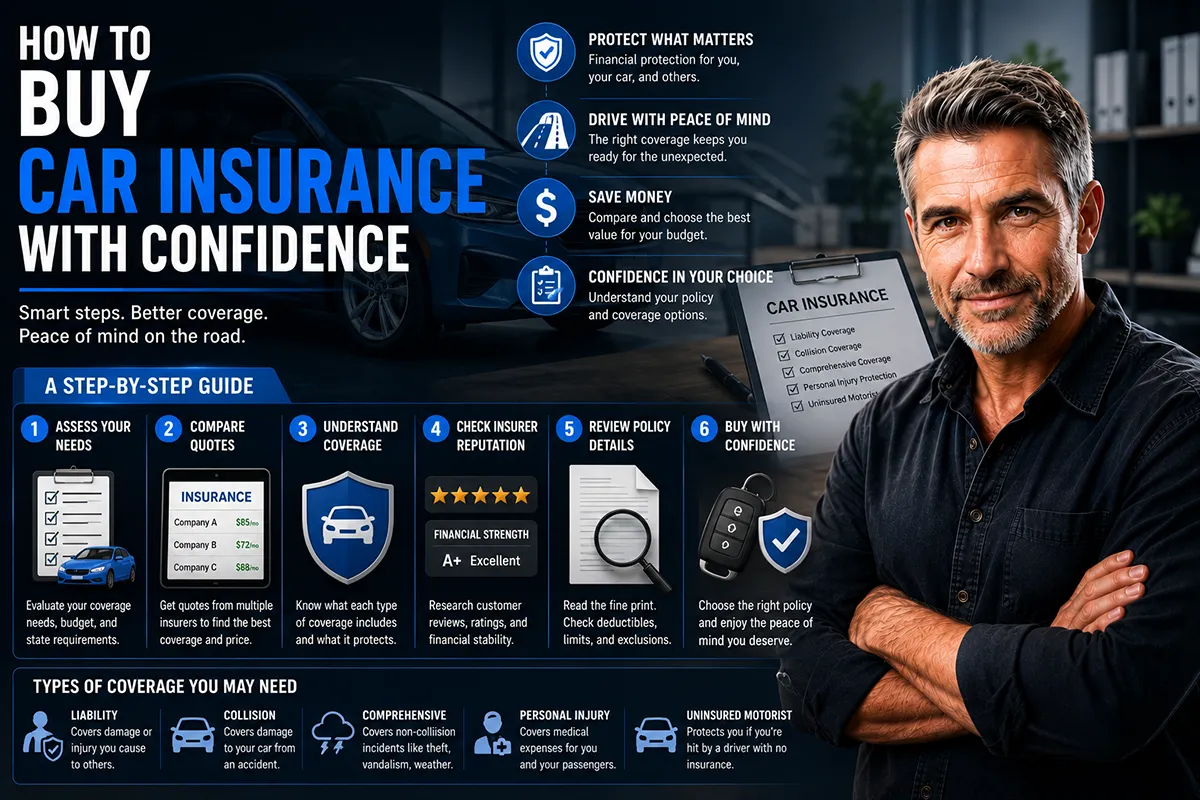
The Six Core Coverage Types
- Liability Coverage (Bodily Injury & Property Damage): This is legally required in almost every US state. It pays for damage you cause to other people and their property. It does NOT cover your own vehicle.
- Collision Coverage: This pays to repair or replace your car after an accident, regardless of who’s at fault. If you’ve just invested in premium tires and wheels, this coverage suddenly matters a lot more.
- Comprehensive Coverage: This covers non-collision events — theft, vandalism, hail, falling objects, animal strikes, and flooding. I’ve personally filed a comprehensive claim after a deer strike that destroyed a headlight and cracked a wheel rim.
- Uninsured/Underinsured Motorist Coverage: Protects you when the other driver doesn’t have enough (or any) insurance. About 14% of US drivers are uninsured, according to the Insurance Research Council.
- Medical Payments / Personal Injury Protection (PIP): Covers medical bills for you and your passengers after an accident, regardless of fault.
- Roadside Assistance: This is the coverage that directly intersects with your tire life. It typically covers towing, flat tire changes, lockout service, and fuel delivery.
I recommend that every driver understand all six types before sitting down to compare quotes. You don’t necessarily need all of them — but you need to make an informed choice about which ones to include.
How Much Car Insurance Do You Actually Need?
This is the question I struggled with the most when I was shopping for my own policy. Every state has minimum requirements, but minimums are rarely enough.
State Minimums vs. Real-World Protection
Let me give you an example. In California, the minimum liability requirement is 15/30/5 — that’s $15,000 per person for bodily injury, $30,000 per accident, and $5,000 for property damage. Sounds reasonable until you realize that the average new car in the US costs over $48,000. If you total someone’s vehicle, that $5,000 in property damage coverage won’t even cover one set of their OEM wheels and tires.
In my experience, I recommend carrying at least 100/300/100 in liability coverage. It costs more per month, but the difference is often surprisingly small — sometimes just $15 to $30 extra per month for dramatically better protection.
When to Carry Full Coverage vs. Liability Only
Here’s a rule of thumb I use and share with friends: if your car is worth more than $5,000, carry full coverage (liability + collision + comprehensive). If you’ve just installed a $1,000 set of performance tires and upgraded alloy wheels, your vehicle’s functional value is even higher than its book value.
If you’re driving a beater that’s worth less than your annual insurance premium, liability-only might make sense. But be honest with yourself about what you’d do if that car was totaled tomorrow. Could you afford to replace it out of pocket?
Step-by-Step: How to Shop for Car Insurance Like a Pro
Over the years, I’ve developed a repeatable process for shopping car insurance that saves time and money. Here’s exactly what I do, and what I recommend you do too.
Step 1: Gather Your Information First
Before you request a single quote, collect the following:
- Your driver’s license number
- Vehicle Identification Number (VIN) for each car on the policy
- Current odometer reading
- Your current policy declarations page (if you’re already insured)
- Driving history for the past 3-5 years for all listed drivers
- Information about any vehicle modifications (including aftermarket wheels and tires)
That last point is important. I’ve found that some insurers ask about modifications, and upgraded wheels/tires can affect your comprehensive and collision premiums. Be upfront about it — it protects you in the event of a claim.
Step 2: Get Quotes From at Least 3-5 Companies
I cannot stress this enough. The difference between the cheapest and most expensive quote I received during my last shopping round was over $900 per year for the exact same coverage levels. That’s real money — enough to buy a solid set of all-season tires.
Here’s where to get quotes:
- Major national carriers: State Farm, GEICO, Progressive, Allstate, USAA (if you qualify)
- Online-first insurers: Lemonade, Root, Metromile (now part of Lemonade)
- Independent insurance agents: These brokers shop multiple carriers for you and can often find deals you’d never see online
- Comparison websites: The Zebra, Policygenius, and NerdWallet’s insurance tool can streamline the process
I personally use a combination of direct quotes and an independent agent. The agent found me a regional carrier I’d never heard of that beat every major brand by $400 per year.
Step 3: Compare Apples to Apples
This is where most people make mistakes. You can’t compare a quote with a $500 deductible to one with a $1,000 deductible and declare the cheaper one the winner. They’re not the same product.
I created a simple comparison spreadsheet that I still use today. Here’s what it tracks:
| Coverage Detail | Company A | Company B | Company C |
|---|---|---|---|
| Liability (BI/PD) | 100/300/100 | 100/300/100 | 100/300/100 |
| Collision Deductible | $500 | $500 | $500 |
| Comprehensive Deductible | $250 | $250 | $250 |
| Uninsured Motorist | 100/300 | 100/300 | 100/300 |
| Roadside Assistance | Included | $12/yr add-on | Not offered |
| Rental Car Reimbursement | $50/day, 30 days | $40/day, 30 days | $30/day, 21 days |
| 6-Month Premium | $680 | $720 | $590 |
| Annual Total | $1,360 | $1,440 | $1,180 |
| AM Best Rating | A+ | A++ | A |
When you lay it all out like this, the right choice becomes obvious. In this example, Company C looks cheapest, but it doesn’t offer roadside assistance and its rental reimbursement is weaker. Depending on your priorities, Company A might actually be the better value.
Step 4: Check the Insurer’s Financial Strength and Reputation
A cheap policy is worthless if the company fights every claim or goes bankrupt. I always check two things:
- AM Best rating: Look for A- or higher. This tells you the insurer is financially stable enough to pay claims.
- J.D. Power claims satisfaction scores: These surveys reflect how real customers felt about the claims process.
- NAIC complaint ratio: The National Association of Insurance Commissioners tracks complaints relative to each insurer’s market share. A ratio above 1.0 means more complaints than average.
I once had a claim with a bargain-basement insurer that took almost two months to process. They disputed the damage estimate, required three separate inspections, and I was without my vehicle for weeks. I saved $200 on the annual premium but lost far more in frustration and rental car costs. Never again.
Step 5: Ask About Every Possible Discount
Insurers offer dozens of discounts, but they don’t always advertise them. Here are the ones I’ve personally benefited from or confirmed with agents:
- Multi-policy (bundle) discount: Combine auto with homeowners or renters insurance for 5-25% off.
- Safe driver discount: No accidents or violations for 3-5 years can save 10-30%.
- Low annual mileage discount: If you drive less than the national average, some insurers reward you. This is especially relevant if you work from home.
- Anti-theft device discount: Aftermarket alarms, GPS trackers, and even certain wheel locks may qualify.
- Defensive driving course discount: Taking a state-approved course can save 5-10% in many states.
- Good student discount: For drivers under 25 with a B average or higher.
- Automatic payment / paperless billing discount: Small savings that add up over time.
- Vehicle safety features discount: Anti-lock brakes, airbags, electronic stability control, and even tire pressure monitoring systems (TPMS) can reduce your premium.
That last one connects directly to what we talk about here on TireAdvise. Your vehicle’s TPMS — the system that warns you about low tire pressure — is a safety feature that some insurers reward. Make sure it’s functioning properly and mention it when you’re getting quotes.
The Connection Between Your Tires and Your Insurance
Now let’s get into the territory I know best. Your tires are the only part of your car that touches the road, and they have a bigger impact on your insurance situation than most people realize.
Tire Condition and Accident Risk
Insurance is fundamentally about risk. The riskier you are to insure, the more you pay. Worn tires dramatically increase your stopping distance, reduce your ability to handle wet roads, and make blowouts more likely.
I’ve tested dozens of tires in wet braking scenarios, and the difference between a new all-season tire and one that’s worn down near the wear bars is staggering. We’re talking about additional car lengths of stopping distance at highway speeds. That’s the difference between a close call and a collision that spikes your insurance premium for years.
While your insurer won’t inspect your tires before issuing a policy, an accident caused by tire failure will absolutely affect your rates going forward. Investing in quality tires is, in a very real sense, an investment in keeping your insurance premiums low.
Aftermarket Wheels and Tires: Will Insurance Cover Them?
This is a question I get frequently, and the answer is: it depends on your policy. Standard auto insurance typically covers your vehicle as it was manufactured. If you’ve added $3,000 worth of aftermarket wheels and performance tires, they may not be fully covered unless you have a custom parts and equipment (CPE) endorsement.
I recommend calling your insurer after any significant modification. Most companies offer CPE coverage for an additional $20-$75 per year, which is a small price to pay when you consider how much those upgrades cost.
Roadside Assistance: Insurance vs. Tire Warranty
Here’s where things get interesting and where I’ve seen a lot of overlap and confusion. Many tire manufacturers and tire retailers offer roadside assistance as part of a tire purchase. Discount Tire, Tire Rack, Costco, and even brands like Michelin and Continental have programs that include flat tire changing and towing.
At the same time, your insurance policy may include roadside assistance as an add-on, and your AAA membership (if you have one) covers the same things.
Before you pay for roadside assistance through your insurance, check what you already have through your tire warranty or purchase program. You might be triple-covered, which means you’re wasting money on redundant services.
In my experience, the tire retailer’s roadside program is often the most limited — it might only cover you during the warranty period or within a certain distance. Insurance-based roadside is usually more comprehensive. But you should know exactly what each one covers before you decide.
Common Mistakes to Avoid When Buying Car Insurance
Over the years, I’ve made some of these mistakes myself and watched friends and family members make others. Here are the biggest pitfalls I want to help you avoid.
Mistake 1: Only Shopping on Price
Price matters, but it’s not everything. The cheapest policy I ever had was also the worst experience I ever had when filing a claim. Look at the full picture — coverage limits, deductibles, customer service reputation, and claim processing speed.
Mistake 2: Setting Your Deductible Too High
A higher deductible lowers your premium, and that’s tempting. But ask yourself: can you actually come up with $2,000 out of pocket tomorrow if you need to? If not, a lower deductible — even though it costs more monthly — gives you better real-world protection.
I keep my collision deductible at $500 and my comprehensive deductible at $250. The premium difference between that and a $1,000 deductible was about $8 per month. I’ll take the peace of mind.
Mistake 3: Not Updating Your Policy After Life Changes
Moved to a new ZIP code? Got married? Started working from home? Added a teen driver? Each of these changes can significantly affect your premium — sometimes in your favor. I forgot to update my address after a move and missed out on almost a year of savings because my new area had lower rates.
Mistake 4: Forgetting About Rental Car Reimbursement
If your car is in the shop after an accident, rental car reimbursement covers your temporary transportation costs. This add-on usually costs $3-$5 per month and can save you hundreds if you’re ever in a bind. I always carry it.
Mistake 5: Letting Your Policy Auto-Renew Without Shopping Around
Insurance companies count on inertia. They know most people won’t shop around at renewal time, so they quietly raise premiums by 5-15% each cycle. I set a calendar reminder 30 days before every renewal to re-shop my policy. It takes about an hour and has saved me meaningful money every single time.
How Often Should You Re-Shop Your Car Insurance?
I recommend shopping at least once a year, ideally about a month before your renewal date. But there are also specific trigger events that should prompt an immediate re-evaluation:
- You buy or sell a vehicle
- You add or remove a driver from your household
- You move to a new address
- Your credit score significantly improves
- You pay off your auto loan (your lender may have required certain coverage minimums)
- You have a birthday that moves you into a new age bracket (turning 25 is a big one)
- You complete a defensive driving course
Each of these changes can shift your risk profile, and different insurers weigh them differently. The company that was cheapest last year might not be cheapest this year.
State-Specific Considerations for US Drivers
Insurance requirements and costs vary wildly across the United States. Here are a few things I’ve noticed in my own experience and research:
No-Fault vs. At-Fault States
Twelve states plus Washington D.C. operate under no-fault insurance systems, meaning your own insurer pays for your medical bills regardless of who caused the accident. These states often require Personal Injury Protection (PIP) coverage, which adds to your premium but provides faster access to medical care.
If you live in a no-fault state (like Michigan, Florida, or New York), your insurance will likely cost more, but you’ll also have stronger medical protections.
States With High Uninsured Driver Rates
Mississippi, Michigan, Tennessee, New Mexico, and Florida consistently rank among states with the highest rates of uninsured drivers. If you live or frequently drive in these states, uninsured/underinsured motorist coverage isn’t optional in my book — it’s essential.
Weather and Road Conditions
Here’s where my tire expertise intersects with insurance in a practical way. If you live in a state with harsh winters, you’re more likely to be involved in a weather-related accident. Good winter tires reduce that risk, and carrying adequate insurance coverage protects you financially if it happens anyway.
I always tell readers in northern states: budget for winter tires AND make sure your insurance coverage is solid. One without the other leaves you exposed.
Digital Tools That Make Insurance Shopping Easier
The insurance industry has modernized significantly over the past few years. Here are the tools I personally use and recommend:
- The Zebra: Compares quotes from dozens of insurers in minutes. I’ve found it to be one of the most user-friendly comparison tools.
- Policygenius: Great for bundling auto with home or renters insurance. Their advisors are helpful and not overly pushy.
- Jerry: An app that automatically re-shops your insurance and can handle the switching process for you. I tested it during my last shopping round and was impressed by the time savings.
- Your state’s Department of Insurance website: Many states publish rate comparison guides and complaint data. It’s dry reading but incredibly useful.
I will say this: even with all these digital tools, there’s still value in talking to a human. An independent insurance agent can catch things that algorithms miss, like obscure discounts or coverage gaps that a website won’t flag.
My Personal Insurance Setup (And Why)
I want to be transparent about my own coverage because I think it’s helpful to see what a real person actually carries. Here’s my current setup:
- Liability: 250/500/100 — higher than most recommendations, but I have assets to protect
- Collision: $500 deductible
- Comprehensive: $250 deductible
- Uninsured/underinsured motorist: 250/500
- Medical payments: $10,000
- Rental car reimbursement: $50/day for up to 30 days
- Roadside assistance: Included (but I also have coverage through Discount Tire’s certificate program)
- Custom parts and equipment: $5,000 endorsement to cover aftermarket wheels and tires
I pay about $1,480 per year for this coverage through a regional carrier that my independent agent found. Before switching, I was paying over $1,900 per year with a major national brand for slightly less coverage. Shopping around quite literally paid for my last set of tires.
Final Thoughts: Insurance Is Part of Being a Smart Car Owner
I spend most of my time on this site talking about tread patterns, rubber compounds, noise levels, and wet braking performance. But the truth is, being a smart car owner means more than just choosing the right tires — it means protecting your entire investment.
Buying car insurance with confidence comes down to understanding what you’re buying, shopping aggressively, and revisiting your choices regularly. It’s not glamorous, and it’s not as fun as testing a new set of high-performance summer tires on a twisty backroad. But it’s just as important.
Take an hour this weekend, pull up your current declarations page, and ask yourself: does this policy actually protect me the way I need it to? If you’re not sure, it’s time to shop.
Your tires keep you connected to the road. Your insurance keeps you connected to financial stability. Both deserve your attention, and both reward you for doing your homework.
Drive smart. Stay covered. And as always, I’ll be here to help you make the best decisions for your vehicle — from the rubber to the paperwork.
Frequently Asked Questions
How does buying new tires affect my car insurance rates?
Installing new, high-quality tires generally won’t directly lower your car insurance premiums, but it can indirectly help you avoid accidents caused by worn treads or blowouts, which keeps your driving record clean and your rates low. Some insurers may also look favorably on vehicles that are well-maintained when assessing risk. I always make sure to keep receipts for new tire purchases as proof of vehicle upkeep in case I ever need to file a claim.
Does car insurance cover tire damage from potholes or road hazards in the US?
If you carry comprehensive or collision coverage, your car insurance may cover tire damage caused by potholes, debris, or road hazards, but you’ll still need to meet your deductible first. Since a single replacement tire typically costs between $100 and $300 for most passenger vehicles, filing a claim often isn’t worth it unless multiple tires and wheels are damaged. This is exactly why I recommend looking into road hazard warranties from your tire retailer as a more practical alternative for everyday tire damage.
Should I buy road hazard tire protection or rely on my car insurance?
Road hazard tire warranties, usually priced between $15 and $30 per tire, specifically cover punctures, sidewall damage, and blowouts that standard car insurance often won’t pay for without a high deductible. I personally buy road hazard coverage every time I purchase replacement tires because filing a small tire claim through my auto insurer could raise my premiums. Think of tire protection plans and car insurance as complementary — one handles everyday road damage while the other covers major collision or theft events.
How do I buy car insurance with confidence if I drive on worn tires?
Driving on worn or bald tires can actually put your insurance coverage at risk because some policies include vehicle maintenance clauses that may reduce or deny a claim if negligence is a factor. To buy car insurance with confidence, I make sure my tires have at least 4/32″ of tread depth and are properly rated for my local US driving conditions, whether that means all-season tires for moderate climates or winter tires for northern states. Keeping your tires in good condition strengthens your position if you ever need to file a claim.
What type of car insurance coverage do I need if I just bought expensive performance tires?
If you’ve invested in premium performance tires or upgraded to a larger wheel-and-tire package costing $1,000 or more, I’d recommend reviewing your comprehensive and collision coverage limits to make sure aftermarket upgrades are included. Many standard US auto insurance policies only cover factory-equipped parts unless you add a custom parts and equipment endorsement, which typically costs $20 to $75 per year. I learned this the hard way — always confirm with your insurer that your upgraded tires and wheels are covered before driving off the lot.
Can I get a car insurance discount for equipping winter tires in cold-weather states?
While some Canadian insurers offer winter tire discounts, most US car insurance companies currently don’t provide a direct premium reduction for installing winter or snow tires. However, equipping proper winter tires in states like Minnesota, Michigan, or Colorado significantly reduces your risk of accidents on ice and snow, which protects your claims history and keeps your rates from increasing. I always view winter tires as an investment in both safety and long-term insurance savings.
How do I compare car insurance quotes confidently when I’m also budgeting for new tires?
When I’m budgeting for both replacement tires and car insurance, I start by getting at least three to five insurance quotes online from US providers like State Farm, GEICO, and Progressive, then factor in my annual tire maintenance costs to build a realistic vehicle ownership budget. Choosing a slightly higher insurance deductible — say $1,000 instead of $500 — can save $150 to $300 per year on premiums, which I redirect toward buying better-quality tires with longer treadwear warranties. This balanced approach lets me buy car insurance with confidence while still affording the safest tires for my driving needs.
