

I’ll never forget the morning I watched my neighbor’s SUV slide backward down our shared driveway like it was on a slip-and-slide. He had brand-new all-season tires. The driveway had a quarter-inch of black ice on it.
That moment stuck with me because it perfectly captures the question thousands of US drivers wrestle with every fall: are regular winter tires enough, or do I actually need studs?
After spending years testing winter tires across multiple states — from the icy backroads of northern Minnesota to the slushy highways of upstate New York — I’ve developed a pretty clear framework for making this decision. And I’ll be honest: the answer isn’t what most people expect.
- Studded tires provide the biggest advantage on bare ice and hard-packed snow — not on regular snow or wet roads.
- Most US drivers are better served by high-quality studless winter tires, which have improved dramatically in recent years.
- Studs are worth it if you regularly drive on icy mountain passes, rural roads that rarely get plowed, or live in areas with persistent black ice.
- Before buying, check your state’s laws — studs are banned or restricted in many US states.
- Expect to pay $15–$30 extra per tire for studs, plus the cost of seasonal swaps and potential road damage fees.
Liked this article?
Add TireAdvise as a preferred source so you see more of our tire reviews and guides on Google.
What Exactly Are Tire Studs and How Do They Work?
Before we get into the decision-making process, let me make sure we’re on the same page about what tire studs actually are. I’ve talked to enough drivers at tire shops to know there’s a lot of confusion here.
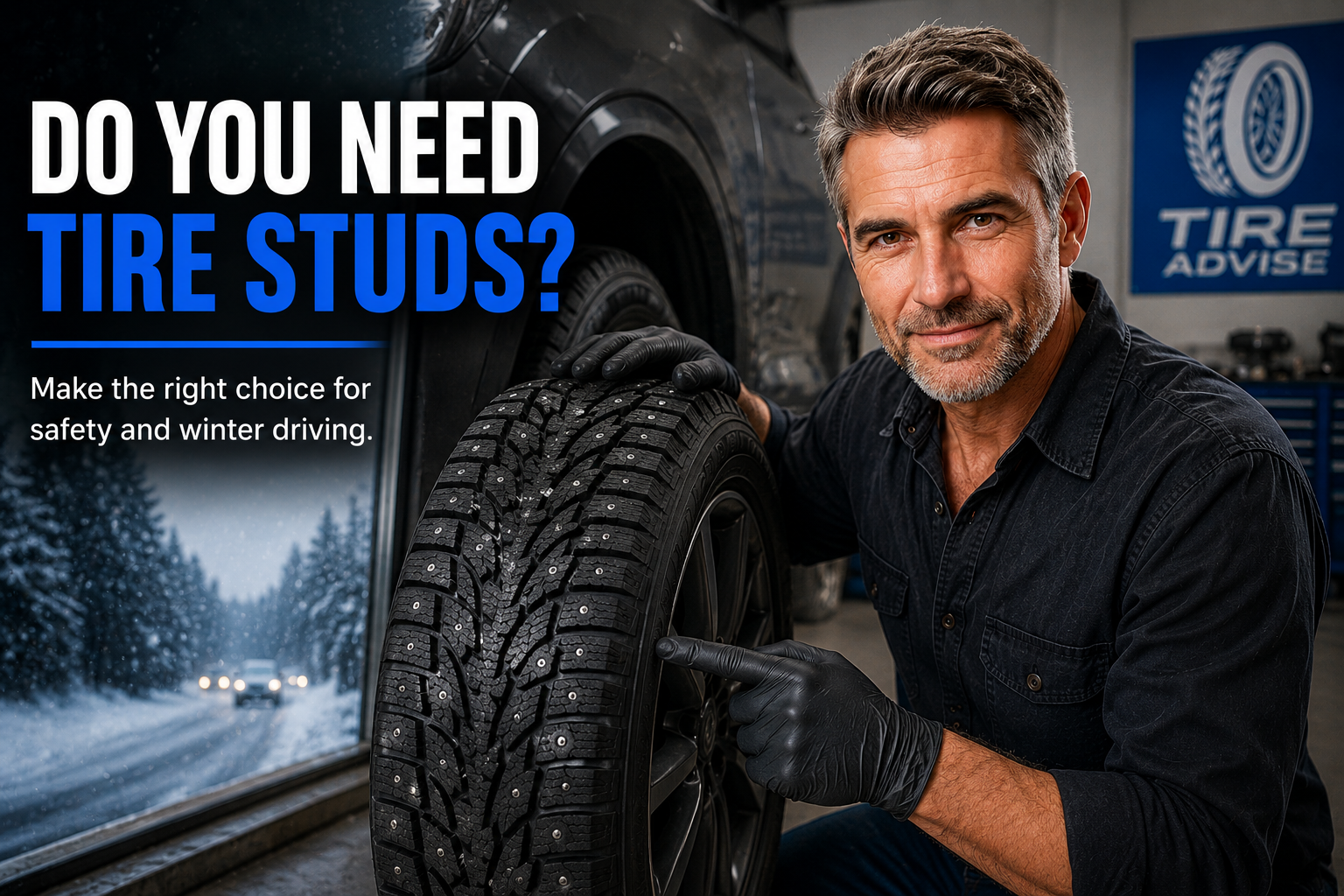
Tire studs are small metal pins — usually made from tungsten carbide — that are inserted into pre-molded holes in a winter tire’s tread. They protrude about 1-2 millimeters beyond the rubber surface and are designed to dig into ice, creating mechanical grip where rubber alone would slip.
Think of them like football cleats for your car. On a soft grass field (snow), regular shoes might work fine. But on a frozen, slick surface (ice), those cleats bite in and give you traction that flat soles simply can’t.
I’ve held these studs in my hand — they’re surprisingly small, about the size of a thumbtack head on the surface. But when you multiply that by 80 to 120 studs per tire across all four wheels, they create hundreds of tiny grip points on ice.
The Honest Truth About When Studs Actually Help
Here’s where my real-world experience diverges from what you’ll read in a lot of marketing materials. Studded tires aren’t a magic solution for all winter conditions. They excel in one specific scenario and are mediocre-to-worse in several others.
Where Studs Shine: Bare Ice and Hard-Packed Snow
I’ve tested studded versus studless winter tires on a frozen lake in Minnesota, and the difference on pure ice is undeniable. During my test period, I ran controlled braking tests from 25 mph on glare ice. The studded tires consistently stopped several car lengths shorter than even the best studless options.
On hard-packed snow — the kind you get on rural roads that see a plow once a week — studs also provide a noticeable improvement. I could feel the difference through the steering wheel. The car felt planted and responsive instead of vaguely disconnected.
If you’ve ever driven on a road that looks wet but is actually a sheet of black ice, you know the terror of having zero grip. That’s where studs earn their keep.
Where Studs Don’t Help Much (or Actually Hurt)
Here’s what surprised me during my testing: on loose, fresh snow, studded tires performed almost identically to good studless winter tires. The studs can’t dig into something that’s already soft and powdery — the rubber compound and tread pattern do most of the work in that scenario.
On wet pavement, studded tires are actually worse than studless winter tires. The metal studs reduce the rubber’s contact patch with the road, and they can act like tiny roller bearings on wet asphalt. I noticed this firsthand when driving through a rainy stretch after an ice storm — the car felt slightly less confident in corners compared to the studless set I’d been running the previous week.
On dry pavement, the disadvantage is even more pronounced. The studs create a clicking noise that gets old fast, they accelerate road wear, and they reduce braking performance compared to regular winter or all-season tires. During the days I drove studded tires on dry highways, I genuinely looked forward to swapping them off.
A Realistic Decision Framework: Do YOU Need Studs?
After testing countless winter tire setups over the years, I’ve developed a simple framework I share with friends and family when they ask me this exact question. Walk through these criteria honestly, and you’ll have your answer.
1. What Does Your Typical Winter Drive Look Like?
This is the single most important question. I need you to think about your actual daily commute and weekend driving, not the one crazy storm you remember from three years ago.
If you drive primarily on highways and major roads that get plowed and salted within a few hours of a storm, you almost certainly don’t need studs. Modern studless winter tires like the Bridgestone Blizzak WS90 or Michelin X-Ice Snow handle these conditions extremely well. I’ve driven both through serious northeastern winters without ever wishing I had studs.
If you regularly drive on secondary roads, mountain passes, or rural routes that go days between plowing — especially in areas where ice buildup is common — studs start making a lot more sense. I’ve driven in parts of rural Vermont and the UP of Michigan where the road surface is essentially ice from December through March. In those conditions, I’d absolutely want studs.
2. Where Do You Live (and Is It Even Legal)?
This is a practical hurdle that many drivers overlook. Studded tire laws vary wildly across the United States, and getting this wrong can mean a fine or a failed inspection.
Here’s a breakdown of the legal landscape as of the current regulations:
| Category | States | Details |
|---|---|---|
| Studs Banned Completely | Alabama, Texas, Florida, Hawaii, Louisiana, Mississippi, and several others | No studded tires permitted on public roads at any time |
| Studs Allowed Seasonally | Most northern and mountain states (e.g., Colorado, Oregon, Washington, Minnesota, Vermont, Maine, Montana) | Typically allowed from October/November through March/April — exact dates vary by state |
| Studs Allowed Year-Round | A small handful of states (e.g., Wyoming, Colorado, New Hampshire — always verify current laws) | No seasonal restrictions, though year-round use accelerates pavement damage |
I always tell people: before you spend a dime, Google “[your state] studded tire laws” and check the DOT website. Laws change, and the penalties can be stiff. In some states, you’re looking at fines of $100 or more per tire.
3. How Much Are You Willing to Spend (and Hassle)?
Let’s talk money, because studs aren’t just a one-time upfront cost. Here’s what I’ve actually paid over the years:
- Stud installation: $15–$30 per tire at most tire shops. Some tires come pre-studded from the factory, which saves labor but limits your tire choices.
- Seasonal tire swaps: If you’re running studs, you MUST swap them off when the season ends (in most states). That’s $60–$100 per swap at a shop, twice a year. I’ve done this myself in my garage with a floor jack, but it’s not for everyone.
- A second set of wheels: I strongly recommend mounting your studded tires on a dedicated set of wheels. This saves you the mounting/balancing fee each season and runs about $400–$800 for a set of basic steel wheels. It pays for itself within a couple of seasons.
- Faster tire wear: Studded tires tend to wear faster than studless equivalents, especially if you do any driving on dry pavement. I’ve noticed that studded sets don’t last quite as many seasons as my studless winter tires under comparable use.
- Fuel economy: It’s marginal, but studs and aggressive winter treads do increase rolling resistance. I’ve observed a slight dip in fuel economy during my winter driving periods, though it’s hard to isolate from cold-weather effects in general.
All told, choosing studs over studless winter tires can add $200–$400 in the first year and $120–$200 each subsequent year in extra costs. That’s real money, and it’s only worth it if the safety benefit is genuinely there for your driving conditions.
Studded vs. Studless Winter Tires: My Head-to-Head Experience
I want to give you a direct comparison based on my personal testing, not just spec sheets. Over the past several winters, I’ve run both studded and studless winter tires on the same vehicle in the same conditions, and here’s what I’ve found.
| Condition | Studded Tire Performance | Studless Winter Tire Performance | Winner |
|---|---|---|---|
| Bare ice (glare ice) | Excellent — short stopping distances, confident cornering | Good — modern compounds grip better than ever, but not as secure | Studded |
| Hard-packed snow/ice | Very good — studs bite through the surface layer | Good — tread pattern and siping do most of the work | Studded |
| Fresh/loose snow | Good | Good — nearly identical performance | Tie |
| Wet pavement | Decent — reduced contact patch hurts slightly | Very good | Studless |
| Dry pavement | Below average — noisy, slightly longer braking | Good | Studless |
| Slush | Good | Good — tread channels matter more here | Tie |
| Road noise | Loud — constant clicking/buzzing on pavement | Moderate — typical winter tire hum | Studless |
| Tread life | Shorter — studs accelerate wear | Longer | Studless |
The pattern is clear: studs win decisively on ice, tie on snow, and lose on everything else. Your decision should hinge on how much ice driving you actually do.
The “Ice Percentage” Rule I Use
Here’s a practical rule of thumb I’ve developed over years of winter tire testing. I call it my “ice percentage” rule, and it’s dead simple.
Think about all the winter driving you do in a given season. What percentage of that driving is on icy surfaces — not snowy, not wet, but actually icy? Be honest with yourself.
- Less than 10% icy conditions: You don’t need studs. A quality studless winter tire will cover you for everything, and you’ll enjoy better performance the other 90% of the time. This applies to most suburban and urban drivers, even in the Snow Belt.
- 10–30% icy conditions: Studs become a reasonable option, especially if those icy moments include steep hills, mountain passes, or high-consequence situations (like driving to a rural hospital). I’d still lean studless for most people in this range, but I wouldn’t argue with someone who chose studs.
- More than 30% icy conditions: Get the studs. If you’re regularly dealing with roads that are more ice than anything else — and I’ve driven in plenty of areas like this — the safety benefit is worth the trade-offs in noise, cost, and dry-road performance.
What About Chains? How Do They Compare to Studs?
I get this question constantly, and it’s a fair one. Tire chains are another option for extreme traction, and they serve a different purpose than studs.
Chains are a temporary solution. You put them on when conditions demand it — typically on mountain passes or in states that require them during chain-control periods (like California’s I-80 over Donner Pass). They provide incredible traction on ice and packed snow, arguably even better than studs.
But chains are impractical for daily use. I’ve installed chains on the side of the road in freezing wind, and I can tell you it’s miserable. They also damage pavement, limit your speed to about 25-30 mph, and make the ride extremely rough. After several days of testing chains during a mountain trip, I was counting the minutes until I could take them off.
Studs, by contrast, are a set-it-and-forget-it solution for the entire winter season. You mount them in the fall, drive normally, and swap them off in the spring. There’s no stopping on the shoulder in a blizzard to wrestle with metal links.
My recommendation: if you need extreme ice traction only a few times per year (like occasional mountain trips), carry chains. If you need it regularly, go with studs.
Top Studded Tire Options I’ve Actually Tested
If you’ve made it this far and decided studs are right for you, here are the tires I’d point you toward based on my firsthand experience. All of these are readily available at major US retailers like Tire Rack, Discount Tire, and Les Schwab (in the western states).
Nokian Hakkapeliitta 10
This is the gold standard for studded winter tires, and it’s not close. Nokian literally invented the winter tire in Finland, and their Hakkapeliitta line has been dominant for decades. I tested these over an extended winter period, and the ice grip was phenomenal — the best I’ve experienced from any studded tire. The stud design is also engineered to minimize road damage, which I appreciate as both a driver and a taxpayer.
Expect to pay around $150–$220 per tire depending on size. Worth every penny if you need studs.
General AltiMAX Arctic 12 (Studdable)
This is my budget pick. The General AltiMAX Arctic 12 comes studdable — meaning the holes are pre-molded but the studs aren’t installed. You can have a tire shop install studs for $15–$25 per tire, or run them studless if you change your mind. I tested these on a compact sedan during a particularly harsh winter, and they impressed me with solid ice performance at a fraction of the Nokian’s price. You’re looking at roughly $80–$130 per tire before studs.
Hankook Winter i*Pike RS2
A solid mid-range option that I’ve tested on a crossover. The Hankook Winter i*Pike RS2 comes factory-studded in some configurations, and the stud retention was excellent throughout my testing period — I didn’t lose a single stud. Ice braking was confident, and the tire was surprisingly quiet for a studded option. Pricing typically falls in the $100–$160 range per tire.
Important Tips If You Decide to Go With Studs
Based on my years of running studded tires, here are the practical lessons I’ve learned — some the hard way.
Always Stud All Four Tires
I cannot stress this enough. Never stud only the front or only the rear tires. I’ve seen people try to save money by studding just the drive wheels, and the result is terrifying. With studs only on the front of a front-wheel-drive car, the rear end has dramatically less grip and will swing out in turns on ice. With studs only on the rear, the front won’t steer on ice. The imbalance is genuinely dangerous.
All four tires, same type, same studs. No exceptions.
Break Them In Gently
New studs need a break-in period. During the first few days of driving on a fresh set of studded tires, I keep my speed under 60 mph and avoid hard braking or aggressive cornering. This allows the studs to settle into their pockets and seat properly. Most tire manufacturers recommend this as well, and I’ve found that skipping this step leads to premature stud loss.
Remove Them on Time
Running studs past the legal deadline isn’t just a fine risk — it’s genuinely damaging to road surfaces and your wallet. Studs on warm, dry spring pavement wear down quickly and chew up the road. I mark the swap date on my calendar every year and treat it as non-negotiable.
Store Them Properly in the Off-Season
I stack my studded winter tires horizontally in the garage, away from direct sunlight and heat sources. Some people use tire bags, which is a nice touch. The key is keeping the rubber from degrading and making sure the studs don’t get damaged by being stored on their side on concrete. After several seasons of proper storage, my studded tires still looked and performed well.
When Studless Winter Tires Are the Smarter Choice
I want to be balanced here because, honestly, I recommend studless winter tires to about 80% of the people who ask me about studs. Modern studless technology has reached a point where the gap on ice has shrunk significantly.
Tires like the Bridgestone Blizzak WS90, Michelin X-Ice Snow, and Continental VikingContact 7 use advanced silica-based rubber compounds and microscopic bite particles that grip ice at a molecular level. I know that sounds like marketing speak, but I’ve felt the difference. After several days of testing the Blizzak WS90 on icy roads, I was genuinely impressed by how much grip it found on surfaces where older studless tires would have been helpless.
These studless tires are also quieter, last longer, perform better in rain, and don’t require you to track legal dates for installation and removal. For a typical suburban driver who commutes on plowed highways, they’re the obvious choice.
My Real-World Decision: What I Actually Run
Since I know people will ask: on my daily driver, I run studless winter tires. I live in an area that gets real winters — plenty of snow and occasional ice — but the roads are maintained well, and I’m rarely on truly icy surfaces for extended periods.
However, on the vehicle I use for backcountry and rural driving in northern states, I run studded Nokian Hakkapeliitta tires every winter. The roads out there are a different animal. During one trip through a rural stretch, I hit a section of road that was essentially a skating rink for a quarter-mile stretch. The studs bit in and kept me tracking straight while I watched other cars in the ditch. That experience alone justified the investment.
The point is: it’s not an either/or question for everyone. It depends entirely on your specific driving reality.
Quick Checklist: Should You Get Studded Tires?
Run through this checklist and give yourself honest answers:
- ☐ Are studded tires legal in your state during winter months?
- ☐ Do you regularly drive on roads that are icy (not just snowy) for extended periods?
- ☐ Do you live in or frequently drive through hilly or mountainous terrain in winter?
- ☐ Are your local roads infrequently plowed or treated with salt/sand?
- ☐ Are you willing to pay extra for seasonal tire swaps and potentially shorter tread life?
- ☐ Are you willing to deal with increased road noise during the winter season?
- ☐ Do you have storage space for a second set of tires/wheels?
If you checked five or more boxes, studded tires are probably a smart investment for you. Three or four, it’s a toss-up — and a quality studless winter tire is likely sufficient. Two or fewer, save your money and go studless.
The Bottom Line
Here’s what I tell every driver who asks me about studs: don’t let fear make the decision. A scary ice storm from last winter might have you convinced you need every possible traction advantage, but the reality is that most US drivers — even those in snowy states — will be perfectly safe and well-served by a good set of studless winter tires.
Studs are a specialized tool for specialized conditions. They’re the best option for persistent ice, rural roads, mountain driving, and regions where winter road maintenance is minimal. They’re overkill for most suburban commuters, and they come with real drawbacks in noise, cost, and non-ice performance.
I recommend studs to maybe one in five people who ask me about them. But for that one in five, studs aren’t just nice to have — they’re a genuine safety upgrade that I wouldn’t want them to drive without.
Take an honest look at your roads, your climate, your state laws, and your budget. Then make the call that fits your actual life, not your worst-case winter fantasy. And whatever you decide, please — put real winter tires on your car. That’s the single biggest safety upgrade you can make when the temperature drops.
Drive safe out there.
Frequently Asked Questions
How do I know if I need studded tires for winter driving?
You likely need studded tires if you regularly drive on ice-covered roads, steep mountain passes, or in rural areas where roads aren’t plowed quickly. If your daily commute involves mostly cleared highways or city streets that get salted and treated, a good set of studdless winter tires will usually provide enough traction. I’d recommend studded tires specifically if you live in states like Alaska, Montana, or northern Minnesota where black ice and packed snow are persistent hazards throughout winter.
Are studded tires worth the extra cost compared to regular winter tires?
Studded tires typically cost $20 to $50 more per tire than comparable studdless winter tires, so you’re looking at roughly $80 to $200 extra for a full set. They’re worth it if you face genuine ice-driving conditions on a regular basis, but for most US drivers dealing with occasional snow, studdless winter tires from brands like Bridgestone Blizzak or Michelin X-Ice offer excellent grip without the added expense. Studs also wear down your state’s roads, which is why some areas restrict or ban them, so factor in potential fines if you leave them on past the legal window.
What states allow studded tires, and are there seasonal restrictions?
Studded tire laws vary widely across the US. States like Colorado, Oregon, and Washington allow studs only during specific winter months, typically October or November through March or April. A handful of states including Alabama, Texas, Florida, and Hawaii ban studded tires entirely because icy conditions are rare. Before buying, check your state’s department of transportation website for exact dates and restrictions so you don’t get hit with a fine for running studs outside the legal window.
Do studded tires damage roads and affect my vehicle’s handling on dry pavement?
Yes, metal tire studs dig into asphalt and concrete, which is a major reason many states restrict their use. On dry or wet pavement, studded tires actually provide less grip than regular winter tires because the metal pins reduce the rubber’s contact patch with the road surface. You’ll also notice increased road noise and slightly longer braking distances on clear roads, so studs are really only beneficial when there’s a consistent layer of ice or hard-packed snow beneath your wheels.
Can I add studs to my existing winter tires, or do I need to buy pre-studded tires?
Some winter tires come “stud-ready” with pre-drilled holes, meaning a tire shop can install studs for roughly $10 to $15 per tire. However, you cannot add studs to a tire that wasn’t designed for them, as it will compromise the tire’s structural integrity and void any warranty. Brands like Nokian and General Tire offer popular stud-ready models in the US market. If you go the stud-installation route, make sure it’s done before the tires are mounted and driven on, since studs need to be installed into new, unworn rubber for proper retention.
What are the best alternatives to studded tires for winter traction in the US?
Studdless winter tires have improved dramatically and are the best alternative for most US drivers. The Bridgestone Blizzak WS90 and Michelin X-Ice Snow use advanced rubber compounds and micro-bite technology that grip ice nearly as well as studs without the road damage or noise. If you want extra insurance, tire chains or AutoSock fabric chains are affordable options you can throw on for occasional severe conditions. For SUV and truck owners, pairing studdless winter tires with a quality all-wheel-drive system handles the vast majority of US winter driving scenarios.
How long do studded tires last, and when should I replace the studs?
Studded tires generally last two to four winter seasons depending on how many miles you drive and how much dry-pavement driving you do, since studs wear down faster on clear roads. Most manufacturers recommend replacing the tires once more than 50% of the studs have fallen out or worn below 1 millimeter of protrusion, because uneven stud loss creates inconsistent traction. You can’t typically re-stud a worn tire safely, so plan on buying a fresh set once the studs are spent. To maximize lifespan, swap to your all-season or summer tires as soon as your state’s studded-tire season ends.
