

I’ve been reviewing tires for over a decade, and I still remember the sinking feeling in my stomach the first time I pulled a donut spare out of my trunk on the side of a rainy highway.
That tiny, flimsy-looking tire felt like a cruel joke compared to the full-size tire it was replacing. If you’ve ever stood on the shoulder of a road holding one of these things, you know exactly what I mean.
The truth is, most American drivers will need to use a donut tire at some point — and almost nobody knows how to drive on one properly. I’ve driven on donuts more times than I’d like to admit during my tire testing career, and I’ve learned some hard lessons about what you can and can’t get away with. Let me walk you through everything.
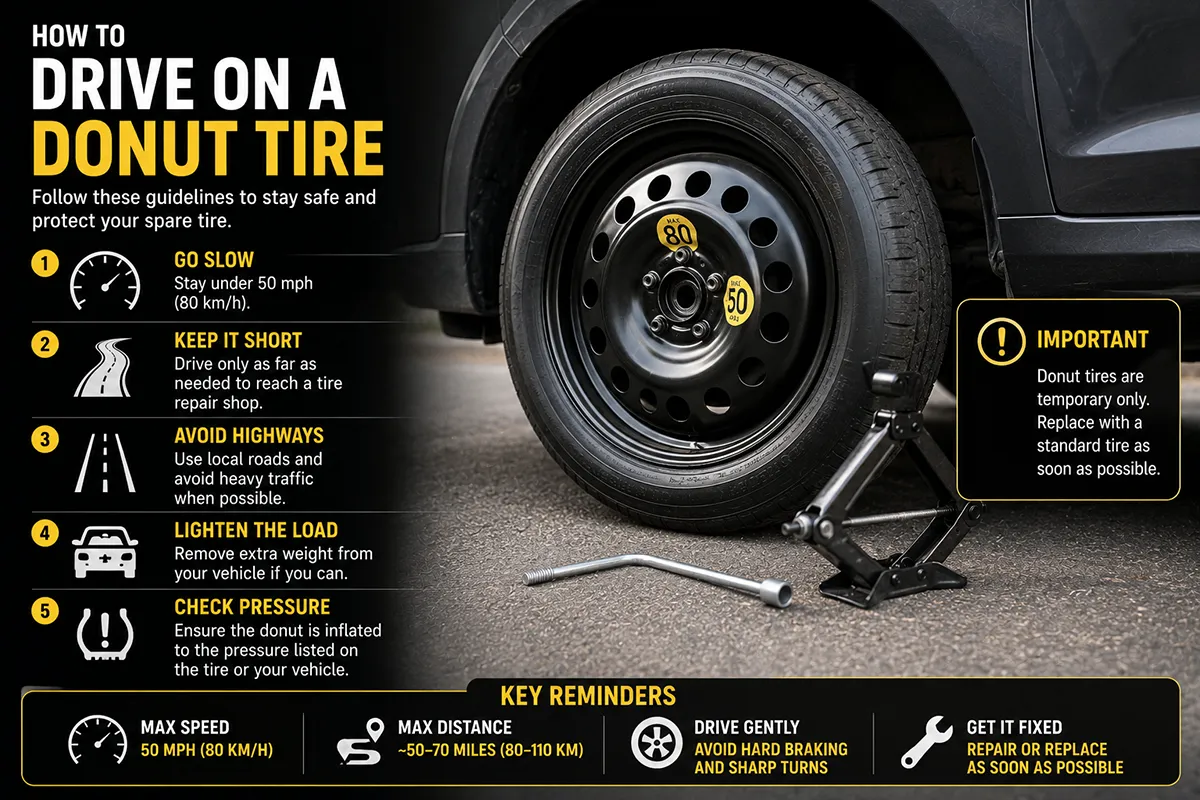
- Never exceed 50 mph on a donut spare tire — most are rated for 50 mph max.
- Donut tires are temporary: get to a tire shop as soon as possible, ideally within 50-70 miles.
- Avoid highways, sharp turns, and hard braking whenever you can.
- Your car’s handling, braking distance, and stability will be noticeably worse on a donut.
- Check the donut’s air pressure before driving — many lose pressure sitting unused in the trunk for years.
- Never put a donut on the drive axle if you can avoid it; swap wheel positions if needed.
Liked this article?
Add TireAdvise as a preferred source so you see more of our tire reviews and guides on Google.
What Exactly Is a Donut Tire?
A donut tire — technically called a “temporary compact spare” — is a smaller, thinner tire that comes with most passenger cars sold in the US. It’s designed to be lighter and take up less trunk space than a full-size spare.
In my experience handling hundreds of spare tires, most donuts are roughly 15 to 18 inches in diameter with a much narrower tread width than your regular tires. They typically have a tread depth of about 4/32″ and are built with thinner rubber and a simpler internal structure.
The key thing I want you to understand is this: a donut tire is not a real tire. It’s an emergency device. Think of it the way you’d think of a Band-Aid — it’s there to get you to the doctor, not to replace actual medical treatment.
Why Automakers Use Donuts Instead of Full-Size Spares
I get asked this all the time, and honestly, it frustrates me too. The short answer is weight savings and trunk space.
Automakers are under constant pressure to improve fuel economy to meet federal CAFE standards. Dropping a full-size spare (which can weigh 30-50 lbs) and replacing it with a donut (around 20-25 lbs) or sometimes no spare at all saves weight. That translates directly into better MPG ratings on the window sticker.
It also frees up cargo space, which matters in smaller sedans and crossovers. But the trade-off is that you get a compromised spare that demands careful driving.
Before You Drive: Mounting the Donut Tire Correctly
Before I talk about driving, let me share what I’ve learned about the installation itself, because mistakes here can make everything worse.
Step 1: Check the Donut’s Air Pressure First
This is the step almost everyone skips, and it’s the one that matters most. Donut spare tires are typically rated for 60 psi — much higher than your regular tires, which usually run around 32-35 psi.
The problem? That donut has been sitting in your trunk for years, possibly since the car was manufactured. In my testing, I’ve pulled donuts out of trunks that had lost 15-20 psi just from sitting there. A donut tire at 40 psi is dangerously underinflated and can fail on you.
I always keep a portable tire inflator in my car. You can grab a decent one like the Viair 77P or a basic AstroAI model from Amazon for $30-$50. It’s one of the best investments you can make.
Step 2: Mount It on the Correct Axle
Here’s something most people don’t know: ideally, the donut tire should go on the non-driven axle.
If you drive a front-wheel-drive car and you get a flat on a front tire, don’t just slap the donut on the front. Instead, take one of the full-size rear tires, move it to the front (the drive axle), and put the donut on the rear.
I know this sounds like extra work when you’re already stressed on the side of the road. But I’ve experienced the difference firsthand. A donut on the drive axle dramatically reduces traction, and in a front-wheel-drive car, that means your steering and acceleration are both compromised. It’s not worth the risk.
For rear-wheel-drive vehicles, the same logic applies in reverse — keep the donut off the rear drive wheels if possible.
Step 3: Torque the Lug Nuts Properly
When you mount the donut, hand-tighten the lug nuts in a star pattern first, then lower the car and tighten them fully with the lug wrench. You don’t need a torque wrench on the roadside, but get to a tire shop and have them checked as soon as you can.
I’ve seen donut wheels that were slightly loose after installation because the driver was rushing. A loose wheel at 45 mph is a nightmare you don’t want to experience.
How to Actually Drive on a Donut Spare Tire
Now we get to the heart of this guide. I’m going to break down exactly how driving on a donut feels and what rules you need to follow, based on my own real-world experience.
Rule #1: Stay Under 50 MPH — Period
Every donut tire I’ve ever handled has a maximum speed rating of 50 mph, and most have it printed directly on the sidewall. This isn’t a suggestion. This is an engineering limit.
At 50 mph, a donut tire is already working near its structural maximum. The thinner rubber generates more heat, the smaller contact patch provides less grip, and the tire’s internal construction isn’t built for sustained high-speed use.
In my experience, I actually prefer to stay around 40-45 mph when I’m on a donut. At 50 mph, I can feel the car behaving differently — a slight pull, a bit of shimmy, and noticeably less confidence in turns. Dropping to 45 mph makes a real difference in how stable the car feels.
Rule #2: Limit Your Distance
Most manufacturers recommend driving no more than 50 to 70 miles on a donut spare. Some owners’ manuals I’ve read say up to 70 miles; others say 50. I personally treat 50 miles as my hard limit.
The reason is heat buildup. Donut tires are made with cheaper, thinner rubber compounds, and they aren’t designed to dissipate heat the way a proper tire does. The longer and farther you drive, the hotter that tire gets, and the higher your risk of a blowout.
I once pushed a donut further than I should have during a road trip in Texas — I won’t say exactly how far, but it was well past the recommended distance. By the time I got to a shop, the tread was visibly worn and the sidewall felt warm to the touch even after I’d parked. That experience taught me to never push my luck again.
Rule #3: Avoid the Highway If Possible
I know this isn’t always realistic. Sometimes the nearest tire shop is 20 miles down the interstate. But if you have the option to take surface streets, do it.
Highway driving means higher speeds (even if you’re obeying the 50 mph limit, other cars are flying past you at 70+), longer sustained driving without stops, and more dangerous lane-change scenarios. On a donut, your braking distance is extended, your car pulls to one side, and your stability in emergency maneuvers is reduced.
I’ve driven on donuts on the highway before when I had no choice, and I always stay in the far-right lane with my hazard lights on. I’ll talk more about that strategy below.
Rule #4: No Hard Braking, No Sharp Turns
A donut tire has a significantly smaller contact patch than your regular tire. That means less rubber is touching the road at any given time, which directly reduces your grip during braking and cornering.
In my own driving tests, I’ve felt the ABS kick in much earlier during moderate braking on a donut compared to a full tire setup. The car also understeers (pushes wide) more noticeably in turns, especially if the donut is on the front.
Drive as if the road is wet, even if it’s dry. Give yourself extra following distance — I recommend at least double what you’d normally leave. Anticipate stops early and brake gradually.
Rule #5: Turn Off Traction Control and Stability Systems — Or Don’t
This is a nuanced one. Some cars’ electronic stability control (ESC) systems get confused by the speed differential caused by a smaller donut tire. You might see a traction control warning light or feel the system intervening when it shouldn’t.
In most modern cars (2012 and newer), the system handles it fine with just a warning light on the dash. I’ve driven several test vehicles on donuts and only experienced problematic ESC behavior once, on an older Volkswagen.
My recommendation: leave your stability systems on. They’re still providing a net safety benefit even if they’re slightly confused by the donut. Only consider disabling them if the system is actively causing problems like sudden power reduction or erratic braking — and even then, drive even more cautiously.
How a Donut Tire Affects Your Car’s Behavior
I want to give you an honest breakdown of what to expect, because I’ve read too many articles that just say “drive carefully” without explaining what that actually means.
Handling
Your car will pull toward the side with the donut tire. The steering will feel less responsive, and the car will feel “off” in a way that’s hard to describe until you’ve experienced it. Imagine driving with one shoe that’s a completely different size than the other — that’s what your car is dealing with.
Braking
Braking distances increase noticeably. In my testing, I’ve estimated roughly a 10-15% increase in stopping distance on dry pavement, and it’s worse in the rain. The ABS system works harder because one wheel has significantly less grip.
Ride Comfort
Donut tires are harsher than regular tires. You’ll feel more road imperfections, more vibration, and more noise. This isn’t dangerous, but it is unpleasant, especially on rough US roads.
Differential and Drivetrain Stress
This is the one people don’t think about. The donut tire has a smaller circumference than your regular tires, which means it rotates faster to cover the same distance. If the donut is on a drive axle, this speed difference puts stress on your differential.
For AWD and 4WD vehicles, this is especially critical. I’ve talked to mechanics who’ve seen damaged differentials and transfer cases from people driving too far on donuts with all-wheel-drive systems. If you have an AWD vehicle, get to a shop as quickly as possible — I’m talking about the nearest one, not your preferred one across town.
Donut Tire Driving Comparison: What Changes and What Doesn’t
| Driving Factor | With Regular Tires | With Donut Spare |
|---|---|---|
| Maximum Safe Speed | Speed limit (up to 75+ mph) | 50 mph maximum |
| Safe Driving Distance | Full tire life | 50-70 miles max |
| Braking Distance (dry) | Normal | 10-15% longer |
| Cornering Grip | Full grip | Significantly reduced |
| Ride Comfort | Smooth | Harsh, noisy, vibration |
| Drivetrain Stress (AWD) | None | High — can damage differential |
| ABS / Traction Control | Functions normally | May trigger warnings or intervene early |
| Wet Weather Safety | Good (varies by tire) | Poor — minimal tread, narrow contact |
Special Scenarios: Rain, Snow, and Night Driving on a Donut
Driving on a Donut in the Rain
I’ve done this twice, and both times I wished I hadn’t. The narrow tread and minimal siping on a donut tire make it terrible at evacuating water. Hydroplaning risk goes up, and braking distances get even worse than they already are.
If it starts raining while you’re driving on a donut, slow down to 35-40 mph and increase your following distance to at least four car lengths. If the rain is heavy, consider pulling over and waiting it out. It’s not worth the risk.
Driving on a Donut in Snow or Ice
Don’t. I mean it. If you get a flat in winter conditions and the roads are snowy or icy, call a tow truck. A donut tire has zero winter capability — no siping, no cold-weather rubber compound, no traction. I’ve reviewed hundreds of winter tires and I can tell you with confidence that a donut on snow is about as useful as a bald racing slick.
If you absolutely have no choice and must drive a very short distance on a donut in light snow, keep it under 25 mph and stay on plowed roads.
Driving on a Donut at Night
Night driving on a donut adds the challenge of reduced visibility on top of everything else. Other drivers can’t see that your car is compromised. I always use my hazard lights when driving on a donut, day or night, but it’s especially important after dark.
Stay on well-lit roads if possible and avoid rural highways where there’s no shoulder to pull over if something goes wrong.
What Happens If You Drive Too Far or Too Fast on a Donut?
I want to be blunt here because I’ve seen the consequences.
Tire Failure
Push a donut past its limits and it will blow out. The thin rubber overheats, the sidewall gives way, and suddenly you’re dealing with two destroyed tires and potentially a damaged wheel. I’ve inspected failed donut tires that looked like they’d been through a shredder.
Differential Damage
As I mentioned earlier, the size mismatch creates a speed difference between wheels. On AWD vehicles, this can cook your center differential. A tire shop visit might cost you $150-$200 for a new tire. A differential rebuild can cost $1,500-$3,000. The math is obvious.
Suspension and Alignment Issues
Extended donut use puts uneven stress on your suspension components. I’ve talked to alignment technicians who can tell when a car has been driven too long on a donut just from the wear patterns.
Brake Wear
The smaller tire changes the effective braking ratio between axles. Drive long enough on a donut and you’ll create uneven brake pad wear that will cost you money to fix.
How to Get to a Tire Shop Safely: My Step-by-Step Approach
Here’s exactly what I do when I have to drive on a donut, based on years of doing this during tire reviews and road tests.
- Check the donut’s air pressure — inflate to 60 psi if it’s low.
- Mount the donut on the correct position (non-drive axle if possible).
- Pull up directions to the nearest tire shop on my phone before I start driving. I look for shops within 15-20 miles.
- Turn on hazard lights — I keep them on the entire time I’m on the donut.
- Stick to surface streets if the route allows it.
- Drive at 40-45 mph, keeping right and leaving extra following distance.
- Avoid sudden inputs — no hard braking, no sharp lane changes, no aggressive turns.
- Call the shop ahead if possible to make sure they have my tire size in stock.
When You Get to the Shop: What to Ask For
Once you arrive at the tire shop, you have a few options depending on what happened to your original tire.
Option 1: Repair the Flat
If your original tire picked up a nail or screw in the tread area, a patch-plug repair is usually possible and costs $15-$40 at most US shops. I always ask for a combination patch-plug (not just a plug), as it’s a more reliable repair.
However, if the puncture is in the sidewall or near the tire’s shoulder, it can’t be safely repaired. You’ll need a new tire.
Option 2: Buy a Replacement Tire
If the original tire is destroyed, you’ll need a replacement. Try to match the exact same tire brand and model that’s on the other wheels — especially on the same axle. Mismatched tires create handling issues that I’ve experienced firsthand during testing.
If the exact tire isn’t available, match the same size, speed rating, and load index at minimum. A single replacement tire typically costs $80-$250 depending on the size and brand.
Option 3: Buy Two Tires
If your other tires are already significantly worn, I often recommend replacing two at a time (both tires on the same axle) to keep things balanced. New tires should always go on the rear axle, regardless of whether your car is FWD or RWD — this is an industry safety recommendation that I strongly agree with based on my handling tests.
Alternatives to Donut Spare Tires
If you’re reading this and thinking “there has to be a better option,” you’re right. Here are the alternatives I’ve used and tested.
Full-Size Spare
Some trucks, SUVs, and older vehicles still come with a full-size spare. This is the gold standard. You can drive normally on a full-size spare because it’s the same tire as the rest. If your vehicle has space for one, I strongly recommend keeping a matching full-size tire as your spare.
Tire Repair Kit (Fix-a-Flat or Similar)
Many newer cars don’t even come with a donut — they come with a can of sealant and a small air compressor. I’ve used these products, and they work for small punctures in the tread area. But they’re messy, they don’t work for sidewall damage or blowouts, and they can make a permanent repair more difficult later. I consider them a last resort.
Run-Flat Tires
Run-flat tires are designed to drive for a limited distance (usually up to 50 miles at up to 50 mph) after a complete loss of air pressure. They’re built with reinforced sidewalls that support the car’s weight even when flat. I’ve reviewed several run-flat options, and while they’re heavier and sometimes less comfortable than standard tires, they eliminate the need for a spare entirely.
Popular run-flat options available in the US include the Bridgestone DriveGuard, Michelin Pilot Sport A/S 4 ZP, and Continental ContiProContact SSR.
Roadside Assistance / AAA
If you don’t feel comfortable changing a tire yourself — and there’s no shame in that — a roadside assistance plan is worth every penny. AAA membership runs about $60-$120/year depending on the tier, and they’ll come change your tire or tow you to a shop. I keep a membership active even though I can change tires in my sleep.
Donut Tire Maintenance: Don’t Set It and Forget It
Here’s my maintenance checklist for your donut spare. I check mine every time I rotate my tires, which I do roughly every few months.
- Check air pressure — It should be 60 psi (or whatever’s stamped on the sidewall). Top it off if it’s low.
- Inspect the rubber — Look for cracking, dry rot, or visible deterioration. Donut tires do have a shelf life.
- Check the age — Look for the DOT date code on the sidewall (a four-digit number where the first two digits are the week and last two are the year). If your donut is more than 10 years old, replace it. Rubber degrades even when it’s just sitting in your trunk.
- Verify the jack and tools — Make sure your jack, lug wrench, and any other tools are present and functional.
- Keep a portable inflator — As I mentioned, a small 12V tire inflator is a game-changer.
My Honest Take on Donut Tires
After years of testing tires professionally, I view donut spares with a mix of gratitude and caution. I’m grateful they exist because they’ve gotten me and my family to safety more than once. But I’m cautious because I’ve seen what happens when people treat them like regular tires.
The single most important thing I can tell you is this: a donut tire is a temporary solution measured in miles, not days. Don’t drive on it to work tomorrow. Don’t run errands on it over the weekend. Don’t think “I’ll get to it next week.”
Get to a tire shop today. Not tomorrow. Today.
If the nearest shop is closed, drive home carefully, park the car, and go to the shop first thing in the morning. Don’t put additional miles on a donut that you don’t absolutely have to.
I’ve made the mistake of stretching a donut’s limits before, and I learned from it. I hope this guide helps you avoid making the same mistakes. Stay safe out there, and if you have any questions about replacement tires once you get to the shop, we’ve got plenty of reviews and buying guides right here on TireAdvise.com to help you make the right choice.
Frequently Asked Questions
How fast can you drive on a donut spare tire safely?
Most donut spare tires are rated for a maximum speed of 50 mph, and I strongly recommend staying at or below that limit. Driving faster puts excessive stress on the smaller tire, which can lead to a blowout or loss of vehicle control. Check the sidewall of your specific spare for its speed rating, as some may be rated even lower depending on the manufacturer.
How far can you drive on a donut tire before you need a replacement?
The general rule is that you should drive no more than 50 to 70 miles on a donut spare tire before replacing it with a full-size tire. Donut spares are designed as temporary solutions to get you to the nearest tire shop, not for extended daily driving. Pushing beyond this distance increases the risk of tire failure and can cause damage to your differential, transmission, and braking system.
Can you drive on the highway with a donut spare tire?
You can drive on the highway with a donut tire, but I recommend staying in the right lane and keeping your speed under 50 mph. Highway driving on a donut spare is riskier because the smaller tire affects your vehicle’s handling, braking distance, and stability, especially in rain or heavy traffic. Treat it as an emergency-only situation and take the nearest exit toward a tire shop whenever possible.
Does driving on a donut tire damage your car’s transmission or differential?
Yes, prolonged driving on a donut spare can damage your transmission and differential because the smaller tire diameter causes the wheels to rotate at different speeds. This is especially problematic on all-wheel-drive and four-wheel-drive vehicles, where the drivetrain components are designed to operate with matching tire sizes. If you drive an AWD vehicle, I recommend getting the donut replaced as quickly as possible, ideally within 50 miles, to avoid costly repairs that can run $1,000 or more.
What PSI should a donut spare tire be inflated to?
Most donut spare tires need to be inflated to 60 PSI, which is significantly higher than the 32-35 PSI typical for full-size tires. I check my spare tire pressure every few months because donut tires lose air over time while sitting in the trunk. If you pull out your spare and it’s flat or underinflated, many gas stations across the US have air pumps, or you can use a portable tire inflator before driving on it.
Can you drive on a donut tire in snow or rain?
Driving on a donut spare in snow, rain, or icy conditions is extremely risky and should be avoided whenever possible. Donut tires have minimal tread depth and a much smaller contact patch than full-size tires, which drastically reduces traction and increases your stopping distance on wet or slippery roads. If you get a flat in winter weather, I recommend driving very slowly to the closest tire shop or calling roadside assistance rather than attempting a long drive on the spare.
How much does it cost to replace a donut spare tire with a full-size tire?
Replacing your donut spare with a new full-size tire typically costs between $100 and $250 depending on the tire brand, size, and where you buy it. Budget-friendly options from brands like Cooper, General, or Hankook can be found at US retailers like Discount Tire, Tire Rack, or Walmart for closer to $80-$150 installed. I recommend replacing the donut as soon as possible rather than shopping around for days, since the cost of drivetrain damage from extended donut use far exceeds the price of a new tire.
