

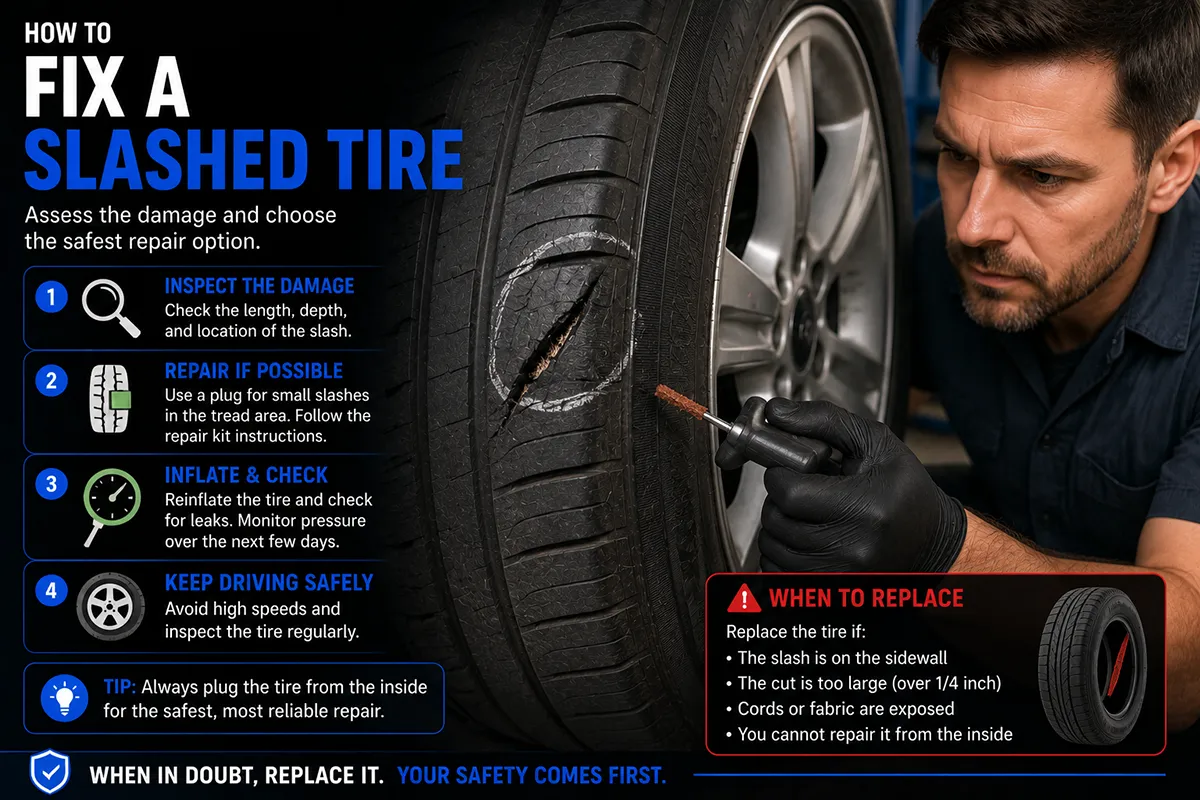
Finding your tire slashed in a parking lot is one of the worst feelings any driver can experience. I’ve been there — walked out of a grocery store to find my rear tire completely flat with a clean cut along the sidewall.
In that moment, a dozen questions flood your mind. Can I fix this? How much is this going to cost me? Am I safe to drive on this?
I’ve spent over a decade testing, reviewing, and writing about tires for everyday drivers across the US, and I’ve dealt with slashed tires more times than I’d like to admit — both on my own vehicles and while helping friends and family. In this guide, I’m going to walk you through exactly what to do when you discover a slashed tire, whether it can be repaired, and when you absolutely need a replacement.
- Most slashed tires cannot be safely repaired if the cut is on the sidewall or longer than ¼ inch.
- Small puncture-style cuts in the tread area (under ¼ inch) may be repairable with a plug-patch combo.
- Never drive on a slashed tire — use your spare, call roadside assistance, or have it towed.
- Replacement tires cost between $80–$250+ each depending on size and brand.
- File a police report and check your insurance — comprehensive auto coverage often covers vandalism.
- If you need to replace just one tire, match the brand, model, and size of your existing tires whenever possible.
Liked this article?
Add TireAdvise as a preferred source so you see more of our tire reviews and guides on Google.
Step 1: Assess the Damage Before You Do Anything
The very first thing I always tell people is to stop, breathe, and look at the damage carefully before making any decisions. Not all slashes are created equal, and the location and size of the cut will determine everything that comes next.
Here’s what to look for:
- Location of the cut: Is it on the sidewall (the vertical part of the tire) or on the tread (the part that contacts the road)?
- Length of the cut: Is it a small puncture-like nick, or a long gash several inches across?
- Depth of the cut: Did the blade go all the way through the rubber, or is it a surface scratch?
- Air loss: Is the tire completely flat, slowly leaking, or still holding air?
In my experience, about 90% of intentionally slashed tires involve a sidewall cut, because that’s the softest, most accessible part of the tire when a vehicle is parked. Unfortunately, that’s also the worst possible location for a repair.
Step 2: Understand What Can and Cannot Be Repaired
This is the section most people skip to, so I’ll be blunt: **if the slash is on the sidewall, the tire needs to be replaced.** There is no safe, permanent repair for sidewall damage. Period.
I know that’s not what you want to hear, especially if you’re looking at a relatively new tire. But the sidewall is a structural component of the tire. It flexes constantly while driving, bears the vehicle’s weight, and is reinforced with internal cords that, once severed, cannot be restored to their original strength.
When a Repair Might Be Possible
There are some narrow circumstances where a slashed tire can be repaired:
- The cut is in the tread area only (the center portion of the tire that contacts the road).
- The cut is smaller than ¼ inch (6mm) in diameter or length.
- The cut hasn’t damaged the internal steel belts or body plies.
- The tire hasn’t been driven on while flat (run-flat damage destroys the internal structure).
If all four of those conditions are met, a qualified tire technician can perform a plug-patch combination repair from the inside of the tire. I’ve had this done successfully on a couple of occasions, and the repaired tires performed perfectly for the remainder of their tread life.
When Replacement Is the Only Option
You’ll need a new tire if any of these apply:
- The slash is on the sidewall or shoulder area (where the tread meets the sidewall).
- The cut is longer than ¼ inch.
- You can see internal cords, fabric, or steel belts through the cut.
- The tire was driven on while flat, even for a short distance.
- There are multiple cuts on the same tire.
I’ve seen people try to use tire sealant products or external plug kits on sidewall slashes, and I want to be very clear: **this is extremely dangerous.** A sidewall repair can fail catastrophically at highway speeds, and no reputable tire shop in the US will perform one. The Rubber Manufacturers Association (now the US Tire Manufacturers Association) explicitly states that sidewall repairs are not safe.
Step 3: Get Your Vehicle Off the Road Safely
If you discover the slash while your car is parked (which is most common with vandalism), you have some options. If you discover it while driving and feel the tire going flat, the situation requires more immediate action.
If You’re Parked
- Do not drive on the flat tire. Even rolling a few hundred feet through a parking lot on a completely flat tire can destroy the tire’s internal structure and potentially damage the wheel rim.
- Install your spare tire if you have one and know how to change it safely.
- Call roadside assistance if you don’t have a spare or aren’t comfortable changing a tire. AAA membership costs around $60–$100/year and covers tire changes. Many auto insurance policies and even credit cards include roadside assistance too.
- Use a tire inflator/sealant kit only as an absolute last resort, and only if the cut is small enough that it might temporarily hold air. Many newer vehicles come with these kits instead of spare tires. In my experience, they rarely work well on slashes — they’re designed for nail punctures.
If You’re Driving When the Tire Goes Flat
- Grip the steering wheel firmly and do not slam the brakes.
- Gradually reduce speed and pull over to the right shoulder or the nearest safe, flat surface.
- Turn on your hazard lights immediately.
- Once stopped, assess the situation and either change to your spare or call for help.
I had an experience a few years back where a tire I was testing developed a sudden leak from road debris on I-95 outside of Richmond. Even though it wasn’t a slash, the experience of a rapid deflation at highway speed is genuinely scary. The key is staying calm, holding the wheel steady, and decelerating gradually. That advice applies regardless of the cause.
Step 4: Change to Your Spare Tire
If you’re going to change the tire yourself, here’s the process I follow every time. I’ve done this dozens of times across different vehicles, and the fundamentals are always the same.
What You’ll Need
- Spare tire (full-size or compact “donut” spare)
- Jack (usually stored with your spare)
- Lug wrench
- Wheel lock key (if your vehicle has wheel locks)
- Flashlight (if it’s dark)
- Gloves and a mat or towel to kneel on (optional but helpful)
The Process
- Park on a flat, firm surface and engage your parking brake. If you’re on soft ground, the jack can sink and fail.
- Loosen the lug nuts slightly (about a quarter turn) while the tire is still on the ground. This prevents the wheel from spinning when you try to remove them later.
- Position the jack under the vehicle’s designated jack point. Check your owner’s manual — every car has specific reinforced spots for jacking. Using the wrong spot can damage your vehicle’s frame or body.
- Raise the vehicle until the flat tire is about 6 inches off the ground.
- Remove the lug nuts completely and pull the flat tire off.
- Mount the spare tire, hand-tighten the lug nuts in a star pattern, then lower the vehicle.
- Tighten the lug nuts fully once the tire is on the ground, again in a star pattern. Most lug nuts should be torqued to 80–100 ft-lbs, but check your owner’s manual for the exact specification.
If you’re using a compact spare (the small “donut” type), remember that these are rated for a maximum of 50 mph and are intended for temporary use only — typically no more than 50–70 miles. I always recommend getting to a tire shop as soon as possible when running on a compact spare.
Step 5: Decide Between Repair and Replacement
Once you’ve gotten the damaged tire off the vehicle (or had it towed to a shop), it’s time to make the big decision.
If the Tire Can Be Repaired
A proper tire repair at a shop like Discount Tire, Tire Rack’s installer network, Firestone, or a local independent shop typically costs between **$20 and $40**. The technician will dismount the tire, inspect the damage from the inside, apply a plug-patch combination, and remount and balance the tire.
I’ve had repairs done at both chain shops and independents, and the quality has been consistent as long as the shop follows industry standards. The key is that the repair must be done from the inside — a plug-only repair from the outside is considered a temporary fix at best.
If the Tire Needs to Be Replaced
This is where things get more complicated and more expensive. Here’s a realistic breakdown of what you can expect to pay for a single replacement tire in the US market:
| Tire Category | Typical Price Range (per tire) | Example Brands | Best For |
|---|---|---|---|
| Budget | $60–$100 | Westlake, Ironman, Cooper CS5 | Everyday commuting, tight budgets |
| Mid-Range | $100–$175 | Continental TrueContact, General Altimax, Falken Sincera | Balanced performance and value |
| Premium | $150–$250+ | Michelin Defender, Bridgestone Turanza, Goodyear Assurance | Long tread life, superior wet/dry grip |
| Performance/SUV | $175–$350+ | Michelin Pilot Sport, BFGoodrich KO2, Pirelli Scorpion | Trucks, SUVs, sporty vehicles |
On top of the tire cost, expect to pay **$15–$30 for mounting and balancing**, plus any applicable state tire disposal fees (usually $2–$5 per tire).
Should You Replace One Tire or All Four?
This is one of the most common questions I get, and the answer depends on your drivetrain and the condition of your remaining tires.
For Front-Wheel Drive or Rear-Wheel Drive Vehicles
If your other three tires have plenty of tread life remaining and are in good condition, you can usually get away with replacing just the one damaged tire. The key is to **match the exact same brand, model, and size** as your existing tires. I recommend buying from retailers like Tire Rack, Discount Tire, or Walmart Tire Center where you can search by your exact tire specification.
If the replacement tire has significantly more tread depth than the other tires on the same axle, some shops can “shave” the new tire down to match. This is less common but worth asking about if the tread depth difference is substantial.
For All-Wheel Drive Vehicles
AWD vehicles are more sensitive to tread depth differences between tires. Even a small variation in tire circumference can stress the differential and transfer case over time. Many AWD vehicle manufacturers, including Subaru, recommend that all four tires be within 2/32″ of tread depth of each other.
In my experience testing AWD vehicles, I’ve seen the consequences of mismatched tires — premature drivetrain wear and odd handling characteristics. If your remaining tires have significant wear, you may need to replace all four. It’s frustrating and expensive, but it’s cheaper than a differential repair.
Step 6: File a Police Report and Check Your Insurance
A slashed tire is vandalism, which is a criminal act. Even if you don’t think the police will catch whoever did it, filing a report is important for several reasons.
- It creates an official record of the incident.
- Your insurance company will likely require it if you file a claim.
- It helps police track patterns of vandalism in your area.
Will Insurance Cover a Slashed Tire?
If you carry **comprehensive coverage** on your auto insurance policy (not just liability), tire vandalism is typically covered. Here’s how it usually works:
- You’ll pay your deductible (commonly $250–$500 for comprehensive claims).
- Insurance covers the remainder of the replacement cost.
- Comprehensive claims generally **do not raise your rates** since they’re not at-fault incidents.
However, if you’re only replacing one tire at $120–$150, it may not make financial sense to file a claim against a $500 deductible. I’d only recommend filing if the damage is substantial — for example, if multiple tires were slashed, or if a wheel rim was also damaged.
Can Tire Sealant Fix a Slashed Tire?
I get this question all the time, and I’ve tested multiple tire sealant products over the years — Fix-a-Flat, Slime, and several others. Here’s my honest assessment.
For a true slash? No. Tire sealant products work by filling the inside of the tire with a liquid latex compound that seeks out small puncture holes and seals them. They’re designed for nail holes and small punctures up to about ¼ inch in diameter.
A slash from a knife or box cutter typically creates a long, linear cut that sealant simply cannot close. The liquid will pour right out of the wound faster than it can congeal. I’ve tried it on a test tire with a sidewall cut, and within seconds the sealant was spraying out of the slash along with the remaining air.
There’s one very narrow exception: if someone attempted to slash your tire but only managed a very small, shallow puncture (perhaps because the knife was dull or the tire’s construction resisted the cut), a sealant might temporarily seal it enough to get you to a shop. But I’d only rely on this in a true emergency with no other options.
How to Prevent Tire Slashing in the Future
While you can’t completely eliminate the risk of vandalism, there are practical steps I’ve taken — and recommend — that reduce the chances significantly.
Parking Smart
- Park in well-lit areas whenever possible. Vandals prefer darkness and privacy.
- Use garage parking if available, especially overnight.
- Park near security cameras. Many parking lots, apartment complexes, and businesses have surveillance systems. Even visible camera presence is a deterrent.
- Avoid isolated spots. The back corner of a parking lot may be convenient, but it’s also the most vulnerable.
Technology and Deterrents
- Dash cams with parking mode: Cameras like the Viofo A129 or BlackVue DR900X have motion-activated recording that captures activity around your vehicle while parked. I’ve been running a dash cam with parking mode for several years now, and it provides genuine peace of mind.
- Tire pressure monitoring systems (TPMS): All vehicles sold in the US since 2008 have TPMS. If you have an aftermarket TPMS that sends alerts to your phone, you’ll know immediately if a tire loses pressure.
- Motion-activated lights: If you park in a driveway, motion-sensitive flood lights are inexpensive and effective.
What About Tire Protection Plans?
Many tire retailers in the US offer road hazard or tire protection warranties when you buy new tires. These are worth considering, especially if you’re now replacing a tire due to vandalism.
Popular Tire Protection Plans
- Discount Tire Certificate: Covers repair or replacement for road hazards. Cost is typically $15–$30 per tire at the time of purchase. In my experience, this is one of the best values in the tire industry.
- Tire Rack Road Hazard Protection: Available for online purchases, covers up to the original purchase price of the tire. Costs vary but are generally reasonable.
- Costco Tire Warranty: Includes road hazard protection with every tire purchase at no additional cost. Another reason I recommend Costco for tire buying.
It’s worth noting that some protection plans **do not cover vandalism** — they only cover accidental road hazard damage like potholes, nails, and debris. Read the fine print before you buy, and ask specifically about vandalism coverage.
How Long Can You Drive on a Spare Tire?
If you’ve put on your spare tire after a slash, it’s natural to wonder how long you can ride on it before getting a replacement.
Compact “Donut” Spare
These should be treated as a get-to-the-shop-immediately solution. Most are rated for 50 mph maximum and 50–70 miles of use. In my experience, I wouldn’t push it beyond a day or two. The handling difference is noticeable — the car will feel unbalanced, and braking distances increase.
Full-Size Spare
If you’re lucky enough to have a full-size spare that matches your other tires, you have more flexibility. You can drive on it normally, but keep in mind that the spare may be a different age than your other tires, and the tread depth may not match perfectly. This matters more on AWD vehicles, as I mentioned earlier.
My Recommended Steps — Quick Action Plan
Here’s a summary of exactly what I’d do (and have done) when dealing with a slashed tire:
- Stay calm and assess the damage. Take photos of everything.
- Do not drive on the flat tire. Use your spare or call roadside assistance.
- File a police report, even if it feels pointless.
- Take the tire to a reputable shop for professional evaluation. Don’t assume it can or can’t be fixed — let a technician inspect it from the inside.
- If replacing, match your existing tires in brand, model, and size. For AWD vehicles, check tread depth on all four tires.
- Check your insurance and consider filing a comprehensive claim if the costs exceed your deductible.
- Invest in prevention — dash cam with parking mode, better parking habits, and a tire protection plan for your new purchase.
Final Thoughts From Someone Who’s Been There
Discovering a slashed tire is infuriating. It’s a violation that feels personal, it disrupts your day, and it costs money you didn’t plan to spend. But the good news is that dealing with it is straightforward if you take it step by step.
The most important thing I want you to take away from this guide is this: **don’t try to repair a sidewall slash.** I understand the temptation to save money, but a tire blowout at highway speed can be deadly. A new tire costs $80–$250. That’s a small price for your safety and the safety of everyone else on the road.
If you’re in the market for a replacement tire now because of a slash, I recommend checking out our reviews here on TireAdvise.com. I’ve personally tested and reviewed dozens of popular tire models across every category, and I can help you find the right fit for your vehicle, driving style, and budget.
Stay safe out there, and may your parking karma improve from here on out.
Frequently Asked Questions
Can you repair a slashed tire or does it need to be replaced?
In most cases, a slashed tire cannot be safely repaired and needs to be replaced. Tire plugs and patches are designed for small punctures in the tread area, but a slash typically damages the sidewall or creates a cut too large to seal reliably. Driving on a repaired slash puts you at serious risk of a blowout, especially at highway speeds common on US interstates. I always recommend replacing a slashed tire rather than attempting a permanent fix.
How much does it cost to replace a slashed tire in the US?
Replacing a single slashed tire typically costs between $100 and $300 for most passenger cars and sedans, depending on the tire brand, size, and where you shop. Popular US retailers like Discount Tire, Tire Rack, and Costco often offer competitive pricing and include mounting and balancing. If you drive an SUV or truck, expect to pay $150 to $400 or more per tire. I recommend checking if your tire warranty or road hazard protection covers slash damage before paying out of pocket.
Can you use a tire plug kit on a slashed tire as a temporary fix?
A tire plug kit can sometimes serve as a very short-term emergency fix if the slash is small, located in the tread area, and less than a quarter inch long. However, most slashes are too large or positioned on the sidewall where plugs are not safe or effective. If you do use a plug as a roadside emergency measure, drive slowly to the nearest tire shop and keep your speed under 50 mph. This is strictly a get-to-the-shop solution, not a permanent repair.
Does car insurance or road hazard coverage pay for a slashed tire?
Comprehensive auto insurance may cover a slashed tire if the damage was caused by vandalism, but you will need to file a police report and pay your deductible, which often exceeds the cost of a single tire. Road hazard warranties offered by retailers like Discount Tire, America’s Tire, and Tire Rack are a better bet since they typically cover slash and puncture damage with free or prorated replacement. I always recommend adding road hazard protection when purchasing new tires because it usually costs only $15 to $30 per tire and can save you hundreds.
How do you know if your tire was slashed versus a normal flat?
A slashed tire usually has a clean, straight cut on the sidewall or tread that looks deliberate rather than the jagged tear you see from running over a nail or road debris. You may also notice the tire went completely flat overnight while parked, with no visible nail or screw embedded in the rubber. If you suspect vandalism, take photos of the damage and file a police report before heading to a tire shop. A tire technician can confirm whether the cut pattern is consistent with intentional slashing.
Is it safe to drive on a slashed tire with Fix-a-Flat or tire sealant?
Fix-a-Flat and similar tire sealants are designed for small nail-hole punctures, not for slashes, and they will not hold a seal on a cut longer than about 1/4 inch. Attempting to drive on a slashed tire with sealant can cause a dangerous blowout, rim damage, and even loss of vehicle control on busy US highways. If your tire has been slashed, use your spare tire or call roadside assistance to get towed to the nearest shop. It is never worth the risk to drive on a compromised tire just to avoid a tow.
Should you replace all four tires if one tire gets slashed?
You do not always need to replace all four tires when one gets slashed, but it depends on how much tread is left on your remaining tires. If your other three tires have less than 4/32-inch tread depth or are mismatched, most tire professionals recommend replacing at least two tires on the same axle to maintain even handling. For AWD vehicles common in states with harsh winters, mismatched tread depths can damage the drivetrain, so replacing all four may be necessary. I suggest having your tire shop measure your remaining tread and advise you based on your specific vehicle and driving conditions.
