

I got a call from my neighbor last winter asking why his brand-new tires felt “weird” in the rain. He’d just had a set of directional tires installed at a local shop, and two of them were mounted backward. It took me about five seconds of looking at the sidewall to spot the problem.
It’s a mistake that happens more often than you’d think — and it can seriously compromise your safety.
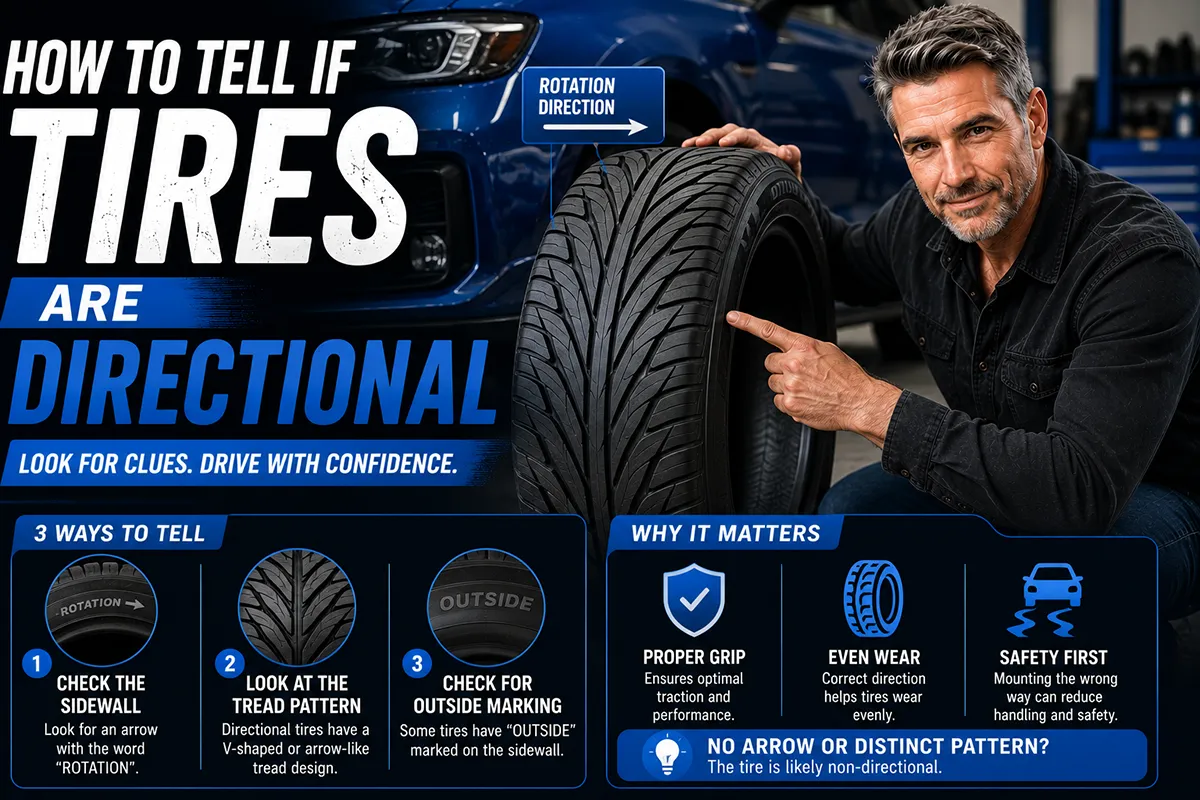
- Directional tires have an arrow or “ROTATION” marking on the sidewall indicating the correct rolling direction.
- The tread pattern on directional tires typically forms a V-shape or arrowhead pointing forward.
- Mounting directional tires backward reduces wet traction, increases road noise, and can cause uneven wear.
- Non-directional and asymmetric tires look different and have their own mounting rules — don’t confuse the three.
- You can visually identify a directional tire in under 30 seconds once you know what to look for.
Liked this article?
Add TireAdvise as a preferred source so you see more of our tire reviews and guides on Google.
What Are Directional Tires, Exactly?
Directional tires — sometimes called “unidirectional” tires — are designed to rotate in only one direction. The tread pattern is engineered to channel water away from the contact patch in a specific way, almost like a plow pushing snow or water to the sides.
I’ve been reviewing and recommending tires for years, and directional designs remain one of the most popular choices for drivers in wet or snowy climates across the US. Brands like Michelin, Continental, Bridgestone, and Goodyear all offer directional options in their lineups.
The key thing to understand is that the tread grooves are angled to work optimally when spinning in one direction. If you mount the tire backward, those grooves actually funnel water *toward* the center of the contact patch instead of away from it. That’s the opposite of what you want.
The Fastest Way to Tell: Check the Sidewall
In my experience, the single fastest and most reliable way to identify a directional tire is to look at its sidewall. Every directional tire I’ve ever handled — and I’ve handled hundreds — has a clear marking that tells you which direction it should spin.
Here’s what to look for:
- An arrow or triangle: Most directional tires have a small arrow molded into the rubber on the sidewall. This arrow points in the direction the tire should rotate when the vehicle moves forward.
- The word “ROTATION”: You’ll often see the word “ROTATION” printed next to the arrow. Sometimes it says “DIRECTION” or “THIS SIDE OUT” combined with an arrow.
- A directional indicator stamp: Some manufacturers use a small icon or graphic that shows the intended rotation direction.
I always recommend doing this check before the tire goes on the wheel. It takes literally seconds. If you see an arrow on the sidewall pointing in a specific direction, you’re holding a directional tire.
What If the Markings Are Worn or Hard to Read?
I’ve run into this a few times with used tires or older stock. If the sidewall marking is faded or covered in grime, grab a rag and some soapy water and clean the area. The molded markings are pressed into the rubber itself, so even if painted-on text fades, the physical imprint should still be there.
If you still can’t find any marking, move on to the tread pattern check, which I’ll cover next.
Reading the Tread Pattern Like a Pro
Even without looking at the sidewall, I can usually tell if a tire is directional just by studying the tread from the front. Directional tires have a very distinctive look that’s hard to miss once you know what you’re looking for.
The V-Shape or Arrow Pattern
The most common directional tread design features grooves that form a V-shape or chevron pattern. Imagine looking at the tire head-on: the grooves angle downward and outward from the center of the tread, creating a shape that looks like an arrowhead or the letter V.
This V-shaped design is what makes directional tires so effective at evacuating water. As the tire rolls forward, the angled grooves push water from the center toward the outer edges, reducing the risk of hydroplaning.
I tested a set of Continental ExtremeContact DWS 06 Plus tires during a particularly rainy stretch of driving, and the difference in wet grip compared to my old non-directional all-seasons was immediately noticeable. The directional pattern on those tires does exactly what it’s supposed to — it pushes water out fast and gives you confident traction.
Symmetry Around the Centerline
Another visual clue is symmetry. Directional tires are typically symmetric around the center circumferential line of the tread. In other words, the left half of the tread mirrors the right half. Both sides angle in the same V-shaped direction.
This is different from asymmetric tires, which have a distinctly different pattern on the inner and outer halves. I’ll explain that distinction in more detail below because confusing the two is a common mistake.
Directional vs. Non-Directional vs. Asymmetric: Know the Difference
This is where things get confusing for a lot of people. I’ve had readers email me asking whether their tires are directional when they’re actually asymmetric — or vice versa. These are three fundamentally different tire designs, and each one has its own mounting rules.
| Feature | Directional | Asymmetric | Symmetric (Non-Directional) |
|---|---|---|---|
| Tread pattern | V-shaped, mirrors around center | Different inner vs. outer tread zones | Uniform pattern, no specific orientation |
| Sidewall marking | “ROTATION” arrow | “OUTSIDE” / “INSIDE” markings | No orientation markings |
| Can be rotated side to side? | No (must stay on same side) | Yes (just keep “OUTSIDE” facing out) | Yes (any position) |
| Best for | Wet/snow performance | Balanced dry/wet handling | General all-around use, budget tires |
| Tire rotation pattern | Front-to-rear only (same side) | Cross-pattern or any standard pattern | Any standard pattern |
| Common examples (US market) | BFGoodrich g-Force COMP-2, Firestone Winterforce 2 | Michelin Pilot Sport 4S, Continental PureContact LS | Cooper CS5 Grand Touring, General AltiMAX RT45 |
The Most Common Mix-Up
I see people confuse directional tires with asymmetric tires all the time. Here’s the simplest way I explain it:
Directional tires care about which direction they spin. They have a rotation arrow. They must stay on the same side of the vehicle (left or right) and can only be rotated front to rear.
Asymmetric tires care about which side faces outward. They have “OUTSIDE” and “INSIDE” markings. They can go on either side of the car, as long as the “OUTSIDE” marking faces out.
Some high-performance tires are actually both directional and asymmetric, but those are rare and usually found on exotic or high-end performance vehicles. If you’re shopping for everyday replacement tires in the US, you’ll almost always encounter one type or the other — not both.
What Happens If You Mount Directional Tires Backward?
I want to be direct about this because I’ve seen it firsthand: mounting directional tires backward is a real safety issue, not just a theoretical concern.
Reduced Wet Traction
When a directional tire is mounted in reverse, the V-shaped grooves work against their design. Instead of channeling water outward and away from the center of the contact patch, they funnel water inward. This dramatically increases your risk of hydroplaning.
I experienced this myself during a test period where I intentionally mounted one directional tire backward on a test vehicle in a controlled setting. The difference in wet braking was alarming — the vehicle pulled noticeably toward the side with the correctly mounted tire.
Increased Road Noise
The tread pattern on directional tires is optimized for airflow in one direction. When reversed, air gets trapped in the grooves differently, creating a noticeable hum or whine. After several days of driving with my neighbor’s improperly mounted set, he told me the road noise was driving him crazy before he even realized the cause.
Uneven and Accelerated Wear
Over time, a backward-mounted directional tire will wear unevenly. The edges of the tread blocks aren’t designed to handle forces from the wrong direction, so you’ll see cupping, feathering, or irregular wear patterns develop faster than normal. This shortens the tire’s lifespan and wastes your money.
Step-by-Step: How to Check Your Tires Right Now
If you’re reading this and wondering whether your current tires are directional — or whether they’re mounted correctly — here’s exactly what I do when I inspect a set of tires. You can do this in your driveway in about two minutes.
Step 1: Look at the Sidewall
Walk up to one of your tires and look at the sidewall — the flat side of the tire facing outward. Scan for any of these markings:
- An arrow or triangle symbol
- The word “ROTATION” with a directional indicator
- The word “DIRECTION” with an arrow
- Any text saying “MOUNT THIS SIDE OUT” (this usually indicates asymmetric, not directional)
If you see a rotation arrow, your tire is directional. The arrow should point in the direction the tire rotates when the car moves forward — which means it should point toward the front of the car when viewed from the outside.
Step 2: Examine the Tread
Stand in front of the tire and look at the tread pattern. Does it form a V-shape or chevron that points upward (toward 12 o’clock)? If yes, that’s the telltale directional pattern.
If the tread has clearly different designs on the left and right halves — like bigger blocks on one side and smaller ones on the other — you’re probably looking at an asymmetric tire, not a directional one.
Step 3: Verify Correct Mounting
If your tire is directional, confirm that the rotation arrow points forward (toward the front of the vehicle). Do this for all four tires. The left-side tires should have the arrow pointing clockwise when viewed from the left side of the car, and the right-side tires should have it pointing counterclockwise when viewed from the right.
If any tire’s arrow points the wrong way, the tire is mounted backward and should be remounted.
Step 4: Check the Other Sidewall (If Needed)
Some tire manufacturers put the rotation marking on only one sidewall. If you don’t see it on the outboard side, crouch down and check the inboard sidewall (the side facing the vehicle). You might need a flashlight for this.
Popular Directional Tires on the US Market
To give you a practical reference, here are some of the most common directional tires I’ve personally tested or reviewed that are widely available through US retailers like Tire Rack, Discount Tire, and Costco.
Winter/Snow Tires
Directional tread patterns are extremely common in the winter tire category. The V-shaped grooves excel at dispersing slush and water, and the biting edges perform well on packed snow.
- Bridgestone Blizzak WS90: One of the best-selling winter tires in the US. I’ve tested these during several winter seasons, and the directional tread is unmistakable — deep V-grooves that do an outstanding job in slush. The rotation arrow is clearly marked on the sidewall.
- Michelin X-Ice Snow: Another top winter performer. The directional pattern here is a bit more complex than a simple V, but the sidewall arrow makes identification easy.
- Firestone Winterforce 2: A budget-friendly winter option. Very obviously directional with an aggressive V-pattern.
All-Season and Performance Tires
- BFGoodrich g-Force COMP-2 A/S PLUS: A sporty all-season with a directional tread pattern. I drove on these during a particularly wet spring, and the hydroplaning resistance was impressive.
- Continental ExtremeContact DWS 06 Plus: One of my favorite ultra-high-performance all-seasons. The directional V-tread is a big part of why this tire handles wet roads so confidently.
- Yokohama ADVAN Sport A/S+: A newer entry in the UHP all-season space with a directional design that prioritizes wet-weather grip.
Summer/Performance Tires
- Michelin Pilot Sport Cup 2: A track-capable summer tire with a directional pattern. If you see these on a sports car, the tread direction matters enormously for lap times and safety.
- Pirelli P Zero (some variants): Certain Pirelli P Zero fitments come in directional configurations. Always check the sidewall — not all P Zero models are directional.
Tire Rotation Rules for Directional Tires
This is one of the most practical things I can tell you about owning directional tires: you cannot cross-rotate them.
With non-directional tires, most shops use a cross-rotation pattern — left front goes to right rear, right front goes to left rear, etc. This helps even out wear across all four tires.
Directional tires can’t do this. Because each tire must spin in only one direction, a tire on the left side of the vehicle has to stay on the left side. That means your rotation pattern is strictly front-to-rear on each side.
Why This Matters for Wear
Front-to-rear-only rotation is slightly less effective at evening out wear compared to a full cross-pattern rotation. In my experience, this means directional tires sometimes show marginally faster wear on the front axle (especially on front-wheel-drive vehicles) compared to a non-directional tire that benefits from cross-rotation.
I recommend getting your directional tires rotated on schedule — typically every 5,000 to 7,500 miles, or at every other oil change, whichever you remember more easily. Staying on top of rotations helps compensate for the limited rotation pattern.
The Dismount-and-Remount Exception
Technically, you *can* move a directional tire from the left side to the right side — but only if you dismount it from the wheel, flip it around, and remount it on the opposite side. This is more labor-intensive and costs more at a tire shop (typically $15-$25 per tire for dismounting and remounting), so most people just do the simple front-to-rear swap.
Some shops won’t even offer this service for a standard rotation because it’s not cost-effective. I generally don’t recommend it either unless you have a specific unusual wear issue.
Common Questions I Get About Directional Tires
Over the years of writing tire reviews and helping readers make purchasing decisions, certain questions about directional tires come up again and again. Let me address the ones I hear most often.
“Can I Put a Directional Tire on as a Spare?”
Yes, but with a caveat. If your directional spare ends up on the opposite side of the car from where it was designed to go, it will technically be spinning backward. For a short, low-speed drive to a tire shop, this is acceptable as an emergency measure. But I wouldn’t drive on it for extended periods or at highway speeds.
If you carry a full-size directional spare, try to keep track of which side of the vehicle it belongs on. Some drivers mark their spare with a piece of tape — “LEFT” or “RIGHT” — for quick reference.
“Do Directional Tires Really Perform Better in the Rain?”
In my experience, yes — particularly at higher speeds where hydroplaning risk increases. The V-shaped grooves are specifically engineered to move high volumes of water quickly. I’ve tested directional tires back-to-back against non-directional tires of similar quality on wet pavement, and the directional tires consistently delivered shorter braking distances and more confident handling.
That said, a high-quality non-directional or asymmetric tire from a top brand can also perform very well in the rain. Tread design is just one factor — compound, siping, and groove depth all play a role.
“Are Directional Tires More Expensive?”
Not necessarily. The directional design itself doesn’t add much to the manufacturing cost. You’ll find directional tires across all price ranges — from budget winter tires around $80-$100 each to premium performance tires over $300 each.
The potential extra cost comes from rotation. Since you can’t cross-rotate, and the dismount/remount option costs more, there’s a small long-term ownership cost difference. But in my opinion, it’s negligible compared to the safety benefits of the tread design.
“My Tire Shop Mounted Them Wrong — What Should I Do?”
Go back immediately and have them remounted at no charge. Any reputable tire shop will fix this for free — it’s their error. I’ve seen this happen at both big chains and independent shops. Don’t be embarrassed about pointing it out. If you can see the rotation arrow pointing toward the rear of the vehicle, you have clear evidence that the tire was mounted incorrectly.
Also, inspect the tires for any uneven wear that may have developed while they were mounted backward. If you catch it within the first few days of driving, there’s usually no lasting damage.
How to Verify Before Buying Online
If you’re shopping for tires online — through Tire Rack, Discount Tire Direct, SimpleTire, or Amazon — you might want to know whether a tire is directional before you buy it. Here’s how I check.
Read the Product Description
Most online tire retailers will list the tread type in the product specifications. Look for terms like “directional tread design,” “unidirectional pattern,” or “V-shaped tread.” Tire Rack is particularly good about noting this in their product descriptions and technology tabs.
Look at the Tread Photo
Most product listings include a head-on photo of the tread. If you see the V-shape or arrow pattern I described earlier, it’s almost certainly directional. Compare it to the tread photos of tires you know are directional — after seeing a few, the pattern becomes unmistakable.
Check the Manufacturer’s Website
When in doubt, go to the tire manufacturer’s website and pull up the specific model. Michelin, Continental, Bridgestone, Goodyear, and most other major brands provide detailed specifications including whether the tire is directional, asymmetric, or symmetric.
A Quick Note on Directional Tires and TPMS
If your vehicle has a tire pressure monitoring system (TPMS) — which all US-market vehicles manufactured after 2007 are required to have — keep in mind that swapping tire positions may require a TPMS relearn procedure.
When you rotate your directional tires front-to-rear, the TPMS sensors move with the wheels. Most vehicles will automatically relearn the new sensor positions after a few minutes of driving, but some require a manual relearn procedure using a TPMS tool. Your tire shop should handle this as part of the rotation service.
I mention this because I’ve gotten emails from readers who panicked when their TPMS light came on after a tire rotation. It’s usually just the system needing to relearn which sensor is in which position — not an actual pressure problem.
My Final Advice on Identifying Directional Tires
After years of reviewing tires, testing them in every condition from Arizona heat to Minnesota blizzards, and helping everyday drivers make sense of tire technology, I can tell you this: identifying a directional tire is one of the simplest yet most important skills you can have as a car owner.
Here’s my three-second checklist:
- Look for the arrow. If there’s a rotation arrow on the sidewall, it’s directional. Period.
- Check the V. If the tread forms a V-shape pointing forward, it’s almost certainly directional.
- Verify the mount. The arrow should point toward the front of the vehicle. If it doesn’t, the tire is on backward.
Don’t rely on your tire shop to get it right every time. I trust most shops, but mistakes happen — especially during busy seasons when winter tire changeovers flood the service bays. Take 30 seconds after your appointment to walk around your vehicle and verify that every rotation arrow points forward.
Your tires are the only thing connecting your car to the road. Making sure they’re mounted correctly isn’t being obsessive — it’s being smart.
Frequently Asked Questions
How can I tell if my tires are directional just by looking at them?
The easiest way to tell if your tires are directional is to check the sidewall for an arrow or triangle marking along with the word “Rotation” indicating the intended rolling direction. Directional tires also have a distinct V-shaped or arrow-like tread pattern that points toward the direction of travel. If you see a symmetrical or asymmetrical tread with no rotation arrow, your tires are likely non-directional.
What does a directional tire tread pattern look like compared to a non-directional tire?
A directional tire tread pattern features V-shaped or chevron grooves that funnel down the center of the tire, designed to channel water away from the contact patch at high speeds. Non-directional tires, on the other hand, have symmetrical or asymmetrical block patterns that don’t follow a single directional flow. This visual difference is usually obvious once you compare the two side by side, making it one of the quickest ways to identify directional tires on your vehicle.
Can you put directional tires on the wrong way, and what happens if you do?
Yes, directional tires can be mounted backward, and doing so significantly reduces their performance in wet conditions because the tread can no longer channel water efficiently away from the tire. Driving on incorrectly mounted directional tires increases the risk of hydroplaning, causes uneven tread wear, and may produce more road noise. If you suspect your directional tires are on the wrong way, I’d recommend visiting a local tire shop immediately to have them remounted — most places in the US will correct this for $15–$30 per tire.
Can directional tires be rotated from side to side on a vehicle?
Directional tires cannot be swapped from the left side to the right side without dismounting and remounting them on the rim, because the rotation direction would be reversed. The standard rotation pattern for directional tires is front-to-back on the same side of the vehicle. If you want to cross-rotate them, a tire shop will need to break the bead and flip the tire on the wheel, which typically costs $20–$40 per tire for the extra labor.
Are directional tires better for driving in rain and snow in the US?
Directional tires are specifically engineered to excel in wet and snowy conditions common across much of the US, from Pacific Northwest rain to Midwest winter storms. Their V-shaped tread pattern displaces water and slush more effectively than most non-directional designs, reducing hydroplaning risk at highway speeds. Popular US-market directional tires like the Michelin Pilot Sport and Continental ExtremeContact DWS06 Plus are top choices if you frequently drive in heavy rain or light snow.
Do all performance tires have a directional tread pattern?
Not all performance tires are directional, though many high-performance and ultra-high-performance tires do use directional tread designs for superior wet traction and high-speed stability. Brands like Bridgestone, Goodyear, and Continental offer both directional and asymmetric performance tires depending on the model. When shopping for replacement performance tires, I always recommend checking the sidewall markings and the manufacturer’s specs to confirm whether the tire is directional, asymmetric, or symmetric before buying.
How do I know if my spare tire is directional before mounting it in an emergency?
Before mounting a full-size spare, check the sidewall for the word “Rotation” and an arrow indicating the correct rolling direction, just as you would on your regular tires. If the spare is directional and only fits correctly on one side of the vehicle, mount it on the appropriate side and drive to the nearest tire shop to get your setup corrected if needed. Most compact temporary spares (donuts) are non-directional, so direction typically isn’t a concern — but you should still stay under 50 mph and replace it as soon as possible.
