

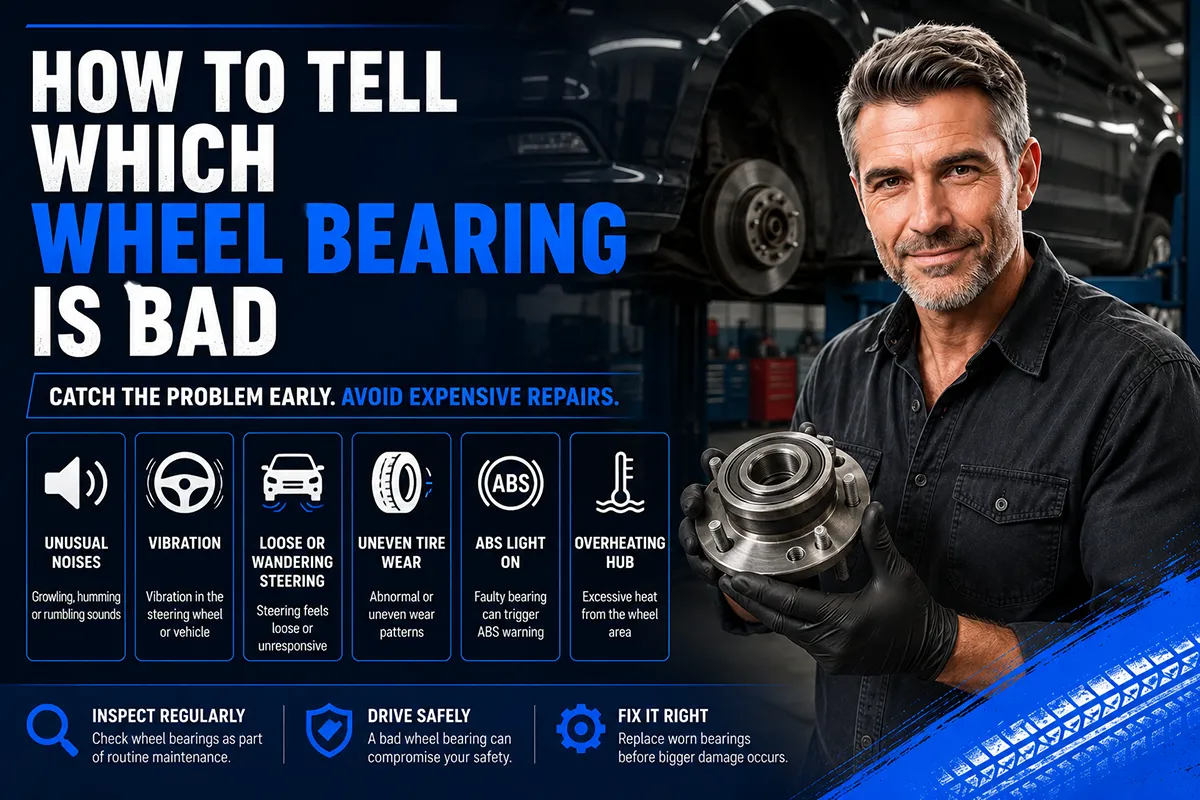
You’re cruising down the highway and there it is — a low, persistent hum that gets louder the faster you go. It almost sounds like a small airplane is following you, and no matter what you do, it won’t go away.
That sound haunted me for about a week before I finally figured out it was a failing wheel bearing. And the trickiest part wasn’t knowing something was wrong — it was figuring out which wheel bearing was the culprit.
I’ve spent years reviewing tires and diagnosing tire-related noises for TireAdvise.com, and I can tell you that bad wheel bearings are one of the most commonly misdiagnosed issues I encounter. People replace tires, swap alignments, and rotate endlessly — all while the real problem is a $40 bearing slowly destroying itself inside the hub.
- A bad wheel bearing typically produces a humming or growling noise that changes with vehicle speed, not engine RPM.
- You can isolate the bad side by listening for noise changes when you gently sway the steering wheel left and right at highway speed.
- Physical checks include jacking up each corner and wiggling the wheel at 12 and 6 o’clock for play.
- Replacement costs in the US typically range from $150–$400 per wheel depending on whether it’s a press-in bearing or a bolt-on hub assembly.
- Don’t ignore a bad wheel bearing — it can cause uneven tire wear, ABS malfunctions, and in extreme cases, wheel separation.
Liked this article?
Add TireAdvise as a preferred source so you see more of our tire reviews and guides on Google.
What Does a Wheel Bearing Actually Do?
Before I walk you through the diagnostic steps, it helps to understand what you’re actually dealing with. A wheel bearing is a set of steel balls or rollers held together by a metal ring (called a race) that sits inside your wheel hub. Its job is to let the wheel spin freely with as little friction as possible.
Every wheel on your car has at least one bearing. On most modern US-market vehicles — think Honda Civics, Toyota Camrys, Ford F-150s, and Chevy Equinoxes — the bearing is either pressed into the steering knuckle or integrated into a bolt-on hub assembly. Either way, when it fails, you’ll know something is off.
In my experience working on everything from compact sedans to full-size trucks, wheel bearings typically last a long time under normal driving conditions. But potholes, deep puddles, heavy loads, and the general abuse of American roads can shorten that lifespan significantly. I’ve seen bearings go bad surprisingly early on vehicles driven regularly on rough Midwest roads or through standing water.
Symptoms of a Bad Wheel Bearing
Let me break down the telltale signs I look for every time I suspect a wheel bearing issue. These are the symptoms I’ve personally encountered across dozens of vehicles over the years.
1. A Humming or Growling Noise That Changes With Speed
This is the number-one giveaway. A bad wheel bearing produces a continuous humming, growling, or roaring sound that gets louder as you accelerate and quieter as you slow down. It’s speed-dependent, not RPM-dependent — so if you put the car in neutral and coast, the noise continues.
I always tell people: if the noise disappears when you rev the engine in park but appears every time you’re rolling, it’s almost certainly not an engine or transmission issue. It’s in the wheels.
2. Noise Changes When You Turn the Steering Wheel
This is actually the single most useful diagnostic clue, and I’ll explain exactly how to use it in the step-by-step section below. When you gently sway left on the highway, weight transfers to the right side of the car. If the noise gets louder when you turn left, the right-side bearing is likely bad — because you’re loading more weight onto it.
Conversely, if the noise increases when you drift right, suspect the left side. I’ve used this technique countless times and it’s remarkably reliable.
3. Vibration in the Steering Wheel or Floorboard
A badly worn bearing can cause a subtle vibration that you’ll feel through the steering wheel (for front bearings) or through the seat and floorboard (for rear bearings). This is different from a tire balance vibration — it tends to feel rougher and more inconsistent.
I once spent an afternoon chasing what I thought was a tire defect on a client’s Nissan Altima, only to discover the left rear bearing was so far gone it was creating a rhythmic pulsing through the car. After the bearing was replaced, the “tire vibration” vanished completely.
4. Uneven Tire Wear
Since I review tires for a living, this one catches my eye immediately. A failing wheel bearing can allow the wheel to wobble ever so slightly, which causes irregular wear patterns on the tire. If you notice one tire wearing differently from the others — especially with a cupping or scalloping pattern — and your alignment checks out fine, a bad bearing could be the hidden cause.
5. ABS Warning Light
On many modern vehicles, the ABS wheel speed sensor is built into or mounted directly on the wheel hub assembly. When a bearing gets rough or develops excessive play, it can affect the sensor reading and trigger the ABS light on your dashboard. I’ve seen this happen on several late-model Chevy and Ford trucks.
6. Wheel Play or Looseness
If a bearing is severely worn, you may be able to feel actual physical looseness in the wheel when the car is jacked up. I’ll cover exactly how to test for this below. But if you can grab the tire and wiggle it, that’s a bearing that needs to be replaced immediately — not next week, not next month, now.
How to Tell Which Wheel Bearing Is Bad: Step-by-Step
Now let’s get to the core of this article. Here’s the exact process I use to identify which specific wheel bearing has failed. You don’t need special tools for most of these steps — just a jack, a jack stand, and your ears.
Step 1: Confirm It’s Actually a Wheel Bearing
Before you start diagnosing individual corners, make sure the noise is actually a bearing and not something else. The most common things I see people confuse with a bad bearing are:
- Worn or cupped tires — These produce a humming noise that can sound nearly identical to a bad bearing. The key difference is that tire noise often changes when you rotate the tires to different positions.
- CV joint issues — These typically click or pop when turning, especially at low speeds. Bearing noise is more of a constant drone.
- Transmission whine — This changes with RPM, not vehicle speed. Coast in neutral to rule it out.
- Differential noise — On rear-wheel-drive trucks, a worn differential can sound similar. But differential noise usually changes when you’re accelerating vs. decelerating.
I always do a quick tire rotation first if I’m unsure. If the noise follows the tire to a new position, it’s the tire. If the noise stays at the same corner of the car, it’s the bearing.
Step 2: The Highway Sway Test
This is my go-to test and it works incredibly well on front wheel bearings. Find a quiet stretch of highway where you’re traveling at a steady moderate-to-high speed and the bearing noise is clearly audible.
Gently — and I mean gently — sway the steering wheel to the left, as if you’re making a very lazy lane change. Hold it for a second or two and listen. Then gently sway to the right and listen again.
Here’s the principle: when you turn the wheel left, vehicle weight shifts to the right side. This puts more load on the right-side bearings. If the noise gets louder when you sway left, the right-side bearing is likely the problem. If the noise gets louder when you sway right, it’s the left side.
| Steering Direction | Weight Shifts To | If Noise Increases, Suspect |
|---|---|---|
| Sway left | Right side | Right wheel bearing |
| Sway right | Left side | Left wheel bearing |
| Noise unchanged | — | Possibly a rear bearing or tire noise |
I want to be very clear: this test is not about jerking the wheel. You’re making gentle, controlled movements. Safety comes first. If you’re not comfortable doing this, skip to the next steps, which are done with the car stationary and safely jacked up.
Step 3: Jack Up the Vehicle and Check for Play
This is where you get physical confirmation. Park on a flat, hard surface, engage the parking brake, and use a properly rated floor jack and jack stands. I cannot stress enough — never work under a vehicle supported only by a jack. I use a 3-ton floor jack and steel jack stands for every test I perform.
Once the suspect wheel is off the ground, grab the tire at the 12 o’clock and 6 o’clock positions (top and bottom). Try to rock the wheel back and forth. A good bearing will have zero perceptible play. A bad bearing will allow the wheel to wobble — sometimes just barely, sometimes dramatically.
Then try the same thing at the 9 and 3 o’clock positions (left and right). Some play in this direction can also indicate tie rod or ball joint wear, so the 12-and-6 test is more specific to bearings. In my experience, if you feel play at 12 and 6 and not at 9 and 3, you’re almost certainly looking at a bearing.
Step 4: Spin the Wheel and Listen
With the wheel still in the air, spin it by hand as fast as you can. A healthy wheel will spin smoothly and quietly, maybe with just a light swishing from the brake pads lightly touching the rotor. A bad bearing will produce a grinding, rumbling, or rough-sounding rotation.
I like to put my hand on the coil spring or strut tower while spinning the wheel. You can often feel the vibration from a rough bearing through the suspension components. This tactile feedback has helped me identify borderline cases that weren’t obviously noisy yet.
Repeat this process on the opposite side for comparison. Having a “known good” side to compare against makes the diagnosis much easier.
Step 5: Use a Stethoscope or Screwdriver (Yes, Really)
If you want to get more precise, an automotive stethoscope is a fantastic tool. You can pick one up at Harbor Freight or AutoZone for under $10. Place the probe on the steering knuckle or hub assembly near the bearing while a helper spins the wheel. You’ll hear the bearing noise amplified dramatically.
Don’t have a stethoscope? A long screwdriver works in a pinch. Place the tip against the hub or knuckle and press your ear against the handle end. It acts like a crude sound conductor. I’ve used this trick more times than I can count, especially in my earlier days before I invested in proper diagnostic tools.
Compare all four corners. The bad bearing will be obviously louder and rougher than the others.
Step 6: Check for Heat
Here’s a bonus test that not many people talk about. After driving the car for a sustained period at highway speed, carefully feel the center of each wheel hub (or use an infrared thermometer if you have one). A failing bearing generates excess friction, which produces excess heat.
If one hub is noticeably hotter than the others, that’s another strong indicator. I use a $25 infrared thermometer from Amazon for this — it’s the same kind of tool you’d use for cooking, and it works perfectly for this application.
Front Bearing vs. Rear Bearing: How to Tell the Difference
One of the trickiest aspects of bearing diagnosis is determining whether the noise is coming from the front or the rear. Sound travels through the vehicle’s structure, and a rear bearing can sometimes sound like it’s coming from the front, especially in sedans and crossovers with unibody construction.
In my experience, front bearings are easier to isolate because the highway sway test works so well for them. Rear bearings are sneakier. The noise from a bad rear bearing tends to sound more “centralized” in the cabin, almost like it’s coming from underneath you rather than from a specific side.
Here are a few tips I’ve developed over time for separating front from rear:
- Have a passenger sit in the back seat and ask them where the noise sounds loudest. Sound is often more directional from the rear seats.
- Check all four corners with the jack-and-wiggle test. Don’t assume it’s a front bearing just because you hear it up front.
- Use the stethoscope method on all four hubs. This is the most definitive way I know to pinpoint the exact location.
I made the mistake early in my career of replacing a front bearing on a Subaru Outback because that’s where the noise “seemed” to come from. The noise persisted. Turned out it was the left rear bearing the whole time. Lesson learned — always check all four corners.
What Causes Wheel Bearings to Fail?
Understanding why bearings fail can help you prevent premature failure in the future, especially if you’re investing in new tires and want them to wear evenly.
Water and Contamination
The number-one killer of wheel bearings in my experience is water intrusion. Driving through deep puddles, flooded roads, or getting frequent car washes that blast water directly into the wheel wells can push moisture past the bearing seals. Once water gets into the bearing grease, corrosion begins and the bearing’s life is dramatically shortened.
I’ve seen this issue especially frequently in the Southeast and Gulf Coast states where heavy rain and standing water on roads are common. If you regularly drive through water, keep an ear out for bearing symptoms.
Potholes and Rough Roads
Impact damage from potholes is a huge factor, especially in northern states where freeze-thaw cycles create brutal road conditions. A single hard hit can dent a bearing race or crack the cage that holds the balls or rollers in place. The bearing might feel fine for a while after the impact, but it’s living on borrowed time.
Improper Installation
If a bearing was recently replaced and it’s already making noise again, improper installation is a likely cause. Press-in bearings are particularly finicky — if the bearing isn’t pressed in perfectly straight, or if the wrong amount of preload is applied, it will fail quickly. This is one reason I generally recommend having bearings installed by a qualified shop with a hydraulic press.
Worn or Damaged Seals
The rubber seals on wheel bearings keep grease in and contaminants out. Over time, these seals can dry out, crack, or get damaged by road debris. Once the seal is compromised, it’s only a matter of time before the bearing fails.
Overloading the Vehicle
I see this a lot with pickup trucks and SUVs. Consistently carrying heavy loads — especially beyond the vehicle’s rated payload — puts tremendous stress on wheel bearings. If you regularly haul heavy equipment, tow trailers, or load up for camping trips, your bearings are working harder than the factory intended.
Can You Drive on a Bad Wheel Bearing?
I get this question constantly, and my answer is always: it depends on how bad it is, but you shouldn’t push your luck.
A bearing that’s just starting to hum can usually be driven on for a short period while you arrange for a repair. But a bearing with noticeable play, loud grinding, or visible heat is a serious safety concern. In extreme cases, a completely failed bearing can cause the wheel to lock up or even separate from the vehicle at speed.
I personally would never drive more than a few days on a bearing I suspected was failing, and I’d avoid highway speeds during that time. The risk just isn’t worth it — especially when you consider that a catastrophic bearing failure at 70 mph could be fatal.
How Much Does It Cost to Replace a Wheel Bearing?
Here in the US, wheel bearing replacement costs vary quite a bit depending on the vehicle and the type of bearing used.
| Bearing Type | Parts Cost | Labor Cost | Total Estimate |
|---|---|---|---|
| Bolt-on hub assembly | $50–$150 | $80–$150 | $130–$300 |
| Press-in bearing | $30–$80 | $150–$300 | $180–$380 |
| Dealer replacement | $80–$200 | $150–$350 | $230–$550 |
Bolt-on hub assemblies are much easier and faster to replace, which keeps labor costs down. These are common on many popular US vehicles like the Ford F-150, Chevy Silverado, Jeep Wrangler, and Toyota Tacoma. The entire hub comes out as a unit — bearing and all — and a new one bolts right in. I’ve done these in my driveway in under an hour.
Press-in bearings require a hydraulic press to remove the old bearing and install the new one. This means you’ll need a shop to do the work unless you have access to a press. Vehicles like the Honda Civic, Toyota Corolla, and Mazda3 commonly use this type. The bearing itself is cheaper, but labor is higher.
I generally recommend buying quality bearings from reputable brands like Timken, SKF, Moog, or National. You can find these at AutoZone, O’Reilly, NAPA, or online through RockAuto. I’d steer clear of no-name imported bearings — I’ve seen cheap ones fail within a few months. It’s not worth saving $20 on a part that keeps your wheel attached to your car.
Should You Replace Both Sides at Once?
This is a question I get a lot, and there’s no universal answer. Unlike brake pads — which should always be replaced in pairs — wheel bearings don’t necessarily need to be done in pairs. If only one bearing has failed and the other side shows no symptoms, you can replace just the bad one.
That said, in my experience, if one bearing has failed due to age or general wear, the other side is often not far behind. If I’m already paying for the labor and the vehicle has significant age on it, I’ll sometimes opt to replace both sides for peace of mind. It’s a judgment call based on the vehicle’s age and overall condition.
However, if the failure was caused by something specific — like hitting a massive pothole on one side — there’s no reason to assume the other bearing is compromised.
How Bad Wheel Bearings Affect Your Tires
Since this is a tire-focused site, I want to address something I see far too often: people replacing tires that are wearing unevenly without realizing a bad bearing is the root cause.
A worn bearing allows the wheel to wobble microscopically as it spins. This wobble creates uneven contact between the tire and the road surface, leading to cupping, feathering, or scalloped wear patterns. I’ve seen brand-new tires develop visible irregular wear within just a few weeks of being mounted on a hub with a bad bearing.
If you’re shopping for replacement tires and you’ve noticed odd wear on your current set, do yourself a favor: check your bearings before you mount new rubber. There’s nothing more frustrating than spending $600 or more on a set of new tires only to have them chewed up by a bearing that costs a fraction of that to replace.
I also want to note that a bad bearing can throw off your TPMS readings in some cases. If the wheel isn’t rotating true, the TPMS sensor may give slightly erratic readings. It’s not a primary diagnostic tool, but it’s worth mentioning if you’ve noticed odd pressure fluctuations on one wheel.
Common Mistakes People Make When Diagnosing Bearings
Over the years, I’ve seen — and made — plenty of mistakes when it comes to bearing diagnosis. Here are the most common ones I’d encourage you to avoid:
- Assuming the noise is coming from the side it sounds like. Sound bounces around inside the cabin. Always verify with physical tests.
- Confusing tire noise with bearing noise. Rotate your tires first. If the noise follows the tire, it’s the tire.
- Ignoring the rear bearings. Most people instinctively suspect the front because that’s where the steering wheel and most of the “feedback” comes from. Rear bearings fail too.
- Not using jack stands. I know I keep saying it, but I’ve seen too many close calls. A floor jack alone is not safe to work under or beside.
- Replacing a bearing and not checking the tone ring or ABS sensor. If your ABS light was on, the bearing replacement alone may not fix it if the sensor was damaged during the failure.
When to See a Professional
I’m all for DIY diagnosis, but there are limits. If you’ve gone through the steps above and you’re still not sure which bearing is bad, take it to a trusted mechanic. Many shops will do a bearing inspection for free or for a minimal diagnostic fee.
I also recommend going to a pro if you have a press-in bearing, limited tools, or if you’re not comfortable working with jacks and jack stands. Wheel bearings are a safety-critical component — there’s no shame in letting someone with a lift and a press handle it.
Look for an ASE-certified mechanic or a reputable independent shop. In my experience, independent shops often charge significantly less than dealerships for bearing work, and the quality is just as good. Chains like Firestone, Pep Boys, and Midas can also handle bearing replacements, though prices vary by location.
My Final Thoughts on Diagnosing a Bad Wheel Bearing
After diagnosing and replacing more wheel bearings than I can count, here’s what I want you to take away from this article: the process of identifying a bad wheel bearing isn’t complicated, but it does require patience and a systematic approach.
Start with the highway sway test to narrow down the side. Confirm with the jack-and-wiggle test and the hand-spin test. Use a stethoscope or screwdriver to compare all four corners. And above all, don’t ignore the symptoms — a humming noise that gets louder over the course of several days of driving is a bearing telling you its time is almost up.
If you’re in the middle of shopping for new tires and you’ve noticed uneven wear or a strange hum, please check your bearings first. I’ve seen too many people waste money on new tires that get destroyed by a worn bearing that could have been caught with five minutes of inspection.
Your wheel bearings are literally what keep your wheels attached and spinning. Give them the attention they deserve, and they’ll reward you with smooth, quiet, and safe driving.
Frequently Asked Questions
How can I tell which wheel bearing is bad while driving?
The easiest way to identify a bad wheel bearing while driving is to listen for a humming, grinding, or roaring noise that gets louder as you accelerate. Try gently swerving left and right on a safe, empty road — if the noise gets louder when you turn left, the right wheel bearing is likely failing, and vice versa, because turning loads more weight onto the opposite side bearing.
What does a bad wheel bearing sound like vs. a bad tire?
A bad wheel bearing typically produces a constant humming or growling noise that changes pitch with vehicle speed but stays the same regardless of road surface. A bad tire, such as one with uneven wear or a flat spot, usually creates a rhythmic thumping or droning that changes noticeably when you switch road surfaces. If the noise persists after rotating or replacing your tires, a worn wheel bearing is the most likely culprit.
Can I check for a bad wheel bearing at home without special tools?
Yes, you can perform a basic check at home by jacking up each wheel and trying to wiggle it by gripping the top and bottom of the tire. If you feel noticeable play or looseness, that wheel bearing is likely worn out. You can also spin the wheel by hand and listen for grinding or roughness, which indicates the bearing is failing and needs replacement.
How much does it cost to replace a wheel bearing in the US?
In the US, replacing a single wheel bearing typically costs between $300 and $800, including parts and labor, depending on your vehicle make and model. Trucks and SUVs with hub-assembly-style bearings often fall on the higher end, while smaller sedans tend to be more affordable. I always recommend getting quotes from at least two or three shops, since labor rates vary significantly by region.
Is it safe to keep driving with a bad wheel bearing?
Driving on a bad wheel bearing is not safe and can lead to serious consequences, including the wheel seizing or even separating from the vehicle at highway speeds. A failing bearing also causes uneven tire wear, which means you could end up replacing expensive tires sooner than expected. Once you identify the bad wheel bearing, I’d recommend getting it replaced as soon as possible — ideally within a few days of noticing symptoms.
Can a bad wheel bearing cause vibration and uneven tire wear?
Absolutely — a worn wheel bearing allows the wheel hub to develop play, which causes the tire to sit at a slightly off angle as you drive. This leads to vibrations you can often feel through the steering wheel or floorboard, and it creates irregular tire wear patterns such as cupping or feathering on that corner. If you notice one tire wearing faster than the others, have your mechanic inspect both the bearing and your alignment before investing in new tires.
How long do wheel bearings last, and what causes them to fail early?
Most modern sealed wheel bearings are designed to last between 85,000 and 100,000 miles, but harsh US driving conditions like potholes, road salt in northern states, and frequent off-road use can shorten that lifespan significantly. Driving through deep water or flooding can also wash out bearing grease and accelerate wear. If you’ve recently hit a major pothole or curb and notice new noise from one corner, that impact may have damaged the wheel bearing even on a newer vehicle.
