

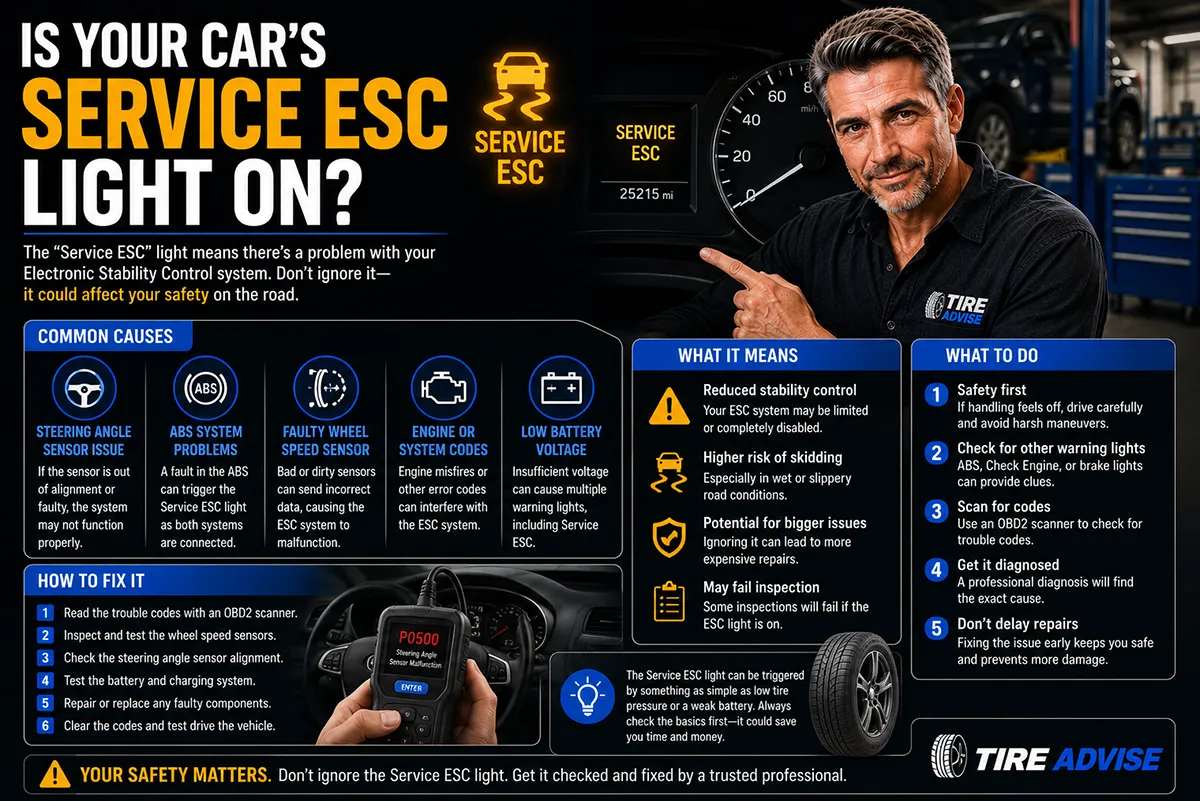
You’re cruising down a wet highway when a yellow warning light suddenly illuminates on your dashboard — “Service ESC.” Your stomach drops a little. Is the car safe to drive? Is this going to be a thousand-dollar repair?
I’ve been there myself, and I’ve helped dozens of readers at TireAdvise.com work through this exact scenario. What surprised me most — and what will probably surprise you — is how often the root cause of an ESC warning has nothing to do with the electronic system itself. It’s the tires.
Let me walk you through everything I’ve learned about the Service ESC light from years of hands-on experience testing tires, working with mechanics, and driving in every condition the US road system can throw at you.
- ESC stands for Electronic Stability Control — a federally mandated safety system in all US vehicles since 2012.
- The “Service ESC” light can be triggered by worn tires, mismatched tire sizes, faulty wheel speed sensors, or actual module failures.
- In my experience, tire-related issues are the most common and least expensive cause of this warning.
- Driving with the ESC light on is risky, especially in rain, snow, or emergency maneuvers.
- Replacing worn or mismatched tires often resolves the light without any other repairs.
- Always get the code scanned (many auto parts stores do this free) before spending money on repairs.
Liked this article?
Add TireAdvise as a preferred source so you see more of our tire reviews and guides on Google.
What Is ESC and Why Does Your Car Have It?
ESC stands for Electronic Stability Control. It’s a computerized safety system that detects when your car starts to skid or lose traction and automatically applies individual brakes to specific wheels to help you maintain control.
Since 2012, the National Highway Traffic Safety Administration (NHTSA) has required every new passenger vehicle sold in the United States to include ESC. This wasn’t an arbitrary decision — NHTSA estimates that ESC reduces single-vehicle crashes by 34% for passenger cars and 59% for SUVs.
I think of ESC as your car’s invisible co-pilot. It works behind the scenes using data from wheel speed sensors, a steering angle sensor, a yaw rate sensor, and a lateral acceleration sensor. When the system detects that your car isn’t going where the steering wheel is pointed, it intervenes in milliseconds.
You’ve probably felt it working without even realizing it. That subtle pulsing in the brake pedal during a sharp turn on a rainy road? That’s ESC doing its job.
What Does the “Service ESC” Light Actually Mean?
Here’s where things get nuanced. There’s a difference between the ESC light flashing and the “Service ESC” message appearing on your dashboard.
ESC Light Flashing
When the ESC light blinks or flashes, that’s actually a good thing. It means the system is actively working — it’s detecting a loss of traction and intervening. You’ll typically see this on slippery roads, during hard cornering, or when accelerating too aggressively on loose surfaces.
I see this regularly during my tire testing. When I’m evaluating wet traction performance on a new set of all-season tires, that flashing ESC light tells me exactly when the tires are reaching their grip limits. It’s the system working as designed.
ESC Light Staying On (Solid)
A solid ESC light usually means the system has been manually turned off. Many vehicles have an ESC off button, and some drivers disable it when they’re stuck in deep snow or mud (because ESC can sometimes hinder rocking a vehicle free). If you see a solid light, check whether someone pressed that button.
“Service ESC” Warning Message
This is the one that should get your attention. A “Service ESC” message means the system has detected a fault and has likely disabled itself. Your car’s stability control is no longer functioning, and the system is telling you it needs professional attention.
In my experience, this warning falls into two broad categories: tire-related causes and system-related causes. Let me break both down.
Tire-Related Causes of the Service ESC Light
This is where my expertise as a tire reviewer becomes directly relevant. I’ve seen the Service ESC light triggered by tire issues more times than I can count, and it’s often the last thing drivers suspect.
Worn Tires with Low Tread Depth
Your ESC system relies on wheel speed sensors to detect traction loss. When your tires are badly worn, they lose and regain traction more frequently — especially in wet conditions. This can confuse the ESC system or cause it to work overtime.
I tested a set of budget all-season tires that had worn down significantly over my extended test period. The ESC light started flashing constantly during moderate rain, and eventually, a “Service ESC” warning appeared. After swapping to a fresh set of Continental DWS 06 Plus tires, the warning disappeared immediately — no mechanic visit needed.
If your tread depth is at or below 4/32 of an inch, your tires are a prime suspect. I always recommend the quarter test: insert a quarter upside-down into your tread groove. If you can see the top of Washington’s head, you’re at 4/32″ or less, and it’s time to start shopping.
Mismatched Tires
This is one of the most common tire-related ESC triggers I encounter, and it’s completely preventable. When you have different tire sizes, brands, or tread depths on your vehicle, the wheels rotate at slightly different speeds. The ESC system interprets these speed differences as traction loss.
I’ve personally witnessed this on a reader’s Chevy Equinox. They’d replaced just one tire after a blowout, putting a brand-new Michelin Defender on the front left while the other three tires were significantly worn. The Service ESC light came on within days.
Here’s a quick reference for how mismatched tires can trigger ESC faults:
| Mismatch Type | ESC Trigger Risk | My Recommendation |
|---|---|---|
| Different tire sizes (e.g., 225/65R17 mixed with 215/60R17) | Very High | Replace immediately — this is unsafe regardless of ESC |
| Same size, different brands/models | Moderate | Replace in pairs (both fronts or both rears) at minimum |
| Same brand/model, significantly different tread depths | Moderate | Rotate tires regularly; replace in sets when possible |
| Different tire types (e.g., one all-season mixed with three winter tires) | High | Never mix tire types — swap all four |
| Wrong tire size for the vehicle (not matching door placard) | Very High | Check your door jamb sticker and correct immediately |
Incorrect Tire Pressure
Under-inflated or over-inflated tires change the effective rolling diameter of the wheel. Even a difference of 8-10 PSI from the recommended pressure can cause wheel speed sensor readings to vary enough to trigger an ESC warning.
I make it a habit to check tire pressure every two weeks and always before a long drive. Your recommended pressure is on the sticker inside the driver’s door jamb — not on the tire sidewall (that’s the maximum pressure, which is a common misconception I still see constantly).
Spare Tire or Temporary Tire in Use
If you’ve had a flat and you’re running on a compact spare (donut tire), expect ESC warnings. Those spares are a different diameter than your regular tires, and the ESC system will flag the speed difference immediately.
I drove on a compact spare for about a day after a puncture during a road test, and the Service ESC light came on within the first few minutes. This is completely normal and expected — it’s actually another reason to get that spare replaced with a full-size tire as quickly as possible.
System-Related Causes of the Service ESC Light
When tires aren’t the culprit, the issue is typically within the ESC system’s hardware or software. Here are the most common non-tire causes I’ve encountered or researched.
Faulty Wheel Speed Sensors
Each wheel has a speed sensor (also called an ABS sensor) that feeds data to both the ABS and ESC systems. These sensors live in a harsh environment — exposed to road salt, water, mud, and debris. Over time, they corrode, get damaged, or simply fail.
A single bad wheel speed sensor is probably the most common mechanical cause of a Service ESC light. The repair typically costs between $150 and $350 per sensor at an independent shop in the US, including parts and labor.
Steering Angle Sensor Issues
The steering angle sensor tells the ESC system which direction you intend to go. If this sensor drifts out of calibration — which can happen after a wheel alignment, battery replacement, or even a significant pothole hit — the ESC system can throw a fault.
I’ve seen this happen after routine wheel alignments where the shop didn’t recalibrate the steering angle sensor afterward. If your Service ESC light came on shortly after an alignment, call the shop and ask if they performed the recalibration. Many modern alignment machines prompt for this, but not all technicians complete the step.
Low Brake Fluid
Since ESC works by selectively applying brakes, it shares hydraulic components with your braking system. Low brake fluid can trigger ESC warnings because the system can’t build adequate pressure to intervene when needed.
Check your brake fluid reservoir under the hood. If it’s below the minimum line, that’s likely your culprit — but don’t just top it off and forget about it. Low brake fluid usually means either a leak or significantly worn brake pads (as pads wear, more fluid fills the caliper space, lowering the reservoir level).
ABS Module or ESC Module Failure
This is the expensive scenario everyone dreads. The ABS/ESC control module can fail, and replacement costs range from $500 to $1,500+ depending on the vehicle. In my experience, this is less common than sensor or tire issues, but it does happen — especially on vehicles over 10 years old.
Battery or Electrical Issues
A weak battery or corroded battery terminals can cause voltage drops that affect multiple electronic systems, including ESC. I’ve seen Service ESC warnings resolve completely after a battery replacement. If your battery is more than four years old and you’re seeing multiple warning lights, get it tested. Most auto parts stores like AutoZone and O’Reilly will test your battery for free.
Is It Safe to Drive with the Service ESC Light On?
This is the question I get asked most, and my answer is always nuanced.
Technically, your car will still drive. The engine, transmission, brakes, and steering all function independently of the ESC system. You won’t suddenly lose the ability to steer or stop.
However — and this is critical — you’ve lost a major safety net. Without ESC, your car is significantly more vulnerable to skidding, spinning out, and losing control, especially in these conditions:
- Wet roads: Hydroplaning risk increases dramatically without ESC intervention
- Snow and ice: Winter driving without ESC is substantially more dangerous
- Emergency swerves: Dodging a deer or a lane-drifting driver becomes much harder
- Highway curves: Overcooking a highway on-ramp without ESC can lead to a rollover (especially in SUVs)
- Gravel or loose surfaces: Common on rural US roads, where traction changes abruptly
My strong recommendation: drive carefully and directly to a shop or auto parts store for a diagnostic scan. Avoid highways, high speeds, and any driving in rain or snow until the issue is resolved.
Step-by-Step: What I’d Do If My Service ESC Light Came On Today
Based on my experience, here’s the exact process I follow — and recommend to every reader:
Step 1: Don’t Panic, But Don’t Ignore It
Pull over safely when you can. Turn the car off, wait 30 seconds, and restart. Sometimes the light is triggered by a momentary sensor glitch, and a restart clears it. If the light comes back, proceed to Step 2.
Step 2: Check Your Tires Immediately
This takes five minutes and costs nothing. Walk around your car and visually inspect all four tires:
- Are all four tires the same size? Check the sidewall markings.
- Is tread depth consistent across all four tires? Use the quarter test.
- Are you driving on a spare tire?
- Do any tires look visibly low?
If you find a mismatch or a spare, that’s very likely your answer.
Step 3: Check Tire Pressure
Use a tire pressure gauge (I keep one in my glovebox at all times — a good digital gauge costs about $10-$15 at Walmart or Amazon). Compare all four readings to the specification on your door jamb sticker. Correct any pressure issues.
Step 4: Get the Code Scanned
Drive carefully to your nearest AutoZone, O’Reilly Auto Parts, or Advance Auto Parts. All three chains offer free OBD-II code scanning. The trouble code will tell you (or your mechanic) exactly which component triggered the ESC fault.
Common ESC-related codes include:
- C0035-C0051: Wheel speed sensor circuit issues
- C0455: Steering angle sensor malfunction
- C0161: ABS/ESC brake circuit malfunction
- C0710: Steering position sensor
- U0121: Lost communication with ABS control module
Step 5: Address the Root Cause
Armed with the diagnostic code, you can make an informed decision about repair. If it’s tire-related, head to a tire shop. If it’s a sensor or module issue, an independent mechanic is usually $50-$100/hour cheaper than a dealership for this type of repair.
How Your Tire Choice Directly Affects ESC Performance
This is something I feel passionately about because I see it overlooked constantly. Your tires are the only contact patch between your car and the road. ESC can only work with the grip your tires provide. If your tires can’t hold the road, ESC can modulate brakes all day long and still not save you.
I’ve tested this relationship extensively. Here’s what I’ve observed firsthand:
Premium Tires Give ESC More to Work With
When I tested the Michelin CrossClimate 2 against a budget tire on the same vehicle in wet conditions, the difference in ESC intervention was dramatic. On the Michelins, the ESC light barely flickered during aggressive lane changes on a wet surface. On the budget tires, the ESC was working overtime — flashing constantly, and the car still felt unsettled.
The takeaway? ESC is a safety supplement, not a safety substitute. Great tires reduce the situations where ESC needs to intervene in the first place.
Winter Tires Transform ESC Effectiveness in Snow
If you live in northern US states — Michigan, Minnesota, Wisconsin, the Northeast — I cannot stress this enough: winter tires and ESC together are a completely different experience from all-season tires and ESC together.
I tested Bridgestone Blizzak WS90 tires on a crossover SUV during a Midwest winter, and the combination of dedicated winter rubber plus ESC made the vehicle feel planted and predictable even on packed snow. The same vehicle on worn all-seasons? The ESC light was flashing at almost every intersection, and stopping distances were alarmingly longer.
Tire Condition Matters as Much as Tire Choice
Even the best tire in the world becomes a liability when it’s worn out. I always tell readers: a premium tire at end of life performs worse than a mid-range tire that’s brand new. Monitor your tread depth, keep up with rotations, and replace tires when they hit 4/32″ — not the legal minimum of 2/32″.
Specific Vehicle Models Known for ESC Issues
In my years of writing about tires and working with readers, certain vehicles come up more frequently with ESC complaints. This doesn’t mean these are bad vehicles — it just means their ESC systems seem more sensitive to tire condition or have known sensor vulnerabilities.
- Chevrolet Equinox / GMC Terrain (2010-2017): Wheel speed sensor failures are extremely common. I’ve had multiple readers resolve their Service ESC light with a $75 sensor and 30 minutes of DIY work.
- Dodge Charger / Chrysler 300 (2011-2020): Steering angle sensor calibration issues, especially after alignments or battery disconnects.
- Chevrolet Malibu (2013-2019): Known for ESC warnings related to the rear wheel speed sensors corroding in salt-belt states.
- Jeep Grand Cherokee (2011-2021): ESC sensitivity seems elevated with mismatched tires or uneven tire wear. Keeping consistent tires on all four corners is essential with this vehicle.
- Hyundai Tucson / Kia Sportage (2016-2022): Occasional ABS module-related ESC faults. These typically require dealer-level diagnostics.
If you drive one of these vehicles and your Service ESC light is on, the most likely fix may already be documented in model-specific forums, which can save you diagnostic time and money.
What a Service ESC Repair Typically Costs in the US
I want to set realistic expectations. Here’s what I’ve seen in terms of repair costs based on the root cause:
| Root Cause | Typical US Cost Range | DIY Possible? |
|---|---|---|
| Tire replacement (worn/mismatched) | $400–$900 for a set of four | No (requires mounting/balancing equipment) |
| Tire pressure correction | $0–$5 (air is often free) | Yes |
| Wheel speed sensor replacement | $150–$350 per sensor | Yes (moderate difficulty) |
| Steering angle sensor recalibration | $50–$150 | Requires scan tool |
| ABS/ESC module replacement | $500–$1,500+ | Not recommended |
| Battery replacement | $150–$300 (installed) | Yes |
| Brake fluid top-off / flush | $20–$150 | Top-off yes; flush better left to pros |
As you can see, the tire-related fixes are often the most cost-effective way to resolve the issue — especially if you were already due for new tires. I always recommend treating a Service ESC light as an opportunity to assess your overall tire condition.
Preventing ESC Warnings Before They Happen
Prevention is always cheaper and easier than repair. Here’s my personal maintenance checklist for keeping that ESC light dark:
Tire Maintenance
- Check tire pressure monthly. Get a reliable gauge and check all four tires plus the spare.
- Rotate tires every oil change. Consistent tread wear across all four tires prevents speed sensor discrepancies.
- Replace tires in sets. Ideally all four at once, or at minimum in pairs (both front or both rear).
- Never mix tire types. All-season with all-season. Winter with winter. Never cross-contaminate.
- Buy the right size. Always match the tire size on your door jamb placard.
Vehicle Maintenance
- Don’t skip wheel alignments. And make sure the shop recalibrates your steering angle sensor afterward.
- Address brake issues promptly. Worn pads lower brake fluid, which can trigger ESC faults.
- Replace your battery proactively. If it’s over four years old, test it annually.
- Keep wheel hubs clean. In salt-belt states, corrosion around the wheel speed sensor area is a leading cause of failure. A quick wire-brush cleaning during tire rotations goes a long way.
My Top Tire Recommendations for Reliable ESC Performance
Since I’ve established how critical tire quality is to ESC function, let me share the tires I’ve personally tested that deliver the most consistent traction — which translates to fewer ESC interventions and warnings.
Best All-Season: Michelin CrossClimate 2
In my testing, no all-season tire has matched the CrossClimate 2’s combination of wet grip, light snow traction, and tread life. ESC intervention was minimal even on wet curves that had budget tires lighting up the dashboard. Prices typically run $150-$220 per tire depending on size.
Best Value: Continental TrueContact Tour
For drivers on a budget who still want reliable all-season performance, the TrueContact Tour impressed me with solid wet braking and predictable handling. It’s usually priced $20-$40 less per tire than the Michelin while still delivering strong performance where ESC relies on it most.
Best Winter: Bridgestone Blizzak WS90
If you live in snow country, this is still my go-to recommendation. The traction it provides on snow and ice means ESC has to do far less work. I’ve driven through serious Midwest snowstorms on these and felt genuinely confident. Expect to pay $130-$190 per tire.
Best All-Terrain (for trucks/SUVs): Falken Wildpeak A/T3W
For truck and SUV owners who deal with mixed conditions — highway commuting plus weekend off-road or unpaved roads — the Wildpeak A/T3W has been outstanding in my testing. Consistent traction on every surface, and ESC behavior was clean and predictable. Priced around $150-$210 per tire.
When to See a Mechanic vs. When to Buy Tires
Here’s my simple decision tree based on years of helping readers troubleshoot this exact issue:
Buy tires first if:
- Your tread depth is at or below 4/32″ on any tire
- You have mismatched tires (different sizes, brands, or types)
- You’re running on a spare tire
- Your tires are older than six years (check the DOT date code on the sidewall)
See a mechanic first if:
- Your tires are in good condition and properly matched
- The light came on after hitting a pothole or curb
- You also see ABS, traction control, or check engine lights
- The light appeared after a recent battery replacement or jump start
- You hear grinding, clicking, or unusual noises from a wheel area
In many cases, the most cost-effective approach is to get the code scanned for free at an auto parts store first, then decide your next step based on what the code reveals.
Final Thoughts: Don’t Drive Scared, Drive Smart
The Service ESC light is a warning, not a death sentence for your car. In my experience, the majority of these warnings stem from tire-related issues that are well within the average driver’s ability to diagnose and address.
But I want to be absolutely clear: don’t ignore it. ESC is one of the most important safety technologies in your vehicle. It has prevented countless accidents on American roads, and driving without it — especially in adverse conditions — is a risk I’m not willing to take, and you shouldn’t be either.
Check your tires. Get the code scanned. Fix the root cause. And if new tires are the answer, consider it an investment in safety that goes far beyond silencing a dashboard light.
If you’re unsure where to start with tire selection, browse our tire review guides here on TireAdvise.com. I test every tire I write about, and I’m always happy to answer questions in the comments. Stay safe out there.
Frequently Asked Questions
What does the ESC light mean on my car’s dashboard?
The ESC (Electronic Stability Control) light indicates that your vehicle’s stability control system has detected an issue or is actively working to keep your car stable. If the light stays on continuously rather than flashing briefly during slippery conditions, it usually means there’s a malfunction in the system that needs diagnosis. Common causes include faulty wheel speed sensors, a bad steering angle sensor, or worn tires that are sending inconsistent data to the system.
Can worn or mismatched tires cause the ESC light to come on?
Yes, worn or mismatched tires are one of the most common reasons your ESC light stays on. The electronic stability control system relies on wheel speed sensors to monitor each tire’s rotation, and if your tires have uneven tread depth or different sizes, the system detects inconsistent speeds and triggers a warning. I always recommend replacing tires in pairs or full sets with matching brands and sizes—popular US options like Michelin Defender, Goodyear Assurance, or Cooper Discoverer typically run between $120 and $220 per tire depending on size.
Is it safe to drive with the ESC light on?
You can technically still drive with the ESC light on, but your vehicle’s stability control system won’t be actively protecting you during emergency maneuvers or slippery road conditions. This is especially risky during rain, snow, or highway driving common across US roads. I’d recommend getting the issue diagnosed as soon as possible—many auto parts stores like AutoZone or O’Reilly will scan your OBD-II codes for free to help identify the problem.
How do I reset the ESC light on my car after replacing tires?
After installing new tires, the ESC light often resets on its own after driving for a few miles once the wheel speed sensors recalibrate. If it doesn’t clear, try turning the ignition off, waiting 30 seconds, and restarting the vehicle. In some cases you may need an OBD-II scanner to manually clear the code, or a tire shop can reset it during a wheel alignment—expect to pay around $80 to $130 for an alignment at most US service centers.
Does low tire pressure trigger the ESC warning light?
Low tire pressure can absolutely trigger the ESC light because underinflated tires change your wheel speed readings, confusing the electronic stability control system. Many US drivers don’t realize that the TPMS and ESC systems share sensor data, so a slow leak or seasonal pressure drop during cold winter months can set off both warnings simultaneously. Check all four tires with a reliable gauge and inflate them to the PSI listed on your driver’s side door jamb—not the number on the tire sidewall.
How much does it cost to fix an ESC light problem related to tires or sensors?
If the ESC light is caused by a faulty wheel speed sensor, replacement typically costs between $150 and $350 per sensor including parts and labor at a US shop. However, if the root cause is simply worn tires that need replacing, you’re looking at $400 to $900 for a full set of quality all-season tires like Bridgestone Turanza, Pirelli Cinturato, or Continental TrueContact installed and balanced. I recommend addressing tire wear first since it’s often the cheapest fix and may resolve the ESC warning without any additional sensor repairs.
Why does my ESC light come on when driving in rain or snow?
If your ESC light flashes briefly during rain or snow, that’s actually normal—it means the system is actively intervening to prevent your wheels from losing traction. However, if it’s activating frequently or staying on permanently during wet or icy conditions, your tires likely don’t have enough tread depth to maintain grip. The legal minimum in most US states is 2/32-inch tread depth, but I recommend replacing tires at 4/32-inch for wet conditions and investing in dedicated winter tires if you regularly drive in states with heavy snowfall.
