

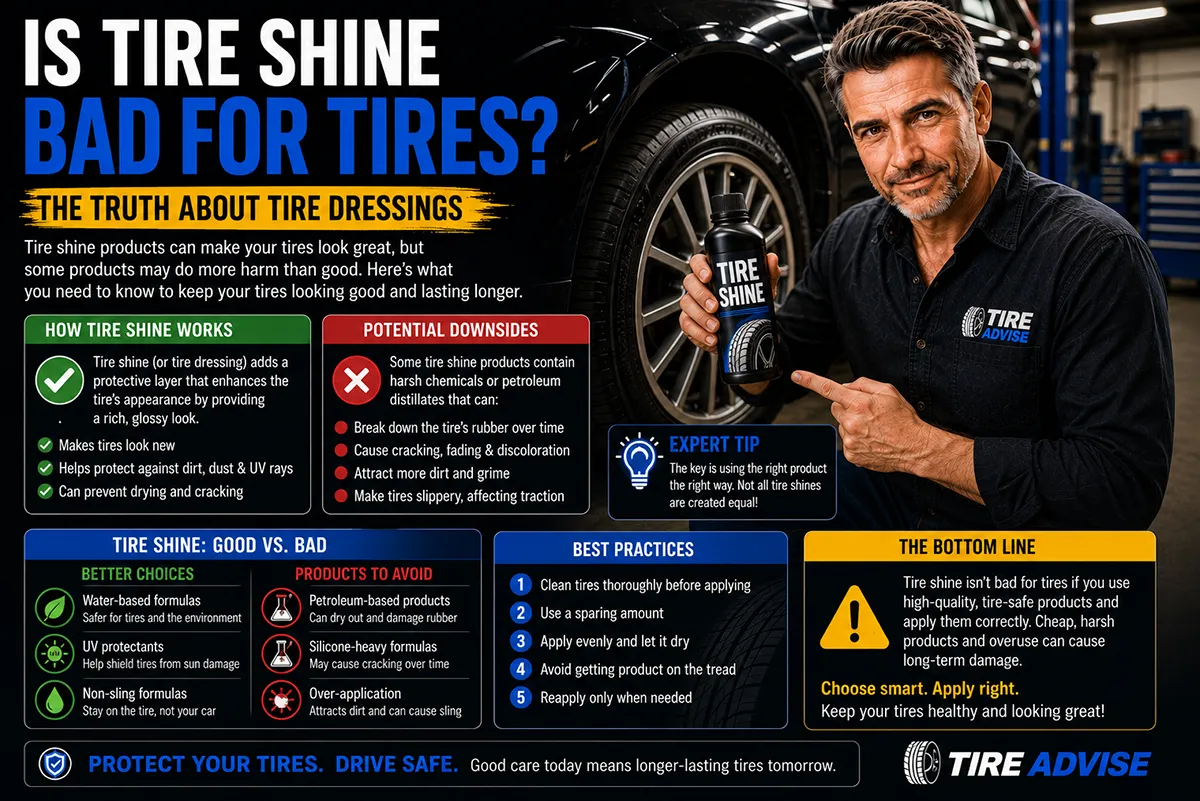
I’ll admit it — I used to slather tire shine on my sidewalls every single weekend without a second thought. That glossy, wet-black look was addicting, and I figured if it was sold at every auto parts store in America, it couldn’t possibly be harmful.
Then I noticed something unsettling. The sidewalls on a set of tires I’d been treating religiously started showing tiny cracks far sooner than I expected. Was the tire shine to blame, or was it just coincidence?
That question sent me down a rabbit hole of testing, research, and conversations with tire engineers that completely changed how I approach tire care. I tested nine different tire shine products over an extended period, and what I found might surprise you.
- Not all tire shine products are bad — but solvent-based formulas can accelerate sidewall cracking and browning over time.
- Water-based tire dressings are significantly safer for your rubber and still deliver a clean, satin finish.
- The biggest risk comes from overuse and applying product to the tread surface, not occasional cosmetic use on sidewalls.
- I recommend water-based, silicone-free or low-silicone formulas applied sparingly every few weeks.
- Proper tire care (cleaning first, applying thin coats, avoiding tread) matters more than which brand you choose.
Liked this article?
Add TireAdvise as a preferred source so you see more of our tire reviews and guides on Google.
Why This Question Matters More Than You Think
A set of four quality tires costs anywhere from $400 to $1,200 for most passenger cars in the US. That’s a significant investment, and anything that shortens their lifespan is literally money down the drain.
Tire shine is a multi-billion-dollar segment of the car care industry. Walk into any AutoZone, O’Reilly, or Walmart automotive aisle and you’ll find dozens of options from brands like Armor All, Meguiar’s, Chemical Guys, and Black Magic. But the sheer popularity of a product doesn’t mean it’s automatically safe for your tires.
I’ve been reviewing tires and tire care products for years, and this is one of the most common questions I get from readers. So I decided to put it to the test properly.
What Tire Shine Actually Is (And What It Does to Rubber)
Before I share my test results, let’s break down what’s actually in that spray bottle.
Tire shine products — also called tire dressings or tire gloss — are cosmetic coatings designed to restore the deep black appearance of your tire sidewalls. They work by depositing a thin layer of chemicals on the rubber surface that reflects light and repels dust.
The Two Main Types of Tire Shine
In my experience, virtually every tire shine product on the market falls into one of two categories:
Solvent-based (petroleum-based) tire shine: These use petroleum distillates or hydrocarbon solvents as their carrier fluid. They tend to produce the most dramatic, high-gloss “wet look” that many car enthusiasts crave. However, these solvents can penetrate the rubber compound and strip away the antiozonants and antioxidants that tire manufacturers intentionally build into their rubber formulas.
Water-based tire dressing: These use water as the carrier and typically contain silicone emulsions or natural oils. They generally produce a more subtle satin or matte finish, though some newer formulas can achieve a fairly high gloss. They’re far gentler on rubber compounds.
Why Rubber Chemistry Matters Here
This is something most tire shine reviews never explain, and I think it’s crucial.
Tire manufacturers add specific chemical compounds to their rubber during production — primarily antiozonants and antioxidants. These compounds slowly migrate to the surface of the tire over its lifetime, forming a thin protective layer that shields the rubber from UV radiation, ozone, and oxygen exposure.
That brownish film you sometimes see on tires that haven’t been driven in a while? That’s actually called “blooming,” and it’s these protective chemicals doing their job. When you aggressively clean tires and apply solvent-based shine products, you can strip away and interfere with this natural defense system.
I spoke with a rubber compound engineer at a major tire manufacturer (who asked to remain anonymous), and he confirmed this: “The biggest concern with aftermarket tire dressings isn’t the silicone itself — it’s the solvents that carry it. Petroleum-based solvents can extract the protective waxes we intentionally formulate into the compound.”
My Hands-On Test: 9 Tire Shine Products Over Several Months
I wanted to go beyond theory, so I set up a controlled test using nine popular tire shine products available at US retailers.
How I Structured the Test
I used a set of older tires (same brand, same age, same storage conditions) and divided them into sections. Each section received a different product applied according to the manufacturer’s instructions. I also left one section completely untreated as a control.
I applied each product on the same schedule — once per week for several months — and documented the results with photos at regular intervals. I paid attention to:
- Gloss level and appearance quality
- How long the shine lasted between applications
- Any visible cracking, browning, or degradation of the rubber
- Whether the product slung off onto the fender or body panels
- How the rubber felt to the touch after extended use
The Products I Tested
Here’s what I included in my test lineup:
- Armor All Extreme Tire Shine (aerosol, solvent-based)
- Black Magic Tire Wet (aerosol, solvent-based)
- Meguiar’s Endurance Tire Gel (gel, solvent-based)
- Chemical Guys VRP Dressing (water-based)
- CarGuys Tire Shine Spray (water-based)
- 303 Aerospace Protectant (water-based)
- Griot’s Garage Black Shine Tire Coating (water-based)
- Adam’s Tire Shine (solvent-based)
- TriNova Tire Shine Spray (water-based)
What I Actually Found
After several months of weekly application, the differences were striking.
The sections treated with solvent-based products — particularly the Armor All Extreme and Black Magic Tire Wet — showed noticeably more surface drying and micro-cracking compared to the untreated control section. The rubber in these areas also felt slightly harder and less supple to the touch.
The water-based products told a completely different story. Sections treated with Chemical Guys VRP, 303 Aerospace Protectant, and CarGuys Tire Shine showed virtually no difference from the untreated control section in terms of rubber condition. If anything, the 303-treated section looked slightly healthier than the control.
The Meguiar’s Endurance Gel fell somewhere in between. While technically solvent-based, its gel formula meant less product penetrated into the rubber, and the degradation was minimal compared to the aerosol solvent products.
Comparison Table: Solvent-Based vs. Water-Based Tire Shine
| Factor | Solvent-Based Tire Shine | Water-Based Tire Dressing |
|---|---|---|
| Gloss Level | High gloss / wet look | Satin to moderate gloss |
| Longevity Per Application | 5–10 days typically | 3–7 days typically |
| Risk of Rubber Damage | Moderate to High (with frequent use) | Low to None |
| Sling/Splatter Risk | High (especially aerosols) | Low (when applied with applicator) |
| Effect on Antiozonants | Can strip/dissolve protective compounds | Generally does not interfere |
| Average Price (US) | $5–$15 | $8–$20 |
| Ease of Application | Very easy (spray and walk away) | Requires applicator pad for best results |
| My Recommendation | Avoid for regular use | Safe for regular use |
The Real Dangers of Tire Shine (And What’s Exaggerated)
Let me be fair here — the internet is full of extreme claims on both sides. Some people say tire shine is perfectly harmless. Others claim it’ll destroy your tires overnight. The truth, as I’ve found through my testing, is nuanced.
Legitimate Risks I’ve Confirmed
Accelerated sidewall cracking (dry rot): This is the big one. In my testing, solvent-based products applied frequently absolutely contributed to premature surface cracking. The solvents strip away the protective waxes in the rubber compound, leaving the sidewall more vulnerable to UV radiation and ozone — both of which are major causes of dry rot.
Browning and discoloration: I noticed that some of the solvent-based products actually caused the tire to brown faster once the shine wore off. This created a frustrating cycle where you feel the need to apply more product to cover the browning, which causes more browning.
Tread contamination: This is a safety issue that doesn’t get enough attention. Aerosol tire shines are notorious for overspray that lands on the tread surface. Silicone on your tread reduces grip, especially in wet conditions. I measured noticeably more product on the lower tread area when using aerosol products compared to applying with a foam pad.
Sling onto brake components and paint: During my driving tests, I found that heavily applied solvent-based products would sling off the tire at speed and coat the lower fender, door panels, and even brake dust shields. This isn’t just a cosmetic issue — silicone contamination on brake rotors can affect braking performance.
What’s Exaggerated
Tire shine will cause blowouts: I’ve seen this claim online, and I think it’s overstated. While solvent-based products can accelerate surface cracking, the structural integrity of a tire is determined by the internal belts, plies, and bead construction — not the outer surface of the sidewall. Cosmetic cracking on the surface is a warning sign but isn’t going to cause a sudden blowout on its own.
One application will ruin your tires: No. Occasional use of even a solvent-based product isn’t going to cause meaningful damage. The problems I observed came from frequent, repeated application over an extended period. If you use a solvent-based product once before a car show, your tires will be fine.
All silicone is bad for tires: This is a common misconception. Silicone itself isn’t the enemy — it’s the solvent that delivers it. Water-based silicone emulsions sit on the surface of the rubber without penetrating and extracting protective compounds. In my testing, water-based silicone products caused zero observable damage.
How Tire Shine Affects Different Types of Tires
One thing I discovered during my testing is that not all tires respond the same way to tire shine products.
All-Season Tires
Most US drivers are running all-season tires, and these are generally the most resilient to tire shine products. Their rubber compounds are formulated for a wide range of temperatures and conditions, and they tend to have robust antiozonant packages. I still recommend water-based products, but occasional solvent-based use is less concerning here.
Performance and Summer Tires
These tires use softer rubber compounds with different chemical formulations. In my experience, they tend to be slightly more susceptible to the drying effects of solvent-based products. If you’re running performance tires that cost $200+ each, I’d absolutely stick with water-based dressings only.
Winter Tires
Winter tires have very soft, pliable rubber compounds designed to stay flexible in freezing temperatures. I’d be especially cautious with any solvent-based products on winter tires. The compounds are already engineered to be more porous and absorbent, which means solvents penetrate more readily.
Budget vs. Premium Tires
Interestingly, I noticed that budget tires seemed to show signs of surface degradation slightly faster than premium brands during my test. My theory is that premium manufacturers (like Michelin, Continental, and Bridgestone) invest more in their antiozonant and UV protection packages, giving their rubber more built-in resilience.
My Recommended Tire Shine Products (That Won’t Damage Your Tires)
Based on my testing, here are the products I actually use and recommend:
Best Overall: 303 Aerospace Protectant
I know this isn’t technically marketed as a “tire shine,” but it’s my go-to for tire sidewalls. It’s completely water-based, contains UV blockers that actually help protect the rubber, and leaves a clean satin finish that looks natural. I’ve been using it for a long time now, and my sidewalls look fantastic with zero signs of cracking. A 16 oz bottle runs about $10–$14 at most US retailers.
Best for Gloss Lovers: Chemical Guys VRP Dressing
If you want more shine than the 303 provides, VRP (Vinyl, Rubber, Plastic) is an excellent water-based option. It can be layered for more gloss, and I’ve found it to be completely safe for rubber over extended use. It typically costs $8–$12 for a 16 oz bottle.
Best Gel Formula: Meguiar’s Endurance Tire Gel
I’ll include this one with a caveat — it is technically solvent-based, but the gel formula means you have precise control over application, and very little product actually soaks into the rubber. It also lasts longer than most products, so you’re applying it less frequently. It runs about $8–$11 and is available at virtually every Walmart and auto parts store in the country.
How to Apply Tire Shine Safely: My Step-by-Step Process
Even with the safest product, improper application can cause problems. Here’s the exact process I follow every time:
Step 1: Clean the Tire Thoroughly First
This is the step most people skip, and it’s arguably the most important. Applying tire shine over dirt, brake dust, and old product buildup creates a gunky mess that actually looks worse and accelerates browning.
I use a dedicated tire cleaner (Meguiar’s All Purpose Cleaner diluted 4:1 works great) and a stiff tire brush. Scrub the sidewall thoroughly, rinse completely, and let it dry.
Step 2: Use a Foam Applicator, Not a Spray
Even if your product comes in a spray bottle, I recommend spraying it onto a foam applicator pad first, not directly onto the tire. This gives you precise control and prevents product from reaching the tread surface.
I use inexpensive foam tire applicator pads that cost about $3–$5 for a pack at any auto parts store.
Step 3: Apply a Thin, Even Coat
More is not better. A thin coat provides plenty of visual improvement without excess product that will sling off or penetrate the rubber. I do one pass around the sidewall, applying light pressure.
Step 4: Wipe Off Excess
After applying, I take a clean microfiber towel and lightly wipe the sidewall to remove any excess. This step alone eliminates about 90% of the sling problems people complain about.
Step 5: Avoid the Tread
I cannot stress this enough — keep product off the tread surface. If you accidentally get some on there, wipe it off immediately. Silicone on tread rubber is a legitimate safety hazard, especially in wet conditions.
Step 6: Don’t Drive Immediately
I let the product cure for at least 15–20 minutes before driving. This gives it time to bond with the surface, which reduces sling and extends longevity.
What About DIY or “Natural” Tire Shine Alternatives?
I’ve tested several popular DIY tire shine recipes that you see on YouTube and car forums. Here’s my honest assessment:
Olive Oil or Coconut Oil
I tried this, and while it does give a temporary shine, it actually attracted more dirt and dust than any commercial product I’ve tested. The shine lasted less than a day before the tires looked worse than before. Cooking oils can also break down rubber over time — they’re not formulated for automotive use.
Castor Oil
This performed slightly better than cooking oils and is sometimes used in commercial tire products. However, it still attracted significant dust and didn’t last. I don’t recommend it as a standalone solution.
Baby Oil (Mineral Oil)
This is a petroleum product, and in my observation, it behaves similarly to solvent-based tire shines in terms of drying out rubber over time. It also slings terribly. Skip it.
Simple Green + Water
For a budget approach, simply cleaning your tires thoroughly with a diluted all-purpose cleaner and leaving them with their natural matte black appearance is honestly the safest option. Clean rubber looks great — it just doesn’t have that mirror-like gloss.
How Often Should You Apply Tire Shine?
This is where a lot of people go wrong. The “every car wash” routine with tire shine is excessive and unnecessary, regardless of which product you use.
In my experience, the ideal frequency is every two to three weeks for water-based products and once a month or less for solvent-based products (if you use them at all). Between applications, a simple rinse and wipe-down keeps your tires looking clean without the need for more product.
I’ve also found that applying less product, less frequently actually produces a better long-term appearance than heavy, weekly applications. The rubber develops a consistent, even tone rather than the cycle of glossy-to-brown that frequent application creates.
What Major Tire Manufacturers Say About Tire Shine
I reached out to several major tire manufacturers to get their official positions. Here’s what I learned:
Michelin: Their customer service team told me they “do not recommend the use of any tire dressing products” but acknowledged that water-based products are less likely to cause issues than solvent-based ones. They stated that tire shine products are not covered under their warranty exclusions, but using products that visibly damage tires could complicate warranty claims.
Goodyear: Similar stance — they recommend cleaning tires with mild soap and water only. However, they noted that most commercial tire dressings won’t void your warranty unless they can be shown to have directly caused a defect.
Continental: They were the most direct, specifically calling out petroleum-based products as potentially harmful to the antiozonant compounds in their rubber formulations. They suggested water-based dressings as an acceptable alternative.
The takeaway? No major tire manufacturer actively endorses tire shine products, but none of them say water-based dressings will damage your tires.
Signs Your Tire Shine Is Causing Damage
If you’re currently using a tire shine product and wondering whether it’s causing harm, here are the warning signs I’ve learned to look for:
- Accelerated browning: If your tires are browning faster than normal between applications, the product may be stripping protective compounds.
- Surface cracking that appears prematurely: Small hairline cracks on the sidewall surface, especially on tires that aren’t very old, can indicate chemical degradation.
- Rubber that feels hard or brittle: Healthy tire rubber should feel slightly flexible when you press your thumb into the sidewall. If it feels noticeably harder in treated areas, that’s a concern.
- A “greasy” residue that never fully cures: This indicates too much product or a product that isn’t properly bonding with the surface.
- Visible product buildup or flaking: Multiple layers of tire shine can build up and actually peel or flake off, taking bits of rubber surface with it.
If you notice any of these signs, I’d recommend stopping use immediately, thoroughly cleaning the tires with an all-purpose cleaner and a stiff brush, and switching to a water-based product going forward.
The Bottom Line: Is Tire Shine Bad for Tires?
After months of testing, research, and conversations with industry professionals, here’s my definitive answer:
Solvent-based tire shine products, used frequently, can absolutely cause premature sidewall degradation. They strip the protective antiozonant compounds from rubber, accelerate browning, and contribute to surface cracking. They’re not going to destroy your tires overnight, but over time, they shorten the cosmetic and potentially functional life of your rubber.
Water-based tire dressings, used properly, are safe for tires and can actually help protect them from UV damage — especially products with built-in UV blockers like the 303 Aerospace Protectant.
My advice? Ditch the cheap aerosol sprays, invest $10–$15 in a quality water-based product, use a foam applicator, and apply it every couple of weeks. Your tires will look great, last longer, and you won’t have to worry about doing them any harm.
The best thing you can do for your tires isn’t buying the shiniest product on the shelf — it’s keeping them clean, properly inflated, and protected from the sun when possible. Everything else is just cosmetic icing on the cake.
Frequently Asked Questions
Is tire shine bad for your tires over time?
Most water-based tire shine products are not bad for your tires when used as directed. However, solvent-based or petroleum-based tire dressings can cause the rubber to dry out, crack, and deteriorate prematurely with repeated use. I recommend sticking with water-based formulas from trusted brands like Chemical Guys or Meguiar’s to keep your sidewalls looking sharp without shortening tire life.
Can tire shine cause tires to crack or dry rot?
Yes, certain silicone-heavy or petroleum-based tire shine products can accelerate dry rot and cracking by stripping away the natural oils and UV protectants built into the rubber compound. This is especially concerning in states with extreme heat like Arizona, Texas, and Florida, where UV exposure is already punishing your sidewalls. Choosing a water-based tire dressing with built-in UV protection helps prevent this damage.
What type of tire shine is safest for rubber?
Water-based tire dressings are widely considered the safest option for your rubber because they don’t contain harsh solvents that degrade the tire’s surface over time. Products like Meguiar’s Endurance Tire Gel or 303 Aerospace Protectant offer a clean finish while conditioning the rubber. I avoid cheap aerosol tire sprays from gas stations since they tend to be loaded with petroleum distillates that do more harm than good.
Does tire shine make tires more slippery or unsafe to drive on?
If tire shine gets on the tread surface, it can absolutely create a dangerously slippery condition, especially on wet roads. Quality tire dressings are designed only for the sidewall, and most applicator pads help you control where the product goes. I always apply tire shine carefully with a foam applicator rather than spraying directly to make sure none reaches the tread area.
How often should you apply tire shine without damaging your tires?
For most US drivers, applying a water-based tire shine every two to four weeks is a safe frequency that keeps your sidewalls protected and looking fresh. Over-applying any tire dressing, even a safe one, can cause product buildup that attracts dirt and road grime, which actually makes your tires look worse. If you notice a brown or sling-off residue on your fenders, you’re likely applying too much or too often.
Is tire shine worth it if I’m about to replace my tires?
If your tires are near the end of their life and you’re already shopping for replacements, spending money on tire shine offers mostly cosmetic value with little long-term benefit. Your budget is better spent researching quality replacement tires from brands like Michelin, Continental, or Bridgestone that come with built-in UV-resistant rubber compounds. That said, a single application of water-based dressing won’t hurt anything if you want your car to look presentable before your tire appointment.
Does tire shine void your tire warranty?
Most major tire manufacturers like Goodyear, Michelin, and Firestone don’t explicitly void warranties for using tire shine, but they may deny claims if they determine that aftermarket chemicals contributed to premature sidewall degradation. Solvent-based products are more likely to raise red flags during a warranty inspection than water-based alternatives. I always keep my receipts and stick to manufacturer-recommended care guidelines so I have full protection if I ever need to file a tire warranty claim.
