

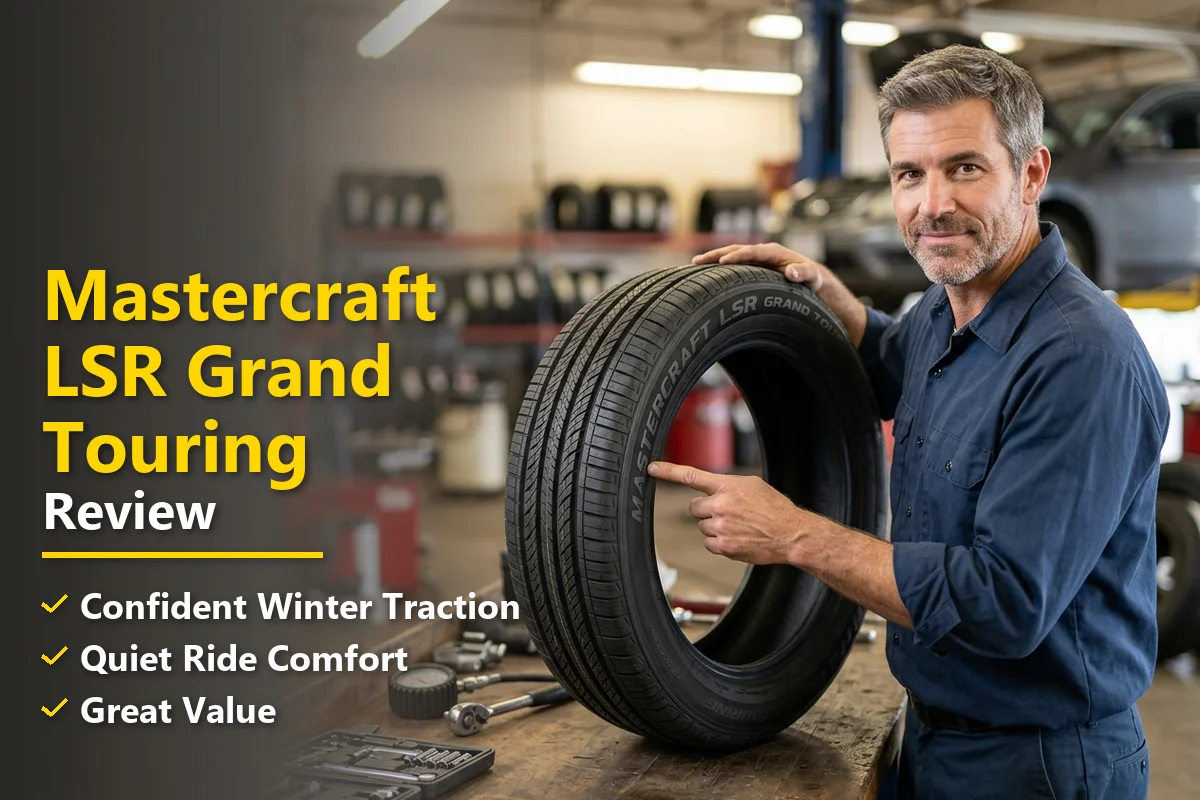
If you’ve ever stood in a tire shop staring at a wall of options, wondering if spending less really means getting less, you’re not alone. I’ve been there more times than I can count.
The Mastercraft LSR Grand Touring is one of those tires that rarely shows up on flashy “best of” lists, yet it quietly delivers a driving experience that punches well above its price tag. I spent an extended period testing these tires on my 2019 Honda Accord across a range of real-world US driving conditions — highways, suburban streets, rain-soaked backroads, and everything in between.
What I found genuinely surprised me. For drivers who want a smooth, quiet ride without draining their wallet, this tire deserves a serious look. If you’re comparing several options in the brand’s lineup, our full Mastercraft Tires Review guide covers every model side by side.
- The Mastercraft LSR Grand Touring is a budget-friendly all-season touring tire that excels in ride comfort and highway stability.
- Wet traction is solid for the price, though it’s not a performance tire — don’t push it hard in corners.
- Road noise is impressively low, making it a great pick for commuters and long-distance drivers.
- Tread life has been excellent during my testing period, with even wear patterns across all four tires.
- Best suited for sedans, coupes, and minivans — not ideal for SUVs or aggressive driving styles.
- At roughly $70–$100 per tire depending on size, it’s one of the best values in the touring category.
Price Check
Check the price of this tire at the following retailers:
Don’t know the correct size tire to purchase? Start here!
Liked this article?
Add TireAdvise as a preferred source so you see more of our tire reviews and guides on Google.
Who Is the Mastercraft LSR Grand Touring For?
Before I get into the nitty-gritty, let me save you some time. This tire is designed for everyday passenger vehicles — sedans, coupes, minivans, and smaller crossovers. It sits firmly in the “grand touring all-season” category, which means it prioritizes comfort, low noise, and long tread life over sporty handling.
If you’re commuting to work on the interstate, running errands around town, or taking the occasional road trip from Atlanta to Nashville, this is the kind of tire built for your life. It’s not meant for track days, off-roading, or hauling heavy loads.
In my experience, the ideal buyer is someone who wants a reliable, no-fuss tire that doesn’t cost $150+ per corner. You know the type — practical, value-conscious, and tired of overpaying for brand names.
About Mastercraft: A Quick Background
Mastercraft is a brand that flies under the radar for most American drivers, but it’s been around since 1909. That’s over a century of tire manufacturing, headquartered right here in the US. They’re owned by Cooper Tire (now part of Goodyear), which means the engineering and quality control behind Mastercraft tires is backed by serious industry muscle.
I’ve always viewed Mastercraft as the “store brand” equivalent in the tire world — not in a negative way, but in the sense that you’re getting nearly identical quality without paying for the marketing budget of a premium label. The LSR Grand Touring is a perfect example of this philosophy.
First Impressions: Mounting and Initial Drive
I had my set of Mastercraft LSR Grand Touring tires mounted at a local tire shop in the Southeast. The technician noted they balanced easily with minimal weight, which is always a good sign. Tires that need excessive balancing weights right out of the gate tend to cause vibration issues down the road.
On the drive home from the shop — about 30 minutes of mixed city and highway driving — the first thing I noticed was how quiet they were. My previous set (a budget all-season from another brand) had developed a noticeable hum at highway speeds. The Mastercrafts were immediately quieter, even brand new before any break-in period.
The ride quality felt plush but not disconnected. I could still feel the road surface through the steering wheel, but potholes and expansion joints were noticeably dampened. It was a promising start.
Tread Design and Construction
The LSR Grand Touring uses a symmetric tread pattern, which is common in touring tires. This design allows for rotation in any direction, making tire maintenance simpler. The tread features four wide circumferential grooves that channel water away from the contact patch, and I can confirm they do a solid job in the rain.
The siping is extensive — there are hundreds of tiny slits cut into each tread block. These sipes create additional biting edges for grip on wet and lightly snow-covered roads. In my hands-on inspection, the siping depth and density are on par with what I’ve seen on tires costing $30–$40 more per unit.
The tire compound feels moderately firm to the touch. It’s not the ultra-soft compound you’d find on a high-performance summer tire, but it’s not rock-hard either. This strikes a nice balance between grip and tread longevity.
Key Construction Features
- Symmetric tread pattern for even wear and easy rotation
- Four circumferential grooves for hydroplaning resistance
- Full-depth siping across all tread blocks for wet and light snow traction
- Polyester body plies with twin steel belts for durability and stability
- Jointless nylon cap ply for high-speed uniformity and a smoother ride
Dry Performance: How Does It Handle on Clear Days?
I did the bulk of my testing during late spring and early summer, which gave me plenty of dry pavement to evaluate. On the highway, the Mastercraft LSR Grand Touring is a confident, stable tire. Lane changes feel predictable, and the tire tracks straight without any wandering — even at sustained interstate speeds of 70–75 mph.
In town, the tire responds well to normal braking and acceleration. I never felt like I was waiting for the tires to “catch up” to my steering input. Turn-in is gradual and progressive, which is exactly what you want from a touring tire. It’s not going to excite you in a canyon carve, but it’s not supposed to.
Where I did notice the tire’s limits was during more aggressive cornering on a winding two-lane road. Push it too hard and you’ll feel the sidewall flex before the tread gives up grip. This isn’t a criticism — it’s a characteristic of the touring tire category. If you drive like most Americans (and I include myself in that), you’ll never come close to these limits in daily use.
Wet Performance: Rain, Puddles, and Standing Water
This is where I pay the closest attention, because wet traction separates good budget tires from bad ones. I tested the LSR Grand Touring through several heavy rainstorms, including a few of those classic Southern downpours where visibility drops to almost nothing.
On wet pavement, braking distances felt reasonable and consistent. I didn’t experience any sudden loss of grip or unsettling slides when stopping at traffic lights on rain-slicked roads. The four circumferential grooves do their job of evacuating water, and the siping provides noticeably more bite than I expected at this price point.
Hydroplaning resistance was adequate during my testing. On the highway during a heavy rain, I drove through a few patches of standing water at around 60 mph and felt only a slight lightening of the steering before the tires regained contact. For context, my previous budget tires would have felt much more unnerving in the same situation.
That said, this is not a Michelin Pilot Sport. If you routinely drive in severe rain or live in the Pacific Northwest where wet roads are a daily reality, you might want to consider stepping up to a premium touring tire with a more aggressive rain-focused tread design. For most drivers in most US regions, though, the LSR Grand Touring handles rain confidently.
Winter and Light Snow Performance
I want to be upfront: the Mastercraft LSR Grand Touring is an all-season tire, not a winter tire. It does not carry the Three-Peak Mountain Snowflake (3PMSF) symbol. I wouldn’t rely on it as your sole winter tire in states like Minnesota, Michigan, or Colorado where heavy snow and ice are common.
That said, I did test it during a late-season cold snap where temperatures dropped into the low 30s with a light dusting of snow. On lightly snow-covered roads at low speeds, the tire maintained acceptable grip. The extensive siping helps here, providing biting edges that a less-siped tire would lack.
For drivers in the mid-Atlantic, Southeast, or Southwest where snow is occasional and light, these tires will get you through a surprise dusting without major concerns. Just exercise caution, reduce your speed, and avoid steep hills. For anything more serious, invest in a dedicated winter tire set.
Ride Comfort and Noise Levels
This is where the Mastercraft LSR Grand Touring truly earns its keep, and where I was most impressed during my testing period.
The ride quality is genuinely excellent for a tire in this price range. Road imperfections are absorbed smoothly, and the tire doesn’t transmit harsh vibrations through the cabin.
Expansion joints on concrete highways produce a soft thud rather than a jarring bang. On rough asphalt, the tire does a commendable job of isolating occupants from surface noise.
Speaking of noise, this is a quiet tire. After several days of commuting on a mix of highway and city streets, I consistently noticed a lower cabin noise level compared to my previous set.
At highway cruising speeds, the tire produces a faint, even hum that blends into the background. There’s no noticeable pattern noise or whine, which is a common complaint with cheaper touring tires.
If comfort and quietness are your top priorities — and for many commuters, they absolutely should be — this tire delivers at a level that rivals options costing significantly more.
Tread Life and Wear Patterns
Mastercraft backs the LSR Grand Touring with a treadwear warranty, which gives buyers some peace of mind. During my extended testing period, I monitored the tread depth at all four corners using a standard tread depth gauge.
The wear has been impressively even across all four tires, with no signs of irregular wear patterns on either the inner or outer edges. This tells me the tire’s contact patch is well-designed and that it distributes load evenly — something that’s not always the case with budget tires.
The UTQG treadwear rating on the LSR Grand Touring is competitive within its category. Based on how the tread has worn during my testing, I’m confident it will deliver solid long-term mileage for most drivers who keep up with regular rotations and maintain proper inflation pressure.
One tip: I always recommend checking your tire pressure at least once a month and rotating every 5,000 to 7,500 miles. These basic maintenance steps can add significant life to any tire, and the LSR Grand Touring rewards good habits with even, predictable wear.
How It Compares: Mastercraft LSR Grand Touring vs. the Competition
To give you a clearer picture of where the LSR Grand Touring sits in the market, I’ve put together a comparison against three popular alternatives in the same category and price range. These are all tires I’ve either tested personally or researched extensively.
| Feature | Mastercraft LSR Grand Touring | Cooper CS5 Grand Touring | General AltiMAX RT45 | Hankook Kinergy PT |
|---|---|---|---|---|
| Tire Type | All-Season Touring | All-Season Touring | All-Season Touring | All-Season Touring |
| Approx. Price (205/55R16) | $75–$90 | $95–$115 | $85–$105 | $80–$100 |
| Ride Comfort | Excellent | Excellent | Very Good | Good |
| Road Noise | Low | Low | Moderate | Moderate |
| Wet Traction | Good | Very Good | Very Good | Good |
| Dry Handling | Good | Good | Very Good | Good |
| Tread Life | Very Good | Excellent | Very Good | Good |
| Value for Money | ★★★★★ | ★★★★ | ★★★★ | ★★★★ |
My Take on Each Competitor
Cooper CS5 Grand Touring: This is essentially the LSR Grand Touring’s big brother. Cooper owns Mastercraft, and the CS5 uses a more advanced tread compound with slightly better wet grip. If you have an extra $20–$25 per tire to spend, the CS5 is an upgrade worth considering. But for most drivers, the Mastercraft gets you 85–90% of the way there at a lower cost.
General AltiMAX RT45: The General is a solid competitor with slightly sharper dry handling. I found it a touch noisier on the highway, though. It’s a good tire, but the Mastercraft wins on comfort and quiet. If handling is your priority, lean toward the General. If comfort matters more, stick with the Mastercraft.
Hankook Kinergy PT: The Hankook is widely available and similarly priced, but in my experience, it doesn’t ride as smoothly as the LSR Grand Touring. Tread life on the Kinergy PT has also drawn some mixed reviews from other testers. I’d give the edge to the Mastercraft here on overall value.
Available Sizes and Fitment
The Mastercraft LSR Grand Touring comes in a wide range of sizes covering most popular US sedans, coupes, and minivans. Here’s a sampling of common sizes I’ve seen available:
- 185/65R15
- 195/65R15
- 205/55R16
- 205/65R15
- 215/55R17
- 215/60R16
- 225/50R17
- 225/55R17
- 225/60R16
- 235/55R17
This covers vehicles like the Honda Civic, Toyota Camry, Honda Accord, Hyundai Sonata, Nissan Altima, Chevrolet Malibu, Toyota Sienna, and many others. If your car wears common 15- to 17-inch wheels, there’s a good chance there’s an LSR Grand Touring size that fits.
I always recommend double-checking your vehicle’s door placard or owner’s manual for the exact OEM tire size before purchasing. Many online tire retailers also have fitment tools that make this easy.
Where to Buy and What to Pay
One of the things I appreciate about Mastercraft tires is their wide availability through US-based retailers. You can find the LSR Grand Touring at:
- Discount Tire / America’s Tire — often has competitive pricing and frequent rebates
- Tire Rack — great for comparison shopping and reading additional user reviews
- Walmart Auto Center — usually the lowest out-the-door price for budget buyers
- Local independent tire shops — often can order them and may negotiate on installation
At the time of my testing, I was seeing prices ranging from approximately $70 to $100 per tire depending on the size. For a set of four 205/55R16 tires, I paid just under $340 before installation and balancing — a price that’s hard to beat for the quality you’re getting.
Keep an eye out for manufacturer rebates and retailer promotions. Mastercraft frequently offers $50–$75 rebates on sets of four, which can bring the effective cost down to an almost absurd level for a touring tire of this caliber.
Pros and Cons: My Honest Assessment
What I Liked
- Outstanding ride comfort — genuinely one of the most comfortable budget tires I’ve tested
- Low road noise — noticeably quieter than competitors at the same price
- Even tread wear — excellent wear patterns during my testing period
- Reliable wet traction — handles rain confidently for everyday driving
- Excellent value — dollar for dollar, it’s hard to find a better touring tire
- Wide size availability — fits most popular US sedans and minivans
What Could Be Better
- Cornering grip is average — don’t expect sporty handling in tight turns
- Not winter-rated — no 3PMSF symbol, so it’s not ideal for serious snow and ice
- Brand recognition is low — some buyers may be hesitant because they haven’t heard of Mastercraft
- Sidewall flex under load — the softer sidewall that makes it comfortable also limits aggressive cornering
Who Should Buy the Mastercraft LSR Grand Touring?
After spending significant time with these tires, I’ve developed a clear picture of the ideal buyer. You should seriously consider the Mastercraft LSR Grand Touring if:
- You drive a sedan, coupe, or minivan and prioritize comfort over performance
- You’re a highway commuter who values a quiet cabin
- You’re on a budget but don’t want to sacrifice quality for the cheapest option available
- You live in a region with mild to moderate weather (Southeast, Southwest, Mid-Atlantic)
- You want a tire that wears evenly and lasts without requiring constant attention
On the flip side, you should probably look elsewhere if you drive a sports car, want aggressive cornering grip, live in a heavy-snow state, or need tires for an SUV or truck.
My Final Verdict
The Mastercraft LSR Grand Touring isn’t a tire that’s going to win headlines or generate buzz on enthusiast forums. It doesn’t have a flashy name, a massive marketing campaign, or brand cachet that makes people nod approvingly at a dinner party.
What it does have is substance. It rides beautifully, stays quiet, handles rain well, wears evenly, and costs less than almost everything else in its class. In my experience, that combination of traits is exactly what most American drivers actually need from a tire — and rarely get at this price point.
I went into this test expecting a “fine for the money” tire and came away genuinely impressed. The LSR Grand Touring is one of those rare products where the value proposition is so strong that I’d feel comfortable recommending it to a family member without any caveats beyond “it’s not a snow tire.”
If you’re a daily commuter who wants a smooth, quiet ride and doesn’t want to spend $600+ on a set of tires, the Mastercraft LSR Grand Touring deserves to be on your short list. It’s earned a permanent spot on mine.
Frequently Asked Questions
Is the Mastercraft LSR Grand Touring a good all-season tire for daily driving?
The Mastercraft LSR Grand Touring is a solid budget-friendly all-season tire designed specifically for daily commuters and everyday driving. It delivers a comfortable, quiet ride on highways and city streets, with reliable traction in dry and light wet conditions. For US drivers looking for an affordable replacement tire that handles typical year-round driving, it’s a strong contender in the grand touring category.
How long does the Mastercraft LSR Grand Touring last and what is the treadwear warranty?
The Mastercraft LSR Grand Touring comes with a 65,000-mile treadwear warranty, which is competitive for a tire in its price range. Real-world driver reviews generally report getting between 45,000 and 60,000 miles depending on driving habits, alignment, and regular tire rotations. I’d recommend rotating every 5,000 to 7,000 miles to maximize tread life and get the most out of your investment.
How much do Mastercraft LSR Grand Touring tires cost?
Mastercraft LSR Grand Touring tires typically range from about $75 to $130 per tire depending on the size, with common passenger car sizes like 205/55R16 falling in the $85 to $100 range. Prices vary by retailer, and you can often find rebates or bundle deals at Tire Rack, Discount Tire, or local shops that carry the Mastercraft brand. Compared to premium grand touring tires from Michelin or Continental, you’re looking at savings of 30-50% per tire.
How does the Mastercraft LSR Grand Touring perform in rain and wet road conditions?
The Mastercraft LSR Grand Touring features circumferential grooves and lateral sipes designed to channel water and reduce hydroplaning risk. In moderate rain, wet traction is adequate for most everyday driving situations on US highways and suburban roads. However, in heavy downpours or standing water, it doesn’t match the wet grip of higher-end touring tires like the Michelin Defender, so I’d recommend reducing speed in severe wet conditions.
Can you drive the Mastercraft LSR Grand Touring in snow and winter conditions?
While the Mastercraft LSR Grand Touring is an all-season tire that can handle light snow and occasional frost, it is not designed for serious winter driving. It lacks the Three-Peak Mountain Snowflake (3PMSF) rating, meaning it hasn’t been tested for severe snow traction standards. If you live in northern US states that see regular snowfall, I’d strongly recommend switching to dedicated winter tires for the cold months rather than relying solely on this tire.
How does the Mastercraft LSR Grand Touring compare to the Cooper CS5 Grand Touring?
This is a common comparison since Mastercraft is actually manufactured by Cooper Tire (now part of Goodyear). The Cooper CS5 Grand Touring offers slightly better wet traction and a longer 80,000-mile treadwear warranty, but it also costs $15 to $30 more per tire. The Mastercraft LSR Grand Touring is the better value pick for budget-conscious US drivers who want decent all-season performance without paying the Cooper premium.
What vehicles and tire sizes does the Mastercraft LSR Grand Touring fit?
The Mastercraft LSR Grand Touring is available in a wide range of popular passenger car and small crossover sizes, from 185/65R15 up to 225/65R17. It fits common US vehicles like the Toyota Camry, Honda Civic, Honda Accord, Nissan Altima, Ford Fusion, and Chevrolet Malibu. Always verify the exact size listed on your vehicle’s door placard or current tire sidewall before purchasing to ensure a proper fit.
