

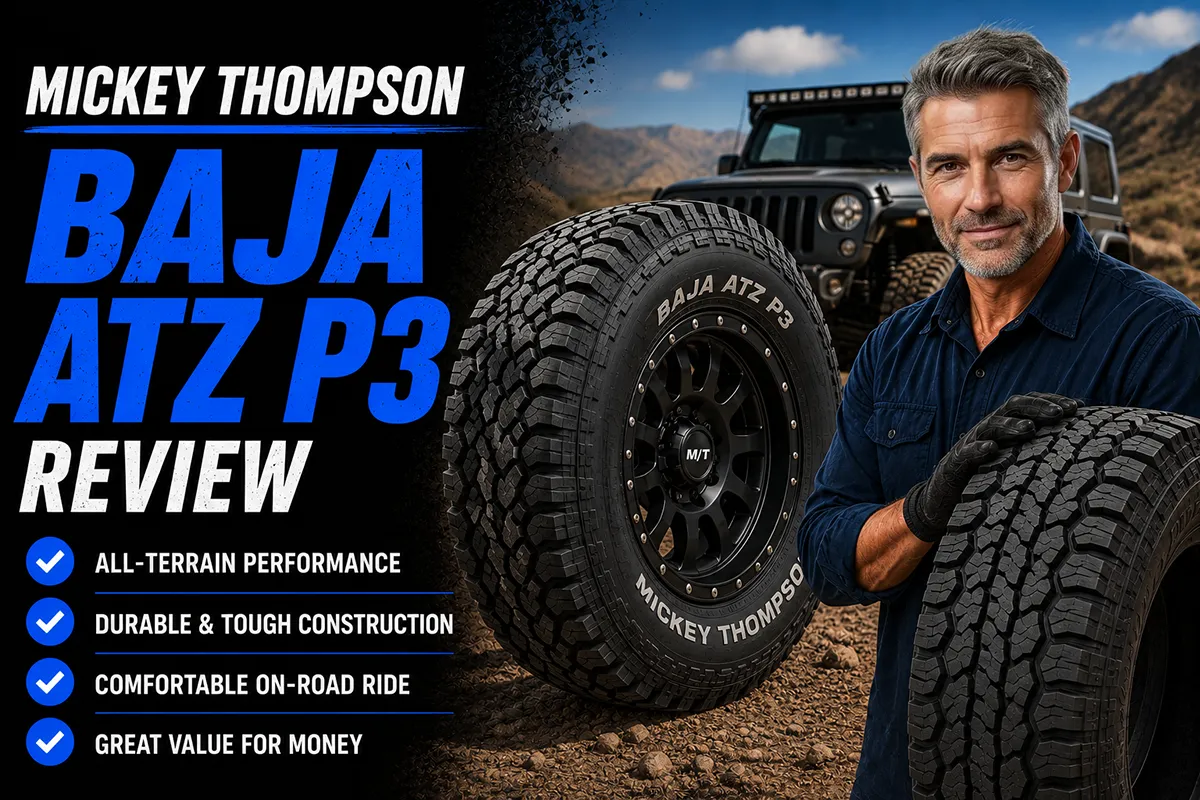
Finding a tire that can handle a rutted forest service road on Saturday morning and still feel composed on your Monday highway commute sounds like asking for too much. Most all-terrain tires force you to pick a side — either they’re great off-road and miserable on pavement, or they’re smooth on the highway but useless the moment gravel turns to mud.
The Mickey Thompson Baja ATZ P3 claims to live right in that sweet spot. I spent an extended test period putting these tires through everything I could throw at them — wet highways, dry desert trails, loose gravel, packed mud, and even a surprise snowfall — to find out whether that claim holds up.
If you’re exploring the full lineup, our comprehensive Mickey Thompson Review guide covers every model side by side and can help you narrow down the best fit for your truck or SUV.
- The Baja ATZ P3 is a hybrid all-terrain tire that bridges the gap between aggressive mud-terrains and mild highway all-terrains.
- Off-road traction in mud, gravel, and loose sand impressed me consistently during my test period.
- Highway manners are surprisingly refined — lower road noise than I expected, stable tracking, and confident wet braking.
- Tread life appears solid, with even wear patterns after several weeks of mixed-surface driving.
- Best suited for truck and SUV owners who split time between pavement and moderate off-road trails.
- Pricing falls in the mid-to-upper range for the all-terrain category, but the versatility justifies the cost.
Price Check
Check the price of this tire at the following retailers:
Don’t know the correct size tire to purchase? Start here!
Liked this article?
Add TireAdvise as a preferred source so you see more of our tire reviews and guides on Google.
What Exactly Is the Mickey Thompson Baja ATZ P3?
Before I dive into how these tires performed, let me set the stage. The Baja ATZ P3 sits in Mickey Thompson’s lineup as what I’d call a “hybrid all-terrain” — more aggressive than your typical AT tire, but not quite a full-blown mud-terrain. Mickey Thompson brands it as an “Anything-Terrain” tire, and honestly, that marketing language is closer to the truth than I initially gave it credit for.
The “P3” designation represents the third generation of this design. Mickey Thompson took feedback from the previous ATZ iterations and made meaningful changes to the tread compound, sidewall construction, and lug geometry. The result is a tire that looks tough enough to belong on a Baja race truck but behaves well enough for daily driving.
Available in a wide range of sizes — from 15-inch passenger fitments all the way up to 20-inch truck sizes — the Baja ATZ P3 covers most popular half-ton and three-quarter-ton trucks, as well as full-size SUVs. LT (light truck) and flotation sizes are both available, which matters if you’re running a leveled or lifted rig.
First Impressions: The Tread Design and Build Quality
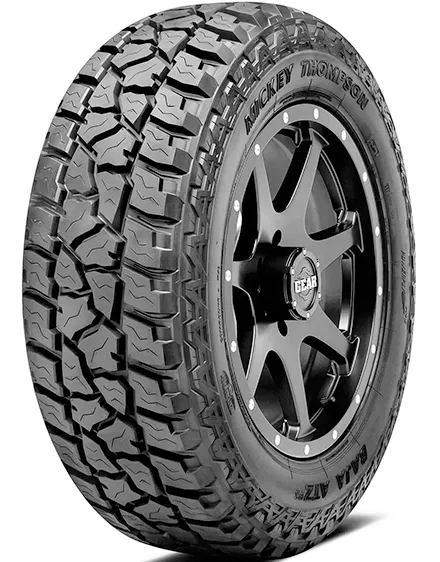
When I first pulled these tires out of the box, the tread pattern immediately caught my eye. The Baja ATZ P3 features what Mickey Thompson calls a “Deegan 38” inspired design, with deep, asymmetric lugs that are spaced aggressively but not chaotically. There’s clear engineering logic in how the tread blocks are arranged.
The sidewall is where this tire really makes a visual statement. Deep side-biters wrap around the shoulder, providing both extra protection against rock punctures and additional traction when you’re aired down on a trail. The Mickey Thompson branding is raised and bold — this is not a tire that tries to hide what it is.
Build quality felt premium right out of the gate. The rubber compound has a firm but pliable feel, and the overall construction feels dense and substantial without being excessively heavy. I noticed stone ejector ribs between the main tread lugs, which is a detail I always appreciate — these help prevent rocks from lodging in the tread and causing damage or balance issues.
On-Road Performance: Highway Comfort and Handling
Let me start with where most owners will spend the majority of their time: the highway. I drove these tires extensively on interstate highways, suburban roads, and city streets before I ever pointed the truck toward a dirt trail.
Road Noise
This is typically where aggressive all-terrain tires fall apart, so I paid close attention. At highway speeds on fresh pavement, the Baja ATZ P3 produces a noticeable but not offensive hum. It’s quieter than any mud-terrain I’ve tested, and it’s in the same ballpark as many mainstream all-terrain tires like the BFGoodrich KO2 or the Falken Wildpeak AT3W.
On coarser chip-seal road surfaces — the kind you find on a lot of rural US highways — the noise does increase. I’d describe it as a steady drone rather than a sharp whine. With the radio at moderate volume, it fades into the background. After several days of highway driving, I stopped noticing it entirely unless I was actively listening for it.
Ride Quality
The ride is firm but not harsh. These tires have reinforced sidewalls, which means they don’t absorb small bumps as eagerly as a standard highway tire would. Sharp expansion joints and potholes transmit more feedback through the steering wheel and seat than a softer touring tire would allow.
That said, I never found the ride punishing. On smooth interstate pavement, the Baja ATZ P3 is genuinely comfortable. I took a road trip spanning several hours, and I arrived without the fatigue I’ve experienced with stiffer mud-terrain tires. The tire finds a middle ground that I think most truck owners will appreciate.
Dry Handling
Straight-line stability is excellent. The tire tracks true at highway speeds with no wandering or tramline sensitivity. During lane changes and highway on-ramp sweepers, the Baja ATZ P3 transitions smoothly without the vague, squishy feeling some off-road-oriented tires produce.
In parking lots and around town, steering response feels reasonably sharp for a tire of this weight class. It’s not a sports car tire, but it doesn’t feel sluggish either. I was pleasantly surprised by the confidence it inspired in everyday driving situations.
Wet Performance
Wet pavement is where I wanted to stress-test this tire’s on-road credentials. I drove through multiple rainstorms during my test period, including some genuine downpours that left standing water across highway lanes.
Braking in the wet felt predictable and strong. The wide circumferential grooves and open tread design do a solid job of evacuating water, and I never experienced hydroplaning — even at speeds where I’ve had lesser tires start to feel sketchy. Cornering grip on wet roads was also confidence-inspiring, with gradual and predictable breakaway rather than the sudden loss of traction that can catch you off guard.
I’d rate the Baja ATZ P3’s wet performance as above average for the all-terrain category. It’s clearly engineered for more than just dry dirt.
Off-Road Performance: Where the Baja ATZ P3 Comes Alive
Now for the fun part. I tested these tires across a range of off-road surfaces, because that’s where Mickey Thompson has built its reputation, and that’s where any tire carrying the “Baja” name needs to deliver.
Gravel and Hard-Pack Dirt
On maintained gravel roads and hard-pack fire roads, the Baja ATZ P3 feels absolutely at home. Traction is plentiful, the tire digs in confidently under acceleration, and braking distances on loose gravel felt short and controlled.
I spent an entire afternoon driving forestry roads in varying conditions — some freshly graded with loose material on top, others packed down and rutted from heavy vehicle traffic. The tire handled everything without drama. Steering feel remained communicative, and I always had a clear sense of how much grip was available.
Mud Performance
This is where a lot of all-terrain tires reveal their limitations, but the Baja ATZ P3 genuinely surprised me. The aggressive lug spacing and deep voids between the tread blocks allow this tire to self-clean far better than milder AT tires. When I drove through sections of thick, clay-heavy mud, the tread cleared itself within a rotation or two rather than packing up and turning into a slick.
To be clear, this is not a dedicated mud-terrain tire. In truly extreme bog conditions, a purpose-built MT tire will outperform it. But for the kind of mud you encounter on typical US trail systems — rain-soaked two-tracks, seasonal creek crossings, muddy campsites — the ATZ P3 handles it with impressive composure.
Sand
I took the truck out to a sandy wash area and aired the tires down to around 18 PSI to test their flotation capabilities. The Baja ATZ P3 performed well in soft sand, spreading its footprint enough to stay on top rather than digging in. The open tread design helps here, too — it paddles through loose material rather than compacting it under the tire.
If you regularly drive on beach sand or in desert washes, you’ll be pleased with how these tires handle that environment. They’re not as specialized as a paddle tire, of course, but for occasional sand driving, they’re more than capable.
Rock Crawling and Rocky Trails
I took the tires over some moderately technical rocky terrain — not extreme boulder crawling, but the kind of rock-strewn trails you’d find in places like Moab’s easier routes or the Rocky Mountain backcountry. The reinforced sidewalls provided peace of mind against punctures, and the side-biters added noticeable traction when the sidewall was contacting rock faces at extreme articulation angles.
Grip on dry rock was excellent. The compound felt sticky enough to hold on ledges and shelves without spinning. On wet rock, traction was reduced — as it is with any tire — but still adequate for careful driving.
The stone ejectors I mentioned earlier earned their keep on these trails. After driving over miles of rocky terrain, I checked the tread and found almost no lodged stones. That’s a significant quality-of-life feature that protects both the tire and your sanity.
Winter and Snow Performance
The Baja ATZ P3 is not a dedicated winter tire, and it doesn’t carry the Three-Peak Mountain Snowflake (3PMSF) rating. That’s an important distinction for anyone who lives in areas with serious winter weather.
That said, I did encounter an unexpected early-season snowfall during my testing period, and I can share my impressions. On a few inches of fresh snow over pavement, the tire performed reasonably well. The aggressive tread pattern bites into snow similarly to how it grips in mud, and I maintained adequate traction for cautious driving.
On compacted snow and ice, however, the limitations became apparent. The rubber compound isn’t formulated for sub-freezing flexibility the way a true winter tire’s is, and braking distances on icy surfaces were noticeably longer than what I’d expect from a winter-rated tire. If you live in the northern US and deal with months of snow and ice, I’d recommend either running dedicated winter tires or considering an all-terrain with the 3PMSF rating.
For occasional snow encounters in milder climates — a surprise storm in the Southeastern foothills or a dusting in the Pacific Northwest lowlands — the ATZ P3 will get you home safely with reasonable caution.
Tread Life and Durability
Assessing long-term tread life during a single test period is inherently limited, but I can share some meaningful observations. After several weeks of aggressive mixed-surface driving — including a significant amount of off-road use that accelerates wear — the tread depth showed minimal measurable reduction.
More importantly, the wear pattern was remarkably even across the tread face. I didn’t see accelerated shoulder wear or center-strip wear, which tells me the tire’s contact patch is well-designed and distributing forces effectively. With proper rotation intervals and appropriate air pressures, I’d expect these tires to deliver competitive tread life for the category.
Mickey Thompson uses a proprietary silica-reinforced compound in the ATZ P3 that’s designed to balance off-road grip with on-road longevity. Based on the wear characteristics I observed, that balance appears to be working. The compound isn’t so soft that it’ll burn off on hot summer pavement, but it isn’t so hard that it sacrifices wet or off-road grip.
One note on durability: I intentionally drove over sharp shale and jagged limestone without puncturing the tire. The cut-and-chip resistance of the tread compound impressed me, and the sidewall construction feels robust enough to handle regular trail abuse without premature failure.
How the Baja ATZ P3 Compares to Key Competitors
No tire exists in a vacuum, so let me put the ATZ P3 in context against some of the most popular all-terrain tires in the US market. Here’s how it stacks up based on my direct experience:
| Feature | Mickey Thompson Baja ATZ P3 | BFGoodrich KO2 | Falken Wildpeak AT3W | Toyo Open Country AT III |
|---|---|---|---|---|
| Off-Road Traction (Mud) | ★★★★★ | ★★★★☆ | ★★★☆☆ | ★★★★☆ |
| Off-Road Traction (Rock) | ★★★★★ | ★★★★★ | ★★★☆☆ | ★★★★☆ |
| Highway Comfort | ★★★★☆ | ★★★★☆ | ★★★★★ | ★★★★★ |
| Road Noise | ★★★★☆ | ★★★☆☆ | ★★★★★ | ★★★★☆ |
| Wet Traction | ★★★★☆ | ★★★★☆ | ★★★★★ | ★★★★★ |
| Snow Performance | ★★★☆☆ | ★★★★☆ | ★★★★★ | ★★★★★ |
| Sidewall Durability | ★★★★★ | ★★★★★ | ★★★★☆ | ★★★★☆ |
| Aggressive Looks | ★★★★★ | ★★★★☆ | ★★★☆☆ | ★★★★☆ |
| Approx. Price (LT 275/70R17) | $260–$290 | $270–$310 | $210–$240 | $240–$270 |
Versus the BFGoodrich KO2: The KO2 is the reigning king of all-terrain tires in the US, and for good reason — it’s proven, widely available, and carries the 3PMSF snowflake rating. In my experience, the Baja ATZ P3 offers better mud traction due to its more aggressive tread spacing, and it looks meaner on the truck. However, the KO2 edges it out in snow performance and arguably in long-term tread life reputation. If winter capability is a priority, the KO2 has the edge. If off-road aggression matters more, the ATZ P3 wins.
Versus the Falken Wildpeak AT3W: The Wildpeak is a phenomenal value tire that excels on the highway and in winter conditions. It’s quieter and more comfortable than the ATZ P3 for daily driving. But it’s noticeably less capable in serious off-road situations — particularly mud and rock. If your driving is 80% highway and 20% light gravel roads, the Wildpeak might be the smarter buy. If you genuinely hit trails, the ATZ P3 is the better tool.
Versus the Toyo Open Country AT III: The Toyo occupies similar middle ground as the ATZ P3 but leans slightly more toward on-road refinement. It’s a fantastic all-rounder with strong wet and snow performance. The ATZ P3 is the more aggressive choice — better in mud, better in sand, and better-looking on a built truck. The Toyo is the more polished daily driver.
Pricing and Value
At the time of testing, the Mickey Thompson Baja ATZ P3 falls in the $220 to $330 per tire range depending on size, with the most popular LT sizes for half-ton trucks (like 275/70R17 or 285/70R17) landing around $260 to $290 each. That puts it roughly on par with the BFGoodrich KO2 and above budget-friendly options like the Falken Wildpeak.
Is the price justified? In my opinion, yes — but with a caveat. If you genuinely use the off-road capability this tire offers, it represents excellent value. The combination of trail-ready aggression and civilized highway manners means you can run one set of tires year-round (in non-winter climates) without compromise. You’re essentially buying a tire that replaces the need for both a mild AT tire and a dedicated trail tire.
If you rarely leave pavement, you’re paying a premium for capability you won’t use. In that case, a more road-focused all-terrain tire would be a better use of your money.
Who Should Buy the Mickey Thompson Baja ATZ P3?
Based on my extensive testing, here’s who I think this tire is best suited for:
- Weekend warriors who trail ride regularly: If you hit off-road parks, forest service roads, or backcountry trails at least a couple of times a month, this tire gives you serious capability without destroying your daily driving experience.
- Truck owners who want an aggressive look without mud-terrain compromises: The Baja ATZ P3 looks like it means business. If aesthetics matter to you (and let’s be honest, they do), this tire transforms the appearance of any truck or SUV.
- Owners in the South, Southwest, and West: In regions where snow and ice aren’t persistent winter threats, the ATZ P3’s mild-weather versatility makes it a year-round tire that covers almost every scenario.
- Hunters, campers, and outdoor enthusiasts: Getting to a remote campsite or trailhead often means dealing with unpredictable road conditions. This tire gives you the confidence to keep going when the road gets ugly.
Who Should Look Elsewhere?
Equally important — here’s who this tire probably isn’t ideal for:
- Drivers in heavy snow states: Without the 3PMSF rating, the ATZ P3 isn’t the right choice as a primary tire in Minnesota, Michigan, Wisconsin, or similar climates. Look at the Falken Wildpeak AT3W or BFGoodrich KO2 instead.
- Primarily highway commuters: If 95% of your driving is interstate commuting, you’ll get better ride quality, lower noise, and longer tread life from a highway-biased all-terrain or touring tire.
- Extreme rock crawlers and mud boggers: The ATZ P3 is aggressive, but it’s not a dedicated mud-terrain or rock crawler. If you’re doing serious obstacle courses or competition-level mud bogging, step up to a purpose-built tire like the Mickey Thompson Baja MTZ P3 or Baja Boss.
Installation Tips and Recommended Air Pressures
I ran these tires at 35 PSI on the highway (for my specific truck and load rating — always check your door placard) and aired down to 18-20 PSI for off-road trails. The difference in ride quality and traction between highway and aired-down pressures was dramatic. If you’re new to airing down for off-road driving, invest in a portable air compressor — it’s the single best accessory you can pair with these tires.
During installation, I recommend having your tire shop use proper torque specs and check the bead seating carefully. These are beefy tires with stiff sidewalls, and ensuring a good bead seat is important for preventing vibration. I also suggest a road-force balance rather than a standard spin balance — it makes a noticeable difference in ride smoothness with tires this heavy-duty.
Rotate these tires every 5,000 to 7,500 miles (or per your vehicle manufacturer’s recommendation) to promote even wear. Given the asymmetric tread design, a standard cross-rotation pattern works well.
My Final Verdict on the Mickey Thompson Baja ATZ P3
After weeks of driving the Baja ATZ P3 across a wide range of conditions, I came away genuinely impressed. This tire doesn’t just talk a good game — it delivers real-world performance that bridges the gap between trail capability and highway civility better than most tires in this category.
Is it perfect? No. It’s noisier than the quietest all-terrains, it lacks a snow rating, and it costs more than budget-friendly alternatives. But if you’re the kind of driver who actually uses your truck the way truck commercials suggest — highway miles during the week, dirt roads and trails on the weekend — the ATZ P3 is one of the best all-terrain tires you can bolt on.
The off-road traction in mud and loose terrain is exceptional for an AT tire. The highway manners are refined enough for road trips. The build quality and durability feel top-shelf. And yes, it looks absolutely fantastic on the truck. Sometimes that matters too.
I recommend the Mickey Thompson Baja ATZ P3 for any truck or SUV owner who refuses to choose between off-road capability and on-road comfort. It’s the rare tire that lets you have both — not perfectly, but in a balance that actually works for real-world driving across the diverse road conditions you’ll find all over the United States.
Frequently Asked Questions
How does the Mickey Thompson Baja ATZ P3 perform on highway vs off-road?
The Mickey Thompson Baja ATZ P3 delivers a surprisingly smooth and quiet highway ride for an all-terrain tire, thanks to its computer-optimized tread design that reduces road noise. Off-road, the aggressive sidewall lugs and PowerPly XD construction provide excellent traction on rocks, mud, and loose dirt. I found it handles the daily commute just as confidently as weekend trail runs, making it a genuine 50/50 on-road/off-road performer.
How long do Mickey Thompson Baja ATZ P3 tires last?
Most drivers report getting between 40,000 and 50,000 miles out of the Mickey Thompson Baja ATZ P3, though tread life varies based on driving habits and whether you regularly air down for off-roading. The silica-reinforced compound is designed for extended wear, and the tire does not come with a manufacturer treadwear warranty, which is common for aggressive all-terrain tires. Rotating every 5,000 to 7,000 miles and keeping proper alignment will help maximize longevity.
How much do Mickey Thompson Baja ATZ P3 tires cost?
The Mickey Thompson Baja ATZ P3 typically ranges from about $220 to $380 per tire depending on size, with popular sizes like LT285/70R17 falling around $280 to $310 at major US retailers like Discount Tire, Tire Rack, and Amazon. Prices can fluctuate based on seasonal promotions and rebates that Mickey Thompson frequently offers. For a full set, budget roughly $900 to $1,500 installed, which positions it competitively against comparable all-terrain tires like the BFGoodrich KO2.
Is the Mickey Thompson Baja ATZ P3 good in snow and ice?
The Baja ATZ P3 performs reasonably well in light to moderate snow thanks to its open tread pattern and biting edges, but it does not carry the Three-Peak Mountain Snowflake (3PMSF) rating, so it is not a substitute for dedicated winter tires in severe snow states. In my experience, it handles slushy highway conditions and packed snow trails better than most all-terrain tires, but it can struggle on pure ice. If you regularly drive through harsh Midwest or Northeast winters, pairing these with a set of winter tires is the safest approach.
How does the Mickey Thompson Baja ATZ P3 compare to the BFGoodrich KO2?
The Baja ATZ P3 tends to offer more aggressive off-road traction, especially in mud and loose terrain, thanks to its deeper sidewall lugs and wider tread voids compared to the BFGoodrich KO2. However, the KO2 edges ahead in tread life with its 50,000-mile warranty and carries the 3PMSF severe snow rating, which the ATZ P3 lacks. On highway comfort and noise levels, the two are very close, though some drivers feel the P3 has a slightly softer ride. Your choice may come down to whether you prioritize trail capability or longer wear and winter certification.
What sizes does the Mickey Thompson Baja ATZ P3 come in for trucks and SUVs?
The Mickey Thompson Baja ATZ P3 is available in a wide range of light truck and SUV sizes from 15-inch to 20-inch wheel diameters, covering popular fitments like LT265/70R17, LT285/75R16, LT305/70R16, and LT35x12.50R20. This makes it compatible with most full-size trucks and SUVs including the Ford F-150, Chevrolet Silverado, Toyota Tacoma, and Jeep Wrangler. Check Mickey Thompson’s official fitment guide or retailers like Tire Rack to confirm exact sizing for your vehicle.
Is the Mickey Thompson Baja ATZ P3 loud on the road?
For an all-terrain tire with such an aggressive tread pattern, the Baja ATZ P3 is noticeably quieter than you might expect. Mickey Thompson uses a variable pitch tread design that disrupts harmonic noise patterns, resulting in a low hum rather than a roar at highway speeds. Most owners, myself included, notice some tire noise above 60 mph compared to a standard highway tire, but it is significantly less intrusive than mud-terrain alternatives and easy to live with as a daily driver.
