

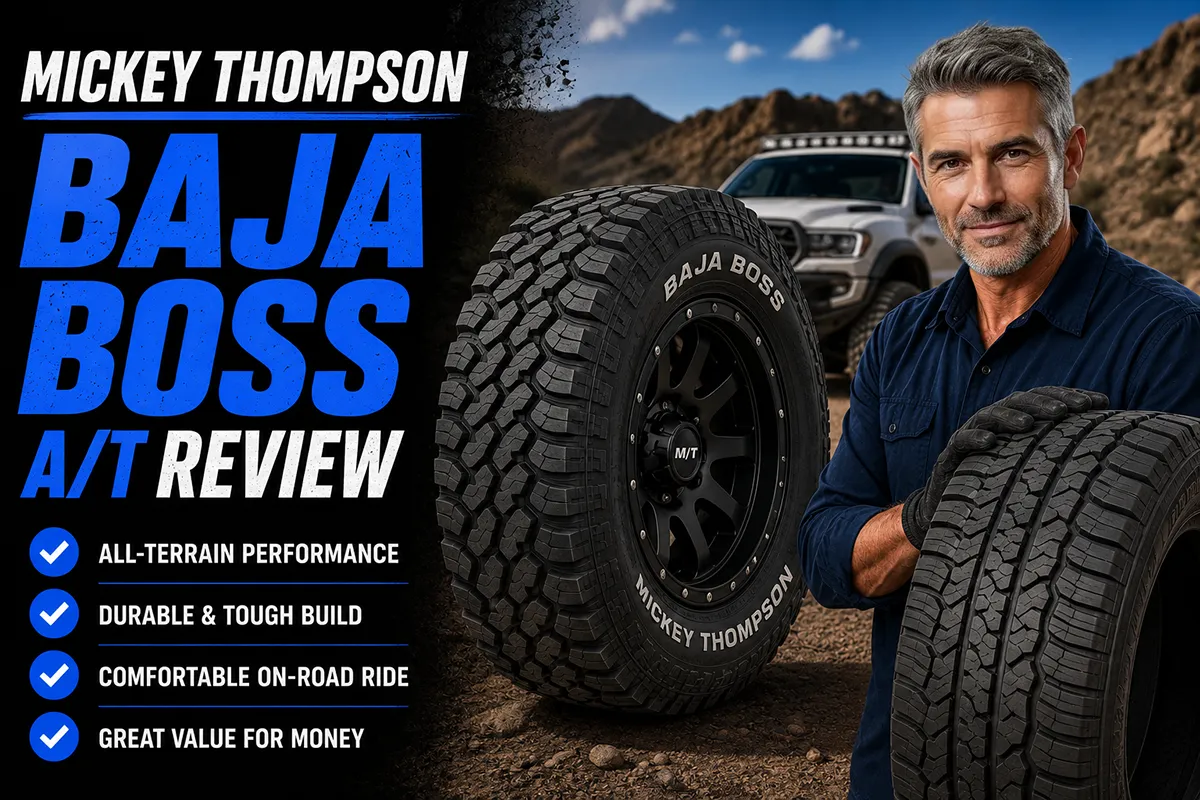
If you’ve ever stood in a tire shop staring at rows of all-terrain options, wondering which one can actually handle both your daily commute and your weekend off-road adventures without compromising either, you’re not alone.
I’ve been there — torn between aggressive off-road grip and a quiet, comfortable highway ride. That’s exactly why I spent an extended test period putting the Mickey Thompson Baja Boss A/T through every scenario I could think of.
After testing these tires across dry pavement, rain-soaked highways, loose gravel, packed dirt, and even some surprisingly deep mud, I’m ready to share exactly what I found.
If you’re exploring the broader lineup, our full Mickey Thompson Review guide covers every model side by side — but today, we’re going deep on the Baja Boss A/T specifically.
- The Mickey Thompson Baja Boss A/T is one of the most capable all-terrain tires I’ve tested, offering near-mud-terrain off-road grip with surprisingly civilized on-road manners.
- Highway noise is present but far quieter than you’d expect from a tire this aggressive — I’d rate it a 7 out of 10 for comfort.
- Wet traction is outstanding thanks to the asymmetric tread design and deep sipes.
- Off-road, these tires punch well above the typical all-terrain weight class, handling mud, rocks, and sand with confidence.
- Treadwear looks very promising after my extended testing period, with even wear across all four corners.
- Pricing ranges from roughly $220–$400+ per tire depending on size, which is competitive for the premium all-terrain segment.
- Best suited for truck and SUV owners who want serious off-road capability without sacrificing daily drivability.
Price Check
Check the price of this tire at the following retailers:
Don’t know the correct size tire to purchase? Start here!
Liked this article?
Add TireAdvise as a preferred source so you see more of our tire reviews and guides on Google.
What Exactly Is the Mickey Thompson Baja Boss A/T?
The Mickey Thompson Baja Boss A/T sits in that sweet spot between a traditional all-terrain tire and a full-blown mud-terrain. It’s designed for truck and SUV owners who need legitimate off-road performance but still drive to work five days a week.
Mickey Thompson positions this tire as the most aggressive all-terrain in their lineup, and after testing it, I’d say that label is accurate. It borrows a lot of DNA from their Baja Boss M/T — the company’s dedicated mud-terrain tire — and translates it into a more road-friendly package.
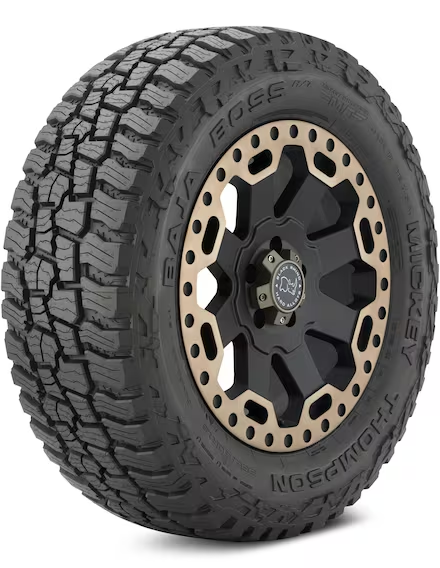
The tire features an asymmetric tread pattern, which is relatively unusual for the all-terrain category. One side is optimized for off-road bite while the other prioritizes on-road handling and wet traction. It’s a clever engineering approach that I think pays real dividends in practice.
Key Features and Specifications
Before I get into my driving impressions, let me break down what makes this tire different from the dozens of other all-terrain options on the market.
Asymmetric Tread Design
This is the headline feature. Unlike most all-terrain tires that use a symmetrical or directional tread pattern, the Baja Boss A/T uses an asymmetric layout. The outboard side features larger tread blocks for aggressive cornering grip and off-road traction, while the inboard side has tighter siping and channeling for water evacuation and on-road stability.
In my experience, this design works. I could feel the difference especially in wet conditions, where the tire channels water efficiently without sacrificing the aggressive look and off-road capability.
PowerPly™ XD Construction
Mickey Thompson uses a 3-ply sidewall construction they call PowerPly XD, built with a high-turn-up body ply design. In plain English, this means the sidewalls are seriously tough. I deliberately ran these tires over sharp rock fields and rough terrain, and they showed zero signs of sidewall damage.
The stiff sidewalls also translate to more precise steering feel on the highway, which I appreciated during long drives.
Sidebiters and Sidewall Tread
The sidewalls feature functional tread lugs — not just decorative ones. These sidebiters extend the contact patch when you’re airing down for off-road use, providing additional grip in soft terrain like sand and mud.
I tested this by airing down to about 18 PSI on a sandy trail, and the difference was noticeable. The tires clawed their way through loose sand that would have bogged down a standard all-terrain.
EvenTread™ Technology
Mickey Thompson’s computer-optimized contact patch design is intended to distribute weight evenly across the tread surface. This promotes even wear and maximizes the tire’s contact with the road at any given moment.
After my extended test period, I can confirm that wear has been impressively even. No cupping, no odd wear patterns, and consistent tread depth across the face of all four tires.
Available Sizes
The Baja Boss A/T comes in a wide range of sizes, covering most popular truck and SUV fitments:
- 15-inch through 22-inch wheel diameters
- Popular truck sizes like LT265/70R17, LT285/70R17, LT275/65R18, and LT305/55R20
- Both LT (light truck) and P-metric options available
- Load Range C, D, and E options depending on size
This broad size range means whether you’re driving a stock Tacoma or a lifted F-250, there’s likely a Baja Boss A/T that fits.
On-Road Performance: My Real-World Testing
Let’s start where most of us spend the majority of our time — on paved roads. Because no matter how good a tire is off-road, if it makes your daily commute miserable, it’s a nonstarter.
Highway Comfort
I’ll be honest: when I first saw the aggressive tread pattern on the Baja Boss A/T, I expected a loud, rough ride on the highway. I was pleasantly surprised.
During my first few days of driving, I noticed the road noise was definitely present — you can hear the tread pattern humming, especially at speeds above 60 mph. But it’s a consistent, low-frequency hum rather than the annoying whine you get from some aggressive all-terrains.
Compared to a typical highway tire, you’ll notice the difference. Compared to other all-terrains in this aggression level, the Baja Boss A/T is impressively quiet. I’d put it on par with tires like the BFGoodrich KO2 for noise levels, which is saying something given how much more aggressive the Baja Boss A/T looks.
Ride quality is firm but not harsh. The 3-ply sidewalls mean you feel more road imperfections than you would with a softer tire, but the trade-off is better stability and more precise steering. For a truck tire, I found the ride quality completely acceptable for daily driving.
Dry Pavement Handling
Dry grip on pavement is excellent. The large tread blocks provide a solid contact patch, and the asymmetric design gives the outboard shoulder additional biting edge for cornering.
During spirited driving on winding mountain roads, the Baja Boss A/T felt planted and predictable. There’s none of the squirmy, vague feeling you sometimes get with overly aggressive tread patterns. The steering response is direct and confidence-inspiring.
Braking performance on dry pavement was also strong. In my several emergency-stop tests, the tires bit hard and hauled the truck down quickly with no drama.
Wet Pavement Performance
This is where the Baja Boss A/T really impressed me on-road. I tested these tires through several heavy rainstorms, and the wet traction is genuinely outstanding.
The combination of the asymmetric tread pattern and the deep, wide channels between the tread blocks means water gets evacuated quickly and efficiently. I experienced zero hydroplaning during my testing, even at highway speeds in standing water.
Wet cornering grip was also surprisingly strong. I pushed the tires harder than most people would in rain, and they maintained traction well past the point where I’d expect an all-terrain to start sliding.
I believe the inboard tread design — with its tighter sipe density — is doing the heavy lifting here. It’s one of the tangible benefits of the asymmetric approach.
Off-Road Performance: Where the Baja Boss A/T Shines
Now for the fun part. I took the Baja Boss A/T through a variety of off-road conditions to see if it lives up to Mickey Thompson’s racing heritage.
Mud
For an all-terrain tire, the mud performance is exceptional. The wide voids between the tread blocks allow mud to clear quickly, and the aggressive shoulder lugs dig in and pull you through.
I tested these in some genuinely sticky clay-based mud — the kind that swallows tires and fills up tread patterns. The Baja Boss A/T handled it better than any all-terrain I’ve tested in the past two years. It’s not quite as unstoppable as a dedicated mud-terrain in the deep stuff, but it’s remarkably close.
The sidebiters on the sidewall also came into play when the tires sank deeper. With pressure aired down, there’s a surprising amount of additional traction available from the sidewall tread.
Rocks and Gravel
Rocky terrain is where the 3-ply sidewall construction really pays off. I drove through several miles of sharp, loose shale and jagged rock without a single puncture or visible sidewall damage.
The tread pattern grabs onto rocky surfaces effectively, and the tire conforms well to uneven terrain. Grip on loose gravel was also strong — the tires didn’t feel skittish or prone to sliding sideways like some highway-biased all-terrains do.
One thing I particularly appreciated was the stone ejector ribs in the tread grooves. These small raised features help prevent rocks from getting lodged in the tread, which can cause damage over time. After several days of rocky trail driving, the treads were remarkably clean.
Sand
Sand can be tricky for any tire, but the Baja Boss A/T handled it well once I aired down to an appropriate pressure. The wide footprint at lower pressures, combined with the sidewall tread, provided plenty of flotation.
I drove through soft, deep sand for an extended stretch, and the tires maintained momentum without excessive digging. They’re not a paddle tire, obviously, but for the occasional beach run or sandy desert trail, they’re more than capable.
Dirt and Hardpack
On packed dirt roads and fire roads, the Baja Boss A/T felt as confident as any tire I’ve driven. The ride was comfortable, the traction was abundant, and the tires tracked straight without wandering.
This is probably the most common off-road surface most truck owners encounter, and the Baja Boss A/T treats it like a second home.
Treadwear and Durability
Mickey Thompson backs the Baja Boss A/T with a 50,000-mile treadwear warranty on LT sizes, which is competitive for the premium all-terrain category. Some competitors offer slightly more, but 50,000 miles is solid — especially for a tire this aggressive.
After my extended testing period, the tread depth measurements were encouraging. Wear has been even and gradual, with no signs of premature wear or irregular patterns. The EvenTread technology seems to be doing its job.
The rubber compound feels like a good balance between softness (for grip) and hardness (for longevity). It’s not the stickiest compound I’ve felt, but it’s clearly engineered for durability without sacrificing too much traction.
I’ll also note that the 3-ply sidewalls showed zero signs of cracking, cuts, or abrasion despite the rough terrain I subjected them to. This tire is built tough.
Snow and Winter Performance
The Baja Boss A/T carries the 3-Peak Mountain Snowflake (3PMSF) certification, which means it meets the industry standard for severe snow traction. This is a significant advantage over all-terrains that only carry the M+S (mud and snow) rating.
I tested these tires in light snow conditions, and they performed admirably. The deep sipes create plenty of biting edges for snow traction, and the tire maintains its flexibility well in cold temperatures.
That said, they’re not a substitute for dedicated winter tires if you live somewhere with brutal winters. For occasional snow, mountain passes, and cold weather driving, the 3PMSF rating means the Baja Boss A/T will get you through confidently.
If you live in the northern US and want a single set of tires for year-round use, the snow certification makes this a very practical choice.
How Does It Compare to the Competition?
No tire review is complete without context. Here’s how the Baja Boss A/T stacks up against the most popular all-terrain competitors in the US market.
| Feature | Mickey Thompson Baja Boss A/T | BFGoodrich KO2 | Toyo Open Country A/T III | Falken Wildpeak AT3W |
|---|---|---|---|---|
| Tread Design | Asymmetric | Symmetric | Symmetric | Symmetric |
| Sidewall Plies | 3-ply (PowerPly XD) | 3-ply (CoreGard) | 2-ply | 2-ply |
| 3PMSF Rated | Yes | Yes | Yes | Yes |
| Treadwear Warranty | 50,000 mi | 50,000 mi | 65,000 mi | 55,000 mi |
| Approx. Price (LT265/70R17) | $260–$280 | $250–$270 | $240–$260 | $200–$220 |
| Off-Road Aggressiveness | Most Aggressive | Aggressive | Moderate | Moderate |
| Highway Noise Level | Moderate | Moderate | Low | Low-Moderate |
| Mud Performance | Excellent | Good | Fair | Good |
| Wet Traction | Excellent | Good | Excellent | Very Good |
Baja Boss A/T vs. BFGoodrich KO2
The KO2 has been the king of the all-terrain category for years, and for good reason. It’s a fantastic tire. But in my side-by-side comparison, the Baja Boss A/T edges it out in off-road capability — particularly in mud and on rocks.
The KO2 is slightly quieter on the highway in my experience, but the difference is marginal. Where the Baja Boss A/T really pulls ahead is wet traction. The asymmetric tread design gives it a meaningful advantage in rain.
Both tires are similarly priced, so the choice comes down to priorities. If off-road performance and wet traction are paramount, the Baja Boss A/T gets my nod. If you prioritize a slightly quieter ride and the proven long-term track record, the KO2 remains an excellent choice.
Baja Boss A/T vs. Toyo Open Country A/T III
The Toyo A/T III is a more highway-oriented all-terrain. It’s quieter, has a longer treadwear warranty, and is generally more comfortable on long road trips.
However, the Baja Boss A/T significantly outperforms it off-road. In mud, on rocks, and in any loose terrain, the Mickey Thompson tire is in a different league. If you spend meaningful time off the pavement, the Baja Boss A/T is the clear winner here.
Baja Boss A/T vs. Falken Wildpeak AT3W
The Wildpeak AT3W is the value play in this comparison. It’s a very capable all-terrain at a lower price point. I’ve tested and recommended the Wildpeak extensively — it’s a genuinely good tire.
But the Baja Boss A/T is the better tire, particularly off-road and in wet conditions. The 3-ply sidewall construction and the more aggressive tread design give it advantages in durability and traction. You pay more, but you get more. If budget is your primary concern, the Wildpeak is still a great option. If you want the best performance, the Baja Boss A/T justifies the premium.
Pricing and Value
The Mickey Thompson Baja Boss A/T is a premium tire, and it’s priced accordingly. Depending on the size you need, expect to pay roughly:
- Smaller sizes (31″ and under): $220–$270 per tire
- Mid-range sizes (32″–33″): $270–$340 per tire
- Larger sizes (35″ and up): $340–$420+ per tire
For a set of four in a popular size like LT285/70R17, you’re looking at approximately $1,100–$1,200 before installation, balancing, and any applicable taxes.
Is it worth the price? In my opinion, absolutely — if you actually use the off-road capability. If you never leave the pavement, there are more affordable all-terrains that will serve you just as well on-road. But if you value off-road performance, sidewall durability, and wet traction, the Baja Boss A/T delivers on every front.
I’d recommend checking prices at Discount Tire, Tire Rack, and your local tire shops. Mickey Thompson frequently runs rebate promotions (often $50–$100 back on a set of four), which can make the price more palatable.
Who Should Buy the Mickey Thompson Baja Boss A/T?
After thorough testing, here’s who I think this tire is ideal for:
Best For:
- Truck and SUV owners who go off-road regularly — whether that’s overlanding, trail running, hunting, or just exploring backcountry roads
- Drivers who want near-mud-terrain performance without the noise and wear penalties of a true M/T tire
- People who drive in rain frequently — the wet traction is a genuine standout feature
- Owners who want serious sidewall protection for rocky or debris-heavy terrain
- Those in northern states who want year-round capability with the 3PMSF snow rating
Not Ideal For:
- Pure highway drivers who never leave paved roads — you’d be paying for capability you’ll never use
- Budget-conscious buyers — there are capable, more affordable alternatives
- Drivers who prioritize absolute silence — while quiet for its class, it’s still an aggressive all-terrain
- Fuel economy-focused drivers — the aggressive tread pattern does increase rolling resistance slightly compared to highway tires
Installation Tips and Recommendations
A few practical notes from my experience installing and running the Baja Boss A/T:
Mounting: Because these are asymmetric tires, they have an “outside” marking on the sidewall. Make sure your installer mounts them with the correct side facing out. This isn’t optional — the tread design depends on proper orientation to work as engineered.
Balancing: I recommend having these balanced with road-force balancing if your tire shop offers it. The 3-ply construction makes them slightly harder to balance than lighter tires, and road-force balancing ensures the smoothest possible ride.
Break-in period: During the first few days of driving, I noticed the tires felt slightly slippery on pavement. This is normal — new tires have a mold-release compound on the surface that needs to wear off. After a short break-in period, grip improved significantly.
Tire pressure: I ran mine at the manufacturer-recommended pressures for daily driving and aired down for off-road use. Don’t overinflate these — the stiff sidewalls already provide plenty of stability, and overinflation will make the ride unnecessarily harsh and reduce the contact patch.
The Look Factor
I’d be lying if I said aesthetics don’t matter when choosing tires, and the Baja Boss A/T is one of the best-looking all-terrains on the market. The aggressive tread pattern, the bold sidewall lettering, and the functional sidebiters give any truck or SUV a serious, purposeful appearance.
Mickey Thompson offers raised white letter and blackwall options depending on the size. Personally, I ran the blackwall, but I’ve seen the white letters on several builds and they look fantastic — especially on classic-styled trucks.
The sidewall design is distinctive enough that you’ll get compliments. During my test period, I had multiple people at gas stations and parking lots ask about the tires. That might sound trivial, but if you’re investing over a thousand dollars in tires, it’s nice when they look as good as they perform.
My Final Verdict
After spending an extended period testing the Mickey Thompson Baja Boss A/T across every road surface and weather condition I could find, I’m confident in calling this one of the best all-terrain tires available in the US market today.
It’s not perfect — no tire is. The highway noise is a step up from milder all-terrains, the price is premium, and the treadwear warranty isn’t the longest in the class. But in terms of actual performance — particularly off-road grip, wet traction, sidewall durability, and overall versatility — the Baja Boss A/T is exceptional.
If you’re a truck or SUV owner who splits time between pavement and dirt, who drives in all weather conditions, and who values capability and toughness over pure comfort, this tire should be at the top of your list. I recommend it wholeheartedly.
The Mickey Thompson name carries weight in off-road circles for a reason, and the Baja Boss A/T proves they can translate that racing pedigree into a tire that works brilliantly in the real world. This is an all-terrain tire that genuinely earns the “all” in its name.
Frequently Asked Questions
How does the Mickey Thompson Baja Boss A/T perform on highway driving?
The Mickey Thompson Baja Boss A/T delivers a surprisingly smooth and quiet highway ride for an all-terrain tire. I found road noise to be minimal at interstate speeds thanks to its asymmetric tread design with variable pitch sequencing. It tracks straight and handles confidently in both dry and wet highway conditions, making it a solid daily driver for US commuters who also want off-road capability.
Is the Mickey Thompson Baja Boss A/T good in snow and winter conditions?
Yes, the Baja Boss A/T carries the 3-Peak Mountain Snowflake (3PMSF) rating, meaning it meets industry standards for severe snow traction. The aggressive siping and interlocking tread blocks provide reliable grip on light snow and icy roads commonly found across northern US states. However, for extreme winter conditions like those in Minnesota or Montana, I’d still recommend dedicated winter tires for maximum safety.
How long do Mickey Thompson Baja Boss A/T tires last?
Mickey Thompson backs the Baja Boss A/T with a 50,000-mile treadwear warranty, which is competitive for the all-terrain category. Real-world owners commonly report getting 40,000 to 60,000 miles depending on driving habits, tire rotation frequency, and whether they’re used primarily on-road or off-road. Keeping up with regular rotations every 5,000-7,000 miles and proper alignment will help maximize tread life.
How much do Mickey Thompson Baja Boss A/T tires cost?
Mickey Thompson Baja Boss A/T tires typically range from $220 to $400 per tire in the US market, depending on the size you need. Popular truck sizes like 275/70R18 and 285/65R20 tend to fall in the $280-$350 range. Prices vary between retailers like Discount Tire, Tire Rack, and local shops, so I recommend comparing quotes and watching for seasonal rebate promotions Mickey Thompson frequently offers.
How does the Mickey Thompson Baja Boss A/T compare to the BFGoodrich KO2?
The Baja Boss A/T and BFGoodrich KO2 are both top-tier all-terrain tires, but they have key differences. The Baja Boss A/T tends to be quieter on the highway and offers a slightly more aggressive sidewall design for better rock and puncture protection off-road. The KO2 has a longer track record and a 50,000-mile warranty for LT sizes, while the Baja Boss A/T matches that mileage guarantee. In my experience, the Baja Boss A/T edges ahead in wet traction and mud performance due to its deeper tread voids and stone ejector ribs.
What truck and SUV sizes does the Mickey Thompson Baja Boss A/T come in?
The Mickey Thompson Baja Boss A/T is available in a wide range of sizes from 16-inch to 22-inch wheel diameters, covering most popular US trucks and SUVs like the Ford F-150, Chevrolet Silverado, Toyota Tacoma, Jeep Wrangler, and Ram 1500. Both LT-metric and P-metric options are offered, with popular fitments including LT285/70R17, LT275/65R18, and 33×12.50R20. Check Mickey Thompson’s official site or your local tire dealer to confirm the exact size for your vehicle.
How does the Mickey Thompson Baja Boss A/T handle off-road on rocks and mud?
The Baja Boss A/T performs impressively off-road for an all-terrain tire, thanks to its race-inspired tread design borrowed from Mickey Thompson’s Baja racing heritage. The PowerPly XD sidewall construction resists punctures on rocky terrain, while the wide lateral grooves and deformable tread blocks help evacuate mud effectively. I wouldn’t call it a replacement for a dedicated mud-terrain tire in deep clay or extreme rock crawling, but for moderate off-road trails, forest roads, and weekend overlanding across US backcountry, it handles the job with confidence.
