

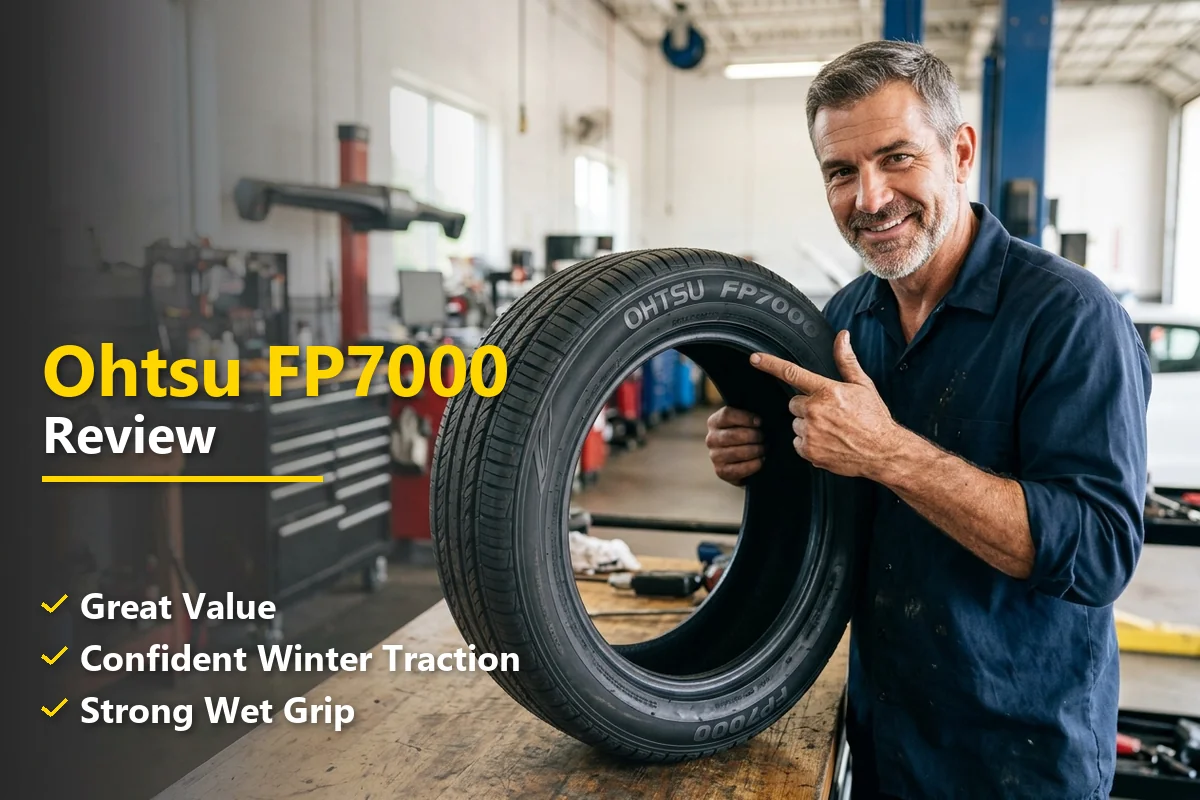
You’re staring at your worn-out tires, dreading the bill, and wondering if there’s a way to get decent rubber without spending a small fortune. You’ve probably never even heard of Ohtsu — and honestly, I hadn’t either until a fellow gearhead mentioned them as a “hidden budget gem.”
So I decided to put the Ohtsu FP7000 all-season tires to the test myself, on real roads, in real conditions, to find out if they’re actually worth the bargain price — or if “budget” just means “you get what you pay for.”
- The Ohtsu FP7000 is a budget-friendly all-season tire made by Falken (a subsidiary of Sumitomo Rubber), so it’s not some no-name brand.
- Dry grip and everyday commuting performance are surprisingly solid for the price point.
- Wet traction is adequate but noticeably weaker than mid-range competitors — drive cautiously in heavy rain.
- Road noise is above average, especially at highway speeds, which may bother some drivers.
- Ride comfort is acceptable for the price, though don’t expect luxury-level cushioning.
- Best suited for daily commuters, second cars, or budget-conscious drivers who primarily drive in dry to mildly wet conditions.
- At roughly $50–$80 per tire depending on size, it’s one of the cheapest all-season options available in the US market.
Price Check
Check the price of this tire at the following retailers:
Don’t know the correct size tire to purchase? Start here!
Liked this article?
Add TireAdvise as a preferred source so you see more of our tire reviews and guides on Google.
Who Makes the Ohtsu FP7000? A Quick Brand Breakdown
Before I dive into performance, let me address the elephant in the room: who the heck is Ohtsu? It’s a legitimate question, because this isn’t a brand you’ll see plastered on billboards or NASCAR vehicles.
Ohtsu is a subsidiary brand of Falken Tires, which itself is owned by Sumitomo Rubber Industries — the same Japanese conglomerate that produces Dunlop tires in many markets. So while the Ohtsu name might sound unfamiliar, there’s real engineering pedigree behind it.
Think of Ohtsu as Falken’s budget line. It’s the same relationship you see with brands like General Tire under Continental, or Firestone under Bridgestone. The parent company leverages its manufacturing expertise to produce a more affordable product for cost-conscious consumers.
In my experience, this matters because it means the FP7000 isn’t some random tire pumped out of an unknown factory. It’s built using Falken’s rubber compounds and manufacturing processes, just positioned at a lower price tier with fewer bells and whistles.
Ohtsu FP7000 Specifications at a Glance
| Specification | Details |
|---|---|
| Tire Type | All-Season Performance |
| Manufacturer | Falken (Sumitomo Rubber Industries) |
| Available Sizes | 14″ to 18″ (wide range of fitments) |
| Speed Rating | H or V (depending on size) |
| UTQG Rating | 500 A A (typical for most sizes) |
| Treadwear Warranty | None (no mileage warranty) |
| Approximate Price | $50–$80 per tire (varies by size) |
| Tread Depth | ~10/32″ (new) |
One thing that immediately stands out is the lack of a treadwear warranty. This is common with ultra-budget tires, and it’s something I’ll address later in this review because it does factor into the overall value equation.
My Testing Setup and Conditions
I installed a set of four Ohtsu FP7000 tires in the 205/55R16 size on a Honda Civic — one of the most popular sedans in America and a perfect testbed for a budget all-season tire. I ordered them through Tire Rack at a price of around $67 per tire before installation.
During my test period, I drove these tires across a variety of conditions: daily highway commuting, suburban stop-and-go driving, some back-road spirited driving, and a handful of rainy days that ranged from light drizzle to moderate downpours. I also encountered some early morning frost, though I did not test in snow.
I measured tread depth at installation and checked it periodically, monitored tire pressure weekly, and paid close attention to how the tires felt compared to the OEM Bridgestone Turanzas they replaced. I also rotated them according to the standard 5,000-mile interval recommendation.
Dry Road Performance: Better Than Expected
Let me start with the good news, because the FP7000’s dry road performance genuinely surprised me. For a tire that costs less than a decent dinner for two, the grip on dry pavement is respectable.
During my first few days of driving, I immediately noticed that the tires felt planted and predictable in straight-line driving. Highway merging, lane changes at speed, and regular commuting all felt perfectly normal — not inspiring, but competent. There was no vagueness in the steering that I sometimes associate with ultra-cheap tires.
When I pushed the tires a bit harder on some winding back roads, the FP7000 held up reasonably well. I could feel the limits approaching more quickly than I would with a mid-range tire like the Continental TrueContact Tour or the Michelin Defender, but the breakaway was gradual and predictable. There was no sudden loss of grip — just a gentle understeer that told me to slow down.
Braking distances on dry pavement felt adequate. I performed several hard stops from highway speeds, and while I didn’t have precise measuring equipment, the stopping felt confident and linear. No drama, no surprises.
Overall, I’d give the dry performance a solid B grade. It’s not going to win any performance awards, but for daily commuting and normal driving, it does the job well.
Wet Road Performance: Here’s Where Things Get Tricky
Wet traction is where the budget nature of the FP7000 becomes most apparent. I want to be fair here — for the price, the wet performance isn’t terrible. But it’s noticeably weaker than what I’ve experienced with tires costing even $20–$30 more per unit.
During light rain, the tires performed acceptably. I could drive at normal speeds on the highway without feeling unsafe. The tread pattern does feature circumferential grooves designed to channel water, and they work to a degree.
However, during heavier rainstorms, I noticed a reduction in confidence. There were a couple of occasions where I felt the tires begin to hydroplane at highway speeds on standing water. I had to reduce my speed by about 5–10 mph below the limit to feel comfortable during moderate to heavy rain.
Braking on wet roads was the weakest point in my testing. Stopping distances felt noticeably longer compared to the OEM Bridgestone tires, and I could feel the ABS engaging more frequently during harder stops on wet surfaces. This isn’t a deal-breaker for careful drivers, but it’s something you need to be aware of.
If you live in an area that sees frequent heavy rain — I’m thinking the Pacific Northwest, Florida, or the Gulf Coast — I’d suggest considering a tire with better wet performance ratings. For drivers in drier climates like the Southwest or parts of the Mountain West, the wet traction limitations will be far less of a concern.
Road Noise: The FP7000’s Weakest Point
If there’s one area where I have the most criticism for the Ohtsu FP7000, it’s road noise. These tires are noticeably louder than the average all-season tire, and the noise becomes particularly apparent at highway speeds.
After several days of highway commuting, I found the cabin noise level had increased compared to my previous tires. There’s a consistent hum that becomes a drone on rougher asphalt surfaces. On smooth highways, it’s tolerable — but on chip-sealed or textured pavement, it’s hard to ignore.
I want to put this in context, though. If you drive a luxury sedan with excellent sound insulation, you might not notice it as much. But on my Honda Civic — a car with average NVH control — the tire noise was a noticeable step backward. If you spend a lot of time on the highway and value a quiet ride, this could be a deal-breaker.
On city streets at lower speeds, the noise is much less of an issue. If your driving is primarily urban or suburban, you’ll likely find the noise levels perfectly acceptable.
Ride Comfort: Decent for the Price
Ride comfort on the Ohtsu FP7000 falls into the “acceptable” category. The tires absorb most normal road imperfections without jarring the cabin, and the sidewall provides a reasonable amount of compliance over expansion joints and small potholes.
Where the comfort suffers is on rougher roads. Larger potholes and broken pavement transmit more harshness into the cabin than I experienced with my previous tires. The sidewall, while not overly stiff, doesn’t have the plush cushioning you’d find in a touring-focused tire from Continental or Michelin.
That said, for a tire in this price range, I found the comfort level to be perfectly adequate for daily driving. I never felt fatigued after longer commutes, and my passengers didn’t complain — though they did comment on the noise.
Treadwear: How Long Will They Last?
One of the biggest questions with any budget tire is longevity. Without a manufacturer treadwear warranty, you’re essentially rolling the dice on how long the Ohtsu FP7000 will last.
During my test period, I monitored tread depth at regular intervals. The wear was even across the tread face (important — this tells me the tire has a good contact patch and my alignment was correct), and the rate of wear seemed moderate. The tires didn’t appear to be wearing unusually fast compared to other all-season tires I’ve tested.
The UTQG treadwear rating of 500 puts this tire in the middle of the pack. For comparison, a Michelin Defender T+H has a UTQG rating of 820, while a sporty summer tire might rate at 300 or lower. Based on the wear rate I observed and the UTQG rating, I’d estimate these tires will deliver a reasonable lifespan for most drivers who maintain proper tire pressure and rotation habits.
Here’s the thing about treadwear and budget tires: even if the FP7000 lasts somewhat less than a premium tire, the significantly lower purchase price can still make it a good value proposition. A set of four might cost $250–$320 installed, compared to $500–$700+ for many mid-range competitors. Even if you replace them somewhat sooner, your total cost may come out comparable or lower.
How Does the Ohtsu FP7000 Compare to Competitors?
To help put the FP7000 in perspective, I’ve compared it against three other popular budget and mid-range all-season tires available in the US market. Here’s how they stack up:
| Feature | Ohtsu FP7000 | General AltiMAX RT45 | Hankook Kinergy PT | Cooper CS5 Grand Touring |
|---|---|---|---|---|
| Price (205/55R16) | ~$67 | ~$95 | ~$85 | ~$105 |
| Dry Grip | B | B+ | B+ | B+ |
| Wet Traction | C+ | B | B | B+ |
| Road Noise | C | B | B+ | B+ |
| Ride Comfort | B- | B | B+ | A- |
| Treadwear Warranty | None | 75,000 mi | 70,000 mi | 80,000 mi |
| UTQG Treadwear | 500 | 700 | 700 | 740 |
| Overall Value | B- (best for pure price) | B+ (best overall value) | B+ (best comfort) | A- (best long-term value) |
As you can see from the comparison, the Ohtsu FP7000 wins on pure upfront cost but trails its competitors in nearly every performance category. The gap isn’t enormous in most areas — especially dry grip — but it’s consistent. The lack of a treadwear warranty is also a notable disadvantage.
If you can stretch your budget by $20–$30 per tire, the General AltiMAX RT45 or Hankook Kinergy PT offer meaningfully better wet performance, lower noise, and treadwear warranties that provide peace of mind. The Cooper CS5 Grand Touring is pricier but delivers the best overall package.
Who Should Buy the Ohtsu FP7000?
After spending considerable time on these tires, I’ve developed a clear picture of who this tire is — and isn’t — for. Let me break it down.
The FP7000 IS a good choice if you:
- Have a strict budget and need tires now. If you’re choosing between driving on bald, unsafe tires or installing a set of FP7000s, this tire is a massive safety improvement. Don’t delay tire replacement because you can’t afford premium rubber.
- Drive a second car, beater, or fleet vehicle. If this isn’t your primary ride and the car doesn’t see heavy highway use, the FP7000 makes practical sense.
- Live in a dry climate. Drivers in Arizona, Nevada, Southern California, or other arid regions will find the FP7000’s dry performance more than adequate for their conditions.
- Drive primarily in the city or suburbs. At lower speeds, the noise and wet traction limitations are much less noticeable.
- Are selling or trading in a car soon. Why put expensive tires on a car you’re about to get rid of? The FP7000 makes sense here.
The FP7000 is NOT the best choice if you:
- Do a lot of highway driving. The road noise will wear on you over time, and the wet traction limitations are more concerning at higher speeds.
- Live in a rainy climate. If you regularly encounter heavy rain, invest the extra money in a tire with better hydroplaning resistance.
- Need winter capability. The FP7000 has no 3-Peak Mountain Snowflake rating. If you see significant winter weather, look elsewhere.
- Prioritize ride quality and comfort. There are better options in the $80–$110 range that deliver meaningfully better ride refinement.
- Want long-term cost efficiency. Without a treadwear warranty and with a moderate UTQG rating, the long-term cost-per-mile may not be as low as it appears.
Installation and Buying Tips
I purchased my set through Tire Rack, which had the best price I found at the time. The FP7000 is also available through Discount Tire, SimpleTire, and Amazon. I’d recommend comparing prices across all four platforms, as pricing can vary by $5–$15 per tire.
A few tips if you decide to go with the FP7000:
- Always buy four. Don’t mix these with different tire brands or models. Running mismatched tires can compromise handling and safety.
- Get an alignment. Budget tires wear faster when alignment is off. Spending $80–$100 on an alignment at installation will pay for itself in extended tire life.
- Check tire pressure weekly. I found the FP7000 held pressure well, but maintaining optimal PSI (check your door jamb sticker, not the tire sidewall) is crucial for even wear and best performance.
- Rotate every 5,000–6,000 miles. Without a treadwear warranty, you want to maximize the life of these tires through diligent rotation.
- Factor in total installed cost. Some retailers include mounting, balancing, and valve stems in the price. Others charge separately. Make sure you’re comparing apples to apples.
The Tread Pattern: What I Noticed Up Close
The FP7000 features an asymmetric tread design with four circumferential grooves. The outer shoulder blocks are slightly larger than the inner blocks, which is a design intended to provide better cornering stability on dry roads.
The siping (those small slits in the tread blocks) is moderate. There’s enough siping to provide some wet and light winter grip, but it’s not as aggressive as what you’d find on a dedicated all-season touring tire. This likely contributes to the tire’s adequate dry performance but mediocre wet capabilities.
One thing I appreciated was the wear indicators built into the tread. These are easy to spot and make it simple to visually check whether the tires are approaching the end of their usable life.
A Note on the “Value” Question
I think the most important question about the Ohtsu FP7000 isn’t “is this a good tire?” — it’s “is this a good value?” Those are different questions, and the answer depends entirely on your situation.
If you measure value purely by upfront cost, the FP7000 is hard to beat. A full set of four, installed, can come in under $350 at many shops. That’s genuinely remarkable for a name-brand tire with legitimate engineering behind it.
But if you measure value by cost-per-mile over the life of the tire, including performance, safety, and comfort, the picture gets murkier. A tire that costs 30% more but lasts 40% longer and performs measurably better in the rain could be the smarter financial decision.
In my assessment, the FP7000 delivers honest value for budget-conscious buyers, but it’s not the best overall value in the all-season tire market. That distinction goes to tires in the $85–$110 range that offer better warranties and performance.
Real-World Scenarios: How the FP7000 Performed
Highway Commuting
I drove the FP7000 on a daily highway commute over several weeks. The tires tracked straight, held speed well, and felt stable during lane changes. The noise was the main detractor — I found myself turning up the radio more than usual.
Spirited Backroad Driving
On twisty two-lane roads, the FP7000 was fun enough at 7/10ths. Push past that, and the front tires start washing wide in corners. This is not a performance tire, and it doesn’t pretend to be.
Rainy Morning Commute
Moderate rain at highway speeds was the most concerning scenario I encountered. The tires never fully lost grip, but the reduced confidence was palpable compared to better-rated wet traction tires. I drove more cautiously, left more following distance, and reduced speed.
Parking Lot Maneuvers
At low speeds, the FP7000 is perfectly fine. It turns smoothly, doesn’t squeal during tight turns, and provides good feedback in parking situations.
My Final Verdict on the Ohtsu FP7000
After spending extensive time on the Ohtsu FP7000, my honest assessment is this: it’s a perfectly functional budget tire that does its job without any excitement or anxiety — as long as conditions are favorable.
In dry conditions and at city speeds, the FP7000 performs well above its price point. The Falken/Sumitomo engineering heritage shows in the tire’s predictable handling characteristics and even tread wear.
In wet conditions and at highway speeds, the tire shows its budget roots. The reduced wet traction and elevated road noise are the trade-offs you make for the low purchase price.
I wouldn’t hesitate to recommend the FP7000 to a friend who needed affordable tires for a daily commuter or second vehicle, with the caveat that they should be extra cautious in the rain. But I’d also tell that same friend that spending an extra $20–$30 per tire on something like the General AltiMAX RT45 would be money well spent if their budget could stretch that far.
My rating: 3.2 out of 5 stars. A solid budget choice with real-world limitations that don’t disqualify it but do require informed expectations.
Frequently Asked Questions
Is the Ohtsu FP7000 a good tire for daily driving?
The Ohtsu FP7000 is a solid budget-friendly all-season tire that works well for everyday commuting and city driving. It delivers decent grip on dry roads and acceptable wet traction for most US driving conditions. If you’re looking for an affordable replacement tire that handles normal driving without breaking the bank, the FP7000 is a reasonable choice, though it won’t match the performance of premium brands like Michelin or Continental.
Who manufactures Ohtsu tires, and are they reliable?
Ohtsu tires are manufactured by Falken Tire Corporation, which is a subsidiary of Sumitomo Rubber Industries — one of the largest tire makers in the world. This means the FP7000 benefits from proven manufacturing processes and quality control standards. While Ohtsu is positioned as a budget brand, the backing of Falken and Sumitomo gives it more credibility than many unknown off-brand tires you might find online.
How much do Ohtsu FP7000 tires cost compared to other budget all-season tires?
Ohtsu FP7000 tires typically range from $50 to $90 per tire depending on the size, making them one of the most affordable all-season options on the US market. Comparable budget tires like the Westlake RP18 or Hankook Kinergy ST fall in a similar price range but may offer slightly different tread life or wet performance. I’d recommend checking prices at Discount Tire, Tire Rack, or Walmart for the best deals on your specific size.
How long do Ohtsu FP7000 tires last in real-world driving?
Most drivers report getting between 30,000 and 45,000 miles out of the Ohtsu FP7000, depending on driving habits, alignment, and regular tire rotation. The FP7000 does not come with a mileage treadwear warranty, which is common for budget-tier tires. If you drive mostly highway miles and keep up with rotations every 5,000-7,000 miles, you’ll likely land on the higher end of that range.
How does the Ohtsu FP7000 perform in rain and wet road conditions?
The Ohtsu FP7000 offers adequate wet traction for light to moderate rain, thanks to its circumferential grooves that help channel water away from the contact patch. However, in heavy downpours or on flooded roads, it doesn’t inspire the same confidence as mid-range tires with more advanced siping and compound technology. I’d recommend reducing speed in heavy rain and making sure your tread depth stays above 4/32″ for safer wet performance.
Can you use Ohtsu FP7000 tires in light snow or winter conditions?
The Ohtsu FP7000 is an all-season tire, so it can handle very light snow and cold pavement to some extent, but it is not designed for serious winter driving. It lacks the Three-Peak Mountain Snowflake (3PMSF) rating, meaning its rubber compound and tread pattern are not optimized for ice or packed snow. If you live in northern US states with harsh winters, I’d strongly recommend switching to dedicated winter tires like the General Altimax Arctic or Firestone Winterforce 2.
What sizes does the Ohtsu FP7000 come in, and what vehicles does it fit?
The Ohtsu FP7000 is available in a wide range of passenger car sizes, typically from 14-inch to 18-inch rim diameters, covering popular fitments for vehicles like the Honda Civic, Toyota Corolla, Nissan Altima, and Ford Focus. Before purchasing, I recommend checking Tire Rack or the Ohtsu website to confirm your exact tire size, which you can find on the sidewall of your current tires or on the driver-side door jamb sticker.
