

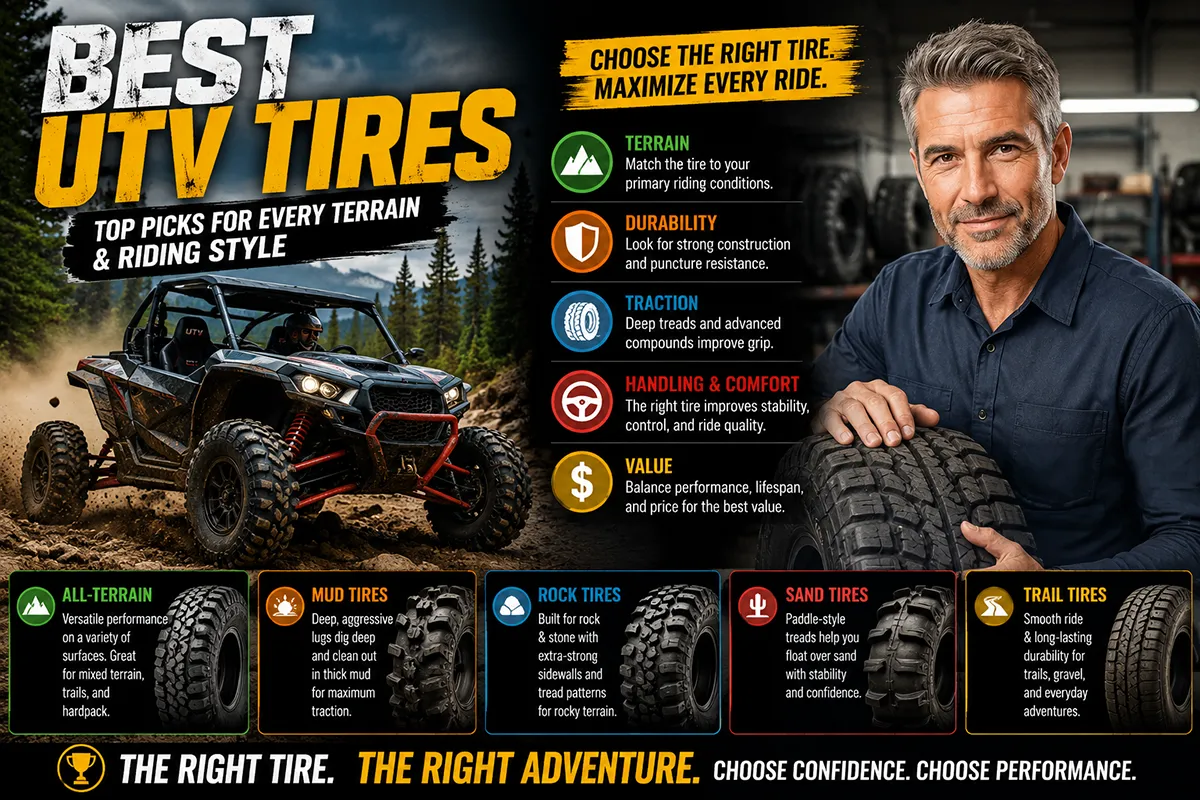
A tire that dominates thick Louisiana mud will feel vague and squirrely on Arizona hardpack. A smooth trail tire leaves you spinning the moment the ground turns soft.
Your terrain, riding style, and machine weight all factor into the right choice — which is why this guide is organized around how you actually ride, not brand loyalty.
It’s based on manufacturer specifications, aggregated owner reports, and independent testing data. Here’s what actually holds up, by terrain.
- Best overall: Maxxis Carnivore.
- Best for mud: ITP Cryptid.
- Best for rocks: Tensor Regulator A/T.
- Best for sand: STI Sand Drifter.
- Best for trail riding: EFX MotoVator.
- Best improved mud/rock hybrid: Maxxis Carnivore RT.
- Best budget pick: Sedona Rip-Saw R/T.
- Full sizing guidance, a real DOT-rating correction, and a buyer’s guide are below.
Liked this article?
Add TireAdvise as a preferred source so you see more of our tire reviews and guides on Google.
A Correction Worth Knowing: No Maxxis UTV Tire Is DOT-Rated
This is worth addressing directly, since it’s a genuinely important safety fact that gets misstated often, including in earlier versions of this guide. Maxxis has confirmed directly on its own product pages that it does not manufacture DOT-rated UTV tires — none of them, including the Carnivore, are approved for public road use.
If your UTV ever needs to cross a public road, check your specific tire’s sidewall for a genuine DOT marking rather than assuming a well-known brand automatically qualifies. Several tires in this guide, including the EFX MotoVator, do carry DOT ratings — but brand reputation alone isn’t a substitute for checking.
How These Were Evaluated
This comparison draws on manufacturer specifications, aggregated owner reports across riding communities, and independently reported traction and durability testing for each tire.
Tires were evaluated on traction in their intended terrain, durability under real-world impact and puncture stress, ride quality and noise, self-cleaning capability in mud and soft terrain, weight and its effect on drivetrain components, and overall value relative to price.
Where specific figures or owner experiences are cited, the source is noted rather than presented as a personal measurement.
Quick Comparison: 11 Best UTV Tires
| Tire | Best For | Ply Rating | Construction | Price Range (per tire) |
|---|---|---|---|---|
| Maxxis Carnivore | Overall / mixed terrain | 8-ply | Radial | $150–$220 |
| ITP Cryptid | Mud | 6-ply | Bias | $120–$170 |
| Tensor Regulator A/T | Rocks | 8-ply | Radial | $170–$240 |
| STI Sand Drifter | Sand/dunes | 2-ply | Bias | $80–$130 |
| EFX MotoVator | Trail riding | 8-ply | Radial | $130–$180 |
| Maxxis Carnivore RT | Improved mud/rock hybrid | 8-ply | Radial | $160–$230 |
| Sedona Rip-Saw R/T | Budget all-terrain | 6-ply | Radial | $90–$140 |
| Carlisle All Trail | Hard surface/utility | 4-ply | Bias | $50–$90 |
| Maxxis Bighorn 2.0 | Balanced trail grip | 6-ply | Radial | $130–$190 |
| ITP Terracross R/T | Mixed terrain durability | 8-ply | Radial | $140–$200 |
| GBC Kanati Mongrel | Value all-terrain | 6-ply | Radial | $100–$150 |
Prices are street prices at major UTV tire retailers as of mid-2026 for common sizes. Expect variation by exact size and retailer.
1. Maxxis Carnivore: Best Overall
Price Check
Check the price of this tire at the following retailers:
This tire earns near-universal recommendation as the strongest all-around choice for riders who encounter mixed terrain.
Its non-directional radial tread pattern works equally well regardless of direction, with lugs aggressive enough to dig into soft terrain but tight enough to avoid excessive vibration on hardpack. Real owner reports consistently describe minimal wear on gravel roads that chew up softer compounds.
The 8-ply radial carcass absorbs rock impacts well, and multiple owners report several seasons of hard riding without blowouts — genuine durability across mud, rock, sand, and hardpack in one tire.
Pros: Genuine versatility across terrain types, remarkably quiet for an aggressive tire, strong impact resistance.
Cons: Heavier than some competitors, premium price, not a mud specialist compared to dedicated options.
2. ITP Cryptid: Best for Mud
Price Check
Check the price of this tire at the following retailers:
For riders in genuinely soft, swampy terrain, this tire delivers real self-cleaning capability that owners consistently rate above competitors.
Deep, widely-spaced lugs create channels that actively shed mud with every rotation — real, visible clearing rather than the packed-up “slick” effect lesser tires develop within minutes of hitting deep clay.
The 6-ply construction keeps weight manageable, which matters for maintaining momentum through heavy mud, and a stepped lug design provides genuine lateral bite on off-camber muddy hillsides.
Pros: Genuine best-in-class self-cleaning, strong forward and lateral mud traction, lighter than many comparable mud tires.
Cons: Noisy and rough on hard surfaces, mediocre tread life on gravel and hardpack, limited size options.
3. Tensor Regulator A/T: Best for Rocks
Price Check
Check the price of this tire at the following retailers:
Rocky terrain is where tires fail most often, and this tire’s genuine puncture resistance is why it’s trusted for rock crawling and desert washes.
A reinforced 8-ply carcass with thick sidewalls shrugs off impacts that would flat lesser tires — real, tested resistance against sharp edges and ledge rock. The tread compound is firm enough to resist chunking without sacrificing grip.
Real owner reports describe confident, predictable traction on both wet and dry rock surfaces, and a relatively tight tread pattern keeps the ride well-mannered on the road to the trailhead.
Pros: Genuine impact and puncture resistance, confident grip on wet and dry rock, comfortable enough for longer approach rides.
Cons: Not a mud performer, stiffer ride from the heavy-duty construction, premium price.
4. STI Sand Drifter: Best for Sand
Price Check
Check the price of this tire at the following retailers:
Sand requires a fundamentally different tire design, and this paddle-style tire delivers a genuinely dramatic improvement over standard all-terrain rubber.
Rear tires scoop sand and throw it backward for real forward thrust rather than just digging a hole, while front tires use a ribbed pattern for directional control. This front/rear split is essential for sand riding — running the same tire on all four corners is a real, common mistake.
Real owner reports describe climbing steep dune faces that bog down standard tires within minutes, with smooth handling through transitions between packed and soft sand.
Pros: Genuine, dramatic sand-traction improvement, lightweight construction, front/rear-specific design optimizes both grip and steering.
Cons: Essentially useless on any other terrain, paddle rears wear quickly on hard surfaces, limited size availability.
5. EFX MotoVator: Best for Trail Riding
Price Check
Check the price of this tire at the following retailers:
Not every ride is an extreme adventure, and this tire is built for riders who want to cruise forest roads and moderate trails without fighting their tires.
Ride quality is a genuine strength — noticeably smoother and quieter than most aggressive all-terrain options, with 8-ply construction providing real puncture protection without a harsh ride.
Wet-weather capability is a real, notable strength for a trail tire, with tread channels that evacuate water effectively on slippery roots and wet clay. This tire also carries a genuine DOT rating, useful for machines that split time between trails and pavement.
Pros: Genuinely comfortable, quiet ride, strong wet-weather traction, real DOT road-legal rating.
Cons: Not aggressive enough for deep mud or serious rock crawling, mid-range pricing for a “trail” tire.
6. Maxxis Carnivore RT: Best Improved Mud/Rock Hybrid
Price Check
Check the price of this tire at the following retailers:
This is a genuinely newer addition to Maxxis’s lineup, built specifically to improve on the original Carnivore’s mud and rock capability rather than replace its all-around strength.
A center tread block design optimizes traction and steering response across varied terrain, and a triple square shoulder profile genuinely improves lateral support and cornering. Shoulder blocks extend over the sidewall for real added protection in rugged, rocky terrain.
Real owner reports from riders in genuinely rocky, granite-heavy terrain describe this as a noticeable step up from the standard Carnivore in exactly the conditions it targets — mud and rock specifically, rather than an all-around replacement.
Pros: Genuine mud and rock improvement over the standard Carnivore, strong sidewall protection, confident cornering.
Cons: Premium price, newer to market with a shorter track record than the original Carnivore.
7. Sedona Rip-Saw R/T: Best Budget Pick
Price Check
Check the price of this tire at the following retailers:
Not every rider needs a $200-per-corner tire, and this tire proves genuinely capable all-terrain performance is available without that price tag.
Radial construction provides a real comfort advantage over comparably priced bias-ply alternatives, and the tread pattern handles light mud and loose rock without feeling overwhelmed — a real, honest capability at roughly half the price of premium options.
Real owner reports describe minimal wear after hard use including gravel road work and moderate trail riding. It’s not as refined as the Carnivore or as tough as the Regulator, but the value proposition is genuine.
Pros: Genuine value at the price, comfortable radial ride, adequate traction across varied terrain.
Cons: Sidewall durability trails premium options, softer compound wears faster on abrasive surfaces, not suited to extreme conditions.
8. Carlisle All Trail: Best for Hard-Surface and Utility Use
Price Check
Check the price of this tire at the following retailers:
This isn’t a glamorous tire, but for UTVs that spend most of their time on gravel, pasture, and pavement, it’s a genuine workhorse that delivers where it counts.
A smooth, turf-friendly tread pattern won’t tear up grass or maintained trails, and a hard compound resists wear on abrasive surfaces far better than any aggressive off-road tire — real, practical durability for daily utility use.
Ride quality on hard surfaces is a real strength among the tires in this comparison, and at a genuinely low price point, it’s an easy choice for farm and ranch machines that occasionally hit a trail.
Pros: Genuinely exceptional hard-surface wear life, won’t damage turf, very affordable.
Cons: Minimal off-road capability, no sidewall protection for rocky terrain.
9. Maxxis Bighorn 2.0: Best Balanced Trail Grip
Price Check
Check the price of this tire at the following retailers:
This tire delivers a genuinely balanced blend of traction, durability, and ride comfort across the mixed terrain most trail riders actually encounter.
An updated tread compound and pattern improve on the original Bighorn’s grip in rocks, roots, and hardpack dirt — common conditions on established US trail systems — without sacrificing the comfortable, predictable ride the Bighorn line is known for.
Real owner reports describe confident handling transitioning between surface types on a single ride, a genuinely useful trait for riders who don’t stick to one terrain type.
Pros: Genuine mixed-terrain versatility, predictable handling across surface transitions, respectable tread life.
Cons: Not a specialist in any single extreme condition, mid-range pricing.
10. ITP Terracross R/T: Best Mixed Terrain Durability
Price Check
Check the price of this tire at the following retailers:
For riders who want genuine durability across rocks, roots, and hardpack without a mud-specialist’s on-road compromises, this tire delivers a real, tested balance.
An 8-ply construction provides confident puncture resistance for rough backcountry trails, and the tread pattern maintains traction without the excessive road noise more aggressive tires produce.
Real owner reports describe this as a dependable choice for riders who cover genuinely varied terrain in a single outing, from rocky climbs to root-covered singletrack.
Pros: Genuine puncture resistance for rough trails, well-controlled road noise, dependable mixed-terrain traction.
Cons: Not a specialist tire for deep mud or dunes, premium pricing relative to budget options.
11. GBC Kanati Mongrel: Best Value All-Terrain
Price Check
Check the price of this tire at the following retailers:
This tire delivers genuinely dependable all-terrain performance at a price that undercuts most premium competitors.
A DOT-rated design with a less aggressive tread pattern reduces road noise and improves handling at higher speeds, making it a real, practical choice for UTVs that split time between pavement, gravel roads, and hard-surface trails.
Real owner reports describe respectable grip on mixed surfaces without the harsh ride or rapid wear some budget tires produce, delivering genuine value for riders who don’t need extreme-terrain capability.
Pros: Genuine value with real DOT road-legal rating, well-controlled road noise, respectable mixed-surface grip.
Cons: Not built for deep mud or serious rock crawling, doesn’t match premium tires’ extreme-condition durability.
How to Choose the Right UTV Tire: A Buyer’s Guide
Be honest about your primary terrain. The most aggressive-looking tire isn’t automatically the right one. If most riding is moderate trails with the occasional mud hole, a good all-terrain tire beats a dedicated mud specialist. Choose based on where you actually ride most often, not where you ride once a year.
Understand radial vs. bias-ply construction. Radial tires have plies running perpendicular to the direction of travel, giving a more flexible sidewall, smoother ride, better heat dissipation, and generally longer tread life — the right choice for most riders. Bias-ply tires run plies diagonally, giving stiffer sidewalls (an advantage in rocky terrain), a lower price, and better sidewall-damage resistance, at the cost of a rougher ride and faster wear. Radial has become the standard for good reason.
Get the ply rating right. UTV tires typically range from 2-ply (sand tires) to 10-ply (heavy-duty work tires). For most recreational riding, 6-ply is the sweet spot — adequate puncture protection without excessive weight. Step up to 8-ply for regular rocky terrain, and consider 8- or 10-ply for heavy utility machines at full payload. More plies isn’t automatically better, since each one adds weight and stiffness.
Size carefully — bigger isn’t always better. Larger tires increase ground clearance but add unsprung weight, reduce acceleration, stress clutch and drivetrain components, and can rub without a lift kit. Staying within one to two inches of stock size delivers the best balance for most riders unless you’re prepared to re-gear and potentially lift the machine.
Consider tire weight. UTV tires can vary by 10-plus pounds per tire between models of the same size — 40-plus pounds of additional rotating mass across a set. Heavy tires sap horsepower, reduce braking performance, and accelerate wear on wheel bearings and CV joints. When two similar tires are close in capability, the lighter option is usually the better default.
Common UTV Tire Mistakes to Avoid
Running car tire pressures. UTV tires operate at much lower pressures than car tires — typically 8 to 15 PSI depending on the tire and terrain. Running them at 30-plus PSI makes them bouncy, reduces traction dramatically, and increases bead-failure risk. Check the owner’s manual and tire sidewall for the correct range.
Mixing tire types on the same machine. Running mud tires on the rear and all-terrain tires on the front creates unpredictable handling, since front and rear respond differently to the same terrain. Run the same tire on all four corners, with the sand-tire front/rear split being the intentional exception.
Ignoring the DOT rating. If a UTV ever crosses a public road, DOT-rated tires are technically required, and they’ve passed real safety standards non-DOT tires haven’t. As noted above, no Maxxis UTV tire currently carries DOT certification — check the sidewall directly rather than assuming based on brand.
Buying on looks alone. The most aggressive-looking tire is rarely the best fit. Large lugs that look dramatic in photos create noise, vibration, and reduced tread life on anything other than soft terrain.
Tire Maintenance Tips
Check pressure before every ride, using a quality low-pressure gauge rather than a standard pencil-type gauge, which isn’t accurate enough at UTV pressures. Temperature swings between rides can shift pressure by several PSI.
Inspect for damage after every ride. A quick walk-around checking for embedded rocks, thorns, sidewall cuts, and uneven wear catches a slow leak before it becomes a trailside problem.
Rotate tires periodically, roughly every few months or whenever uneven wear appears, to promote even wear and extend tire life.
Store UTVs out of direct UV exposure. Sun exposure degrades rubber over time; tire covers or shaded parking help prevent dry rot on machines that sit outside between rides.
Avoid automotive tire dressings. Many contain chemicals that can accelerate rubber degradation on UTV tires. Mild soap and water is the safer cleaning choice.
Where to Buy UTV Tires
Online retailers like Rocky Mountain ATV/MC and Chaparral Motorsports typically offer the best prices and widest selection, with strong sizing tools and fair return policies. Amazon can have good deals, but third-party sellers offering suspiciously cheap tires warrant extra caution.
Local UTV/powersports dealers charge more but provide expert advice and sometimes installation, worth considering for uncertain sizing or wanting to see a tire in person first.
Tire Rack and Discount Tire have both expanded UTV tire selection in recent years, with Discount Tire’s free mounting a real perk where available.
Direct-from-manufacturer purchases, like Tensor’s website, run comparable to online retailers and sometimes offer exclusive configurations.
Frequently Asked Questions
What are the best UTV tires for trail riding?
The Maxxis Bighorn 2.0, ITP Terracross R/T, and GBC Kanati Mongrel all offer a genuinely balanced blend of traction, durability, and comfortable ride on mixed trail terrain including rocks, roots, and hardpack, typically priced $100–$200 per tire depending on size.
How long do UTV tires typically last before needing replacement?
Most UTV tires last 3,000 to 8,000 miles depending on terrain, riding style, and compound. Aggressive mud tires with softer rubber wear faster on hardpack and pavement, while harder-compound all-terrain tires deliver longer tread life. Check for sidewall cracking and uneven wear every few hundred miles.
Are 8-ply or 6-ply UTV tires better for rocky terrain?
For rocky terrain and rough backcountry trails, 8-ply tires offer meaningfully more puncture resistance and sidewall protection. 6-ply tires are lighter and ride softer but are more prone to sidewall damage on sharp rocks.
What is the difference between radial and bias-ply UTV tires?
Radial tires have flexible sidewalls and a stiffer tread area, delivering a smoother ride, better high-speed stability, and longer tread life on mixed terrain. Bias-ply tires have stiffer sidewalls that resist punctures and perform well at lower speeds in deep mud or heavy-load situations, but ride rougher.
Is the Maxxis Carnivore DOT-rated for road use?
No. Maxxis states directly that it does not manufacture DOT-rated UTV tires, including the Carnivore. If road crossings are part of your riding, confirm a genuine DOT marking on the sidewall — the EFX MotoVator and GBC Kanati Mongrel are examples of tires that do carry DOT ratings.
What are the best UTV mud tires that actually self-clean?
The ITP Cryptid stands out for genuine self-cleaning capability, with deep, widely spaced lugs that shed mud quickly to maintain traction in thick terrain. The newer Maxxis Carnivore RT also offers real improved mud performance over the standard Carnivore.
How do I choose the right UTV tire size for my side-by-side?
Start with the stock tire size listed in the owner’s manual, typically shown as diameter x width x wheel diameter (like 27x9R14). Going up one or two inches in overall diameter is generally safe; beyond that usually requires a lift kit and clutch tuning to avoid rubbing or power loss. Confirm bolt pattern and wheel offset compatibility before ordering.
