

I walked into my local Honda dealership last year for a routine oil change and walked out with a quote for four new tires that nearly made me choke on my complimentary waiting-room coffee.
The price was almost $400 more than what I’d seen online for the exact same tire — same brand, same size, same speed rating. That moment sent me down a rabbit hole of research, phone calls, and real-world price comparisons that I’m about to share with you.
If you’ve ever wondered whether you’re overpaying at the dealership — or whether their convenience and expertise might actually be worth the premium — you’re in the right place.
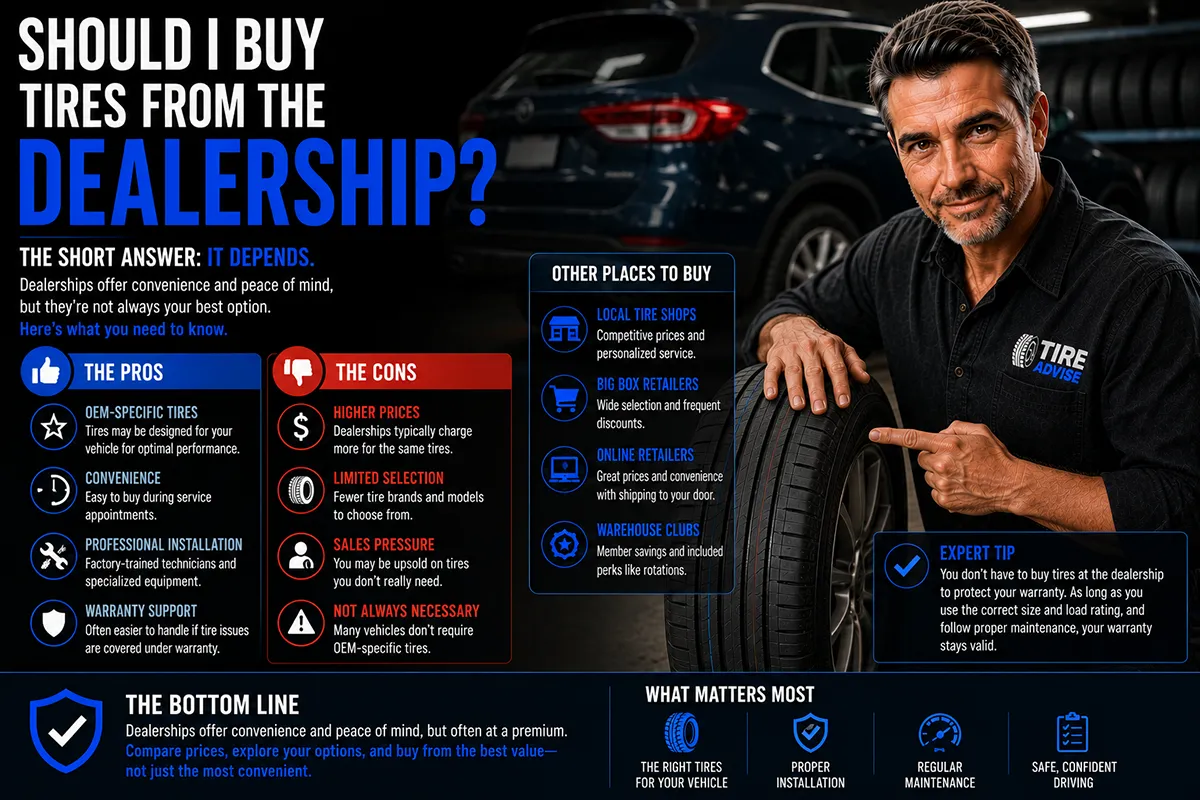
- Dealership tires typically cost 15–30% more than the same tires at independent shops, tire chains, or online retailers.
- You’re mainly paying for OEM expertise, convenience, and sometimes a more comfortable waiting area — not necessarily better tires.
- Dealerships can make sense if you have a tire-and-wheel protection plan, if your car requires specialized OEM tires, or if you value a single service relationship.
- For most everyday drivers, buying from Tire Rack, Costco, Discount Tire, or a trusted local shop will save you real money without sacrificing quality.
- Always compare at least 3–4 quotes before committing, and don’t forget to factor in installation, balancing, alignment, and warranty.
Liked this article?
Add TireAdvise as a preferred source so you see more of our tire reviews and guides on Google.
Why This Question Matters More Than You Think
Tires are one of the biggest recurring maintenance expenses for any vehicle. The average American driver spends between $600 and $1,200 on a set of four replacement tires, and that’s before installation, balancing, and alignment.
Where you buy those tires can swing the total cost by hundreds of dollars. I’ve seen the same set of Michelin Defenders priced at $720 online, $780 at Costco, $840 at a regional tire chain, and $1,050 at a dealership — all within the same metro area.
That’s a meaningful difference, especially if you’re on a budget or managing multiple vehicles in a household. So let’s break this decision down piece by piece.
What It’s Actually Like Buying Tires From a Dealership
I’ve purchased tires from dealerships three times over the years — twice from a Toyota dealer and once from a Ford dealer. I want to be fair here because the experience wasn’t universally bad. In fact, in some ways, it was extremely convenient.
When I bought tires at the Toyota dealership, I dropped off my Camry in the morning, they handled everything — mounting, balancing, a four-wheel alignment check, and even a complimentary multi-point inspection — and I picked the car up that afternoon. No shopping around, no scheduling a separate appointment, no hauling tires from my garage to a shop.
The service advisor knew my car’s history, pulled up my VIN instantly, and recommended the exact OEM tire that came on the vehicle from the factory. There was zero guesswork.
But here’s the catch: I paid a significant premium for that simplicity. And when I later compared the invoice to what I could have paid elsewhere, I realized I’d left a lot of money on the table.
Dealership Tire Pricing: What I’ve Actually Seen
Let me share some real numbers from my own experiences and research. These aren’t hypothetical — these are quotes I personally collected or verified within the past year.
| Tire Model | Dealership Price (per tire, installed) | Tire Chain / Independent Shop | Online + Local Install |
|---|---|---|---|
| Michelin Defender 2 (215/55R17) | $245 | $195 | $175 + $20 install |
| Bridgestone Turanza QuietTrack (225/45R18) | $260 | $210 | $190 + $22 install |
| Continental CrossContact LX25 (235/65R18) | $230 | $185 | $168 + $20 install |
| Goodyear Assurance MaxLife (205/55R16) | $195 | $155 | $140 + $18 install |
| Pirelli Scorpion AS Plus 3 (245/60R18) | $240 | $198 | $182 + $20 install |
On average, across these examples, the dealership charged about 20–30% more per tire than the best alternative. Multiply that by four tires, and you’re looking at $150 to $300 in extra cost for the exact same rubber.
Why Are Dealership Tires More Expensive?
It’s not because they’re ripping you off — at least, not intentionally. Dealership pricing reflects a genuinely different cost structure.
Higher Overhead Costs
Dealerships have massive facilities, large staffs, and significant real estate costs. A franchise-branded service center in a suburban commercial zone costs a lot more to operate than a standalone tire shop. That overhead gets baked into every service and product they sell, including tires.
OEM Markup and Supplier Agreements
Many dealerships source tires through manufacturer-approved supply chains rather than buying from the most cost-effective wholesale distributors. This means they sometimes pay more for the tires themselves, and those costs get passed directly to you.
The “Convenience Tax”
Dealerships know that many customers will pay more for a one-stop-shop experience. You’re already there for an oil change or an inspection — why not just get tires too? That convenience has real value, and they price accordingly.
Bundled Service Charges
Some dealerships fold alignment checks, TPMS sensor resets, tire disposal fees, and shop supplies into a higher per-tire price rather than itemizing them separately. This makes the sticker price look even higher, even though some of those services are legitimate add-ons you’d pay for elsewhere too.
The Advantages of Buying Tires at a Dealership
I want to be balanced here. Despite the higher prices, there are legitimate scenarios where a dealership purchase makes sense. I’ve experienced some of these benefits firsthand.
1. OEM Tire Expertise
Your dealership service team works on your specific make and model every single day. They know the factory-recommended tire sizes, load ratings, and speed ratings without having to look anything up. If you drive something with unusual tire requirements — like a BMW with run-flats or a Tesla with acoustic foam tires — the dealership is less likely to make a mistake.
I once watched a well-meaning independent shop try to put non-run-flat tires on a BMW 3 Series that didn’t have a spare tire. The dealership would never have made that error.
2. Tire and Wheel Protection Plans
If you purchased a tire-and-wheel protection plan when you bought your car (many F&I departments push these), it almost certainly requires you to get service at the dealership for coverage to apply. In that case, buying tires there could actually save you money since the plan might cover the full replacement cost for road hazard damage.
Check your plan’s fine print carefully. I’ve seen plans that cover replacement tires at no cost for the first several years of ownership, which effectively makes the dealership the cheapest option.
3. Single Service Record
If you’re the type of person who likes having every service logged in one place — tied to your VIN and accessible to future buyers — the dealership keeps impeccable records. This can add resale value when you eventually sell or trade in the vehicle.
4. Loaner Cars and Shuttle Service
Many dealerships offer loaner vehicles or shuttle services that independent shops can’t match. If you can’t afford to be without your car for even a few hours, this perk might justify the premium.
5. Financing Options
Some dealerships allow you to roll tire costs into a service financing plan with 0% interest for 6–12 months. If cash flow is tight and you need tires immediately, this can be a lifeline — though I’d always caution against financing consumables if you can avoid it.
The Disadvantages of Buying Tires at a Dealership
Now for the flip side, which in my experience carries more weight for the average driver.
1. Significantly Higher Prices
This is the elephant in the room. As I showed in the comparison table above, you will almost always pay more at the dealership. Over the life of a vehicle, if you replace tires two or three times, this difference could add up to $500–$900.
2. Limited Tire Selection
Dealerships typically stock or recommend a narrow range of tires — often just one or two options per tire size. They’ll usually push the OEM tire (whatever came on the car from the factory) or a premium brand they have a supplier relationship with.
In contrast, a place like Tire Rack offers dozens of options for any given tire size, with user reviews, test data, and pricing from budget to premium. When I shop online, I have far more control over what I’m putting on my car.
3. Pressure to Upsell
Every time I’ve gotten tires at a dealership, the service advisor tried to add on services I didn’t need — nitrogen inflation ($50+), premium valve stems, extended road hazard warranties, and alignment packages that cost twice what an independent shop charges. Not all of these are bad, but the upsell pressure can cloud your judgment.
4. Scheduling Hassles
Dealership service departments are often booked out for days or even weeks. I’ve had to wait over a week for a tire appointment at a busy dealer, while Discount Tire down the street could get me in the same afternoon.
Where Else Can You Buy Tires? My Top Alternatives
Over the years, I’ve bought tires from nearly every type of retailer available to US drivers. Here’s my honest take on each one.
Tire Rack (Online)
Tire Rack is my go-to recommendation for most drivers. Their selection is enormous, their pricing is consistently competitive, and their review system is one of the best in the industry. I’ve ordered from them multiple times and had tires shipped directly to a local installer — the process is seamless.
They also run frequent promotions, like $60–$100 manufacturer rebates, that stack with their already-low prices. After several days of driving on tires I ordered through Tire Rack, I’ve never once felt like the quality was any different than what I’d get at a dealership.
Costco Tire Center
If you have a Costco membership, their tire center is hard to beat. Pricing is competitive, installation includes lifetime balancing, rotation, and flat repair, and they frequently run instant savings events ($150 off a set of four Michelins, for example).
The downside? Limited selection compared to online retailers, and the wait times can be long — I’ve sat in the Costco tire center for over three hours on a busy Saturday.
Discount Tire / America’s Tire
Discount Tire (called America’s Tire in some western states) is the largest independent tire retailer in the US, and for good reason. Their prices are competitive, their service is fast, and their free lifetime rotation and balancing deal is one of the best in the business.
I’ve been a Discount Tire customer for years and have never had a bad experience. Their price-match guarantee also means you can show them a lower quote and they’ll usually beat it.
Walmart Auto Center
Walmart’s tire prices are often among the lowest you’ll find for budget and mid-range tires. However, in my experience, the quality of installation varies wildly by location. I’ve had perfectly fine service at one Walmart and a borderline negligent experience at another where they didn’t properly torque my lug nuts.
If you go the Walmart route, I’d recommend double-checking the torque specs yourself after the install.
Local Independent Tire Shops
Don’t overlook your neighborhood tire shop. Many independent shops buy from the same wholesale distributors as the big chains and can offer very competitive pricing — especially if you’re a repeat customer. They also tend to provide more personalized service.
I have a local shop I’ve trusted for over a decade. The owner knows my vehicles, remembers my preferences, and has never tried to sell me something I don’t need. That relationship is worth a lot.
When You Should Buy Tires From the Dealership
Despite everything I’ve said, there are specific situations where I’d actually recommend going to the dealership. These aren’t common for most drivers, but they’re worth knowing about.
- You have an active tire-and-wheel protection plan that requires dealership service for coverage.
- Your vehicle requires specialty OEM tires — like Tesla’s acoustic tires, BMW’s run-flat star-marked tires, or Porsche’s N-rated tires — and you want the peace of mind that the dealership will get the exact right specification.
- Your car is still under the factory warranty or extended warranty and you want to avoid any potential disputes about non-OEM parts (note: legally, using non-dealership tires can’t void your warranty under the Magnuson-Moss Warranty Act, but some dealers will still give you a hard time).
- You’ve received a competitive quote — some dealerships, especially during slow periods, will price-match or come close to what you’d pay elsewhere. If the price is comparable, the convenience factor might tip the scales.
- You’re getting other significant service done and combining everything into one appointment makes logistical sense.
When You Should NOT Buy Tires From the Dealership
For most everyday drivers, my advice is straightforward: shop around before defaulting to the dealership.
- You’re budget-conscious. The 20–30% premium adds up fast when you’re buying four tires.
- You want more tire options. Dealerships typically offer a limited selection, while online retailers and tire chains give you access to dozens of alternatives.
- You don’t have a protection plan. Without a plan that mandates dealership service, there’s little financial incentive to pay more.
- You have a trusted local shop. An independent shop that knows your car can match or beat dealership service quality at a fraction of the price.
- You’re comfortable ordering online. If you can handle a few clicks and a short wait for shipping, buying online and having tires installed locally is almost always the cheapest route.
How to Get the Best Deal Wherever You Buy
Whether you end up at the dealership or somewhere else, these tips will help you get the most value for your tire purchase.
Always Get at Least Three Quotes
I can’t stress this enough. Before I buy any set of tires, I check prices at Tire Rack, Discount Tire, and at least one local shop. It takes about 20 minutes and regularly saves me $100 or more. I also check the dealership’s price — not because I expect it to be the lowest, but so I have a complete picture.
Look for Manufacturer Rebates
Michelin, Bridgestone, Continental, Goodyear, and Pirelli all run seasonal rebate programs — usually $60 to $100 back on a set of four tires. These rebates are available regardless of where you buy, so they can effectively reduce the price gap between a dealership and a discount retailer.
Ask About Package Deals
Many tire retailers offer package pricing that includes mounting, balancing, new valve stems, TPMS sensor service, and tire disposal. When comparing prices, always look at the out-the-door cost, not just the per-tire sticker price.
Don’t Skip the Alignment
A wheel alignment after installing new tires costs $75–$120 at most shops and can dramatically extend the life of your tires. I’ve seen tires wear unevenly within just a few weeks of driving on a vehicle with poor alignment. This is one area where spending a little extra is always worth it.
Negotiate at the Dealership
Most people don’t realize that dealership tire prices are often negotiable, especially if you present a lower competitor quote. I’ve personally gotten a Toyota dealer to knock $40 per tire off their initial quote just by showing them a Tire Rack screenshot on my phone. The worst they can say is no.
The Magnuson-Moss Warranty Act: Know Your Rights
One thing that frustrates me about some dealerships is the implication — sometimes subtle, sometimes not — that using non-dealership tires or parts could void your vehicle’s warranty.
This is flatly untrue under federal law. The Magnuson-Moss Warranty Act (1975) prohibits manufacturers from requiring you to use branded parts or authorized service providers as a condition of your warranty. The only exception is if the manufacturer provides the parts or service for free.
So if a service advisor tells you that buying tires elsewhere will void your warranty, that’s either a misunderstanding or a deliberate pressure tactic. Either way, don’t fall for it. You have every right to buy tires wherever you choose without jeopardizing your warranty coverage.
My Personal Buying Process: Step by Step
Here’s exactly what I do when it’s time for new tires, and I recommend you follow the same approach.
Step 1: I check my vehicle’s door jamb sticker or owner’s manual for the correct tire size, load index, and speed rating. I never guess on this — getting it wrong can compromise safety.
Step 2: I go to Tire Rack and filter by my vehicle’s year, make, and model. I sort by rating and price, then narrow down to 2–3 options that balance performance, tread life, and value.
Step 3: I read both expert and user reviews. I pay special attention to reviews from drivers in my region (I deal with Midwest winters, so wet and snow traction matter to me).
Step 4: I get quotes from Tire Rack (with shipping to a local installer), Discount Tire, Costco (if the tire is in their catalog), and my local independent shop.
Step 5: I check for active manufacturer rebates — these rotate seasonally, and timing your purchase right can save you another $60–$100.
Step 6: I compare total out-the-door costs, including mounting, balancing, alignment, valve stems, TPMS reset, and disposal fees.
Step 7: I buy from whoever offers the best total value. More often than not, that’s Tire Rack shipped to a local installer or Discount Tire. But I’ve also bought from Costco and my local shop when the numbers made sense.
That process takes me about 30–45 minutes and has saved me hundreds of dollars on every tire purchase. Over the past several days after my most recent tire swap, my new set has been performing exactly as expected — and I paid about $220 less than the dealership quoted me for the same tires.
What About Tire Quality? Is There a Difference?
A question I get asked all the time is whether the tires you buy at a dealership are somehow better or fresher than what you’d get from Tire Rack or Discount Tire.
The short answer: no. A Michelin Defender LTX is a Michelin Defender LTX regardless of where you buy it. It’s the same tire, made in the same factory, to the same specifications.
The one thing worth checking is the tire’s manufacturing date, which is stamped on the sidewall as a four-digit DOT code (e.g., “2324” means the 23rd week of 2024). I always check this regardless of where I buy — you want tires that are less than two years old at the time of purchase. I’ve found slightly older stock at small independent shops and even at Walmart, but I’ve also seen fresh tires at those same places. It just pays to look.
Dealerships don’t have any special advantage in tire freshness. In fact, because they sell fewer tires than dedicated tire retailers, their stock sometimes sits longer.
The Bottom Line: My Honest Recommendation
After years of buying tires from dealerships, tire chains, independent shops, and online retailers, here’s where I land on this question.
For the vast majority of US drivers, buying tires from the dealership is not the best financial decision. You’ll pay more — often significantly more — for the same product. The convenience and expertise benefits are real but rarely justify a 20–30% premium.
My recommendation is to do a little homework, compare prices across 3–4 sources, and buy from wherever gives you the best combination of price, service, and warranty coverage. For most people, that’s going to be Tire Rack, Discount Tire, Costco, or a trusted local shop.
But if you have a protection plan that requires dealership service, if your vehicle needs specialized OEM tires, or if the dealer matches a competitor’s price — go for it. There’s nothing wrong with buying from the dealership when the value proposition makes sense.
The most important thing is that you get the right tire for your vehicle and driving conditions, that it’s installed correctly, and that you maintain it properly with regular rotations and pressure checks. Where you buy it matters far less than what you buy and how you care for it.
Drive safe out there.
Frequently Asked Questions
Is it more expensive to buy tires from a dealership than a tire shop?
In most cases, yes — dealership tire prices are typically 10-30% higher than what you’d pay at a dedicated tire shop like Discount Tire, Tire Rack, or Costco. Dealerships have higher overhead costs and often carry a limited selection of premium brands, which drives up the price. I always recommend getting quotes from at least two or three sources before committing, because you can often save $200-$400 on a full set by shopping around.
Do dealership tires come with better warranties than tire shop tires?
Not necessarily. The tire manufacturer warranty is the same regardless of where you buy — a set of Michelin Defenders carries the same mileage warranty whether purchased at a Ford dealership or a local tire shop. Some dealerships do offer added perks like free rotations or road hazard coverage, but many independent tire shops and chains like Discount Tire offer similar or even better protection plans at no extra cost. Always compare the full warranty package, not just the tire price.
Will buying tires from somewhere other than the dealership void my car warranty?
No, buying tires from an independent tire shop or online retailer will not void your vehicle warranty. The Magnuson-Moss Warranty Act, a US federal law, prohibits manufacturers from requiring you to purchase parts or services exclusively from a dealership to maintain warranty coverage. As long as you install the correct tire size and type specified in your owner’s manual, you’re fully protected.
Are dealership tires better quality than tires from Costco or Tire Rack?
The tires themselves are identical in quality because they come from the same manufacturers — a Bridgestone Turanza sold at your Honda dealership is the exact same tire sold at Costco or Tire Rack. The difference is in selection and pricing, not quality. Dealerships may stock OEM-specific tires that were originally fitted to your car, but you can order those same tires from any major retailer, often at a lower price.
What are the advantages of buying tires at a dealership?
The biggest advantage is convenience — the dealership already knows your vehicle’s exact tire specifications, and their technicians are trained specifically on your car’s make and model. Some dealerships also offer bundled service deals where a tire purchase includes alignment, mounting, balancing, and future rotations. If you value a one-stop-shop experience and trust your dealership’s service department, the premium you pay can be worth the peace of mind, especially for newer or luxury vehicles.
Where is the cheapest place to buy tires in the US?
For most US drivers, the cheapest options are warehouse clubs like Costco and Sam’s Club, online retailers like Tire Rack or SimpleTire, and national chains like Discount Tire. Costco frequently offers $150 off installation for a set of four, and Tire Rack lets you compare dozens of brands at competitive prices and ship directly to a local installer. I’ve personally saved the most money by buying tires online and having them mounted at a local shop, which typically charges $15-$25 per tire for installation.
Should I buy OEM tires from the dealership or switch to a different brand?
OEM tires are specifically chosen by the manufacturer to match your vehicle’s ride, handling, and noise characteristics, so they’re a safe choice — but they’re not your only good option. Aftermarket tires from brands like Continental, Michelin, or General Tire can offer better tread life, improved wet traction, or lower cost while still meeting your car’s requirements. If you drive in harsh US winter conditions or put on high mileage, switching to a tire optimized for your specific needs can actually outperform the OEM option at a lower price point.
