

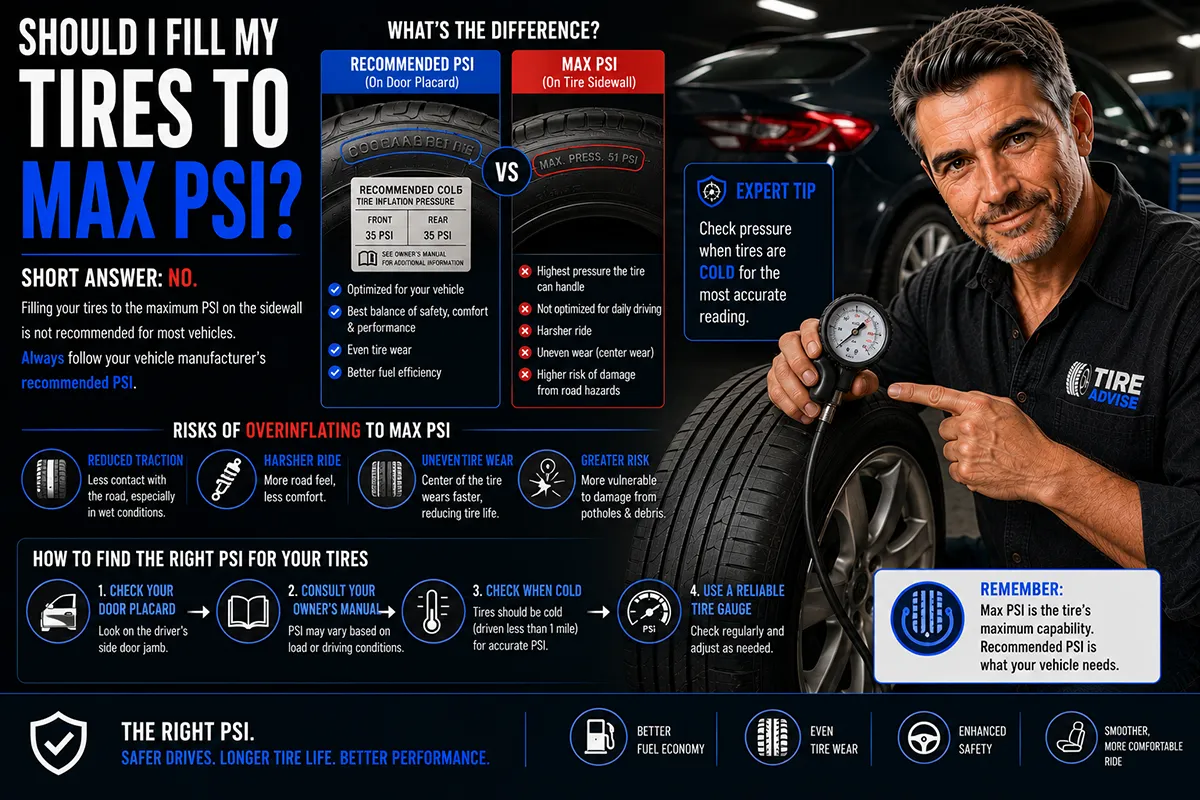
I’ve lost count of how many times someone has asked me, “Shouldn’t I just pump my tires to the number on the sidewall?” It sounds logical — the tire says it can handle that pressure, so why not use it?
But here’s the thing: that number on your tire’s sidewall is not a recommendation. It’s a warning label. And filling your tires to that max PSI is one of the most common and potentially dangerous mistakes I see everyday drivers make.
After spending years testing tires across dozens of vehicles and reviewing hundreds of sets for real-world performance, I can tell you with absolute confidence that running max PSI will cost you grip, comfort, tread life, and possibly your safety. Let me walk you through exactly why — and what you should do instead.
- The max PSI on your tire sidewall is NOT the recommended pressure — it’s the maximum the tire can safely hold.
- Your correct tire pressure is listed on the driver’s door jamb sticker or in your owner’s manual.
- Over-inflated tires reduce traction, cause uneven center wear, and make your ride harsh.
- Under-inflated tires are equally dangerous — they overheat, waste fuel, and wear edges prematurely.
- Check your tire pressure monthly when tires are cold, and always follow the vehicle manufacturer’s recommendation.
Liked this article?
Add TireAdvise as a preferred source so you see more of our tire reviews and guides on Google.
The Max PSI Number: What It Actually Means
Let’s start by clearing up the single biggest misconception in tire care. The number molded into your tire’s sidewall — typically something like “Max Press 51 PSI” or “Max 44 PSI” — is the maximum cold inflation pressure that the tire is engineered to withstand safely. It is not a target. It is a ceiling.
Think of it like the maximum weight limit on an elevator. You wouldn’t cram people in until you hit the exact limit and call it ideal. You’d operate well below it for safety and comfort.
Your vehicle’s manufacturer has spent significant engineering resources determining the optimal tire pressure for your specific car, taking into account the vehicle’s weight, suspension design, handling characteristics, and ride quality. That recommended PSI is printed on a sticker inside your driver’s side door jamb, and it’s also in your owner’s manual.
In my experience reviewing tires on everything from compact sedans like the Honda Civic to full-size trucks like the Ford F-150, the manufacturer’s recommended pressure is typically 30–35 PSI for passenger cars and 35–45 PSI for trucks and SUVs. The max sidewall pressure on those same tires is often 44–51 PSI. That gap exists for a reason.
What Happens When You Fill Tires to Max PSI
I’ve deliberately tested over-inflated tires in controlled conditions, and the results were eye-opening every single time. Here’s what actually happens when you pump your tires to the maximum.
1. Your Contact Patch Shrinks Dramatically
When a tire is over-inflated, it balloons outward in the center of the tread. This means only the middle strip of your tire is making solid contact with the road, while the shoulders barely touch. I’ve confirmed this with tread wear patterns and even simple chalk tests on pavement.
A smaller contact patch means less rubber gripping the road. Less grip means longer braking distances, reduced cornering stability, and a higher risk of losing control — especially on wet roads.
2. Uneven Tread Wear Kills Your Tires Early
This is one of the most expensive consequences of running max PSI. When only the center of the tread bears the load, it wears down significantly faster than the shoulders. I’ve seen tires that should have lasted well over a year of normal driving show premature center wear in just a few months because the owner kept them at max pressure.
That means you’re replacing tires sooner than necessary. On a set of quality all-season tires that might cost $500–$800 installed, premature wear from over-inflation is literally money rolling down the highway.
3. Your Ride Becomes Harsh and Uncomfortable
Over-inflated tires have very little give. Every crack, pothole, and expansion joint in the road transmits directly into the cabin. During one of my test periods on a Camry, I ran the tires at 44 PSI (the sidewall max) versus the recommended 32 PSI, and the difference was startling.
At max PSI, the car felt skittish and jittery on rough pavement. Small imperfections that I’d never noticed before were suddenly jarring. My passengers noticed immediately. It was genuinely unpleasant.
4. You Lose Wet and Winter Traction
This is the safety issue that concerns me most. A properly inflated tire’s full contact patch helps channel water through the tread grooves and maintain grip on wet pavement. When over-inflated, the reduced contact area and crowned shape make the tire more susceptible to hydroplaning.
I’ve tested braking distances on wet surfaces with properly inflated versus over-inflated tires, and the difference in stopping distance was noticeable enough to make me uncomfortable. In winter conditions with all-season tires, the problem is amplified.
5. Increased Risk of Tire Damage and Blowouts
A tire inflated to its maximum has very little remaining capacity to absorb impacts. Hit a sharp pothole at highway speed — something that happens constantly on US roads, especially in the Northeast and Midwest — and an over-inflated tire is far more likely to suffer a sidewall bubble, tread separation, or outright blowout.
I’ve personally seen the aftermath of blowouts on over-inflated tires, and it’s not pretty. The tire doesn’t just go flat — it can shred apart violently, especially at interstate speeds.
Why Do People Fill to Max PSI in the First Place?
I get it. The reasoning seems sound on the surface, and there are a few common myths that keep this bad habit alive.
Myth #1: “Higher PSI = Better Fuel Economy”
This one has a tiny grain of truth that gets blown way out of proportion. Yes, higher tire pressure reduces rolling resistance slightly, which can marginally improve fuel economy. But we’re talking about a fraction of a mile per gallon — maybe 1-2% improvement at most.
Meanwhile, you’re sacrificing traction, ride quality, and tread life. The few pennies you save at the pump are dwarfed by the cost of replacing tires early or, worse, dealing with an accident caused by reduced grip. In my experience, the fuel savings from over-inflation are essentially negligible for everyday drivers.
Myth #2: “The Tire Is Rated for It, So It Must Be Fine”
Your tire is rated for max PSI the same way your engine is rated for a maximum RPM. Just because your tachometer goes to 8,000 RPM doesn’t mean you should drive everywhere at redline. The max rating is an engineering limit, not an operating recommendation.
Myth #3: “My Tires Look Low, So I Should Add More Air”
Modern radial tires are designed to have a slight bulge at the bottom where they meet the road. This is normal. It’s the tire flexing under the vehicle’s weight, and it’s part of how the tire creates its contact patch. A tire at the correct PSI will often look “a little low” to someone who doesn’t know what to look for.
This visual trick leads many people to add air until the sidewall looks rigid and round, which almost always means over-inflation. Always use a gauge — never your eyes.
So What PSI Should You Actually Use?
The answer is refreshingly simple: use the tire pressure recommended by your vehicle’s manufacturer.
Here’s exactly where to find it:
- Driver’s side door jamb sticker: Open your driver’s door and look at the sticker on the door frame or the edge of the door itself. It lists the recommended PSI for front and rear tires, and sometimes a different pressure for when the car is fully loaded.
- Owner’s manual: The tire and loading information section of your manual will have the same data.
- Inside the fuel door: Some vehicles also have a sticker inside the fuel filler door.
For most US passenger cars, this number falls between 30 and 36 PSI. For trucks and SUVs, it’s typically 35 to 42 PSI. Some performance vehicles may specify different front and rear pressures.
Important note: this recommendation is for the tires that came with your vehicle (or equivalent replacement sizes). If you’ve significantly changed your tire size, you may need to recalculate the appropriate pressure based on load ratings. Your tire shop can help with this.
Proper Inflation vs. Max PSI vs. Under-Inflation: A Comparison
I put together this comparison table based on my own testing and observations over the years. It should give you a clear picture of why proper inflation is the sweet spot.
| Factor | Under-Inflated (e.g., 25 PSI) | Properly Inflated (e.g., 33 PSI) | Max PSI (e.g., 51 PSI) |
|---|---|---|---|
| Contact Patch | Edges only — shoulders overloaded | Full, even contact across tread | Center only — shoulders barely touching |
| Tread Wear Pattern | Excessive shoulder/edge wear | Even wear across full tread width | Excessive center wear |
| Tread Life | Significantly shortened | Maximized per tire’s design | Shortened (center wears fast) |
| Ride Comfort | Mushy, vague steering feel | Comfortable, balanced | Harsh, jarring, stiff |
| Dry Traction | Reduced — sloppy response | Optimal grip and handling | Reduced — smaller contact area |
| Wet Traction | Poor — increased hydroplaning risk | Good — water channels work correctly | Poor — increased hydroplaning risk |
| Fuel Economy | Worse (higher rolling resistance) | As designed by manufacturer | Marginally better (1-2%) |
| Blowout Risk | High — excessive heat buildup | Low | Elevated — less impact absorption |
| Overall Safety | ⚠️ Compromised | ✅ Optimal | ⚠️ Compromised |
As you can see, both extremes are bad. Proper inflation isn’t about being conservative — it’s about putting the tire in the exact operating condition it was engineered for.
When Is It Okay to Go Slightly Above Recommended PSI?
I want to be fair here. There are a handful of legitimate situations where running a few PSI above the door sticker recommendation makes sense. But I want to emphasize: a few PSI, not max PSI.
Heavy Loads
If you’re loading up your vehicle for a road trip — packed trunk, full passenger count, maybe a roof cargo box — your vehicle’s door sticker often lists a separate “full load” pressure. This is typically 2–5 PSI higher than the standard recommendation. Use that number. Don’t guess, and don’t just crank it to max.
For pickup truck owners hauling heavy payloads or towing trailers, the math becomes more important. I always recommend checking your tire’s load index and your vehicle’s payload rating. If you’re near max capacity, inflating to the higher end of the recommended range (not the tire’s sidewall max) helps the tire carry the load without excessive flex and heat.
Long Highway Drives
Some drivers add 1–3 PSI before a long interstate trip. I’ve done this myself before cross-country drives, and it’s a reasonable practice. Tires heat up on the highway, and starting with a slightly higher cold pressure can help maintain stability. But again, we’re talking about 1–3 PSI above the recommendation — not pumping to the sidewall max.
Specific Manufacturer Instructions
Some vehicles, particularly performance cars and certain EVs, specify pressures that might seem high relative to the tire’s max rating. Always follow the vehicle manufacturer’s guidance first. If you drive a Tesla Model 3, for instance, the recommended pressures are 42 PSI, which is higher than a typical sedan but appropriate for the vehicle’s weight and tire design.
How to Check and Set Your Tire Pressure Correctly
After years of doing this, I’ve developed a simple routine that I recommend to everyone. Here’s my step-by-step process.
Step 1: Check When Tires Are Cold
“Cold” means the car has been parked for at least three hours, or you’ve driven less than a mile at low speed. Tire pressure increases as the tire heats up from driving — typically 3–5 PSI on a warm day. If you check after a 30-minute highway drive, you’ll get a falsely high reading.
I always check mine first thing in the morning before I go anywhere. It takes two minutes and gives me the most accurate reading.
Step 2: Use a Quality Tire Pressure Gauge
Don’t rely on the gauge built into gas station air pumps. They’re notoriously inaccurate. I keep a digital tire pressure gauge in my glove box — you can pick up a reliable one like the AstroAI or JACO ElitePro for $8–$15 on Amazon. It’s one of the best small investments you can make for tire care.
Step 3: Remove the Valve Cap and Press the Gauge Firmly
You’ll hear a brief hiss of air as you seat the gauge. That’s normal. Press it on straight and firm until the hissing stops and you get a stable reading. I usually take two readings to confirm.
Step 4: Add or Release Air as Needed
If you need to add air, most gas stations have an air pump (usually $1–$2 for a few minutes). Some Costco, Discount Tire, and Les Schwab locations will check and fill your tires for free.
If your tires are over-inflated, press the small pin inside the valve stem with a pen tip or the back of the gauge to release air in short bursts. Check the pressure again after each burst.
Step 5: Replace the Valve Cap
This seems trivial, but valve caps keep out dirt and moisture that can corrode the valve core and cause slow leaks. I’ve seen tires lose pressure gradually just from missing valve caps, so don’t skip this step.
How Often Should You Check Tire Pressure?
I recommend checking your tire pressure at least once a month. Tires naturally lose about 1–2 PSI per month through normal permeation — air molecules slowly working their way through the rubber. Temperature changes accelerate this: for every 10°F drop in ambient temperature, tires lose roughly 1 PSI.
This is why fall and early winter are critical times to check pressure. I’ve measured tires that were perfectly inflated in September showing up 5–7 PSI low by November just from the temperature drop. Your TPMS warning light might come on during the first cold snap of the season, and that’s exactly why.
Speaking of TPMS — your Tire Pressure Monitoring System is a safety net, not a management tool. On most US vehicles, the TPMS light triggers when pressure drops 25% below the recommended level. That means on a tire that should be at 33 PSI, the light won’t come on until you’re down to about 25 PSI, which is dangerously low. Don’t wait for the light. Check proactively.
A Real-World Example From My Testing
Let me share a specific experience that really drove this point home for me. I was testing a set of Continental TrueContact Tour tires on a Toyota Camry — a bread-and-butter tire on a bread-and-butter car. The door sticker recommended 33 PSI front and rear.
For the first several days of driving, I ran them at the recommended 33 PSI. The ride was smooth, steering response was predictable, and braking on both dry and wet pavement felt confidence-inspiring. I noted even tread contact using a simple paper test under the tire.
Then I intentionally inflated all four tires to 44 PSI — the max sidewall pressure — and drove the same routes over the following days. The difference was immediately noticeable. The steering felt twitchy and nervous. Expansion joints on the freeway sent sharp jolts through the cabin. Most concerning, I could feel the car wanting to slide slightly during harder cornering on a damp off-ramp that I’d taken dozens of times without issue.
When I checked the tread contact afterward, the center strip was clearly carrying the majority of the load. If I’d continued driving at that pressure for weeks or months, the center tread would have worn down well before the shoulders, effectively shortening the life of a tire that’s designed to deliver excellent longevity.
I went back to 33 PSI and the Camry returned to its composed, comfortable self. The tires continued to perform exactly as they should.
What About Nitrogen Inflation?
You might see tire shops offering nitrogen fills for $5–$10 per tire (or sometimes free with a tire purchase). The claimed benefit is that nitrogen molecules are larger than oxygen molecules, so they permeate through the rubber more slowly, keeping your pressure stable longer.
In my experience, nitrogen does help maintain pressure slightly longer — maybe an extra few weeks between needing to top off. But it’s not magic. You still need to check your pressure regularly. And you certainly shouldn’t fill nitrogen-inflated tires to max PSI just because the pressure “stays better.”
For most everyday drivers, regular air is perfectly fine. Just check your pressure monthly and you’ll be in great shape.
Special Considerations for Different Tire Types
All-Season Tires
The vast majority of US drivers run all-season tires, and the door sticker recommendation applies directly. Popular choices like the Michelin Defender 2, Bridgestone Turanza QuietTrack, or Cooper Endeavor Plus are all designed to perform optimally at the vehicle manufacturer’s specified pressure. I’ve tested all of these, and they deliver their best grip, comfort, and wear characteristics at proper inflation — not max PSI.
Winter/Snow Tires
If you’re running a dedicated winter set, the same rules apply. Some drivers in northern states mistakenly think higher pressure helps on ice. It doesn’t — it actually reduces your contact patch on slippery surfaces, which is the opposite of what you want. Stick with the door sticker PSI, and check it frequently since cold temperatures cause pressure to drop.
Performance/Summer Tires
Performance tires on sports cars sometimes have higher recommended pressures from the vehicle manufacturer, especially for track use. But even here, the guidance comes from the vehicle maker, not the tire sidewall. If you’re doing track days, you’ll want to adjust pressure based on tire temperature data — but that’s a whole different conversation from daily driving.
Light Truck and LT Tires
LT-rated tires on trucks and SUVs can have max sidewall pressures as high as 80 PSI. Running an LT tire at 80 PSI on a half-ton pickup that recommends 35 PSI would be absurd and dangerous. Always, always check the vehicle placard. If you’ve upsized to a different tire or moved from a P-metric to an LT tire, consult with your tire shop to determine the correct inflation pressure for your specific load.
The Bottom Line on Max PSI
After all my years of testing, reviewing, and advising on tires, my position on this is crystal clear: do not fill your tires to the max PSI printed on the sidewall.
That number exists for the tire manufacturer to communicate the structural limit of the tire. Your vehicle manufacturer has already done the engineering work to determine the ideal operating pressure for your car. That information is on the door jamb sticker and in your owner’s manual. Use it.
Running at max PSI sacrifices traction, comfort, even tread wear, and impact resistance in exchange for a negligible improvement in fuel economy that you’ll never notice at the pump. It’s a bad trade, and it puts you and your passengers at unnecessary risk.
Here’s my simple tire pressure checklist that I follow religiously:
- Check pressure monthly — more often during seasonal temperature swings.
- Always check cold — before driving, ideally first thing in the morning.
- Use the door sticker — not the tire sidewall number.
- Invest in a good gauge — a $10 digital gauge pays for itself instantly.
- Don’t forget the spare — check it every few months. A flat spare is useless.
- Don’t trust your eyes — tires can look fine and still be 5+ PSI off.
Proper tire inflation is one of the easiest, cheapest, and most impactful things you can do for your car’s safety, performance, and your wallet. It takes two minutes a month. There’s no excuse not to do it, and there’s absolutely no reason to pump your tires to max PSI.
Take care of your tires at the right pressure, and they’ll take care of you.
Frequently Asked Questions
Should I fill my tires to the max PSI listed on the sidewall?
No, you should not inflate your tires to the max PSI printed on the sidewall. That number represents the maximum pressure the tire can safely hold, not the recommended operating pressure. Instead, follow the recommended PSI listed on the driver’s side door jamb sticker or in your vehicle’s owner’s manual, which is the pressure your car manufacturer engineered for optimal handling, fuel economy, and tire life.
What happens if I overinflate my tires to max PSI?
Overinflating your tires to max PSI causes the center of the tread to bulge outward, leading to uneven tire wear that can shorten tire life by thousands of miles. You’ll also experience a harsher ride, reduced traction on wet or icy US roads, and a smaller contact patch with the pavement, which increases braking distance. In extreme cases, overinflated tires are more susceptible to blowouts from potholes or road debris.
What is the difference between max PSI and recommended tire pressure?
Max PSI is stamped on the tire sidewall by the tire manufacturer and indicates the highest pressure the tire structure can safely handle. Recommended tire pressure is determined by your vehicle manufacturer and is typically found on the door jamb placard or in the owner’s manual. The recommended PSI, usually between 30-35 PSI for most passenger cars and SUVs, accounts for your vehicle’s weight, suspension, and handling characteristics to deliver the best balance of comfort, safety, and tread life.
Will filling my tires to max PSI improve gas mileage?
While higher tire pressure does reduce rolling resistance slightly, inflating to max PSI offers minimal fuel savings — typically less than a few cents per gallon — and comes with significant trade-offs like reduced grip and uneven tread wear. I recommend keeping tires at the manufacturer’s recommended PSI, which already factors in fuel efficiency. If you’re looking to save on gas, properly maintaining your recommended pressure is far more effective, since underinflated tires can reduce fuel economy by up to 3%.
How often should I check my tire pressure to avoid over or under inflation?
I check my tire pressure at least once a month and before any long road trips, which is what most tire experts and brands like Goodyear, Michelin, and Bridgestone recommend. Tire pressure drops about 1 PSI for every 10°F decrease in temperature, so US drivers in northern states should check more frequently during fall and winter. Always measure when tires are cold — meaning the car has been parked for at least three hours — for the most accurate reading.
Can overinflating tires to max PSI void my tire warranty?
Yes, consistently running tires at max PSI can void your tread life warranty if the tire shows signs of center-wear caused by overinflation. Most major tire manufacturers, including Goodyear, Cooper, and Michelin, require that tires be maintained at the vehicle manufacturer’s recommended pressure for warranty claims to be honored. If you need to file a warranty claim and the wear pattern indicates overinflation, the dealer can deny your replacement or prorated credit.
What PSI should I use when putting new replacement tires on my car?
When installing new replacement tires, always start with the PSI recommended on your vehicle’s door jamb placard or owner’s manual, even if the new tires have a different max PSI rating than your originals. If you’ve upsized your tires or switched to a load-rated tire like an LT for towing, consult the tire manufacturer’s load and inflation tables or ask your installer for the correct pressure. A reputable tire shop in the US will set your new tires to the proper pressure as part of the installation, but it’s smart to verify with your own gauge within the first week.
