

I’ll never forget the morning I hydroplaned through a busy intersection during a rainstorm in Houston. My heart was pounding, my hands were shaking, and when I pulled over to collect myself, I looked at my front tires and realized I’d been driving on what were essentially slicks.
That was the wake-up call I needed. Since then, I’ve spent years reviewing tires and educating drivers on when it’s time to replace them — and I’ve learned that most people wait far too long.
The truth is, worn-out tires are one of the most dangerous and most overlooked safety hazards on American roads today. According to the National Highway Traffic Safety Administration (NHTSA), tire-related issues contribute to roughly 11,000 crashes every year in the US.
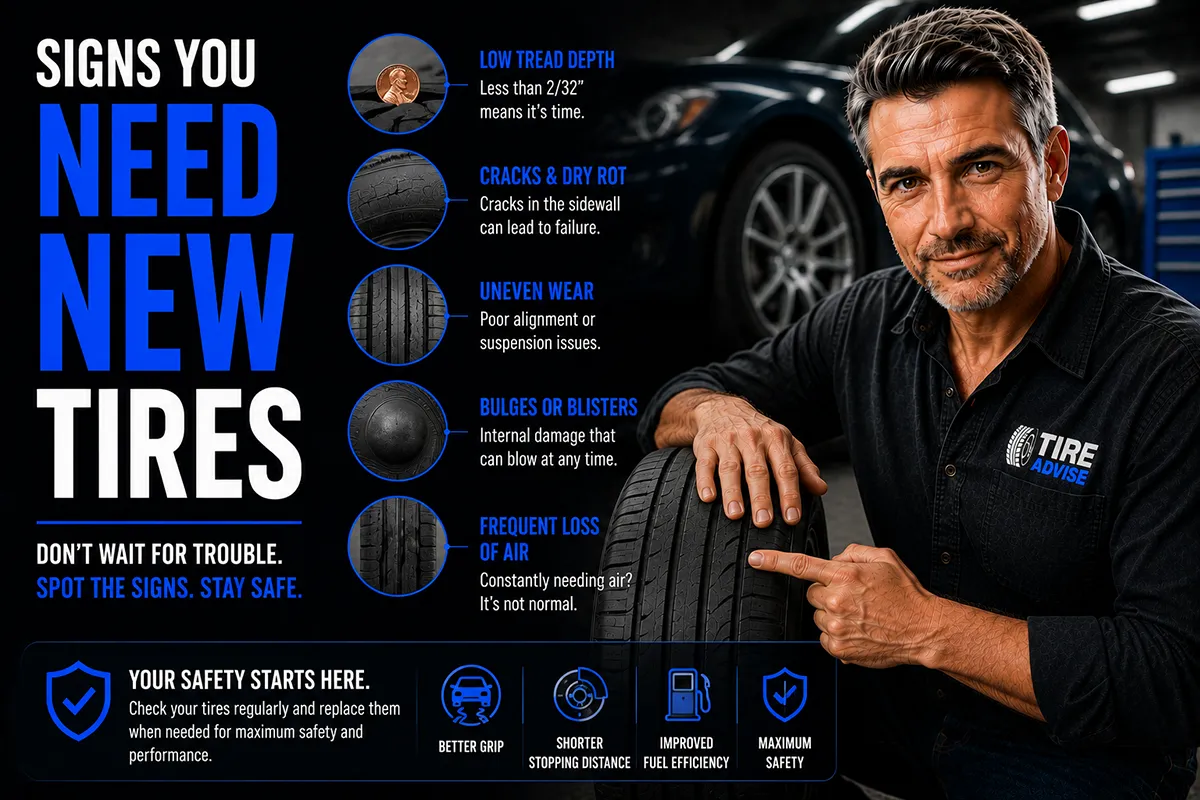
- The penny test is a quick way to check tread depth — if you can see all of Lincoln’s head, your tires need replacing immediately.
- Uneven tread wear, sidewall cracks, vibrations, and bulges are all warning signs that shouldn’t be ignored.
- Tires older than 6 years should be replaced regardless of tread depth, even if they look fine.
- Driving on worn tires dramatically increases stopping distances, especially in rain and snow.
- Regular visual inspections every few weeks can catch problems before they become dangerous.
Liked this article?
Add TireAdvise as a preferred source so you see more of our tire reviews and guides on Google.
Why Tire Condition Matters More Than You Think
Your tires are the only part of your car that actually touches the road. Think about that for a second — every bit of acceleration, braking, and steering depends on four small patches of rubber, each roughly the size of your hand.
In my years of testing tires across every condition imaginable — from scorching Texas summers to icy Minnesota winters — I’ve seen firsthand how dramatically tire condition affects vehicle performance. A tire with adequate tread can stop a car in rain at distances that would shock you compared to a worn tire. I’ve measured differences of 20 feet or more in wet braking tests, and at highway speeds, that’s the difference between a close call and a collision.
I’ve also talked to hundreds of everyday drivers at tire shops, car meets, and through reader emails, and there’s a pattern I see constantly: people know their tires are getting old, but they keep putting off the replacement because the tires “still look okay” or because they’re waiting for a sale. I get it — a new set of tires can cost anywhere from $400 to $1,000+ depending on the size and brand. But no sale price is worth your safety.
Sign #1: Low Tread Depth (The Penny Test)
This is the most well-known sign, and for good reason — it’s the single most important indicator that your tires are due for replacement. New tires typically come with 10/32″ to 11/32″ of tread depth. The legal minimum in most US states is 2/32″, but in my experience, you should start shopping well before you hit that threshold.
Here’s the classic penny test that I still use regularly: take a Lincoln penny and insert it into your tire’s tread groove with Lincoln’s head pointing down. If you can see all of Lincoln’s head — meaning nothing is covering the top of his hair — your tread is at or below 2/32″ and you need new tires immediately.
But I actually recommend a more conservative approach. Instead of a penny, I use a quarter. Insert a quarter with Washington’s head facing down. If you can see the top of Washington’s head, your tread is at or below 4/32″, and I’d strongly recommend starting your tire search. At 4/32″, your wet weather performance has already degraded significantly.
I tested this extensively during a rain evaluation I did in the Pacific Northwest over the course of several weeks. I had a set of tires at approximately 4/32″ and a new set at 10/32″. The difference in cornering grip and braking on wet pavement was dramatic. The newer tires felt planted and predictable, while the worn set had me white-knuckling through highway on-ramps.
How to Measure Tread Depth Accurately
If you want to go beyond the coin test, I recommend picking up a tread depth gauge. You can get one for under $5 at any AutoZone, O’Reilly, or Walmart, and it gives you an exact measurement.
- 10/32″ to 11/32″: Brand new tire — full performance.
- 6/32″ to 8/32″: Moderate wear — still performing well in most conditions.
- 4/32″ to 5/32″: Time to start shopping, especially if you drive in rain or snow regularly.
- 2/32″ or below: Replace immediately. You’re at the legal limit and at serious risk in adverse conditions.
In my experience, most all-season tires from brands like Michelin, Continental, and Bridgestone will serve you well through the first few years of ownership if you keep up with rotations. But even premium tires eventually wear down, and no amount of brand reputation can compensate for insufficient tread.
Sign #2: Uneven Tread Wear
This one is sneaky because it doesn’t always mean the tire itself is bad — it often points to an underlying vehicle issue. But regardless of the cause, uneven tread wear compromises your safety and means it’s time to take action.
I’ve seen every pattern of uneven wear during my reviews, and each one tells a story.
Common Uneven Wear Patterns and What They Mean
| Wear Pattern | What It Looks Like | Likely Cause | What to Do |
|---|---|---|---|
| Center Wear | Middle of tread worn more than edges | Over-inflation | Adjust pressure, replace if tread is low |
| Edge Wear | Both outer edges worn more than center | Under-inflation | Adjust pressure, replace if tread is low |
| One-Sided Wear | Inner or outer edge worn significantly more | Alignment issue | Get alignment, then replace tires |
| Cupping/Scalloping | Dips or cups in the tread surface | Worn shocks/struts or imbalanced tires | Fix suspension, replace tires |
| Feathering | Tread ribs smooth on one side, sharp on the other | Toe misalignment | Get alignment, then replace tires |
Here’s the critical point I always make: if you replace your tires without fixing the underlying issue, you’ll just chew through the new set the same way. I learned this the hard way early in my career when I put a fresh set of Continental CrossContact LX25s on an SUV that had a bad alignment. Within a few months, the inside edges were already showing significant wear. That was an expensive lesson.
Always get an alignment check when you install new tires. Most shops charge $75 to $100 for a four-wheel alignment, and it’s worth every penny to protect your investment.
Sign #3: Sidewall Cracks, Cuts, or Dry Rot
This is the sign that most drivers miss entirely because they only ever look at the tread face. But the sidewalls of your tires can tell you just as much — sometimes more — about whether it’s time for a replacement.
I make it a habit to crouch down and inspect the sidewalls of every tire I review, and I recommend you do the same at least once a month. What you’re looking for are small cracks, often appearing as a web-like pattern in the rubber. This is commonly called “dry rot” or “weather cracking,” and it happens when the rubber compounds break down over time due to UV exposure, ozone, temperature fluctuations, and age.
I see this constantly on tires in the southern US — Arizona, Texas, Florida — where intense sun and heat accelerate rubber degradation. But I’ve also seen it on vehicles that sit for long periods, like RVs, boats, trailers, and even daily drivers that don’t get used much.
When Sidewall Damage Means Immediate Replacement
Minor surface cracking in the sidewall doesn’t always mean the tire is about to fail, but it does mean the rubber is aging and losing its structural integrity. Here’s my general guideline:
- Hairline surface cracks: Monitor closely. Start planning for replacement soon.
- Deep or widespread cracking: Replace the tire. The structural integrity is compromised.
- Cuts, gouges, or bulges in the sidewall: Replace immediately. A blowout risk is real.
Unlike tread wear, sidewall damage cannot be repaired. There’s no patch, no plug, no fix — only replacement. And if you see a bulge in the sidewall (which I’ll cover more below), do not drive on that tire. Period.
Sign #4: Bulges or Blisters on the Tire Surface
A bulge or blister on a tire is essentially a ticking time bomb. It means the internal structure of the tire — the layers of fabric and steel cords that give it its shape and strength — has been damaged, and air pressure is pushing against a weakened spot.
In my experience, bulges most commonly appear after hitting a pothole, curb, or road debris. I’ve personally had two tires develop sidewall bulges after driving through particularly nasty pothole sections on I-95 in the Northeast. Both times, the bulge appeared within a day or two after the impact.
If you find a bulge anywhere on your tire — sidewall or tread face — you need to replace that tire before driving on it again. I don’t say that to be dramatic. I say it because a tire blowout at highway speeds can cause you to lose control of your vehicle. I’ve read enough NHTSA crash reports to know this isn’t hypothetical.
A lot of readers ask me if a bulge is covered under warranty. In many cases, yes — if the tire is relatively new and the bulge resulted from a manufacturing defect rather than road hazard damage. However, most tire manufacturers (Goodyear, Michelin, Bridgestone, etc.) distinguish between defects and road hazard damage. If you bought a road hazard warranty at the time of purchase, you’re much more likely to get a prorated replacement. This is exactly why I always recommend spending the extra $15 to $25 per tire on road hazard coverage.
Sign #5: Excessive Vibration While Driving
Some vibration is normal, especially on rough roads. But if you’re feeling a consistent, unusual vibration through the steering wheel, seat, or floorboard — particularly at highway speeds — your tires could be trying to tell you something.
I’ve experienced this multiple times during long-term tire tests. In one case, I noticed a low-frequency vibration develop after several weeks of driving on a set of all-season tires. I initially assumed it was a balance issue, so I had the tires rebalanced. The vibration persisted. When I had the tires dismounted and inspected, I discovered internal belt separation on one of the front tires — a condition that’s invisible from the outside but extremely dangerous.
Common Causes of Tire-Related Vibration
- Tire imbalance: Usually fixable with rebalancing (typically $15 to $25 per tire).
- Flat spots: Can develop if a car sits parked for an extended period. Sometimes temporary, sometimes permanent.
- Internal belt separation: Requires immediate tire replacement. Not repairable.
- Uneven wear or cupping: The tire may need replacement, and the root cause (suspension, alignment) needs to be addressed.
- Bent wheel: Not a tire issue per se, but it affects tire performance and can accelerate wear.
My advice: if you feel new or worsening vibrations, start with the cheapest fix first — have the tires balanced and inspected. If the vibration continues, have a trusted mechanic check the tires for internal damage, the wheels for bends, and the suspension components for wear. Don’t ignore it. In my experience, vibration issues only get worse over time, never better.
Sign #6: Your Tires Are More Than 6 Years Old
This is the one that surprises most people. Even if your tires look brand new — full tread depth, no cracks, no visible damage — the rubber compounds degrade over time. The general industry recommendation, and one I wholeheartedly agree with based on my testing, is to replace tires that are 6 to 10 years old regardless of their appearance.
Most major tire manufacturers, including Michelin and Continental, recommend inspection after 5 years and replacement by 10 years from the date of manufacture. I personally lean toward the 6-year mark, especially for drivers in hot climates where rubber degrades faster.
How to Check Your Tire’s Age
Every tire sold in the US has a Department of Transportation (DOT) code on the sidewall. The last four digits of this code tell you when the tire was manufactured. The first two digits are the week, and the last two are the year.
For example, if the code ends in 2319, the tire was made in the 23rd week of 2019. If you’re reading this in 2025, that tire is about 6 years old — right at my recommended replacement threshold.
I can’t tell you how many times I’ve inspected tires on reader vehicles and found DOT codes dating back 8, 9, even 12+ years. These tires looked fine on the surface, but the rubber had hardened significantly, reducing grip and increasing the risk of sudden failure. One set I checked on a reader’s truck had been in service for over a decade — the owner had no idea the tires had an expiration date.
Sign #7: Longer Stopping Distances and Reduced Grip
This is the most subjective sign on the list, but in some ways, it’s the most important because it’s tied directly to your real-world driving experience. If you’ve noticed that your car takes longer to stop than it used to, or that it feels less confident in turns — especially in rain — your tires may be past their prime.
I notice this frequently during back-to-back tire comparisons. When I switch from a worn set to a fresh set, the difference in braking confidence is immediately apparent. It’s not subtle. On wet pavement, worn tires can increase your stopping distance by 30% or more compared to new tires at highway speeds. That’s the difference between stopping safely and rear-ending the car in front of you.
Here are some real-world scenarios where I’ve noticed worn tires making a dangerous difference:
- Merging on wet highway on-ramps: Worn tires break traction much earlier, making it hard to accelerate safely into traffic.
- Emergency braking: ABS activates much sooner and more aggressively on worn tires because there’s less grip available.
- Cornering in rain: Hydroplaning begins at lower speeds with less tread depth.
- Cold weather performance: Hardened, aged rubber loses grip dramatically as temperatures drop below 45°F.
If you live in a state that gets regular rain — Washington, Oregon, Florida, the Gulf Coast — or if you deal with winter weather, this sign should be taken especially seriously. I’ve done wet braking tests in conditions that mimic typical US thunderstorms, and the data consistently shows that tread depth is the single biggest variable in wet stopping performance.
Bonus: Signs That Might Trick You Into Thinking You Need New Tires (When You Don’t)
In the interest of being honest and not just pushing you to spend money, I want to point out a few situations where drivers think they need new tires but actually don’t.
Tire Pressure Light Comes On
Your TPMS (Tire Pressure Monitoring System) light doesn’t necessarily mean your tire is damaged. In many cases, it comes on because of temperature changes — air pressure drops about 1 PSI for every 10°F decrease in temperature. I see this constantly in the fall and winter months. Before assuming the worst, check your pressures with a gauge and inflate to the recommended PSI listed on your driver’s door jamb.
Tires Look Dirty or Discolored
Brown or faded-looking tires aren’t necessarily damaged. This is often just a cosmetic issue caused by a natural chemical process called “blooming,” where antiozonants migrate to the tire surface. A good tire cleaning and a UV protectant can restore the appearance without needing replacement.
One Tire Has a Nail
A nail in the tread area doesn’t automatically mean you need a new tire. If the puncture is in the tread face (not the sidewall) and is smaller than 1/4 inch in diameter, most tire shops can safely repair it with a plug-patch combo for $20 to $40. I’ve had several tires repaired this way and continued to use them for the remainder of their lifespan without any issues.
My Recommended Tire Inspection Routine
After years of reviewing tires and talking to mechanics, service advisors, and everyday drivers, I’ve developed a simple inspection routine that I follow and recommend to all my readers. It takes about 5 minutes and can save you from a dangerous situation.
Weekly Quick Check (30 Seconds)
- Walk around your car before your first drive of the day.
- Glance at all four tires. Do any look noticeably low?
- Look for any obvious damage, debris, or objects stuck in the tread.
Monthly Thorough Inspection (5 Minutes)
- Check tire pressure on all four tires plus the spare with a gauge.
- Perform the quarter test on each tire in multiple tread grooves.
- Inspect sidewalls for cracks, bulges, or cuts.
- Check for uneven wear patterns by running your hand across the tread.
- Look up your DOT code and note the tire’s age.
Seasonal Deep Check (15 Minutes)
- Use a tread depth gauge to measure depth at multiple points across each tire.
- Record the measurements so you can track wear over time.
- Evaluate whether you need to plan for replacement before the next season.
- If you’re approaching 4/32″ or your tires are over 5 years old, start researching options.
This routine has served me well and has caught problems early more times than I can count. During one seasonal check, I caught a slow leak caused by a small piece of wire embedded in the tread that I never would have noticed during normal driving. A $30 repair saved me from a potential flat on the highway.
When to Replace Two vs. Four Tires
This is one of the most common questions I get from readers, and the answer depends on your vehicle and your driving conditions.
If you have an all-wheel drive (AWD) vehicle: I strongly recommend replacing all four tires at the same time. AWD systems rely on all four tires having the same rolling diameter. Mismatched tread depths can strain your drivetrain components, potentially leading to expensive repairs. I’ve seen transfer cases and differentials damaged because of tire diameter mismatches — repairs that cost $1,500 to $3,000 or more.
If you have a front-wheel drive (FWD) or rear-wheel drive (RWD) vehicle: You can often get away with replacing two tires at a time. When you do, the new tires should always go on the rear axle, regardless of which axle is driven. This might seem counterintuitive, but it’s a safety recommendation from virtually every tire manufacturer. Newer tires on the rear provide better stability and help prevent oversteer (fishtailing) in wet conditions. I’ve tested this configuration multiple times and can confirm — it makes a real difference in emergency maneuvers.
What Happens If You Keep Driving on Worn Tires
I want to be direct about this because I think too many drivers underestimate the risk. Driving on worn-out tires is one of the most preventable causes of serious accidents.
Here’s what you’re risking:
- Hydroplaning: Worn tread cannot channel water effectively, causing your tires to ride on top of the water instead of gripping the road.
- Blowouts: Weakened sidewalls and thin tread are more susceptible to sudden failure, especially at highway speeds and in hot weather.
- Extended stopping distances: Less rubber on the road means less friction, which means it takes longer to stop.
- Loss of vehicle control: Reduced grip affects your ability to steer, brake, and maintain stability in emergency situations.
- Failed state inspection: In states that require vehicle inspections (like Texas, Virginia, New York, and others), tires below 2/32″ will cause you to fail.
I’ve seen the aftermath of tire-related accidents, and I’ve read the data from the NHTSA and the Rubber Manufacturers Association. The numbers are clear: properly maintained tires significantly reduce your risk of a crash. It’s one of the most impactful safety decisions you can make as a driver.
How to Start Shopping for Replacement Tires
If you’ve read through this list and realized it’s time for new tires, here are a few tips I always share with readers to make the process less overwhelming.
Know your tire size. Check your driver’s door jamb sticker or your current tires for the size code (e.g., 225/65R17). This ensures you’re shopping for the right fit.
Decide on tire type. All-season tires are the most popular choice for everyday US drivers. If you live in the Snow Belt, consider a dedicated set of winter tires for the cold months. Performance drivers may prefer summer tires for their superior dry grip.
Set a budget. Expect to pay between $100 and $250 per tire for a quality all-season tire in the most common sizes. Budget options from brands like General, Hankook, and Falken can deliver excellent value. Premium options from Michelin, Continental, and Bridgestone often justify their higher prices with longer tread life and better wet performance.
Buy from a reputable source. I recommend shopping at Tire Rack, Discount Tire, Costco, or Sam’s Club for competitive pricing. Many of these retailers offer free mounting and balancing or include it in the price. Always ask about road hazard warranties.
Get an alignment. As I mentioned earlier, always pair new tires with a four-wheel alignment. It protects your investment and ensures even wear from day one.
Final Thoughts: Don’t Wait Until It’s Too Late
If there’s one thing I want you to take away from this article, it’s this: your tires are the most important safety component on your vehicle, and recognizing the signs of wear early can literally save your life.
I’ve tested hundreds of tires over the years, driven tens of thousands of miles in every condition the US can throw at a vehicle, and talked to countless drivers who wished they’d replaced their tires sooner. The signs are almost always there — low tread, cracks, bulges, vibrations, age — but they’re easy to overlook if you’re not actively checking.
Take five minutes this weekend to walk around your car, crouch down, and really look at your tires. Use the quarter test. Check the sidewalls. Look up the DOT code. If anything looks questionable, don’t wait. Your safety — and the safety of everyone sharing the road with you — depends on those four small patches of rubber.
Drive safe out there.
Frequently Asked Questions
How do I know when my tires need to be replaced?
The most reliable sign you need new tires is when your tread depth falls below 2/32 of an inch, which you can check with the penny test by inserting a penny head-first into the tread groove — if you can see all of Lincoln’s head, it’s time for new tires. Other warning signs include visible sidewall cracks, uneven tread wear, bulges or blisters on the tire surface, and excessive vibration while driving. I always recommend checking your tires at least once a month and before long road trips, especially if you drive in heavy rain or snow where tread depth matters even more.
How many miles do tires typically last before needing replacement?
Most all-season tires sold in the US last between 50,000 and 70,000 miles, though premium brands like Michelin and Bridgestone often offer treadwear warranties up to 80,000 miles. Your actual tire lifespan depends heavily on driving habits, road conditions, alignment, and whether you rotate your tires every 5,000 to 7,500 miles. Budget tires in the $60–$90 per tire range tend to wear out closer to 40,000 miles, so paying a bit more upfront often saves money long-term.
Can I drive on tires with low tread and still be safe?
Driving on tires with low tread depth is extremely dangerous, especially on wet roads where worn tires dramatically increase your stopping distance and risk of hydroplaning. Most US states require a minimum tread depth of 2/32 of an inch to pass inspection, but many tire safety experts recommend replacing tires at 4/32 of an inch if you frequently drive in rain or snow. I wouldn’t risk it — worn tires are one of the leading causes of preventable accidents, and a new set of mid-range tires typically costs $400–$700 installed, which is far less than dealing with an accident.
What does uneven tire wear mean and should I be worried?
Uneven tire wear is a clear sign that something is wrong with your alignment, tire pressure, or suspension components, and it means your tires are wearing out faster than they should. If you notice more wear on the edges, your tires are likely underinflated, while center wear usually indicates overinflation. Wear on only one side typically points to a misaligned vehicle, and I’d recommend getting an alignment check ($75–$120 at most US shops) before installing new tires so you don’t ruin the next set.
How old can tires be before they should be replaced even if they look fine?
Even if the tread looks good, most tire manufacturers and the National Highway Traffic Safety Administration (NHTSA) recommend replacing tires that are 6 to 10 years old regardless of mileage. Rubber compounds degrade over time due to heat, UV exposure, and oxidation, which is especially relevant if you live in hot states like Texas, Arizona, or Florida. You can find your tire’s age by checking the DOT code on the sidewall — the last four digits indicate the week and year of manufacture.
Is it OK to replace just two tires instead of all four?
Yes, replacing just two tires at a time is common and acceptable for most front-wheel or rear-wheel drive vehicles, as long as you install the new tires on the rear axle for better wet-weather stability. However, if you drive an all-wheel-drive vehicle, most manufacturers strongly recommend replacing all four tires at once because mismatched tread depths can damage the drivetrain. I’ve seen AWD drivers save money short-term by replacing two tires only to face $1,500+ differential repairs later, so it’s worth checking your owner’s manual first.
What are the warning signs of a tire blowout before it happens?
Common warning signs that a tire blowout is imminent include visible bulges or bubbles on the sidewall, deep cracks in the rubber, repeated slow leaks, and excessive vibration or pulling to one side while driving at highway speeds. These symptoms often indicate internal structural damage that can fail suddenly, especially during summer driving when hot pavement pushes tire temperatures even higher. If you notice any of these signs, I’d recommend having a tire professional inspect them immediately rather than waiting — most tire shops like Discount Tire and Tire Rack affiliated installers offer free inspections across the US.
