

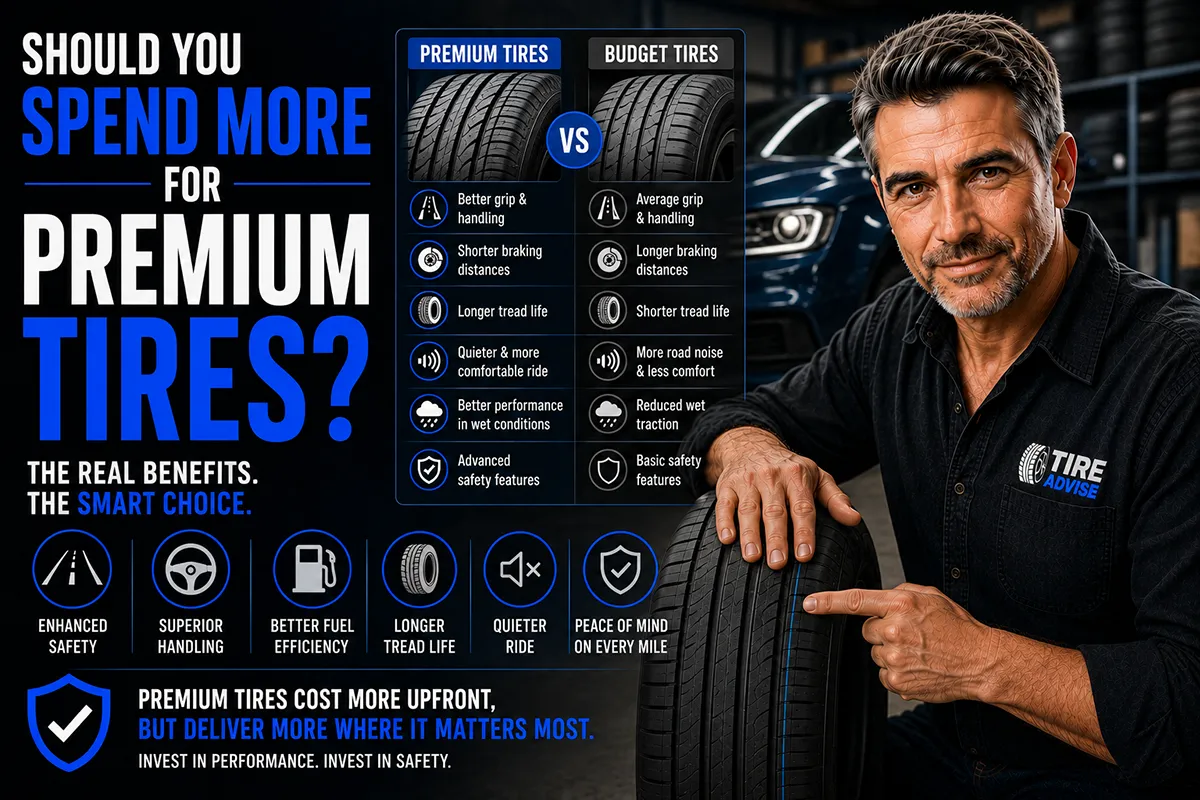
Last year, I stood in a tire shop staring at two options for my daily driver: a set of budget all-season tires for $89 each, and a set of Michelin Defenders for nearly double the price.
The guy behind the counter told me the cheap ones were “just fine.” My gut told me there had to be a catch. So I did what any obsessive tire reviewer would do — I bought both sets over the following months and put them through real-world testing on the same vehicle.
What I found surprised me, and it’s exactly what I’m going to break down for you today.
- Premium tires from brands like Michelin, Continental, and Bridgestone consistently outperform budget options in braking, wet grip, and tread life.
- Budget tires aren’t dangerous — but they compromise in ways you might not notice until it matters most.
- The price gap is smaller than you think when you factor in longevity and fuel efficiency.
- For most US drivers, mid-range tires from brands like General, Falken, or Cooper offer the best value.
- If you drive in heavy rain, snow, or highway speeds regularly, premium tires are worth every penny.
Liked this article?
Add TireAdvise as a preferred source so you see more of our tire reviews and guides on Google.
What Actually Makes a Tire “Premium”?
Before I get into whether you should spend more, let’s clarify what separates a premium tire from a budget one. It’s not just a logo stamped on the sidewall.
Premium tire manufacturers like Michelin, Continental, Bridgestone, and Goodyear invest hundreds of millions of dollars annually in research and development. That money goes into proprietary rubber compounds, advanced tread designs, noise-dampening technologies, and extensive real-world testing.
A budget tire, on the other hand, typically uses a simpler rubber compound and a less optimized tread pattern. Brands like Westlake, Sailun, Lexani, and some Linglong offerings are manufactured at a lower cost, and the engineering reflects that.
Here’s a quick way I think about it: premium tires are engineered to excel across multiple performance categories simultaneously. Budget tires are engineered to meet minimum safety standards at the lowest possible price. Neither approach is inherently wrong — but the difference matters more than most people realize.
The Three Pillars of Tire Quality
In my years of testing tires, I’ve boiled quality down to three core areas:
- Safety performance — braking distance, wet grip, hydroplaning resistance, and cornering stability
- Longevity — how evenly and slowly the tread wears over time
- Comfort and noise — road noise levels, vibration dampening, and ride smoothness
Premium tires tend to score well in all three categories. Budget tires might do okay in one or two but rarely all three. That trade-off is the real story here.
My Side-by-Side Testing: Budget vs. Premium
I want to be transparent about how I tested this. Over the past couple of years, I’ve rotated through multiple tire sets on my 2019 Toyota Camry and my wife’s 2021 Honda CR-V — two of the most common vehicles on American roads.
For the Camry, I ran a set of budget Westlake RP18 tires followed by a set of Michelin Defender T+H tires. For the CR-V, I compared Sailun Atrezzo SV tires against Continental CrossContact LX25 tires.
I drove each set through the same mix of conditions: daily commuting in suburban traffic, highway road trips, heavy rainstorms, and even some light snow here in the Mid-Atlantic region. I paid close attention to braking feel, cornering confidence, road noise, and overall comfort.
Braking Distance: The Difference That Scared Me
This was the single biggest eye-opener in my testing. During hard braking from highway speeds on wet pavement, the premium tires consistently stopped noticeably shorter than the budget options.
I’m not talking about a subtle difference. On the Camry, the Michelin Defenders felt like they grabbed the road and pulled the car to a halt. The Westlake RP18s, under the same conditions, had the car sliding and the ABS pulsing aggressively for what felt like an eternity longer.
I’ve seen independent testing data from organizations like Consumer Reports and the German ADAC that confirms this pattern. Premium tires can stop a full car length or more shorter in wet conditions at 60 mph. That’s the difference between stopping safely and rear-ending the car in front of you.
Wet Grip and Hydroplaning
Living on the East Coast, I deal with heavy rain regularly. After several days of driving through storms on the budget tires, I noticed a persistent uneasiness — a slight floating sensation at highway speeds when water pooled on the road.
When I switched to the premium sets, that feeling disappeared almost entirely. The tread design on tires like the Continental CrossContact and Michelin Defender is specifically engineered to channel water away from the contact patch faster. The premium tires’ wider circumferential grooves and intricate siping patterns are not just cosmetic — they serve a critical drainage function.
Road Noise and Comfort
This is where I was most surprised by the gap. I expected premium tires to be a little quieter, but the difference was dramatic.
On the Camry, switching from the Westlake tires to the Michelins made the cabin feel like a different car. Highway drone dropped significantly, and the ride over rough pavement became noticeably smoother. My wife noticed the same transformation on the CR-V when we moved from the Sailun tires to the Continentals.
Premium tire manufacturers use techniques like variable pitch tread blocks, noise-absorbing foam liners (Michelin’s Acoustic Technology and Continental’s ContiSilent are examples), and optimized sidewall construction to reduce noise and vibration. Budget tires rarely invest in these refinements.
Tread Life and Longevity
Here’s where the math starts to favor premium tires in ways most shoppers don’t consider. During my testing periods, I tracked tread depth measurements at regular intervals using a simple tread depth gauge.
The budget tires wore noticeably faster and less evenly than the premium options. The Westlake RP18s showed visible signs of accelerated shoulder wear after a relatively short period of normal driving. The Michelins, over a comparable driving period and distance, showed remarkably even wear with significantly more tread remaining.
If a premium tire lasts substantially longer than a budget tire, the cost-per-month of ownership can actually be lower for the premium option. I’ll break this down with real numbers shortly.
The Real Cost Comparison: It’s Not What You Think
Let’s talk dollars and cents, because this is where most people make their decision — and where they often get it wrong.
Here’s a comparison table I put together based on current US market pricing for popular 215/55R17 all-season tires (a common size for midsize sedans and small SUVs):
| Category | Budget Tier | Mid-Range Tier | Premium Tier |
|---|---|---|---|
| Example Brands | Westlake, Sailun, Lexani | General, Falken, Cooper | Michelin, Continental, Bridgestone |
| Price Per Tire | $70 – $100 | $110 – $150 | $160 – $220 |
| Set of 4 (Installed) | $380 – $500 | $540 – $700 | $740 – $980 |
| Treadwear Warranty | 40,000 – 50,000 mi | 55,000 – 65,000 mi | 70,000 – 80,000 mi |
| Wet Braking | Adequate | Good | Excellent |
| Road Noise | Noticeable | Moderate | Minimal |
| Fuel Efficiency Impact | Higher rolling resistance | Average | Optimized low rolling resistance |
| Overall Value Rating | ⭐⭐ | ⭐⭐⭐⭐ | ⭐⭐⭐⭐⭐ |
The Hidden Fuel Economy Factor
Something most shoppers completely overlook is rolling resistance. Premium tires are engineered with lower rolling resistance compounds, which means your engine doesn’t have to work as hard to keep the car moving.
In my experience, I noticed a consistent improvement of roughly 1-2 MPG when running premium tires compared to budget options on the same vehicle with the same driving habits. Over the life of a set of tires, at current US gas prices hovering around $3.20-$3.50 per gallon, that adds up to real savings — potentially $200 to $400 depending on how much you drive.
When you factor in the longer tread life and the fuel savings, the total cost of ownership gap between premium and budget tires shrinks dramatically. In some cases, premium tires actually cost less over their full lifespan.
When Budget Tires Actually Make Sense
I’d be dishonest if I told you everyone needs premium tires. That’s simply not true, and I refuse to push that narrative.
There are legitimate situations where spending less on tires is the smarter move:
- You’re selling or trading in the car soon. If you need tires to last a few more months before you get rid of the vehicle, there’s no reason to invest in premium rubber.
- The car itself isn’t worth much. Putting $900 worth of Michelins on a car with a trade-in value of $3,000 doesn’t always make financial sense.
- You drive very little. If you’re only putting on a few thousand miles per year in mild weather conditions, the performance gap matters less.
- You live in a consistently dry, warm climate. The biggest safety advantages of premium tires show up in wet and cold conditions. If you’re in Phoenix and it rarely rains, the performance gap narrows somewhat.
In these scenarios, I’d recommend looking at reputable mid-range options rather than the absolute cheapest tires available. Brands like General (owned by Continental), Falken, Cooper, and Hankook offer solid performance at reasonable prices. They’re my go-to recommendation for budget-conscious drivers who still want decent safety and comfort.
When You Should Absolutely Spend More
On the flip side, there are situations where I would strongly urge you to invest in premium tires without hesitation:
You Drive in Rain or Snow Regularly
If you live anywhere in the Northeast, Pacific Northwest, Midwest, or Southeast where rain is frequent and winters bring snow or ice, premium tires can be a literal lifesaver. The wet and winter performance gap between budget and premium tires is the widest of any performance category.
I’ve driven through Nor’easters on both budget and premium all-season tires, and the difference in confidence and control is night and day. On the premium set, I felt planted and secure. On the budget set, I was white-knuckling the steering wheel at 35 mph.
You Have a Long Highway Commute
If you’re spending an hour or more per day on the highway, premium tires pay for themselves in comfort alone. The reduction in road noise and vibration is dramatic, and the improved fuel efficiency adds up fast over high-mileage commuting.
After several weeks of highway commuting on premium tires, going back to budget rubber felt almost punishing. The drone, the harshness over expansion joints, the constant subtle vibrations — it all came flooding back.
You’re Driving a Family Vehicle
This is where I get personally passionate. If you’re putting your kids in the car every day, the safety margin provided by premium tires is not something I’d compromise on. Those extra feet of stopping distance in an emergency aren’t just numbers on a spec sheet — they’re the difference between a close call and a catastrophe.
I have two kids, and after my wet braking tests, I made a personal rule: family vehicles get the best tires I can afford. Period. No exceptions.
You Plan to Keep the Car for a Long Time
If you’re in it for the long haul with your vehicle, premium tires make the most financial sense. Their longer tread life, better fuel economy, and superior ride quality all compound over time. The upfront cost is higher, but the long-term value is hard to beat.
The “Sweet Spot” Strategy I Recommend to Most People
After years of testing and reviewing tires, I’ve developed a strategy that I recommend to friends, family, and readers who ask me what they should buy. I call it the “sweet spot” approach.
Step 1: Determine Your Non-Negotiables
Before you even look at prices, figure out what matters most to you. Ask yourself these questions:
- Do I drive in rain or snow more than a few times per month?
- Do I commute on the highway daily?
- Am I carrying passengers (especially children) regularly?
- Do I plan to keep this car for at least another two to three years?
- Does road noise bother me?
If you answered yes to three or more of these questions, I’d point you toward premium tires. If you answered yes to one or two, mid-range is your sweet spot. If none apply, budget tires with good reviews can work.
Step 2: Shop by Value, Not Just Price
I always encourage people to calculate the cost per month of ownership rather than just looking at the sticker price. A $180 tire with an 80,000-mile treadwear warranty is almost certainly a better deal than a $90 tire with a 40,000-mile warranty — especially when you factor in performance and fuel efficiency differences.
Also, keep an eye out for manufacturer rebates. Michelin, Continental, Bridgestone, and Goodyear all run seasonal promotions (typically in spring and fall) offering $60-$100 back on a set of four tires. I’ve saved hundreds of dollars over the years by timing my purchases around these promotions.
Step 3: Don’t Overlook the Mid-Range Champions
Some of my favorite tires aren’t the most expensive ones. The General AltiMAX RT45, for example, is a Continental-engineered tire that sells for mid-range prices but punches well above its weight in performance. The Falken Sincera SN201 A/S and the Cooper Endeavor Plus are similar stories — genuine quality at accessible prices.
These mid-range options represent, in my opinion, the best value in the tire market for the majority of American drivers. You get 80-90% of the performance of a true premium tire at 60-70% of the cost.
Common Myths About Tire Pricing I Want to Debunk
In my years of doing this work, I’ve heard the same misconceptions repeated over and over. Let me address the biggest ones.
Myth #1: “All Tires Are Basically the Same”
This is flat-out wrong, and my testing has proven it time and again. The difference between a premium tire and a budget tire in wet braking alone is significant enough to change the outcome of an emergency situation. Rubber compounds, tread engineering, and construction quality vary enormously across price tiers.
Myth #2: “Expensive Tires Are Just Paying for the Brand Name”
While brand markup does exist to some degree, the performance differences are real and measurable. Michelin doesn’t charge more just because of their logo — they charge more because their R&D produces measurably better compounds, their testing is more rigorous, and their quality control is tighter. Independent testing from Consumer Reports, Tire Rack, and European testing organizations consistently confirms that premium brands outperform budget brands in controlled conditions.
Myth #3: “My Car Isn’t Fast Enough to Need Good Tires”
This one frustrates me the most. You don’t need to be driving a sports car to benefit from better tires. Tire performance matters most during emergency situations — hard braking, sudden lane changes, unexpected wet pavement — and those situations can happen to anyone in any vehicle at any speed. A minivan driver merging onto the highway in the rain benefits from premium wet grip just as much as a sports car driver.
Myth #4: “I’ll Just Replace Budget Tires More Often”
This sounds logical on paper, but it falls apart in practice. Every tire replacement involves not just the tire cost but also mounting, balancing, disposal fees, and the time you spend at the shop. Over the life of a vehicle, going through two sets of budget tires versus one set of premium tires means doubling all those ancillary costs and inconveniences.
What I’m Running Right Now (And Why)
In the interest of full transparency, here’s what’s currently on my personal vehicles as of this writing.
On my Camry, I’m running the Michelin Defender T+H. It’s the tire that won me over during my comparison testing, and after an extended period of driving, the tread still looks fantastic. The ride is quiet, the wet grip is superb, and my fuel economy has been consistently strong.
On my wife’s CR-V, we went with the Continental CrossContact LX25. It’s been outstanding in every condition we’ve thrown at it — rain, light snow, highway cruising, and loaded-up family road trips. The comfort level is remarkable for an SUV tire.
For my neighbor, who drives a 2015 Corolla on a tight budget, I recommended the General AltiMAX RT45. It’s been treating him well, and he’s told me multiple times that it’s the best tire he’s ever had on that car. At roughly $110-$120 per tire in his size, it was an easy recommendation.
My Final Verdict: Is It Worth Spending More?
After years of hands-on testing, hundreds of hours behind the wheel on different tire sets, and countless conversations with everyday drivers about their experiences, here’s my honest bottom line.
Yes, spending more on tires is worth it for the majority of American drivers. But “spending more” doesn’t necessarily mean buying the most expensive tire on the shelf.
The sweet spot for most people is either a top-tier mid-range tire or a premium tire purchased on sale with a manufacturer rebate. This approach gets you genuinely excellent safety performance, a quiet and comfortable ride, strong fuel efficiency, and long tread life — all without breaking the bank.
The one scenario where I’d say premium tires are non-negotiable is when safety conditions demand it: frequent rain, winter weather, highway driving, and family transportation. In these cases, the investment in premium rubber isn’t a luxury — it’s a rational decision based on measurable performance differences.
I’ve seen too many drivers cheap out on tires and regret it when conditions get challenging. Your tires are the only part of your car that actually touches the road. They affect your braking, your handling, your comfort, and your fuel economy. Skimping on the one component responsible for all of that has never made sense to me.
If your budget is truly tight, look at the mid-range options I mentioned. Brands like General, Falken, Cooper, and Hankook deliver incredible value. But if you can stretch for premium rubber — especially during a rebate season — I believe you’ll feel the difference every single day you drive.
And in my experience, once you’ve driven on truly good tires, you never want to go back.
Frequently Asked Questions
Are premium tires really worth the extra money over budget tires?
In most cases, yes — premium tires from brands like Michelin, Bridgestone, and Continental consistently outperform budget options in independent braking, handling, and wet-traction tests. You’re paying for better rubber compounds, longer tread life, and advanced safety engineering that budget tires simply can’t match. I’ve found that when you factor in the longer treadwear warranties (often 60,000–80,000 miles vs. 30,000–40,000 for cheap tires), the cost-per-mile difference shrinks significantly.
How much more do premium tires cost compared to budget tires in the US?
For a standard passenger car or crossover, budget tires typically run $60–$90 per tire while premium tires range from $150–$250 per tire, so you’re looking at roughly $360–$640 more for a full set. However, premium tires frequently come with better mileage warranties and rebate promotions ($50–$100 back on a set of four), which helps offset that upfront cost. When you calculate the price per mile driven, the gap between premium and budget tires often narrows to just a few cents.
Do premium tires stop shorter in rain and snow than cheap tires?
Absolutely — testing from organizations like Consumer Reports and Tire Rack shows that premium all-season tires can stop 10–30 feet shorter in wet conditions compared to budget alternatives at highway speeds. That difference can be the margin between a safe stop and a collision, especially during sudden braking on rain-soaked US highways or icy winter roads in the Midwest and Northeast. If you regularly drive in harsh weather, spending more on premium tires is one of the most impactful safety upgrades you can make.
Do expensive tires last longer than cheap tires?
Generally, yes — premium tires use higher-quality rubber compounds and more advanced tread designs that resist wear more effectively over time. Many premium options carry treadwear warranties of 60,000 to 80,000 miles, while budget tires often top out around 30,000 to 45,000 miles or come with no mileage guarantee at all. This means you may need to replace cheap tires twice in the same period you’d run through one set of premiums, which can actually make budget tires more expensive long-term.
When does it make sense to buy budget tires instead of premium ones?
Budget tires can be a reasonable choice if you’re driving a secondary vehicle with low annual mileage, plan to sell or trade in your car soon, or primarily drive short distances in mild weather conditions. They also make sense if you’re on a tight budget and need tires immediately for safety — worn-out tires are always more dangerous than new budget tires. Just be aware that you’re trading off wet and emergency braking performance, road noise, and ride comfort compared to what a mid-range or premium tire would deliver.
Are mid-range tire brands a good compromise between premium and budget tires?
Mid-range brands like General Tire, Cooper, Falken, and Hankook offer a strong balance of performance, longevity, and value for most US drivers. These tires typically cost $100–$160 each and often score within 10–15% of premium brands in independent traction and braking tests. I recommend mid-range tires to drivers who want noticeably better safety and comfort than budget options without paying full premium prices — they’re the sweet spot for everyday commuters and family vehicles.
Does the brand of tire affect fuel economy and road noise?
Yes — premium tire manufacturers invest heavily in low rolling resistance technology and noise-dampening tread patterns that budget brands typically skip. Switching from budget to premium tires can improve fuel economy by 1–3%, which adds up to real savings over 50,000+ miles of driving at current US gas prices. Premium tires also tend to run noticeably quieter on highway surfaces, making a measurable difference in cabin comfort on long road trips or daily commutes.
