

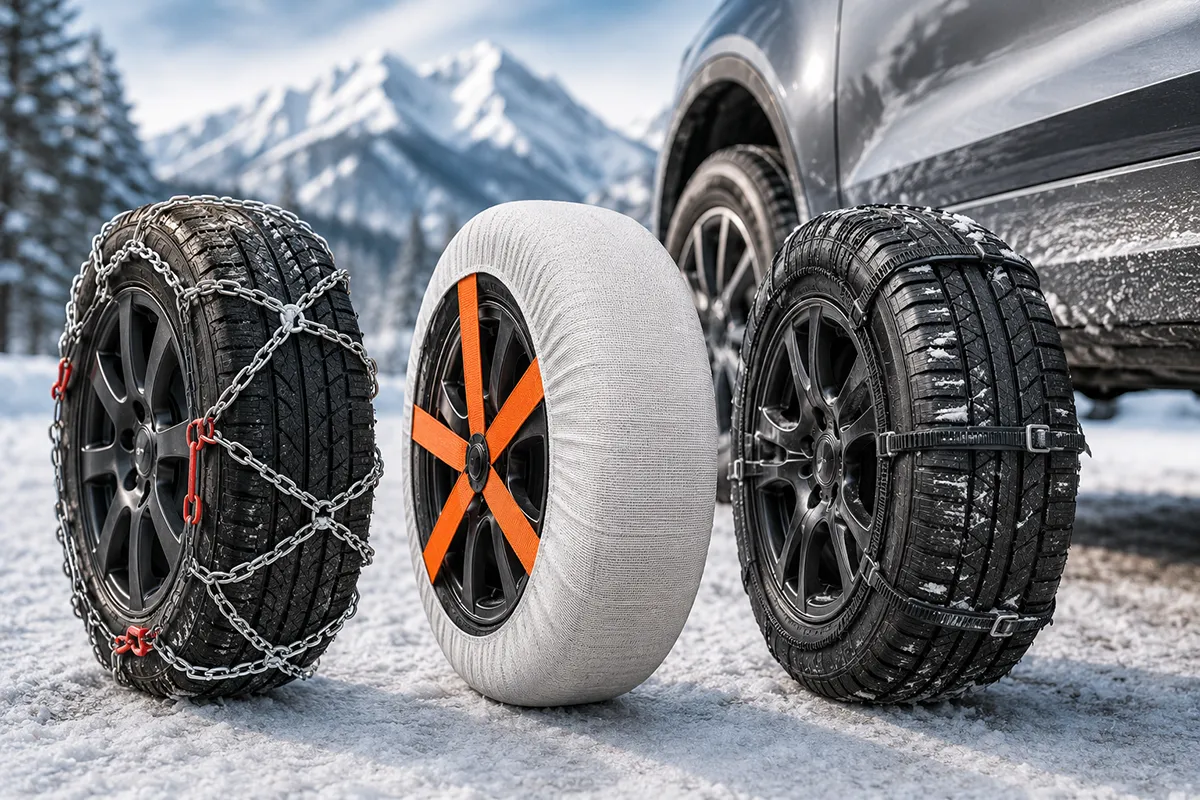
Last winter, I found myself white-knuckling my steering wheel on a mountain pass in Colorado, watching a sedan ahead of me spin its wheels helplessly on a grade that my chained-up tires crawled over without drama.
That moment reminded me why traction devices aren’t optional — they’re survival gear.
But here’s the thing most drivers don’t realize: traditional snow chains aren’t your only option anymore, and they might not even be the best option depending on how and where you drive.
- Snow chains offer the best raw traction on ice and packed snow, but they’re heavy, slow to install, and can damage roads and vehicles if misused.
- Snow socks are lightweight, easy to install, and legal in most states — but they wear out faster and don’t grip as well on solid ice.
- Zip-tie-style traction devices are the cheapest emergency option, but they’re truly temporary and shouldn’t be your primary plan.
- For most US drivers who encounter occasional snow, snow socks are the best balance of convenience and performance.
- If you drive mountain passes or live in heavy-snow regions, invest in quality cable-style snow chains.
Liked this article?
Add TireAdvise as a preferred source so you see more of our tire reviews and guides on Google.
Why I Decided to Test All Three Traction Devices
I’ve been reviewing tires and traction products for over a decade, and I kept getting the same question from readers: “Do I really need chains, or is there something easier?” It’s a fair question. The traditional image of snow chains — heavy metal links, frozen fingers, kneeling in slush on the side of the road — isn’t exactly appealing.
Over the past few winters, I’ve personally used all three types of traction devices in real-world conditions across Colorado, Utah, and the Sierra Nevada region of California. I’m not pulling data from a spec sheet. I’m sharing what happened when I actually drove on snow-covered highways, steep mountain grades, and icy residential streets.
My goal was simple: figure out which device gives everyday drivers the best combination of traction, ease of use, durability, and value. Let me walk you through everything I found.
Snow Chains: The Old-School Champion
Let’s start with the heavyweight. Snow chains have been around since 1904, and there’s a reason they’re still the gold standard for raw traction in severe winter conditions. When a state DOT puts up a “chains required” sign, they mean it — and they usually mean actual metal chains or cables.
What Are Snow Chains?
Traditional snow chains are metal link assemblies that wrap around your drive tires. They come in several styles — ladder pattern, diamond pattern, and cable chains. Ladder chains are the most basic, with cross-links running straight across the tread. Diamond patterns offer better lateral grip. Cable chains use aircraft-grade steel cable instead of heavy links, making them lighter and easier to handle.
In my testing, I primarily used two popular products: the Security Chain Company Super Z6 (a cable chain) and a set of traditional ladder-link chains from Peerless. Both are widely available at retailers like AutoZone, O’Reilly, and Walmart, and they’re priced between $50 and $150 depending on your tire size.
How Snow Chains Performed
On packed snow and ice, nothing I tested came close to the grip that metal chains provided. During a steep climb on a snow-packed forest service road in Utah, the chains bit into the surface with authority. I could feel the difference immediately — the steering felt more responsive, braking distances shortened noticeably, and I had genuine confidence making turns on grades that would have been sketchy without them.
The cable-style Super Z6 chains were particularly impressive. They offered slightly less aggressive bite than the heavy ladder chains, but the ride was considerably smoother, and I didn’t feel like I was destroying the road surface underneath.
On solid glare ice, chains still outperformed every other device I tested. The metal physically digs into ice in a way that fabric and plastic simply can’t replicate.
The Downsides of Snow Chains
Here’s where the honest truth comes in: installing snow chains is still a miserable experience for most people. Even with “easy fit” designs, I spent about 12 to 15 minutes getting them on during my first attempt with each set. After several practice rounds, I got that down to about 8 minutes — still not fun when it’s 20°F and snowing sideways.
They’re also heavy. A set of chains for a midsize sedan weighs 15 to 25 pounds. Cable chains are lighter, typically 10 to 15 pounds, but it’s still extra weight you’re hauling in your trunk all winter.
Speed is limited. Most manufacturers and state laws cap you at 25 to 30 mph with chains on. And if you accidentally drive on bare pavement, you can damage both your chains and your car — I’ve seen torn wheel well liners and scratched alloy wheels from improper chain use.
There’s also the noise. Driving with chains sounds like you’re dragging a medieval weapon under your car. It’s loud, it’s relentless, and it gets old fast on longer stretches.
Snow Chains: Best For
- Mountain pass driving where chains are legally required (California I-80, Colorado I-70, etc.)
- Severe snow and ice conditions with steep grades
- Drivers who don’t mind the installation process and weight
- Situations where maximum traction is non-negotiable
Snow Socks: The Modern Alternative
Snow socks are the newcomer that’s been gaining serious traction — pun intended — in the US market over the past several years. They’ve been popular in Europe for much longer, and several US states now recognize them as a legal alternative to chains.
What Are Snow Socks?
Snow socks are textile covers made from high-strength woven fabric (usually polyester or a proprietary blend) that slip over your tires like, well, a sock. The fabric creates friction against snow and ice through a combination of its woven texture and the way it absorbs and channels surface moisture.
The two most prominent brands in the US market are AutoSock and ISSE. I tested AutoSock’s standard passenger car model and the ISSE Classic. Prices typically run between $70 and $130 per pair, which puts them in the same range as mid-tier cable chains.
How Snow Socks Performed
I was genuinely surprised by how well snow socks worked on moderate snow-covered roads. During several days of testing on packed snow in a residential neighborhood — the kind of driving most Americans actually do in winter — the AutoSock socks provided confident traction for starting, stopping, and turning.
On a moderate uphill grade covered in about three inches of packed snow, I was able to climb without wheelspin in a front-wheel-drive sedan. The car felt planted and predictable. I wouldn’t call the grip “aggressive” the way chains feel, but it was more than adequate for the conditions.
Where snow socks started to show their limits was on solid ice. They still improved traction compared to bare all-season tires, but the improvement was noticeably less dramatic than what I experienced with chains. On a glare-ice parking lot test, my braking distance with socks was roughly 20 to 25 percent longer than with cable chains.
The ride quality, though? Night and day compared to chains. Snow socks are quiet, smooth, and you almost forget they’re on. I drove at speeds up to 30 mph comfortably, and the handling felt much more natural than with chains.
The Downsides of Snow Socks
Durability is the big concern. Snow socks are not designed for extended driving. The manufacturers themselves say they’re for temporary use — getting through a snowy stretch, climbing a hill, or navigating a chain-control zone. After several days of intermittent use during my testing, the AutoSock set showed visible wear on the contact patch area. I’d estimate you could get a handful of meaningful uses out of a set if you’re careful, but they’re not going to last an entire winter of regular use.
Driving on bare pavement will destroy them quickly. If you hit a cleared section of highway, you need to pull over and remove them. This is less of an issue than it sounds — they come off in about 60 seconds — but it’s still something to plan for.
They’re also not universally accepted as a chain alternative. California, Colorado, and several other states do allow snow socks when chain controls are in effect, but enforcement can be inconsistent. I’ve heard from readers who were told by roadside officers to turn around despite having AutoSock installed. Check your specific state’s DOT regulations before relying on socks as your only chain-control solution.
Snow Socks: Best For
- Occasional snow driving in moderate conditions
- Drivers who want an easy-to-install emergency traction solution
- Compact cars and vehicles with limited wheel well clearance (socks add almost no bulk)
- Keeping in your trunk as a “just in case” backup — they weigh about 2 to 3 pounds per pair
Snow Zip Ties: The Budget Emergency Option
Snow zip ties — also called tire zip ties, traction zip ties, or cable tie traction devices — are exactly what they sound like. They’re heavy-duty plastic zip ties that you loop around your tire and through your wheel spokes to create raised ridges that grip snow. Some commercial products, like the popular Zip Grip Go, are purpose-built with reinforced nylon and wider contact surfaces.
What Are Snow Zip Ties?
These are the simplest traction devices you can buy. Most products consist of a set of heavy-gauge nylon ties (much thicker than standard cable ties) with textured gripping surfaces. You thread them around the tire tread and through your wheel, pull them tight, trim the excess, and go.
I tested the Zip Grip Go set, which runs about $25 to $40 per set of ten ties. I also tried a DIY approach with heavy-duty 250-pound-rated cable ties from a hardware store, which cost about $15 total.
How Snow Zip Ties Performed
Let me set expectations: these are emergency devices. I want to be clear about that upfront.
On light to moderate snow — a couple of inches on a residential street — the Zip Grip Go ties did provide a noticeable improvement over bare all-season tires. I could feel the raised ridges biting into the snow on acceleration, and there was a modest improvement in braking grip. They helped me get out of an unplowed parking lot that would have been a spinning-wheels situation without them.
On packed snow and inclines, the performance dropped off significantly compared to both chains and socks. I could tell the tires wanted to break loose, and the ties didn’t provide the same consistent contact-patch coverage that a full chain or sock delivers. They’re essentially creating a few narrow raised lines across your tread, not covering the entire surface.
On ice, I’m going to be blunt: they did almost nothing. The hard plastic has very little grip on ice, and the narrow contact area means you’re relying on a few thin ridges instead of a comprehensive traction surface.
The Downsides of Snow Zip Ties
Durability is extremely limited. During my testing, two of the ten ties broke within the first couple of days of use. The constant flexing and impact of road driving puts enormous stress on the plastic, and once a tie snaps, it can flap against your wheel well or fender.
The ride quality is rough. Each tie creates a bump as it rolls through the contact patch, so you feel a rhythmic thumping at all speeds. It’s not as loud as chains, but it’s far from comfortable.
Installation is actually not as quick as you’d expect. Threading ties through wheel spokes and around the tire takes some finesse, especially with cold fingers. It took me about 10 minutes to install a full set, which is comparable to chains. And unlike snow socks, you can’t easily remove and reinstall them — once a zip tie is cut, it’s done.
They are also not recognized as a legal chain alternative in any state I’m aware of. If you encounter a chain-control checkpoint, zip ties will not pass inspection.
Snow Zip Ties: Best For
- True emergencies when you have no other option
- Keeping in your trunk as an ultra-lightweight, ultra-cheap backup
- Getting unstuck from a parking spot or short unplowed section
- Budget-conscious drivers who rarely encounter snow
Head-to-Head Comparison Table
| Feature | Snow Chains | Snow Socks | Snow Zip Ties |
|---|---|---|---|
| Traction on Packed Snow | ★★★★★ | ★★★★☆ | ★★★☆☆ |
| Traction on Ice | ★★★★★ | ★★★☆☆ | ★☆☆☆☆ |
| Ease of Installation | ★★☆☆☆ | ★★★★★ | ★★★☆☆ |
| Ride Comfort | ★★☆☆☆ | ★★★★★ | ★★☆☆☆ |
| Durability | ★★★★★ | ★★★☆☆ | ★★☆☆☆ |
| Weight | 15–25 lbs | 2–3 lbs | <1 lb |
| Typical Price (per pair/set) | $50–$150 | $70–$130 | $15–$40 |
| Legal as Chain Alternative | Yes (all states) | Most states | No |
| Max Speed | 25–30 mph | 30 mph | 25 mph |
| Best Use Case | Mountain passes, severe conditions | Moderate snow, convenience | Emergency only |
State-by-State Legal Considerations
This is something I wish more articles covered because it matters a lot. Not all traction devices are treated equally under US law, and getting it wrong can mean a fine — or worse, getting turned around on a mountain highway.
Chain-Control States
States like California, Colorado, Oregon, Washington, Nevada, and Idaho regularly implement chain controls on mountain highways during winter storms. When a “chains required” (R2) or “chains or snow tires required” (R1) advisory goes up, you need to comply.
In California, for example, Caltrans has specifically approved AutoSock as a legal alternative to chains when chain controls are in effect. Colorado has similar allowances. However, I always recommend carrying actual chains as a backup even if you plan to use socks, because enforcement officers have discretion, and I’ve personally witnessed inconsistency at chain-control checkpoints.
Zip-tie-style devices are not recognized as a chain alternative in any state I’ve researched. They simply don’t provide the level of traction that regulators consider adequate for controlled highway conditions.
States with Chain Restrictions
Some states actually restrict or prohibit metal chains on certain roads to prevent pavement damage. In these states, snow socks become an even more attractive option. Always check your local DOT website before heading out — regulations can change year to year, and they vary by road type and condition level.
Installation: Real-World Time and Difficulty
I timed myself installing each device multiple times under realistic conditions — meaning outside, in cold weather, with gloves on. Here’s what I found.
Snow Chains
My first attempt with the Super Z6 cable chains took about 15 minutes per pair. By my third installation, I had it down to about 8 minutes. The key is practicing in your driveway before you actually need them. Trust me on this — you do not want your first chain installation to happen on the shoulder of I-70 during a blizzard.
The process involves draping the chain over the top of the tire, driving forward a couple of feet, then connecting the fasteners at the back and tightening with a bungee tensioner. It’s manageable but not intuitive, and cold, wet hands make every step harder.
Snow Socks
Snow socks were dramatically easier. My first installation took about 3 minutes per pair, and I quickly got it under 2 minutes with practice. You simply stretch the sock over the top half of the tire, drive forward a few feet, then pull it over the rest. Done.
This is where snow socks really shine for the average driver. No tools, no crawling under the car, no fighting with metal fasteners. I installed them in a parking lot wearing regular winter gloves without breaking a sweat.
Snow Zip Ties
Zip ties took about 10 minutes for a full set of ten ties. You need to thread each one individually through your wheel spokes and around the tire, pull them tight, and trim the excess. It’s tedious, and the ties are stiff in cold weather, making them harder to thread. You also need a cutting tool for trimming.
The real frustration is that removal means cutting them off, so they’re single-use. If conditions change and you need to remove them, you’re throwing them away.
When None of These Replace Proper Winter Tires
I want to be direct about something that I feel strongly about as a tire reviewer: traction devices are supplements, not substitutes for proper tires.
If you live in a region that gets regular snowfall — the upper Midwest, New England, the Mountain West — your first investment should be a dedicated set of winter tires. A good set of Bridgestone Blizzak WS90s or Michelin X-Ice Snow tires on your car will outperform all-season tires with chains in most real-world conditions. They provide better braking, better cornering, and better traction at normal driving speeds, all without the hassle of installation and removal.
Traction devices are designed for specific, temporary situations: getting through a chain-control zone, handling an unexpected snowstorm, or navigating a particularly treacherous stretch of road. They are not meant for daily commuting on snowy roads.
I’ve reviewed dozens of winter tires, and I always tell readers the same thing: if your budget allows, buy winter tires first. Then keep a set of chains or socks in your trunk for the really bad days.
My Personal Recommendation for Different Drivers
After testing all three options extensively, here’s how I’d advise different types of drivers.
If You Drive Mountain Passes Regularly
Get cable-style snow chains. Period. I recommend the Security Chain Company Super Z6 or the Thule/Konig self-tensioning chains if your budget allows. Practice installing them at home before winter. Keep them in your trunk from November through April. They are the only device that will consistently satisfy chain-control requirements and provide maximum traction on steep, icy grades.
If You’re an Occasional Snow Driver
Snow socks are your best bet. If you encounter snow a few times per winter — maybe a ski trip, a visit to family in a snowy region, or an unexpected storm — a set of AutoSock or ISSE socks gives you excellent convenience-to-performance ratio. They’re light enough to forget about in your trunk until you need them, and they install in minutes.
If You Want a Bare-Minimum Emergency Kit
Zip ties are better than nothing, and I mean that literally. A $30 set of Zip Grip Go ties in your trunk could be the difference between getting home and spending the night in your car. But please don’t treat them as your primary traction plan. They are a last resort.
If You Want the Best Overall Setup
Here’s what I personally run during winter: dedicated winter tires on a second set of wheels for daily driving, plus a set of cable chains in the trunk for mountain trips. This combination has never left me stranded or uncertain in any winter condition I’ve encountered. It’s an investment upfront, but it pays for itself in safety and peace of mind.
Common Mistakes I See Drivers Make
Over the years of reviewing traction devices and talking with readers, these are the errors that come up again and again.
Buying the Wrong Size
Traction devices are sized to your specific tire size. A chain or sock that’s too big will be loose and potentially dangerous. One that’s too small won’t fit at all or could damage your tire. Always check the sizing chart for your exact tire dimensions (found on your tire sidewall or in your owner’s manual) before purchasing.
Never Practicing Installation
I cannot stress this enough. The first time you install chains should not be the first time you need chains. Spend 20 minutes in your driveway on a dry weekend. Your future self, standing in a snowstorm on a mountain shoulder, will thank you.
Driving Too Fast
Every traction device has a speed limit — usually 25 to 30 mph. I’ve seen drivers with chains on doing 45 mph on the highway, and it’s dangerous. Chains can break at high speed, and the physics of how they grip changes dramatically above their rated speed. Respect the limits.
Leaving Devices On Too Long
When the road clears, your traction devices need to come off. Driving on bare pavement with chains will damage your car, your chains, and the road. Snow socks will shred. Zip ties will snap. Treat these as temporary tools, not permanent accessories.
Only Putting Devices on Two Tires
Most traction devices are sold in pairs and intended for your drive wheels (front for FWD, rear for RWD). This is generally correct, but on AWD vehicles, check your owner’s manual — some manufacturers recommend all four wheels. And remember, even with devices on your drive wheels, your other two tires are still on the same slippery surface. Drive accordingly.
Final Thoughts: Making the Right Choice
After testing snow chains, snow socks, and zip-tie traction devices across multiple winters and conditions, my conclusion is that there’s no single “best” option — it depends entirely on your driving situation, your risk tolerance, and your willingness to deal with installation hassle.
For maximum traction and legal compliance, chains are king. For everyday convenience and surprisingly solid performance, snow socks have earned my recommendation. And for a dirt-cheap emergency backup, zip ties serve a narrow but valid purpose.
Whatever you choose, the most important thing is to have something in your trunk before you need it. Winter doesn’t send calendar invites. The storm that catches you unprepared is the one you’ll remember — and the traction device sitting in your trunk could be the thing that gets you home safely.
Drive smart, prepare early, and don’t let winter win.
Frequently Asked Questions
Are snow chains, snow socks, or snow zip ties best for winter driving in the US?
It depends on how often you drive in snow and where you live. Traditional snow chains offer the best traction on packed snow and ice, making them ideal for mountain passes and states like Colorado or Washington that enforce chain laws. Snow socks are lighter and easier to install for occasional snow, while zip-tie style traction devices work well for emergency use but wear out quickly on plowed roads.
Do snow socks work as well as snow chains on icy roads?
Snow socks provide decent traction on light-to-moderate snow but do not grip ice nearly as well as metal snow chains. In my experience, they’re better suited for getting through a few inches of snow in suburban areas rather than tackling icy mountain highways. If you frequently encounter black ice or hard-packed snow, chains are the safer and more reliable choice.
How much do snow chains, snow socks, and snow zip ties cost in the US?
Basic snow chains typically run $30 to $100 per pair, with premium self-tensioning chains from brands like SCC or Peerless costing $100 to $250. Snow socks like the AutoSock brand usually cost $80 to $150 per set, while snow zip ties or zip-tie traction devices range from $20 to $50. Keep in mind that cheaper options like zip ties may need to be replaced after a single use, so the long-term cost can add up.
Are snow zip ties legal to use instead of snow chains in US chain-law states?
Most US states with chain laws, including California, Colorado, and Oregon, specify that approved traction devices must meet certain standards, and basic zip ties often do not qualify. Some commercially manufactured zip-tie traction devices may be accepted as alternatives, but you should always check your specific state’s DOT requirements before relying on them. Using a non-approved device in a chain-control zone can result in fines and leave you stranded if turned away at a checkpoint.
Can I use snow socks or snow zip ties on all-season tires instead of buying winter tires?
Snow socks and zip-tie traction devices can add grip to all-season tires in a pinch, but they are not true substitutes for dedicated winter tires. All-season tires lose flexibility and traction below about 45°F, and a fabric sock or plastic zip tie does not change the compound’s performance on cold pavement. If you regularly drive in winter conditions, investing in a set of winter tires will provide far better braking and handling than any add-on traction device over all-season rubber.
How do I install snow chains vs snow socks vs snow zip ties on my tires?
Snow chains require you to drape them over the tire, connect them behind the wheel, and then tighten or re-tighten after driving a short distance, which can take 10 to 20 minutes per tire in cold conditions. Snow socks simply stretch over the tire like a fitted cover and take about 2 to 5 minutes per tire with no tools. Snow zip ties are looped around the tire and through the wheel spokes, which is fast but can be tricky to space evenly, and improper installation can damage your wheel or brake components.
Will snow chains, snow socks, or zip ties damage my tires or wheels?
Improperly installed or loose snow chains are the most likely to cause damage, potentially scratching alloy wheels, cutting into tire sidewalls, or even damaging fender liners if a chain breaks free. Snow socks are the gentlest option since they are fabric-based and sit flush against the tread, though driving on dry pavement will shred them quickly. Zip-tie traction devices can rub against wheel spokes and valve stems, so I always recommend checking fitment carefully and removing any traction device as soon as you reach cleared roads to minimize wear on both your tires and wheels.
