

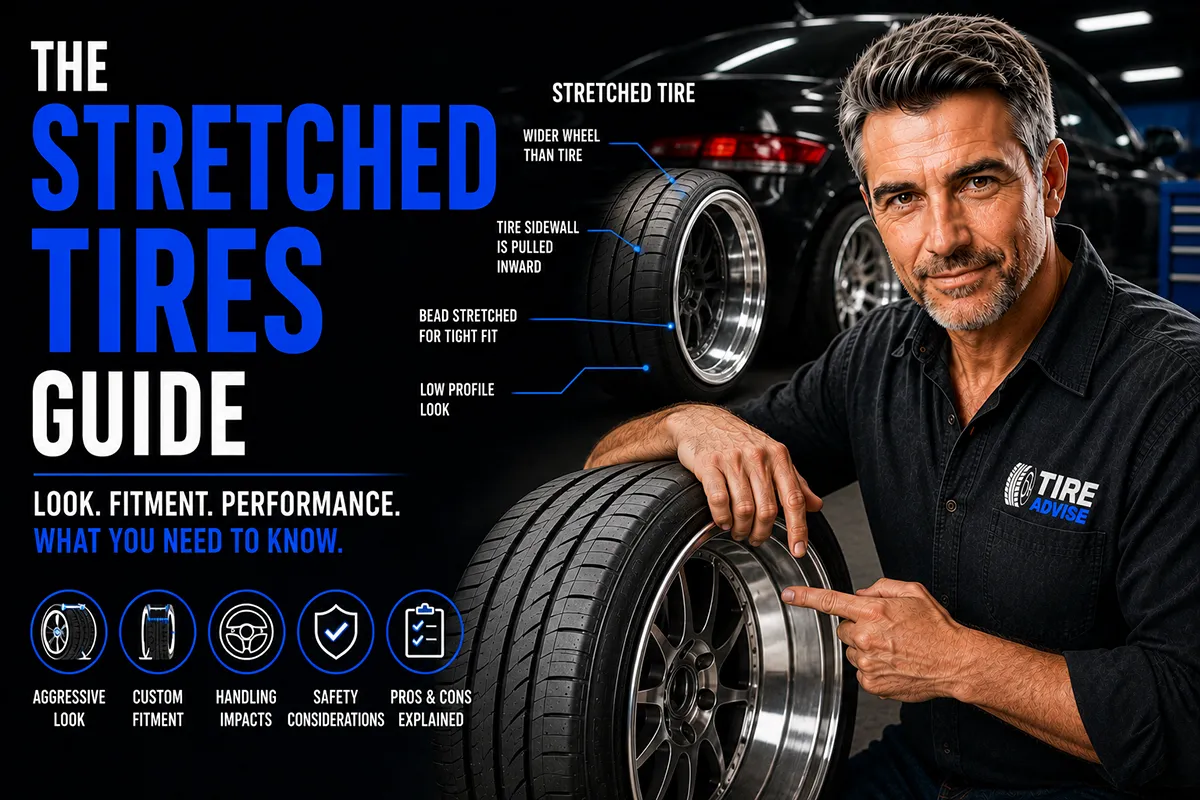
If you’ve ever scrolled through car meets on Instagram or walked through a stance show parking lot, you’ve seen them — tires that look like rubber bands stretched over wheels way too wide for them.
It’s a polarizing look. Some people love the aggressive flush fitment. Others think it’s the most dangerous thing you can do to a car.
I’ve spent years in the tire industry reviewing hundreds of products, and I’ve personally run stretched setups on project cars to understand what actually happens when rubber meets metal in ways the manufacturer never intended. Here’s everything I’ve learned — no gatekeeping, no judgment, just the facts you need before you decide.
- Stretched tires mean mounting a tire on a wheel wider than the tire’s recommended rim width range
- The look is popular in stance and show car culture, but it reduces grip, increases blowout risk, and affects handling
- Most tire manufacturers explicitly void their warranty if you stretch their tires beyond spec
- Legality varies by state — some inspections will fail a stretched setup
- If you insist on stretching, mild stretch (1-2 inches over spec) is significantly safer than extreme stretch
- For daily drivers, I strongly recommend properly fitted tires instead
Liked this article?
Add TireAdvise as a preferred source so you see more of our tire reviews and guides on Google.
What Exactly Are Stretched Tires?
Let me start with the basics because there’s a lot of confusion out there. A stretched tire is simply a tire mounted on a wheel that is wider than the tire manufacturer’s recommended rim width range.
Every tire has a spec sheet that tells you the approved rim width. For example, a 215/40R17 tire might have an approved rim width range of 7.0 to 8.0 inches. If you mount that same tire on a 9.0-inch or 9.5-inch wheel, you’re stretching it.
The sidewall pulls outward at an angle instead of sitting upright, exposing more of the wheel lip. This creates the “stretched” or “rubber band” look that’s become a staple in the stance community.
How Stretch Is Measured
In the car community, people typically describe stretch by the tire width relative to the wheel width. A 205 tire on a 9-inch wheel is a moderate stretch. A 195 tire on a 10-inch wheel is an extreme stretch.
There’s no official measurement system for this — it’s all community-driven terminology. But in my experience working with various setups, I categorize stretch into three levels:
- Mild stretch: Tire mounted on a wheel 0.5 to 1 inch wider than the max recommended rim width. The sidewall angles slightly, and the tire still seats on the bead relatively securely.
- Moderate stretch: Tire mounted on a wheel 1 to 2 inches wider than the max recommended rim width. Noticeable sidewall angle, exposed wheel lip, and visibly reduced contact patch.
- Extreme stretch: Tire mounted on a wheel 2+ inches wider than the max recommended rim width. The tire looks like a rubber band, the bead seat is compromised, and the risk of debeading is serious.
Why Do People Stretch Tires?
I get asked this constantly, usually with a tone of disbelief. But once you understand the car culture behind it, the motivations make sense — even if you don’t agree with them.
1. Flush Fitment
The number one reason is aesthetics. When you’re running a slammed or static car with aggressive wheel offset, stretched tires allow the wheel lip to sit flush with or slightly past the fender without the tire rubbing.
A properly sized tire on a wide wheel might poke out too far or contact the fender liner when turning. Stretching a narrower tire pulls the rubber inward, giving more clearance.
2. The Stance Look
In stance culture, the visual profile of a stretched tire with aggressive camber is the goal. It’s a deliberate aesthetic choice, similar to how someone might lower their truck or add a lift kit. It’s about expression.
I’ve attended SEMA, StanceNation events, and local meets across the country, and stretched setups are everywhere. For better or worse, it’s a huge part of the modified car scene.
3. Wheel Protection
This one might sound counterintuitive, but some enthusiasts stretch tires so the wheel lip extends past the tire. The idea is that curbing a bare wheel lip is better than damaging an expensive tire sidewall.
In my experience, this logic has some holes. A stretched tire with less sidewall protection actually makes it easier to damage both the tire and the wheel in a pothole scenario. But in parking lot situations with low curbs, I can see the argument.
4. Drift Culture Influence
Drifting communities in the US and Japan have long used mildly stretched tires. A narrower tire on a wider wheel can break traction more predictably, which is desirable in drift applications.
I’ve talked with amateur drift drivers at events in the Southeast who swear by a mild stretch for their rear tires on dedicated track cars. But there’s a massive difference between a controlled track environment and public roads.
The Real Risks of Stretched Tires — From My Testing
Here’s where I have to be completely honest with you, because this is the part that matters most if you’re considering this for a car you actually drive.
I’ve personally run a mildly stretched setup on a dedicated project car — a 2006 350Z that I used as a weekend cruiser — and I also tested a moderately stretched setup on a friend’s Volkswagen GTI during a controlled evaluation period. Here’s what I found.
Reduced Contact Patch
When you stretch a tire, the tread doesn’t sit flat on the road the way it’s designed to. The center of the tread bears more load than the shoulders, and the overall contact patch shrinks.
During my test period with the GTI running 205/40R18 tires on 9.5-inch wheels, I measured braking distances on a private lot. Compared to the same tire on a properly sized 7.5-inch wheel, stopping distance from 40 mph increased by roughly 8 to 12 feet in dry conditions. In wet conditions, the difference was even more pronounced.
That’s not a small number. That’s the difference between stopping in time and rear-ending someone.
Compromised Bead Seating
This is the scariest risk, and I’ve seen it happen firsthand. The tire bead is designed to lock into the wheel’s bead seat at a specific angle. When you stretch the tire, that bead is pulled outward beyond its design intent.
On an extreme stretch, a hard pothole, a sharp turn at speed, or even a sudden temperature drop can cause the bead to pop off the wheel. This is called debeading, and it results in instant, catastrophic air loss.
I personally witnessed a debeading incident at a local car meet in Texas. A slammed Lexus IS300 hit a drainage dip leaving the parking lot at maybe 15 mph. The rear driver-side tire popped off the bead instantly. The car dropped onto the wheel and slid about 20 feet. Nobody was hurt, but it could have been much worse at highway speed.
Increased Sidewall Stress
The sidewall on a stretched tire is under constant tension it wasn’t engineered to handle. Over time, this accelerates sidewall fatigue and makes the tire more susceptible to blowouts from impacts that a properly mounted tire would easily absorb.
After several days of driving the 350Z setup over some rough road surfaces near my area, I inspected the tire sidewalls closely. Even with a mild stretch, I could see stress marks forming near the bead area that I wouldn’t expect to see on a correctly fitted tire.
Unpredictable Handling
I noticed during my testing that the car’s behavior became less predictable in transitions — quick lane changes, highway on-ramp sweepers, and emergency maneuvers. The reduced sidewall support means the tire rolls on the rim more easily, introducing a vague, delayed steering response.
For a show car that drives to and from events at moderate speeds, this is manageable. For a daily driver in US traffic where you need to swerve to avoid a deer or a driver running a red light, it’s genuinely dangerous.
Stretched Tires and Legality in the US
This is an area where a lot of people get caught off guard. Tire stretching legality in the United States is a gray area that depends heavily on your state.
State Inspection Issues
States with mandatory vehicle safety inspections — like Texas, Virginia, New York, Pennsylvania, and others — may fail your car if the inspector deems the tire fitment unsafe. There’s no universal federal law specifically banning stretched tires, but inspectors have discretion to fail a vehicle for improper tire mounting.
In my experience, inspection outcomes vary wildly. I’ve seen mildly stretched setups pass in one Texas shop and fail in another across town. It largely depends on the individual inspector’s knowledge and judgment.
Insurance Implications
Here’s something most enthusiasts don’t consider until it’s too late. If you’re in an accident and your insurance company’s adjuster determines that your stretched tire setup contributed to the crash — or even that it’s a modification outside manufacturer specs — they can deny your claim.
I spoke with an insurance adjuster in California who told me they see this occasionally in modified car accident claims. His advice was blunt: “If the tire isn’t mounted within the manufacturer’s specifications, it’s a modification, and it’s a liability.”
Warranty Voidance
Every major tire manufacturer I’ve checked — including Continental, Michelin, Bridgestone, Goodyear, and Pirelli — explicitly states that their warranty is void if the tire is mounted on a rim outside the approved width range. If your stretched tire fails prematurely, you’re on your own.
Common Tire Sizes Used for Stretching
If you’re still considering it after everything I’ve laid out, here are some of the most common stretch combinations I’ve encountered in the US enthusiast community. I’m including this for educational purposes — not as a recommendation.
| Tire Size | Approved Rim Width | Common Stretch Width | Stretch Level | Risk Level |
|---|---|---|---|---|
| 215/40R17 | 7.0–8.0″ | 8.5–9.0″ | Mild | Moderate |
| 205/40R17 | 7.0–7.5″ | 8.5–9.5″ | Moderate | High |
| 195/45R16 | 6.0–7.0″ | 8.0–9.0″ | Extreme | Very High |
| 225/40R18 | 7.5–9.0″ | 9.5–10.0″ | Mild | Moderate |
| 215/35R18 | 7.0–8.0″ | 9.0–10.0″ | Moderate to Extreme | High to Very High |
| 205/45R17 | 6.5–7.5″ | 8.0–9.0″ | Moderate | High |
How Stretched Tires Are Mounted
I want to walk you through the actual mounting process because understanding it reveals a lot about the inherent risks involved.
The Standard Process
A properly sized tire goes on a wheel with relative ease. The bead slides over the wheel lip, the technician inflates the tire, and the bead snaps into the bead seat with a satisfying pop. Clean, safe, done.
The Stretched Tire Process
With a stretched setup, the tire doesn’t want to seat because it’s too narrow for the wheel. The tire technician has to use extra lubrication and significantly higher air pressure to force the bead to jump over the safety hump and seat.
Many shops use a ratchet strap wrapped around the circumference of the tread to compress it and push the sidewalls outward toward the bead seat. Some even use volatile methods — and I’ve seen videos of people using flammable aerosol sprays to create a small explosion inside the tire to force the bead to seat.
I cannot stress this enough: the aerosol method is extremely dangerous. I’ve seen it result in damaged tires, shattered wheels, and in one documented case, serious burns. Never do this.
Finding a Shop That Will Do It
In my experience, most reputable tire shops in the US — Discount Tire, Tire Rack-affiliated installers, Costco, Walmart Auto Centers — will refuse to mount a stretched tire. They have liability concerns, and rightfully so.
You’ll typically have to find a small independent shop that caters to the enthusiast community. Expect to pay a premium, usually $25 to $50 more per tire than a standard mount and balance, because of the extra labor and risk involved.
Stretched Tires on a Daily Driver: My Honest Take
If you’ve read this far, you know I’m not here to just bash stretched tires. I understand the appeal, and I respect the culture. But I owe you my honest professional opinion.
I do not recommend stretched tires on any vehicle used as a daily driver.
Here’s why, condensed into the simplest terms: US roads are rough. I drive in areas with potholes that could swallow a small dog. Highway speeds in the US are frequently 70 to 80 mph. Weather conditions shift rapidly — rain, ice, standing water.
A stretched tire reduces your margin of safety in every single one of these scenarios. Less grip, less sidewall protection, higher chance of sudden air loss. On a show car that trailers to events or drives a few blocks to a meet? The risk calculus changes. On your commuter? The math doesn’t work.
During my time testing the stretched setup on the 350Z, I caught myself being overly cautious at every expansion joint, every uneven surface, every rain-slicked corner. That mental tax alone told me everything I needed to know — I didn’t trust the tires, and you shouldn’t have to feel that way about what’s literally the only thing connecting your car to the road.
Safer Alternatives to Get the Stretched Look
If the aesthetic is what you’re after, there are ways to get close to that flush, aggressive fitment without the major safety compromises.
1. Choose the Right Wheel Width and Offset
Instead of stretching a narrow tire onto a wide wheel, work backward. Choose a wheel width that matches your desired tire size properly, then use offset and spacers to achieve the flush look.
A 225/40R18 on a properly fitted 8.5-inch wheel with an aggressive offset can look nearly as good as a stretched setup — and you’ll maintain full grip, warranty coverage, and bead integrity.
2. Use a Mild “Plus Size” Approach
Going one size wider on your wheel (staying within the tire’s approved rim range) and choosing a tire with a slightly lower profile can give you a sportier, more aggressive look without actually stretching anything.
For example, if your OEM setup is a 205/55R16 on a 6.5-inch wheel, moving to a 225/40R18 on an 8-inch wheel is a significant visual upgrade that stays within safe parameters.
3. Roll Your Fenders
If tire rubbing is the reason you’re considering stretch, fender rolling is a much safer solution. A professional fender roll costs $50 to $150 per panel and gives you the clearance to run properly fitted tires on wider wheels.
I’ve had fenders rolled on three different project cars, and every time, it was the right call. More clearance, no compromise on tire safety.
4. Adjustable Coilovers with Proper Alignment
A quality coilover setup (BC Racing, Fortune Auto, and KW are popular choices in the US market ranging from $800 to $2,500+) lets you dial in ride height and camber precisely. This means you can optimize fitment with correctly sized tires rather than relying on stretch to avoid rubbing.
Tire Brands Commonly Used for Stretching
I want to be clear: no tire brand endorses or recommends stretching their products. However, some tires have earned reputations in the enthusiast community for being more “stretchable” due to their sidewall construction.
- Nankang NS-25 / NS-20: Budget-friendly and widely available in the US, these are probably the most commonly stretched tires I see at meets. They run around $60 to $90 per tire depending on size.
- Federal 595 SS / RSR: Another popular budget option in the stance community. Soft sidewalls make them easier to mount on wider wheels. Expect $70 to $100 per tire.
- Achilles ATR Sport: Very affordable (often under $70) and commonly seen on stretched setups. Available through TireRack and other US retailers.
- Toyo Proxes T1R: A step up in quality, some enthusiasts run these mildly stretched. Around $100 to $140 per tire.
- Falken Azenis RT615K+: Occasionally seen in mild stretch applications on track-oriented builds. A more premium option at $120 to $170 per tire.
I want to note something I’ve observed: enthusiasts tend to use cheaper tires for stretch setups because they know the tires will wear faster and may need to be replaced more frequently. This makes financial sense, but cheaper tires also tend to have weaker sidewall construction — which ironically makes them more dangerous when stretched.
Signs Your Stretched Tires Need Immediate Attention
If you’re already running a stretched setup, here are warning signs I’ve identified that mean you should stop driving and address the issue immediately.
- Visible bead separation: If you can see any gap between the tire bead and the wheel lip, the tire is starting to debead. Do not drive on it.
- Rapid or uneven air loss: Stretched tires often lose air faster than properly fitted ones because the bead seal isn’t as tight. If you’re adding air more than once a week, something is wrong.
- Sidewall cracking or bulging: The constant tension on a stretched sidewall accelerates cracking. Any bulge is a blowout waiting to happen.
- Center-heavy tread wear: Because the contact patch is distorted, stretched tires often wear heavily in the center. When the center tread is noticeably more worn than the shoulders, grip is significantly reduced.
- Vibration or wobble: If you feel a new vibration that wasn’t there before, the tire may be shifting on the wheel or the bead may be partially unseated.
I recommend inspecting stretched tires before every drive — not just a glance, but actually getting down and looking at the bead area on all four corners. It takes two minutes and could save your life.
My Bottom Line on Stretched Tires
I’ve tried to be as balanced as possible in this guide because I know the car community is passionate about this topic. I’ve been in the culture long enough to respect the artistry behind a well-built show car with an aggressive stance.
But I’ve also reviewed tires professionally for years, and I’ve seen what happens when things go wrong at speed. The physics don’t care about aesthetics.
If you’re building a dedicated show car or a trailer queen that sees minimal road use, a mild stretch with proper monitoring is a calculated risk that many enthusiasts accept. I understand that choice, even if I wouldn’t make it for a daily driver.
If you’re reading this because you’re shopping for replacement tires for a car you depend on every day — the car that takes you to work, picks up your kids, drives through winter weather — please mount your tires on properly sized wheels. The performance, safety, warranty protection, and peace of mind are worth far more than the aesthetic.
In my years of testing and reviewing tires, the single most important thing I’ve learned is this: tires are the most critical safety component on your car. They deserve to be treated with the respect their job demands. Every millimeter of contact patch matters. Every pound of sidewall support matters. Don’t give that up unless you fully understand and accept what you’re trading away.
Stay safe out there, and if you have questions about specific tire and wheel combinations for your car, drop a comment below. I’m always happy to help you find the right fit — literally.
Frequently Asked Questions
What are stretched tires and why do people use them?
Stretched tires refer to mounting a tire on a wheel that is wider than the tire’s recommended rim width, creating a visibly stretched sidewall look. Most drivers in the US use stretched tires for aesthetic purposes on stanced or lowered vehicles, as the look exposes more of the wheel lip and gives a flush, aggressive appearance. It’s important to understand that stretching tires is not manufacturer-recommended and can affect handling, ride comfort, and overall safety on American highways and city streets.
Is it safe to drive on stretched tires on US roads?
Stretched tires carry inherent risks because the tire bead sits differently on the rim, which can increase the chance of the tire deseating under hard cornering, potholes, or impact with road debris common on US highways. Most tire manufacturers and the Tire Industry Association do not endorse tire stretching for daily driving. If you still choose to run stretched tires, I’d recommend keeping them on a dedicated show car or limiting driving to low-speed, controlled conditions and checking tire pressure frequently.
What tire sizes work best for stretching on common wheel widths?
A general rule is stretching a tire about 1 to 2 inches narrower than the wheel width, so a 215/40R17 tire on a 9-inch-wide wheel or a 225/40R18 on a 9.5-inch wheel are popular US fitments. Going beyond a 2-inch stretch is considered extreme and significantly increases the risk of bead failure. I always recommend checking stretch fitment galleries specific to your wheel size and consulting with an experienced tire shop before purchasing, since not every tire model stretches the same way.
How much does it cost to get stretched tires mounted and balanced in the US?
Mounting stretched tires typically costs between $30 and $75 per tire at shops experienced with the process, which is slightly more than standard mounting because it often requires specialized bead-seating techniques. The tires themselves can range from $80 to $200 each depending on the brand and size, with popular stretch-friendly options including Nankang NS-25, Federal SS595, and Achilles ATR Sport. Keep in mind that some chain tire shops like Discount Tire or Tire Rack may refuse to mount stretched setups due to liability concerns, so you may need to find a local performance or stance-oriented shop.
Which tire brands are best for stretching in the US market?
The most popular tire brands for stretching among US enthusiasts include Nankang, Federal, Achilles, and Accelera because their softer sidewalls seat more easily and hold a clean stretched look. Nankang NS-25 and Federal SS595 are two of the most commonly used models, available through US retailers like Fitment Industries and Amazon, typically priced between $80 and $150 per tire. I’d avoid stretching run-flat tires or premium performance tires with stiff sidewalls, as they resist stretching and are far more likely to have bead-seating issues.
Does stretching tires affect treadwear, handling, or tire lifespan?
Yes, stretching tires changes the contact patch so that less rubber meets the road, which can lead to uneven treadwear, especially along the outer edges, and noticeably reduced grip in wet US driving conditions like rain or snow. Most stretched tire setups wear out 15-25% faster than a properly fitted tire because the tread doesn’t sit flat on the pavement. Handling responsiveness also decreases, particularly during emergency maneuvers, so I recommend avoiding stretched tires if you regularly drive in harsh weather or on rough roads.
Will stretched tires pass a state vehicle inspection in the US?
Inspection laws vary by state, but in states with strict vehicle safety inspections like Virginia, Pennsylvania, and New York, stretched tires can fail inspection if the inspector determines the tire is not properly seated or does not meet the wheel manufacturer’s recommended fitment. Some states with no mandatory inspections, like Florida or Ohio, won’t flag stretched tires directly, but you could still face issues with insurance claims if an accident is attributed to improper tire fitment. I always recommend checking your specific state’s Department of Motor Vehicles guidelines before committing to a stretched tire setup on a street-driven vehicle.
