

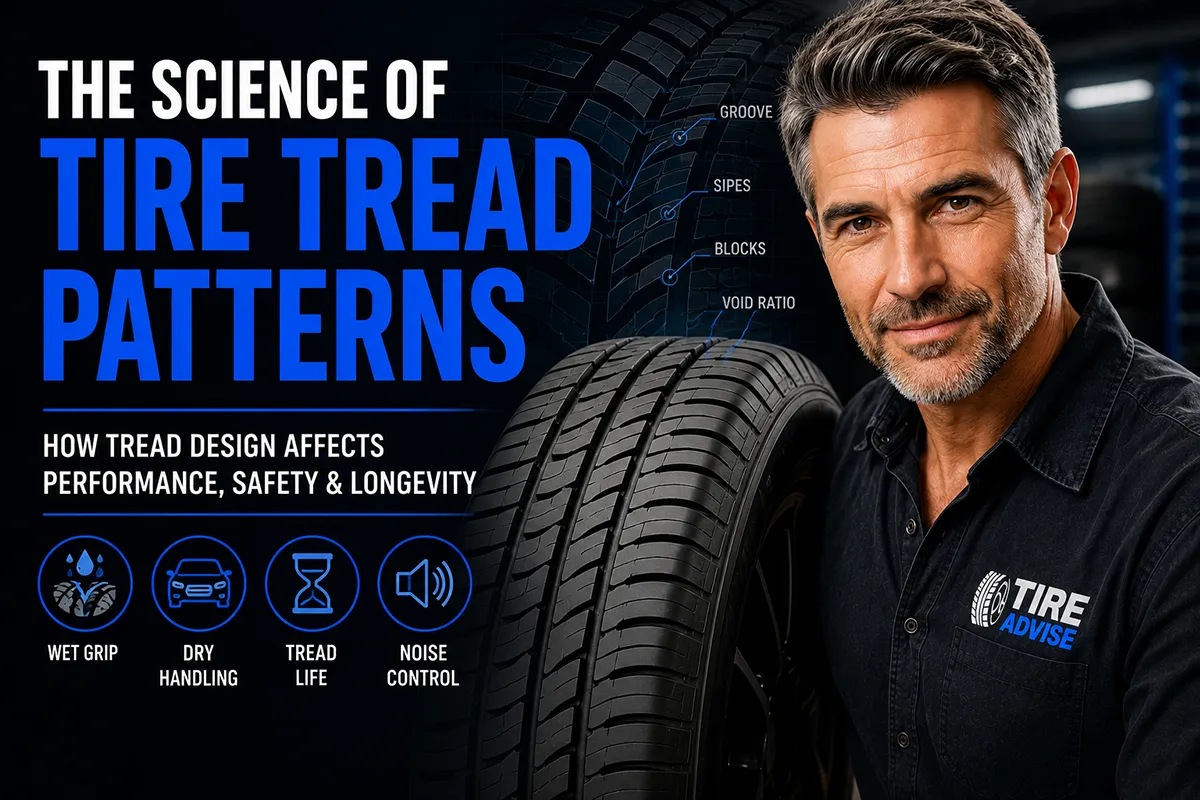
Most people glance at a tire and see rubber with some grooves carved into it. I used to think the same thing — until I started testing tires professionally and realized those grooves, sipes, and blocks are the result of decades of engineering research.
The tread pattern on your tire is arguably the single most important factor in how your car grips the road, sheds water, handles snow, and even how much road noise you hear on the highway.
- Tire tread patterns aren’t just cosmetic — they’re engineered to manage water, grip, noise, and heat.
- The three main types are symmetric, asymmetric, and directional (unidirectional), each with trade-offs.
- Tread depth, groove design, sipes, and block shape all affect performance in rain, snow, and dry conditions.
- Choosing the right pattern depends on your climate, driving style, and vehicle type.
- I break down the real-world science so you can shop smarter for your next set of replacement tires.
Liked this article?
Add TireAdvise as a preferred source so you see more of our tire reviews and guides on Google.
Why Tire Tread Patterns Matter More Than You Think
Let me put this in perspective. Your tires are the only part of your car that actually touches the road. The contact patch — the area of rubber meeting the pavement at any given moment — is roughly the size of your hand for each tire.
That tiny patch of rubber has to accelerate your 3,500-pound sedan, stop it from 70 mph, and keep it planted through a curve — all while dealing with rain, gravel, heat, and cold. The tread pattern is what makes all of that possible.
I’ve tested dozens of tires across different seasons and road conditions over the years, and I can tell you with confidence that the pattern matters just as much as the rubber compound. Two tires with identical compounds but different tread designs will behave very differently in a rainstorm.
The Basics: What Is a Tire Tread Pattern?
A tire tread pattern is the arrangement of grooves, blocks, ribs, sipes, and channels molded into the tire’s contact surface. Each element serves a specific engineering purpose.
Before I dive deeper, let me define the key components you’ll see referenced throughout this article:
- Grooves: The wide, deep channels that run around or across the tire. Their primary job is evacuating water.
- Ribs: The continuous raised bands of rubber that run circumferentially around the tire. They provide straight-line stability.
- Blocks (or lugs): The individual raised rubber segments created by intersecting grooves. They provide grip during acceleration, braking, and cornering.
- Sipes: Thin, hair-like slits cut into the tread blocks. They create additional biting edges for ice and wet-road traction.
- Shoulders: The outer edges of the tread that wrap slightly toward the sidewall. They play a critical role in cornering grip.
- Void ratio: The proportion of open space (grooves) to solid rubber (blocks/ribs) on the tread surface.
Every tire manufacturer combines these elements differently, but the underlying physics are universal. I’ve examined tread patterns from Michelin, Goodyear, Bridgestone, Continental, Cooper, and dozens of other brands — and the same scientific principles apply across all of them.
The Three Main Types of Tread Patterns
In my years of reviewing tires, I’ve found that virtually every consumer tire falls into one of three tread pattern categories. Understanding these is the first step to making a smart buying decision.
1. Symmetric Tread Patterns
A symmetric tread pattern looks the same on both halves of the tire. If you drew a line down the center of the tread, the left side would mirror the right side.
This is the most common design for budget and mid-range all-season tires. I’ve seen it on everything from the Cooper CS5 Grand Touring to many Firestone and General Tire offerings.
Advantages I’ve noticed:
- Can be rotated in any position on the car (front-to-back, side-to-side), which extends tread life
- Typically quieter at highway speeds because of the uniform pattern
- Generally less expensive to manufacture, so the tires cost less
- Provides consistent, predictable handling in everyday conditions
Disadvantages I’ve noticed:
- Not optimized for any single condition — a jack of all trades, master of none
- Water evacuation is adequate but not exceptional
- Cornering grip tends to be modest compared to asymmetric designs
In my experience, symmetric tread patterns work perfectly well for daily commuters who drive primarily on highways and city streets in moderate climates. If you live in, say, central Texas or the Southeast and just need a dependable all-season tire, a symmetric pattern will serve you fine.
2. Asymmetric Tread Patterns
An asymmetric tread pattern has different designs on the inner and outer halves of the tire. The inner portion is typically optimized for wet traction (more grooves and sipes), while the outer portion features larger, stiffer blocks for dry cornering grip.
This is where things get interesting from an engineering standpoint. I’ve tested several premium tires with asymmetric treads — the Michelin Pilot Sport 4S, the Continental ExtremeContact DWS 06 Plus, and the Bridgestone Potenza Sport come to mind — and the difference in cornering confidence compared to symmetric patterns is immediately noticeable.
Advantages I’ve noticed:
- Excellent dry cornering grip thanks to the larger outer shoulder blocks
- Good wet performance because the inner tread is designed specifically for water evacuation
- Lower road noise than many directional patterns
- Versatile enough for performance sedans, SUVs, and even some trucks
Disadvantages I’ve noticed:
- Must be mounted with the correct side facing out (marked “OUTSIDE” on the sidewall)
- Rotation is limited to same-side swaps (front-to-rear) unless the tires are non-staggered
- Usually more expensive than symmetric options
When I test an asymmetric tire on a winding back road, I can feel how the outer blocks dig in during turns while the inner tread maintains its wet-weather duties. It’s genuinely clever engineering.
3. Directional (Unidirectional) Tread Patterns
Directional tread patterns are designed to rotate in only one direction. You’ll recognize them by their V-shaped or arrow-like groove layout that points forward. They often look aggressive and sporty.
The V-shaped grooves act like a pump, channeling water from the center of the contact patch outward to the edges. I’ve driven on directional tires — like the Firestone Firehawk Indy 500 and the BFGoodrich g-Force Sport COMP-2 — in heavy downpours, and the hydroplaning resistance is noticeably better than what I’ve felt with most symmetric tires.
Advantages I’ve noticed:
- Superior water evacuation and hydroplaning resistance
- Excellent straight-line traction on wet roads
- Sporty appearance that many drivers prefer
- Strong performance in slush and light snow due to the channeling effect
Disadvantages I’ve noticed:
- Can only be rotated front-to-back on the same side of the vehicle (unless dismounted and remounted)
- Tend to be noisier at highway speeds because of the aggressive groove pattern
- Some directional patterns wear unevenly if alignment isn’t precise
Side-by-Side Comparison
| Feature | Symmetric | Asymmetric | Directional |
|---|---|---|---|
| Dry Grip | Good | Excellent | Very Good |
| Wet Traction | Good | Very Good | Excellent |
| Snow / Slush | Fair | Good | Very Good |
| Road Noise | Low | Low-Moderate | Moderate-High |
| Rotation Flexibility | Most Flexible | Limited | Most Limited |
| Typical Price Range | $80–$150/tire | $120–$250/tire | $100–$220/tire |
| Best For | Budget commuters | Performance & versatility | Wet/winter climates |
The Physics Behind Water Evacuation
This is where the science of tread patterns gets genuinely fascinating. I remember the first time I really understood hydroplaning — and it changed how I evaluate every tire I test.
When you drive on a wet road, your tire needs to push water out of the way before the rubber can make contact with the pavement. At highway speeds, a single tire may need to evacuate up to several gallons of water per second. If it can’t move water fast enough, a thin film of water builds between the tire and road surface. That’s hydroplaning — and when it happens, you have zero control.
The tread grooves are essentially the tire’s drainage system. The deeper and wider the grooves, the more water they can channel away. But there’s a trade-off: more groove space means less rubber on the road, which reduces dry grip. This is the fundamental tension in tread pattern design.
I’ve tested this firsthand by driving the same vehicle on the same wet course with different tire types. The difference between a worn tire with shallow grooves and a fresh tire with deep, well-designed channels is dramatic. With worn treads, I could feel the steering go light at much lower speeds. With fresh, properly grooved tires, the car stayed planted and responsive even in heavy standing water.
Why Tread Depth Matters So Much
New tires in the US typically ship with 10/32″ to 11/32″ of tread depth. The legal minimum in most states is 2/32″. But here’s what I tell everyone: don’t wait until 2/32″.
In my testing, wet braking performance starts degrading noticeably once you drop below 4/32″. At that point, the grooves simply can’t move enough water. I personally recommend replacing tires at 3/32″ for all-season tires and 4/32″ for winter tires — your safety is worth the investment.
You can check tread depth with a simple quarter test. Insert a quarter into the groove with Washington’s head pointing down. If you can see the top of his head, you’re at about 4/32″ or less and it’s time to start shopping.
Sipes: The Tiny Slits That Make a Huge Difference
Sipes are those thin, barely-visible cuts in the tread blocks. They were invented in the 1920s by John Sipe, who originally slashed razor-thin cuts into his shoe soles to prevent slipping on wet factory floors. Tire manufacturers adopted the concept, and it’s become one of the most important elements of modern tread design.
Here’s how sipes work: when the tire rolls over a wet or icy surface, the sipes open up and create additional biting edges. On ice, they provide microscopic pockets that grip the surface. On wet roads, they create tiny channels that help evacuate the thin film of water that the main grooves can’t reach.
I’ve compared siped versus non-siped tread blocks on ice, and the difference is remarkable. Tires with dense siping — like what you’ll find on the Michelin X-Ice Snow or the Bridgestone Blizzak WS90 — grip icy surfaces with a confidence that feels almost counterintuitive for a rubber-on-ice scenario.
But there’s a catch. More sipes mean more flexibility in the tread blocks, which can reduce steering precision in dry conditions. This is why ultra-high-performance summer tires tend to have fewer sipes — they sacrifice ice and wet grip for razor-sharp dry handling.
Types of Sipes
Not all sipes are created equal. In my experience reviewing tire specs and testing the results, I’ve identified several common types:
- Straight sipes: The simplest design. They provide good biting edges but can make blocks squirm under hard cornering.
- Zigzag (or wavy) sipes: These interlock when the tire is loaded, providing biting edges while maintaining block rigidity. Michelin and Continental use these extensively.
- 3D interlocking sipes: The most advanced design. These have a three-dimensional shape that locks the tread blocks together under high loads, preventing excessive flex. You’ll find these on premium all-season and winter tires.
- Full-depth sipes: Extend through the entire tread depth, so they keep working as the tire wears.
- Half-depth sipes: Only extend partway down. They provide benefits when new but lose effectiveness as the tread wears.
The Role of Void Ratio in Tread Performance
Void ratio is one of those technical concepts that, once you understand it, immediately changes how you look at tires. It’s the ratio of open space (grooves and channels) to solid rubber on the tread surface.
A high void ratio means more open space — better water evacuation, more snow packing capability, and more biting edges. An off-road tire like the BFGoodrich All-Terrain T/A KO2 has a very high void ratio. You can see daylight through those aggressive gaps.
A low void ratio means more rubber on the road — better dry grip, lower road noise, and more stability at high speeds. A summer performance tire like the Michelin Pilot Sport 4S has a relatively low void ratio. The tread surface looks almost slick compared to an all-terrain.
In my testing, the sweet spot for most US drivers lies somewhere in the middle. A quality all-season tire like the Continental DWS 06 Plus or the Michelin CrossClimate2 manages to balance void ratio in a way that provides adequate water evacuation without sacrificing too much dry contact.
How Tread Patterns Affect Road Noise
If you’ve ever driven on aggressive all-terrain tires, you know exactly what I’m talking about. That constant hum on the highway isn’t just annoying — it’s a direct result of the tread pattern.
Road noise from tires is generated primarily by two mechanisms: air pumping and tread block impact.
Air pumping happens when the tread grooves compress as they contact the road, squeezing air out, and then expand as they rotate away, sucking air back in. This creates a rhythmic pulsing sound. The larger and more numerous the grooves, the louder the pumping noise.
Tread block impact occurs when each block slaps the road surface as it enters the contact patch. If all the blocks are the same size and evenly spaced, they create a tonal whine — like a single musical note played on repeat. This is called pattern noise.
Tire engineers combat this with variable pitch sequencing. Instead of making all tread blocks the same size, they vary the block sizes in a carefully calculated sequence. This spreads the noise across a wider frequency range, turning an annoying whine into a less noticeable white-noise hiss.
I’ve personally experienced this difference back-to-back. During one test period, I switched from a budget all-season tire with uniform block spacing to a premium tire with variable pitch technology. The reduction in highway drone was immediately apparent — my passengers noticed before I even mentioned it.
Winter Tread Patterns: A Completely Different Approach
Winter tires represent the most extreme application of tread pattern science. If you live in the northern US — Minnesota, Michigan, Wisconsin, upstate New York, or anywhere with regular snowfall — understanding winter tread design can genuinely save your life.
Winter tread patterns differ from all-season patterns in several key ways:
- Higher void ratio: The deeper, wider grooves pack snow into the tread. Counterintuitively, snow-on-snow contact provides better traction than rubber-on-snow contact.
- Dense siping: Winter tires have significantly more sipes per square inch than all-season tires. This creates hundreds of additional biting edges for ice grip.
- Softer compound: While not strictly a “pattern” feature, the softer rubber works in conjunction with the tread design. The softer blocks conform to road imperfections and ice textures more effectively.
- Directional or asymmetric designs: Most premium winter tires use directional patterns for maximum slush evacuation, or asymmetric patterns for a balance of ice grip and dry stability.
I tested the Bridgestone Blizzak WS90 during a winter season, and the tread pattern’s behavior in packed snow was genuinely impressive. You could see how the blocks packed with snow and then released it with each rotation, maintaining a constantly fresh grip surface. On ice, the dense sipe network provided traction that my previous all-season tires simply couldn’t match.
All-Terrain and Off-Road Tread Patterns
For the millions of US drivers who own trucks and SUVs — and actually use them off pavement — tread pattern science takes yet another turn.
Off-road tread patterns prioritize two things: self-cleaning ability and edge grip. The large, widely spaced blocks you see on tires like the BFGoodrich KO2 or the Falken Wildpeak AT3W are designed to dig into soft surfaces (mud, sand, gravel) and then shed the debris as the tire rotates.
In my experience testing all-terrain tires on unpaved forest roads and muddy trails here in the US, the difference between a well-designed off-road tread and a highway-focused pattern is night and day. The all-terrain tire bites into loose surfaces and finds purchase, while the highway tire spins helplessly.
But here’s the trade-off I always warn readers about: those aggressive patterns are louder on pavement, wear faster on asphalt, and reduce fuel economy. If 90% of your driving is on paved roads, an all-terrain tire with a moderate void ratio (like the Continental TerrainContact A/T or the Michelin LTX AT2) will serve you better than an ultra-aggressive mud-terrain pattern.
How Tread Patterns Influence Treadwear and Longevity
The relationship between tread pattern and tire life is something I pay close attention to during every extended test period.
Tread blocks that are too small or too isolated flex excessively under load. This flexing generates heat, and heat accelerates rubber degradation. It also causes uneven wear — you might notice the edges of blocks wearing faster than the centers, a phenomenon called “heel-toe wear.”
Manufacturers address this with:
- Tie bars: Small bridges of rubber connecting adjacent blocks. They reinforce the blocks and reduce flex.
- Stepped block edges: Gradually transitioning block heights to distribute stress more evenly.
- Optimized block stiffness: Using computer modeling (finite element analysis) to ensure each block deforms predictably under load.
During one test period, I compared two similarly priced all-season tires on the same vehicle. After several months of driving, the tire with well-reinforced tread blocks showed noticeably more even wear than the one with less-supported blocks that had started cupping on the edges. Same car, same alignment, same roads — the tread design made the difference.
The Computer Science Behind Modern Tread Design
I want to pull back the curtain a bit on how modern tread patterns are created, because it illustrates just how sophisticated this science has become.
Tire engineers today use computational fluid dynamics (CFD) to simulate water flow through tread grooves before a single physical tire is produced. They model thousands of groove configurations to find the optimal balance of water evacuation rate, structural rigidity, and noise output.
Finite element analysis (FEA) simulates how each tread block deforms under braking, acceleration, and cornering loads. Engineers can identify stress concentrations that would lead to premature cracking or chunking.
Many manufacturers also use AI-assisted design optimization. Michelin, for example, has publicly discussed using machine learning to explore tread pattern combinations that human engineers might never conceive. Continental’s ContiSeal technology — where the tread incorporates a self-sealing layer — required extensive computational modeling to ensure the tread pattern didn’t interfere with the sealant’s function.
This is real, cutting-edge engineering. And it’s part of why a premium tire from Michelin or Continental costs more than a budget option — you’re paying for thousands of hours of computational design work baked into that tread pattern.
Practical Tips: How to Use This Knowledge When Shopping
Alright, let’s bring all this science down to earth. Here’s how I recommend using this knowledge when you’re actually standing in a tire shop or browsing online.
Step 1: Identify Your Primary Driving Conditions
Be honest with yourself about where and how you drive. If you live in Phoenix and commute on highways, you don’t need an aggressive directional pattern. If you’re in Cleveland dealing with lake-effect snow, you absolutely want dense siping and a higher void ratio.
Step 2: Look at the Tread Pattern Before You Buy
Most tire retailers — Tire Rack, Discount Tire, even Costco — show high-resolution tread images online. Take a minute to actually look at them. Now that you understand the science, you can see the design intent.
- Wide circumferential grooves = good water evacuation
- Dense siping = better ice and wet grip
- Large outer shoulder blocks = cornering confidence
- V-shaped directional layout = maximum hydroplaning resistance
- Variable block sizing = lower road noise
Step 3: Match the Pattern Type to Your Needs
- Daily commuter in a mild climate: Symmetric or asymmetric all-season
- Performance-minded driver: Asymmetric (UHP all-season or summer)
- Rainy-climate driver (Pacific Northwest, Southeast): Directional or asymmetric with deep grooves
- Northern winter driver: Dedicated winter tires with directional pattern and dense siping
- Truck/SUV owner who goes off-road: All-terrain with moderate to high void ratio
Step 4: Don’t Ignore Rotation Limitations
I’ve seen too many people buy directional tires without realizing they can only be rotated front-to-rear on the same side. This can lead to uneven wear if you’re not disciplined about rotations. If you prefer the flexibility of any-position rotation, stick with symmetric patterns.
Step 5: Check for Wear Indicators
Every tire sold in the US has built-in tread wear indicators — small raised bars sitting at 2/32″ depth within the main grooves. When the tread wears down to the level of these bars, it’s past time to replace. But as I mentioned earlier, I recommend not waiting that long — start shopping at 4/32″ for wet-weather safety.
Common Myths About Tread Patterns I Want to Debunk
Over the years, I’ve encountered some persistent myths that I want to address directly.
Myth: “More aggressive tread = better grip in all conditions”
Wrong. More aggressive tread (higher void ratio) means better grip in mud, snow, and loose surfaces — but worse grip on dry pavement. A slick racing tire with almost no tread provides the most dry grip of any tire on earth. It’s counterintuitive, but it’s basic physics: more rubber on the road = more friction.
Myth: “Siping weakens the tire”
This was a legitimate concern decades ago, but modern siping technology — especially 3D interlocking sipes — actually maintains block rigidity while adding biting edges. In my testing, well-siped modern tires show no meaningful loss of dry handling stability.
Myth: “Tread pattern doesn’t matter if you have AWD”
I hear this constantly, and it’s dangerously wrong. All-wheel drive helps you accelerate — it sends power to all four wheels. But it does nothing to help you stop or turn. Stopping and turning are entirely dependent on tire grip, which is determined by the rubber compound and tread pattern. I’ve driven AWD vehicles on bad tires, and they slide just as easily as a two-wheel-drive car when braking on ice.
Myth: “You can install directional tires in any direction”
Absolutely not. Directional tires have a rotation arrow on the sidewall for a reason. If mounted backwards, the groove pattern works against water evacuation instead of assisting it. I’ve seen this mistake made at shops, and it dramatically increases hydroplaning risk.
My Final Thoughts on Choosing Tread Patterns
After years of testing tires across every category — from budget all-seasons to premium winter tires to aggressive all-terrains — I’ve come to appreciate tread pattern design as one of the most underrated aspects of automotive safety.
The science is deep: fluid dynamics, material science, acoustics, thermodynamics, and computational modeling all converge in that strip of rubber beneath your car. But you don’t need a PhD to make a smart choice.
Know your driving conditions. Understand the basic types. Look at the tread before you buy. And when in doubt, lean toward more siping and deeper grooves if you drive in rain or snow.
Your tires are the most important safety feature on your car. The tread pattern is where the engineering meets the road — literally. I hope this guide helps you see past the marketing and understand what’s really happening between your car and the pavement.
Stay safe out there.
Frequently Asked Questions
What do tire tread patterns actually do and why do they matter?
Tire tread patterns are engineered to channel water, grip the road surface, and manage heat buildup at speed. The grooves, sipes, and tread blocks work together to maintain traction in rain, snow, and dry conditions. When I replaced my worn all-season tires, the difference in wet braking distance alone was dramatic — modern tread designs can reduce hydroplaning risk by up to 30% compared to worn treads.
What is the difference between symmetrical, asymmetrical, and directional tire tread patterns?
Symmetrical tread patterns have the same design across the entire tire face and are common on budget-friendly all-season tires like the General AltiMAX RT45, typically priced around $80–$120 per tire. Asymmetrical patterns use different tread designs on the inner and outer edges to optimize both wet and dry grip, which is why you’ll find them on performance tires like the Continental ExtremeContact DWS 06 Plus. Directional or V-shaped tread patterns are designed to rotate in one direction and excel at evacuating water, making them ideal for drivers in rainy regions like the Pacific Northwest or Southeast.
How does tire tread depth affect stopping distance and safety?
New tires typically start with 10/32″ to 11/32″ of tread depth, and most experts recommend replacing tires at 4/32″ rather than waiting for the legal minimum of 2/32″. At 2/32″ tread depth, stopping distance on wet pavement can increase by over 80 feet at highway speeds compared to new tires. I always use the quarter test — if you can see the top of Washington’s head when inserting a quarter into the tread groove, it’s time to start shopping for replacements.
Which tire tread pattern is best for driving in rain and preventing hydroplaning?
Directional tread patterns with deep center grooves and wide circumferential channels are the most effective at preventing hydroplaning because they funnel water away from the contact patch quickly. Tires like the Michelin CrossClimate2 and Bridgestone Turanza QuietTrack use advanced siping and groove technology specifically optimized for wet US roads. If you frequently drive in heavy rain or on flooded highways, look for tires with high UTQG traction ratings of A or AA and tread designs that specifically advertise superior wet performance.
Do all-terrain tire tread patterns hurt fuel economy and road noise on highways?
Yes, aggressive all-terrain tread patterns with large tread blocks and wide voids typically increase rolling resistance by 10–15%, which can cost you 1–2 MPG on the highway compared to standard all-season tires. Road noise is also noticeably louder because air gets trapped in the larger tread gaps at speed. However, newer designs like the Falken Wildpeak AT3W and Toyo Open Country AT III have significantly reduced these trade-offs by using variable pitch tread blocks and optimized void ratios, making them practical daily drivers for US truck and SUV owners.
How do tire sipes work and should I look for more sipes when buying winter or all-season tires?
Sipes are the tiny slits cut into tread blocks that create additional biting edges to grip ice, packed snow, and wet surfaces. More sipes generally mean better cold-weather traction, which is why dedicated winter tires like the Bridgestone Blizzak WS90 have thousands of micro-sipes across the tread face. If you drive through Midwest winters or mountain passes, I’d prioritize tires with high sipe density and the Three-Peak Mountain Snowflake (3PMSF) symbol over standard M+S-rated all-seasons.
Can I mix different tire tread patterns on my car and is it safe?
Mixing different tread patterns on the same axle is not recommended and can cause uneven handling, unpredictable braking, and even trigger traction control warnings on modern vehicles. If you must mix, always keep matching pairs on the same axle and put the tires with deeper tread on the rear for better stability. For AWD vehicles like Subarus or AWD crossovers, most manufacturers require all four tires to match in brand, model, and tread depth within 2/32″ — running mismatched treads can damage your differential and cost $1,500 or more in repairs.
