

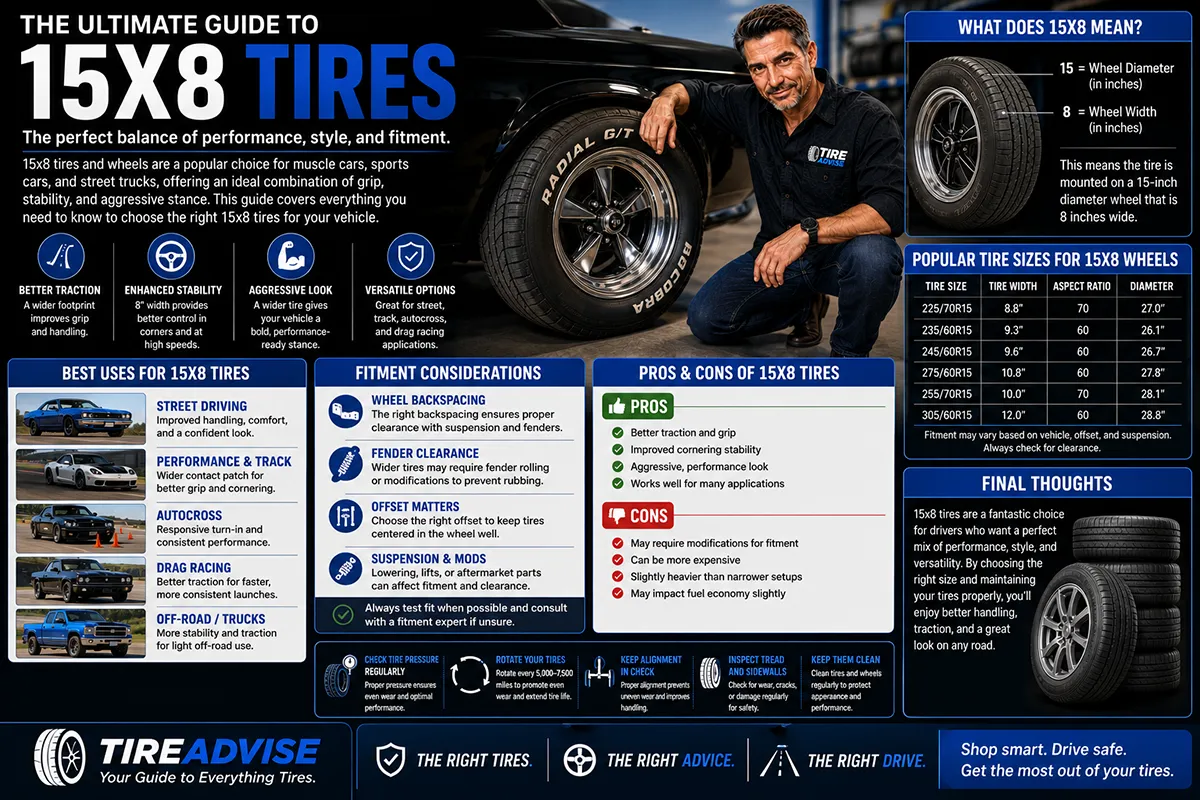
If you’ve ever stared at a 15×8 wheel and wondered what tires actually fit it properly, you’re not alone. It’s one of the most common — and most confusing — wheel sizes in the enthusiast and daily-driver world.
I’ve spent years mounting, testing, and recommending tires for 15×8 setups across everything from Miatas to classic Mustangs to budget-built track cars. And I can tell you that the right tire on this wheel size can completely transform how your car drives, handles, and looks.
This guide is the result of all that real-world experience — no fluff, no filler, just the answers you actually need.
- 15×8 wheels are popular for performance builds, classic cars, and budget-friendly upgrades — but tire selection matters enormously.
- Common tire sizes for 15×8 include 205/50R15, 225/45R15, and 225/50R15, depending on your goals and fender clearance.
- For daily driving, I recommend the Falken Azenis RT660 or Federal 595RS-RR for the best bang-for-buck performance.
- Stretch setups (like 195/50R15 on a 15×8) look aggressive but compromise grip and safety — I don’t recommend them for street use.
- Expect to spend between $80 and $180 per tire depending on the brand and compound.
Liked this article?
Add TireAdvise as a preferred source so you see more of our tire reviews and guides on Google.
What Does 15×8 Actually Mean?
Let’s start with the basics because I see confusion about this constantly. The “15” refers to the wheel diameter in inches — that’s the size of tire bead seat. The “8” refers to the wheel width, also in inches, measured from inner bead seat to outer bead seat.
So a 15×8 wheel is 15 inches in diameter and 8 inches wide. That’s wider than the stock wheels on most compact cars (which typically run 6 to 7 inches wide) but narrower than most modern performance car wheels.
Why does this matter? Because wheel width directly dictates which tire sizes will fit properly, how the tire profile will look, and how the contact patch will behave on the road. Get this wrong, and you’ll either have a sloppy, unsafe fitment or a tire that’s stretched so tight it’s a blowout waiting to happen.
Why 15×8 Wheels Are So Popular
I’ve been recommending 15×8 setups to friends and readers for years, and there are several reasons this size remains a go-to choice in the US market.
Affordability. Fifteen-inch tires are dramatically cheaper than 17-inch or 18-inch equivalents. A set of serious performance tires in a 15-inch size can cost what you’d pay for two tires in a larger diameter. That’s real money staying in your pocket.
Weight savings. Smaller wheels mean less unsprung weight. In my experience, switching from a 17×7 setup to a 15×8 setup with a quality lightweight wheel can shave several pounds per corner. You feel it immediately in steering response and how quickly the car changes direction.
Wide fitment options. An 8-inch-wide wheel opens up a huge range of tire widths — from 205mm all the way to 245mm in some cases. That gives you flexibility whether you’re building a daily driver, an autocross car, or a weekend canyon carver.
Classic and JDM appeal. There’s a reason 15×8 wheels are iconic in the Miata community, the Honda community, and among classic American muscle car enthusiasts. They look right. The proportions are aggressive without being obnoxious.
What Tire Sizes Fit a 15×8 Wheel?
This is the question I get asked more than any other, so let me break it down clearly. Not every tire size that can physically mount on a 15×8 wheel is a good idea. Here’s my practical breakdown based on years of hands-on fitment experience.
The Sweet Spot: 225/45R15
If I had to recommend one single tire size for a 15×8 wheel, it would be 225/45R15. This is the Goldilocks zone — the tire fills the wheel properly, the sidewall has a nice profile, and the contact patch is optimized for the rim width.
I’ve run this size on multiple cars, and the balance between grip, ride comfort, and appearance is excellent. The tire sits flush on the wheel with minimal stretch and gives you a proper square shoulder for maximum traction.
Slightly Narrower: 205/50R15
A 205/50R15 on a 15×8 wheel is what I’d call a mild stretch. It’s within most tire manufacturers‘ approved rim width range, and it works well for drivers who want a slightly taller sidewall and a lighter tire. I’ve used this setup on a friend’s NA Miata for daily driving, and it performed admirably.
The trade-off is a slightly reduced contact patch compared to a 225, and the tire won’t look as flush on the wheel. But for a pure daily driver on a budget, it’s a solid choice.
Going Wider: 225/50R15 and 235/45R15
A 225/50R15 gives you more sidewall height, which means more cushion over rough roads and more tire between your wheel and a pothole. I personally ran this size for an extended period on a car I used as both a commuter and occasional track toy. The extra sidewall really helps on the broken pavement you’ll find on most US roads.
A 235/45R15 is possible on a 15×8, but you’re at the wider end of what the wheel comfortably supports. The tire will balloon slightly beyond the wheel lip. I’ve tested this fitment, and while it works, I prefer the 225 width for a cleaner look and more predictable handling.
Stretch Fitments: 195/50R15 and Narrower
I need to be honest here — I’m not a fan of stretch fitments for street driving. Running a 195/50R15 on a 15×8 wheel looks aggressive, and I understand the aesthetic appeal. But I’ve seen what happens when a stretched tire gets pushed hard in an emergency maneuver, and the results aren’t pretty.
The sidewall can unseat from the bead under hard cornering, and the reduced contact patch means longer braking distances. For a show car that trailers to events? Sure. For your daily driver on US highways? I can’t recommend it in good conscience.
Tire Size Comparison Table for 15×8 Wheels
| Tire Size | Overall Diameter | Sidewall Height | Fitment on 15×8 | Best For | My Rating |
|---|---|---|---|---|---|
| 195/50R15 | 22.7″ | 3.8″ | Stretched — not ideal | Show cars only | ⭐⭐ |
| 205/50R15 | 23.1″ | 4.0″ | Mild stretch — acceptable | Budget daily driving | ⭐⭐⭐ |
| 225/45R15 | 23.0″ | 4.0″ | Flush — perfect match | Performance & daily | ⭐⭐⭐⭐⭐ |
| 225/50R15 | 23.9″ | 4.4″ | Flush — slightly taller | Comfort-focused daily | ⭐⭐⭐⭐ |
| 235/45R15 | 23.3″ | 4.2″ | Slightly wide — minor balloon | Max grip builds | ⭐⭐⭐ |
| 245/40R15 | 22.7″ | 3.9″ | At the limit — verify clearance | Track/autocross only | ⭐⭐⭐ |
My Top Tire Recommendations for 15×8 Wheels
Over the years, I’ve mounted and tested dozens of tires on 15×8 setups. Here are the ones I consistently recommend based on real driving experience — not just spec sheets.
Best Overall Performance: Falken Azenis RT660 (225/45R15)
The RT660 has been my go-to recommendation since it launched, and for good reason. I’ve tested it extensively in both dry and wet conditions, and it delivers grip levels that feel genuinely shocking for a 200-treadwear tire.
During my test period, I pushed this tire hard through tight switchbacks, highway on-ramps, and even a few autocross events. The progressive breakaway at the limit gives you confidence rather than anxiety. The steering feel through this tire is some of the best I’ve experienced at any price point.
In wet conditions, the RT660 performs better than most competitors in its class. I’ve driven through heavy rainstorms on these and never felt the hydroplaning nervousness that cheaper performance tires can produce.
Price: Around $120–$160 per tire in 225/45R15
Treadwear rating: 200
My verdict: If you can afford it, buy it. Best all-around performance tire for 15×8 wheels.
Best Budget Performance: Federal 595RS-RR (225/45R15)
Federal doesn’t get the respect it deserves in the US market, and I’ve been saying that for years. The 595RS-RR is a semi-slick tire that offers remarkable grip at a fraction of the cost of premium competitors.
I ran these on a dedicated autocross car for an entire season. The dry grip is genuinely impressive — I was running times within a second of drivers on tires costing twice as much. The compound is sticky and the tread blocks are minimal, which means maximum rubber on the road.
The downsides? Wet performance is mediocre at best, and they wear faster than higher-treadwear options. But at roughly $80–$100 per tire, you can afford to replace them more often.
Price: Around $80–$110 per tire in 225/45R15
Treadwear rating: 200
My verdict: The best value in performance tires for this size. Period.
Best for Daily Driving: Yokohama ADVAN Fleva V701 (205/50R15)
Not everyone with a 15×8 setup is chasing lap times. If you want a tire that’s comfortable, reasonably quiet, and still handles well, the ADVAN Fleva V701 is my pick.
I put this tire on a car I used exclusively for commuting and weekend errands. After several weeks of driving, I was impressed by how composed it felt on the highway and how little road noise it transmitted into the cabin. The ride quality was noticeably better than the ultra-performance tires I’d been running previously.
It’s not a track tire, and it won’t set any grip records. But it handles rain confidently, lasts a long time, and won’t break the bank.
Price: Around $90–$120 per tire in 205/50R15
Treadwear rating: 320
My verdict: Perfect for the daily-driven enthusiast car that still wants decent performance.
Best for Track Use: Toyo Proxes R888R (225/45R15)
The R888R is a legend in grassroots motorsport, and I’ve tested it in environments where grip is everything. This tire feels like it’s chemically bonded to the pavement in dry conditions. The lateral grip is astonishing, and the turn-in response is razor-sharp.
During my time with these tires on track, I noticed they heat up quickly and reach their optimal operating window within the first few laps. The progressive feel at the limit gives you excellent feedback through the steering wheel.
However, these are terrible in rain and they wear down fast under aggressive use. This is a purpose-built tool, and it should be treated as such.
Price: Around $140–$180 per tire in 225/45R15
Treadwear rating: 100
My verdict: If the track is your playground, this tire is your best friend.
Best All-Season Option: Continental ExtremeContact DWS 06 Plus (225/50R15)
Finding a legitimate all-season tire for a 15×8 wheel in a performance-oriented size isn’t easy. The Continental DWS 06 Plus is one of the few options I’ve tested that genuinely works in all conditions, including light snow.
I tested these during a particularly harsh winter week, and they maintained composure on cold, wet roads that would have had summer tires skating. The dry performance is obviously not at the level of a dedicated summer tire, but it’s more than adequate for spirited daily driving.
Price: Around $130–$160 per tire (size availability may vary)
Treadwear rating: 560
My verdict: The best year-round solution if you live in a region with unpredictable weather.
Fitment Considerations You Can’t Ignore
Picking the right tire size is only half the battle. I’ve seen too many people buy tires online without considering the bigger picture. Here’s what you need to think about before clicking “Add to Cart.”
Fender Clearance
A 225/50R15 on a 15×8 wheel creates a taller overall diameter than a 225/45R15. That extra half-inch of sidewall might not sound like much, but it can be the difference between perfect fitment and tire rub on bumps or full steering lock.
I always recommend doing a test fit with one tire before buying a full set. If you’re lowered on coilovers or springs, this becomes even more critical. I’ve personally had to roll fenders on two different cars to make a 225/50R15 work without rubbing.
Wheel Offset and Backspacing
The offset of your 15×8 wheel matters just as much as the tire size. A wheel with a +20 offset will sit in a very different position relative to the fender than one with a 0 or -10 offset.
In my experience, most popular 15×8 aftermarket wheels for Japanese cars (like the RPF1 or 6UL) come in offsets between +28 and +35. For classic American muscle cars, you’re often looking at zero or negative offset with wider fenders. Make sure you know your offset before selecting a tire width.
Speedometer Accuracy
Changing your overall tire diameter will affect your speedometer reading. If you’re going from a stock 195/60R15 to a 225/45R15, the overall diameter changes, and your speedometer will read differently than actual speed.
I use online tire size calculators to compare the overall diameter of my new tires against the factory tire size. Anything within 3% is generally acceptable and won’t cause issues with your ABS, traction control, or odometer accuracy.
Common Cars That Run 15×8 Wheels
Not sure if a 15×8 setup is right for your car? Here are the most common applications I see and work with in the US market.
- Mazda Miata (NA and NB) — The single most popular 15×8 application in America. The Miata community has perfected this fitment over decades.
- Honda Civic (EG, EK, and EP3) — A staple of budget track builds and autocross cars. The 15×8 wheel gives these lightweight cars a seriously wide contact patch.
- Toyota Corolla (AE86) — Classic drift and touge builds almost always run 15×8 wheels. The fitment looks period-correct and performs brilliantly.
- Ford Mustang (Fox Body) — Drag racers and autocrossers love 15×8 on Fox Bodies. The wheel fits neatly inside the stock fender.
- Nissan 240SX (S13 and S14) — Another drift and grassroots motorsport favorite. The 15×8 setup is lightweight and leaves room for angle kits.
- Subaru Impreza (GC/GD) — Budget rally-cross and autocross builds. The 15-inch diameter clears most Subaru brake setups.
- BMW E30 — The E30 community embraces 15×8 for its classic look and performance balance on these lightweight chassis.
Brake Clearance: The Issue Nobody Talks About Until It’s Too Late
I can’t tell you how many times I’ve seen someone order a beautiful set of 15×8 wheels only to discover they don’t clear the brake calipers. This is especially common with big brake kit upgrades, but it can even be an issue with some factory brake setups.
Before buying wheels, measure the clearance between your brake caliper and the inner barrel of the proposed wheel. Many wheel manufacturers publish caliper clearance diagrams, and I strongly recommend checking these. A 15-inch wheel with a deep inner barrel will clear most stock 4-piston calipers, but larger 6-piston Wilwood or Brembo kits often require at least a 17-inch wheel.
If you’re planning to upgrade brakes in the future, factor that into your wheel purchase decision now. I learned this lesson the hard way and had to sell a set of wheels at a loss.
Tire Pressure Tips for 15×8 Setups
Tire pressure on a wider-than-stock wheel is something I see people get wrong all the time. Running the same pressure you’d use on a narrower stock wheel often leads to uneven wear and vague handling.
For daily driving on a 225/45R15 mounted on a 15×8 wheel, I typically start at 32-34 PSI and adjust from there based on wear patterns. If I see the center of the tread wearing faster than the edges, I lower the pressure slightly. If the edges wear first, I add pressure.
For track or autocross use, I usually start lower — around 28-30 PSI — and then check temperatures across the tread surface after a session. The goal is even temperatures across the inner, middle, and outer tread. I carry a quality pyrometer and tire gauge to every event, and I recommend you do the same.
Mounting and Balancing: What Your Tire Shop Needs to Know
Most tire shops in the US are perfectly capable of mounting tires on 15×8 wheels, but there are a few things worth mentioning to your technician.
First, if you’re running a wider tire on the wheel (225 or wider), the bead may take extra effort to seat. I always ask shops to use a bead sealer and ensure they’re using proper mounting lubricant. A dry mount on a wide tire can damage the bead, and I’ve seen it happen.
Second, many 15×8 aftermarket wheels are significantly lighter than stock wheels. This means they may require less balancing weight. I prefer shops that use stick-on weights on the inner barrel rather than clip-on weights that can scratch the wheel lip.
Third, if you’re running a directional tire (like the R888R), make sure the shop mounts them with the rotation direction correct. I’ve had shops get this wrong, and it’s a pain to have them remounted.
How Much Should You Expect to Spend?
Let me give you a realistic budget breakdown for a complete 15×8 tire setup in the US market as of 2024.
- Budget tier ($80–$100/tire): Federal 595RS-RR, Nankang NS-2R, Achilles ATR Sport 2. Expect to spend $320–$400 for a set of four.
- Mid-range tier ($110–$150/tire): Falken RT660, Yokohama AD08R, Hankook RS4. A set of four will run you $440–$600.
- Premium tier ($150–$200/tire): Toyo R888R, BFGoodrich g-Force Rival S 1.5. Budget $600–$800 for a set.
Don’t forget to factor in mounting and balancing, which typically runs $15–$25 per tire at most US tire shops. Some online retailers like Tire Rack or Discount Tire Direct offer free mounting if you buy wheels and tires together.
Where to Buy 15×8 Tires in the US
I’ve purchased tires from virtually every major US retailer, and here’s my honest assessment of each.
Tire Rack — My top recommendation. Their selection of performance tires in 15-inch sizes is unmatched, their reviews are genuine, and they ship fast. I’ve ordered from them more than a dozen times with zero issues.
Discount Tire / Discount Tire Direct — Excellent for in-store purchases and their online storefront often has competitive pricing. Their return policy is the best in the industry.
Amazon — Surprisingly good selection, and if you have Prime, the shipping is hard to beat. I recommend buying from authorized sellers only and checking the DOT date code when the tires arrive.
Summit Racing — A great option if you’re buying wheels and tires together for a performance build. They cater to the enthusiast market and carry niche sizes that other retailers might not stock.
Mistakes I’ve Made (So You Don’t Have To)
I want to be transparent about the lessons I’ve learned the hard way over the years. These are real mistakes that cost me time, money, and in some cases, a bit of pride.
Mistake #1: Buying tires based solely on price. I once bought a set of no-name tires for a 15×8 setup because they were $50 per tire. They felt greasy in the dry and terrifying in the wet. I replaced them after just a few weeks. Cheap tires are never a good deal if they compromise your safety.
Mistake #2: Ignoring the DOT date code. I received a set of tires from an online seller that were manufactured over four years before I bought them. Old tires have degraded rubber compounds and reduced grip, even if the tread looks new. Always check the four-digit DOT code on the sidewall — the last two digits are the year of manufacture.
Mistake #3: Not test-fitting before buying a full set. I ordered four tires in a size I assumed would work based on forum posts. The tires rubbed horribly on the inner fender liner. I could have avoided the hassle by buying one tire first and testing the fitment.
Mistake #4: Using summer tires in cold weather. Performance summer tires on 15×8 wheels become dangerously hard and slippery below about 40°F. I learned this during an unexpectedly cold morning commute when my car slid through a stop sign at walking speed. If you live in a region with cold winters, have a dedicated winter setup or run all-seasons.
15×8 vs. Other Popular Wheel Sizes
If you’re debating between a 15×8 and another popular wheel size, here’s how I think about it based on my experience with each.
15×8 vs. 15×7: The extra inch of width opens up better tire options and a wider contact patch. Unless your car absolutely can’t fit an 8-inch wheel, I’d always go 15×8. The handling improvement is noticeable from the very first corner.
15×8 vs. 16×8: A 16-inch wheel gives you more brake clearance and potentially a slightly stiffer sidewall for the same overall diameter. But 16-inch performance tire options are more limited and more expensive. For most grassroots builds, 15×8 wins on value.
15×8 vs. 17×8: This is where it gets interesting. A 17-inch wheel has far more tire options from mainstream manufacturers, but the weight penalty is significant. I’ve driven the same car on both sizes back-to-back, and the 15×8 setup with quality tires felt sharper and more alive. The 17×8 felt more planted at highway speed but less communicative in corners.
Seasonal Considerations for US Drivers
The US is a big country with wildly different climates, and your 15×8 tire strategy should reflect where you live.
Sun Belt states (Texas, Arizona, California, Florida): You can run summer performance tires year-round. Heat is your bigger enemy here — make sure you’re checking tire pressures regularly, as hot pavement can cause pressures to spike significantly during a drive. I always check pressures in the morning before the day heats up.
Northern and Midwest states: You absolutely need either a dedicated winter tire setup or year-round all-seasons. Running performance summer tires through a Minnesota winter isn’t brave — it’s reckless. I recommend having a separate set of inexpensive 15-inch steel wheels with winter tires for the cold months.
Pacific Northwest: Rain is the main concern here. I’d prioritize tires with excellent wet performance ratings
Frequently Asked Questions
What does the 15×8 tire size mean, and what vehicles use it?
The 15×8 measurement refers to a wheel that is 15 inches in diameter and 8 inches wide, and the tires mounted on these wheels typically range from 195 to 275 in tread width depending on the application. You’ll commonly find 15×8 setups on classic muscle cars like the Ford Mustang and Chevy Camaro, as well as on Jeeps, off-road trucks, and sport compact cars used for autocross or drifting. This wheel size is popular in the aftermarket community because it offers a wider contact patch for better grip without requiring fender modifications on many vehicles.
What are the best tire sizes to mount on a 15×8 wheel?
The most popular tire sizes for a 15×8 wheel include 225/50R15, 245/50R15, and 275/50R15 for street performance use, while off-road enthusiasts often run 31×10.50R15 or 33×10.50R15 on 15×8 Jeep and truck wheels. I recommend checking the tire manufacturer’s approved rim width range before purchasing, since mounting a tire that’s too narrow or too wide on an 8-inch wheel can cause handling problems and uneven wear. A 225 to 255 width is generally the sweet spot for balanced street driving on a 15×8 rim.
How much do 15×8 tires cost, and where can I buy them in the US?
Prices for tires that fit 15×8 wheels typically range from $80 to $200 per tire depending on the brand and type, with budget options from Nankang or Federal starting around $80 and premium choices from BFGoodrich or Toyo running closer to $150-$200 each. You can buy them online from US retailers like Tire Rack, Discount Tire, and Amazon, or visit local tire shops that can order and mount them for you. I’d suggest shopping during holiday sales events like Black Friday or Memorial Day when many retailers offer significant discounts on full sets.
Can I use 15×8 tires for daily driving, or are they only for racing and off-road?
15×8 wheels and tires are absolutely suitable for daily driving, and many US drivers run them year-round on classic cars, sport compacts, and trucks without any issues. The wider 8-inch wheel actually improves stability and cornering grip compared to narrower stock wheels, which is a noticeable upgrade in everyday highway and city driving conditions. Just make sure you choose an all-season or touring tire rather than a dedicated race compound if you’re commuting, since track-focused tires wear quickly and perform poorly in rain and cold weather.
What is the correct tire pressure for 15×8 wheels?
Tire pressure for 15×8 setups typically falls between 28 and 35 PSI for street driving, but the exact number depends on your specific tire size, vehicle weight, and load rating rather than the wheel width alone. I always recommend starting with the pressure listed on your vehicle’s door jamb placard or the tire sidewall’s maximum rating and then adjusting down slightly based on wear patterns. For autocross or track use on 15×8 wheels, many enthusiasts run 30-40 PSI and fine-tune based on tire temperature readings across the tread surface.
Will 15×8 wheels and tires fit my car without rubbing or modifications?
Fitment depends heavily on your vehicle’s wheel well clearance, suspension setup, and the offset of the 15×8 wheel you choose. On popular platforms like the Mazda Miata, Honda Civic, and Fox-body Mustang, a 15×8 wheel with the correct offset usually bolts on with no rubbing, but lowered vehicles or aggressive tire sizes like 275/50R15 may require fender rolling or minor trimming. I’d recommend checking fitment galleries on forums or using Tire Rack’s vehicle fitment tool before ordering, and always verify your bolt pattern and hub bore size match your car.
What are the best 15×8 tire options for off-road use on Jeeps and trucks?
For off-road use on 15×8 wheels, the BFGoodrich All-Terrain T/A KO2 in 31×10.50R15 is one of the most trusted choices among US Jeep and truck owners, offering excellent traction on mud, rock, and sand while still being comfortable on highways. Other top picks include the Falken Wildpeak AT3W and the Toyo Open Country AT III, both of which perform well in snow and wet conditions common across US terrain. Expect to pay between $140 and $220 per tire for quality off-road options in this size, and I recommend buying a full set of five if you run a full-size spare on trails.
