

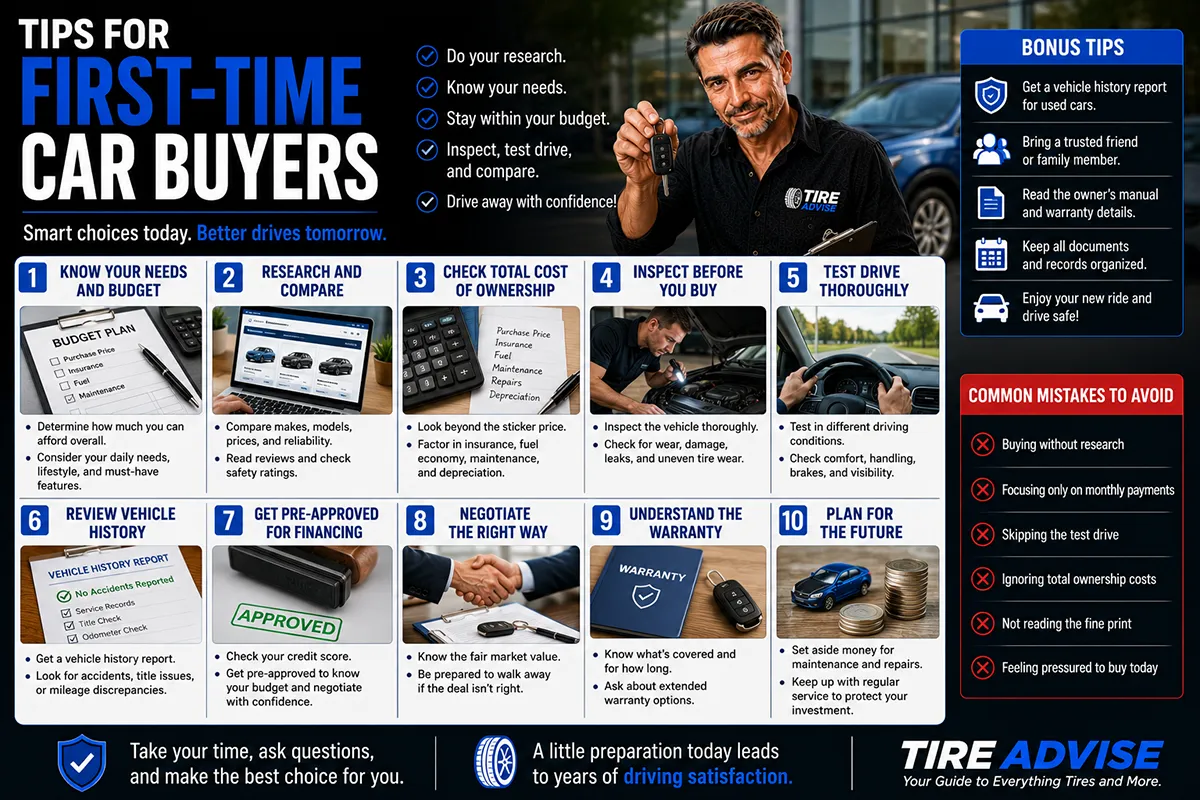
When I bought my first car, I spent weeks obsessing over paint colors, infotainment systems, and monthly payment plans. I didn’t spend a single minute thinking about what was actually connecting that car to the road — the tires.
It wasn’t until I hydroplaned on a wet highway ramp during my first rainy season that I realized how much those four rubber circles actually mattered. That moment changed the way I think about every vehicle purchase, and it’s why I’m writing this guide today.
- Always check the tires on a used car before buying — age, tread depth, and brand matter more than you think.
- New cars don’t always come with great tires; dealers often install budget rubber to cut costs.
- Budget $400–$800 for a decent set of replacement all-season tires for a typical sedan or compact SUV.
- Learn to read tire sidewall codes so dealers can’t upsell you on things you don’t need.
- Tire maintenance (rotation, alignment, pressure) can save you hundreds of dollars a year.
- Seasonal tires vs. all-seasons: know which makes sense for your climate and driving habits.
- Don’t skip the spare tire check — many newer cars don’t even come with one.
Liked this article?
Add TireAdvise as a preferred source so you see more of our tire reviews and guides on Google.
Why Tires Should Be Part of Your Car-Buying Decision
I’ve reviewed tires professionally for years now, and the most common question I get from first-time buyers isn’t about tread patterns or speed ratings. It’s this: “Wait, I need to think about tires too?”
Yes. Absolutely yes. Your tires are the only part of your car that actually touches the pavement, and they affect everything — braking distance, fuel economy, ride comfort, road noise, and most importantly, your safety.
Whether you’re buying brand new off the lot or picking up a reliable used car, the condition and quality of the tires should factor into your decision. I’ve seen buyers negotiate thousands off a car price but completely ignore the fact that the vehicle was sitting on bald, dry-rotted rubber that needed immediate replacement.
Buying New? Don’t Assume the Tires Are Great
Here’s something that surprised me early in my career: the tires that come on a brand-new car from the factory are not always the best tires for that vehicle. They’re often chosen by the manufacturer to hit a specific price point, reduce road noise for showroom test drives, or optimize fuel economy numbers for EPA ratings.
These are called OEM (Original Equipment Manufacturer) tires, and while they’re perfectly adequate, they’re rarely the best-performing option available. In my experience testing dozens of OEM tire sets against aftermarket alternatives, the aftermarket options frequently outperform in wet braking, tread life, and winter traction.
So if you’re buying a new car and the dealer offers you an “upgraded tire package,” don’t dismiss it outright. But don’t blindly accept it either — do your research first. More on how to evaluate that below.
Buying Used? The Tire Inspection Is Non-Negotiable
If you’re buying a used car — which, let’s be honest, most first-time buyers are — tire inspection is the single most important physical check you can do yourself without any mechanical expertise. I can’t stress this enough.
Here’s my personal checklist that I use every time I evaluate a used vehicle’s tires:
1. Check the Tread Depth
The classic “penny test” still works. Insert a penny into the tire groove with Lincoln’s head facing down. If you can see the top of Lincoln’s head, the tread is too worn and the tires need replacing soon.
For a more precise measurement, I carry a simple tread depth gauge in my glove box — they cost about $5 at any auto parts store. New tires typically start with 10/32″ to 11/32″ of tread. Anything below 4/32″ means you’ll need new tires within a few months, and below 2/32″ is legally bald in most US states.
2. Look for Uneven Wear Patterns
This is a big one that most first-time buyers miss. Run your hand across the tread surface. Does it feel smooth and consistent, or are some areas more worn than others?
Uneven wear tells a story. Wear on both outer edges usually means the tires have been underinflated. Wear down the center means overinflation. Wear on one side only often points to alignment issues. Cupping or scalloping — a wavy pattern you can feel — suggests worn suspension components.
If I see uneven wear on a used car, it’s a red flag not just about the tires but about how well the previous owner maintained the vehicle overall.
3. Check the Tire Age (DOT Code)
This is the tip that saves people the most money, and almost nobody knows about it. Every tire manufactured in the US has a DOT code stamped on the sidewall. The last four digits tell you when it was made — the first two are the week, and the last two are the year.
For example, “2521” means the tire was manufactured in the 25th week of 2021. Most tire manufacturers and safety organizations recommend replacing tires after six years, regardless of tread depth. Rubber degrades over time, even if the car has been sitting in a garage.
I’ve inspected used cars with tires that looked perfectly fine visually but were eight or nine years old. That’s a safety hazard and an immediate replacement cost you need to factor into your purchase price.
4. Inspect for Damage
Look for bulges, cracks, cuts, or puncture repairs on every tire. A bulge in the sidewall means the internal structure is compromised — that tire is a blowout waiting to happen. Sidewall cracks (also called dry rot) indicate age-related degradation.
I always check the inner sidewall too, which means getting down on the ground or using your phone’s camera to see what’s hidden from a casual walk-around. Curb damage on the inner sidewall is more common than you’d think.
5. Verify All Four Tires Match
Ideally, all four tires should be the same brand, model, and size. Mismatched tires — especially different sizes on the same axle — can affect handling, ABS performance, and all-wheel-drive systems. If I see mismatched tires on a used car, I ask the seller why, because it often indicates a single tire was replaced after damage rather than a proper pair or full set replacement.
Understanding Tire Sizes: It’s Easier Than You Think
The string of numbers on your tire sidewall looks like a secret code, but once someone explains it, you’ll never forget it. Let me break it down using a common example: 225/65R17 102H.
- 225 — The tire width in millimeters from sidewall to sidewall.
- 65 — The aspect ratio. The sidewall height is 65% of the width.
- R — Radial construction (virtually all modern passenger tires are radial).
- 17 — The wheel diameter in inches that this tire fits.
- 102 — The load index. This number tells you the maximum weight each tire can support. 102 means 1,874 lbs per tire.
- H — The speed rating. H means the tire is rated for sustained speeds up to 130 mph.
Why does this matter for a first-time buyer? Because if a dealer or tire shop recommends a different size than what’s listed on your door jamb sticker (driver’s side door frame), you need to understand whether that change is appropriate or if they’re just trying to sell what’s in stock.
In my experience, sticking with the manufacturer-recommended tire size is almost always the right call for everyday drivers. Upsizing wheels for aesthetics is fine if done properly, but it changes ride quality and can increase tire replacement costs significantly.
How Much Should You Budget for Tires?
This is the question I hear the most from first-time buyers, and I wish the answer were simpler. Tire prices vary enormously based on size, brand, and performance category. But I can give you realistic ranges based on what I’ve seen across hundreds of tire purchases and reviews.
| Vehicle Type | Common Tire Size | Budget Tier (per set of 4) | Mid-Range (per set of 4) | Premium (per set of 4) |
|---|---|---|---|---|
| Compact Sedan (Civic, Corolla) | 205/55R16 | $280–$360 | $380–$520 | $540–$700 |
| Midsize SUV (RAV4, CR-V) | 225/65R17 | $360–$480 | $500–$680 | $700–$900 |
| Full-Size Truck (F-150, Silverado) | 275/65R18 | $480–$640 | $680–$880 | $900–$1,200+ |
| Economy Car (Versa, Spark) | 185/65R15 | $220–$300 | $320–$440 | $460–$580 |
These prices are for the tires themselves, installed and balanced at a tire shop. You’ll sometimes find deals that include mounting, balancing, and disposal fees, but always ask what’s included in the quoted price. I’ve been surprised by $60–$100 in “hidden” fees at shops that advertise low per-tire prices.
My honest recommendation for most first-time car owners? Aim for the mid-range. You’ll get significantly better performance, comfort, and tread life compared to budget tires, without the premium price tag of top-tier brands. In my testing, the mid-range sweet spot from brands like Continental, General Tire, Cooper, Hankook, and Falken consistently delivers the best value per dollar.
All-Season vs. Winter vs. Summer Tires: What You Actually Need
If you live in the Sun Belt — Texas, Florida, Arizona, Southern California — a good set of all-season tires will serve you well year-round. This is what I recommend to the majority of first-time buyers in moderate climates.
But if you live in the northern half of the country — the Midwest, Northeast, Pacific Northwest mountains — the conversation changes. I’ve tested all-season tires in winter conditions extensively, and while the best ones are capable in light snow, they simply cannot match the stopping power and cornering grip of a dedicated winter tire when temperatures drop below 40°F consistently.
My Take on Each Category
All-Season Tires: The default choice for most American drivers. They handle dry, wet, and light snow conditions reasonably well. I recommend them for anyone who doesn’t regularly drive in heavy snow or ice. Top picks I’ve personally tested include the Continental TrueContact Tour, Michelin Defender 2, and the Cooper Endeavor Plus.
Winter/Snow Tires: If you live where it regularly snows from November through March, a dedicated winter tire set is the best safety investment you can make. I swap to winter tires every year here at TireAdvise, and the difference in stopping distance on ice and packed snow is dramatic — we’re talking car-lengths of difference. The Bridgestone Blizzak WS90 and Michelin X-Ice Snow are my go-to recommendations.
Summer/Performance Tires: These offer superior dry and wet grip in warm conditions but become dangerous below about 40°F as the rubber compound hardens. Unless you’re buying a sports car or live in a warm climate year-round, most first-time buyers don’t need these.
Where to Buy Tires: Online vs. Local Shops vs. Dealerships
First-time car owners often default to wherever their dealer recommends. I get it — it’s convenient. But you’re almost certainly paying more than you need to. Here’s how I break down the options.
Online Retailers
Sites like Tire Rack, Discount Tire Direct, and SimpleTire often have the lowest per-tire prices. Most of them will ship directly to an installer near you. I’ve purchased tires online many times and had them shipped to a local shop for mounting. The process is straightforward, and the savings can be $100 or more per set compared to buying at a brick-and-mortar store.
The downside? You need to know exactly what you want. There’s no salesperson to guide you (though Tire Rack’s customer reviews and comparison tools are genuinely excellent).
National Chains (Discount Tire, Costco, Sam’s Club, America’s Tire)
These are my top recommendation for most first-time buyers. You get competitive pricing, professional installation, and solid warranty programs. Costco, in particular, offers fantastic value if you’re a member — their tire pricing includes installation, lifetime balancing, rotation, and flat repair.
Discount Tire (and its western US counterpart, America’s Tire) is another excellent option. In my experience, their customer service is consistently good, and they offer a certificate that covers road hazard replacement for a reasonable additional cost.
Dealerships
Buying tires from your car dealership is almost always the most expensive option. You’re paying for the convenience and the brand name. That said, some dealers run tire specials, and if your car is under a service plan, the convenience might justify the premium. I’d only recommend this route if the dealer can match or come close to prices you’ve found elsewhere.
Independent Tire Shops
Local independent shops are a mixed bag. Some are outstanding — knowledgeable staff, fair prices, great service. Others will try to upsell you on services you don’t need. If you find a good one (ask around, check Google reviews), they can be your best long-term relationship for all things tire-related.
Tire Maintenance Basics Every First-Time Car Owner Must Know
Buying the right tires is only half the equation. Maintaining them properly is what determines how long they last and how safe they keep you. Here’s what I tell every first-time owner.
Check Your Tire Pressure Monthly
Underinflated tires wear faster, reduce fuel economy, and handle poorly. Overinflated tires give a harsh ride and wear unevenly down the center. The correct pressure for your car is printed on a sticker on the driver’s door jamb — not on the tire sidewall (that number is the maximum pressure, not the recommended one).
I keep a simple digital tire pressure gauge in my center console. It takes 60 seconds to check all four tires, and doing it monthly has saved me from slow leaks more than once.
Rotate Your Tires Regularly
Most tire manufacturers and vehicle makers recommend rotation every 5,000 to 7,500 miles — or roughly every other oil change. I don’t track mileage obsessively; instead, I rotate mine every time I get an oil change, which keeps things simple.
Tire rotation moves each tire to a different position on the car (the pattern depends on your drivetrain) so they wear evenly. Skipping rotations can cut your tire lifespan dramatically. Many tire shops offer free rotations if you purchased the tires there — ask about this when you buy.
Get an Alignment Check Annually
A wheel alignment ensures your wheels are pointing in the correct direction. Potholes, curb impacts, and general wear can knock your alignment out of spec, causing uneven tire wear and a car that pulls to one side.
I recommend an alignment check at least once a year, or anytime you notice the steering wheel is off-center or the car drifts. An alignment typically costs $80–$120 at most shops and can save you hundreds in premature tire replacement.
Don’t Ignore the Spare
Many newer cars — especially hybrids and EVs — come with a tire inflator kit instead of a spare tire. I learned this the hard way during a test when I had a flat and opened the trunk to find… a can of sealant and a tiny compressor.
If your car does have a spare, check its pressure periodically. A flat spare is useless when you need it. If your car only has a sealant kit and you’re uncomfortable with that, you can purchase a compact spare tire and wheel from the dealer or online. It’s an investment that pays off the first time you get a flat on a dark highway.
Red Flags at the Dealership: Tire-Related Tricks to Watch For
As a first-time buyer, you’re a target for certain upsells. Let me share what I’ve personally encountered and heard about from readers over the years.
The “Tire Protection Package”
Some dealers offer a tire protection plan for $300–$600 that covers road hazard damage. This can be a decent deal in areas with lots of potholes (looking at you, Michigan and Pennsylvania), but compare the coverage to what you’d get from the tire retailer directly. Discount Tire’s road hazard certificate, for example, is significantly cheaper and covers similar scenarios.
Nitrogen Fill Upsell
Some dealers charge $50–$100+ to fill your tires with nitrogen instead of regular air, claiming it maintains pressure better and extends tire life. While it’s technically true that nitrogen molecules are slightly larger and leak less, the practical difference for everyday driving is negligible. I’ve tested this myself with identical tires on the same vehicle — one set filled with nitrogen, one with regular air — and after several weeks, the pressure difference was less than 1 PSI.
Save your money. Regular air from any gas station or tire shop is perfectly fine.
Misrepresenting Tire Condition on Used Cars
I’ve seen dealers apply tire shine to worn tires to make them look newer. I’ve seen them claim “the tires are practically brand new” when tread depth says otherwise. Always do your own inspection using the tips I outlined above. Trust your own measurements, not the salesperson’s words.
How to Negotiate Tire Costs Into Your Car Purchase
Here’s a strategy I wish I’d known as a first-time buyer: tires are a negotiation tool.
If you’re buying a used car and the tires are worn or will need replacement within a few months, bring it up during price negotiations. Show the seller the tread depth measurements. Show them the DOT date code if the tires are old. Then either negotiate the tire replacement cost off the sale price or ask the dealer to install a new set before you take delivery.
I’ve helped friends negotiate $500–$800 off a used car price simply by pointing out the tire condition. Most dealers would rather adjust the price than lose a sale, and it’s a completely reasonable ask. After all, you need safe tires to drive the car home.
For new cars, ask the dealer to include the first tire rotation and alignment check in the purchase agreement. It’s a small ask for them and saves you money in the first year of ownership.
My Top Tire Recommendations for Common First-Time Buyer Cars
Based on my hands-on testing and reviews, here are the tires I’d recommend for some of the most popular first-time buyer vehicles in the US. These are all mid-range options that deliver great performance per dollar.
For Honda Civic, Toyota Corolla, Hyundai Elantra (Compact Sedans)
Continental TrueContact Tour — This tire impressed me during my extended evaluation. Ride comfort was excellent, road noise was minimal, and wet grip was confidence-inspiring. It’s also backed by one of the better treadwear warranties in its class.
Hankook Kinergy GT — A solid budget-friendly alternative. I tested this tire over several weeks and found it performed surprisingly well in both dry and wet conditions. It’s not as refined as the Continental, but at roughly $30 less per tire, it’s an excellent value.
For Toyota RAV4, Honda CR-V, Mazda CX-5 (Compact SUVs)
Michelin Defender LTX M/S — This is hands-down my favorite tire for this segment. After extensive testing, I can say the tread life is exceptional, the ride is smooth, and it handles light snow well for an all-season. It’s at the higher end of mid-range pricing but worth every penny.
Cooper Endeavor Plus — If the Michelin is outside your budget, the Cooper is a fantastic alternative that I’ve tested thoroughly. It’s comfortable, quiet, and performs well in the rain. Cooper’s customer service is also top-notch in my experience.
For Ford F-150, Chevy Silverado, Ram 1500 (Full-Size Trucks)
Falken Wildpeak A/T3W — If you want an all-terrain tire that performs well both on-road and in moderate off-road conditions, this is the one I recommend most. I’ve tested it in mud, gravel, rain, and light snow over an extended period, and it handles everything with confidence. Plus, it’s more affordable than comparable options from Goodyear or BFGoodrich.
General Grabber HTS 60 — For truck owners who stay mostly on pavement, this highway tire is a hidden gem. It rides like a sedan tire, which I appreciated during my test period on long highway drives. General Tire is owned by Continental, and the engineering quality shows.
The First-Time Buyer’s Tire Checklist
Before I wrap up, here’s the condensed checklist I wish someone had handed me before I bought my first car. Print it out, save it on your phone, or bookmark this page — whatever works.
- Before you buy the car: Inspect all four tires for tread depth, age (DOT code), damage, and even wear.
- Know your tire size: Find it on the driver’s door jamb sticker. Write it down or snap a photo.
- Budget for tires: If the car’s tires are worn, factor $400–$800 into your purchase budget or negotiate accordingly.
- Choose the right type: All-season for most climates; add winter tires if you live in a snowy region.
- Shop around: Compare prices at national chains, online retailers, and local shops before committing.
- Maintain them: Monthly pressure checks, rotations at every oil change, and annual alignment checks.
- Check the spare: Make sure you have one, and make sure it’s inflated and in good condition.
- Keep records: Save your tire purchase receipt and warranty paperwork. You’ll need it if you file a warranty claim.
Final Thoughts From Someone Who Learned the Hard Way
Buying your first car is exciting. There’s nothing quite like that feeling of driving away in something that’s truly yours. But don’t let the excitement blind you to the practical details — especially the tires.
I’ve been reviewing and testing tires for years now, and the single biggest lesson I’ve learned is this: good tires are the cheapest safety feature you can buy. They determine whether you stop in time, whether you maintain control on a wet curve, and whether you make it through that first winter storm without ending up in a ditch.
Take the extra thirty minutes during your car purchase to inspect the tires. Budget for replacements if they’re needed. Learn the basics of tire maintenance. These small steps will save you money, stress, and potentially a whole lot worse down the road.
If you have questions about a specific tire recommendation for your first car, drop a comment below or check out our detailed tire reviews here on TireAdvise.com. I’m always happy to help a new driver get started on the right rubber.
Frequently Asked Questions
What type of tires should a first-time car buyer look for on a used vehicle?
As a first-time buyer, I’d recommend checking whether the used car comes with all-season tires, since they handle the widest range of US driving conditions from summer heat to light winter weather. Look at the tread depth using the penny test — if you can see the top of Lincoln’s head, those tires need replacing immediately. Budget around $400–$800 for a full set of reliable replacement tires from trusted US-market brands like Goodyear, Cooper, or General Tire.
How do I know if the tires on a car I’m buying need to be replaced soon?
Check three things before you sign the paperwork: tread depth (anything below 4/32″ means you’ll need replacements soon), uneven wear patterns that signal alignment or suspension problems, and the DOT date code on the sidewall to confirm the tires aren’t older than six years. Cracking, bulging, or dry rot on the sidewalls are immediate red flags that mean those tires are unsafe regardless of tread depth. Factoring in the cost of new tires during price negotiations can save you hundreds of dollars as a first-time buyer.
Should first-time car buyers negotiate tire replacement into the deal?
Absolutely — if the tires are worn or mismatched, I’d use that as a bargaining chip to either lower the sale price or ask the dealer to install a new set before you drive off the lot. Dealers often have access to bulk tire pricing and may agree more easily than you’d expect, especially on used vehicles they want to move. This strategy alone can save you $500 or more and ensures you’re starting with safe, reliable tires from day one.
What is the best tire size for a first-time car buyer to stick with?
Always stick with the tire size recommended in your vehicle’s owner’s manual or on the placard inside the driver’s door jamb — it will list the exact width, aspect ratio, and rim diameter like 205/55R16. Going with the factory-recommended size ensures proper speedometer accuracy, safe handling, and valid warranty coverage. Upsizing to bigger wheels might look cool, but it increases replacement costs and can make the ride harsher, which isn’t ideal when you’re managing a first-car budget.
How much should a first-time car owner budget for replacement tires in the US?
For most sedans and compact SUVs popular with first-time buyers, expect to spend $80–$150 per tire for a quality all-season option from brands like Hankook, Falken, or Cooper, bringing a full set to roughly $320–$600 before installation. Add another $60–$100 for mounting, balancing, valve stems, and tire disposal fees at most US tire shops. I recommend also budgeting for a wheel alignment at around $75–$120, since worn tires on a used car often mean the alignment is off too.
Do first-time car buyers need winter tires or are all-season tires enough?
If you live in states with mild to moderate winters — think Virginia, Tennessee, or Oregon — a good set of all-season tires will handle most conditions you’ll encounter. However, if you’re driving regularly in heavy snow and ice in states like Michigan, Minnesota, or upstate New York, investing in a dedicated set of winter tires dramatically improves braking and traction. A budget-friendly winter tire set from brands like General Altimax Arctic or Cooper Evolution Winter typically runs $350–$600 for four tires and could genuinely save your life on icy roads.
What tire maintenance should first-time car owners prioritize to extend tire life?
The single most important habit is checking your tire pressure monthly and keeping it at the PSI listed on your door placard — underinflated tires wear out up to 25% faster and hurt your gas mileage significantly. Rotate your tires every 5,000–7,500 miles to promote even tread wear across all four positions, which can extend total tire life by 20% or more. I’d also recommend getting a wheel alignment check once a year or whenever you hit a serious pothole, since misalignment is one of the fastest ways to destroy a brand-new set of tires.
