

Have you ever been cruising down the highway at 65 mph and felt your steering wheel start to shimmy and vibrate like it had a mind of its own? That unsettling wobble is one of the most common complaints I hear from drivers, and nine times out of ten, the culprit is something surprisingly small.
I’m talking about tire balancing weights — those little metal pieces clamped or stuck onto your wheels that most people never think about until something goes wrong.
After years of testing tires, visiting tire shops, and deliberately running unbalanced setups to see what happens (so you don’t have to), I’ve learned that these tiny weights are one of the most underappreciated components of a smooth, safe ride. In this guide, I’m going to walk you through everything you need to know about tire balancing weights — what they are, why they matter, the different types available, how much they cost, and when you should be concerned about them.
- Tire balancing weights compensate for uneven weight distribution in your tire-and-wheel assembly, eliminating vibration and preventing uneven wear.
- There are two main types: clip-on (hammer-on) weights and adhesive (stick-on) weights, each suited for different wheel styles.
- Balancing typically costs $15–$50 per tire at US shops, and you should rebalance every time you get new tires, rotate tires, or notice vibrations.
- Lead weights are being phased out in favor of zinc and steel alternatives for environmental reasons.
- Skipping tire balancing can lead to premature tire wear, suspension damage, and an uncomfortable driving experience.
Liked this article?
Add TireAdvise as a preferred source so you see more of our tire reviews and guides on Google.
What Are Tire Balancing Weights, Exactly?
Let me start with the basics, because I’ve found that a lot of drivers confuse tire balancing with wheel alignment. They’re completely different services, and understanding the distinction is important.
Tire balancing weights are small metal pieces — usually made of lead, zinc, steel, or composite materials — that are attached to your wheel rim to counteract heavy spots in the tire-and-wheel assembly. Every tire and wheel combination has slight imperfections in weight distribution. We’re talking about differences measured in fractions of an ounce, but at highway speeds, even tiny imbalances create significant centrifugal force.
Think of it like a washing machine with an unevenly loaded drum. At low spin speeds, you might not notice anything. But crank it up, and the whole machine starts walking across your laundry room. Your tires work the same way — an imbalance that’s undetectable at 25 mph can turn into a violent vibration at 60 mph.
In my experience testing dozens of tire sets over the years, I’ve seen imbalances as small as half an ounce cause noticeable steering wheel vibration. That’s about the weight of a few coins. It’s remarkable how sensitive the system is.
Why Tire Balancing Weights Matter More Than You Think
I’ll be honest — before I got deep into tire testing, I used to blow off tire balancing. I figured it was one of those upsell services that shops push to pad the bill. I was wrong, and my wallet eventually proved it.
Here’s what happens when your tires are out of balance:
- Steering wheel vibration: This is the most obvious symptom. It usually shows up between 55–75 mph and can range from a mild buzz to a full-on shake.
- Uneven tire wear: An imbalanced tire doesn’t maintain consistent contact with the road. Over time, I’ve seen this create cupping or scalloped wear patterns that shorten tire life dramatically.
- Suspension and bearing wear: That constant vibration doesn’t just annoy you — it’s hammering your wheel bearings, struts, shocks, and tie rod ends. I’ve talked to mechanics who trace premature suspension failures back to tires that were never properly balanced.
- Reduced fuel efficiency: An unbalanced tire creates uneven rolling resistance. It’s not going to double your gas bill, but every little bit counts when you’re paying $3.50+ per gallon.
- Decreased ride comfort: Beyond the vibration, unbalanced tires create road noise and a general sense that something’s “off” with the car. During my test periods, I can always feel the difference between a freshly balanced set and one that’s even slightly out of spec.
The Different Types of Tire Balancing Weights
Not all balancing weights are created equal. Over the years, I’ve worked with every type, and the right choice depends on your wheel style, your budget, and sometimes your local regulations. Let me break down the main categories.
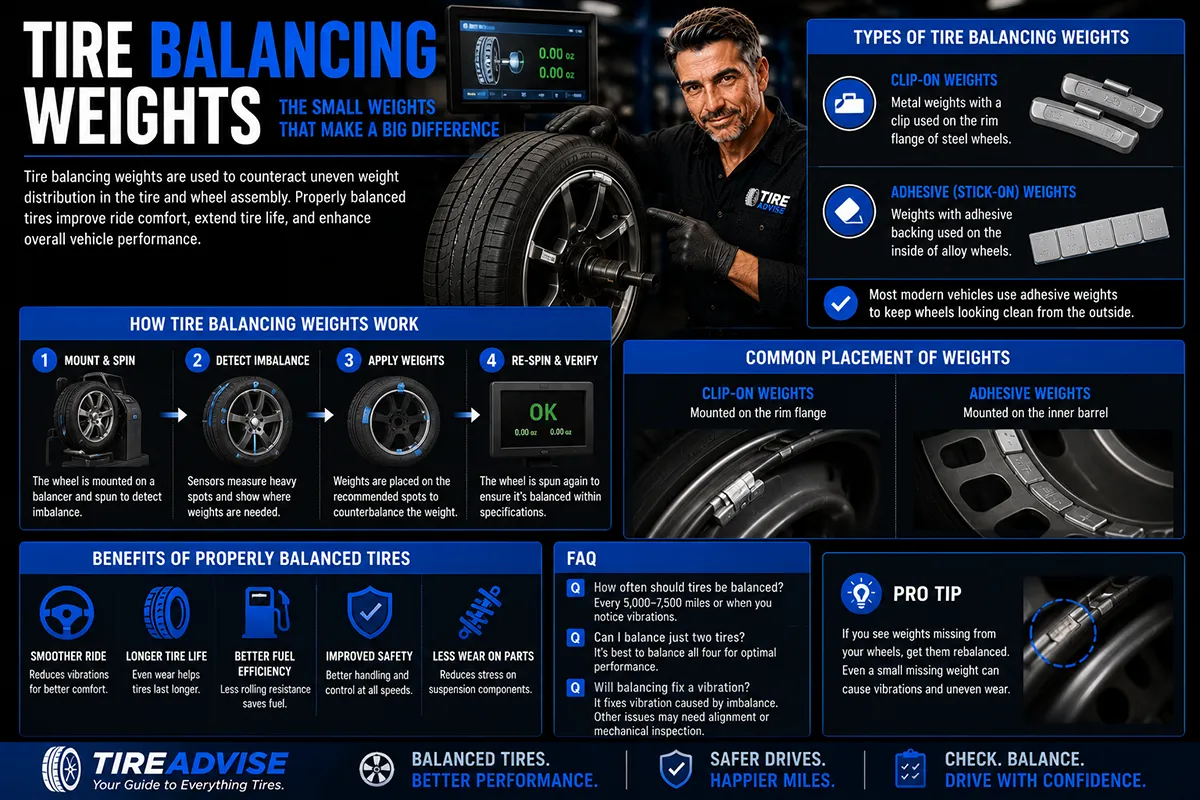
Clip-On (Hammer-On) Weights
These are the traditional balancing weights that have been around for decades. They feature a metal clip that a technician hammers onto the inner or outer lip of your wheel rim. I see these most often on steel wheels and some older-style alloy wheels with a pronounced lip.
The advantages are clear — they’re secure, easy for techs to install, and they stay put even in harsh conditions. I’ve tested vehicles through brutal Northeast winters with clip-on weights, and they rarely come loose.
The downside? On modern alloy and painted wheels, clip-on weights can scratch the finish. I’ve seen beautiful aftermarket wheels marred by careless installation. If you have nice alloys, make sure you mention this to your tire tech before they start working.
Adhesive (Stick-On) Weights
Stick-on weights use a strong adhesive backing to attach to the inside barrel of the wheel. They’re the go-to choice for alloy wheels, custom wheels, and any rim where you don’t want visible weights on the outside.
I personally prefer stick-on weights for most modern vehicles. They’re hidden from view, they don’t damage wheel finishes, and when installed properly on a clean surface, they hold remarkably well. I’ve only had adhesive weights fall off a handful of times, usually because the wheel surface wasn’t properly cleaned before application.
The catch is that adhesive can fail in extreme heat or if the wheel wasn’t prepped correctly. If you live in Arizona or Texas and park in direct sun regularly, it’s worth mentioning this to your tech so they use high-temperature adhesive tape.
Coated Weights
These are essentially clip-on weights with a protective coating — usually plastic or epoxy — that prevents direct metal-to-metal contact with the wheel. I recommend these as a middle ground if you have alloy wheels but the tire shop prefers clip-on application. The coating prevents scratching while maintaining the secure grip of a mechanical clip.
Weight Materials: Lead vs. Steel vs. Zinc
This is an area that’s been evolving, and I think it’s worth understanding. Here’s the breakdown:
| Material | Pros | Cons | Average Cost | Status |
|---|---|---|---|---|
| Lead | Dense (small size), easy to work with, inexpensive | Toxic, environmental concerns, being phased out | $0.10–$0.30 per weight | Banned or restricted in several states |
| Steel | Inexpensive, widely available, eco-friendly | Less dense (bulkier), can corrode without coating | $0.15–$0.40 per weight | Most common replacement for lead |
| Zinc | Good density, corrosion-resistant, eco-friendly | Slightly more expensive than steel | $0.20–$0.50 per weight | Increasingly popular, preferred by many shops |
| Composite/Plastic | Lightweight, no corrosion, eco-friendly | Very bulky, limited availability | $0.30–$0.60 per weight | Niche use, mainly in Europe |
In my experience, zinc and steel weights have become the standard at most major US tire chains like Discount Tire, Tire Rack, and Costco. Lead is still out there, but states like California, Illinois, Maine, Vermont, and Washington have enacted or are considering restrictions on lead wheel weights due to environmental contamination concerns.
I’ve tested vehicles with all four materials, and honestly, from a performance standpoint, you’re not going to feel any difference. The material doesn’t affect ride quality — proper placement and the right amount of weight is what matters.
How Tire Balancing Actually Works
I’ve stood next to the balancing machine more times than I can count, watching techs work. Here’s what actually happens during the process, because I think understanding it helps you evaluate whether a shop is doing a good job.
Step 1: Mount the Tire and Wheel on the Balancer
The technician places your wheel assembly on a computerized balancing machine — a spin balancer. The machine has a cone and locking mechanism that centers the wheel perfectly. I always watch to make sure the tech uses the correct cone and adapter for my wheel size. A sloppy setup here can throw off the entire reading.
Step 2: Spin and Measure
The machine spins the wheel at high speed and uses sensors to detect where the heavy and light spots are. Modern balancers from companies like Hunter Engineering and CEMB are incredibly precise — they can detect imbalances down to a fraction of a gram. The machine’s screen displays exactly where weights need to go and how much weight is needed.
Step 3: Apply Weights
Based on the machine’s readings, the tech places weights at specific locations on the wheel. For a standard dynamic balance (which is what you want), weights are placed on both the inner and outer planes of the wheel. This corrects both static imbalance (up-and-down bounce) and dynamic imbalance (side-to-side wobble).
Step 4: Verification Spin
This is the step I always insist on watching. After the weights are applied, the tech should spin the wheel again to confirm it reads zero on both planes. If it doesn’t, adjustments are made. I’ve been to shops where techs skip this step — that’s a red flag, and I’d take my business elsewhere.
Static vs. Dynamic Balancing: What’s the Difference?
You might hear these terms thrown around, and they matter.
Static balancing only addresses vertical imbalance — the up-and-down bounce. It places weight on a single plane (usually the centerline of the wheel). This was more common in older shops and is generally considered less thorough.
Dynamic balancing addresses both vertical and lateral imbalance by placing weights on the inner and outer edges of the wheel. This is the modern standard, and I always insist on it. Any reputable shop should be doing dynamic balancing by default.
There’s also road force balancing, which I consider the gold standard. Machines like the Hunter Road Force Elite simulate the pressure of the road against the tire while it spins. This catches issues that standard spin balancers miss, like stiff spots in the tire sidewall or out-of-round wheels. I’ve had tires that balanced perfectly on a standard machine but still produced a slight vibration — road force balancing identified and resolved the problem.
Road force balancing typically costs $10–$20 more per tire, but in my experience, it’s worth every penny, especially on luxury vehicles or if you’re sensitive to vibrations.
Signs Your Tire Balancing Weights Need Attention
Over the years, I’ve developed a pretty reliable checklist for identifying balance-related issues. Here’s what I watch for:
- Steering wheel vibration at highway speeds: This is the classic symptom. If your steering wheel shakes between 55–75 mph but smooths out at lower speeds, your front tires are likely out of balance.
- Seat or floorboard vibration: If the vibration is coming from behind you or through the floor, the rear tires are probably the culprits. This one is easy to miss because it’s less obvious than a shaking steering wheel.
- Visible missing weights: I make it a habit to visually inspect my wheels periodically. If I see a clean spot where an adhesive weight used to be, or an empty clip mark on the rim lip, I know a weight has fallen off.
- Uneven tire wear: Cupping or scalloped patterns on the tread surface are a telltale sign of imbalance. I check my tire tread with a hand rub — if it feels smooth in one direction but rough in the other, there’s likely a balance or suspension issue.
- Recent pothole impact or curb strike: After hitting a significant pothole (which happens all too often on US roads, especially in the Midwest and Northeast), I always get my balance checked. The impact can shift weights or change the tire’s balance characteristics.
How Much Does Tire Balancing Cost in the US?
I’ve tracked prices across multiple shops and regions over the years. Here’s what you can generally expect to pay in 2024:
- Standard spin balancing: $15–$30 per tire ($60–$120 for all four)
- Road force balancing: $25–$50 per tire ($100–$200 for all four)
- Balancing included with new tire purchase: Many shops like Discount Tire, Costco, Sam’s Club, and America’s Tire include lifetime balancing with new tire purchases — this is a huge value
- Rebalancing only: $10–$20 per tire at most independent shops
I always recommend buying tires from a shop that includes lifetime balancing and rotation. Discount Tire is my go-to recommendation for this — their lifetime balancing program has saved me hundreds of dollars over the years. Costco also includes this with their tire installation package.
If you’re paying out of pocket for standalone balancing, independent tire shops are usually cheaper than dealerships. I’ve seen dealerships charge $25–$40 per tire for a service that the indie shop down the street does for $15.
When Should You Get Your Tires Rebalanced?
Based on my testing and experience, here are the situations where I always get my tires rebalanced:
- When installing new tires: This is non-negotiable. Every new tire must be balanced on the wheel it’s being mounted to.
- During tire rotations: I recommend rebalancing at every rotation. Some shops include this automatically, others charge extra. It’s worth asking.
- After noticing vibrations: Don’t wait and hope it goes away. Vibrations get worse, not better, and they’re causing wear on your tires and suspension components every moment you drive.
- After a significant impact: Potholes, curb strikes, or hitting road debris can all throw off your balance.
- Seasonal tire swaps: If you switch between summer and winter tires, balance each set when it goes on the car.
- After a tire repair: Any time a tire is dismounted and remounted (like for a patch), it should be rebalanced.
Tire Balancing Weights vs. Internal Balancing Methods
Traditional clip-on and adhesive weights aren’t the only game in town. I’ve experimented with several alternative balancing methods, and I want to give you an honest assessment of each.
Balancing Beads
Products like Counteract Balancing Beads, Checkered Flag Beads, and Dyna Beads are small glass or ceramic beads that you put inside the tire. As the wheel spins, the beads distribute themselves to the light spots through centrifugal force.
I’ve tested balancing beads on a set of all-terrain tires, and I’ll say this — they work, but with caveats. They were effective at highway speeds once the beads settled into position after a few days of driving. However, at lower speeds, I noticed they weren’t as effective as traditional weights. They also don’t address dynamic imbalance as precisely as machine-placed weights.
Where I think beads shine is for off-road vehicles and trucks that frequently throw clip-on weights. If you’re constantly losing weights on the trail, beads are a practical alternative. For everyday passenger car use, I still recommend traditional weights.
Tire Balancing Fluid (Liquid Balancing)
Products like Equal Flexx and Balance Plus use a liquid or gel substance inside the tire. Similar concept to beads. I’ve found these to work reasonably well for commercial vehicles and larger truck tires, but I don’t recommend them for standard passenger cars. They can mask TPMS sensor readings and create a mess if the tire needs to be dismounted for repair.
Match Mounting
This isn’t really a balancing method, but it works alongside it. Match mounting involves aligning the tire’s lightest point (marked with a yellow dot) with the wheel’s heaviest point (usually the valve stem). This minimizes the total imbalance before any weights are applied, meaning less weight is needed.
I always ask my tire tech to match-mount when possible. It results in a cleaner installation and often a smoother ride. Not all techs bother with this, so it’s worth requesting specifically.
Common Myths About Tire Balancing Weights
I’ve heard a lot of misinformation over the years. Let me set the record straight on the most common myths.
Myth 1: “You Only Need to Balance Tires Once”
Wrong. Tires change over time. Tread wears unevenly, weights can shift or fall off, and impacts alter the balance. I’ve seen tires that were perfectly balanced at installation develop significant imbalances after several months of driving. Regular rebalancing is maintenance, not a one-time event.
Myth 2: “Balancing and Alignment Are the Same Thing”
I hear this constantly, and it drives me nuts. Balancing deals with weight distribution on the wheel. Alignment deals with the angles of the wheels relative to each other and the road. You can have perfectly balanced tires with terrible alignment, and vice versa. Both matter, but they’re separate services addressing different issues.
Myth 3: “More Weights Means Something Is Wrong”
Not necessarily. Some tire-and-wheel combinations simply require more weight than others. I’ve seen perfectly good setups that needed 3+ ounces per wheel. The important thing is that the final balance reads zero, not how many weights it took to get there. That said, if a wheel requires an abnormally large amount of weight (say, over 5 ounces), I’d investigate whether the tire or wheel has a defect.
Myth 4: “You Can Balance Tires Yourself at Home”
Can you? Technically, yes, with bubble balancers or portable balancers available on Amazon for $30–$80. Should you? In my opinion, no — not if you want it done right. Home balancers only perform static balancing and lack the precision of computerized spin balancers. For the $15–$20 a shop charges per tire, it’s not worth the compromise.
Myth 5: “Adhesive Weights Always Fall Off”
I used to believe this one myself. But modern 3M adhesive tape used on quality stick-on weights is incredibly strong. In my testing, properly applied adhesive weights on a clean, degreased wheel surface held up through extreme heat, bitter cold, highway driving, and even car washes without any issues. The ones that fall off are almost always the result of poor surface prep during installation.
How to Choose the Right Balancing Weights for Your Wheels
In most cases, your tire shop will select the appropriate weight type for your wheels. But it helps to know what to ask for, especially if you have aftermarket or specialty wheels.
- Steel wheels (like winter wheel sets): Standard clip-on weights work perfectly. They’re affordable and secure.
- OEM alloy wheels: Adhesive stick-on weights are usually the best choice to avoid cosmetic damage. Coated clip-on weights are a good alternative.
- Custom/aftermarket wheels: Always use adhesive weights on the inside barrel. I’ve seen too many expensive aftermarket wheels damaged by improperly applied clip-on weights. If your shop insists on clip-ons for your custom wheels, find a different shop.
- Chrome or polished wheels: Adhesive only, no exceptions. Clip-on weights will chip and scratch chrome finishes immediately.
What to Tell Your Tire Shop
After years of being in and out of tire shops, I’ve learned that clear communication makes a big difference. Here’s what I recommend telling your tire technician:
- Specify whether you want adhesive or clip-on weights, especially if you have alloy wheels
- Request lead-free weights if environmental impact matters to you
- Ask for match mounting (yellow dot to valve stem)
- Request road force balancing if available, especially if you’ve had recurring vibration issues
- Ask them to verify balance with a second spin after applying weights
- If you have TPMS sensors, remind them to be careful during weight placement so adhesive weights don’t interfere with the sensor
Most good techs do all of this automatically. But I’ve been to enough shops to know that not every tech is equally thorough.
DIY Weight Inspection: What to Look For
You don’t need to be a mechanic to inspect your balancing weights. I do a quick visual check every time I wash my car or check my tire pressure. Here’s what I look for:
For clip-on weights: Make sure they’re still firmly attached to the rim lip. Give them a light tap — they shouldn’t move at all. Look for rust or corrosion that could weaken the clip.
For adhesive weights: Check the inside of the wheel (you might need a flashlight). Look for weights that are peeling away or shifting position. If an adhesive weight is dangling or missing entirely, get rebalanced as soon as possible.
For any type: Look for clean rectangular marks or adhesive residue on the wheel where a weight used to be — this means one has fallen off.
I’ve found that a quick post-winter inspection is especially important. Road salt, temperature swings, and pothole impacts during the winter months in the Northern US are brutal on balancing weights.
The Environmental Angle: Why Lead Weights Are Disappearing
This is something I think more drivers should be aware of. The EPA estimates that millions of pounds of lead wheel weights fall off vehicles and end up on US roadways every year. That lead eventually washes into waterways and soil, creating real environmental contamination.
As I mentioned earlier, several states have already restricted or banned lead wheel weights. The industry is moving toward zinc and steel alternatives, and I fully support that transition. In my testing, zinc and steel weights perform identically to lead. There’s literally no downside for the consumer.
When you’re at the tire shop, you can specifically request lead-free weights. Most major chains have already made the switch, but some independent shops still use lead because it’s cheaper. It’s a small thing you can do that adds up on a large scale.
My Final Take on Tire Balancing Weights
After all my years of tire testing, I can tell you with confidence that proper tire balancing is one of the highest-value maintenance items you can invest in. The cost is minimal — often free if bundled with a tire purchase — and the benefits to ride comfort, tire longevity, and suspension health are enormous.
Don’t skip it. Don’t delay it. And don’t settle for a shop that cuts corners on the process.
If you’re shopping for new tires, factor balancing into your total cost and look for shops that include lifetime balancing. It will save you money and headaches down the road. If you’re experiencing vibrations right now, get your balance checked before you start worrying about more expensive problems — there’s a very good chance a few small weights are all it takes to fix everything.
These little pieces of metal are easy to overlook, but they make a massive difference in how your car drives. Trust me on this one.
Frequently Asked Questions
What are tire balancing weights and why does my car need them?
Tire balancing weights are small metal or adhesive weights attached to your wheel rim to correct uneven weight distribution in the tire and wheel assembly. Without them, you’ll experience vibrations in the steering wheel or floorboard, especially at highway speeds of 55-75 mph. Every time you mount new replacement tires, a technician uses a balancing machine to identify heavy spots and then places these weights to ensure smooth, even rotation.
How much does it cost to have tire balancing weights installed in the US?
Most US tire shops charge between $15 and $40 per tire for balancing, which includes the cost of the weights themselves. Retailers like Discount Tire, Tire Rack, and Costco often include free lifetime balancing when you purchase replacement tires through them. I always recommend asking about bundled balancing services when shopping for new tires because it can save you $100 or more over the life of the tires.
What’s the difference between clip-on and adhesive stick-on tire balancing weights?
Clip-on weights clamp directly onto the outer lip of steel rims and are the traditional, most durable option for standard wheels. Adhesive stick-on weights attach to the inside barrel of the wheel and are preferred for alloy and custom rims because they stay hidden and won’t scratch the finish. If you’re buying aftermarket alloy wheels with your replacement tires, make sure the shop uses stick-on weights to protect your investment.
How often should tire balancing weights be checked or replaced?
You should have your tire balance checked every 5,000 to 7,500 miles, which conveniently lines up with most tire rotation schedules. Balancing weights can fall off due to potholes, curb strikes, or corrosion, especially if you drive on rough US roads or through harsh winter conditions. If you notice vibrations developing between rotations, get your balance checked immediately to prevent uneven tread wear on your new tires.
Can tire balancing weights fall off and what happens if they do?
Yes, tire balancing weights can and do fall off, particularly clip-on weights that get knocked loose by potholes or curb impacts. When a weight falls off, the tire becomes unbalanced, which causes vibrations and can lead to accelerated and uneven tread wear that shortens your tire life significantly. I’ve seen cases where a missing weight caused cupping wear on a brand-new set of tires within just a few thousand miles, so it’s worth getting it addressed quickly.
Are lead tire balancing weights still legal or should I ask for lead-free alternatives?
Several US states including California, Illinois, Maine, Vermont, and Washington have banned or restricted lead balancing weights due to environmental concerns. Most reputable tire shops now use zinc, steel, or composite lead-free weights as standard practice, and these alternatives perform just as well for everyday driving. When getting replacement tires mounted, it’s worth confirming your shop uses lead-free weights, especially if you want to stay compliant and reduce environmental impact.
What’s the difference between tire balancing weights and wheel alignment, and do I need both with new tires?
Tire balancing weights correct the weight distribution of each individual tire and wheel assembly to eliminate vibrations, while wheel alignment adjusts the angles of your suspension so all four tires make proper contact with the road. When installing replacement tires, balancing is always required, and I strongly recommend getting an alignment at the same time since misalignment causes rapid and uneven tire wear. Expect to pay $75 to $120 for a four-wheel alignment at most US shops on top of the balancing cost.
