

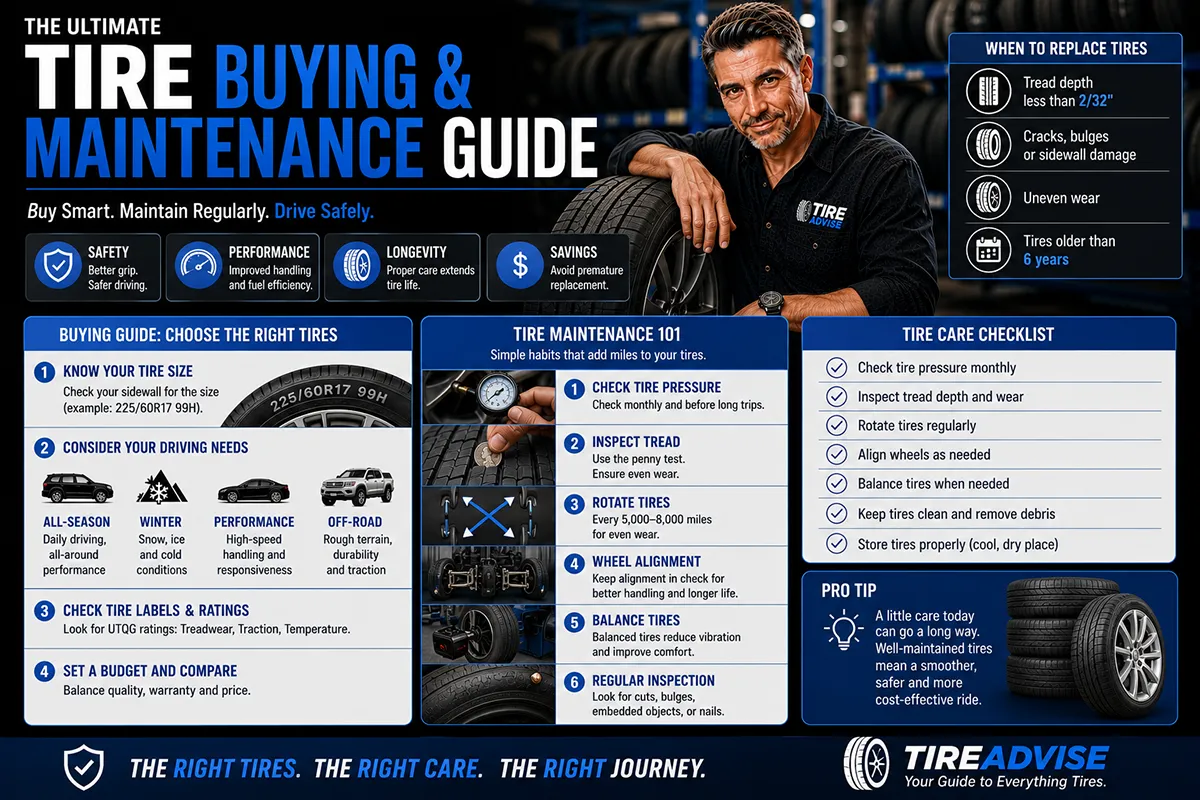
Most people don’t think about their tires until something goes wrong — a blowout on the highway, a failed inspection, or that sickening feeling when your car hydroplanes through a puddle at 60 mph.
I’ve been there. Years ago, I cheaped out on a set of tires, skipped rotations, and ignored my tire pressure for months. I ended up with uneven wear so bad that one tire was nearly bald while the others still had half their tread left. That expensive lesson changed the way I approach every tire purchase and every bit of maintenance I do.
After testing dozens of tire brands across multiple vehicles and spending years writing about tires for everyday drivers, I’ve distilled everything I know into this guide. Whether you’re buying your first set of replacement tires or you’ve been driving for decades, I’m confident this will save you money and keep you safer on the road.
- Always check your vehicle’s tire size on the door placard or owner’s manual before shopping.
- Don’t buy on price alone — consider treadwear rating, speed rating, and warranty length.
- Check tire pressure at least once a month and before long trips.
- Rotate your tires every 5,000–7,500 miles (or roughly every other oil change).
- Alignment and balancing issues can destroy a new set of tires in a matter of months.
- Buying from retailers like Tire Rack, Costco, or Discount Tire often gets you the best value in the US market.
- Proper maintenance can extend your tire life by 20–30% compared to a neglected set.
Liked this article?
Add TireAdvise as a preferred source so you see more of our tire reviews and guides on Google.
Part 1: How to Buy the Right Tires
Buying tires can feel overwhelming. There are hundreds of brands, confusing size codes, and a dizzying range of prices from $60 to $300+ per tire. I’m going to walk you through my exact process for narrowing down the options and making a smart purchase.
Step 1: Know Your Tire Size
Before you even start browsing, you need to know your tire size. This is non-negotiable.
You’ll find it in three places: the sticker on your driver’s side door jamb, your owner’s manual, or printed on the sidewall of your current tires. It looks something like 225/65R17.
Here’s what that code means:
- 225 — the tire width in millimeters
- 65 — the aspect ratio (sidewall height as a percentage of width)
- R — radial construction (virtually all modern tires)
- 17 — the wheel diameter in inches
I always recommend going with the size specified by your vehicle manufacturer. Upsizing or downsizing can affect speedometer accuracy, ride quality, and even your car’s stability control systems. In my experience, the factory size is the factory size for a reason.
Step 2: Choose Your Tire Type
Not all tires are created equal, and choosing the right category for your driving conditions is one of the most important decisions you’ll make. Here’s a breakdown of the main types I recommend for US drivers:
All-Season Tires: These are the default for most American drivers, and for good reason. They handle a wide range of conditions — dry highways, wet city streets, and light snow. If you live anywhere from the Southeast to the Pacific Northwest and don’t deal with extreme winters, all-season tires are probably your best bet. I’ve tested sets from Continental, Michelin, and Cooper that performed admirably across three seasons with no complaints.
Winter/Snow Tires: If you live in the northern states — Minnesota, Michigan, Wisconsin, the Northeast — I strongly recommend a dedicated set of winter tires for the cold months. In my testing, winter tires consistently stopped 20–40 feet shorter on snow and ice compared to all-season tires at the same speed. That difference can be the margin between stopping safely and a fender bender.
All-Terrain Tires: For truck and SUV owners who mix highway driving with dirt roads or light off-roading, all-terrain tires strike a solid balance. I’ve tested options from BFGoodrich, Falken, and Toyo that held up well on both pavement and gravel without being unbearably loud on the highway.
Performance Tires: These are designed for grip, handling, and responsiveness. They’re great on dry and wet pavement but typically wear faster and perform poorly in cold weather. I only recommend these if you drive a sports car or genuinely prioritize handling over longevity.
Highway Tires: Designed for trucks and SUVs that stay on paved roads, these offer a quieter, smoother ride than all-terrain options. If your truck never leaves the pavement, highway tires are a smart move.
Step 3: Read the Sidewall — UTQG Ratings Matter
Every tire sold in the US is required to display UTQG (Uniform Tire Quality Grading) ratings. I pay close attention to these, and you should too.
- Treadwear: This is a comparative rating. A tire rated 400 should last twice as long as one rated 200 under identical conditions. I generally look for tires rated 500 or higher for daily driving.
- Traction: Rated AA, A, B, or C. This measures wet braking grip. I won’t buy anything rated below A for a vehicle I drive regularly.
- Temperature: Rated A, B, or C. This measures heat resistance at speed. For highway driving, I always go with A-rated tires.
These ratings aren’t perfect — they’re based on manufacturer testing against a reference tire — but they’re one of the best standardized tools we have for comparison shopping.
Step 4: Set a Realistic Budget
Here’s the honest truth from my experience: you don’t need to buy the most expensive tire, but the cheapest options usually cost you more in the long run.
In the US market, I’ve found the sweet spot for quality all-season tires to be between $100 and $180 per tire for common passenger car sizes. For trucks and SUVs, expect $150 to $250 per tire. Premium brands like Michelin and Continental sit at the top of that range, while brands like Cooper, Hankook, and General Tire offer excellent value in the middle.
I’ve tested budget tires priced under $70 per tire, and while some are acceptable, many show significantly faster wear and noticeably worse wet braking performance. You’re not saving money if you have to replace tires 30% sooner.
Step 5: Compare Specific Models
Once I know my tire size, type, and budget, I start comparing specific models. Here’s a comparison table of some of the most popular all-season tire options I’ve personally tested or thoroughly evaluated for the US market:
| Tire Model | Type | Approx. Price (per tire) | Treadwear Warranty | Best For |
|---|---|---|---|---|
| Michelin Defender 2 | All-Season | $150–$200 | 80,000 miles | Long-lasting daily driving |
| Continental TrueContact Tour | All-Season | $130–$170 | 80,000 miles | Comfort and wet grip |
| Cooper Endeavor Plus | All-Season | $110–$140 | 65,000 miles | Budget-friendly value |
| Bridgestone Alenza AS Ultra | All-Season (SUV) | $170–$220 | 80,000 miles | SUV comfort and longevity |
| General AltiMAX RT45 | All-Season | $90–$120 | 75,000 miles | Budget all-rounder |
| Hankook Kinergy PT | All-Season | $85–$115 | 90,000 miles | High-mileage warranty value |
I’ve had personal seat time with every tire on this list, and I can tell you there are no bad options here. The right choice depends on your priorities: longevity, comfort, wet performance, or price.
Step 6: Where to Buy — My Honest Recommendations
In the US, you have several great options for purchasing tires, and I’ve used all of them extensively:
Tire Rack: This is my go-to for selection and research. They ship to a local installer near you, and their user reviews are genuinely helpful. I’ve ordered more sets through Tire Rack than I can count, and the process has been smooth every single time.
Costco: If you’re a member, Costco offers competitive pricing, free lifetime rotation and balancing, and nitrogen inflation. Their selection is more limited, but the value proposition is excellent. I recommend Costco especially if you’re buying a mainstream brand like Michelin or Bridgestone.
Discount Tire / America’s Tire: The largest independent tire dealer in the US. Great in-store experience, price matching, and their certificate program (which covers road hazard damage) is one of the best in the business. I’ve used Discount Tire for emergency replacements and always had a positive experience.
Walmart Auto Care: Walmart offers some of the lowest installed prices, especially on budget and mid-range brands. The installation quality varies by location, though. I’ve had good experiences at some locations and mediocre ones at others.
Local tire shops: Don’t overlook independent shops. They often match online prices, and you’re supporting a local business. I’ve found some of my best tire deals through local shops that were willing to negotiate.
Part 2: Tire Maintenance That Actually Matters
Buying the right tire is only half the equation. I’ve seen people ruin perfectly good tires through neglect. Here’s the maintenance routine I follow — and recommend — based on years of real-world experience.
Tire Pressure: The Single Most Important Thing You Can Do
If you only do one thing from this entire guide, let it be this: check your tire pressure at least once a month.
Underinflated tires wear faster on the edges, reduce fuel economy, generate excess heat, and can even lead to blowouts. Overinflated tires wear faster in the center and reduce your contact patch, hurting grip. I’ve personally seen sets of tires with uneven wear patterns that were caused entirely by incorrect pressure — nothing else.
Your correct tire pressure is listed on the driver’s side door jamb sticker, not on the tire sidewall. The number on the sidewall is the maximum pressure, not the recommended pressure. This is one of the most common mistakes I see.
I keep a good digital tire gauge in my glove box. They cost around $10–$15 at any auto parts store, and they’re far more accurate than the pencil-type gauges or gas station units. I check my pressure on cool tires — first thing in the morning or after the car has sat for at least three hours.
Here’s a tip I wish someone had told me years ago: tire pressure drops about 1 PSI for every 10°F drop in temperature. So when fall arrives and temperatures drop from the 80s to the 50s, you could easily lose 3 PSI without driving a single mile. I always do a pressure check when seasons change.
Tire Rotation: Don’t Skip It
Tire rotation is the practice of moving tires from one position on the vehicle to another to promote even wear. Front tires on a front-wheel-drive car, for example, wear faster because they handle both steering and most of the braking and acceleration forces.
I rotate my tires every 5,000 to 7,500 miles, which works out to roughly every other oil change for most people. The most common rotation pattern for front-wheel-drive vehicles is moving the front tires straight to the back, then crossing the rear tires to the front. For all-wheel-drive and rear-wheel-drive vehicles, the pattern may differ — your owner’s manual will specify.
In my experience, consistent rotation extends tire life significantly. I’ve seen sets that were rotated regularly last noticeably longer than identical tires on similar vehicles that were never rotated. The wear difference is dramatic.
Many tire retailers — Costco, Discount Tire, and others — offer free rotations when you buy tires from them. There’s no excuse not to take advantage of this.
Wheel Alignment: The Silent Tire Killer
A misaligned vehicle can destroy a brand-new set of tires in a shockingly short time. I once put a fresh set of Continental tires on a vehicle with a slight alignment issue that I didn’t know about. Within a couple of months, the inner edges of the front tires were noticeably more worn than the rest of the tread. I was furious with myself for not catching it sooner.
Here are the signs that your alignment might be off:
- Your car pulls to one side on a straight, flat road
- Your steering wheel is off-center when driving straight
- You notice uneven wear on the inner or outer edges of your tires
- The steering feels loose or wanders
I recommend getting an alignment check whenever you buy new tires, after hitting a significant pothole or curb, or if you notice any of the symptoms above. A four-wheel alignment typically costs $80 to $120 at most shops in the US, and it’s money well spent to protect a $500–$800 tire investment.
Wheel Balancing: Eliminate the Vibrations
Wheel balancing ensures that the weight of the tire and wheel assembly is evenly distributed. Unbalanced wheels cause vibrations — usually felt in the steering wheel at highway speeds — and lead to uneven, accelerated tread wear.
I get my wheels balanced whenever I have new tires mounted and whenever I have a rotation done (if the shop offers it). If I start feeling a vibration that wasn’t there before, I head to a tire shop. It’s usually a quick fix: a small wheel weight either fell off or needs to be repositioned.
Most shops charge $15–$20 per wheel for balancing, and many include it free with tire purchases or rotations.
Tread Depth: How to Know When It’s Time to Replace
In the US, the legal minimum tread depth is 2/32 of an inch. But in my experience, tire performance — especially in wet conditions — starts degrading well before you hit that legal minimum.
I start shopping for replacements when my tread depth reaches 4/32 of an inch. At that point, wet braking distances increase significantly, and hydroplaning risk goes up. I’ve tested tires at various tread depths, and the difference in wet stopping distance between 6/32 and 3/32 is genuinely alarming.
Here’s how I check tread depth:
The penny test: Insert a penny into a tread groove with Lincoln’s head facing down. If you can see the top of Lincoln’s head, your tread is at or below 2/32 of an inch, and you need new tires immediately.
The quarter test: Same concept, but with a quarter. If you can see the top of Washington’s head, your tread is at or below 4/32 of an inch, and I’d recommend starting to plan your next tire purchase.
A tread depth gauge: These cost about $5 at any auto parts store and give you an exact measurement. I keep one next to my tire pressure gauge.
Most tires also have built-in tread wear indicators — small raised bars in the tread grooves. When the tread surface is flush with these bars, you’re at 2/32 and need to replace immediately.
Tire Storage: For Those Who Swap Seasonal Sets
If you run a separate set of winter tires, proper storage of the off-season set matters more than most people realize.
I store my off-season tires in a cool, dry place away from direct sunlight and sources of ozone (like electric motors or furnaces). I clean them before storage, stack them flat if they’re unmounted, or stand them upright if they’re mounted on wheels. I also put them in tire storage bags — they’re cheap and help prevent the rubber from drying out.
UV exposure and temperature extremes break down rubber compounds over time. I’ve seen tires that were perfectly good when stored become cracked and brittle after a few years in a hot, sunny garage. Take care of your investment.
Part 3: Common Mistakes I See (and Have Made)
After years of testing, reviewing, and advising friends and family on tires, here are the most common mistakes I encounter:
Mixing tire brands or types on the same axle. I’ve seen people put one brand on the front left and a different brand on the front right because they replaced a single damaged tire. This can create unpredictable handling, especially in wet conditions. Always replace tires in pairs on the same axle at minimum, and use the same brand and model if possible.
Ignoring the age of the tires. Rubber degrades over time, even if the tread looks fine. I check the DOT date code on the sidewall — a four-digit number where the first two digits are the week and the last two are the year of manufacture. For example, “2322” means the tire was made in the 23rd week of 2022. Most tire manufacturers and safety organizations recommend replacing tires that are six to ten years old, regardless of tread depth.
Not reading the warranty terms. Treadwear warranties sound great — 80,000 miles! — but they come with conditions. Most require proof of regular rotations, correct inflation, and proper alignment. If you can’t show maintenance records, your warranty claim will likely be denied. I keep all my tire service receipts in a folder for this reason.
Buying tires based solely on online reviews without considering driving conditions. A tire that gets rave reviews in Arizona might be terrible for someone in Vermont. I always consider the climate, road conditions, and typical driving scenarios of my area when choosing tires.
Neglecting the spare tire. If your vehicle has a full-size or compact spare, check its pressure regularly. I’ve been on the side of the road with a flat only to discover that my spare was also flat. That’s a mistake you only make once.
Part 4: Seasonal Tire Tips for US Drivers
The US spans an enormous range of climates, and your tire strategy should reflect where you live.
Sun Belt States (Texas, Arizona, Florida, etc.)
Heat is your enemy. High temperatures accelerate rubber degradation and increase the risk of blowouts, especially if your tires are underinflated. I recommend all-season tires with high temperature ratings (Grade A) and checking your pressure more frequently during the summer months. In my experience testing tires in hot climates, premium compounds from brands like Michelin and Continental resist heat degradation better than budget options.
Northern States (Minnesota, Wisconsin, New York, etc.)
If you deal with regular snow and ice, I can’t stress this enough: get a dedicated set of winter tires. All-season tires are a compromise, and in severe winter conditions, that compromise can be dangerous. I’ve tested all-season vs. winter tires back-to-back on the same vehicle in snow, and the difference in traction, braking, and confidence is night and day.
Look for tires with the Three-Peak Mountain Snowflake (3PMSF) symbol on the sidewall. This means the tire has met an industry-standard performance threshold in snow testing.
Pacific Northwest and Rainy Regions
Wet traction should be your top priority. Look for tires with wide circumferential grooves and high traction ratings (AA). I’ve driven extensively in the Pacific Northwest, and tires with strong hydroplaning resistance make an enormous difference on those soaked highways. The Continental TrueContact Tour and Michelin Defender 2 are two of my top picks for rainy climates.
Mountain and High-Altitude Areas (Colorado, Utah, Montana, etc.)
You’re dealing with temperature swings, gravel roads, and potentially mandatory tire chain requirements. All-terrain tires or aggressive all-season tires are often the best choice. I’ve had great results with the Falken Wildpeak A/T3W and the BFGoodrich All-Terrain T/A KO2 in mountain driving conditions.
Part 5: My Maintenance Checklist — Print This Out
I follow this schedule religiously, and I recommend you do the same:
- Monthly: Check tire pressure on all four tires plus the spare. Visually inspect for damage, bulges, or embedded objects.
- Every 5,000–7,500 miles (every other oil change): Rotate tires. Have them rebalanced if you notice any vibrations.
- Every 12 months or when symptoms appear: Get a four-wheel alignment check.
- Every time you check pressure: Do a quick tread depth check with the quarter test.
- At the start of each season change: Re-check pressure (temperature changes affect PSI) and inspect for weather-related damage.
- Every 5–6 years: Have a professional inspect the tires for age-related cracking and degradation, even if tread looks fine.
This takes minimal effort, but the payoff — in safety, tire life, and money saved — is enormous. I’ve found that drivers who follow a routine like this consistently get more life from their tires compared to those who take a “set it and forget it” approach.
Final Thoughts: Tires Are Your Car’s Most Important Safety Feature
I know tires aren’t exciting. Nobody wakes up excited to shop for rubber. But after years of testing tires, pushing them to their limits in rain, snow, and scorching heat, I can tell you this: nothing on your vehicle affects your safety, comfort, and driving experience more than your tires.
They’re the only part of your car that touches the road. Every bit of acceleration, braking, and steering goes through four small contact patches that are each roughly the size of your hand.
Invest in quality tires that match your driving conditions. Maintain them properly. Pay attention to them. In my experience, the drivers who treat their tires as a priority — rather than an afterthought — are the ones who stay safest on the road and spend less money over time.
If you have questions about a specific tire or need help choosing the right set for your vehicle, drop a comment below or check out our individual tire reviews here on TireAdvise.com. I’m always happy to help.
Drive safe out there.
Frequently Asked Questions
How do I know when it’s time to replace my tires?
You should replace your tires when the tread depth reaches 2/32 of an inch, which you can check using the penny test — insert a penny head-first into the tread, and if you can see all of Lincoln’s head, it’s time for new tires. I also recommend replacing tires that are older than 6 years regardless of tread depth, as the rubber compound degrades over time even with minimal driving. Look for visible signs like sidewall cracks, bulges, or uneven wear patterns, which can indicate alignment issues or the need for immediate replacement.
How much does a full set of replacement tires cost in the US?
A full set of four replacement tires typically costs between $400 and $1,200 for most passenger cars and SUVs in the US, depending on the brand, size, and performance rating. Budget-friendly options from brands like Cooper, Hankook, or General Tire can run $80–$130 per tire, while premium brands like Michelin, Bridgestone, or Goodyear range from $150–$300+ per tire. Don’t forget to factor in mounting, balancing, valve stems, and tire disposal fees, which usually add $60–$100 total for all four tires.
What’s the difference between all-season tires and all-weather tires?
All-season tires are designed to handle dry and wet roads in moderate temperatures but lose significant grip below 45°F, making them a poor choice for harsh winters. All-weather tires carry the Three-Peak Mountain Snowflake (3PMSF) symbol, meaning they’re certified for severe snow conditions while still performing well in summer heat — they’re essentially a year-round compromise between all-season and dedicated winter tires. For US drivers in states like Colorado, Michigan, or the Pacific Northwest, all-weather tires from brands like Nokian or Toyo can eliminate the hassle of seasonal tire swaps.
How often should I rotate my tires and why does it matter?
I recommend rotating your tires every 5,000 to 7,500 miles, which conveniently aligns with most oil change intervals so you can knock out both services at once. Tire rotation matters because front and rear tires wear at different rates — front tires on FWD vehicles wear faster due to steering and engine weight — and skipping rotations can cost you thousands of miles of tire life. Most tire warranties actually require proof of regular rotation to honor mileage guarantees, so keep your service receipts.
Should I buy tires online or from a local tire shop?
Buying tires online from retailers like Tire Rack, Discount Tire Direct, or SimpleTire often saves $20–$60 per tire compared to local shop pricing, and most online retailers ship free directly to a local installer. However, local tire shops like Discount Tire, Costco Tire Center, or Les Schwab sometimes offer package deals that include lifetime balancing, rotations, and road hazard warranties, which can offset the higher per-tire price. I personally compare both options every time — check the total installed price including all services before deciding.
What tire maintenance should I do myself to extend tire life?
The single most important thing you can do is check your tire pressure at least once a month with a quality digital gauge — underinflated tires wear faster on the edges, reduce fuel economy by up to 3%, and are more prone to blowouts, especially in US summer heat. You’ll find the correct PSI on the driver’s door jamb sticker, not on the tire sidewall, which lists the maximum pressure. I also visually inspect my tires for nails, uneven wear, and sidewall damage every couple of weeks, and I make sure my alignment is checked annually or after hitting a significant pothole.
What does the tire speed rating and load index mean when buying replacement tires?
The speed rating is a letter code (like H, V, or W) that indicates the maximum sustained speed a tire can safely handle — for example, an H-rated tire is safe up to 130 mph, while a V-rated tire handles up to 149 mph. The load index is a number that tells you the maximum weight each tire can support; for instance, a load index of 95 means 1,521 lbs per tire. When buying replacement tires, always match or exceed your vehicle manufacturer’s recommended speed rating and load index found in your owner’s manual, as going lower can compromise handling and void your vehicle warranty.
