

I’ll never forget the morning I walked out to my car and noticed a bulge on my front passenger tire that looked like a golf ball was trying to escape from the sidewall.
I’d driven on that tire the day before at highway speeds with my family in the car, completely oblivious. That moment changed how I think about tire safety forever.
After years of reviewing tires professionally and logging countless hours behind the wheel testing different brands and models, I’ve developed a systematic tire inspection checklist that I follow religiously — and today, I’m sharing every single step with you.
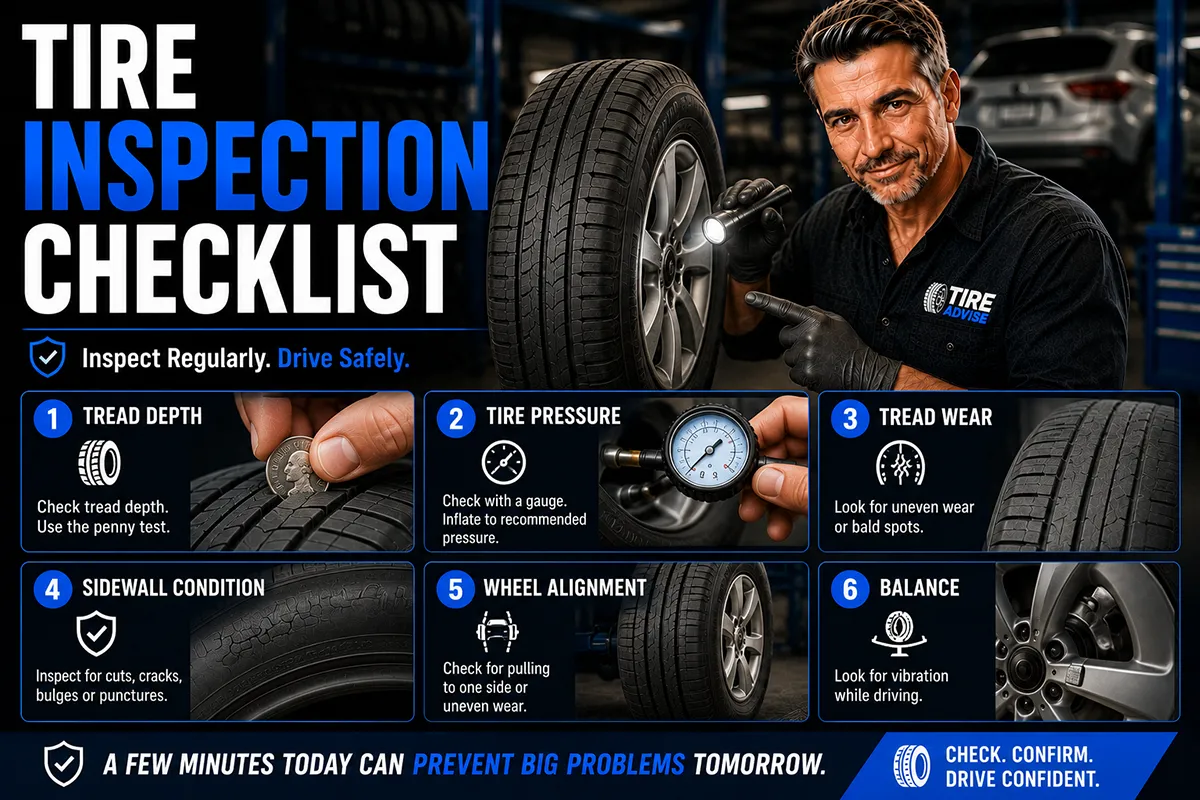
- Inspect your tires at least once a month and before every long trip — it takes less than 10 minutes
- Use the penny test AND the quarter test to check tread depth at multiple points across the tire
- Check tire pressure when tires are cold (before driving) using a reliable gauge, not just the TPMS light
- Look for bulges, cracks, uneven wear, embedded objects, and sidewall damage every time
- Uneven wear patterns reveal alignment, inflation, and suspension problems before they get expensive
- Replace tires at 2/32″ tread depth (legal minimum), but I recommend replacing at 4/32″ for wet-weather safety
- Don’t forget to inspect your spare tire — a flat spare is useless in an emergency
Liked this article?
Add TireAdvise as a preferred source so you see more of our tire reviews and guides on Google.
Why Most Drivers Skip Tire Inspections (And Why That’s Dangerous)
Here’s a stat that genuinely concerns me: according to the National Highway Traffic Safety Administration (NHTSA), tire-related crashes cause roughly 622 fatalities per year in the United States. Many of those are preventable with basic visual inspections.
In my experience reviewing tires and talking with thousands of readers at TireAdvise.com, the number one reason people skip inspections is simple — they don’t know what to look for. They glance at their tires, think “looks fine,” and move on.
The second reason is that people assume their car’s Tire Pressure Monitoring System (TPMS) will catch everything. It won’t. Your TPMS only alerts you when pressure drops significantly — typically 25% below the recommended level. It tells you nothing about tread depth, sidewall integrity, uneven wear, or embedded nails slowly leaking air.
I built this checklist to be fast, thorough, and something any driver can do at home with zero special tools. Let’s walk through it step by step.
My Complete 12-Point Tire Inspection Checklist
I recommend running through this full checklist once a month, before any road trip over a couple of hours, and at every seasonal change. Once you’ve done it a few times, the whole process takes about 8-10 minutes for all four tires plus the spare.
Here’s the checklist at a glance, and then I’ll break down each point in detail below:
| # | Inspection Point | What You Need | How Often |
|---|---|---|---|
| 1 | Tire Pressure Check | Digital tire gauge ($8-$15) | Monthly + before trips |
| 2 | Tread Depth Measurement | Penny/quarter or tread gauge ($5) | Monthly |
| 3 | Tread Wear Pattern Analysis | Visual inspection | Monthly |
| 4 | Sidewall Inspection | Visual + flashlight | Monthly |
| 5 | Bulge and Blister Check | Visual + hand feel | Monthly |
| 6 | Embedded Object Search | Visual + flashlight | Weekly (quick glance) |
| 7 | Cracking and Dry Rot Check | Visual inspection | Monthly |
| 8 | Tire Age Verification | Read DOT code on sidewall | Every 6 months |
| 9 | Valve Stem Inspection | Visual + soapy water | Monthly |
| 10 | Wheel and Rim Check | Visual inspection | Monthly |
| 11 | Lug Nut Torque Check | Torque wrench ($20-$40) | After rotation/service |
| 12 | Spare Tire Inspection | Same as above | Every 3 months |
Now let me walk you through each one based on what I’ve learned from hands-on testing and real-world experience.
1. Tire Pressure Check
This is the single most important thing you can do for your tires, and it takes about 60 seconds. I check my tire pressure every single month and before any road trip — no exceptions.
Here’s what most people get wrong: they check pressure after driving. Tire pressure increases as the rubber heats up from friction with the road. I always check my tires first thing in the morning, before I’ve driven anywhere, when the tires are completely cold.
Where to Find Your Recommended Pressure
Don’t look at the number stamped on the tire sidewall — that’s the maximum pressure, not the recommended pressure. Instead, open your driver’s door and look for the tire information placard on the door jamb. That’s where you’ll find the manufacturer’s recommended PSI for your specific vehicle.
For most passenger cars in the US, this is somewhere between 30-35 PSI, but SUVs and trucks can range higher. I’ve tested vehicles where the front and rear pressures were different, so always check both.
My Preferred Gauge
I’ve gone through a lot of tire pressure gauges over the years. Stick-type gauges are cheap but imprecise. I recommend a quality digital gauge — brands like Accutire, JACO, or AstroAI make solid ones for under $15 that are accurate to within ±0.5 PSI.
I keep one in my glovebox at all times. If the pressure is more than 2-3 PSI below the recommendation, I fill it at the nearest air station. Most gas stations in the US charge $1-$2 for air, but some states like California require free air by law.
2. Tread Depth Measurement
Tread depth determines how well your tire can grip the road, channel water, and resist hydroplaning. New tires typically come with 10/32″ to 11/32″ of tread depth. The legal minimum across all US states is 2/32″.
But here’s what I tell every reader: if you wait until 2/32″ to replace your tires, you’re driving on dangerously compromised rubber, especially in rain. In my testing experience, I’ve felt a dramatic difference in wet braking performance once tires get below 4/32″. That’s my personal replacement threshold, and I recommend it for most drivers.
The Penny Test vs. The Quarter Test
The penny test is the classic move. Insert a penny into the tread groove with Lincoln’s head facing down. If you can see the top of Lincoln’s head, you’re at 2/32″ or less — legally worn out.
I actually prefer the quarter test for everyday use. Same process, but with a quarter and Washington’s head. If the top of Washington’s head is visible, you’re at 4/32″ — my recommended replacement point. This is especially critical for drivers in the Pacific Northwest, the Northeast, or anywhere you encounter frequent rain.
Measure in Multiple Spots
Don’t just measure one spot and call it done. I always check tread depth at three points across the tire’s width: the inner edge, the center, and the outer edge. Then I repeat this at two or three different points around the tire’s circumference.
If the depth varies significantly across the width, that’s telling you something about your tire pressure or alignment — which brings me to point three.
3. Tread Wear Pattern Analysis
This is where your tires become diagnostic tools. The way a tire wears tells a story about your vehicle’s health, and I’ve gotten pretty good at reading that story over the years.
Common Wear Patterns and What They Mean
- Center wear (middle of the tread worn more than the edges): Your tires are overinflated. I see this constantly. Drop the pressure to the manufacturer’s recommendation.
- Edge wear (both edges worn more than the center): Your tires are underinflated. This is the most common tire problem in the US, and it wastes gas too.
- One-sided wear (inner OR outer edge worn significantly more): You have an alignment problem. Get an alignment check — they typically run $75-$120 at most shops.
- Cupping or scalloping (dips or cups in the tread): This usually points to worn suspension components — shocks, struts, or bushings. I’ve felt cupped tires create a noticeable rumbling vibration during testing.
- Feathering (tread blocks worn smooth on one side, sharp on the other): Toe alignment is off. Run your hand across the tread — if it feels smooth one direction and rough the other, that’s feathering.
- Patchy or diagonal wear: Could indicate balance issues or aggressive driving habits. I’ve seen this on tires that were never properly balanced after installation.
In my experience, uneven wear is one of the most overlooked signs that something needs attention. I’ve reviewed tires that should have lasted much longer but wore out prematurely because the owner ignored alignment issues for months.
4. Sidewall Inspection
The sidewall is the tire’s most vulnerable area, and it’s the one part that generally can’t be repaired if damaged. I make it a habit to visually scan all four sidewalls every time I walk around my car.
Look for cuts, gouges, scrapes, and abrasions. If you see any cord material (it looks like fabric or wire threads) exposed through a sidewall cut, that tire needs to be replaced immediately. There’s no safe repair for sidewall damage.
I also look for any signs of impact damage — even if there’s no visible cut, a hard hit from a pothole or curb can weaken the internal structure. This might not show up immediately, which is why regular inspections matter.
5. Bulge and Blister Check
This is what happened to me in the story I mentioned at the beginning. A bulge on the sidewall means the internal structure of the tire has been compromised — usually from a pothole impact or hitting a sharp curb at speed.
When I inspect for bulges, I visually scan the sidewall and then run my hand along it (when the tire is cold and parked, of course). You’re feeling for any area that protrudes outward from the normal sidewall surface.
A bulge means the internal plies have separated, and the only thing containing the air pressure at that point is a thin layer of rubber. This is a blowout waiting to happen. If you find a bulge, do not drive on that tire. Put on your spare and get to a tire shop.
I’ve personally found two bulges over the years during my routine inspections — both on tires that looked perfectly fine from a distance. Up close and with a hands-on check, they were obvious. This is why I can’t stress enough: get close to your tires.
6. Embedded Object Search
I can’t count the number of nails, screws, staples, and glass shards I’ve found embedded in tire treads over the years. Construction debris is everywhere on US roads, especially near new developments and highway work zones.
Here’s the tricky part: a nail or screw can be embedded in your tread and you might not lose any noticeable pressure for days or even weeks. It can create a slow leak that your TPMS might not catch until it reaches the alert threshold.
When I inspect, I walk around the car and visually scan each tire’s tread surface. A small flashlight helps enormously — I keep a cheap LED flashlight in my car for exactly this purpose. Look for anything metallic, shiny, or out of place poking out of the rubber.
Can You Repair a Puncture?
If the puncture is in the tread area (not the sidewall), and the object is a nail or screw (not a large gash), most reputable tire shops can perform a plug-patch combo repair for $25-$45. In my experience, this is a reliable and safe repair when done correctly.
However, I never recommend a plug-only repair. The industry standard endorsed by the Rubber Manufacturers Association is a combination plug-patch applied from the inside. If a shop offers to just plug it from the outside in five minutes, I’d find a different shop.
Repairs should never be done on the sidewall or shoulder of the tire, if the puncture is larger than 1/4 inch, or if there’s been a previous repair in the same area.
7. Cracking and Dry Rot Check
Rubber degrades over time — it’s inevitable. UV exposure, heat, ozone, and simply the passage of time cause the rubber compounds to break down. This shows up as small cracks, usually starting in the sidewall and between the tread blocks.
I live in an area with intense summer sun, and I’ve seen tires develop visible cracking even when they still had plenty of tread left. This is especially common on tires that sit for extended periods — think RVs, trailers, or that second car you only drive on weekends.
Severity Levels
- Surface-level hairline cracks: Common on tires a few years old. Monitor closely but not immediately dangerous.
- Deeper cracks with visible spreading: The tire’s structural integrity is starting to compromise. Start shopping for replacements.
- Deep cracks with any exposed material or chunks missing: Replace immediately. This tire can fail without warning.
I’ve found that tire dressings with UV protectants (like 303 Aerospace Protectant or Chemical Guys VRP) can slow down the cracking process. I apply them after every wash. But they can’t reverse damage that’s already occurred.
8. Tire Age Verification
Here’s something that surprises a lot of people: tires have an expiration date, regardless of tread depth. Most tire manufacturers and safety organizations (including NHTSA) recommend replacing tires that are 6-10 years old, even if they look brand new.
I recommend the 6-year mark as a hard inspection point and the 10-year mark as an absolute replacement deadline, regardless of tread condition.
How to Read the DOT Code
Every tire sold in the US has a DOT (Department of Transportation) code on the sidewall. Look for the letters “DOT” followed by a series of characters. The last four digits tell you the manufacture date.
For example, if the last four digits are “2321,” that tire was manufactured in the 23rd week of 2021. I check this on every set of tires I review, and I also check it when buying new tires — because sometimes tires sit in warehouses for a year or more before being sold.
If you’re buying new tires and they were manufactured more than 18 months ago, I’d ask the retailer for a fresher set. It’s your right as a consumer, and reputable dealers like Tire Rack, Discount Tire, and Costco are generally good about this.
9. Valve Stem Inspection
The valve stem is a small component that’s easy to overlook, but it’s your tire’s only air seal point. I’ve seen cracked, corroded, and damaged valve stems cause mysterious slow leaks that drive people crazy.
During my inspections, I check for visible cracks in the rubber valve stem, any signs of the stem leaning or bending at an unusual angle, and whether the valve cap is present and secure. Valve caps aren’t just decorative — they provide a secondary seal and keep dirt and moisture out of the valve core.
The Soapy Water Test
If you suspect a slow leak but can’t find a puncture, mix a small amount of dish soap with water and apply it around the valve stem. If you see bubbles forming, the valve stem or valve core is leaking.
A new rubber valve stem typically costs just $5-$8 installed when you’re getting tires mounted. I always request new valve stems with any tire purchase — it’s cheap insurance.
10. Wheel and Rim Check
While you’re down there inspecting the tires, take a moment to look at the wheels themselves. I’ve caught bent rims, cracks, and corrosion during tire inspections that I never would have noticed otherwise.
Alloy wheels are particularly susceptible to pothole damage — they can crack or bend where a steel wheel might just dent. If you spot a crack in your wheel, don’t wait. A cracked rim can fail catastrophically and cause a sudden loss of tire pressure.
I also check the bead area where the tire meets the rim. Corrosion on the rim’s bead seat can cause slow air leaks that are extremely difficult to diagnose. If your tire keeps losing air and there’s no puncture, this could be the culprit.
11. Lug Nut Torque Check
This one is especially important after any tire service — rotation, new tire installation, or brake work. I always re-torque my lug nuts after a few days of driving following any wheel removal.
Lug nuts can loosen slightly as the components settle, and driving on loose lug nuts is extremely dangerous. I’ve heard the telltale clicking sound of a loose wheel once in my life, and it’s not something I ever want to experience again.
Your owner’s manual will specify the correct torque specification for your vehicle — it’s typically between 80-100 ft-lbs for most passenger cars, though trucks and SUVs can be higher. A basic torque wrench from Harbor Freight or Amazon costs $20-$40 and is worth every penny.
12. Spare Tire Inspection
I can’t tell you how many times I’ve talked to readers who had a flat on the highway only to discover their spare was also flat. It’s heartbreaking and completely preventable.
I check my spare tire’s pressure every three months. Most compact spares (donuts) require 60 PSI — significantly higher than your regular tires. Check the label on the spare for the correct specification.
Also verify that your jack, lug wrench, and any other tire-changing tools are present and in working condition. During a few of my road trip preparations, I’ve discovered the lug wrench that came with the vehicle didn’t fit the aftermarket wheel locks installed by a previous owner. A roadside emergency is the worst time to discover this.
Seasonal Inspection Adjustments
I adjust my inspection approach based on the season, and I’d recommend you do the same. Different times of year present different challenges to your tires.
Spring
After winter, I do my most thorough inspection of the year. Winter potholes are brutal on tires and wheels, especially in northern states. I check for new bulges, rim damage, and any cuts from road debris hidden under snow and ice all winter.
This is also when I swap back to all-season or summer tires if I’ve been running winter tires. It’s a perfect opportunity to inspect both sets.
Summer
Heat is the enemy of tire longevity. I pay extra attention to tire pressure in summer because heat causes air to expand — you might find your tires reading 3-5 PSI higher than normal on hot days. Don’t bleed air out when tires are hot; check them cold in the morning and adjust accordingly.
I also increase my frequency of cracking and dry rot checks during summer months, especially here in the Sun Belt.
Fall
This is my transition inspection. I’m checking tread depth carefully because if tires are borderline, I want fresh rubber before winter weather arrives. Wet leaves on the road can be surprisingly slippery, and worn tires make it worse.
Winter
Cold weather causes tire pressure to drop — roughly 1 PSI for every 10°F decrease in temperature. I check pressure more frequently in winter, sometimes twice a month. If you live in a region where temperatures fluctuate wildly (40°F one day, 15°F the next), this is especially important.
Tools I Keep in My Car for Tire Inspections
Over the years, I’ve refined my tire inspection kit down to a small bag that lives permanently in my trunk. Here’s what’s in it:
- Digital tire pressure gauge — Accutire MS-4021B ($12). Accurate, backlit, and reliable.
- Tread depth gauge — A simple analog one from any auto parts store ($5-$8). More precise than coins.
- Small LED flashlight — Essential for seeing into tread grooves and inspecting sidewalls in low light.
- Penny and quarter — Backup tread depth tools that never need batteries.
- A pair of nitrile gloves — Because brake dust and road grime are nasty.
- Small spray bottle with soapy water — For leak detection at valve stems and bead areas.
- Torque wrench — I keep this in my trunk after any tire service for the re-torque check.
The total cost of this kit is under $50, and it’s paid for itself many times over in early problem detection.
When to See a Professional
My checklist covers what you can do yourself at home. But certain situations call for professional inspection equipment and expertise. I recommend seeing a tire shop if:
- You notice persistent vibration at highway speeds that wasn’t there before
- Your vehicle pulls consistently to one side on a flat, straight road
- You find an embedded object but aren’t sure if it’s penetrated through the tread
- You see uneven wear that suggests alignment or suspension issues
- Your TPMS light keeps coming on after you’ve verified correct pressure
- You hear unusual road noise that has changed character recently
Most shops like Discount Tire, Les Schwab, and America’s Tire will perform a basic tire inspection for free. I’ve used these free inspections as a second opinion many times, and I’ve found the technicians at these shops to be knowledgeable and honest.
How This Checklist Connects to Tire Buying
If you’re reading TireAdvise.com, there’s a good chance you’re in the market for new tires. Your inspection findings should directly inform your purchase decision.
For instance, if your inspection reveals one-sided wear across all four tires, get an alignment before installing new tires — otherwise, you’ll chew through the new set just as fast. If you find cracking on tires that still have good tread, look for tire models with enhanced UV-resistant compounds. If your current tires wore out quickly in the center, you may have been over-inflating them, and you’ll want to correct that habit with the new set.
I always tell readers: an inspection isn’t just about the tires on your car right now. It’s about making smarter choices for the next set.
My Recommended Inspection Schedule at a Glance
- Weekly: Quick visual walk-around. Glance at each tire for obvious issues (flat spots, embedded objects, visible damage).
- Monthly: Full 12-point checklist. Pressure, tread depth, sidewalls, wear patterns — the works.
- Before road trips: Full 12-point checklist plus spare tire verification.
- Seasonally: Full checklist with season-specific focus areas as described above.
- After any tire service: Re-torque lug nuts after several days of driving.
The Bottom Line
I’ve been reviewing and testing tires professionally for years, and I can tell you with absolute certainty that the most expensive tire in the world is worthless if you don’t maintain and inspect it regularly. Conversely, even a budget-friendly tire can perform well and last a long time with proper care.
This 12-point checklist has become second nature to me. It’s saved me from driving on a bulging sidewall, caught slow leaks before they became blowouts, and helped me identify alignment issues before they destroyed a set of tires I was reviewing.
Print it out. Save it to your phone. Stick it on your garage wall. Whatever it takes to make it a habit.
Your tires are the only part of your car that actually touches the road. Give them the 10 minutes a month they deserve, and they’ll keep you and your family safe in return.
Frequently Asked Questions
What should I look for on a tire inspection checklist before buying replacement tires?
Before purchasing new tires, I always check five critical areas: tread depth (using the penny test or a gauge), sidewall damage like bulges or cracks, uneven wear patterns that signal alignment issues, tire age via the DOT date code, and current tire pressure. This checklist helps you determine whether you actually need replacements or just maintenance, potentially saving you $400–$1,000 on a full set of new tires.
How do I check tire tread depth at home without a gauge?
The easiest at-home method is the penny test — insert a penny into your tire’s tread groove with Lincoln’s head facing down. If you can see the top of Lincoln’s head, your tread depth is below 2/32 of an inch and the tire is legally worn out in most US states. For a more precise reading, I recommend picking up a tread depth gauge from any auto parts store for around $5, which gives exact measurements across the inner, center, and outer tread.
What does uneven tire wear mean and should I replace my tires?
Uneven tire wear is a red flag I always look for during inspections because it usually points to alignment, suspension, or inflation problems. Center wear typically means overinflation, edge wear signals underinflation, and one-sided wear often indicates a bad alignment. You may need replacement tires if the worn areas are below 2/32 of an inch, but fixing the underlying cause first — such as a $75–$150 alignment — prevents the same wear pattern from destroying your new set.
How do I read the DOT date code to check tire age during an inspection?
On every tire’s sidewall, you’ll find a DOT code ending in four digits — the first two represent the week and the last two represent the year of manufacture. For example, 2522 means the tire was made in the 25th week of 2022. Most tire manufacturers and safety organizations, including the NHTSA, recommend replacing tires that are 6–10 years old regardless of tread depth, since the rubber compounds degrade over time, especially in hot US climates like Arizona or Texas.
How often should I do a full tire inspection on my vehicle?
I recommend performing a basic visual tire inspection at least once a month and before any long road trips, which is common advice from brands like Michelin and Goodyear. A more thorough inspection — including tread depth measurements, pressure checks, and sidewall examination — should happen every 5,000–7,500 miles, ideally timed with your tire rotation schedule. Catching issues early during these checks can extend tire life by thousands of miles and help you avoid blowouts on US highways.
What sidewall damage on tires means I need an immediate replacement?
Any bulges, bubbles, or deep cuts on the tire sidewall mean the internal structure is compromised and the tire should be replaced immediately — no repairs are safe for sidewall damage. I’ve also seen tires with dry rot cracking along the sidewall, which is especially common on vehicles that sit outdoors in harsh US weather. If you spot any of these during your inspection, avoid driving at highway speeds and budget $100–$300 per tire depending on whether you choose a budget brand like Cooper or a premium option like Bridgestone.
Can I pass a state vehicle safety inspection with low tire tread?
Most US states that require vehicle safety inspections set the minimum legal tread depth at 2/32 of an inch, and your vehicle will fail if any tire is below that threshold. However, I strongly recommend replacing tires once they reach 4/32 of an inch, especially if you drive in rain or snow, because wet traction drops dramatically below that point. States like Texas, Virginia, and New York are particularly strict during inspections, so checking your tread depth at home first can save you the hassle of a failed inspection and a return trip.
