

When I bought my first truck, the salesperson asked me what ply rating I wanted in my tires, and I stared at him like he was speaking another language.
I had no idea that the number of plies in a tire could dramatically affect everything from ride comfort to load-carrying capacity. It’s one of those critical tire specs that most everyday drivers never think about — until they pick the wrong tire and either get a bone-rattling ride or, worse, a blowout from overloading.
After spending years reviewing tires, testing dozens of sets across sedans, SUVs, and trucks, and digging deep into manufacturer specs, I’ve put together this comprehensive tire ply chart guide to save you from the same confusion I experienced.
- Tire ply rating (load range) tells you how much weight a tire can safely carry — it doesn’t always mean the literal number of layers anymore.
- Passenger cars typically use 4-ply rated tires (Load Range B), while light trucks use 6-ply (C) to 14-ply (G) rated tires.
- Higher ply ratings mean more load capacity but a stiffer, less comfortable ride.
- Always match or exceed your vehicle manufacturer’s recommended ply rating — never go lower.
- The ply rating directly correlates to the tire’s maximum inflation pressure and weight capacity.
Liked this article?
Add TireAdvise as a preferred source so you see more of our tire reviews and guides on Google.
What Exactly Is a Tire Ply Rating?
Let me start with the basics, because I’ve found that even experienced drivers get confused here. A tire ply rating originally referred to the actual number of cotton fabric layers (plies) used in the tire’s construction. Back in the early days of tire manufacturing, more layers of cotton meant a stronger tire that could handle more weight.
Here’s where it gets tricky, though. Modern tires don’t use cotton anymore. They use advanced materials like polyester, nylon, steel, and aramid (Kevlar) that are dramatically stronger than the old cotton plies. So a modern tire rated as “10-ply” doesn’t necessarily have ten physical layers of material inside it.
Instead, the ply rating today is a standardized indicator of the tire’s strength and load-carrying capacity. It tells you that the tire performs equivalent to a tire that would have had that many cotton plies. Think of it as a strength rating rather than a literal layer count.
Tire Ply Rating vs. Load Range: What’s the Difference?
This is something that tripped me up for a long time, and I see it confuse readers constantly. The tire industry has largely moved from using numeric ply ratings to using alphabetical “Load Range” designations. They’re essentially two ways of saying the same thing.
When you look at a tire sidewall today, you’re more likely to see “Load Range E” than “10-ply rated.” But they mean the same thing. The load range letter tells you the tire’s maximum load capacity at its maximum rated inflation pressure.
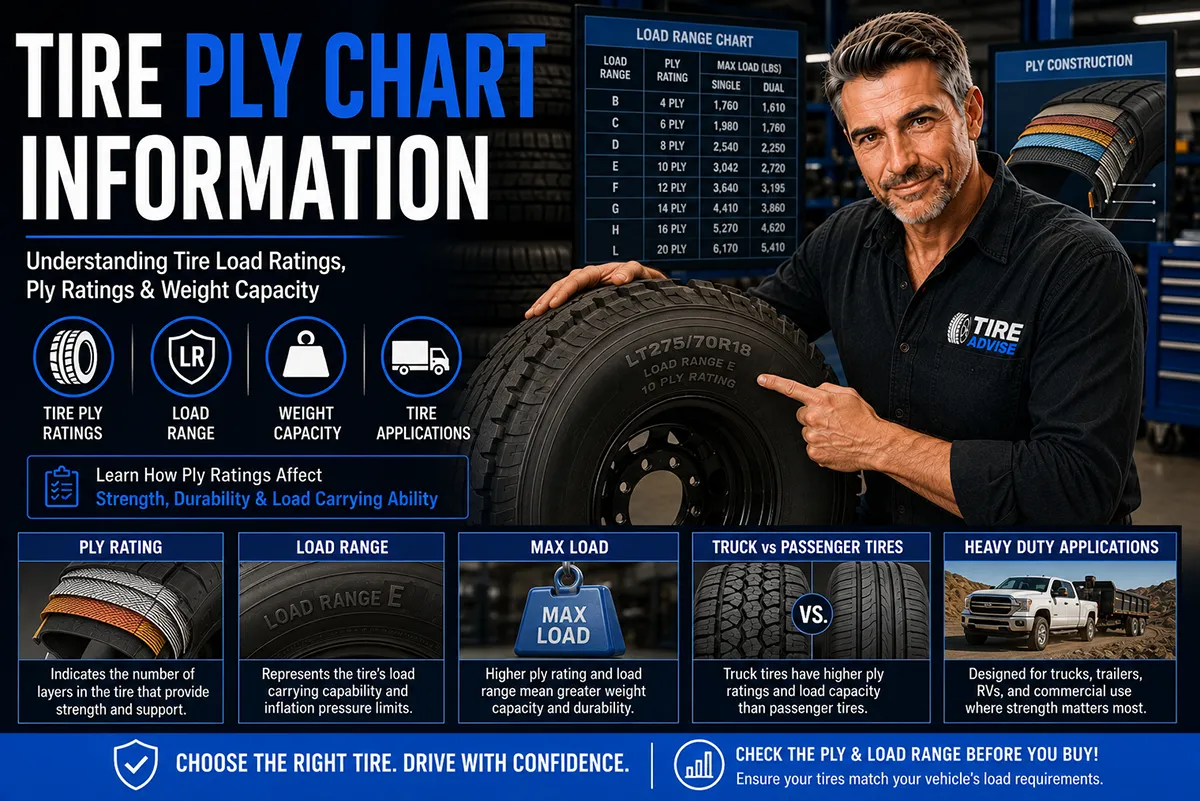
I’ve created the chart below to make this crystal clear. This is the reference I wish I’d had when I started buying tires.
Complete Tire Ply Rating Chart
Here’s the comprehensive tire ply chart that covers every standard load range you’ll encounter in the US market:
| Load Range | Ply Rating | Max PSI | Typical Use |
|---|---|---|---|
| A | 2-ply | 36 PSI | Wheelbarrows, lawn equipment |
| B | 4-ply | 35 PSI | Passenger cars, minivans |
| C | 6-ply | 50 PSI | Light trucks, SUVs, vans |
| D | 8-ply | 65 PSI | Light trucks, heavy SUVs, towing |
| E | 10-ply | 80 PSI | Heavy-duty trucks, towing, hauling |
| F | 12-ply | 95 PSI | Commercial trucks, heavy hauling |
| G | 14-ply | 110 PSI | Heavy commercial, Class 3+ trucks |
Note: Maximum PSI values can vary slightly by manufacturer. Always check the specific tire’s sidewall for its actual max inflation pressure.
What Ply Rating Do Passenger Cars Use?
If you drive a typical sedan, coupe, hatchback, or crossover, you’re almost certainly running 4-ply rated tires with a Standard Load (SL) or Extra Load (XL) designation. In my experience reviewing passenger car tires, the vast majority fall into this category.
Standard Load (SL) passenger tires are rated for a maximum of 35 PSI and are equivalent to the old 4-ply rating. These are what come stock on vehicles like the Toyota Camry, Honda Civic, Ford Fusion, and most everyday cars.
Extra Load (XL) passenger tires are also 4-ply rated but are engineered to handle higher inflation pressures (usually up to 41 PSI) and slightly greater loads. I’ve tested several XL-rated tires on performance sedans, and they’re commonly found on heavier cars or vehicles with performance packages. You’ll see these on cars like the Tesla Model 3, BMW 3 Series, and similar vehicles.
My Experience with Passenger Car Ply Ratings
Over the years, I’ve rarely had to think about ply ratings when reviewing passenger car tires. The reason is simple — almost every tire designed for passenger cars is 4-ply rated, and the load capacity differences are handled through the SL vs. XL designations and individual tire load index numbers.
Where I tell people to pay attention is the load index number on the sidewall (like 91, 95, 99, etc.), which gives you the specific weight capacity per tire. I’ve found that this matters more for passenger car owners than the ply rating itself.
What Ply Rating Do Trucks and SUVs Need?
This is where ply ratings really become critical, and where I’ve seen the most mistakes from buyers. If you drive a pickup truck, full-size SUV, or van, your tire ply rating choice directly impacts safety, especially if you tow or haul heavy loads.
Light Truck (LT) Tire Ply Ratings
Light truck tires are designated with “LT” before the tire size (like LT265/70R17) and come in Load Ranges C through G. Here’s how I break down the most common options:
Load Range C (6-ply rated): These are the lightest-duty LT tires. I’ve tested these on half-ton trucks that are used primarily for daily commuting with occasional light hauling. They offer a better ride quality than higher-rated options, but they’re limited in weight capacity. I’d only recommend these if you rarely carry heavy loads.
Load Range D (8-ply rated): A solid middle ground. During my testing on a Ram 1500, I found that Load Range D tires provided a reasonable balance between ride comfort and load capacity. These work well for half-ton truck owners who occasionally tow a boat or carry a loaded truck bed.
Load Range E (10-ply rated): This is the most popular ply rating for truck tires in the US market, and it’s what I recommend most often. When I’ve tested E-rated tires on three-quarter-ton and one-ton trucks — like the Ford F-250, Chevy Silverado 2500, and Ram 2500 — they handle towing and heavy payloads with confidence. Many half-ton truck owners also choose E-rated tires for the added puncture resistance and peace of mind.
Load Range F (12-ply rated): I’ve tested these primarily on one-ton dually trucks and commercial vehicles. They handle serious weight — we’re talking heavy fifth-wheel trailers, commercial loads, and work truck applications. The ride quality is noticeably firmer, which is a trade-off I’ll discuss shortly.
Load Range G (14-ply rated): Honestly, most everyday truck owners will never need these. I’ve only encountered G-rated tires on Class 3 and above commercial vehicles. They’re built for maximum load capacity, and the ride reflects that.
How to Read the Ply Rating on Your Tire Sidewall
I want to walk you through exactly what to look for, because tire sidewalls are packed with information, and it’s easy to miss the ply rating if you don’t know where to look.
Step-by-Step Sidewall Reading
- Find the tire size: Look for the series of numbers and letters like P225/65R17 or LT265/70R17. The “P” means passenger, and “LT” means light truck.
- Locate the load index and speed rating: Right after the tire size, you’ll see something like “115T” — where 115 is the load index and T is the speed rating.
- Find the load range: On LT tires, look for text that says “Load Range E” or simply “LR E” somewhere on the sidewall. On passenger tires, you might see “Standard Load” or “Extra Load.”
- Check for ply rating text: Many tires also spell it out, like “10 Ply Rating” near the load range designation.
- Look at the max load and pressure: There will be text stating something like “Max Load 3195 lbs at 80 PSI.” This is directly tied to the ply rating.
I always recommend physically walking out to your vehicle and reading your current tire’s sidewall before shopping for replacements. Take a photo with your phone — it makes the shopping process so much easier.
The Relationship Between Ply Rating and Load Capacity
This is probably the most important practical takeaway I can give you. The ply rating determines the maximum air pressure the tire can safely hold, and higher air pressure means greater load-carrying capacity.
Think of it like this: a tire is essentially an air container. The stronger the container (higher ply rating), the more air pressure it can hold, and more air pressure supports more weight.
Here’s a real-world example from my testing. I was reviewing the BFGoodrich All-Terrain T/A KO2 in size LT275/65R18. The Load Range C version of that tire has a max load of 2,535 lbs per tire at 50 PSI. The Load Range E version of the exact same tire? It handles up to 3,415 lbs per tire at 80 PSI.
That’s a difference of 880 lbs per tire — or 3,520 lbs across all four tires. That’s an enormous difference in capability from the same tire model, just in different ply ratings.
How Ply Rating Affects Ride Quality
I’d be doing you a disservice if I didn’t talk about the trade-offs, because this is where I see a lot of buyers make choices they regret.
Higher Ply = Stiffer Ride
In my testing, the difference in ride comfort between a Load Range C tire and a Load Range E tire on the same truck is dramatic. Higher ply-rated tires have stiffer sidewalls, which means they absorb less impact from road imperfections.
I remember testing a set of Load Range E all-terrain tires on a half-ton truck for several days of mixed highway and city driving. Coming from the stock P-metric (passenger-rated) tires, the difference was immediately noticeable. Every expansion joint on the highway sent a thud through the cabin. Small potholes that the old tires absorbed easily suddenly felt like hitting a curb.
Does that mean you should avoid E-rated tires on a half-ton? Not necessarily. But you should go in with realistic expectations.
The Sweet Spot for Most Truck Owners
In my experience, here’s what I generally recommend:
- Half-ton trucks (F-150, Silverado 1500, Ram 1500): Stick with P-metric or LT Load Range C/D unless you regularly tow or haul near your truck’s max capacity. Your ride quality will thank you.
- Three-quarter-ton trucks (F-250, Silverado 2500, Ram 2500): Load Range E is typically standard and appropriate. These trucks have suspension systems designed for the stiffer tires.
- One-ton trucks (F-350, Silverado 3500, Ram 3500): Load Range E minimum, with F or G for serious commercial applications.
P-Metric vs. LT Tires: The Ply Rating Connection
This is a distinction I feel strongly about because it directly ties into ply ratings, and it’s a source of tremendous confusion in the tire-buying world.
P-Metric Tires
P-metric tires (those starting with “P” in the size designation) are designed primarily for passenger vehicles, including many factory-equipped trucks and SUVs. They’re typically 4-ply rated with Standard Load or Extra Load capacity.
The key thing I want you to know: P-metric tires have a built-in safety margin where you should derate (reduce) their load capacity by about 9% when used on light trucks, SUVs, or vans. This is because the Tire and Rim Association applies a different safety factor for multi-purpose vehicles.
LT Tires
LT (Light Truck) tires come in Load Ranges C through G and are specifically engineered for the demands of trucks and heavy SUVs. They have heavier-duty construction, reinforced sidewalls, and no derating requirement.
In my testing across multiple truck platforms, I’ve found that switching from P-metric to LT tires results in:
- Significantly higher load capacity
- Better puncture and cut resistance
- More confident towing performance
- Stiffer ride quality
- Slightly higher road noise in most cases
- Marginally lower fuel economy due to heavier construction
When Should You Upgrade Your Ply Rating?
Based on my years of tire testing and reader feedback, here are the scenarios where I’d recommend moving to a higher ply rating than what came stock on your vehicle:
Upgrade Scenarios
- Regular towing: If you’ve added a towing package and regularly pull a trailer, boat, or camper, stepping up from P-metric to LT Load Range D or E gives you a real safety margin.
- Heavy payloads: If you’re frequently loading your truck bed with heavy materials — landscaping supplies, construction materials, firewood — a higher ply rating ensures you’re within safe limits.
- Off-road driving: I’ve found that higher ply-rated tires resist punctures and sidewall cuts much better on rough terrain. During off-road test sessions on rocky trails, E-rated tires gave me significantly more confidence than C-rated equivalents.
- Commercial or work use: If your truck earns its living, don’t skimp on ply rating. The cost of a blowout — in downtime, potential cargo damage, and safety — far exceeds the price difference.
When NOT to Upgrade
- Daily commuting in a half-ton: If your truck is primarily a daily driver and you don’t tow or haul heavy loads, sticking with P-metric or Load Range C tires is perfectly fine. You’ll enjoy better ride comfort and fuel economy.
- Passenger cars and crossovers: I’ve never encountered a situation where upgrading the ply rating on a passenger car makes sense. The vehicle isn’t designed for the loads that would require it.
How Ply Rating Affects Tire Price
Let me give you straight talk about cost, because I know budget matters. Generally speaking, higher ply-rated tires cost more because they require more materials and more complex construction.
Here’s a rough pricing comparison I’ve observed across popular all-terrain tire models in common truck sizes:
| Load Range | Typical Price Range (per tire) | Price Premium vs. Base |
|---|---|---|
| P-Metric (SL/XL) | $150 – $250 | Baseline |
| Load Range C (6-ply) | $175 – $280 | +10-15% |
| Load Range D (8-ply) | $190 – $310 | +15-25% |
| Load Range E (10-ply) | $210 – $350 | +25-40% |
| Load Range F (12-ply) | $250 – $400 | +35-50% |
Prices reflect 2024 US retail pricing for popular all-terrain tires in the 265/70R17 to 275/65R18 size range. Prices vary by brand, retailer, and specific tire model.
My advice? Buy the ply rating you actually need — not the one that sounds the toughest. I’ve talked to plenty of half-ton truck owners who spent an extra $400-$600 on a set of E-rated tires they didn’t need, only to complain about the harsh ride for the next several years.
Common Tire Ply Rating Mistakes I See
After years of writing tire guides and answering reader questions, these are the mistakes that come up again and again:
Mistake #1: Going Lower Than OEM Specification
This is a safety issue, plain and simple. If your vehicle came equipped with Load Range E tires from the factory, do not replace them with Load Range C or D. The vehicle manufacturer chose that rating because the truck’s gross vehicle weight rating (GVWR) demands it. I’ve heard horror stories from readers who downgraded to save money and experienced tire failures under load.
Mistake #2: Over-Specifying for a Half-Ton Truck
On the flip side, I regularly see half-ton truck owners put 10-ply (Load Range E) tires on their F-150 or Silverado 1500, thinking “more is better.” If you’re not regularly towing heavy loads, you’re paying more for a harsher ride. During one test, I had a reader’s F-150 with E-rated tires and the ride difference versus the stock P-metric tires was night and day — and not in a good way for daily driving.
Mistake #3: Ignoring Inflation Pressure Differences
Different ply ratings have different maximum and optimal inflation pressures. When I switch between ply ratings during testing, I always adjust my tire pressure accordingly. Running a Load Range E tire at the same 35 PSI you used for your P-metric tires means you’re not getting the load capacity you’re paying for. Check the tire sidewall and your vehicle’s placard for the correct pressure.
Mistake #4: Mixing Ply Ratings on the Same Vehicle
I’ve seen this more than once — someone replaces just two tires and puts different load range tires on the same axle or different axles. Don’t do this. Mismatched ply ratings mean mismatched handling characteristics, and that’s a recipe for unpredictable vehicle behavior, especially during emergency maneuvers.
How to Choose the Right Ply Rating: My Decision Framework
After testing countless tires across every vehicle category, I’ve developed a simple framework I use to recommend ply ratings. Here’s how I walk through the decision:
Step 1: Check your vehicle’s tire placard. Open your driver’s door and look at the sticker on the door jamb. It lists the OEM tire size, load range, and recommended inflation pressure. This is your starting point.
Step 2: Assess your actual usage. Be honest with yourself. Are you actually towing every weekend, or did you tow once last summer? Your tire ply rating should match your regular driving demands, not the most extreme scenario you can imagine.
Step 3: Consider your priorities. If ride comfort and fuel economy matter most, lean toward the lower end of acceptable ply ratings. If load capacity, durability, and puncture resistance are paramount, lean higher.
Step 4: Never go below OEM spec. This is non-negotiable. You can go higher than the factory load range, but never lower.
Step 5: Factor in your budget. Higher ply ratings cost more upfront. If you don’t need the extra capacity, that money is better spent on a higher-quality tire at the appropriate ply rating.
Popular US Tire Models and Their Available Load Ranges
To make your shopping easier, here are some of the most popular tire models in the US market and the load ranges they’re available in. This is based on my direct experience testing these tires:
- BFGoodrich All-Terrain T/A KO2: Available in Load Range C, D, and E. I’ve tested the E-rated version extensively and it remains one of my top all-terrain recommendations for heavy-duty trucks.
- Falken Wildpeak AT3W: Available in SL/XL (P-metric), Load Range C, D, and E. The versatility of this tire across ply ratings is one reason I recommend it so often.
- Toyo Open Country AT III: Available in P-metric and Load Range C, D, E, and F. One of the few all-terrains offering an F rating for commercial applications.
- Cooper Discoverer AT3 XLT: Available in Load Range C, D, E, and F. A solid value-oriented choice I’ve tested on several truck platforms.
- Michelin Defender LTX M/S: Available in SL/XL and Load Range C, D, and E. My go-to recommendation for highway-focused truck and SUV owners who want comfort and longevity.
- Goodyear Wrangler DuraTrac: Available in Load Range C, D, and E. I tested these in E-rated form on a heavy-duty truck during winter conditions and was impressed with their grip.
Tire Ply and Treadwear: Is There a Connection?
This is a question I get asked frequently, and the honest answer is: it’s complicated. The ply rating itself doesn’t directly determine tread life. Treadwear is primarily affected by the tread compound, tread design, vehicle alignment, driving habits, and inflation pressure.
However, I’ve noticed an indirect relationship during my testing. Higher ply-rated tires tend to have stiffer constructions, which can result in slightly more even tread wear under heavy loads. When a tire maintains its proper shape under load (which a higher ply rating helps ensure), the tread contact patch stays more consistent, promoting even wear.
That said, I’ve also seen cases where running high ply-rated tires on lightly loaded vehicles causes center-wear patterns, especially if the tires are inflated to their maximum pressure. This happens because the stiff sidewalls and high pressure create a crowned contact patch that concentrates wear on the center of the tread.
The takeaway? Match your ply rating to your actual load requirements and set your inflation pressure accordingly. Don’t automatically inflate to the maximum just because the tire can handle it.
A Quick Word About Trailer Tires
I want to briefly touch on trailer tires because they have their own ply rating considerations, and I know many of my readers tow trailers.
Trailer tires (marked with “ST” for Special Trailer) are available in load ranges from B through G. They’re designed differently from LT tires — they have stiffer sidewalls to prevent sway and aren’t meant for steering or powered axles.
In my experience, trailer tire ply rating is even more critical than truck tire ply rating because trailers often carry concentrated loads. I always recommend erring on the side of a higher ply rating for trailer tires. The ride comfort trade-off is irrelevant here since nobody’s sitting in the trailer.
For most recreational trailers — utility trailers, boat trailers, and travel trailers — I recommend at least Load Range D (8-ply) for trailers under 5,000 lbs GVWR and Load Range E (10-ply) for anything heavier.
Final Thoughts: Getting Your Ply Rating Right
After all the tires I’ve tested and all the questions I’ve answered from readers, my biggest piece of advice regarding ply ratings is this: match the tire to your actual needs. Not your aspirational needs, not what the guy at the truck meet recommended, but what you genuinely require for safe, comfortable driving.
The ply rating chart at the top of this article is your reference point. Bookmark it, screenshot it, or print it out and take it with you when you shop for tires.
Start with your vehicle’s OEM specification and adjust from there based on your real-world usage. If you tow regularly, go up a load range. If you drive mostly unloaded on highways, the factory spec is probably perfect.
Frequently Asked Questions
What is a tire ply rating chart and why does it matter when buying replacement tires?
A tire ply rating chart shows the load-carrying capacity and strength of a tire based on its ply rating, which historically referred to the number of rubber layers but now indicates an equivalent strength rating. When I shop for replacement tires, I always check the ply rating to make sure the tire can handle the weight demands of my vehicle. Choosing the wrong ply rating can lead to premature tire wear, blowouts, or even unsafe handling on US highways and interstates.
How do I read tire ply ratings on the sidewall of my tire?
You can find the ply rating on the tire sidewall, usually expressed as a load range letter such as B, C, D, or E. Load Range B is equivalent to a 4-ply rating, C equals 6-ply, D equals 8-ply, and E equals 10-ply. I recommend matching the load range letter on your current tires or checking your vehicle owner’s manual before purchasing replacements to ensure proper load support.
What is the difference between tire ply rating and load range?
Tire ply rating refers to the original system of counting actual cotton fabric layers in a tire, while load range is the modern equivalent that indicates how much weight a tire can safely carry at a specified inflation pressure. Today, a tire labeled as 10-ply doesn’t necessarily contain 10 physical plies—it simply has the strength equivalent of a 10-ply tire, designated as Load Range E. Understanding this distinction helps US drivers avoid confusion when comparing tires from brands like Goodyear, Michelin, or BFGoodrich.
How many ply tires do I need for a pickup truck or SUV in the US?
For most half-ton pickup trucks and full-size SUVs driven in the US, a 4-ply (Load Range B) or 6-ply (Load Range C) tire works well for everyday commuting and light hauling. If you regularly tow trailers, haul heavy payloads, or drive on rough terrain, I’d recommend stepping up to an 8-ply (Load Range D) or 10-ply (Load Range E) tire for added durability and load capacity. Always consult the tire placard on your driver-side door jamb to confirm the minimum ply rating your vehicle requires.
Does a higher ply rating tire give a rougher ride quality?
Yes, higher ply rated tires generally have stiffer sidewalls, which can result in a firmer and slightly rougher ride compared to lower ply options. I noticed a noticeable difference in ride comfort when I switched from a 6-ply to a 10-ply tire on my daily driver, especially on bumpy US city roads and highways. The trade-off is greater puncture resistance and load-carrying ability, so higher ply tires make more sense for towing and heavy-duty applications than for comfortable commuting.
Are 10-ply tires worth the extra cost for everyday driving?
For most everyday US drivers who aren’t towing or hauling heavy loads, 10-ply tires are often overkill and can cost $30 to $80 more per tire compared to standard 4-ply or 6-ply options. The added sidewall stiffness reduces ride comfort and can slightly decrease fuel efficiency, which adds up over thousands of miles. I’d only recommend investing in 10-ply tires if you frequently tow, carry heavy cargo, or drive on rough construction sites and gravel roads where puncture resistance is critical.
Can I mix different ply rated tires on the same vehicle?
Mixing different ply rated tires on the same vehicle is generally not recommended because it can create uneven handling, inconsistent braking performance, and unpredictable behavior in wet or winter driving conditions common across many US states. If you need to replace just one or two tires, I strongly suggest matching the ply rating and load range of your existing tires. Mismatched ply ratings can also void certain tire warranties and may cause issues during state vehicle inspections in states that require them.
