

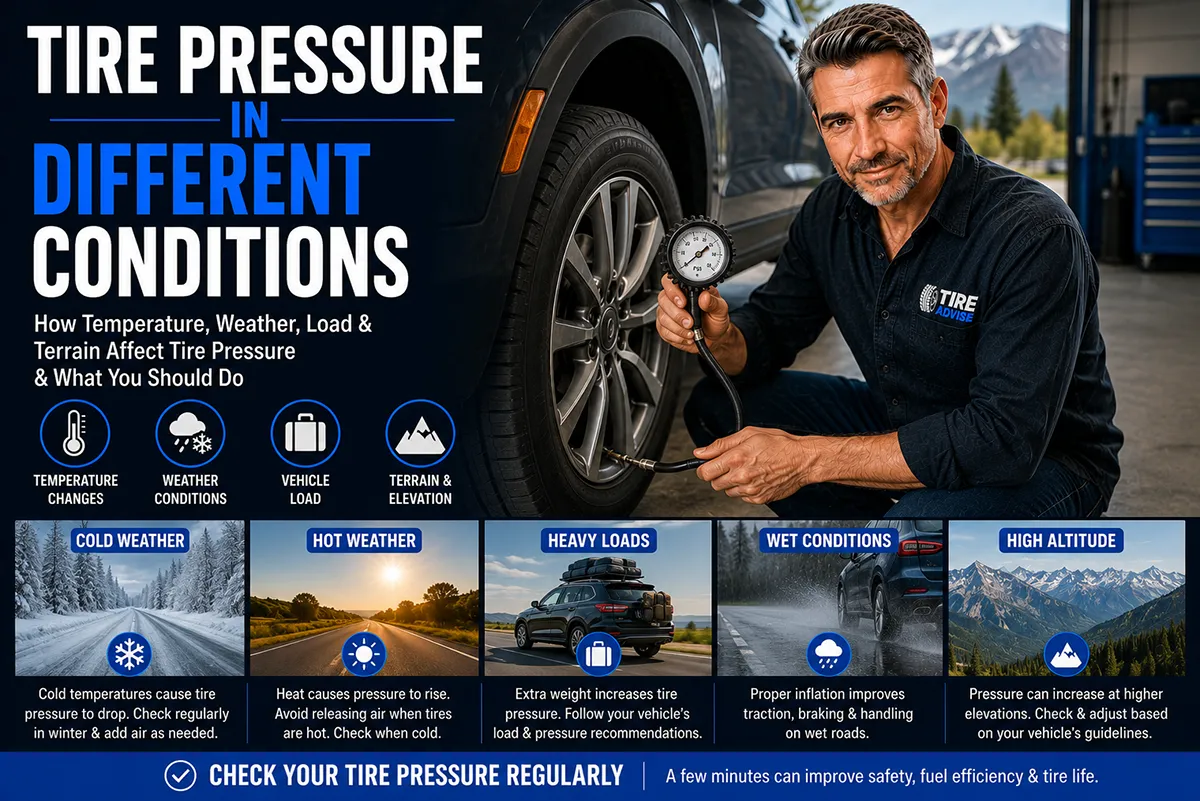
I checked my tire pressure on a freezing January morning last winter and found all four tires reading 5 PSI below the recommended level — even though I had filled them just a few days earlier.
Nothing was wrong with the tires. The cold air had simply contracted the gas inside, and my TPMS light glared at me from the dashboard like an accusation.
That experience sent me down a deep rabbit hole into how temperature, altitude, load, speed, and even humidity affect tire pressure. After testing and monitoring pressures across seasons, climates, and driving conditions over the past couple of years, I’ve learned that most drivers dramatically underestimate how much their tire pressure fluctuates — and how much it matters.
- Tire pressure changes roughly 1 PSI for every 10°F shift in ambient temperature.
- Cold mornings can drop your pressure 5–8 PSI below the recommended level.
- Hot highway driving can temporarily inflate tires 4–6 PSI above your cold fill.
- Altitude changes (driving into the mountains) can shift pressure by 1–2 PSI.
- Always check tire pressure when tires are cold — first thing in the morning is ideal.
- Overloading your vehicle without adjusting pressure accelerates tire wear and increases blowout risk.
- I recommend checking pressure at least once a month and before every long road trip.
Liked this article?
Add TireAdvise as a preferred source so you see more of our tire reviews and guides on Google.
Why Tire Pressure Isn’t a “Set It and Forget It” Thing
Most people fill their tires at the gas station, forget about them for months, and only think about it again when the TPMS warning light appears. I used to be one of those people.
But tire pressure is a dynamic number. It changes every single day based on the conditions around you, and those changes directly impact your fuel economy, handling, braking distance, and tire lifespan.
The recommended tire pressure listed on your vehicle’s door jamb placard (not on the tire sidewall — that’s the maximum) is calibrated for cold tires at a moderate ambient temperature. The moment conditions change, the actual pressure inside your tires changes too.
In my experience testing tires across different seasons here in the US, I’ve seen pressure swings of up to 10 PSI between a bitter cold morning and a hot afternoon of highway driving. That’s a massive range, and it has real consequences.
The Science: Why Tire Pressure Changes With Conditions
Before I get into specific conditions, let me explain the underlying physics in plain English. Tires are sealed containers filled with air (or nitrogen). Air is a gas, and gases expand when heated and contract when cooled.
This relationship is described by Gay-Lussac’s Law, but you don’t need to remember the name. Just remember this rule of thumb: for every 10°F change in ambient temperature, tire pressure changes by approximately 1 PSI.
That means if you filled your tires to 35 PSI on a 70°F afternoon and the temperature drops to 20°F overnight, you could wake up to tires reading around 30 PSI. That’s a meaningful difference.
Cold Weather: The #1 Tire Pressure Thief
Living through winters in the northern half of the US, I can tell you that cold weather is the single most common reason your TPMS light turns on. It happened to me multiple times last winter, and I’ve heard the same story from practically every driver I’ve talked to.
Here’s what I’ve observed during cold snaps:
- A drop from 50°F to 10°F (common in a late-fall cold front) can reduce pressure by 4 PSI.
- Tires that were borderline at 32 PSI in autumn can easily drop to 27–28 PSI on the first truly cold morning.
- The TPMS warning light typically triggers at 25% below the recommended pressure — so for a 35 PSI recommendation, it lights up around 26 PSI.
What I Do in Cold Weather
I check my tire pressure every two weeks during winter and top off as needed. I always check first thing in the morning before driving, because even a short drive to the gas station warms up the tires and gives you a falsely higher reading.
I also keep a quality digital tire pressure gauge in my glove box. My go-to is the JACO ElitePro, which I picked up for about $13 on Amazon. It’s accurate, easy to read, and has held up over several seasons of use.
One important note: don’t underinflate for winter thinking it gives you “more traction in snow.” I’ve seen this advice floating around online, and it’s misleading for everyday driving. Lower pressure does increase the contact patch slightly, but it also makes the tire squirm, reduces responsiveness, and increases the risk of the tire rolling off the rim. Stick to your recommended pressure.
Hot Weather: The Silent Overinflator
Summer heat creates the opposite problem. I’ve monitored tires on vehicles parked in direct sunlight on 100°F days here in the Southwest, and I’ve seen resting pressures climb 3–4 PSI above the cold fill level — before the car even moves.
Once you add highway driving into the mix, friction between the tire and the road surface generates even more heat. During a summer road trip through Arizona, I checked my pressures after a long highway stretch and found them reading 6 PSI above my cold fill. That’s significant.
Is Hot-Weather Overinflation Dangerous?
In most cases, the temporary pressure increase from normal driving in hot weather is something your tires are designed to handle. Tire manufacturers build in a safety margin, and the maximum pressure rating on the sidewall is well above what you’ll see during normal operation.
However, there are situations where it becomes risky:
- If you overfill tires to start with. If you inflate to 40 PSI on a cool morning and then drive on 110°F pavement, you could be pushing closer to the tire’s max rating than you’d like.
- If your tires are old or damaged. A tire with sidewall cracking, bulges, or internal damage is more vulnerable to failure under high pressure and heat.
- If you’re carrying a heavy load. Overloaded vehicles generate more heat, compounding the pressure increase.
What I Do in Hot Weather
I fill my tires to the recommended cold pressure in the morning and then leave them alone. I do NOT bleed air out of hot tires to bring them down to the “correct” number. This is a common mistake — if you reduce pressure when the tires are hot, they’ll be underinflated once they cool down.
The rule is simple: always fill cold, and let the heat take care of itself.
Altitude Changes: The Overlooked Factor
This is one that surprised me. During a road trip from Denver (5,280 feet elevation) up to the Eisenhower Tunnel on I-70 (over 11,000 feet), I checked my tire pressure at both points. The reading at altitude was about 1.5 PSI higher than at Denver.
The reason is atmospheric pressure. At higher elevations, the air outside the tire is thinner (lower atmospheric pressure), so the relative pressure inside the tire reads higher. When you descend back to lower elevations, the pressure reading drops again.
Does Altitude Really Matter for Most Drivers?
For most day-to-day driving at a consistent elevation, this isn’t something you need to worry about. But if you live at sea level and you’re driving up to a ski resort at 9,000+ feet (or vice versa), you could see a combined effect of altitude change AND temperature drop that pushes your pressure into a range worth correcting.
I always check my pressures when I arrive at my destination after a significant elevation change. It takes 60 seconds and gives me peace of mind.
The Effect of Driving Speed and Duration
Tire pressure doesn’t just change because of the weather — it also changes as you drive. The friction between the tire and the road surface generates heat, which increases the air temperature inside the tire, which increases pressure.
During my testing, I’ve consistently observed the following patterns:
| Driving Condition | Typical Pressure Increase (Above Cold Fill) | Time to Reach This Level |
|---|---|---|
| City driving (25–40 mph, stop-and-go) | +1 to 2 PSI | After 15–20 minutes |
| Suburban/highway mix (40–60 mph) | +2 to 4 PSI | After 20–30 minutes |
| Sustained highway (65–80 mph) | +4 to 6 PSI | After 30–60 minutes |
| Aggressive driving (spirited cornering, hard braking) | +5 to 8 PSI | After 15–30 minutes |
| Hot pavement (90°F+) + highway speed | +6 to 10 PSI | After 30–60 minutes |
This is why the industry standard for tire pressure measurement is always “cold” pressure — meaning the car has been parked for at least three hours, or driven less than a mile at low speed.
Vehicle Load: The Factor Everyone Ignores
I’ll be honest — I didn’t think much about this until I helped a friend load up his SUV for a family camping trip. Coolers, tents, gear, four adults, and two kids. The rear tires looked visibly compressed.
When a vehicle is loaded near its maximum capacity, the tires are supporting significantly more weight than normal. This increases sidewall flex, generates more heat, and can lead to dangerously low effective pressure even if the gauge reading seems okay.
How to Handle Tire Pressure When Hauling or Towing
Many vehicles have a separate recommended tire pressure for full-load conditions. You can find this on the door jamb placard or in your owner’s manual. For my Chevy Equinox, the placard shows 35 PSI for normal driving and 38 PSI for full load.
If you’re towing a trailer, the guidance is similar — increase rear tire pressure to the full-load recommendation. Some truck owners I’ve talked to go all the way to the tire’s max sidewall pressure when towing heavy, but I’d recommend consulting your vehicle manufacturer’s towing guidelines first.
- Check pressure before loading up, when tires are cold.
- Inflate to the full-load specification listed on your door jamb.
- Recheck after the first couple hours of driving — heavy loads generate more heat, and you want to make sure nothing looks abnormal.
- Return to normal pressure once you’ve unloaded.
Rain and Wet Conditions: Does Moisture Affect Pressure?
I get this question a lot, and the answer is nuanced. Rain itself doesn’t change the air pressure inside your tires. However, wet roads are cooler than dry roads, so the tires may run slightly cooler, which means slightly lower pressure during sustained wet-weather driving compared to the same drive on a dry day.
The more important concern in wet conditions is that underinflated tires are more prone to hydroplaning. An underinflated tire has a flatter contact patch, which makes it harder for the tread grooves to channel water away. I’ve felt this firsthand — driving on slightly underinflated tires during heavy rain on I-95, the steering felt floaty and disconnected in a way that immediately made me pull over and check.
Keep your tires at the correct pressure during the rainy season. It’s one of the simplest things you can do to stay safe in wet conditions.
Nitrogen vs. Regular Air: Does It Help With Pressure Stability?
You’ve probably seen tire shops offering nitrogen fills for $5–$10 per tire. The claim is that nitrogen molecules are larger than oxygen molecules, so they leak out more slowly, and nitrogen is less affected by temperature changes.
I’ve tested this myself. I filled one set of tires with nitrogen and another identical set with regular compressed air, then monitored them over several weeks through a range of temperatures.
My Results
The nitrogen-filled tires did maintain pressure slightly better — I saw about 0.5 PSI less fluctuation over the same temperature range. The leak rate was also marginally slower: after several weeks, the nitrogen tires had lost about 0.5 PSI less than the air-filled tires.
Is that worth $20–$40 for a full set? In my opinion, not for most drivers. If you check your pressure regularly (which you should), regular air works perfectly fine. Nitrogen is a nice perk if it’s offered for free — Costco, for example, fills with nitrogen at no extra charge when you buy tires there.
Seasonal Transitions: Spring and Fall Are the Trickiest Times
In my experience, the times of year when tire pressure gets most people are the transitional seasons — early fall and early spring. These are periods when daytime highs and nighttime lows can differ by 30–40°F in many parts of the US.
I’ll fill my tires to 35 PSI on a 65°F afternoon in October, and by the next morning when it’s 30°F, they’re at 31.5 PSI. Then by afternoon, when the sun warms things up again, they’re back up to 34 PSI. The constant fluctuation is normal, but it can trigger your TPMS light repeatedly during these shoulder seasons.
My Seasonal Tire Pressure Routine
Here’s what I’ve settled into over the past few years, and it works well:
- Late September / Early October: As nighttime temperatures start dropping, I bump my cold fill up by 1–2 PSI above the placard recommendation to account for the colder mornings. This keeps me from getting constant TPMS warnings.
- December – February: I check every two weeks and maintain the placard recommendation, measured in the cold morning air.
- March / April: As temperatures rise, I check and adjust back down to the placard recommendation, since warmer air means higher resting pressures.
- June – August: I fill to the placard recommendation in the cool morning and leave it alone. The heat handles the rest.
How Underinflation and Overinflation Affect Your Tires
Understanding why pressure matters isn’t just academic — it has real, visible consequences on your tires. I’ve seen both extremes, and the evidence shows up clearly in tread wear patterns.
Underinflation (Below Recommended PSI)
- Wear pattern: Excessive wear on the outer edges of the tread, with the center still looking relatively new.
- Fuel economy: Underinflated tires have more rolling resistance. The US Department of Energy estimates that for every 1 PSI drop in average tire pressure across all four tires, fuel economy decreases by about 0.2%. Running 5 PSI low on all four tires could cost you roughly 1% in fuel economy — not catastrophic, but it adds up.
- Handling: Sluggish steering response, increased stopping distances, and a “mushy” feel in corners.
- Safety: Increased risk of tire failure, especially at highway speeds. The NHTSA has linked underinflation to a significant percentage of tire-related crashes.
Overinflation (Above Recommended PSI)
- Wear pattern: Excessive wear in the center of the tread, with the edges still looking new.
- Ride quality: Harsher ride. The tire can’t flex as much to absorb road imperfections.
- Traction: Smaller contact patch means less grip, especially in wet conditions.
- Vulnerability: Overinflated tires are more susceptible to damage from potholes, curb strikes, and road debris because the sidewall is under more tension.
Both extremes shorten tire life significantly. I’ve seen tires that should have lasted a full season of testing wear out prematurely because the owner never adjusted for seasonal pressure changes.
Tools I Use and Recommend
Over the years, I’ve tried a range of pressure monitoring tools. Here are the ones I actually use and trust:
Manual Gauges
- JACO ElitePro Digital Tire Pressure Gauge (~$13): My everyday carry. Accurate to ±0.5 PSI, easy to read, and the angled chuck makes it simple to reach valves at odd angles.
- Milton S-921 Pencil Gauge (~$5): A no-frills analog pencil gauge I keep as a backup. Not as precise, but it’s reliable and fits anywhere.
Portable Inflators
- Viair 77P Portable Compressor (~$35): Plugs into your 12V outlet. I’ve used it on the side of the road more than once, and it’s never let me down. Fills a standard passenger car tire from 28 to 35 PSI in under two minutes.
- AstroAI Portable Air Compressor (~$30): A solid budget option. Slightly slower than the Viair, but it has a built-in digital gauge, which is convenient.
TPMS Monitors (Aftermarket)
If your car doesn’t have TPMS (vehicles manufactured before 2007 may not), or if you want more precise real-time readings, aftermarket TPMS kits like the Tymate TPMS (~$50) or the VESAFE TPMS (~$45) install on your valve stems and display live pressure and temperature readings on a small dashboard monitor. I’ve tested both, and they’re accurate within 1 PSI of my handheld gauge.
The “1 PSI Per 10°F” Rule in Practice: A Real-World Example
Let me walk you through a real scenario I documented during a fall road trip from Chicago to Nashville.
I set my tire pressure to 35 PSI at 6:00 AM in Chicago. The ambient temperature was 42°F. By 10:00 AM, after three and a half hours of highway driving, the tires had warmed up and the outside temperature had risen to 58°F. My pressure read 39 PSI.
When I stopped for lunch and let the car sit for an hour in a sunny parking lot (ambient temp 62°F), the pressure settled to 37 PSI. By the time I reached Nashville at 3:00 PM (ambient temp 68°F), after another stretch of highway driving, I measured 40 PSI.
The next morning in Nashville, at 48°F, the tires were back down to 35.5 PSI — almost exactly where I started in Chicago.
That entire fluctuation — from 35 to 40 and back to 35.5 — happened without me adding or removing a single molecule of air. It was purely temperature and driving dynamics. This is why “cold pressure” is the only meaningful measurement.
Special Situations: What About Spare Tires and Seasonal Storage?
Spare Tires
I check my spare tire pressure every time I rotate my tires, which is roughly every few months. Full-size spares should be at the same pressure as your main tires. Compact “donut” spares typically require 60 PSI — check the sidewall.
I’ve seen more than a few people pull out their spare only to find it flat. Don’t let that be you.
Seasonal Tire Storage
If you swap between summer and winter tires, store the off-season set at the recommended pressure. Don’t overinflate for storage. I store mine in a cool, dry garage, standing upright, and I check them before the next seasonal swap. They usually lose 2–5 PSI over six months of sitting, which is normal.
A Quick Tire Pressure Checklist for Different Conditions
Here’s a condensed reference you can bookmark:
| Condition | What Happens to Pressure | What You Should Do |
|---|---|---|
| Cold weather (below 40°F) | Drops 1 PSI per 10°F decrease | Check and top off every 2 weeks; fill when cold |
| Hot weather (above 85°F) | Rises 1 PSI per 10°F increase + driving heat | Fill to spec in the cool morning; don’t bleed hot tires |
| Highway driving | Rises 4–6 PSI from friction heat | Normal; don’t adjust. Only measure cold |
| High altitude (5,000+ ft) | Reads slightly higher (1–2 PSI) | Check at your destination; adjust if staying long-term |
| Heavy load / towing | More stress on tires; heat buildup increases | Inflate to full-load spec on your door jamb placard |
| Rain / wet roads | Slightly cooler running temps | Maintain recommended PSI; underinflation increases hydroplaning risk |
| Seasonal transitions (spring/fall) | Fluctuates widely day-to-night | Check weekly; fill to spec in the morning |
Common Myths I Want to Put to Rest
“I should inflate to the number on the tire sidewall.”
No. The number on the sidewall (e.g., “Max Press 51 PSI”) is the maximum allowable pressure for that tire. It is not the recommended pressure for your vehicle. The correct pressure is on the placard inside your driver’s door jamb or in your owner’s manual.
“My TPMS will tell me if something’s wrong, so I don’t need to check manually.”
TPMS systems only alert you when pressure drops significantly — typically 25% below the recommended level. That means your tires could be 5–7 PSI low before the light even comes on. Manual checks catch problems much earlier.
“Overinflating tires makes them last longer.”
Overinflation causes center wear, which actually reduces tire life. It also compromises grip and ride quality. Fill to the manufacturer’s specification — it’s the sweet spot for longevity and performance.
“You need to deflate tires in hot weather.”
Never bleed pressure from hot tires. The reading will normalize when the tires cool down. Deflating hot tires means you’ll be underinflated when they’re cold.
My Final Advice: Build the Habit
After years of testing tires, writing reviews, and logging pressure data across every season, the single most impactful piece of tire advice I can give is this: check your tire pressure regularly and always measure cold.
It takes less than five minutes. A good gauge costs $13. And it will save you money on fuel, extend your tire life, and — most importantly — keep you and your family safer on the road.
I keep a reminder on my phone for the first Sunday of every month. That’s my pressure check day. During seasonal transitions and before road trips, I check more often. It’s become second nature, and I genuinely believe it’s one of the best habits any driver can develop.
Your tires are the only part of your car that touches the road. They deserve a few minutes of your attention.
Frequently Asked Questions
How does cold weather affect tire pressure and how often should I check it in winter?
Tire pressure drops about 1 PSI for every 10°F decrease in outside temperature, so a cold snap can easily leave your tires 5-7 PSI underinflated overnight. I recommend checking your tire pressure at least once a month during winter and every time the temperature drops significantly. Underinflated tires reduce traction on icy and snowy roads and wear unevenly, which can cost you $400-$800 in premature tire replacements.
Should I increase tire pressure when driving in extreme heat or on hot pavement?
No, you should never inflate above the manufacturer’s recommended PSI listed on your driver’s side door jamb, even in summer. Heat causes air inside the tire to expand, so pressure naturally rises 3-5 PSI during highway driving on hot pavement. If you overinflate beforehand, you risk uneven center-tread wear and a higher chance of a blowout, especially on long road trips through states like Arizona, Texas, or Nevada where pavement temperatures can exceed 150°F.
What is the correct tire pressure for highway driving vs city driving in the US?
The correct tire pressure for both highway and city driving is the same number printed on your vehicle’s door placard, typically between 30-35 PSI for most passenger cars and crossovers. Some drivers assume they need higher pressure for highway cruising, but your tires are already engineered to handle sustained speeds at the recommended PSI. Overinflating for highway use actually reduces your contact patch, hurting grip and ride comfort while increasing the risk of hydroplaning in rain.
Does tire pressure change at high altitude and do I need to adjust it for mountain driving?
Tire pressure can increase slightly at higher elevations because there is less atmospheric pressure pushing against the tire, but the change is minimal—usually around 0.5 PSI per 1,000 feet of elevation gain. If you’re driving from sea level in Los Angeles up to Denver or through mountain passes in Colorado, you generally don’t need to make any manual adjustments. Just stick with your vehicle manufacturer’s recommended PSI and verify it with a quality gauge when the tires are cold before starting your drive.
How does tire pressure affect gas mileage and how much money can proper inflation save me?
According to the U.S. Department of Energy, every 1 PSI drop below your recommended tire pressure reduces fuel efficiency by roughly 0.2%. If all four tires are 5 PSI low—common after a seasonal temperature change—you could be wasting about 1% more fuel, which adds up to $50-$150 per year at current US gas prices depending on how much you drive. Keeping a $10-$15 digital tire pressure gauge in your glove box and checking monthly is one of the cheapest ways to protect your fuel budget and extend tire life.
Should tire pressure be different for a fully loaded vehicle or when towing a trailer?
Yes, many vehicles require higher tire pressure when carrying heavy cargo or towing, and you can find the exact specs on the tire placard inside your driver’s door or in your owner’s manual. For example, many half-ton trucks like the Ford F-150 or RAM 1500 recommend increasing rear tire pressure by 5-10 PSI when hauling a full bed or pulling a trailer. Running the standard unloaded pressure with an extra 500-1,000 lbs of weight causes excessive sidewall flex, accelerated tire wear, and dangerous heat buildup on long highway stretches.
Is the tire pressure on my tire sidewall the same as the recommended PSI for my car?
No, and this is one of the most common mistakes US drivers make when inflating tires. The number molded into the tire sidewall is the maximum pressure that tire can safely hold, not the ideal operating pressure for your specific vehicle. Your correct PSI is listed on the sticker inside the driver’s side door jamb or in your owner’s manual, and it’s typically 10-15 PSI lower than the sidewall maximum. Always follow the vehicle manufacturer’s recommendation, especially if you’ve recently purchased replacement tires in a different brand or size.
