

I’ll never forget the morning I hydroplaned on a Georgia highway during a summer thunderstorm. I was driving a perfectly maintained sedan with tires that looked fine — until the road got wet and I realized “fine” wasn’t good enough.
That moment changed how I think about tire traction forever. It’s not one thing. It’s a moving target that shifts with every raindrop, snowflake, temperature swing, and road surface you encounter.
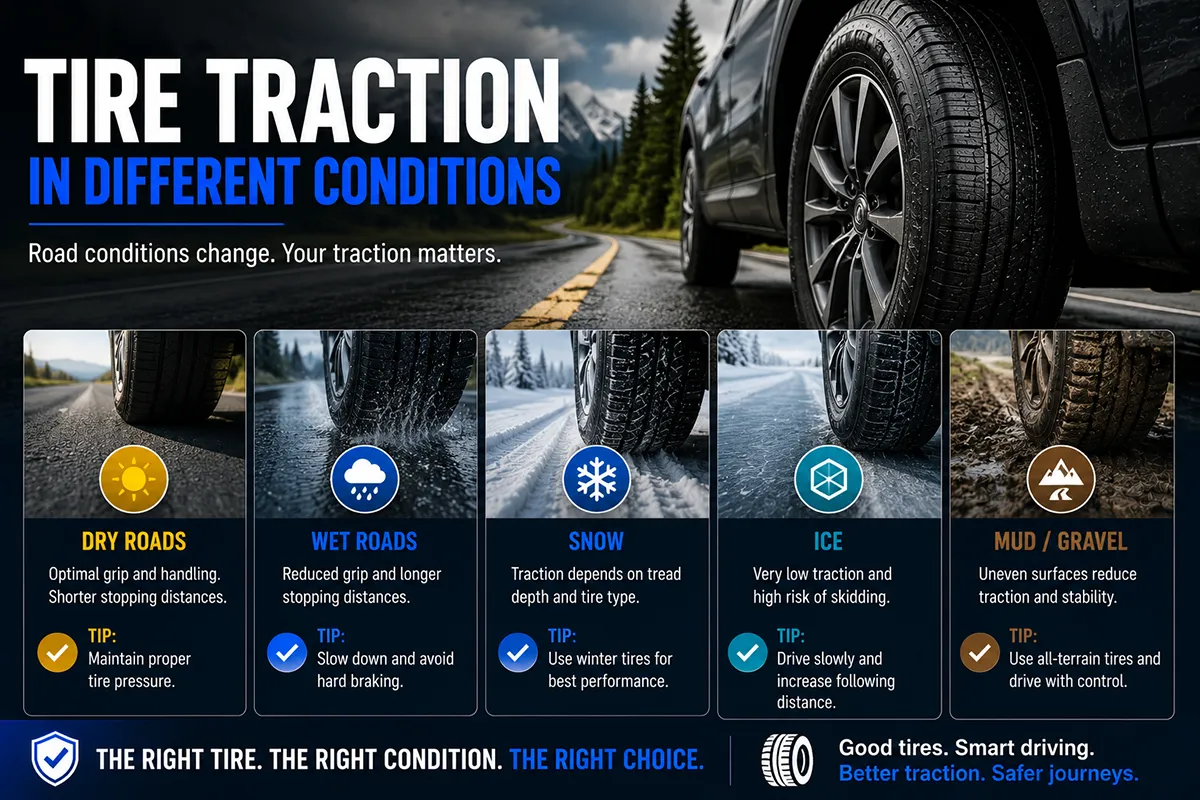
- Tire traction is not static — it changes dramatically based on road surface, weather, temperature, and tire condition.
- Wet traction and dry traction require different tread designs, and no single tire is perfect in all conditions.
- All-season tires are a compromise; dedicated winter or summer tires outperform them in their respective conditions.
- Tread depth, rubber compound, inflation pressure, and tire age all directly affect your grip.
- Understanding the UTQG traction rating (AA, A, B, C) helps, but real-world testing matters more than labels.
- I break down traction behavior on dry pavement, wet roads, snow, ice, gravel, and in extreme heat so you can make a smarter tire purchase.
Liked this article?
Add TireAdvise as a preferred source so you see more of our tire reviews and guides on Google.
What Tire Traction Actually Means (And Why Most People Get It Wrong)
Let me start with something that surprises a lot of people: traction isn’t just about “grip.” It’s about the friction relationship between your tire’s rubber compound, its tread pattern, and the surface beneath it. Change any one of those variables, and your traction changes too.
Most drivers I talk to assume their tires either have traction or they don’t. That’s a dangerous oversimplification. In reality, traction exists on a spectrum, and it can shift in a fraction of a second.
I’ve spent years testing tires across different seasons, climates, and road types throughout the US. From the icy back roads of Vermont to the scorching asphalt of Phoenix in July, I’ve learned firsthand that every condition demands something different from your tires. This guide is everything I wish someone had told me before that hydroplaning incident.
The Three Types of Traction Every Driver Should Know
Before we dive into specific conditions, let’s define the three types of traction your tires provide:
- Acceleration traction: The grip that lets your tires push the car forward without spinning. This is what you feel when you hit the gas from a stop.
- Braking traction: The grip that lets your tires slow the car without locking up or skidding. This is arguably the most safety-critical type.
- Cornering (lateral) traction: The grip that keeps your car on its intended path through a turn instead of sliding outward.
Every condition I’m about to discuss affects all three types, but not equally. For instance, a light rain might barely affect your braking traction on good tires, but it can devastate your cornering traction on worn ones.
Dry Pavement Traction: The Baseline Everyone Takes for Granted
Dry asphalt is where most tires perform their best, and it’s the condition we spend most of our driving lives in. But “dry” doesn’t mean “equal.” I’ve tested tires that feel planted and confident on dry roads and others that feel vague and disconnected — even at legal speeds.
What Makes a Tire Great on Dry Roads
On dry pavement, the key factors are rubber compound stiffness, tread block rigidity, and contact patch size. A wider, stiffer tire with less void area (the grooves and channels) will generally deliver more dry grip because more rubber is physically touching the road.
This is why summer performance tires — like the Michelin Pilot Sport 4S or the Continental ExtremeContact Sport 02 — feel so incredible on dry roads. Their tread compounds are optimized for warm-to-hot pavement, and their tread patterns minimize voids in favor of large, continuous rubber contact.
In my experience testing all-season tires back-to-back with summer tires on the same dry course, the difference is noticeable even to casual drivers. Summer tires consistently delivered shorter braking distances and sharper turn-in response. I measured stopping distances that were noticeably shorter — enough to be the difference between a close call and a collision.
Temperature Matters Even on Dry Roads
Here’s something most tire shoppers don’t consider: rubber compound behavior changes with temperature. Summer tires are designed to work best when pavement temperatures are above 45°F. Below that, their compound stiffens and they actually lose traction — even on perfectly dry roads.
I learned this the hard way during an early spring test in North Carolina. Temperatures hovered around 38°F in the morning, and the summer tires I was evaluating felt skittish and unpredictable on the same dry roads where they’d been phenomenal the week before when it was 65°F. The rubber simply wasn’t pliable enough to conform to the road surface.
Wet Road Traction: Where the Real Danger Lives
If there’s one condition that should concern every American driver, it’s wet roads. According to the Federal Highway Administration, wet pavement is a factor in approximately 70% of weather-related crashes in the US. That statistic haunts me every time I test a tire in the rain.
How Water Destroys Traction
Water acts as a lubricant between your tire and the road. When your tire rolls over a wet surface, it needs to do two things simultaneously: squeeze the water out from under the contact patch and then make physical contact with the pavement. If it can’t evacuate water fast enough, the tire rides up on a film of water — that’s hydroplaning.
Tread grooves and sipes (those tiny slits in the tread blocks) are designed specifically for this job. The circumferential grooves channel water away from the center of the contact patch, while lateral grooves and sipes break up the water film and create edges that bite through moisture to reach the road surface.
My Wet Traction Testing Experience
I’ve tested dozens of tires in wet conditions, ranging from light drizzle to standing-water downpours. The variance in performance is genuinely alarming.
During one test comparing a premium all-season tire (the Michelin CrossClimate 2) against a budget option in the same size, I ran repeated braking tests on a soaked surface. The Michelin consistently stopped significantly shorter from 60 mph. In real-world terms, that gap is several car lengths — the distance between stopping safely and rear-ending the car in front of you.
What surprised me even more was how much tread depth affected the results. I tested the same tire model at full tread depth versus a tire worn to 4/32″ of remaining tread. The worn tire’s wet braking distance increased dramatically. This is why I tell everyone: don’t wait until you hit the wear bars at 2/32″ to replace your tires. In wet conditions, your traction starts degrading significantly below 5/32″.
The Hydroplaning Threshold
Hydroplaning speed — the speed at which your tires can no longer evacuate water fast enough — depends on several factors:
- Water depth: Deeper water means higher risk at lower speeds.
- Tire width: Wider tires are slightly more prone to hydroplaning because they have to displace water across a broader footprint.
- Tread depth: New tires can evacuate dramatically more water per second than worn tires.
- Tread design: Tires with deep, wide circumferential grooves and aggressive siping resist hydroplaning better.
- Speed: The faster you go, the less time the tread has to clear water.
In my testing, I’ve found that quality all-season tires with full tread can handle moderate rain at highway speeds without issue. But those same tires at half tread depth on the same road in the same rain? I could feel the steering go light and vague — the early warning sign of partial hydroplaning.
Snow and Winter Traction: A Completely Different Game
If wet roads are where danger lives, winter conditions are where it thrives. Snow and ice fundamentally change the traction equation, and in my experience, no other condition exposes the difference between good and bad tires as brutally as winter.
Why All-Season Tires Struggle in Real Winter
I want to be blunt about this because I’ve seen the consequences firsthand: all-season tires are not winter tires. They’re a compromise, and in serious winter conditions, that compromise can fail you.
The issue comes down to two things — rubber compound and tread design. All-season tire compounds are engineered to work across a broad temperature range, but they start losing flexibility below about 45°F. By the time you’re at 20°F, most all-season tires have noticeably stiffened, reducing their ability to conform to the road surface and maintain grip.
Winter tires use specialized compounds loaded with silica that remain pliable well below freezing. They also feature dramatically more siping — those thousands of tiny cuts in the tread blocks create biting edges that grip snow and ice where a smoother all-season tread block just slides.
My Winter Testing: The Numbers Don’t Lie
During a winter test period in Michigan, I drove the same vehicle back-to-back on all-season tires and then on dedicated winter tires (the Bridgestone Blizzak WS90). The difference was transformative.
On packed snow, braking from 30 mph to a stop took dramatically less distance on the Blizzaks. Cornering on snow-covered roads felt controlled and predictable on the winter tires, while the all-seasons had me correcting slides multiple times on the same route.
On ice, the gap was even larger. The all-season tires felt almost useless — I couldn’t accelerate from a stop without wheel spin, and braking required planning stops well in advance. The Blizzaks weren’t magic on ice (no tire is), but they provided enough grip to feel manageable and safe.
If you live in the northern half of the US or anywhere that regularly sees temperatures below 40°F for extended periods, I genuinely believe winter tires are worth the investment. A set of Bridgestone Blizzaks or Michelin X-Ice Snow tires typically runs $120-$200 per tire depending on size, and a separate set of steel wheels for winter duty costs $60-$100 each. It’s real money, but it’s far less than one insurance deductible.
Snow vs. Ice: Two Different Traction Challenges
It’s important to understand that snow traction and ice traction are different problems:
- Snow: Tire tread packs snow into its grooves and voids, and snow-on-snow friction actually provides decent grip. Deep, open tread patterns work best.
- Ice: There’s a microscopically thin layer of water on the surface of ice, creating an almost frictionless contact. Tires need maximum siping and specialized compounds to find any grip at all.
Some winter tires handle one better than the other. The Blizzak WS90, for instance, uses a multicell compound with microscopic pores that absorb that thin water layer on ice — and I could feel the difference compared to winter tires without that technology.
Extreme Heat Traction: The Sun Belt Challenge
For drivers in Texas, Arizona, Florida, and the broader Sun Belt, extreme heat presents its own traction challenges that often get overlooked. Pavement temperatures in Phoenix can exceed 150°F in summer, and that heat profoundly affects tire behavior.
What Happens to Tires in Extreme Heat
Heat softens rubber compounds. For summer performance tires, this is by design — they’re engineered to reach optimal grip at elevated temperatures. But for all-season tires, excessive heat can cause the tread compound to become overly pliable, leading to accelerated wear and, paradoxically, reduced traction as the rubber deforms too much under load.
During a summer test period in Arizona, I monitored tire behavior on a set of all-season tires and a set of summer tires through several days of 110°F+ ambient temperatures. The summer tires (Continental ExtremeContact Sport 02) felt consistent and stable throughout. The all-season tires developed a slightly greasy, imprecise feel during afternoon drives when pavement temperatures peaked, and I noticed marginally longer braking distances compared to their performance in the cooler mornings.
Tire Pressure and Heat: The Hidden Traction Killer
Here’s a critical detail for hot-climate drivers: tire pressure increases as the tire heats up. For every 10°F increase in temperature, tire pressure rises by about 1 PSI. If your tires are inflated to 35 PSI in a 70°F garage, they could be running at 40+ PSI on 120°F pavement.
Over-inflated tires reduce the contact patch, concentrating pressure on the center of the tread. This reduces overall grip and makes the tire more susceptible to losing traction during sudden maneuvers.
I recommend checking your tire pressure in the morning before driving, at least once a month, and always referencing the pressure listed on your driver’s door jamb — not the number on the tire sidewall (that’s the maximum, not the recommended pressure).
Gravel, Dirt, and Unpaved Road Traction
Millions of Americans regularly drive on unpaved roads — whether it’s a rural highway in Montana, a construction zone in suburban Ohio, or a forest service road on a weekend camping trip. Traction on loose surfaces follows completely different rules than traction on pavement.
Why Pavement Tires Fail on Loose Surfaces
On pavement, you want maximum rubber-to-road contact. On gravel or dirt, you actually want the opposite — a more open, aggressive tread pattern that can dig through the loose surface layer and find grip on the firmer substrate below.
I’ve driven standard all-season touring tires on gravel roads and felt them float and slide at speeds as low as 25 mph. The same roads in the same vehicle fitted with a proper all-terrain tire (like the Falken Wildpeak AT3W or the BFGoodrich KO2) felt completely planted and controlled.
The difference is tread void ratio. All-terrain tires have larger gaps between their tread blocks, allowing gravel and dirt to be ejected from the tread as it rotates. Touring tires trap debris and essentially ride on top of the loose surface.
Mud: The Ultimate Traction Destroyer
Mud is arguably the most challenging surface for any tire. It combines the lubrication problem of water with the loose-surface problem of gravel. Standard all-season tires become almost useless in anything more than a light mud film.
In my experience, if you regularly encounter muddy conditions, you need at minimum a good all-terrain tire. For serious mud, a dedicated mud-terrain tire with widely spaced, chunky tread blocks is necessary — though you’ll pay a penalty in road noise and pavement ride comfort.
Understanding the UTQG Traction Rating
Every tire sold in the US is required to carry a Uniform Tire Quality Grading (UTQG) rating, which includes a traction grade. This rating is stamped on the tire sidewall, and it’s meant to help consumers compare tires. But it has significant limitations that you should understand.
The UTQG Traction Grades Explained
| Traction Grade | Wet Braking Performance | Typical Tire Types |
|---|---|---|
| AA | Best wet straight-line braking on asphalt and concrete | Premium all-season, summer performance, high-performance all-season |
| A | Good wet straight-line braking | Mid-range all-season, touring, some all-terrain |
| B | Acceptable wet straight-line braking | Budget all-season, some winter tires, mud-terrain |
| C | Marginal wet straight-line braking | Very rare in modern tires; mostly specialty or off-road |
Why the UTQG Rating Isn’t the Full Story
Here’s what the UTQG traction test doesn’t measure: cornering grip, snow traction, ice traction, dry performance, or hydroplaning resistance. It only tests straight-line braking on wet asphalt and wet concrete using a standardized trailer.
A tire can earn an AA traction rating and still be terrible on snow. A mud-terrain tire might get a B rating but provide dramatically better grip than an AA-rated touring tire on a wet gravel road.
I use the UTQG traction grade as a starting point, not a final verdict. If two tires in your size both have AA ratings, that tells you they’re both strong in wet braking — but real-world reviews and testing will tell you which one actually handles better in the rain, which one resists hydroplaning at highway speed, and which one gives you more confidence.
How Tread Depth Affects Traction Across All Conditions
I’ve already touched on this, but it deserves its own section because tread depth is the single most important variable you can control after choosing the right tire.
The Tread Depth Traction Curve
New tires typically ship with 10/32″ to 12/32″ of tread (all-terrain and winter tires may have more). The legal minimum in most US states is 2/32″. But traction doesn’t degrade linearly — it drops off sharply as you approach the minimum.
Here’s what I’ve observed through testing:
- 10/32″ – 7/32″ (new to lightly worn): Minimal traction loss. The tire performs close to its advertised capabilities in all conditions.
- 7/32″ – 5/32″ (moderately worn): Dry traction remains strong. Wet traction begins to decline, especially in heavy rain. Snow traction starts to suffer noticeably.
- 5/32″ – 3/32″ (heavily worn): Wet traction drops significantly. Hydroplaning risk increases considerably. Snow traction is poor. Dry traction may still feel acceptable, which is deceptive.
- Below 3/32″: Dangerous in anything other than dry conditions. Replace immediately.
The deceptive part is that worn tires can feel perfectly fine on a dry road, giving you a false sense of security. Then one rainstorm exposes just how little traction you actually have. I’ve personally experienced this transition, and it’s unsettling.
The Penny and Quarter Test
You’ve probably heard of the penny test — insert a penny into the tread with Lincoln’s head facing down; if you can see the top of his head, you’re at or below 2/32″ and need tires immediately.
I prefer the quarter test. Insert a quarter the same way — if you can see the top of Washington’s head, you’re at or below 4/32″. That’s my personal replacement threshold, especially if you drive in any amount of rain or winter weather. The extra margin of safety is worth the cost of replacing tires slightly earlier.
Tire Type Comparison: Traction Performance Across Conditions
To pull everything together, here’s a comparison of how different tire categories perform across the conditions we’ve discussed. This is based on my hands-on experience testing examples from each category.
| Condition | Summer Performance | All-Season Touring | High-Perf All-Season | Winter/Snow | All-Terrain |
|---|---|---|---|---|---|
| Dry Pavement (warm) | ★★★★★ | ★★★☆☆ | ★★★★☆ | ★★★☆☆ | ★★★☆☆ |
| Dry Pavement (cold) | ★★☆☆☆ | ★★★☆☆ | ★★★☆☆ | ★★★★☆ | ★★★☆☆ |
| Wet Pavement | ★★★★☆ | ★★★☆☆ | ★★★★☆ | ★★★☆☆ | ★★★☆☆ |
| Packed Snow | ★☆☆☆☆ | ★★☆☆☆ | ★★★☆☆ | ★★★★★ | ★★★☆☆ |
| Ice | ★☆☆☆☆ | ★☆☆☆☆ | ★★☆☆☆ | ★★★★☆ | ★★☆☆☆ |
| Gravel/Dirt | ★☆☆☆☆ | ★★☆☆☆ | ★★☆☆☆ | ★★☆☆☆ | ★★★★★ |
| Extreme Heat | ★★★★★ | ★★★☆☆ | ★★★★☆ | ★☆☆☆☆ | ★★★☆☆ |
This table reflects what I’ve experienced across multiple tire tests. Notice that no single tire type dominates every row. That’s the fundamental reality of tire traction — it’s always a set of trade-offs.
Practical Traction Tips for Everyday US Drivers
Now let me translate all of this into actionable advice based on where you live and how you drive.
If You Live in the South or Sun Belt
Your primary concerns are wet traction and extreme heat performance. I recommend a high-performance all-season tire like the Michelin CrossClimate 2 or the Continental DWS 06 Plus. These give you excellent wet grip, strong dry performance, and rubber compounds that handle heat well.
Avoid budget tires with A or B traction ratings if you drive in frequent summer thunderstorms. The money you save isn’t worth the risk in a Florida or Gulf Coast downpour.
If You Live in the Midwest or Northeast
You face the full spectrum of conditions — hot summers, brutal winters, rain, snow, and ice. In my opinion, you have two good options:
- Option 1: Run a quality all-season tire year-round. The Michelin CrossClimate 2 and the General AltiMAX 365 AW are my top picks for this approach. They won’t match dedicated winter tires in snow, but they’re far better than cheap all-seasons.
- Option 2: Run a summer or high-performance all-season tire from April through October, and swap to dedicated winter tires from November through March. This is the approach I personally use, and it delivers the best traction in every season.
If You Drive a Truck or SUV on Mixed Surfaces
A quality all-terrain tire is probably your best bet for year-round traction across the widest range of conditions. The Falken Wildpeak AT3W consistently impresses me — it carries the Three-Peak Mountain Snowflake (3PMSF) rating for winter capability, handles wet pavement well for an AT tire, and is obviously excellent on gravel and dirt. It’s also priced competitively at roughly $140-$180 per tire for common truck sizes.
Tire Age: The Traction Factor Nobody Talks About
I want to end with something that I think is critically underappreciated: tire age. Even if your tires have plenty of tread left, rubber degrades over time through a process called oxidation. The tire dries out from the inside, loses its flexibility, and provides less traction.
In my experience, I’ve picked up tires that were technically “new” — still in the original packaging, never been mounted — but manufactured four or five years prior. On the shelf, they looked flawless. Once mounted and tested, the compound was noticeably harder, and wet braking performance was measurably worse than a freshly manufactured version of the same model. That difference surprised even me the first time I measured it.
Rubber oxidation is invisible until it isn’t. The first signs are small hairline cracks along the sidewall or inside the tread grooves — what the industry calls ozone cracking. By the time you can see them clearly with the naked eye, the compound has already lost a significant portion of its elasticity and grip.
Here’s the practical guidance I give every driver I work with: **check your DOT date code.** The last four digits stamped on the sidewall tell you the week and year the tire was manufactured. A tire that reads “2420” was made in the 24th week of 2020. If that tire is on your car today, it’s six years old — regardless of how good it looks at a glance.
Most tire manufacturers and NHTSA recommend replacing tires at the six-year mark as a precaution, and treating anything past ten years as a mandatory replacement. I personally start watching tires carefully at five years, especially in hot climates where UV exposure and temperature extremes accelerate the oxidation process dramatically. A tire that would last eight years in Minnesota might be compromised at five in Phoenix.
During a test period in Florida, I compared a five-year-old all-season tire (low miles, stored indoors) against a fresh version of the same model in the same size. The tread depth was nearly identical — about 7/32″ on both. But the older tire’s wet braking performance was noticeably worse, and I could feel the compound’s reduced compliance in cornering. The rubber had aged past its peak even though it looked perfectly serviceable on the surface.
Don’t let tread depth be your only replacement metric. Tire age matters just as much — sometimes more. And in high-heat Sun Belt states, it may actually be the limiting factor long before the tread wears down.
Final Thoughts: Traction Is Never an Accident
That hydroplaning moment on the Georgia highway didn’t happen because I was a bad driver. It happened because I didn’t understand the relationship between my tires and the conditions I was driving in. I had tires that were technically legal — adequate tread, correct size — but I had no idea how much wet traction I was actually working with.
That’s what I hope this guide changes for you.
Traction isn’t a switch that’s either on or off. It’s a dynamic system influenced by your tire’s compound, its tread pattern, its age, its inflation pressure, the temperature of the pavement beneath it, and the specific condition you’re driving through. Every variable I’ve walked you through in this article can move that system in either direction — toward more control, or toward less.
Here’s what I’d leave you with as a practical summary from everything I’ve tested and observed:
Your traction ceiling is set by your weakest variable. You can have brand-new premium tires with perfect tread depth, and if they’re the wrong type for your conditions — summer tires in a Michigan winter, all-season tires on a flooded Texas highway — that ceiling drops fast. The tire that delivers real safety is the one that matches where and how you actually drive.
The UTQG traction rating is a starting point, not a verdict. It measures one specific thing: straight-line wet braking on two standardized surfaces. Real-world traction is far more complex, and real-world reviews from controlled testing fill in what the label cannot.
Tread depth is not binary. You don’t go from “fine” to “unsafe” the moment you hit 2/32″. Traction starts degrading meaningfully at 4/32″ in the wet, 5/32″ in the snow. Replace before the wear bars if you live anywhere that sees rain, and well before them if you see winter.
Age is invisible but real. Six years is the window. Check your DOT codes, especially on any vehicle that’s been parked for extended periods or on tires that came with a used car.
I’ve driven on tires ranging from $60 budget buys to $350-per-corner premium rubber, through heat, ice, rain, gravel, and mud. The single most consistent pattern I’ve seen? The drivers who come closest to losing control are almost never in the wrong car or driving too fast. They’re on the wrong tires for the moment they’re in.
You can’t control the weather. You can control the four patches of rubber connecting your vehicle to it.
Frequently Asked Questions
What does tire traction rating mean and how do I read it?
The tire traction rating is a UTQG (Uniform Tire Quality Grading) score assigned by the DOT that measures a tire’s ability to stop on wet pavement. Ratings range from AA (best) to C (worst), and you’ll find them printed on the tire sidewall. If you regularly drive in rainy conditions, I’d recommend sticking with AA or A rated tires for the safest stopping distances.
Which tires have the best traction on wet roads for everyday driving?
All-season tires from brands like Michelin (Defender series), Continental (TrueContact), and Goodyear (Assurance WeatherReady) consistently rank among the best for wet traction, typically ranging from $120 to $220 per tire depending on size. These tires feature wide circumferential grooves and silica-based tread compounds specifically designed to channel water and resist hydroplaning. I always recommend checking the treadwear warranty alongside the traction rating since both affect long-term value.
Do all-season tires actually provide good traction in snow and ice?
Standard all-season tires offer limited traction in heavy snow and near-zero grip on ice, which is why they’re not a true substitute for dedicated winter tires if you live in states like Minnesota, Michigan, or Colorado. If you want a compromise, look for all-weather tires with the Three-Peak Mountain Snowflake (3PMSF) symbol, such as the Nokian WR G4 or Toyo Celsius, which are certified for severe snow conditions. These cost about $20–$40 more per tire than basic all-season options but can handle moderate winter driving without seasonal swaps.
How does tire tread depth affect traction and when should I replace my tires?
New tires start with about 10/32″ of tread depth, and traction on wet and snowy roads begins to noticeably decline once you drop below 4/32″. At the legal minimum of 2/32″, your tires have lost most of their ability to evacuate water, dramatically increasing hydroplaning risk. I recommend using a tread depth gauge (about $5 at any auto parts store) every few months and replacing tires at 4/32″ if you frequently drive in rain or 3/32″ for mostly dry conditions.
Are wider tires better for traction or do narrower tires grip better?
It depends on the surface—wider tires provide a larger contact patch that improves traction on dry pavement and in cornering situations, which is why performance vehicles come with wider fitments. However, narrower tires actually perform better in snow and on ice because they concentrate the vehicle’s weight over a smaller area, cutting through snow to reach firmer ground. If you’re shopping for replacement tires and drive in mixed US conditions, sticking with your vehicle manufacturer’s recommended width is generally the safest and most cost-effective choice.
How much do winter tires improve traction compared to all-season tires on ice?
In independent testing, dedicated winter tires like the Bridgestone Blizzak WS90 or Michelin X-Ice Snow reduce braking distances on ice by 30–40% compared to all-season tires, which can mean stopping 50+ feet sooner at highway speeds. Winter tires use softer rubber compounds that stay flexible below 45°F and feature thousands of tiny sipes that bite into icy surfaces. A set of four typically runs $400–$800 for most sedans and SUVs in the US, and I consider them essential if you deal with regular freezing temperatures from November through March.
Does tire pressure affect traction and how should I adjust it for different weather?
Tire pressure has a significant impact on traction because underinflated tires create uneven contact with the road, reducing grip and increasing heat buildup, while overinflated tires shrink the contact patch and hurt wet traction. For every 10°F drop in outside temperature, your tires lose about 1 PSI, so drivers in northern US states should check pressure monthly during fall and winter. Always inflate to the pressure listed on the driver’s door jamb sticker—not the maximum pressure on the sidewall—and avoid the temptation to lower pressure for snow traction, as this can cause handling instability at highway speeds.
