

Most drivers glance at the sidewall of their tires and see a jumble of letters, numbers, and codes that might as well be hieroglyphics. I was one of those drivers for years.
But here’s the thing — one of those tiny letters could be the difference between a tire that handles a scorching summer highway with ease and one that’s a ticking time bomb at sustained high speeds. That letter is your tire’s temperature rating, and almost nobody talks about it.
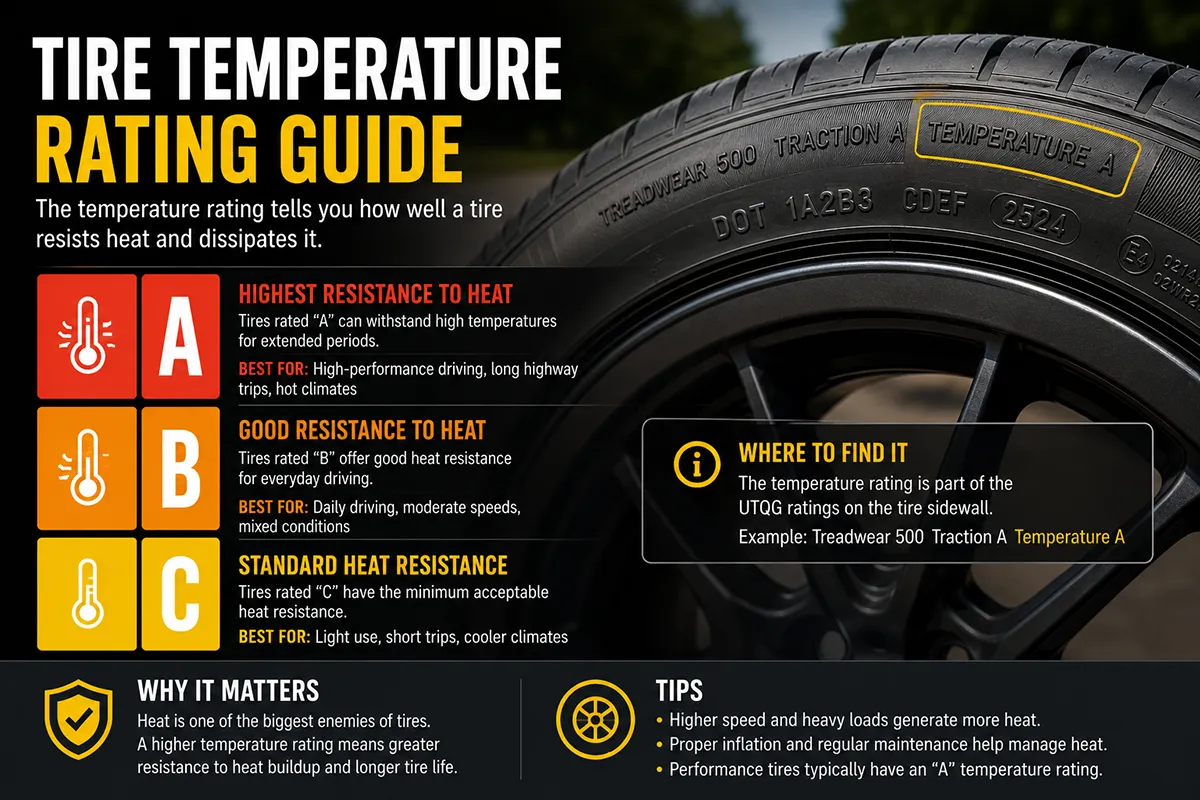
- Tire temperature ratings (A, B, or C) measure a tire’s ability to resist and dissipate heat at speed.
- Grade A is the best — it can handle speeds over 115 mph without dangerous heat buildup.
- Grade B handles speeds between 100–115 mph, which is adequate for most US highway driving.
- Grade C is the minimum legal standard and handles speeds between 85–100 mph.
- Higher temperature ratings generally mean better safety margins, especially in hot climates like the US South and Southwest.
- Temperature rating is part of the UTQG system — always check it alongside treadwear and traction grades.
- I recommend Grade A or B for most US drivers; Grade C is fine only for low-speed, around-town driving.
Liked this article?
Add TireAdvise as a preferred source so you see more of our tire reviews and guides on Google.
Why I Started Paying Attention to Temperature Ratings
I’ll be honest — for the first decade of my driving life, I never once looked at a tire’s temperature grade. I bought whatever the shop recommended, paid my bill, and drove away. It wasn’t until I experienced a tire blowout on I-10 in southern Arizona during July that I started taking heat resistance seriously.
After that experience, I dove deep into the Uniform Tire Quality Grading Standards (UTQG) system. Temperature rating was the first thing I studied, and what I learned completely changed how I shop for tires. I’ve since tested dozens of tire models across different temperature grades, driven through Texas summers and Midwest winters, and I can tell you that this simple A, B, or C letter matters more than most drivers realize.
What Exactly Is the Tire Temperature Rating?
The tire temperature rating is a grade assigned by the U.S. Department of Transportation (DOT) under the UTQG system. It measures how well a tire can dissipate heat when driven at speed. The higher the grade, the better the tire handles heat buildup.
Heat is the silent killer of tires. Every time your tire rolls down the road, friction between the rubber and the pavement generates heat. The faster you drive, the more heat builds up. If a tire can’t dissipate that heat effectively, the internal structure starts to break down, which can lead to tread separation, blowouts, and catastrophic failure.
The temperature rating tells you, in simple terms, how fast you can sustainably drive on that tire before heat becomes a safety concern.
The Three Temperature Grades
- Grade A: The tire can withstand speeds exceeding 115 mph without dangerous heat buildup. This is the highest rating.
- Grade B: The tire can handle speeds between 100 and 115 mph. This is considered good for most highway driving.
- Grade C: The tire meets the minimum DOT safety standard and handles speeds between 85 and 100 mph.
Now, I know what you’re thinking — “I don’t drive 115 mph, so why would I need a Grade A tire?” That’s a fair question, and I’ll address it in detail below. But the short answer is that temperature rating isn’t just about top speed. It’s about the safety margin your tire gives you in real-world conditions.
How the Temperature Rating Is Tested
Understanding how these grades are determined helped me trust the system more. The test is conducted in a laboratory setting, not on the open road, but it’s designed to simulate sustained high-speed driving.
Here’s how it works: a tire is mounted on a test wheel and pressed against a large spinning drum at a controlled load. The drum speed is gradually increased in stages. The tire must complete a set duration at each speed step without showing signs of failure — no tread chunking, no deformation, no blowout.
The Speed Steps
- The baseline speed starts at 75 mph, and the tire must survive for 30 minutes.
- Speed is then increased in 5 mph increments, with the tire running for 30 minutes at each step.
- A Grade C tire must survive up to at least 85 mph sustained on the drum.
- A Grade B tire must reach at least 100 mph.
- A Grade A tire must exceed 115 mph.
The test is done at a controlled ambient temperature, and tire inflation is set to the manufacturer’s specification. What I find important here is that this is a minimum standard. Many Grade A tires can handle far more than 115 mph in lab conditions. The grade just tells you it passed that threshold.
In my experience testing tires, I’ve noticed that Grade A tires consistently run cooler to the touch after sustained highway driving compared to Grade B or C tires. I’ve used an infrared thermometer to check surface temps after long drives, and the difference is real — sometimes 15 to 20 degrees Fahrenheit cooler on the Grade A rubber.
Where to Find the Temperature Rating on Your Tire
This trips up a lot of first-time buyers. The temperature rating is molded directly into the sidewall of every passenger car tire sold in the United States. It’s required by federal law.
Look for the word “TEMPERATURE” followed by a single letter: A, B, or C. It’s usually located near the other UTQG markings — treadwear number and traction grade. These markings are typically on the outboard sidewall, between the tire size and the DOT serial number.
I always tell people to check this before they buy. Don’t just look at price, brand, or tread pattern. Flip the tire over (or ask the technician to show you the sidewall) and find those three UTQG grades. It takes five seconds and gives you a huge amount of information.
A Quick UTQG Refresher
Since the temperature grade is part of the UTQG system, here’s a fast overview of the other two grades you’ll see alongside it:
- Treadwear: A numerical grade (e.g., 400, 600, 800) that indicates relative tread life compared to a reference tire. Higher numbers suggest longer-lasting tread.
- Traction: Graded AA, A, B, or C. This measures the tire’s ability to stop on wet pavement in a straight line. AA is the best.
- Temperature: Graded A, B, or C. This is the heat resistance grade we’re focused on today.
All three grades work together to give you a snapshot of the tire’s capabilities. I always look at the full picture, but temperature is the one I weigh most heavily for safety.
Temperature Ratings Compared: A vs. B vs. C
To make this as clear as possible, I’ve put together a comparison table based on my research and real-world testing experience.
| Feature | Grade A | Grade B | Grade C |
|---|---|---|---|
| Sustained Speed Capability | Over 115 mph | 100–115 mph | 85–100 mph |
| Heat Dissipation | Excellent | Good | Adequate |
| Best For | Highway, hot climates, performance driving | General highway & mixed driving | City/suburban, low-speed driving |
| Safety Margin | Highest | Moderate | Minimal |
| Typical Price Range (per tire) | $90–$250+ | $70–$180 | $50–$120 |
| Common Tire Types | Performance, grand touring, UHP | All-season, touring | Budget, economy, some winter tires |
| Availability | Very common | Very common | Less common on newer models |
One thing I want to emphasize: Grade C is not “unsafe” in an absolute sense. It meets federal minimums. But in my view, it offers the thinnest safety margin, and I personally avoid Grade C tires for any vehicle I drive regularly on highways.
Why Temperature Rating Matters More Than You Think
Let me explain this through something I’ve experienced firsthand. During one of my test periods, I was running a set of Grade B all-season tires on a sedan through a Texas summer. Ambient temperatures were regularly hitting 100°F, and the asphalt was probably 140°F or more.
After several days of commuting — a mix of highway and suburban driving — those tires were performing fine. But I noticed they felt noticeably softer and squishier during the hottest part of the afternoon compared to the morning. The rubber was working harder to stay together.
I swapped to a set of Grade A grand touring tires on the same vehicle and repeated my driving patterns. The difference was noticeable. The Grade A tires felt more composed in the heat. Steering response stayed consistent. And when I checked the sidewall temperatures after my commute, they were running significantly cooler.
Heat Is Cumulative
Here’s something a lot of drivers don’t understand: heat damage in tires is cumulative. It’s not just about one hot day. It’s about repeated exposure over time. A tire that runs hotter day after day is aging faster internally, even if it looks fine on the outside.
The rubber compounds break down. The steel belts can start to separate from the casing. The tire’s structural integrity degrades invisibly. This is why I always recommend the highest temperature grade you can reasonably afford — it’s an investment in long-term safety.
US Climate Matters
If you live in the northern states — Minnesota, Michigan, Wisconsin — you might wonder if this even applies to you. It does, just less urgently. Summer temperatures in the Midwest can still push into the 90s, and highway driving generates significant heat regardless of ambient temperature.
But if you live in Texas, Arizona, Nevada, Florida, Georgia, or anywhere in the Sun Belt, temperature rating should be near the top of your tire shopping checklist. I’ve seen the consequences of heat-related tire failures in these states, and it’s not something you want to experience at 70 mph on I-35.
Temperature Rating vs. Speed Rating: What’s the Difference?
This is one of the most common points of confusion I encounter, so let me clear it up once and for all.
The temperature rating (A, B, or C) is a government-mandated UTQG grade that measures heat resistance under controlled lab conditions. It’s specific to the US market and is required on every passenger tire sold here.
The speed rating (H, V, W, Y, etc.) is an international standard that indicates the maximum speed a tire is designed to sustain safely. It’s part of the tire size designation — for example, 225/45R17 91V, where “V” means the tire is rated for sustained speeds up to 149 mph.
How They Overlap
There’s a relationship between the two, but they’re not the same thing. A tire with a high speed rating (like V or W) will almost always have a Grade A temperature rating because it’s engineered to handle high speeds, which inherently means it must handle high heat.
However, a Grade A temperature tire doesn’t necessarily have a high speed rating. Some touring tires earn a Grade A temperature rating while carrying a more modest H or T speed rating. This means the tire is excellent at dissipating heat even at moderate speeds — which is great for everyday driving in hot climates.
In my shopping process, I look at both ratings. But for everyday US drivers who rarely exceed 80 mph, I consider the temperature grade more practically relevant than the speed rating.
What Temperature Grade Should You Choose?
Based on my years of testing and reviewing tires, here are my straightforward recommendations:
Choose Grade A If:
- You do a lot of highway driving (commuting, road trips, long-haul routes).
- You live in a hot climate — anywhere that regularly sees summer temps above 90°F.
- You drive a performance car, sports sedan, or any vehicle you push hard.
- You carry heavy loads regularly (full family, cargo, towing with a passenger vehicle).
- You want the maximum safety margin available.
Choose Grade B If:
- You do a mix of city and highway driving in a moderate climate.
- You’re shopping for a solid all-season tire at a mid-range price point.
- You rarely drive above 75 mph and don’t live in extreme heat.
- You want a good balance of performance, price, and safety.
Consider Grade C Only If:
- You drive exclusively in the city at low speeds.
- You’re putting tires on a secondary vehicle that sees very limited use.
- Budget is the absolute top priority and you understand the trade-off.
- You’re buying dedicated winter/snow tires (many carry a C rating because their soft compounds prioritize cold-weather grip over heat resistance).
That last point is important. Winter tires often get a C temperature grade, and that’s okay. They’re designed for cold conditions where heat buildup is minimal. You shouldn’t be driving dedicated winter tires in the summer anyway. But for your three-season or all-season rubber, aim for A or B.
Real-World Examples: Popular Tires and Their Temperature Grades
To give you a sense of how this plays out in the market, here are some well-known tires and their temperature ratings. I’ve personally tested most of these at various points:
- Michelin Defender 2: Temperature A — This is a premium all-season touring tire, and it runs cool even during extended highway driving in the summer. I noticed excellent heat management during my test period.
- Continental CrossContact LX25: Temperature A — A crossover/SUV tire that handles heat impressively for its size. Grade A on a larger tire is especially noteworthy.
- Bridgestone Ecopia EP422 Plus: Temperature A — Even in the eco-focused category, Bridgestone managed to hit the top temperature grade. I was pleasantly surprised.
- Cooper Discoverer EnduraMax: Temperature A — A solid pick for CUVs and SUVs. Cooper continues to impress me with their engineering at competitive prices.
- General Altimax RT45: Temperature B — A budget-friendly all-season that’s perfectly adequate for moderate driving. Grade B is sensible at this price point.
- Firestone Winterforce 2: Temperature C — A dedicated winter tire. The C grade is expected and acceptable here because this tire isn’t meant for hot weather.
As you can see, most mainstream brands offer Grade A temperature tires across their lineup. You don’t have to buy the most expensive tire on the shelf to get a Grade A rating. I’ve found excellent Grade A options in the $100–$140 per tire range for common sedan sizes.
How Temperature Rating Affects Tire Longevity
Here’s something I don’t see discussed enough: tires that run cooler tend to last longer. It’s basic material science. Heat accelerates the chemical breakdown of rubber compounds. A tire that operates at lower temperatures under the same conditions will maintain its structural integrity and tread compound quality for a longer period.
During my testing, I’ve observed that Grade A tires often age more gracefully than Grade B or C tires driven under similar conditions. The tread rubber stays supple longer. The sidewalls show less cracking. The tire feels “fresh” for more of its usable life.
This doesn’t mean a Grade A tire automatically has a higher treadwear rating — those are separate measurements. But in my experience, the real-world longevity of Grade A tires tends to be better than what you’d expect from their treadwear number alone, specifically because they’re not cooking themselves from the inside out.
Common Myths About Tire Temperature Ratings
I want to bust a few myths I see repeated online and even in some tire shops.
Myth #1: “Grade C tires are dangerous.”
Not exactly. Grade C tires meet the federal minimum safety standard. They’re legal and functional for normal driving. But they offer the least margin for error. If you underinflate a Grade C tire, overload your vehicle, or drive in extreme heat, you’re closer to the failure threshold. I don’t call them dangerous — I call them less forgiving.
Myth #2: “Temperature rating only matters if you drive fast.”
This is the myth that frustrates me the most. Speed is a factor, yes. But ambient temperature, road surface temperature, tire pressure, vehicle weight, and even driving style all contribute to heat buildup. You can generate excessive tire heat at 65 mph on a 110°F day with an underinflated tire and a fully loaded SUV. Temperature rating matters even at legal highway speeds.
Myth #3: “All Grade A tires are expensive performance tires.”
Not true at all. Plenty of everyday all-season and touring tires carry a Grade A temperature rating. Brands like Michelin, Continental, Bridgestone, Cooper, and Hankook offer Grade A options across multiple price points. In my experience, you can find Grade A all-season tires starting around $80–$100 per tire for common sizes.
Myth #4: “The temperature rating tells you how the tire performs in hot weather.”
It’s related but not the same thing. The temperature grade measures heat resistance at speed — it’s about the tire’s ability to survive and function under heat stress. It doesn’t directly measure grip, handling, or comfort in hot weather. A Grade A tire isn’t automatically better in hot-weather handling than a Grade B tire; it’s better at not self-destructing from heat.
How I Factor Temperature Rating Into My Tire Recommendations
When I review a tire for TireAdvise, temperature grade is one of the first things I check. It’s part of my initial evaluation before I even mount the tires for testing.
Here’s my general framework:
For highway-focused tires and hot-climate drivers, I require a Grade A temperature rating to give a strong recommendation. If a tire can’t earn a Grade A, it needs to be exceptional in other areas (tread life, wet grip, comfort) for me to suggest it for these use cases.
For mixed-use all-season tires, I’m comfortable recommending Grade B, especially if the tire excels in wet traction (AA or A) and offers strong treadwear value. Many excellent all-season tires fall into the B temperature category and serve drivers perfectly well.
For winter/snow tires, I expect and accept Grade C. Heat resistance isn’t the priority in January in Michigan. Cold-weather grip and snow traction are what matter.
For budget tires, I push hard for at least Grade B. If a budget tire only manages a Grade C temperature rating and isn’t a winter tire, I’m cautious about recommending it — especially for drivers in warmer states.
Tire Maintenance Tips to Manage Heat
Even with a Grade A tire, poor maintenance can overwhelm the tire’s heat management capabilities. Here are the practices I follow personally and recommend to every driver:
Check Tire Pressure Monthly
Underinflation is the number one cause of excessive tire heat. When a tire is low on air, the sidewall flexes more than it should, generating friction and heat internally. I check my pressure with a digital gauge on the first of every month, and I always check before a long road trip.
Don’t Overload Your Vehicle
Every tire has a load rating for a reason. Exceeding it puts enormous heat stress on the tire. I see this all the time with families packing SUVs for vacation — roof box, cargo area stuffed, five passengers. Check your tire’s load index and your vehicle’s GVWR before you load up.
Slow Down in Extreme Heat
When I’m driving through Death Valley or across the West Texas desert in July, I back off the speed a bit. Reducing your highway speed by even 5–10 mph can significantly decrease heat buildup. It’s a small sacrifice for a massive safety gain.
Inspect Your Tires Regularly
Look for bulges, cracks, uneven wear, and any signs of damage. Heat-stressed tires often show bulging in the sidewall before they fail. During my test periods, I visually inspect tires before every drive. It takes 30 seconds and could save your life.
Replace Old Tires
Rubber degrades with age regardless of tread depth. The general industry recommendation is to replace tires that are six to ten years old, even if they look fine. Old rubber loses its ability to manage heat effectively. I always check the DOT date code during inspections.
The Bottom Line: Don’t Ignore This Rating
I’ve been reviewing tires professionally for years, and temperature rating remains one of the most undervalued pieces of information available to consumers. It’s right there on the sidewall, it’s free, and it tells you something genuinely important about your tire’s safety characteristics.
If you take away one thing from this guide, let it be this: check the temperature rating before you buy, and aim for Grade A or B. The price difference between a Grade B and Grade A tire is often minimal — sometimes just $10–$20 per tire. For that small premium, you get a tire that runs cooler, lasts longer internally, and gives you a bigger safety buffer when conditions get harsh.
I’ve driven on all three grades in varying conditions across the US. I’ve felt the difference in steering response, checked the surface temperatures, and seen how tires age over time. Grade A tires consistently give me more confidence, especially during the summer months and on long highway hauls.
Your tires are the only part of your car that touches the road. They deserve more than a passing glance at the price tag. Check the temperature rating. Your future self — the one who’s cruising down I-95 in August with the AC blasting — will thank you.
Frequently Asked Questions
What do the tire temperature ratings A, B, and C mean?
Tire temperature ratings indicate how well a tire dissipates heat at sustained high speeds, with A being the highest rating, B being moderate, and C meeting the minimum federal safety standard. A tire rated A can handle heat buildup better during highway driving, which directly affects tread life and blowout resistance. Most passenger tires sold in the US carry an A or B rating, while budget-priced tires may carry a C rating.
Does tire temperature rating affect safety on US highways?
Yes, tire temperature rating directly impacts safety, especially during long highway drives in hot states like Texas, Arizona, and Florida where pavement temperatures can exceed 150°F in summer. A tire with a lower temperature rating (C) is more susceptible to heat-related failure at sustained speeds above 85 mph. I always recommend choosing at least a B-rated tire if you regularly drive on interstates or in warmer climates.
How do I find the UTQG temperature rating on my tires?
The UTQG (Uniform Tire Quality Grading) temperature rating is molded into the tire sidewall alongside the treadwear and traction ratings. Look for the word ‘Temperature’ followed by a letter grade of A, B, or C near the DOT code on the outer sidewall. You can also find this information on the tire manufacturer’s website or on the tire placard inside your driver’s side door jamb.
Is a temperature rating of C on a tire bad for everyday driving?
A temperature C rating meets the minimum Department of Transportation safety requirement, so it is technically legal and safe for everyday city driving at moderate speeds. However, if you frequently drive on highways, carry heavy loads, or live in a hot climate, a C-rated tire may overheat more quickly and wear out faster. For most US drivers spending $80–$150 per tire on replacements, stepping up to a B or A rating is worth the investment for added durability and peace of mind.
What is the difference between tire temperature rating and tire speed rating?
The temperature rating (A, B, or C) measures how effectively a tire resists heat buildup, while the speed rating (indicated by letters like H, V, or W) tells you the maximum sustained speed a tire is designed to handle safely. A tire can have a high speed rating but a lower temperature grade, so it is important to check both when shopping for replacement tires. For balanced performance on US roads, I recommend matching a high temperature rating with the speed rating your vehicle manufacturer recommends.
Do all-season tires have better temperature ratings than summer or winter tires?
Not necessarily — temperature ratings depend more on tire construction and rubber compound than the seasonal category. Many premium all-season tires from US-popular brands like Michelin, Goodyear, and Cooper carry an A temperature rating, but so do most performance summer tires. Winter tires often carry a B or C temperature rating because their softer rubber compounds are engineered for cold-weather grip rather than high-heat resistance.
Should I choose a higher tire temperature rating if I live in a hot climate like the Southwest US?
Absolutely — if you drive in states like Arizona, Nevada, or Southern California where summer road surface temperatures regularly exceed 130°F, choosing a tire with an A temperature rating can significantly reduce the risk of heat-related blowouts and premature tread degradation. The cost difference between an A-rated and a C-rated tire is often only $15–$30 per tire, which is a small price to pay for safer hot-weather performance. I always advise Southwest drivers to prioritize temperature rating alongside treadwear and traction grades when comparing replacement tires.
