

Most drivers never think about what’s actually inside their tires — until a blowout on I-95 forces them to care.
I’ve been reviewing and testing tires for over a decade, and I can tell you that the difference between a confident highway cruise and a white-knuckle emergency often comes down to layers of material you’ll never see. Understanding what’s underneath that rubber isn’t just nerdy engineering talk — it’s genuinely useful knowledge that can save you money and keep your family safer.
- Every tire has multiple hidden layers — bead bundles, body plies, belt packages, and liner — that determine how it handles, rides, and lasts.
- Radial construction dominates the US market and outperforms bias-ply in nearly every measurable way for passenger vehicles.
- Steel belts improve stability and puncture resistance; polyester body plies deliver comfort; nylon cap plies add high-speed durability.
- Knowing construction details helps you compare tires beyond brand names and tread patterns when shopping for replacements.
- I explain each layer from the inside out using real-world observations from years of hands-on tire testing.
Liked this article?
Add TireAdvise as a preferred source so you see more of our tire reviews and guides on Google.
Why I Started Caring About What’s Inside a Tire
Early in my tire-reviewing career, I focused almost exclusively on tread patterns and rubber compounds. Those are the sexy, visible features that marketing teams love to highlight.
But after testing hundreds of tires side by side — swapping them onto the same vehicles, driving the same routes, and measuring the same performance metrics — I realized something. Two tires with nearly identical tread designs could feel completely different on the road, and the answer was always hiding inside the carcass.
That’s when I started digging into construction specs before every review. Now, it’s the first thing I check on any tire’s data sheet.
A Quick Anatomy Lesson: The Layers Inside Every Tire
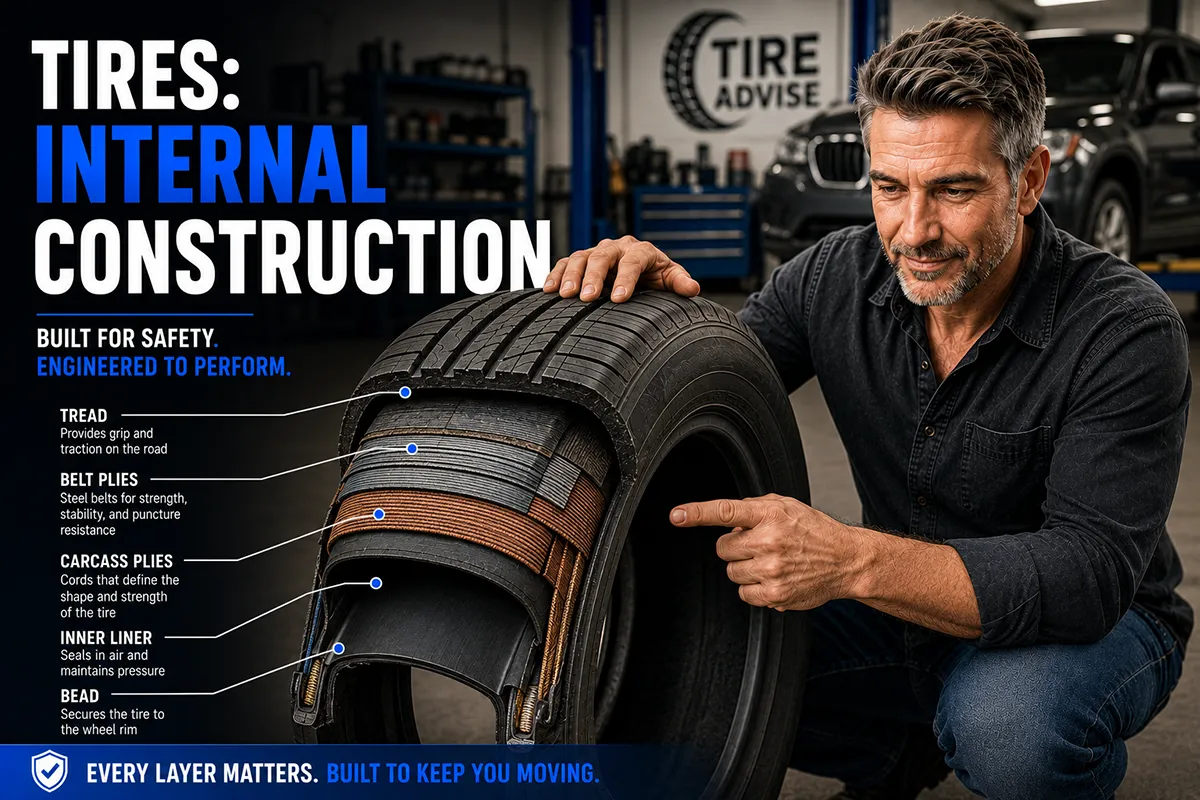
Think of a tire like a multi-layer sandwich. Each layer has a specific job, and they all work together to keep you rolling safely. Here’s the basic inside-out breakdown:
- Inner liner — the airtight rubber membrane that replaces the old-school inner tube
- Body plies — the structural skeleton that gives the tire its shape and strength
- Bead bundle — the steel wire loops that lock the tire onto the wheel
- Belt package — steel and/or fabric layers under the tread that stabilize the footprint
- Cap ply (overlay) — a nylon reinforcement layer that holds everything together at speed
- Sidewall rubber — the protective outer layer that shields the body plies
- Tread — the outermost rubber compound and pattern that contacts the road
Every one of these layers influences ride comfort, noise, handling, durability, and fuel efficiency. Let me walk you through each one in detail.
The Inner Liner: Your Tire’s Invisible Air Barrier
The inner liner is a thin sheet of nearly impermeable rubber — usually a halobutyl compound — bonded to the inside of the tire. Its only job is to keep air in.
Before tubeless tires became standard in the US market (which happened gradually through the 1960s and 70s), drivers relied on separate inner tubes. The inner liner replaced that tube, eliminating a common failure point and reducing weight.
In my experience, you rarely think about the inner liner unless something goes wrong. A manufacturing defect in this layer can cause slow, mysterious air loss that drives you crazy at the tire shop. I’ve encountered this twice during testing — tires that consistently lost pressure despite having no visible puncture. Both times, the culprit was a liner issue.
What to Know as a Buyer
You won’t find inner liner specs on most tire labels or retail listings. But here’s a practical tip: if you buy a new set of tires and one consistently loses pressure faster than the others (say, a couple of PSI per week more than its siblings), don’t just keep refilling it. Take it back to the shop. It could be a liner defect covered under warranty.
Body Plies: The Skeleton That Shapes Everything
The body plies are arguably the most important structural component inside a tire. These are sheets of fabric cords — typically polyester, rayon, or nylon — coated in rubber and layered inside the tire’s carcass.
The number of plies, the cord material, and the angle at which those cords run determine the tire’s fundamental character. This is where the critical distinction between radial and bias-ply construction comes in.
Radial vs. Bias-Ply: The Construction That Changed Everything
In a radial tire, the body ply cords run perpendicular to the direction of travel — from bead to bead, straight across the tire. In a bias-ply tire, the cords run diagonally, crisscrossing at angles (usually around 30-40 degrees).
This might sound like a minor geometric detail, but it changes everything about how the tire behaves.
I’ve driven bias-ply tires on classic cars and on trailer applications, and I’ve driven radials on everything from economy sedans to performance SUVs. The difference is immediately obvious.
Radial tires feel more planted. The tread stays flatter against the road surface, which means a larger, more consistent contact patch. Bias-ply tires feel stiffer, more “wooden” in their response, and they generate noticeably more heat at highway speeds.
Here’s a comparison:
| Feature | Radial Construction | Bias-Ply Construction |
|---|---|---|
| Ply cord angle | 90° (perpendicular to tread) | 30°–40° (diagonal, crisscrossed) |
| Ride comfort | Superior — flexible sidewalls absorb bumps | Stiffer, harsher ride |
| Tread wear | More even, longer-lasting | Tends to wear faster and less evenly |
| Heat buildup | Lower — runs cooler at speed | Higher — more internal friction |
| Fuel efficiency | Better (lower rolling resistance) | Worse (higher rolling resistance) |
| Load handling | Excellent for passenger and light truck | Still used for some trailer and off-road applications |
| Common US use today | 99%+ of passenger car and SUV tires | Trailers, some vintage vehicles, specialty off-road |
For any US driver shopping for replacement tires on a passenger car, SUV, or pickup truck, you’re buying radial. Period. Bias-ply is essentially a niche product in today’s market.
Ply Count: Does More Mean Better?
You’ll sometimes see “2-ply” or “4-ply rated” on a tire’s sidewall. Here’s what I want you to understand: modern materials are so strong that a single polyester body ply in a radial passenger tire does the work that several cotton plies did decades ago.
Most standard passenger car radials use one or two body plies. Light truck tires might use two or three. The ply rating you see (like “Load Range E” or “10-ply rated”) refers to the tire’s load-carrying capacity, not necessarily the literal number of physical plies inside.
I’ve cut open decommissioned tires from multiple brands, and a “10-ply rated” LT tire often has only two or three actual body plies — they’re just made with stronger, heavier-duty cord materials.
Cord Materials: Polyester, Nylon, Rayon, and Aramid
The material used for body ply cords matters more than most shoppers realize.
- Polyester — The most common cord material in US passenger tires. It offers a great balance of strength, flexibility, and comfort. In my testing, polyester-bodied tires consistently deliver the smoothest ride quality for everyday driving.
- Nylon — Stronger and more heat-resistant than polyester, but stiffer. Often used in body plies of light truck tires or as supplemental cap plies. One downside I’ve noticed: nylon can develop temporary flat spots after sitting overnight in cold weather. You’ll feel a thump-thump-thump for the first few minutes of driving that fades as the nylon warms up.
- Rayon — Common in European-made performance tires. Rayon offers excellent dimensional stability at high speeds with less flat-spotting than nylon. I’ve reviewed several Michelin and Continental models with rayon body plies, and steering precision is noticeably sharper.
- Aramid (Kevlar) — The premium option. Goodyear uses DuPont Kevlar in several of their light truck tires (like the Wrangler line). In my testing, aramid-reinforced tires showed impressive puncture resistance and sidewall toughness, especially on rough terrain.
The Bead Bundle: What Locks Your Tire to the Wheel
At the very bottom of the tire — where it seats against the rim — you’ll find the bead bundle. This is a loop of high-tensile steel wire (sometimes multiple wires wound together) coated in rubber.
The bead is what keeps your tire from flying off the wheel when you hit a pothole in downtown Detroit or take an off-ramp a little too aggressively. It’s under tremendous force, and it has to maintain a perfect seal against the wheel flange to keep air in.
I once examined a tire that had been run flat at highway speed for too long. The bead area was completely destroyed — the steel wire was exposed and deformed. This is why run-flat technology and proper tire pressure monitoring matter so much. Once the bead is compromised, that tire is done. No repair can fix it.
Bead Filler (Apex)
Just above the bead wire, there’s a triangular wedge of stiff rubber called the bead filler or apex. This component has a huge influence on sidewall stiffness and handling feel.
A tall, hard bead filler creates a stiffer sidewall — common in performance tires. A shorter, softer filler creates a more compliant sidewall — typical in touring and comfort-oriented tires.
In my experience, this is one of the hidden reasons why two tires of the same size can feel so different. I’ve tested all-season touring tires that felt almost luxury-car soft, and sport tires in the same dimensions that transmitted every crack in the pavement. The bead filler is a big part of that difference.
The Belt Package: The Unsung Hero Under the Tread
If the body plies are the skeleton, the belt package is the armor. These are layers of steel cord (and sometimes fabric) positioned directly under the tread rubber.
Most US-market radial passenger tires have two steel belt layers. The cords in these belts run at opposing angles — typically around 20-26 degrees from the direction of travel. This crisscross pattern creates a stiff, stable platform that keeps the tread flat against the road.
Why Steel Belts Matter for US Drivers
I can’t overstate how important the belt package is for American driving conditions. We deal with everything from rutted interstates to gravel county roads to potholes that could swallow a basketball. The steel belts are your first line of defense against road hazards penetrating into the tire’s structural layers.
During my time testing tires, I’ve seen the aftermath of belt separation — where the steel layers debond from each other or from the body ply. It usually manifests as a visible bubble or bulge in the tread surface, and the tire develops a nasty wobble at speed. This is a serious safety issue. If you ever see a bump or irregularity in your tread surface, stop driving on that tire immediately.
Belt separation is more common in extreme heat, which is why Southern US states see higher rates of tire blowouts during summer. The combination of hot pavement, high ambient temperatures, and sustained highway speeds can push a marginal belt bond past its breaking point.
What Makes a Good Belt Package
Higher-quality tires tend to use higher-grade steel alloys in their belts and more precise manufacturing tolerances. In my reviews, I’ve noticed that premium brands like Michelin, Continental, and Bridgestone generally produce tires with tighter belt uniformity — meaning the steel cords are more evenly spaced and the rubber coating is more consistent.
This translates to better ride smoothness, more predictable handling, and greater resistance to separation. It’s one of the “invisible” reasons why a $180 tire can genuinely outperform a $90 tire in the same size, even if their tread patterns look similar.
Cap Plies (Overlays): The Speed Holder
On top of the steel belts, many tires — especially those rated for higher speeds — have one or two additional layers of nylon fabric called cap plies or overlays. These run circumferentially (in the same direction the tire rolls) and act like a belt tightener.
Their main job is to prevent the steel belts from lifting away from the tread at high speed. As a tire spins faster, centrifugal force tries to push the tread outward. The nylon cap ply resists this expansion and keeps everything locked together.
I always check whether a tire has cap plies when reviewing H-rated (130 mph) and above tires. In my testing, tires with nylon cap plies consistently feel more stable and composed at sustained highway speeds compared to tires without them.
For US drivers, this is especially relevant if you do a lot of highway driving. Even if you’re not going 130 mph, the belt-restraining effect of cap plies reduces tread squirm, which improves tread wear and fuel efficiency at normal cruising speeds.
Edge Strips vs. Full-Width Cap Plies
Some tires use narrow nylon strips only at the edges of the belt package rather than a full-width cap ply. These edge strips target the area most vulnerable to belt-edge separation — a common failure mode.
In premium tires, I’ve seen both full-width cap plies and edge strips used together. This dual approach offers the best of both worlds. Budget tires sometimes skip cap plies entirely to save cost, and in my experience, those tires feel noticeably less settled on the highway.
Sidewall Construction: More Than Just Rubber
The sidewall is the tire’s most vulnerable area. It’s the thinnest part of the tire’s structure, with no steel belts for protection. Just the body ply (or plies), covered by a layer of sidewall rubber.
That sidewall rubber serves as a UV and abrasion shield for the body ply cords underneath. It also often contains the tire’s markings — size, load rating, speed rating, DOT code, and manufacturer information.
Sidewall Inserts and Run-Flat Technology
Run-flat tires (common on BMW, MINI, and some Mercedes models sold in the US) feature reinforced sidewall inserts — thick bands of very stiff rubber inside the sidewall that can temporarily support the vehicle’s weight even with zero air pressure.
I’ve driven on run-flat tires from Bridgestone (DriveGuard series), Continental (SSR models), and Michelin (ZP variants). They work as advertised — you can keep driving at reduced speed after a puncture to reach a safe location. But there’s a tradeoff: the ride is noticeably firmer compared to standard construction tires, even when fully inflated.
If your vehicle came with run-flats and you’re considering switching to standard tires, make sure you’ll have a spare tire or inflator kit available. And always check your owner’s manual — some vehicles with no spare tire well can’t easily accommodate a full-size spare.
How Construction Affects Real-World Performance
Now that you know the layers, let me connect the dots to what you actually feel on the road. Here’s how internal construction choices translate to driving experience, based on my years of testing:
Ride Comfort
Softer body ply materials (polyester over nylon), fewer body plies, a shorter/softer bead filler, and a more flexible sidewall all contribute to a plusher ride. Tires like the Michelin Defender series or the Continental TrueContact Tour exemplify this approach. During my test periods with these tires, the difference in bump absorption versus stiffer-construction alternatives was immediately obvious.
Handling Precision
Stiffer construction — rayon body plies, a taller bead filler, wider steel belts, and full-width cap plies — creates a tire that responds more crisply to steering input. Performance tires like the Michelin Pilot Sport 4S and the Continental ExtremeContact Sport 02 use this formula. When I tested these on a sports sedan, the steering felt directly connected to the road in a way that touring tires just can’t replicate.
Noise
Construction affects noise in ways most people don’t realize. Body ply material and tension influence how vibrations transmit from the road surface into the vehicle cabin. I’ve tested tires where the tread pattern was relatively aggressive, but the carcass construction was so well-damped that road noise was impressively low.
Durability and Puncture Resistance
More robust belt packages, aramid-reinforced plies, and thicker under-tread gauges all improve puncture resistance. For US drivers who regularly encounter construction zones, gravel roads, or debris-strewn urban streets, this matters. In my experience, light truck tires with Kevlar reinforcement (like certain Goodyear Wrangler models) handle rough conditions with noticeably fewer puncture issues.
Fuel Efficiency
Rolling resistance is directly tied to construction. Tires with optimized body ply tension, lighter belt packages, and lower hysteresis rubber compounds in their internal layers consume less energy as they roll. I’ve measured fuel economy differences of 1-3 MPG between construction-optimized tires and conventional alternatives on the same vehicle.
How to Use Construction Info When Shopping for Tires
Here’s the practical part — how you can actually apply this knowledge at the tire shop or while browsing online.
Step 1: Check the Sidewall Markings
Every tire sold in the US must display certain information on its sidewall. Look for the ply construction info, which tells you the number and material of plies in both the tread area and sidewall. For example, you might see: “Tread: 2 Polyester + 2 Steel + 1 Nylon. Sidewall: 2 Polyester.”
That tells you this tire has two polyester body plies, two steel belts, and one nylon cap ply under the tread, with the two polyester body plies continuing through the sidewall.
Step 2: Compare Construction Between Tires You’re Considering
When I’m choosing between two similarly priced tires, I always compare their construction. A tire with a nylon cap ply will generally perform better at highway speeds than one without. A tire with two body plies may ride slightly firmer but offer better load support than a one-ply design.
Step 3: Match Construction to Your Driving Needs
- Mostly highway commuting? Prioritize tires with cap plies and polyester body plies for smooth, stable cruising.
- Rough roads and construction zones? Look for tires with aramid reinforcement or extra belt layers.
- Performance driving? Seek out tires with rayon body plies, stiff bead fillers, and wide belt packages.
- Maximum comfort? Choose tires with polyester body plies, a single body ply, and softer bead filler compounds.
Step 4: Don’t Ignore Construction in Favor of Price Alone
I’ve tested plenty of budget tires that cut costs in construction — fewer cap plies, thinner belt gauges, lower-grade steel. They often perform acceptably when new but degrade faster and feel less stable as they wear. In my experience, investing an extra $20-30 per tire for better internal construction usually pays for itself in longer tread life and better safety margins.
Common Misconceptions About Tire Construction
Let me clear up a few things I hear regularly from readers and fellow drivers.
“More plies always means a stronger tire.”
Not necessarily. Modern materials are so advanced that a single polyester ply can be stronger than four cotton plies from the 1960s. It’s about material quality and construction precision, not just layer count.
“All steel-belted radials are basically the same.”
This couldn’t be further from the truth. The grade of steel, the angle of the belt cords, the rubber compound bonding the belts, and the presence or absence of cap plies all vary enormously between brands and models. I’ve seen dramatic differences in belt uniformity just by cutting open tires from different manufacturers.
“You can’t tell anything about construction from the outside.”
Actually, you can make some educated guesses. A tire with a very stiff sidewall that barely deflects under load likely has reinforced construction. The sidewall markings also give you hard data on ply materials and count. And the speed rating can hint at cap ply usage — most V-rated and above tires include them.
“Run-flat tires are dangerous because their sidewalls can crack.”
I’ve heard this myth circulate online. Run-flat tires are engineered and tested extensively. The reinforced sidewall inserts are designed to handle the additional stress. However, they do need to be replaced promptly after a zero-pressure event — most are only rated for roughly 50 miles at 50 mph in run-flat mode. Follow the manufacturer’s guidelines, and they’re perfectly safe.
The Future of Tire Construction
I want to touch briefly on where tire construction is heading, because it’s fascinating and it will affect what US drivers see on the shelf in the coming years.
Sustainable materials are gaining ground. Goodyear, Michelin, and Continental have all announced tires using recycled steel, reclaimed carbon black, and bio-based rubber compounds. These changes affect internal construction as manufacturers reformulate their ply coatings and belt compounds.
Airless tire technology (like Michelin’s UPTIS and Bridgestone’s Air Free Concept) eliminates the inner liner, body plies, and bead entirely — replacing them with flexible spokes or structural inserts. I’ve had the opportunity to see prototype airless tires in demonstration settings, and while they’re not yet ready for mainstream passenger cars, they’re closer than most people think.
Thinner, lighter constructions are being developed to reduce rolling resistance and improve EV range. As electric vehicles become a larger share of the US fleet, tire makers are redesigning internal structures to handle the instant torque and heavy battery weight of EVs while keeping rolling resistance as low as possible.
My Final Advice on Understanding Tire Construction
You don’t need to become a tire engineer to buy good tires. But understanding the basics of internal construction gives you a genuine edge when comparing options.
Next time you’re shopping for replacement tires — whether you’re browsing Tire Rack, visiting Discount Tire, or chatting with your local independent shop — ask about the ply materials and belt package. Check the sidewall data. Compare construction details between your top two or three choices.
I promise you: the more you understand about what’s inside a tire, the better decisions you’ll make. And those decisions translate directly to a safer, more comfortable, and more enjoyable driving experience on every road in America.
The tread pattern gets all the glory. But the hidden layers underneath? They’re doing the real work.
Frequently Asked Questions
What are the main layers inside a tire and what does each one do?
A modern radial tire is built from several key layers: the inner liner (which holds air like a built-in tube), the body plies (fabric-reinforced rubber sheets that give the tire its shape and strength), steel belts (which stabilize the tread area for better handling and wear), and the tread compound on top. Each layer works together to deliver grip, durability, and ride comfort, so understanding them helps you compare quality when shopping for replacement tires.
What is the difference between radial and bias-ply tire construction?
Radial tires have body ply cords that run perpendicular to the tread, which allows the sidewall and tread to flex independently for better grip, fuel efficiency, and tread life. Bias-ply tires have cords that crisscross at angles, making the sidewall stiffer but less comfortable on highways. For everyday US drivers, radial construction is the standard on virtually all passenger cars, SUVs, and light trucks sold today, so unless you’re shopping for a vintage vehicle or specialty trailer tire, you’ll be buying radials.
How do steel belts inside a tire affect performance and safety?
Steel belts sit between the body plies and the tread and serve as the tire’s structural backbone in the contact patch area. They resist punctures from road debris, keep the tread flat against the pavement for even wear, and improve high-speed stability on US interstates. Some premium brands like Michelin and Goodyear use additional nylon cap plies over the steel belts for extra reinforcement, which is something worth considering if you regularly drive at highway speeds or in hot climates like the Southwest.
What does ply rating mean on a tire and how many plies do I actually need?
Ply rating is a legacy term that originally referred to the number of cotton body plies inside a tire but now indicates its load-carrying capacity. A Standard Load (SL) passenger tire may only have one or two actual polyester plies yet handle everyday loads perfectly. If you drive a pickup truck or tow a trailer, look for Load Range C, D, or E tires, which have reinforced internal construction designed for heavier loads. Choosing the right ply rating prevents overloading, which can cause dangerous blowouts.
Why does the inner liner matter when choosing replacement tires?
The inner liner is a thin layer of butyl rubber bonded to the inside of the tire that keeps air from escaping through the carcass. A high-quality inner liner maintains proper inflation longer, which directly impacts fuel economy, tread life, and safety. If you’ve noticed one of your tires slowly losing 2-3 PSI per week without a visible puncture, a degraded or damaged inner liner could be the cause, and it’s usually a sign the tire needs replacement rather than repair.
How does tire internal construction affect ride comfort and road noise?
The number of body plies, the type of belt material, and the sidewall design all influence how a tire absorbs bumps and transmits noise into the cabin. Tires with polyester body plies and a single-ply sidewall tend to offer a softer ride, which is why brands like Continental and Bridgestone use this setup in their touring lines. Stiffer internal construction with extra nylon overlays improves handling but can feel harsher on rough US roads, so there’s always a trade-off between comfort and performance when selecting your next set.
Can I tell a tire’s internal construction quality by looking at the sidewall markings?
Yes, US regulations require every tire to list its construction type and number of plies right on the sidewall. Look for the section that reads something like ‘Tread: 2 plies polyester + 2 plies steel + 1 ply nylon; Sidewall: 2 plies polyester,’ which tells you exactly what’s inside. Comparing these specs between a $80 budget tire and a $160 premium tire often reveals differences in belt reinforcement and ply materials that explain the price gap and real-world performance difference.
