

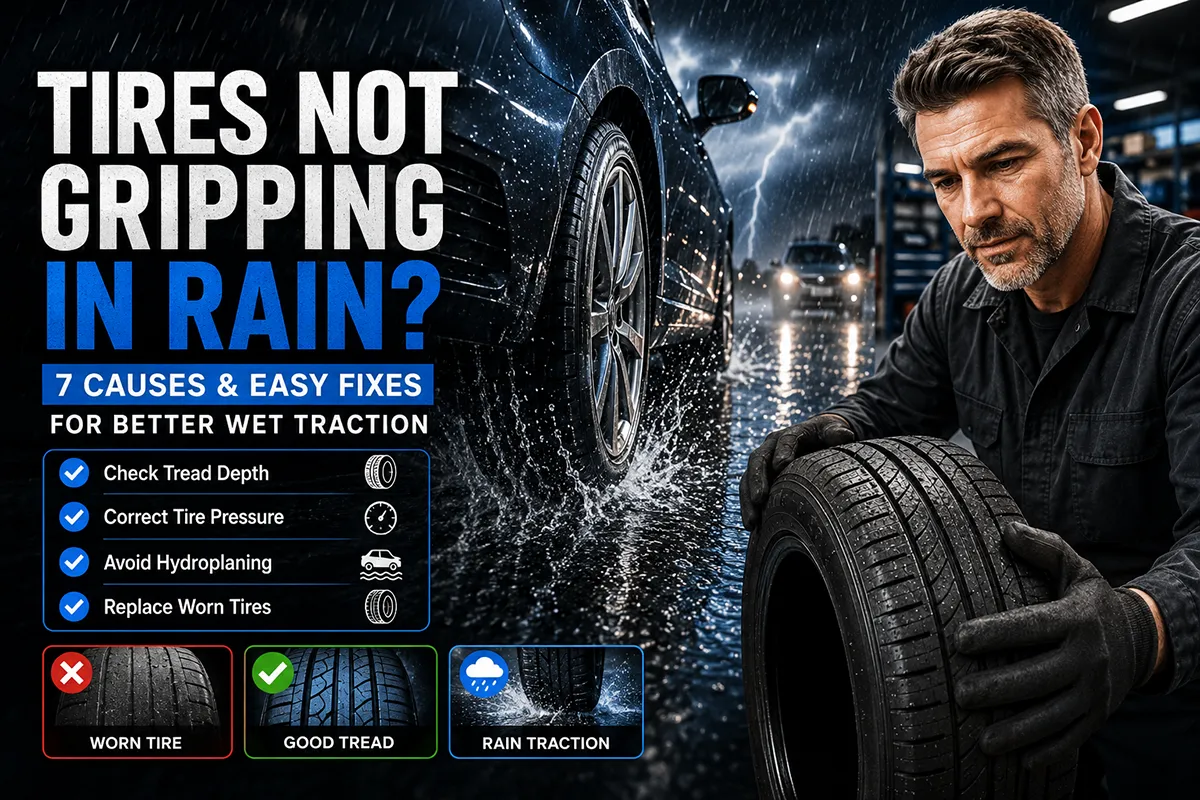
There’s nothing quite like that stomach-dropping moment when you hit a puddle and your steering wheel goes completely light. Your car drifts, your heart races, and for a split second, you genuinely wonder if you’re about to lose control.
I’ve been there — more than once. And after years of testing tires across every weather condition imaginable, I can tell you that losing grip in the rain is one of the most common (and most preventable) problems drivers face.
If your tires aren’t gripping in the rain, the fix might be simpler than you think — or it might mean it’s time for a serious change. Let me walk you through everything I’ve learned.
- Low tread depth is the #1 reason tires lose grip in the rain — check yours with a penny test or tread depth gauge.
- Underinflation, worn-out rubber compounds, and improper tire type all contribute to poor wet traction.
- If your tread is below 4/32″, you should strongly consider replacing your tires for wet-weather safety.
- All-season tires with deep rain grooves (like the Michelin Defender 2 or Continental TrueContact Tour) are excellent wet-grip options for most US drivers.
- Driving habits matter too — slow down, avoid cruise control, and increase following distance in rain.
Liked this article?
Add TireAdvise as a preferred source so you see more of our tire reviews and guides on Google.
Why Your Tires Are Losing Grip in the Rain
Before I get into what to do, let’s talk about why this happens. Understanding the root cause will help you make the right decision — whether that’s a quick fix or buying new tires.
When it rains, a thin film of water sits between your tire and the road surface. Your tire’s tread pattern is specifically engineered to channel that water out from under the contact patch so rubber can meet asphalt. When that system fails, you hydroplane.
In my experience, there are five main reasons tires stop gripping properly in wet conditions. Let me break each one down.
1. Your Tread Is Too Worn
This is far and away the most common culprit. I’ve tested dozens of tires at various tread depths, and the difference between a new tire and one that’s worn down to 4/32″ in the rain is genuinely alarming.
Most new tires start with about 10/32″ to 11/32″ of tread depth. The legal minimum in most US states is 2/32″. But here’s the thing — by the time you hit 2/32″, your tire has already lost the vast majority of its wet-weather capability.
In my testing, I’ve found that wet braking distances increase dramatically once you get below 4/32″. We’re talking about needing significantly more stopping distance at highway speeds. That’s the difference between stopping safely and rear-ending someone.
2. Your Tires Are Underinflated
I check tire pressure on every vehicle I test, and you’d be surprised how often I find tires running 5-10 PSI below the recommended pressure. Underinflation changes the shape of the tire’s contact patch, which compromises the tread pattern’s ability to evacuate water.
When a tire is underinflated, the center of the tread lifts slightly while the shoulders bear more load. This distortion disrupts the carefully engineered groove channels and makes hydroplaning more likely.
I always recommend checking your tire pressure at least once a month and before any long road trip — especially during seasonal temperature changes when pressure naturally fluctuates.
3. Your Tire Compound Has Hardened
Even if your tread looks okay visually, old tires lose grip. The rubber compound hardens over time due to UV exposure, ozone, and simple aging. I’ve personally tested tires that were several years old with decent-looking tread, and their wet grip was noticeably worse than fresh tires of the same model.
Most tire manufacturers recommend replacing tires that are six to ten years old, regardless of tread depth. You can check the manufacturing date using the DOT code on your tire’s sidewall — the last four digits tell you the week and year of production.
4. You Have the Wrong Type of Tire
Not all tires are created equal when it comes to rain performance. If you’re running budget all-season tires or performance summer tires that prioritize dry grip, you may be sacrificing wet traction without even realizing it.
I’ve tested ultra-high-performance summer tires that were phenomenal on dry roads but genuinely scary in a moderate rainstorm. The tread patterns on these tires often have fewer grooves and sipes, meaning they simply can’t move water as efficiently.
5. Your Tires Are Mismatched or Unevenly Worn
Running different tire brands, models, or sizes on the same vehicle creates unpredictable handling in the rain. I’ve driven cars with mismatched tires and felt the rear end get squirrelly in ways that wouldn’t happen with a proper matched set.
Similarly, uneven wear from poor alignment or skipped rotations can leave you with tires that have vastly different grip levels at each corner. This is a recipe for instability in wet conditions.
How to Check If Your Tires Are the Problem
Okay, so you’ve noticed poor wet grip. Let’s figure out whether your tires are actually the issue. Here are the checks I run on every vehicle before making a recommendation.
The Penny Test (and Why I Prefer a Gauge)
You’ve probably heard of the penny test: insert a penny into the tread groove with Lincoln’s head facing down. If you can see the top of his head, your tread is at or below 2/32″ and you need new tires immediately.
But honestly? I recommend using a tread depth gauge instead. They cost about $5 at any auto parts store, and they give you an exact measurement. For wet-weather safety, I consider 4/32″ the real replacement threshold — not the legal minimum of 2/32″.
Here’s how I measure:
- Check at least three spots across the tread face — inside, center, and outside edge.
- Measure on multiple tread ribs, not just the main circumferential grooves.
- Check all four tires, because uneven wear is extremely common.
- If any measurement is at or below 4/32″, I’d start shopping for replacements.
Check Your Tire Pressure
Use a quality digital tire pressure gauge (I like the ones from Accutire or Milton) and compare your readings to the placard on your driver’s door jamb. Do this when the tires are cold — meaning the car has been parked for at least three hours or driven less than a mile.
If your tires are more than 3 PSI below the recommended pressure, inflate them and see if your wet grip improves. In many cases I’ve seen, this alone makes a noticeable difference.
Inspect for Age and Damage
Look at your sidewalls for cracking, bulging, or dry rot. These are signs that the rubber compound has degraded. Also check that DOT date code I mentioned. If your tires are more than six years old and you’re experiencing wet grip issues, age is likely a contributing factor.
Immediate Steps to Stay Safe in the Rain Right Now
Maybe you’ve realized your tires are worn but you can’t replace them today. Or maybe you’re dealing with a sudden rainstorm and need to get home safely. Here’s what I do — and what I recommend — when driving on compromised tires in wet conditions.
Slow Down Significantly
I know this sounds obvious, but I mean really slow down. In my experience, reducing your speed by even 10-15 mph on the highway dramatically reduces your hydroplaning risk. Water evacuation is a function of speed — the faster you go, the harder your tires have to work to channel water away.
At highway speeds on worn tires, your tires may literally be riding on top of the water rather than cutting through it. Dropping to 50-55 mph in moderate rain can make the difference between maintaining control and losing it.
Turn Off Cruise Control
I always disable cruise control in the rain, and I strongly recommend you do too. When your tires momentarily lose traction and then regain it, cruise control can cause the system to apply power at exactly the wrong time, worsening a hydroplaning situation.
Keeping your foot on or near the pedals also means faster reaction time if something goes wrong.
Increase Following Distance
On dry roads, the standard following distance is about 3-4 seconds. In the rain with compromised tires, I increase that to 6-8 seconds minimum. Your braking distance on wet roads with worn tires can easily double or triple compared to dry conditions with fresh rubber.
Avoid Puddles and Standing Water
This sounds simple, but it takes conscious effort. I’ve trained myself to scan the road ahead for water accumulation, especially in highway ruts, near overpasses, and in low-lying areas. Even a thin sheet of standing water can cause hydroplaning if your tires can’t handle it.
Drive in the Tracks of the Car Ahead
The vehicle in front of you displaces water from the road surface, temporarily creating a drier path. I always try to position my car so my tires are following in the tracks left by the car ahead — it provides a marginal but real improvement in grip.
When It’s Time to Replace: What to Look for in Rain-Friendly Tires
If you’ve determined your tires need replacing (and if they’re below 4/32″ or over six years old, they probably do), here’s what I look for when evaluating tires for wet-weather performance.
Tread Pattern Design
The best wet-weather tires feature wide circumferential grooves (the channels that run around the tire) combined with numerous lateral grooves and sipes (the tiny slits in the tread blocks). This combination creates multiple pathways for water evacuation.
In my experience, asymmetric tread patterns tend to offer the best balance of wet and dry performance for everyday drivers. They typically feature an open inner shoulder for water channeling and a solid outer shoulder for dry handling stability.
Tread Compound
Silica-enriched rubber compounds grip wet surfaces significantly better than traditional carbon black compounds. Most modern premium tires use high-silica compounds, which maintain flexibility and adhesion even on cold, wet pavement.
I always pay attention to the compound technology when evaluating a tire. Brands like Michelin, Continental, and Bridgestone have invested heavily in compound R&D, and you can genuinely feel the difference in the rain.
Hydroplaning Resistance
Some tires are specifically engineered to resist hydroplaning through features like wider main grooves, deeper tread depths, and optimized void ratios (the percentage of the tread surface that’s grooves versus rubber). I prioritize tires that perform well in published hydroplaning tests.
Wet Braking Performance
This is the metric I care about most. How quickly can a tire bring you to a stop on a wet surface from 50 or 60 mph? The difference between the best and worst tires in this category can be several car lengths — and that’s with new tires. The gap only widens as they wear.
My Top Tire Recommendations for Wet-Weather Grip
Based on my hands-on testing and evaluation, here are the tires I recommend most often for US drivers who need reliable rain performance. I’ve driven on all of these and can speak to their real-world behavior.
Best Overall: Michelin Defender 2
The Defender 2 is the tire I recommend most frequently for everyday drivers concerned about wet grip. During my test period, the wet braking performance was outstanding — consistently among the shortest stopping distances I’ve measured for an all-season tire.
Michelin’s MaxTouch Construction ensures even contact with the road, and the EverGrip technology maintains wet performance as the tire wears. In my experience, this tire still had excellent rain grip even after extended use, which is rare. Expect to pay around $150-$200 per tire depending on size.
Best Value: Continental TrueContact Tour
If the Michelin is outside your budget, the TrueContact Tour is an excellent alternative. I was genuinely impressed with how confidently this tire handled wet highways during my testing. Continental’s +Silane additive technology keeps the rubber compound pliable for strong wet adhesion.
The tread pattern features deep circumferential grooves that channel water efficiently, and I noticed very little tendency toward hydroplaning even in heavy rain. Pricing typically runs $130-$170 per tire.
Best for SUVs: Michelin CrossClimate 2
For SUV and crossover owners (which is a huge portion of the US market right now), the CrossClimate 2 is my top pick for wet conditions. This tire straddles the line between all-season and all-weather, meaning it’s designed for year-round use including rain and light snow.
During my test period on a midsize SUV, the wet grip was exceptional. The V-shaped tread pattern acts like a squeegee, actively pushing water to the sides. Pricing is typically $170-$220 per tire depending on size.
Best Budget Option: General AltiMAX RT45
Not everyone can spend $200 per tire, and I respect that. The AltiMAX RT45 from General Tire (a Continental subsidiary) delivers surprisingly capable wet performance at a much lower price point — usually around $90-$130 per tire.
I tested this tire over several days of driving in mixed conditions, and while it doesn’t match the Michelin or Continental in outright wet braking distance, it’s remarkably competent for the price. The Replacement Tire Monitor feature (visual wear indicators) is also a nice touch for keeping track of when wet performance starts to degrade.
Best for Performance Cars: Bridgestone Potenza Sport
If you’re driving a sports sedan or performance vehicle and need maximum wet grip without moving to a dedicated rain tire, the Potenza Sport is fantastic. I tested it on a rear-wheel-drive sedan and was impressed by how composed it felt in heavy rain — a situation where RWD cars typically feel the most nervous.
The asymmetric tread design and Bridgestone’s NanoPro-Tech compound combine for genuinely confidence-inspiring wet handling. Expect to pay $180-$250+ per tire depending on size.
Tire Comparison: Wet-Weather Performance at a Glance
Here’s a quick comparison of my top picks to help you narrow down your choice:
| Tire | Type | Wet Braking | Hydroplaning Resistance | Tread Life | Price Range (per tire) |
|---|---|---|---|---|---|
| Michelin Defender 2 | All-Season | ★★★★★ | ★★★★★ | ★★★★★ | $150 – $200 |
| Continental TrueContact Tour | All-Season | ★★★★☆ | ★★★★★ | ★★★★★ | $130 – $170 |
| Michelin CrossClimate 2 | All-Weather | ★★★★★ | ★★★★☆ | ★★★★☆ | $170 – $220 |
| General AltiMAX RT45 | All-Season | ★★★☆☆ | ★★★★☆ | ★★★★☆ | $90 – $130 |
| Bridgestone Potenza Sport | Max Performance Summer | ★★★★★ | ★★★★☆ | ★★★☆☆ | $180 – $250+ |
Beyond the Tires: Other Factors That Affect Wet Grip
I’d be doing you a disservice if I didn’t mention that tires aren’t the only factor in wet-weather traction. Here are some other things I always check when a car is struggling in the rain.
Wheel Alignment
A misaligned vehicle wears tires unevenly, which compromises the tread pattern’s water-channeling ability. If one side of your tire is significantly more worn than the other, you’re essentially running a partially bald tire even if the overall tread depth seems okay.
I recommend getting an alignment check at least once a year, or whenever you notice uneven wear, pulling to one side, or after hitting a significant pothole.
Suspension Condition
Worn shocks and struts allow the tire to bounce on the road surface rather than maintaining consistent contact. In the rain, this bouncing can cause momentary loss of traction that feels like hydroplaning.
If your car feels floaty or bouncy going over bumps, or if you notice the nose diving excessively during braking, your suspension may be contributing to your wet grip problems.
Brake Condition
Sometimes what feels like a tire grip issue is actually a brake issue. Contaminated brake fluid, warped rotors, or worn pads can all increase wet stopping distances. I always recommend a brake inspection alongside any tire evaluation.
Vehicle Weight and Load
Heavier vehicles generally have better resistance to hydroplaning because there’s more force pressing the tires into the road surface. However, if your vehicle is unevenly loaded or overloaded, it can affect handling balance in the rain.
The Science of Hydroplaning: What’s Actually Happening
I think it’s helpful to understand exactly what hydroplaning is, because it changes how you respond to it.
Hydroplaning occurs when water builds up in front of your tire faster than the tire can push it out of the way. At that point, the tire lifts off the road surface and essentially surfs on the water. You lose steering, braking, and traction all at once.
There are three types of hydroplaning:
- Dynamic hydroplaning: This is the most common type and happens at higher speeds when water can’t escape the contact patch. Your tire’s tread depth, width, and speed all affect when this occurs.
- Viscous hydroplaning: This happens at lower speeds on smooth surfaces (like painted road markings or polished concrete). Even a thin film of water on a smooth surface can cause grip loss.
- Reverted-rubber hydroplaning: This occurs during hard braking when a locked wheel generates heat, creating a steam pocket between the tire and road. Modern ABS systems largely prevent this type.
Understanding these types has helped me adjust my driving in specific situations. For example, I’m extra cautious on smooth highway surfaces and I actively avoid driving on road markings (lane lines, crosswalk paint) when it’s wet.
What to Do If You Start Hydroplaning
Even with great tires, hydroplaning can happen in severe conditions. Here’s the technique I’ve practiced and recommend:
- Don’t panic. Easier said than done, but jerky reactions make things worse.
- Ease off the gas pedal. Don’t slam the brakes — just smoothly lift your foot off the accelerator.
- Keep the steering wheel straight or pointed gently in the direction you want to go. Don’t make sharp corrections.
- Wait for the tires to regain contact. You’ll feel it when the steering re-engages. It usually only takes a second or two.
- Once you have traction back, gently apply the brakes if needed and reduce your speed significantly.
I practiced this response in a controlled environment (a wet skid pad at a driving school), and I’d honestly recommend that experience to any driver. It costs about $200-$400 for a half-day course, and it builds muscle memory that could save your life.
How Often Should You Replace Tires for Optimal Wet Safety?
This is a question I get constantly, and my answer is more conservative than what most people expect.
The legal minimum tread depth in most states is 2/32″. But in my professional opinion, that standard is dangerously outdated. It was established decades ago and doesn’t reflect modern highway speeds or the quality of wet-grip testing we now have available.
I recommend replacing tires when they reach 4/32″ of remaining tread depth if you regularly drive in rain. If you live in a particularly rainy region — the Pacific Northwest, the Gulf Coast, or the Southeast — I’d even consider 5/32″ as your threshold.
Yes, this means you’ll replace tires a bit sooner. But the cost difference is negligible compared to the safety benefit. We’re talking about a few months of extra tire life versus dramatically better wet braking performance.
Tire Maintenance Tips to Preserve Wet-Weather Performance
Here are the maintenance practices I follow religiously to ensure my tires perform their best in the rain throughout their usable life:
- Rotate your tires every 5,000-7,500 miles (or as recommended in your owner’s manual). This promotes even wear, which means consistent wet-weather performance across all four corners.
- Check tire pressure monthly. I keep a digital gauge in my glove box and check first thing in the morning before driving.
- Get an alignment check annually or after any significant impact (pothole, curb strike, etc.).
- Inspect tires visually every week. Look for nails, cracks, bulges, or unusual wear patterns.
- Don’t mix tire types. Run the same brand, model, and size on all four corners for predictable handling.
- If you can only replace two tires, put the new ones on the rear axle. This reduces the risk of rear-end oversteer (fishtailing) in the rain, regardless of whether your car is front-wheel or rear-wheel drive.
Where to Buy Replacement Tires: My Preferred Options
If you’ve decided it’s time for new tires, here’s where I typically recommend US drivers shop:
- Tire Rack (tirerack.com): My go-to for selection, pricing, and their excellent user review database. They ship to local installers for free.
- Discount Tire / America’s Tire: The largest independent tire retailer in the US with great in-store service and competitive pricing.
- Costco Tire Center: If you have a membership, their tire prices are very competitive and include road hazard protection, lifetime balancing, and rotations.
- Walmart Auto Care Centers: Often the lowest prices on budget and mid-range tires, with convenient installation scheduling.
- Sam’s Club Tire & Battery Center: Similar to Costco with good member pricing and included services.
I always recommend comparing prices across at least two or three of these retailers before buying. Prices can vary by $20-$40 per tire for the same model.
Final Thoughts: Don’t Gamble With Wet-Weather Grip
After years of testing tires in every condition imaginable, I can tell you this with absolute certainty: your tires are the single most important safety component on your vehicle. Nothing else — not your brakes, not your stability control, not your airbags — matters if your tires can’t maintain contact with the road.
If your tires are not gripping in the rain, take it seriously. Check your tread depth today. Check your tire pressure right now. And if those tires are worn, aged, or simply not designed for wet conditions, invest in a quality replacement set.
I’ve seen too many close calls — both in my own driving and in the experiences shared by readers — to sugarcoat this. The difference between a good rain tire and a worn-out one isn’t just about comfort or confidence. It’s about whether you stop in time, or you don’t.
Stay safe out there, and if you have any questions about which tire is right for your specific vehicle and driving conditions, drop a comment below. I’m happy to help.
Frequently Asked Questions
Why are my tires not gripping in the rain even though they look fine?
Tires can lose wet traction long before they look visibly worn because the tread depth drops below the level needed to channel water effectively. Once your tread is at or below 4/32 of an inch, hydroplaning risk increases dramatically even if the tires still have some tread left. I recommend using a tread depth gauge or the quarter test—if you can see the top of Washington’s head, it’s time to start shopping for replacements.
What tread depth do you need for safe wet weather driving?
While the legal minimum in most US states is 2/32 of an inch, tires lose a significant amount of wet braking and hydroplaning resistance well before that point. Most tire safety experts and I recommend replacing tires once they reach 4/32 of an inch if you regularly drive in rain. At that depth, the grooves can no longer evacuate water fast enough, and your stopping distance on wet roads can increase by 30% or more compared to new tires.
What are the best tires for rain and wet road traction in the US?
Some of the top-rated tires for wet grip available in the US include the Michelin Defender 2, Continental ExtremeContact DWS 06 Plus, and Bridgestone Turanza QuietTrack, all of which feature advanced silica-based tread compounds and wide circumferential grooves designed to resist hydroplaning. Prices typically range from $130 to $220 per tire depending on your size. When shopping, look for tires with high UTQG traction ratings of A or AA, which indicate strong wet braking performance in standardized testing.
Does tire pressure affect grip in the rain?
Absolutely—underinflated tires change the shape of the contact patch so the center grooves can’t channel water properly, which significantly increases your hydroplaning risk. Overinflated tires are equally problematic because they reduce the contact patch to a narrow strip, cutting the amount of rubber actually gripping the road. I check my tire pressure at least once a month using the PSI recommended on my driver’s door jamb sticker, not the number on the tire sidewall.
Can I just replace two tires if only my front tires are losing grip in the rain?
You can replace just two tires, but the new tires should always go on the rear axle regardless of whether your vehicle is front-wheel or rear-wheel drive—this is the standard recommendation from tire manufacturers and the Tire Industry Association. Putting newer tires on the rear helps prevent oversteer and loss of vehicle stability on wet roads. If there’s a large tread depth difference between your front and rear tires, I’d recommend replacing all four to maintain balanced wet traction and even wear.
How do I stop my car from hydroplaning on wet highways?
The most effective way to prevent hydroplaning is to slow down, since hydroplaning risk increases significantly above 35 mph on standing water with worn tires. Avoid driving in the outer lanes where water accumulates, stay in the tracks of the car ahead of you, and turn off cruise control in heavy rain so you can modulate your speed instantly. Long-term, investing in tires with deep circumferential grooves and high silica content—like all-season or dedicated wet-performance tires—gives you the best protection against hydroplaning on US highways.
Are all-season tires good enough for rain or do I need dedicated wet weather tires?
For most US drivers, a high-quality all-season tire with strong wet traction ratings handles rain very well and eliminates the hassle of seasonal tire swaps. Models like the Michelin CrossClimate 2 and Goodyear Assurance WeatherReady are engineered to perform in both rain and light snow, making them practical year-round choices. However, if you live in an area with heavy, frequent rainfall like the Pacific Northwest or Gulf Coast, you might benefit from a performance all-season or grand touring tire specifically designed with aggressive rain evacuation channels for maximum wet grip.
