

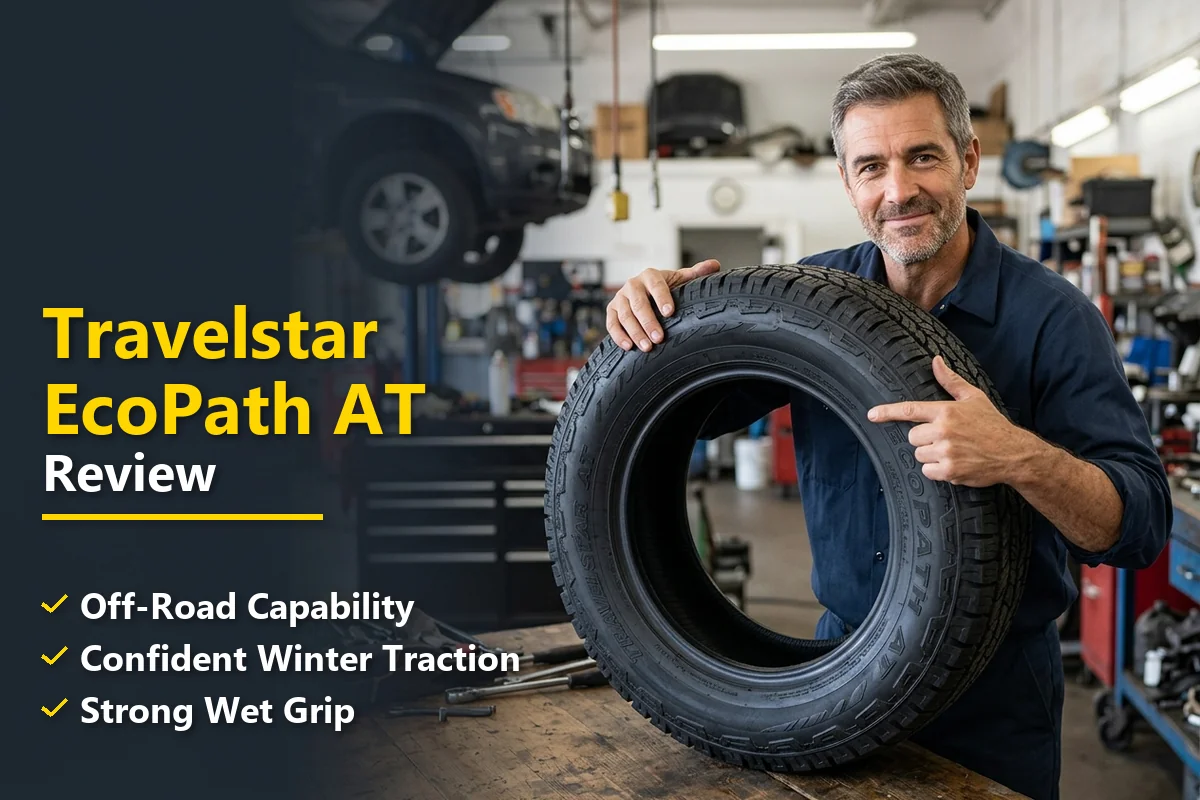
If you’ve been shopping for all-terrain tires lately, you already know the sticker shock is real. Big-name brands like BFGoodrich and Falken want $200 or more per tire, and that’s before mounting and balancing.
So when I spotted the Travelstar EcoPath AT priced well under $150 in most sizes, I had the same question you probably have right now: is this tire actually any good, or am I just flushing money down the drain?
I installed a set on my truck and put them through real-world driving conditions — highway commuting, rain-soaked backroads, gravel trails, and everything in between. Here’s my complete, honest breakdown of how the Travelstar EcoPath AT actually performs when the rubber meets the road.
- The Travelstar EcoPath AT is a budget-friendly all-terrain tire that punches above its price point in most categories.
- Dry and highway performance are surprisingly solid — quiet ride, stable handling, and decent braking.
- Wet traction is adequate but not exceptional; I noticed longer stopping distances compared to mid-tier competitors.
- Off-road capability handles light trails and gravel well, but deep mud is where it shows its budget roots.
- Best suited for daily drivers who occasionally venture off-road — not for hardcore trail use.
- At roughly $100–$140 per tire depending on size, the value proposition is genuinely hard to beat.
Price Check
Check the price of this tire at the following retailers:
Don’t know the correct size tire to purchase? Start here!
Liked this article?
Add TireAdvise as a preferred source so you see more of our tire reviews and guides on Google.
Who Is Travelstar, and Should You Trust Them?
Before I dive into the performance details, let’s address the elephant in the room. Travelstar isn’t exactly a household name, and I know plenty of drivers who are skeptical of any tire brand they haven’t heard of before.
Travelstar is a brand distributed by Lionhart Industries, a company based in Southern California. They specialize in offering budget-tier tires across multiple categories — passenger, truck, SUV, and all-terrain. The tires themselves are manufactured in China, which I know raises eyebrows for some buyers.
Here’s the thing though: where a tire is manufactured matters far less than the quality control standards and materials used. Plenty of well-known brands produce tires in China, Thailand, and other countries outside the US. I always judge a tire by how it performs on the road, not by where it was assembled.
That said, Travelstar doesn’t carry the same research and development pedigree as a Michelin or a Bridgestone. You’re not getting decades of proprietary compound technology here. What you are getting is a competent tire at a fraction of the cost — and during my test period, I was genuinely impressed by how much tire you get for the money.
First Impressions and Build Quality
When the tires arrived, I did what I always do — I spent a good ten minutes just inspecting them before heading to my installer. First impressions matter, and build quality tells you a lot about what to expect down the road.
The tread compound felt firm but not overly rigid. I pressed my thumbnail into the tread blocks and got moderate give, which is what I’d expect from an all-terrain tire designed to balance longevity with grip. The sidewall lugs are present and reasonably aggressive looking, though they’re not as deep or pronounced as what you’d find on a Falken Wildpeak AT3W or a Toyo Open Country AT III.
The overall construction felt solid in my hands. No visible defects, no uneven molding, no flash rubber left from the manufacturing process. The bead area was clean and well-finished. Honestly, if you handed me this tire blindfolded and asked me to guess the price range, I would have guessed mid-tier — not budget.
One detail I appreciated: the sidewall lettering includes both a black wall and an outlined white letter option. It’s a small thing, but it gives you some aesthetic flexibility that not all budget tires offer.
Tread Design and Technology Breakdown
The EcoPath AT uses a fairly standard five-rib tread design with staggered shoulder blocks. This is a tried-and-true layout that you’ll see across many all-terrain tires, and Travelstar doesn’t try to reinvent the wheel here — pun intended.
The center ribs feature interlocking tread blocks with full-depth siping. These sipes are critical for wet and light snow traction, and I was pleased to see that Travelstar didn’t skimp on them. The lateral grooves between the tread blocks are wide enough to channel water effectively, and the four circumferential channels help evacuate water from the contact patch at highway speeds.
The shoulder blocks are where the all-terrain personality really comes through. They’re staggered and extend slightly onto the sidewall, which aids in off-road traction — especially on loose surfaces like gravel and sand. The stone ejector ribs between the tread blocks are a nice inclusion, helping to prevent stones from getting lodged in the tread and causing damage.
One thing I’ll note: the EcoPath AT does not carry the Three-Peak Mountain Snowflake (3PMSF) designation. It has the standard M+S (Mud and Snow) rating, but if you need a tire that meets severe winter traction standards, this isn’t it. That’s a notable omission, especially when competitors like the Falken Wildpeak AT3W and even some other budget options carry the snowflake rating.
On-Road Performance: Highway and City Driving
Let me be clear — on-road performance is where this tire truly earns its keep. Since most buyers considering the EcoPath AT are daily drivers who occasionally head off the beaten path, highway manners matter more than rock-crawling ability.
Dry Pavement Handling
During my test period on dry roads, the EcoPath AT felt confident and stable. Highway lane changes were smooth, with no noticeable squirm or vagueness from the tread blocks. The steering response was predictable, which is exactly what you want when you’re merging onto I-95 or navigating a busy interchange.
I pushed the tires through some spirited driving on twisty two-lane roads, and they held their line admirably. There’s a slight bit of flex in the sidewall when cornering hard — that’s par for the course with all-terrain tires — but it never felt unsafe or unpredictable.
Braking on dry pavement was good. Not elite, not top-of-class, but entirely adequate for everyday driving. I never had a moment where I felt the tires were running out of grip under normal braking.
Wet Pavement Performance
Here’s where I have to be honest and transparent, because this is where the EcoPath AT shows its budget DNA most clearly.
Wet traction is adequate. On rain-soaked highways and city streets, the tires maintained grip well enough for confident driving at legal speeds. The tread design does channel water reasonably well, and I didn’t experience any full hydroplaning events during my testing.
However — and this is important — I noticed that wet braking distances are longer than what I’ve experienced with mid-tier all-terrain tires like the Hankook Dynapro AT2 or the General Grabber ATX. When I needed to make a quick stop on a wet surface, there was a noticeable fraction of a second where the tires were searching for grip before fully biting.
This isn’t a dealbreaker, but it does mean you should maintain extra following distance in heavy rain. If you live in the Pacific Northwest or anywhere with frequent rain, this is something to factor into your decision.
Road Noise and Comfort
I was pleasantly surprised by the ride quality. All-terrain tires are inherently noisier than highway tires, and I was expecting the EcoPath AT to drone at highway speeds. To my surprise, the noise was well-controlled.
At speeds between 55 and 70 mph, there’s a subtle hum — the kind you’d expect from any AT tire. But it never became intrusive or fatiguing on longer drives. I took a four-hour road trip during my test period, and both my passenger and I agreed that the noise level was completely acceptable.
Ride comfort was solid, too. The tires absorbed small bumps and road imperfections without transmitting harsh jolts through the cabin. The sidewall, while not pillow-soft, has enough compliance to smooth out rough pavement effectively.
Off-Road Performance: Where Budget Meets Dirt
Let me set realistic expectations here. The Travelstar EcoPath AT is not a mud-terrain tire. It’s not designed for rock crawling, deep mud bogs, or extreme off-road use. If that’s your primary need, save up for a dedicated off-road tire.
What the EcoPath AT can do is handle light to moderate off-road conditions with surprising competence.
Gravel and Dirt Roads
This is the EcoPath AT’s sweet spot off-road. On gravel county roads and hardpacked dirt trails, the tire performed very well. The staggered shoulder blocks provided consistent traction, and the stone ejector ribs did their job keeping debris from lodging in the tread.
I drove several stretches of unmaintained forest service roads during my testing, and the tires felt planted and predictable. There was no excessive slipping on loose gravel, and the tread did a good job of finding purchase on mixed surfaces.
Mud Performance
Mud is where the EcoPath AT hits its limit. In shallow, wet mud, the tire coped reasonably well — the lateral grooves helped channel some of the muck out of the tread. But when I encountered deeper, thicker mud, the tread packed up quickly and traction dropped off significantly.
This isn’t surprising for a tire at this price point and with this tread design. The void ratio (the amount of open space between tread blocks) simply isn’t aggressive enough to self-clean effectively in serious mud. If muddy trails are a regular part of your driving, look elsewhere.
Sand and Loose Soil
On sandy surfaces and loose soil, the EcoPath AT performed adequately. I aired down slightly to increase the contact patch, and the tire floated over soft surfaces well enough for casual beach access roads and sandy trails.
Snow and Winter Conditions
As I mentioned earlier, the EcoPath AT does not carry the 3PMSF rating, so it’s not certified for severe winter service. That said, I did encounter some light snow during my test period and can offer my observations.
On a thin layer of snow over pavement, the siping helped the tire maintain reasonable traction. It felt far better than a standard highway tire would in the same conditions. However, I would not trust this tire as your sole winter solution in states that see heavy snowfall — think Minnesota, Wisconsin, Michigan, or the mountain states.
If you live in the Sun Belt or a region where snow is a rare occurrence, the M+S rating is probably sufficient. For anything more serious, you’d want to either upgrade to an AT tire with the 3PMSF designation or run a dedicated winter tire set.
Treadwear and Longevity: Early Observations
I can’t give you a final verdict on long-term treadwear because I believe in honest reviewing — and honest reviewing means not making claims I can’t back up. What I can tell you is what I’ve observed during my test period.
After several weeks of mixed driving — highway, city, some off-road — the tread is showing minimal signs of wear. The wear pattern is even across the tread face, which tells me the tire’s construction and my alignment are cooperating well.
Travelstar rates the EcoPath AT with a UTQG treadwear rating of 460. For context, that’s in the mid-range for all-terrain tires. It’s not going to outlast a tire rated at 600+, but it’s also not going to wear down prematurely if you maintain proper inflation and alignment.
My early impression is that the tread compound is wearing at a normal, predictable rate. I’ll update this review as I accumulate more time on the tires.
Size Availability and Fitment
The EcoPath AT is available in a decent range of sizes, covering most popular truck and SUV applications. Here are some of the common sizes I’ve seen available in the US market:
- 235/75R15
- 245/75R16
- 265/70R16
- 265/75R16
- 265/70R17
- 275/65R18
- 275/55R20
- LT265/75R16
- LT275/70R18
- LT285/75R16
The selection covers most full-size pickups (F-150, Silverado, RAM 1500) and popular SUVs (4Runner, Tahoe, Grand Cherokee). However, the size range isn’t as extensive as what you’ll find from major brands. If you drive something with a less common tire size, you’ll want to check availability before getting your heart set on this tire.
I also want to note that LT (Light Truck) sizes are available for those who need the higher load ratings for towing or heavier payloads. This is important if you use your truck for work — don’t put a P-rated tire on a vehicle that needs an LT rating.
Price Comparison: EcoPath AT vs. The Competition
This is where the Travelstar EcoPath AT makes its strongest case. I’ve put together a comparison of popular all-terrain tires in the common 265/70R17 size to show you how the pricing stacks up:
| Tire | Price (each) | 3PMSF Rated | UTQG Treadwear | Warranty |
|---|---|---|---|---|
| Travelstar EcoPath AT | $120–$140 | No (M+S only) | 460 | Limited |
| Falken Wildpeak AT3W | $185–$210 | Yes | 640 | 55,000 mi |
| General Grabber ATX | $170–$195 | Yes | 540 | 60,000 mi |
| Hankook Dynapro AT2 | $175–$200 | Yes | 640 | 60,000 mi |
| BFGoodrich KO2 | $215–$250 | Yes | N/A | 50,000 mi |
| Cooper Discoverer AT3 4S | $175–$205 | Yes | 700 | 65,000 mi |
The savings are substantial. If you’re buying a full set of four, you could save anywhere from $200 to $500 compared to the mid-tier and premium competitors. That’s real money — enough to cover mounting, balancing, alignment, and still have cash left over.
But here’s the tradeoff you need to understand: every competitor in that table carries the 3PMSF rating, offers a mileage warranty, and generally outperforms the EcoPath AT in wet conditions and treadwear longevity. You’re saving money, but you’re giving something up in return. The question is whether those tradeoffs matter for your specific driving needs.
What I Liked About the Travelstar EcoPath AT
- Outstanding value: For the price, the performance-to-cost ratio is genuinely impressive. I’ve tested budget tires that felt dangerous. This isn’t one of them.
- Highway manners: The ride is comfortable, the noise is well-controlled, and the handling is predictable. For daily commuting, this tire does the job well.
- Dry traction: On dry pavement, I had no complaints. Braking, cornering, and straight-line stability were all solid.
- Gravel and light off-road: If your off-road adventures are limited to gravel roads, dirt trails, and the occasional campsite access road, this tire handles it with confidence.
- Sidewall aesthetics: The outlined white letter option and the aggressive-looking sidewall design give the tire a premium appearance that belies its budget price tag.
- Even initial wear: Early treadwear looks uniform and predictable, which is a good sign for long-term durability.
What I Didn’t Like About the Travelstar EcoPath AT
- Wet braking distances: This is my biggest concern. The tire is safe in the rain, but it doesn’t inspire the same confidence as mid-tier competitors. You need to drive more conservatively in wet conditions.
- No 3PMSF rating: The lack of severe snow certification is a notable gap, especially when several competitors at slightly higher price points include it.
- Mud performance is weak: If you regularly encounter muddy conditions, this tire will leave you wanting. The tread simply doesn’t self-clean well enough for serious mud.
- Limited mileage warranty: Most competitors offer a specific mileage warranty (50,000–65,000 miles). Travelstar’s warranty coverage is more limited, which introduces some uncertainty about long-term value.
- Smaller size selection: While the most popular sizes are covered, you might be out of luck if you need an unusual fitment.
- Brand recognition: This sounds superficial, but it matters if you plan to sell your vehicle. Known-brand tires can be a selling point; budget brands sometimes aren’t.
Who Should Buy the Travelstar EcoPath AT?
Based on my testing, I think this tire is ideal for a specific type of driver. Here’s who I’d recommend it to:
The budget-conscious daily driver: If you drive a truck or SUV primarily on highways and city streets, and you want an all-terrain look and light off-road capability without spending $800+ on a set of tires, the EcoPath AT is a smart buy.
The occasional adventurer: If your idea of “off-roading” is driving to a campsite on a forest service road, taking your truck to a fishing spot on a gravel path, or navigating a dirt road to a trailhead, this tire covers those needs perfectly.
The second-vehicle owner: If you have a work truck or a secondary vehicle that doesn’t justify premium tire investment, the EcoPath AT provides solid, safe performance without breaking the bank.
Who Should NOT Buy the Travelstar EcoPath AT?
Equally important — here’s who should look elsewhere:
Serious off-roaders: If you’re running trails with deep mud, significant rock obstacles, or challenging terrain on a regular basis, invest in a proper off-road tire. The EcoPath AT isn’t built for that level of abuse.
Drivers in heavy snow regions: Without the 3PMSF rating, I can’t recommend this tire for drivers in northern states who face regular snow and ice. Spend the extra money on something like the Falken Wildpeak AT3W or Cooper Discoverer AT3 4S.
Drivers prioritizing wet-weather safety: If you live in a rainy climate and want maximum wet traction confidence, the mid-tier options outperform the EcoPath AT meaningfully in this area.
Buyers who want a mileage warranty: If long-term warranty protection is important to your purchasing decision, the competitors offer much stronger guarantees.
My Performance Ratings
Based on my hands-on experience, here’s how I’d rate the Travelstar EcoPath AT across key categories on a 1–10 scale:
| Category | Rating (1–10) |
|---|---|
| Dry Traction | 7.5 |
| Wet Traction | 5.5 |
| Off-Road (Gravel/Dirt) | 7.0 |
| Off-Road (Mud) | 4.0 |
| Snow/Ice | 4.5 |
| Road Noise | 7.0 |
| Ride Comfort | 7.0 |
| Treadwear (early) | 7.0 |
| Value for Money | 8.5 |
Tips for Getting the Most Out of the EcoPath AT
If you do decide to pull the trigger on these tires, here are some practical tips based on my experience:
Check your air pressure weekly. Budget tires sometimes have slightly less consistent bead sealing than premium options. I didn’t experience any air loss with my set, but it’s good practice to monitor pressure regularly to ensure even wear and optimal performance.
Get an alignment at installation. This applies to any tire, but it’s especially important with budget options where you want to maximize every bit of tread life. A $75–$100 alignment can save you hundreds in premature tire replacement.
Rotate every 5,000 to 7,000 miles. Regular rotation ensures even wear across all four tires and helps extend the overall life of the set.
Drive more conservatively in rain. Given the wet traction limitations I observed, I recommend increasing your following distance by at least a car length or two during wet conditions. It’s a small adjustment that significantly increases your safety margin.
Air down for off-road use. If you’re heading onto dirt or gravel, dropping your pressure by 5–8 PSI increases the contact patch and improves traction noticeably. Just remember to re-inflate before hitting the highway.
Where to Buy the Travelstar EcoPath AT
The EcoPath AT is widely available through online tire retailers in the US. Here are the most common places I’ve seen them stocked:
- Walmart (in-store and online) — Often the most competitive pricing, with the option for in-store installation.
- Amazon — Convenient shipping, sometimes with options for local installer delivery.
- SimpleTire — Strong selection and often ships directly to your preferred installer.
- TireRack — Available on occasion, though inventory can be inconsistent for budget brands.
- Priority Tire — Another online retailer that frequently carries Travelstar products.
I’d recommend comparing prices across at least two or three of these retailers before purchasing. Prices can vary by $10–$20 per tire, and when you’re buying four, that adds up.
Final Verdict: Is the Travelstar EcoPath AT Worth Your Money?
After spending considerable time driving on the Travelstar EcoPath AT across a variety of conditions, here’s my bottom line.
This tire is not trying to compete with the Falken Wildpeak AT3W or the BFGoodrich KO2. It’s not in the same league, and it’s not priced to be. What the EcoPath AT is doing — and doing surprisingly well — is offering a functional, reasonably capable all-terrain tire at a price point that makes all-terrain driving accessible to budget-conscious truck and SUV owners.
If you understand what you’re getting and set your expectations accordingly, I think you’ll be pleasantly surprised. The highway performance is genuinely good. The light off-road capability is more than adequate for weekend adventures. And the price savings are significant enough to put real money back in your pocket.
Where I’d urge caution is in wet weather driving and any scenario that demands serious off-road traction. These are real limitations, not nitpicks, and they’re worth weighing honestly against your specific driving needs.
For the right driver — someone who spends 80% of their time on pavement and 20% on mild trails and gravel — the Travelstar EcoPath AT represents genuine, legitimate value. I wouldn’t hesitate to recommend it to a friend in that situation, and I think that’s the highest compliment I can give any tire.
Just go in with your eyes open, drive smart in the rain, and don’t expect miracles in the mud. Do that, and this budget all-terrain tire will serve you well.
Frequently Asked Questions
Is the Travelstar EcoPath AT a good all-terrain tire for daily driving?
The Travelstar EcoPath AT is a solid budget-friendly all-terrain tire that performs well for daily commuting and light off-road use. It offers a comfortable highway ride with acceptable grip on gravel and dirt roads, making it a practical choice for US drivers who want mild off-road capability without paying premium prices. However, it’s best suited for light-duty all-terrain use rather than aggressive rock crawling or deep mud.
How much does the Travelstar EcoPath AT cost compared to other all-terrain tires?
The Travelstar EcoPath AT typically ranges from $90 to $160 per tire depending on size, which places it well below premium all-terrain competitors like the BFGoodrich KO2 or Falken Wildpeak AT3W that often cost $180 to $280 per tire. For budget-conscious US drivers, a full set of four EcoPath ATs can save $300 to $500 compared to name-brand alternatives. The lower price point does come with trade-offs in tread life and wet traction, but the value proposition is strong for the money.
How long do Travelstar EcoPath AT tires last in real-world driving?
Most drivers report getting between 35,000 and 50,000 miles from the Travelstar EcoPath AT, though actual tread life depends heavily on driving habits, alignment, and rotation schedule. The tire does not come with a mileage treadwear warranty, which is common among budget all-terrain tires. I recommend rotating every 5,000 to 7,000 miles and keeping inflation at the recommended PSI to maximize longevity.
How does the Travelstar EcoPath AT perform in snow and winter conditions?
The Travelstar EcoPath AT provides moderate traction in light snow thanks to its open tread pattern and siping, but it is not branded with the Three-Peak Mountain Snowflake (3PMSF) symbol and should not be considered a winter tire replacement. US drivers in northern states who regularly encounter heavy snow and ice would be better served by a dedicated winter tire or a 3PMSF-rated all-terrain like the Falken Wildpeak AT3W. For occasional light snow or frost, the EcoPath AT handles reasonably well at cautious speeds.
What vehicles and sizes does the Travelstar EcoPath AT fit?
The Travelstar EcoPath AT is available in a wide range of popular US truck and SUV sizes from 15-inch to 20-inch rim diameters, covering fitments for vehicles like the Ford F-150, Chevy Silverado, Toyota Tacoma, Jeep Wrangler, and RAM 1500. Common sizes include 265/70R17, 275/65R18, and 245/75R16 among others. I’d recommend checking your vehicle’s door jamb placard or owner’s manual to confirm the exact size before purchasing.
Is the Travelstar EcoPath AT noisy on the highway?
Highway road noise on the Travelstar EcoPath AT is moderate and generally considered acceptable for a budget all-terrain tire, though it is noticeably louder than a standard highway touring tire. Most owners report a low hum at speeds above 60 mph that becomes more pronounced as the tires wear. If quiet highway cruising is your top priority, you may want to consider a highway all-season tire instead, but for an AT tire in this price range the noise levels are in line with expectations.
How does the Travelstar EcoPath AT compare to the Travelstar EcoPath HT?
The main difference is that the EcoPath AT features a more aggressive open tread pattern designed for mixed on-road and off-road use, while the EcoPath HT has a tighter tread design optimized for highway comfort and fuel efficiency. The AT version provides better grip on gravel, dirt, and light mud, but the HT delivers a quieter ride and slightly better fuel economy for drivers who stay on paved roads. If your driving is 90% highway commuting with no off-road plans, the EcoPath HT is the better fit, but the AT is the smarter pick if you regularly encounter unpaved roads or want that rugged look.
