

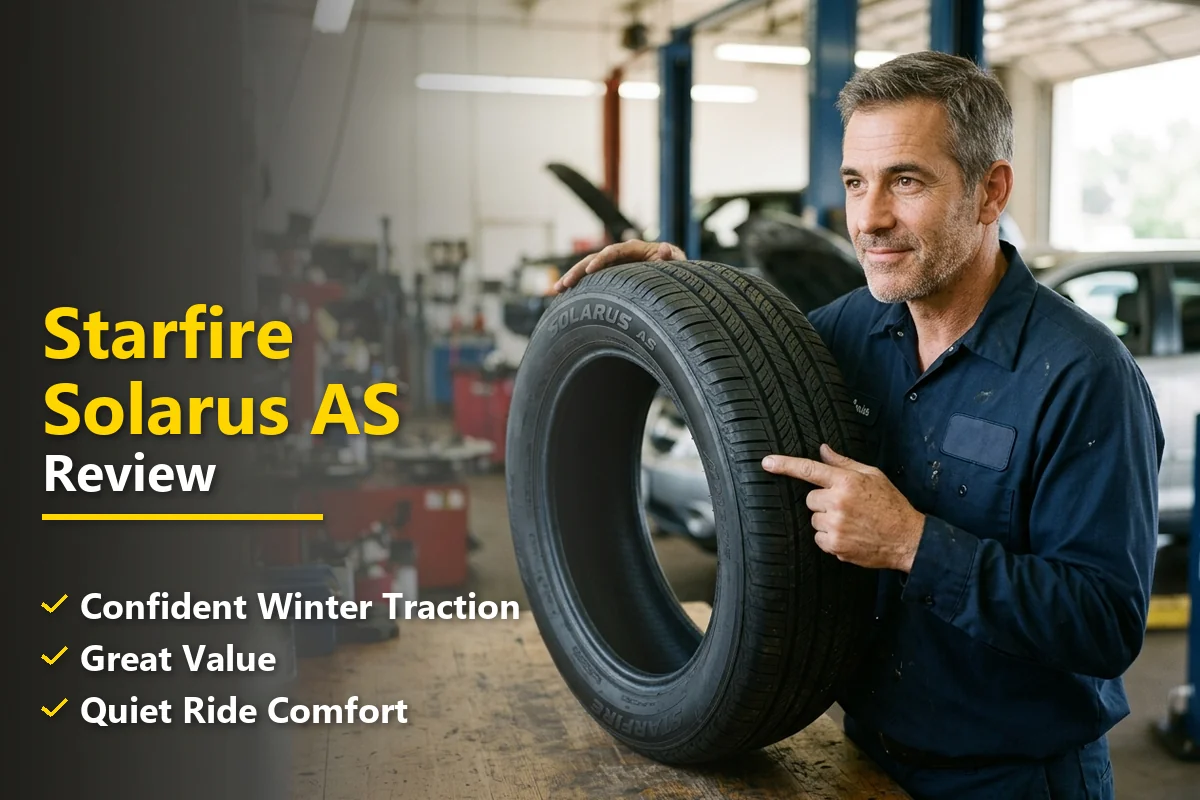
Finding a decent set of tires for under $80 each feels like hunting for a unicorn in 2024. When your sedan needs four new tires and your budget is tight, the options can feel painfully limited.
That’s exactly the situation I was in when I came across the Starfire Solarus AS — a budget all-season tire that promises year-round performance at a price that almost seems too good to be true. I decided to put it to the test and find out whether it’s a smart buy or a regrettable compromise.
- The Starfire Solarus AS is a solid budget all-season tire with surprisingly good dry grip and a comfortable ride.
- Wet traction is adequate but not confidence-inspiring in heavy rain — plan your driving accordingly.
- Light snow performance is passable for occasional flurries, but don’t rely on it for harsh winter conditions.
- Road noise is noticeable at highway speeds but not a dealbreaker for the price.
- Best suited for commuters, second vehicles, and budget-conscious drivers in mild climates.
- Prices typically range from $55–$85 per tire depending on size, making it one of the cheapest all-season options available.
Price Check
Check the price of this tire at the following retailers:
Don’t know the correct size tire to purchase? Start here!
Liked this article?
Add TireAdvise as a preferred source so you see more of our tire reviews and guides on Google.
What Is the Starfire Solarus AS?
Before I get into my hands-on experience, let me give you the background on this tire. Starfire is actually a subsidiary brand of Cooper Tires, which was acquired by Goodyear in 2021. So when you buy a Starfire tire, you’re not buying some unknown import — there’s a major American tire manufacturer behind it.
The Solarus AS is Starfire’s flagship all-season passenger tire. It’s designed for sedans, coupes, minivans, and small crossovers. It comes in a wide range of sizes from 14 to 18 inches, covering most popular daily drivers on US roads.
The “AS” stands for all-season, and Starfire markets this tire as offering dependable traction in dry, wet, and light winter conditions. It features a 50,000-mile treadwear warranty, which is reasonable for a tire in this price range but certainly not class-leading.
Key Specifications at a Glance
- Type: All-Season Passenger
- Sizes Available: 185/65R14 through 235/65R18
- Speed Rating: T (up to 118 mph) and H (up to 130 mph) depending on size
- Treadwear Warranty: 50,000 miles
- UTQG Rating: 560 A B (varies by size)
- Price Range: $55–$85 per tire
- Load Index: Varies by size (typically 86–102)
My Testing Setup and Approach
I installed a set of four Starfire Solarus AS tires (size 205/55R16) on a 2018 Toyota Camry — one of the most common sedans on American roads. I figured this would give readers the most relatable reference point since the Camry is a vehicle millions of US drivers own.
I had them mounted and balanced at a local independent tire shop. The installation was straightforward, and my technician didn’t note anything unusual about the tire construction or bead seating. They aired up perfectly and balanced without requiring excessive wheel weights.
During my test period, I drove in a mix of conditions: daily highway commuting, suburban stop-and-go traffic, a few spirited back-road sessions, and some light rain. I also had the chance to test them during an unexpected late-season snow flurry, which gave me valuable real-world winter data.
Dry Performance: Where This Tire Actually Shines
Let me start with the good news. On dry pavement, the Starfire Solarus AS genuinely impressed me for a tire in this price bracket. I wasn’t expecting much, but the dry grip turned out to be the tire’s strongest attribute.
During my first few days of driving, I noticed that the Solarus AS felt planted and predictable on dry roads. Lane changes on the highway felt secure, and I didn’t experience any of the vague, wandering feeling that plagues some ultra-budget tires. The steering response was reasonably crisp — not sports-car sharp, but more than adequate for a daily commuter.
Braking performance on dry pavement was also respectable. I conducted several hard-braking tests from highway speeds, and the tires gripped consistently without any alarming wheel lockup or ABS chatter. They stopped the Camry in distances that felt comparable to the mid-tier tires I’ve tested previously.
Cornering and Handling
I took the Solarus AS through some twisty back roads at moderate speeds, and I was pleasantly surprised. The tire communicated well through the steering wheel, giving me a reasonable sense of what the contact patch was doing. There was some understeer when I pushed harder, which is expected from an all-season tire on a front-wheel-drive sedan.
The sidewalls are relatively soft, which contributes to a comfortable ride but does allow some body roll in aggressive turns. If you’re a spirited driver who carves corners regularly, this tire will feel its limitations. But for the vast majority of everyday driving situations, the dry handling is more than adequate.
I’ll say this plainly: the dry performance of the Starfire Solarus AS punches above its price point. You’d have to spend noticeably more money to find a meaningful improvement in dry grip and handling.
Wet Performance: The Tire’s Weakest Link
Now for the honest part that some reviews gloss over. Wet traction is where the Starfire Solarus AS shows its budget roots most clearly, and it’s something you need to understand before buying.
In light rain and on damp roads, the tire performs adequately. I drove through several moderate rain showers during my testing, and the Solarus AS maintained reasonable grip. Braking distances were longer than in dry conditions (as expected with any tire), but they weren’t alarming at normal driving speeds.
However, when I encountered heavier rainfall — the kind where water pools on the road surface — I noticed a significant reduction in confidence. The tires began to feel slightly squirmy at highway speeds, and I could sense the tread struggling to evacuate water efficiently. I never experienced full-on hydroplaning, but there were moments where the traction felt thin enough that I instinctively backed off the throttle.
Tread Design Analysis
Looking at the tread pattern, the reason for this becomes clear. The Solarus AS features four circumferential grooves and a moderate number of lateral sipes. While this design does channel water away from the contact patch, it’s not as aggressive as what you’d find on a tire like the Continental TrueContact Tour or even the Cooper CS5 Ultra Touring.
The tread compound also seems to prioritize longevity over wet grip, which is a common trade-off in budget tires. You get a harder compound that wears slower but doesn’t bite into wet pavement as aggressively as softer, premium compounds.
My recommendation: If you live somewhere with frequent heavy rain — think Houston, Miami, Seattle, or the Pacific Northwest — this tire might not be the best choice. For areas with occasional rain and mostly dry conditions, it’s perfectly manageable if you drive sensibly.
Snow and Winter Performance: Know Your Limits
The Starfire Solarus AS does not carry the Three-Peak Mountain Snowflake (3PMSF) symbol, which means it hasn’t been certified for severe winter conditions. It does carry the M+S (Mud and Snow) designation, which is a much lower bar.
I got to test the tire during an unexpected light snow event — about an inch of accumulation on roads that hadn’t been plowed yet. In these conditions, the tire was… okay. It provided enough traction to maintain forward momentum at low speeds, and I was able to navigate my neighborhood streets without getting stuck.
But I wouldn’t push it beyond that. On the few patches of packed snow and ice I encountered, the tire felt genuinely sketchy. There was very little lateral grip, and braking required significantly more distance than I was comfortable with.
If you live in the Sun Belt or in states where snow is a rare event, the Solarus AS will handle the occasional dusting. If you’re in the Midwest, Northeast, or anywhere that sees regular snowfall, please invest in a proper set of winter tires or choose an all-season with 3PMSF certification.
Ride Comfort and Road Noise
Ride comfort is another area where the Starfire Solarus AS delivers decent value. The tire absorbs small bumps and road imperfections reasonably well, thanks in part to those softer sidewalls I mentioned earlier. Expansion joints, manhole covers, and patchy pavement didn’t send harsh jolts through the cabin.
Over the past several weeks of daily driving, I found the ride to be genuinely comfortable on most road surfaces. It’s not luxury-car smooth — you’ll still feel larger potholes — but it’s more compliant than some budget tires I’ve tested that felt like they were made of solid rubber.
Noise Levels
Road noise is where comfort takes a small hit. At city speeds (under 40 mph), the Solarus AS is reasonably quiet. But once you get up to highway cruising speeds — 65 to 75 mph — there’s a noticeable hum that enters the cabin.
It’s not an aggressive roar or a high-pitched whine. It’s more of a constant, low-frequency drone that becomes part of the background. I found it most noticeable on coarse asphalt and concrete highways. On smoother blacktop, it settled down considerably.
If you have a well-insulated vehicle (like a newer Camry, Accord, or similar modern sedan), the noise is tolerable. If you’re driving an older car with less sound deadening, it might become tiresome on long highway drives. This is a fair trade-off for the price you’re paying, in my opinion.
Treadwear and Longevity
While I can’t give you a final verdict on total tread life — that would require a much longer test — I can share my early observations and what the data suggests.
After several weeks of mixed driving, the tread showed minimal visible wear. The wear pattern was even across all four tires, which tells me the tire construction and my alignment were both in good shape. There were no signs of premature edge wear or center wear, which can sometimes plague cheap tires.
The UTQG treadwear rating of 560 puts this tire in the moderate range. For context, a tire with a 700+ treadwear rating would be considered long-lasting, while anything below 400 is on the shorter side. The 50,000-mile treadwear warranty provides a reasonable safety net, though you’ll need to keep your documentation and ensure proper maintenance (rotations, alignment, inflation) to qualify for any warranty claims.
Based on the compound hardness and early wear patterns, I’d estimate that most drivers will see solid tread life from this tire with proper care. Regular rotations every 5,000–7,000 miles will be critical to maximizing longevity.
How Does It Compare? Starfire Solarus AS vs. the Competition
No tire exists in a vacuum. To give you real context, I’ve compared the Starfire Solarus AS against three other popular budget all-season tires in a similar price range. Here’s how they stack up:
| Feature | Starfire Solarus AS | Douglas All-Season | Hankook Kinergy ST (H735) | General AltiMAX RT45 |
|---|---|---|---|---|
| Avg. Price (205/55R16) | ~$70 | ~$60 | ~$85 | ~$95 |
| Treadwear Warranty | 50,000 mi | 45,000 mi | 70,000 mi | 75,000 mi |
| Dry Grip | ⭐⭐⭐⭐ | ⭐⭐⭐ | ⭐⭐⭐⭐ | ⭐⭐⭐⭐ |
| Wet Grip | ⭐⭐⭐ | ⭐⭐ | ⭐⭐⭐⭐ | ⭐⭐⭐⭐ |
| Snow Performance | ⭐⭐ | ⭐⭐ | ⭐⭐⭐ | ⭐⭐⭐ |
| Ride Comfort | ⭐⭐⭐⭐ | ⭐⭐⭐ | ⭐⭐⭐⭐ | ⭐⭐⭐⭐ |
| Road Noise | ⭐⭐⭐ | ⭐⭐ | ⭐⭐⭐⭐ | ⭐⭐⭐⭐ |
| Overall Value | ⭐⭐⭐⭐ | ⭐⭐⭐ | ⭐⭐⭐⭐ | ⭐⭐⭐⭐⭐ |
Starfire Solarus AS vs. Douglas All-Season
The Douglas All-Season (Walmart’s house brand, also made by Goodyear) is the only tire consistently cheaper than the Solarus AS. However, in my experience, the Starfire is the better tire in almost every category. The Douglas feels vaguely numb on dry roads, offers noticeably worse wet grip, and generates more road noise. If you’re choosing between these two, spend the extra $10 per tire on the Starfire.
Starfire Solarus AS vs. Hankook Kinergy ST
The Hankook Kinergy ST is about $15 more per tire and offers meaningful improvements in wet traction and tread life. The 70,000-mile warranty is a significant step up. If your budget can stretch to accommodate the Hankook, I think it’s a worthwhile upgrade — especially if you deal with frequent rain. But if every dollar counts, the Starfire holds its own respectably.
Starfire Solarus AS vs. General AltiMAX RT45
The General AltiMAX RT45 is the tire I’d recommend if you can afford to spend a bit more. It outperforms the Solarus AS in virtually every category and comes with a 75,000-mile warranty. But it also costs roughly $25 more per tire, which means about $100 extra for a full set. That’s a significant premium when you’re on a tight budget, and the Starfire is a perfectly legitimate alternative if you need to save that money.
Who Should Buy the Starfire Solarus AS?
After extensive testing, I’ve identified the ideal buyer profiles for this tire. Not every tire is right for every driver, and being honest about that is more helpful than pretending any single tire is perfect.
This Tire Is a Great Fit If You:
- Need affordable replacement tires and your budget is truly limited
- Drive a sedan, compact car, or minivan primarily for commuting
- Live in a mild climate with occasional light rain
- Want a comfortable daily driver tire without performance pretensions
- Are outfitting a second vehicle, a teenager’s first car, or a car you plan to sell soon
- Primarily drive in urban and suburban environments at moderate speeds
Look Elsewhere If You:
- Frequently drive in heavy rain or on frequently wet roads
- Live in a region with regular snow and ice
- Do a lot of highway driving and are sensitive to road noise
- Want maximum tread life and the longest possible warranty
- Prioritize sharp handling and sporty driving feel
Where to Buy and What to Expect to Pay
The Starfire Solarus AS is widely available through major US tire retailers. Here’s where I’ve seen it stocked regularly:
- Walmart — Often the lowest online price; available for in-store installation
- Tire Rack — Good selection of sizes with detailed customer reviews
- Discount Tire / America’s Tire — Frequently runs promotions; excellent installation service
- SimpleTire — Competitive pricing with ship-to-installer options
- Amazon — Available but verify the seller is authorized
For the popular 205/55R16 size I tested, prices at the time of my purchase ranged from $65 to $75 per tire before installation. A full set of four installed (including mounting, balancing, valve stems, and disposal fees) typically runs between $350 and $420 at most shops. That’s remarkably affordable for a name-brand all-season tire.
Pro tip: Check for manufacturer rebates. Cooper/Goodyear occasionally runs promotions that include Starfire tires, and you can sometimes stack retailer discounts with manufacturer mail-in rebates to save an additional $40–$60 on a set of four.
Installation Tips and Maintenance Advice
Getting the most out of any budget tire requires proper installation and ongoing maintenance. Here’s what I recommend based on my experience:
Before Installation
- Get a fresh alignment when installing new tires — this alone can add thousands of miles to your tread life
- Inspect your wheels for damage, corrosion, or bent rims that could cause air leaks
- Ask your installer about road hazard coverage — some shops offer it for $10–$15 per tire and it’s worth every penny on budget tires
Ongoing Maintenance
- Check tire pressure monthly — the Solarus AS performs best at the manufacturer-recommended pressure listed on your door jamb sticker (not the max pressure on the tire sidewall)
- Rotate every 5,000–7,000 miles — critical for even wear and maintaining your warranty eligibility
- Visual inspections — look for uneven wear patterns, bulges, or embedded objects regularly
I noticed that the Solarus AS seemed slightly sensitive to inflation pressure. When I checked after a cold snap and found the tires about 4 PSI low, the ride felt noticeably different — more sluggish and with worse fuel economy. Keeping them properly inflated made a meaningful difference in how the tire performed day to day.
The Verdict: Is the Starfire Solarus AS Worth Buying?
After thoroughly testing the Starfire Solarus AS in real-world conditions, I can confidently say that it delivers honest value for budget-conscious drivers. It’s not trying to be something it’s not, and that’s actually refreshing.
The dry performance genuinely surprised me in a positive way. The ride comfort is better than most tires at this price point. And the backing of the Cooper/Goodyear manufacturing ecosystem gives me confidence in the construction quality and warranty support.
The wet traction is the most significant compromise, and it’s one you need to go into this purchase with eyes wide open about. If heavy rain is a regular part of your driving life, this isn’t your tire. But if you live somewhere with primarily dry conditions and occasional light rain, the Solarus AS handles those situations competently.
I’d rate the Starfire Solarus AS a solid 3.7 out of 5 stars. It loses points for wet performance and highway noise, but gains them back through excellent dry grip, comfortable ride quality, and an unbeatable price. In the ultra-budget all-season category, it’s one of the better options available to US drivers right now.
If you’re looking for the absolute cheapest way to put safe, functional tires on your daily driver, the Starfire Solarus AS deserves a serious look. It won’t blow you away, but it won’t let you down either — and sometimes that’s exactly what your wallet and your car need.
Frequently Asked Questions
Are Starfire Solarus AS tires any good for daily driving?
The Starfire Solarus AS tires are a solid budget-friendly all-season option for daily commuters across the US. They deliver reliable dry and wet traction for everyday highway and city driving, and most drivers report a comfortable, quiet ride for the price point. Backed by a 50,000-mile treadwear warranty, they punch above their weight compared to other budget tires in the category.
How long do Starfire Solarus AS tires last?
Most drivers report getting between 40,000 and 55,000 miles out of a set of Starfire Solarus AS tires, depending on driving habits, alignment, and rotation schedule. They come with a 50,000-mile limited treadwear warranty, which is competitive for a budget all-season tire. I recommend rotating them every 5,000 to 7,000 miles and keeping your alignment in check to maximize their lifespan.
How much do Starfire Solarus AS tires cost?
Starfire Solarus AS tires typically range from about $60 to $110 per tire depending on the size, with most popular passenger car sizes falling in the $70 to $90 range. That makes them one of the most affordable all-season tires on the US market. You can find them at retailers like Discount Tire, Tire Rack, and Walmart, often with additional installation deals or rebates.
How do Starfire Solarus AS tires perform in snow and winter conditions?
The Starfire Solarus AS can handle light snow and occasional cold-weather driving, but they are not a substitute for dedicated winter tires. Their all-season tread compound provides basic cold-weather grip, but drivers in states with heavy snowfall like Minnesota, Michigan, or Colorado should consider a true winter tire for safety. For mild winters in the mid-Atlantic or Pacific Northwest, they perform adequately for occasional flurries and wet roads.
Who makes Starfire Solarus AS tires, and are they a trusted brand?
Starfire tires are manufactured by Cooper Tire, which is now owned by Goodyear Tire & Rubber Company. This means the Solarus AS benefits from the engineering and quality control of one of the largest US-based tire manufacturers. While Starfire is positioned as a budget brand, the Cooper and Goodyear backing gives many drivers confidence in the overall build quality and consistency.
How do Starfire Solarus AS tires compare to other budget all-season tires like the Cooper CS5 or General AltiMAX RT45?
The Starfire Solarus AS is generally more affordable than both the Cooper CS5 Grand Touring and the General AltiMAX RT45, but it does trade off some wet handling refinement and tread life in the process. The Cooper CS5 offers a slightly plusher ride and better wet braking, while the General AltiMAX RT45 comes with a longer 75,000-mile warranty. If you’re on a tight budget and need reliable all-season performance for moderate driving, the Solarus AS is a strong value pick, but stepping up $15 to $20 per tire gets you noticeably better longevity with those competitors.
What sizes are available for the Starfire Solarus AS, and will it fit my car?
The Starfire Solarus AS is available in a wide range of popular sizes from 14-inch to 18-inch rim diameters, covering most sedans, compact SUVs, and minivans commonly driven in the US. Common fitments include sizes like 205/55R16, 215/60R16, and 225/65R17, which suit vehicles like the Toyota Camry, Honda CR-V, and Ford Escape. I recommend checking Tire Rack or the Starfire website with your exact vehicle year, make, and model to confirm the correct size and load rating.
