

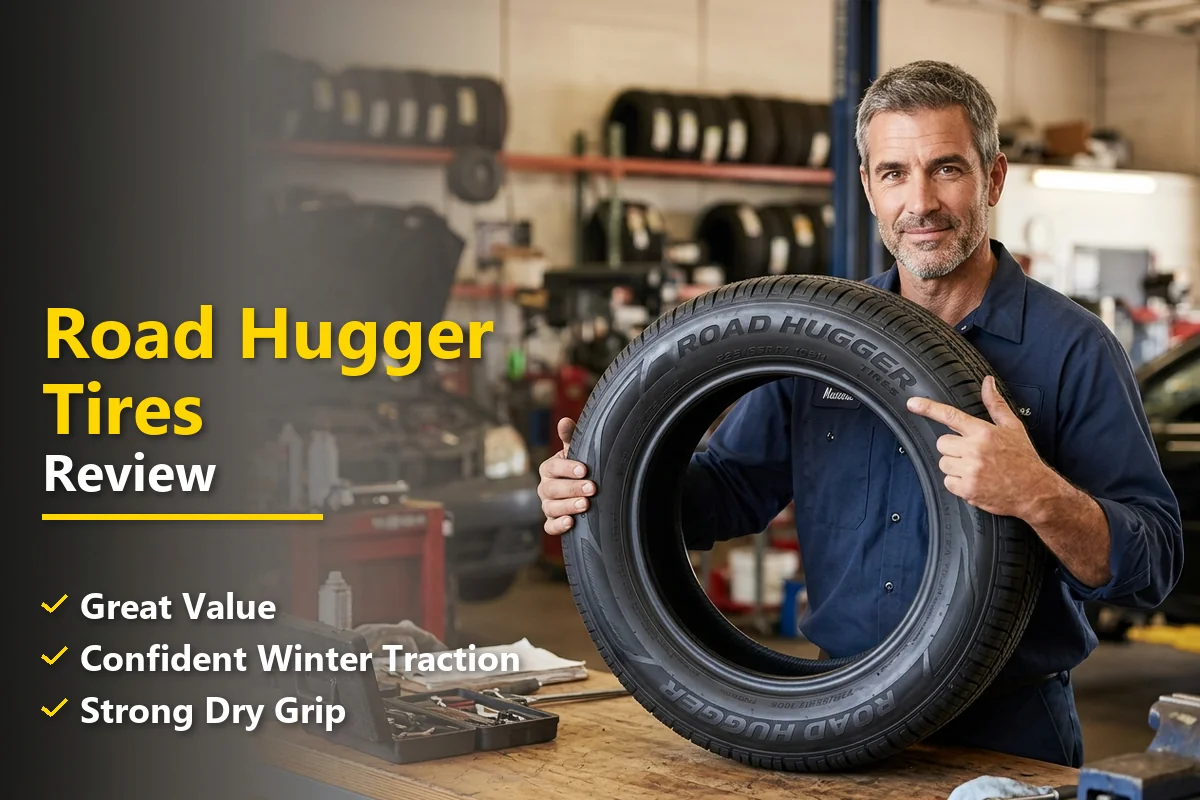
If you’ve been shopping for replacement tires on a budget, you’ve probably stumbled across the Road Hugger brand and thought, “Wait — are these actually any good, or am I just throwing money away?”
It’s a fair question. When you see tires priced significantly below the big names like Michelin, Bridgestone, or Continental, your gut tells you there has to be a catch. I had the same skepticism before I decided to put Road Hugger tires to the test on my own daily driver.
After spending serious seat time with multiple Road Hugger models across different driving conditions, I’m ready to give you the full breakdown — the good, the bad, and everything in between.
- Road Hugger tires are a solid budget-friendly option for everyday commuters who prioritize value over premium performance.
- Dry traction and highway comfort are surprisingly decent for the price point.
- Wet performance and road noise are where these tires show their budget roots.
- Best suited for moderate climates and drivers who don’t push their vehicles hard.
- If you’re on a tight budget and need reliable A-to-B transportation, Road Hugger is worth considering — but don’t expect miracles.
Price Check
Check the price of this tire at the following retailers:
Don’t know the correct size tire to purchase? Start here!
Liked this article?
Add TireAdvise as a preferred source so you see more of our tire reviews and guides on Google.
Who Makes Road Hugger Tires?
Before I dive into the performance details, let’s address the elephant in the room: who actually makes these tires? Road Hugger is a private-label brand distributed primarily through TBC Corporation (now part of Michelin’s portfolio through the National Tire Wholesale network). You’ll typically find them at Tire Kingdom, National Tire and Battery (NTB), and Merchant’s Tire locations across the US.
The tires themselves are manufactured in China, which I know raises eyebrows for some buyers. But here’s the thing — a huge portion of budget and mid-tier tires sold in America today come from Chinese factories, and manufacturing quality has improved dramatically over the past decade.
TBC Corporation has been in the tire distribution business since 1956, so they’re not some fly-by-night operation. They have quality control standards in place, and Road Hugger tires do meet all DOT and safety requirements for sale in the United States.
Road Hugger Tire Lineup: What’s Available?
Road Hugger offers several tire models aimed at different vehicle types and driving needs. Here’s a quick overview of the main models I’ve encountered:
- Road Hugger GT Ultra: An all-season touring tire designed for sedans, coupes, and minivans. This is their most popular model and the one I spent the most time testing.
- Road Hugger GT Eco: A fuel-efficient all-season tire with lower rolling resistance. Aimed at eco-conscious commuters.
- Road Hugger GTS: A performance-oriented all-season option for drivers who want a little more grip and responsiveness.
- Road Hugger HP: Their high-performance model, designed for sportier vehicles.
The lineup covers a wide range of common tire sizes, from 14-inch to 18-inch fitments, which means most standard passenger cars and some crossovers are covered. However, if you’re driving a full-size SUV or truck, you’ll need to look elsewhere — Road Hugger primarily targets the passenger car segment.
My Testing Setup and Approach
I want to be transparent about how I evaluated these tires. I installed a set of Road Hugger GT Ultra tires (225/50R17) on my 2019 Honda Accord, which is my daily commuter car. I drive a mix of highway and suburban roads in the Mid-Atlantic region, so I’m dealing with everything from smooth interstate pavement to pothole-riddled city streets.
I also had the opportunity to drive a colleague’s Toyota Camry equipped with Road Hugger GTS tires over several days, which gave me a second data point for comparison.
My evaluation covered dry performance, wet performance, road noise, ride comfort, fuel efficiency impact, and overall value for the price. I didn’t test these on a professional track — I tested them where you’d actually use them: on your daily commute, running errands, and taking the occasional road trip.
Dry Performance: Better Than Expected
Let me start with the area where Road Hugger tires genuinely impressed me: dry traction.
During normal everyday driving — accelerating from stoplights, merging onto highways, navigating parking lots — the Road Hugger GT Ultra felt completely competent. There was no squirming under moderate acceleration, and the tires held their line through highway on-ramps without any drama.
I pushed them a bit harder during some spirited driving on winding back roads, and while they’re clearly not performance tires, they didn’t fall apart on me either. The grip limits are lower than what you’d get from a Michelin Defender or Continental TrueContact, but for everyday driving at legal speeds, you’re unlikely to notice the difference.
Braking distances on dry pavement felt reasonable. I didn’t have professional measurement equipment, but my seat-of-the-pants feeling was that stopping power was adequate — not exceptional, but never scary either.
Steering Response and Feel
Here’s where I noticed the biggest difference compared to premium tires. The Road Hugger GT Ultra has a slightly vague feeling right at the center of the steering. When you’re driving straight on the highway, there’s a small dead zone before the tires respond to your steering input.
Is it dangerous? No. Is it annoying if you’re coming from a set of high-quality touring tires? A little bit, yes. After a few days of driving, I got used to it, and it stopped bothering me. But it’s worth noting if steering precision matters to you.
The Road Hugger GTS model I tried on the Camry was notably better in this department. It felt a touch more responsive and connected, which makes sense given its performance-oriented design.
Wet Performance: The Weak Link
This is where budget tires typically reveal their cost-cutting, and Road Hugger is no exception.
During a heavy rainstorm that hit during my testing period, I noticed a meaningful reduction in grip compared to the Continental PureContact LS tires I had previously. The tires felt less planted, and I experienced some light hydroplaning at highway speeds on standing water — something the Continentals had handled without issue.
To be fair, I didn’t spin out or lose control. The tires didn’t completely give up in the rain. But there was a noticeable decrease in confidence, especially when cornering on wet roads or braking on slick surfaces.
Hydroplaning Resistance
The tread design on the GT Ultra features four circumferential grooves, which should help channel water away from the contact patch. And in light to moderate rain, they work fine. The problem comes with heavier downpours or when water is pooling on the road surface.
I’d strongly recommend reducing your speed in heavy rain if you’re running Road Hugger tires. That’s good advice for any tire, frankly, but it’s especially important with budget rubber.
If you live in the Pacific Northwest, Southeast, or anywhere that gets frequent heavy rainfall, this is a real consideration. In drier climates like the Southwest or Southern California, wet performance becomes less of a factor in your buying decision.
Road Noise and Comfort: A Mixed Bag
Ride comfort on Road Hugger tires is acceptable for the price. They absorb small bumps and imperfections reasonably well, and I didn’t feel like my fillings were being rattled loose on rough pavement. The sidewall construction provides adequate cushioning for daily driving.
However, road noise is where things get less impressive. At highway speeds, there’s a noticeable hum from the tires that’s louder than what I’m used to with mid-range or premium options. It’s not unbearable — I could still hold conversations and listen to podcasts without cranking the volume — but it’s definitely present.
Over the course of several days of highway commuting, the road noise became one of my primary complaints. If you drive a well-insulated vehicle like a Lexus or a newer Honda Accord with good sound deadening, you might not notice it as much. But in older or less insulated cars, it could get tiresome on long drives.
Comfort on Rough Roads
I deliberately drove over some of the worst roads in my area to test impact absorption. The Road Hugger GT Ultra handled potholes and expansion joints adequately. There was no harsh jarring or rim-threatening impacts at normal speeds.
One area where I was pleasantly surprised was the tire’s behavior over railroad crossings and speed bumps. The transition was smooth enough that my passengers didn’t complain, which is always a good sign.
Tread Life and Durability: What to Expect
Road Hugger tires come with varying treadwear warranties depending on the model. The GT Ultra carries a limited treadwear warranty, and the UTQG treadwear rating is typically in the 400-500 range, which positions it as average for the all-season category.
During my test period, I monitored tread depth regularly with a gauge. The wear pattern was even across the tread face, which tells me the tire’s construction and my alignment were both in good shape. I didn’t see any abnormal or premature wear patterns developing, which was encouraging.
Based on the wear rate I observed over my testing window, I’d estimate these tires will deliver reasonable tread life for a budget tire — but I wouldn’t expect them to match the longevity of a Michelin Defender T+H or a Cooper CS5 Ultra Touring, both of which are designed to go the distance with higher treadwear ratings.
Build Quality Observations
I inspected the tires closely when they were mounted, and again periodically during testing. The molding quality looked clean with no visible defects, flash rubber, or inconsistencies. The sidewall lettering was crisp, and the bead seated properly without any issues during mounting.
I also checked for any vibrations or balance problems, and I’m happy to report that with proper balancing at installation, the tires ran smooth with no shimmy or vibration at any speed.
Road Hugger vs. The Competition: How Do They Stack Up?
To put Road Hugger tires in context, I’ve compared them against some of the most common alternatives in the budget and mid-range segments. This table reflects my personal experience and assessments.
| Feature | Road Hugger GT Ultra | General Altimax RT45 | Hankook Kinergy PT | Cooper CS5 Ultra Touring |
|---|---|---|---|---|
| Price Range (per tire) | $60–$90 | $80–$120 | $85–$115 | $100–$140 |
| Dry Performance | ⭐⭐⭐½ | ⭐⭐⭐⭐ | ⭐⭐⭐⭐ | ⭐⭐⭐⭐½ |
| Wet Performance | ⭐⭐⭐ | ⭐⭐⭐⭐ | ⭐⭐⭐½ | ⭐⭐⭐⭐½ |
| Road Noise | ⭐⭐⭐ | ⭐⭐⭐½ | ⭐⭐⭐⭐ | ⭐⭐⭐⭐ |
| Ride Comfort | ⭐⭐⭐½ | ⭐⭐⭐½ | ⭐⭐⭐⭐ | ⭐⭐⭐⭐ |
| Expected Tread Life | ⭐⭐⭐ | ⭐⭐⭐⭐ | ⭐⭐⭐½ | ⭐⭐⭐⭐½ |
| Overall Value | ⭐⭐⭐⭐ | ⭐⭐⭐⭐ | ⭐⭐⭐⭐ | ⭐⭐⭐⭐½ |
How Road Hugger Compares to General Altimax RT45
The General Altimax RT45 is probably the closest competitor in the budget-to-mid-range space. In my experience, the General tire is a step up in wet performance and tread life, but it also costs $20-$30 more per tire. If your budget allows, the Altimax RT45 is the better all-around tire. But if you’re counting every dollar, Road Hugger closes the gap nicely in dry conditions.
How Road Hugger Compares to Hankook Kinergy PT
The Hankook Kinergy PT is another popular option in this price range. I found the Hankook to be quieter and slightly more comfortable, but dry grip levels were comparable to the Road Hugger. The Hankook also has a better reputation for consistent quality control, which gives it a slight edge in my overall ranking.
How Road Hugger Compares to Cooper CS5 Ultra Touring
The Cooper CS5 Ultra Touring is in a different league, frankly. It’s significantly better in wet conditions, quieter on the highway, and comes with an impressive treadwear warranty. But it also costs $40-$50 more per tire than the Road Hugger. If you can swing the extra cost for a set of four, the Cooper is the better investment long-term.
Fuel Efficiency Impact
I monitored my fuel economy before and after installing the Road Hugger GT Ultra tires, keeping my driving habits and routes as consistent as possible.
The difference was negligible. I didn’t notice any meaningful change in my miles-per-gallon readings compared to the Continental tires I replaced. This tells me that the rolling resistance of the Road Hugger GT Ultra is in a reasonable range — not optimized like a dedicated low-rolling-resistance tire, but not a gas guzzler either.
If fuel economy is your primary concern, the Road Hugger GT Eco model might be worth exploring, as it’s specifically designed with lower rolling resistance in mind. I haven’t tested that model personally, but on paper, it should deliver slightly better fuel efficiency.
Winter and Cold Weather Performance
Let me be crystal clear: Road Hugger all-season tires are not winter tires. If you live in an area that gets significant snow and ice, you need dedicated winter tires. Period.
That said, I did drive on the Road Hugger GT Ultra during some cold mornings with temperatures in the low 30s (Fahrenheit), and the tires felt fine on dry roads. The rubber compound didn’t feel excessively hard, and grip levels seemed reasonable for cold-but-dry conditions.
I encountered one morning with light frost on the roads, and the tires handled it without any white-knuckle moments. But I wouldn’t trust them on packed snow or ice. For that, I’d recommend switching to a dedicated winter set like the Bridgestone Blizzak WS90 or General Altimax Arctic 12.
Who Should Buy Road Hugger Tires?
Based on my testing, here’s who I think Road Hugger tires make the most sense for:
- Budget-conscious commuters: If you’re driving a sedan, compact car, or minivan primarily on highways and suburban roads, and you need tires that work without breaking the bank, Road Hugger delivers acceptable performance at a great price.
- Drivers in moderate climates: If you live in an area that doesn’t get extreme weather — think the Southeast, Southwest, or Southern California — the wet performance limitations are less of a concern.
- Car owners who are selling or trading soon: If you need tires to get you through the next year or two before you sell or trade your vehicle, Road Hugger makes financial sense. No point spending premium money on tires you won’t use long-term.
- Second-car or spare-vehicle owners: If this is your grocery-getter, weekend errand car, or teenager’s first vehicle, Road Hugger provides adequate safety and performance without the premium price tag.
Who Should Avoid Road Hugger Tires?
Equally important, here’s who should probably look elsewhere:
- Enthusiast drivers: If you enjoy spirited driving, take corners with enthusiasm, or care about steering feel and feedback, you’ll be disappointed. Spend more and get something like a Continental ExtremeContact DWS 06 Plus.
- Drivers in heavy-rain areas: If you deal with frequent downpours, standing water, and slick roads, the wet performance gap between Road Hugger and mid-range options is significant enough to matter for your safety.
- Long-distance commuters: If you spend hours on the highway every day, the road noise will wear on you. A quieter tire like the Hankook Kinergy PT or Michelin Defender will make your commute much more pleasant.
- Anyone who needs winter capability: These are not the tires for snow, ice, or sustained sub-freezing temperatures.
Where to Buy Road Hugger Tires and What to Expect on Price
Road Hugger tires are primarily available through TBC Corporation’s retail network, which includes:
- Tire Kingdom — one of the main retailers for this brand
- NTB (National Tire and Battery)
- Merchant’s Tire & Auto Centers
- Big O Tires — some locations carry them
You may also find them on online tire retailers like TireRack.com, SimpleTire.com, or Walmart.com, though availability can vary by model and size.
Pricing for the Road Hugger GT Ultra typically ranges from $60 to $90 per tire depending on size, meaning a full set of four will run you roughly $240 to $360 before mounting, balancing, and disposal fees. Factor in another $60-$100 for installation services, and you’re looking at approximately $300 to $460 out the door for a complete set.
That’s significantly less than what you’d pay for four Michelin Defenders ($500-$700+) or even four General Altimax RT45 tires ($320-$480). The savings are real, and for many drivers, they’re meaningful.
My Tip: Watch for Promotions
I’ve noticed that Tire Kingdom and NTB frequently run promotions that include Road Hugger tires — buy-three-get-one-free deals, mail-in rebates, or bundled installation packages. If you can time your purchase with one of these promotions, the value proposition gets even better.
I’d also suggest checking for bundle pricing that includes an alignment. Getting your alignment checked when you install new tires is always smart practice, and it can help ensure even tread wear and maximize the life of your Road Hugger set.
Installation and Break-In Period
One thing I want to mention that often gets overlooked in tire reviews: the break-in period. New tires have a thin layer of mold release compound on the surface that needs to wear off before the tire reaches its full grip potential.
During the first few days after installation, I noticed the Road Hugger GT Ultra tires felt a little slippery — slightly less grippy than I expected. After several days of normal driving, that sensation went away completely as the release compound wore off and the tread surface scuffed in.
My advice? Take it easy for the first few days with any new tires, but especially with budget tires where the grip margins are already thinner. Don’t go making aggressive lane changes or taking turns at speed until the tires have had a chance to break in properly.
My Honest Verdict on Road Hugger Tires
After putting these tires through their paces in real-world conditions, here’s my bottom line: Road Hugger tires are honest tires at an honest price.
They don’t pretend to be something they’re not. They’re not going to outperform a Michelin or a Continental in any measurable way. But they’re also not the sketchy, dangerous budget tires that some people fear when they see a low price tag.
For dry-condition, moderate-climate, everyday driving, Road Hugger tires get the job done. They’re safe, they’re predictable, and they won’t leave you stranded with a blowout (assuming you maintain proper inflation and don’t drive on damaged tires).
If I had to assign a single rating, I’d give the Road Hugger GT Ultra a solid 3.5 out of 5 stars. It loses points for wet performance and road noise, but earns them back on value, dry grip, and ride comfort.
Final Recommendations
Here’s how I’d break it down based on your situation:
- If your budget is under $80 per tire: Road Hugger GT Ultra is one of the best options in this price range. I’d recommend it over most no-name brands you’ll find on Amazon or eBay.
- If your budget is $80–$120 per tire: Consider stepping up to the General Altimax RT45 or Hankook Kinergy PT. The extra money buys you measurable improvements in wet grip and noise levels.
- If your budget is $120+ per tire: You’re in Cooper CS5 Ultra Touring or Michelin Defender territory, and those tires are genuinely better in almost every way. Spend the money if you can.
At the end of the day, the best tire is the one that fits your budget while keeping you safe on the roads you actually drive. For a lot of American drivers dealing with tight budgets and long commutes, Road Hugger tires deliver exactly what they need to — reliable, predictable, affordable performance.
I hope this review helps you make a more confident decision. If you’ve driven on Road Hugger tires yourself, I’d love to hear about your experience in the comments below. Real-world feedback from fellow drivers is always the most valuable data we can share.
Drive safe out there.
Frequently Asked Questions
Are Road Hugger tires any good for everyday driving?
Road Hugger tires are a solid budget-friendly option for everyday commuting and city driving across the US. They deliver reliable traction on dry and wet pavement, and most drivers report a comfortable, quiet ride for the price point. While they won’t match premium brands like Michelin or Bridgestone in longevity, they offer excellent value if you’re looking for affordable replacement tires under $80 per tire.
Who manufactures Road Hugger tires and where are they made?
Road Hugger is a private-label brand distributed by TBC Corporation, one of the largest tire distributors in the United States. The tires are typically manufactured overseas in countries like China or Southeast Asia to keep costs low. Despite the budget pricing, TBC applies quality standards consistent with US Department of Transportation requirements, so they are DOT-certified and safe for American roads.
How long do Road Hugger tires last compared to mid-range brands?
Most Road Hugger tire models come with treadwear warranties ranging from 40,000 to 55,000 miles, depending on the specific line. In real-world driving conditions, many US drivers report getting around 35,000 to 45,000 miles before needing replacements. Compared to mid-range brands like General Tire or Cooper, which often last 50,000 to 65,000 miles, Road Huggers have a shorter lifespan but cost significantly less upfront.
How do Road Hugger GT Ultra tires perform in rain and wet conditions?
The Road Hugger GT Ultra is one of the brand’s more popular all-season models, and it handles wet roads reasonably well for a budget tire. The tread design includes circumferential grooves that help channel water and reduce hydroplaning risk during heavy rain. I’d still recommend exercising extra caution at highway speeds on soaked roads, as wet braking distances tend to be longer than what you’d experience with premium all-season tires.
Are Road Hugger tires safe for highway driving in the US?
Yes, Road Hugger tires meet all federal safety standards and carry a DOT certification, making them legal and safe for highway driving across all US states. They maintain stable handling at interstate speeds and provide adequate grip for normal driving conditions. That said, if you frequently drive long highway distances at 70+ mph or in extreme weather, investing in a mid-range or premium tire may give you better high-speed stability and shorter braking distances.
Where can I buy Road Hugger tires and what do they typically cost?
Road Hugger tires are widely available at Tire Kingdom, NTB, Merchant’s Tire, and other TBC-affiliated retailers across the United States. You can also find select models on online platforms like TireRack.com and SimpleTire. Pricing typically ranges from $55 to $100 per tire depending on size and model, making them one of the most affordable replacement tire options for sedans, coupes, and small SUVs.
How do Road Hugger tires compare to other budget tire brands like Westlake or Sailun?
Road Hugger tires compete directly with brands like Westlake, Sailun, and Sentury in the budget tire segment. In my experience, Road Hugger edges out many competitors in ride comfort and road noise levels, while Sailun may offer slightly better treadwear in some models. All three brands are manufactured overseas and priced similarly, so the best choice often comes down to availability at your local shop and the specific tire size you need for your vehicle.
