

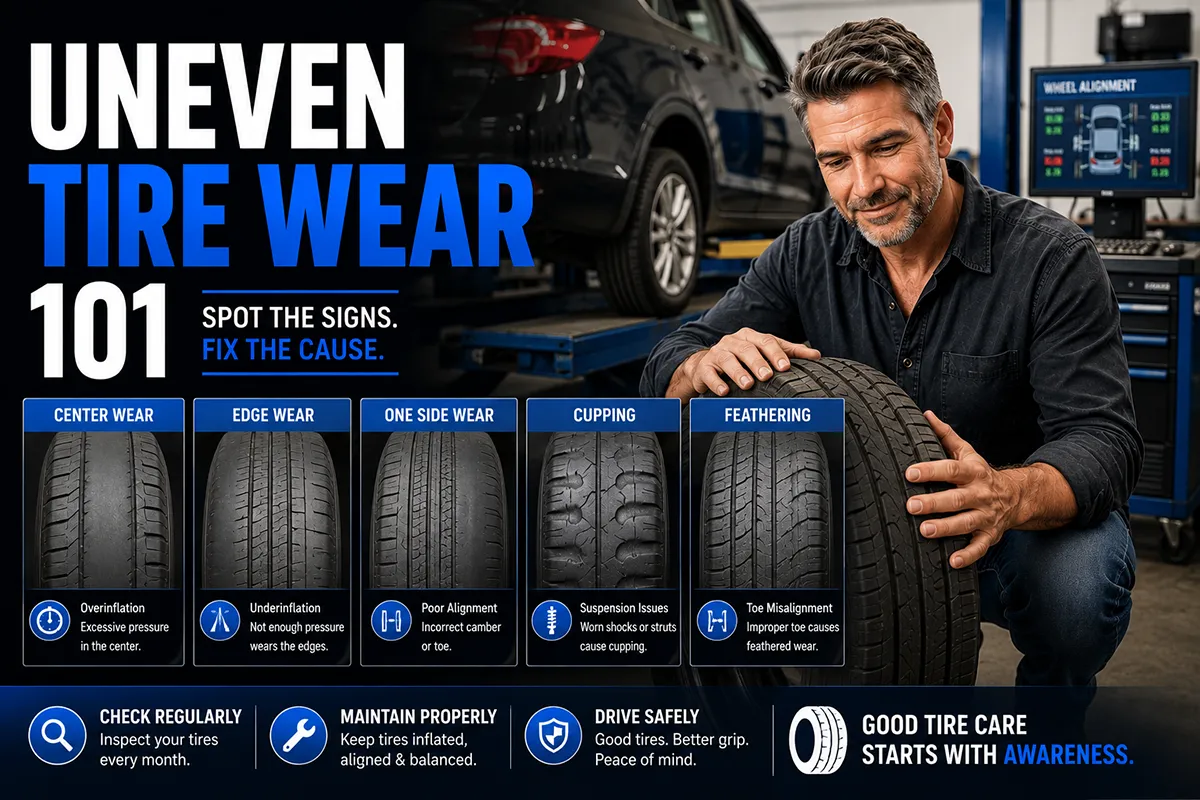
I pulled into my driveway after a long road trip last summer and noticed something that made my stomach drop — the inside edge of my front left tire was nearly bald, while the rest of the tread looked practically new.
That single tire had months of life left across 75% of its surface, but one worn strip meant it was unsafe and needed immediate replacement. I’d essentially thrown money straight into the asphalt.
If you’ve ever been surprised by premature tire replacement or noticed your car pulling to one side, there’s a good chance uneven tire wear is the culprit. And after spending years testing tires, inspecting wear patterns, and diagnosing alignment issues on my own vehicles and those of friends and family, I can tell you this: uneven tire wear is one of the most common — and most preventable — problems everyday drivers face.
- Uneven tire wear has distinct patterns — each one points to a specific cause like misalignment, improper inflation, or worn suspension parts.
- The most common types are inner/outer edge wear, center wear, cupping, and feathering.
- Regular tire rotations, proper inflation, and alignment checks are your best prevention tools.
- Catching uneven wear early can save you hundreds of dollars and keep you safer on the road.
- I walk through each pattern with real-world experience and explain exactly how to fix and prevent it.
Liked this article?
Add TireAdvise as a preferred source so you see more of our tire reviews and guides on Google.
Why Uneven Tire Wear Matters More Than You Think
Let me be blunt: uneven tire wear isn’t just a cosmetic issue. It’s a safety problem, a financial drain, and often a warning sign that something else on your vehicle needs attention.
I’ve seen drivers lose traction in rain because one section of their tire was worn smooth while the rest had plenty of tread. I’ve watched people spend $600 or more on a new set of tires that should have lasted twice as long, all because an underlying issue went unaddressed.
In my experience, most drivers don’t check their tires nearly often enough. You hop in, drive to work, drive home, and repeat — and the tires are the last thing on your mind. But spending just two minutes every couple of weeks examining your tread can save you real money and, more importantly, keep you and your family safe.
The Anatomy of a Tire: A Quick Refresher
Before I dive into the specific wear patterns, it helps to understand the basic structure of a tire. The part that contacts the road is called the tread, and it’s made up of rubber compounds designed to grip pavement in various conditions.
The tread has several zones. There’s the center rib (the strip running down the middle), the intermediate ribs, and the shoulder areas on the inner and outer edges. Each of these zones wears differently depending on what’s happening with your vehicle.
New tires typically come with tread depths between 10/32″ and 12/32″ of an inch. Most states in the US consider a tire legally worn out at 2/32″. But in my experience, you should start shopping for replacements once you hit 4/32″, especially if you drive in rain or snow.
The 6 Most Common Uneven Tire Wear Patterns
Over the years, I’ve encountered just about every wear pattern there is. Each one tells a story about what’s going on with your car. Let me walk you through the six most common types I see.
1. Inner Edge Wear
This is the one that got me on that summer road trip. Inner edge wear means the inside shoulder of your tire — the side facing the vehicle — is wearing down significantly faster than the rest of the tread.
In almost every case I’ve diagnosed, this comes down to negative camber. Camber refers to the angle of the tire when viewed from the front of the vehicle. If the top of the tire tilts inward, that’s negative camber, and it puts excessive pressure on the inner edge.
The most common cause? A vehicle that’s out of alignment. I’ve also seen it caused by worn ball joints, worn control arm bushings, and sagging springs — especially on older vehicles or those that have hit some nasty potholes.
When I notice inner edge wear on a car I’m working with, my first recommendation is always to get a four-wheel alignment before installing new tires. Otherwise, you’ll just chew through the new set the same way.
2. Outer Edge Wear
Outer edge wear is the mirror image of inner edge wear. The outside shoulder of the tire wears down faster than the center and inner portions.
This is typically caused by positive camber — the top of the tire leaning outward — or by toe misalignment. I’ve seen this frequently on trucks and SUVs, particularly ones that have been lifted or had suspension modifications done without a follow-up alignment.
I once checked a friend’s Chevy Silverado that had aggressive outer edge wear on both front tires after he installed a leveling kit. A quick alignment at the shop fixed the angle, and the next set of tires he put on wore beautifully and evenly.
3. Center Wear
If the center of your tread is wearing faster than the edges, you’re almost certainly dealing with overinflation. When a tire has too much air, the center of the tread bulges outward and bears a disproportionate share of the load.
I’ve seen this happen to drivers who religiously fill their tires but use the pressure listed on the tire sidewall (the maximum pressure) rather than the recommended pressure listed on their vehicle’s door placard. There’s a big difference. The number on the sidewall might say 51 PSI max, but your vehicle might only call for 35 PSI.
In my experience, center wear is one of the easiest patterns to prevent. Just check your tire pressure monthly with a quality gauge — I keep a digital one in my glove box — and always go by the vehicle manufacturer’s recommendation, not the tire’s maximum rating.
4. Edge Wear (Both Sides)
When both the inner and outer edges are wearing faster than the center, you’re looking at the opposite problem: underinflation. A tire without enough air pressure sags and puts extra contact on the shoulders while the center lifts slightly off the road.
This is incredibly common. According to the National Highway Traffic Safety Administration (NHTSA), about one in four cars on US roads has at least one significantly underinflated tire. I believe it. During my testing periods, I’ve checked the pressure on friends’ and family members’ cars dozens of times and found underinflation far more often than overinflation.
Underinflation doesn’t just cause uneven wear — it increases rolling resistance (which kills fuel economy), generates excess heat (which can lead to blowouts), and makes your car feel sluggish and vague in corners.
5. Cupping (Scalloping)
Cupping is one of the most distinctive wear patterns, and it’s one I always find a bit alarming when I see it. It shows up as a series of dips or scooped-out patches around the tread surface, almost like someone took a melon baller to the rubber.
This pattern is almost always caused by worn or damaged suspension components — particularly shocks and struts. When your shocks are worn out, the tire literally bounces as it rolls down the road instead of maintaining consistent contact. Each bounce creates a little extra wear in that spot, and over time, you get those scalloped-out cups.
I experienced cupping firsthand on my old Honda Accord. The rear tires developed a noticeable scalloped pattern, and I could hear a rhythmic thumping noise at highway speeds. Sure enough, the rear shocks were completely blown. After replacing them and putting on new tires, the problem disappeared entirely.
If you notice cupping, don’t just replace the tires. Get your suspension inspected first. Shocks and struts typically need replacement every few years depending on driving conditions, and neglecting them will destroy a fresh set of tires in short order.
6. Feathering
Feathering is a subtle wear pattern that you might feel before you see it. Run your hand across the tread — if the ribs feel smooth in one direction but sharp or saw-toothed in the other direction, you’ve got feathering.
This is almost always a toe alignment issue. When your tires aren’t pointing perfectly straight ahead (either toed in or toed out), they essentially scrub sideways slightly with every revolution. That scrubbing creates the feathered edges on the tread blocks.
I’ve found feathering to be particularly common on front-wheel-drive vehicles that haven’t had an alignment in a long time. It’s one of those patterns that can sneak up on you because it doesn’t always show up visually until it’s fairly advanced. That’s why I always recommend the hand test — just run your palm across the tread in both directions and feel for asymmetry.
Comparison Table: Uneven Tire Wear Patterns at a Glance
| Wear Pattern | What It Looks Like | Most Likely Cause | Fix |
|---|---|---|---|
| Inner Edge Wear | Inside shoulder worn smooth | Negative camber / misalignment | Four-wheel alignment; inspect suspension |
| Outer Edge Wear | Outside shoulder worn smooth | Positive camber / toe misalignment | Four-wheel alignment; check modifications |
| Center Wear | Center rib worn faster than edges | Overinflation | Adjust to vehicle’s recommended PSI |
| Both-Edge Wear | Both shoulders worn, center has more tread | Underinflation | Inflate to proper PSI; check for slow leaks |
| Cupping / Scalloping | Dips and scoops around the tread | Worn shocks/struts; suspension damage | Replace worn suspension components |
| Feathering | Saw-tooth feel across tread ribs | Toe misalignment | Toe adjustment / alignment |
How to Check for Uneven Wear: My Step-by-Step Process
I’ve developed a simple routine that takes about five minutes and catches problems early. Here’s exactly what I do.
Step 1: The Visual Inspection
I start by looking at each tire straight on from the front and rear of the vehicle. I’m looking for any obvious differences between the inner and outer shoulders. Sometimes the difference is dramatic — you can see bare rubber on one edge and full tread on the other.
I also look at the tread face from a low angle, almost at ground level. This helps me spot cupping or scalloping that’s harder to see from directly above.
Step 2: The Hand Test
Next, I run my hand across the tread surface in multiple directions. I’m feeling for feathering (that sawtooth texture), for cupping (dips and ridges), and for any unusual roughness that suggests the tire isn’t wearing smoothly.
Be careful doing this — worn tread edges can be sharp. I usually wear a work glove on the hand I’m using.
Step 3: The Tread Depth Check
I use a simple tread depth gauge — you can grab one for about $5 at any auto parts store. I take measurements in at least three spots across the tire face: the inner shoulder, the center, and the outer shoulder.
If all three readings are close to each other, the tire is wearing evenly. If there’s a significant difference — say 3/32″ or more between any two measurements — I know I’ve got a problem to investigate.
Step 4: Compare Front to Rear
Finally, I compare the wear on the front tires to the rear tires. Front tires on front-wheel-drive vehicles will naturally wear faster because they handle both steering and power delivery. But the wear should still be even across each individual tire’s face.
If I notice the fronts are wearing much faster overall, it’s usually a sign that tire rotations have been neglected.
The Causes Behind the Causes: What’s Really Going On
Understanding the wear patterns is half the battle. The other half is understanding why these problems develop in the first place. In my experience, there are a handful of root causes that account for the vast majority of uneven wear issues.
Skipped or Delayed Tire Rotations
This is the number one issue I see. Tire rotations are cheap and simple — most shops charge between $20 and $50, and many tire retailers include free rotations with purchase. Yet a shocking number of drivers skip them entirely.
I rotate my tires every time I get an oil change. It’s an easy habit to build, and it makes a massive difference in how evenly your tires wear. Without regular rotations, the front tires on a front-wheel-drive car will wear out dramatically faster than the rears, and you’ll end up replacing two tires while the other two still have plenty of life.
Neglected Alignment
Your wheel alignment can drift out of spec gradually, or it can be knocked out of alignment by a single event — hitting a deep pothole, clipping a curb, or even driving on rough gravel roads for extended periods.
I recommend getting an alignment check at least once a year, or anytime you notice the car pulling to one side, the steering wheel sitting off-center, or any unusual wear developing. A standard four-wheel alignment at most shops in the US costs between $80 and $150. That’s a small price compared to burning through a set of $600-$800 tires prematurely.
Worn Suspension Components
Shocks, struts, ball joints, tie rod ends, control arm bushings — these are all parts that wear out over time and can directly cause uneven tire wear. I’ve found that many drivers don’t think about their suspension until something breaks or starts making noise.
The tricky thing is that suspension wear is often gradual. Your shocks might be 50% worn, and you’ve adjusted to the softer ride without even realizing it. But your tires are telling the story. If you see cupping, or if your tires are wearing unevenly despite having correct pressure and a recent alignment, it’s time to have the suspension inspected.
Improper Tire Pressure Habits
I check my tire pressure at least once a month, and I always check before long road trips. Tires naturally lose about 1-2 PSI per month just through normal permeation, and temperature swings make it worse. For every 10°F drop in ambient temperature, your tires lose roughly 1 PSI.
This is a big deal in the US, where drivers in places like Minnesota or Colorado can experience 50-degree temperature swings between seasons. A tire that was perfectly inflated in September could be significantly underinflated by December.
I keep a digital tire pressure gauge in every vehicle I own. They’re accurate, easy to read, and cost less than $15. It’s the single cheapest tire maintenance tool you can buy.
How Driving Habits Contribute to Uneven Wear
I’d be dishonest if I didn’t mention the role driving style plays in tire wear. I’ve seen this firsthand — the same tires on two identical vehicles can wear completely differently depending on who’s behind the wheel.
Aggressive Cornering
If you consistently take corners at higher speeds, you’re putting extra stress on the outer shoulder of your tires (or the inner shoulder, depending on the direction). Over time, this contributes to edge wear. I’m not saying you need to crawl through every turn, but smooth, moderate cornering extends tire life noticeably.
Hard Braking and Acceleration
Aggressive braking causes flat spots and accelerated wear, particularly on the driven wheels. Hard acceleration — especially on front-wheel-drive cars — can scrub the front tires prematurely. I’ve noticed that switching to a smoother driving style during my test periods consistently results in more even wear across all four tires.
Carrying Heavy Loads
If you regularly load up your vehicle with heavy cargo, the added weight increases the contact patch pressure and accelerates wear. This is especially relevant for pickup truck owners who carry tools, equipment, or building materials. Make sure your tire pressure is adjusted upward when carrying heavy loads — your door placard often lists a separate, higher pressure for full-load conditions.
What to Do When You Find Uneven Wear
Okay, so you’ve inspected your tires and found uneven wear. What now? Here’s the process I follow every time.
Step 1: Diagnose the Root Cause
Match the wear pattern to the table above. Is it inner edge wear? Get an alignment check. Cupping? Inspect the suspension. Center wear? Check your inflation habits. Don’t skip this step — if you don’t fix the cause, the problem will return.
Step 2: Decide If the Tires Are Salvageable
If the wear is caught early and the tread depth is still above 4/32″ even in the worn area, you may be able to correct the underlying issue and continue using the tires. A rotation can help even things out somewhat after the root cause is fixed.
If the wear is severe — especially if you can see the wear bars or the tread is below 2/32″ anywhere on the tire — it’s time for replacement. Don’t gamble with safety.
Step 3: Fix the Cause Before Installing New Tires
I cannot stress this enough. I’ve watched people buy brand-new tires and mount them on a car with a known alignment problem, only to come back frustrated months later with the same wear pattern on the new set. Get the alignment, replace the worn suspension parts, and correct your inflation habits first. Then install the new tires.
Step 4: Start Fresh with Good Habits
Once you’ve got new tires on a properly maintained vehicle, commit to regular rotations, monthly pressure checks, and annual alignment inspections. This is the formula that keeps tires wearing evenly for their full lifespan.
The Real Cost of Ignoring Uneven Tire Wear
Let me put this in dollar terms, because that’s what often motivates action.
A set of four quality all-season tires for the average sedan in the US costs between $400 and $800. For an SUV or truck, you’re often looking at $600 to $1,200 or more.
If uneven wear forces you to replace your tires at half their expected lifespan, you’re essentially doubling your tire costs. Over the life of a vehicle, that can add up to thousands of dollars in unnecessary spending.
On the flip side, the preventive measures are cheap. A tire rotation costs $20-$50. An alignment costs $80-$150. A tire pressure gauge costs $10-$15. Monthly pressure checks cost you nothing but five minutes of time.
The math is simple. Invest a little in prevention, or pay a lot for premature replacement.
Special Considerations for Different Vehicle Types
Front-Wheel-Drive Cars
In my experience, FWD vehicles are the most prone to uneven front tire wear because the front tires handle steering, braking, and power delivery. Regular rotations are absolutely essential. I typically follow a front-to-rear rotation pattern, moving the fronts straight back and crossing the rears to the front.
Rear-Wheel-Drive Trucks and Cars
RWD vehicles tend to wear the rear tires faster, but the fronts can still develop alignment-related wear. I see a lot of inner edge wear on the front tires of older RWD trucks and sedans, usually due to worn suspension components and road-induced alignment drift.
All-Wheel-Drive Vehicles
AWD vehicles are particularly sensitive to uneven wear because the AWD system relies on all four tires being close to the same diameter. Significant differences in tread depth between tires can stress the transfer case or center differential. This makes regular rotations even more critical on AWD vehicles.
Performance Vehicles with Staggered Setups
If your vehicle has different-sized tires front and rear (a staggered setup, common on sports cars and some performance sedans), you can’t rotate front to rear. In this case, you can only swap left to right on the same axle — and only if the tires are not directional. These setups demand even more attention to alignment and inflation because your rotation options are limited.
Tire Technology That Helps Combat Uneven Wear
I want to give credit where it’s due — tire manufacturers have been working hard to engineer tires that resist uneven wear. Here are some features I’ve noticed making a real difference.
Optimized Contact Patch Design
Modern tires from brands like Michelin, Continental, and Bridgestone use computer-optimized tread profiles that distribute pressure more evenly across the tread face. In my testing, I’ve found that premium tires from these brands tend to wear more evenly than budget options, even when conditions aren’t perfect.
Wear-Resistant Compounds
Some tires use harder rubber compounds in the shoulder areas where edge wear is most common. This doesn’t eliminate the problem, but it does slow it down. I’ve noticed this on several touring tires I’ve tested, where the shoulders hold up remarkably well even under less-than-ideal alignment conditions.
Tire Pressure Monitoring Systems (TPMS)
Since 2007, all new vehicles sold in the US are required to have TPMS. While these systems aren’t perfect — most only alert you when pressure drops 25% or more below the recommended level — they’re a valuable safety net. I still recommend manual pressure checks, but TPMS has undoubtedly prevented some cases of severe underinflation wear.
My Personal Prevention Checklist
After years of testing tires and maintaining my own vehicles, here’s the exact checklist I follow to prevent uneven tire wear. I encourage you to adopt it.
- Monthly: Check tire pressure on all four tires (plus the spare) using a digital gauge. Adjust to the vehicle manufacturer’s recommended PSI found on the driver’s door placard.
- Every oil change: Rotate tires. If your shop doesn’t include this, ask — many will do it for free or at a low cost when combined with other services.
- Every oil change: Do a quick visual and hand inspection of all four tires, checking for uneven wear patterns, damage, and foreign objects.
- Annually: Get a four-wheel alignment check, even if nothing feels wrong. Think of it as preventive maintenance.
- After any impact event: If you hit a deep pothole, clip a curb, or have any kind of collision, get an alignment check as soon as possible.
- When installing new tires: Always get an alignment at the time of installation. Many tire shops offer package deals that include alignment with tire purchase.
When It’s Time to Replace: Choosing Tires That Wear Evenly
If uneven wear has forced your hand and you need new tires, here’s what I recommend looking for based on my experience.
First, check treadwear ratings. The UTQG (Uniform Tire Quality Grading) treadwear number gives you a relative indication of how long a tire will last. Higher numbers generally mean longer tread life, though this isn’t an exact science. I’ve found that tires with treadwear ratings of 500 or higher tend to be good all-around performers for everyday driving.
Second, read real-world reviews from other drivers. Sites like ours exist specifically to give you tested, honest assessments of how tires perform over time — including how evenly they wear.
Third, consider tires with strong warranties. Many brands offer treadwear warranties — Michelin, Continental, Cooper, and General all stand behind their products. If a tire wears out prematurely (and evenly, from normal use), a good warranty can get you prorated credit toward replacements.
Finally, don’t automatically go for the cheapest option. In my testing over the years, I’ve consistently found that mid-range and premium tires from established brands deliver better, more even wear than bottom-dollar budget tires. The upfront cost is higher, but the per-month cost of ownership is often lower because they last longer and wear more uniformly.
Final Thoughts: Your Tires Are Talking — Listen to Them
Every tire on your vehicle is telling you a story. The wear patterns are clues, and if you know how to read them, you can catch problems early, fix them cheaply, and extend the life of your tires dramatically.
I’ve been inspecting and testing tires for years, and the single biggest takeaway I can share is this: the drivers who pay attention to their tires spend less money on tires over time. It sounds paradoxical, but it’s true. Five minutes of inspection and a few dollars of preventive maintenance save hundreds in premature replacements.
Take a walk around your car today. Look at your tires. Run your hand across the tread. Check the pressure. If something looks off, don’t ignore it — investigate it. Your wallet and your safety will thank you.
Frequently Asked Questions
What causes uneven tire wear on my car?
Uneven tire wear is most commonly caused by improper tire inflation, misaligned wheels, worn suspension components, or skipping regular tire rotations. Over-inflated tires tend to wear down the center tread, while under-inflated tires wear along both edges. If you’re driving on US highways and roads with potholes or rough surfaces, your alignment can shift over time and accelerate uneven wear patterns without you even noticing.
How can I tell what type of uneven tire wear I have?
You can identify uneven tire wear by running your hand across the tread and visually inspecting the wear pattern. Center wear usually means over-inflation, edge wear on both sides points to under-inflation, and wear on only one side typically signals a wheel alignment issue. Cupping or scalloped wear along the tread often indicates worn shocks or struts, which is common in vehicles regularly driven on bumpy US roads and highways.
Can uneven tire wear be fixed, or do I need to buy new tires?
Once a tire has worn unevenly, you cannot reverse the damage to the tread, but you can fix the underlying cause to prevent it from happening again. If the remaining tread depth is still above 2/32 of an inch and the wear isn’t severe, a tire rotation and alignment may extend the tire’s usable life. However, if the wear is significant or compromises handling and safety, replacement is the smarter investment — quality all-season tires from US-popular brands like Goodyear, Cooper, or General Tire start around $80 to $150 per tire depending on size.
How often should I rotate my tires to prevent uneven wear?
Most tire manufacturers and mechanics recommend rotating your tires every 5,000 to 8,000 miles, which usually lines up with every other oil change. Regular rotation ensures all four tires wear evenly, especially if you drive a front-wheel-drive vehicle where the front tires handle both steering and acceleration forces. I always tell people that skipping rotations is one of the fastest ways to end up buying new tires sooner than you should.
Does wheel alignment really affect tire wear that much?
Yes, even a slight misalignment can cause noticeable uneven tire wear within just a few thousand miles of driving. When your wheels are out of alignment, one or more tires are dragging at an angle instead of rolling straight, which scrubs rubber off one side of the tread. An alignment check typically costs between $75 and $120 at most US tire shops, and it can save you hundreds of dollars by extending the full life of your tires.
Is inner tire wear dangerous, and what causes it?
Inner tire wear is one of the more concerning uneven wear patterns because it’s hard to spot without getting under the vehicle or removing the tire. It’s usually caused by negative camber, where the top of the tire tilts inward, often due to worn ball joints, control arm bushings, or a misaligned suspension. Driving on tires with significant inner edge wear reduces your grip in wet conditions and during emergency braking, so I’d recommend getting it inspected as soon as you notice it.
Will replacing only two unevenly worn tires cause problems?
Replacing just two tires is acceptable in most cases, but the new tires should always be installed on the rear axle regardless of whether your vehicle is front- or rear-wheel drive — this helps maintain stability during wet-road braking and cornering. If you’re driving an all-wheel-drive vehicle, a significant tread depth difference between the new and old tires can strain the drivetrain, so try to match tread depth within 2/32 of an inch. When shopping for two replacement tires, sticking with the same brand and model as your existing tires is ideal for balanced performance.
