

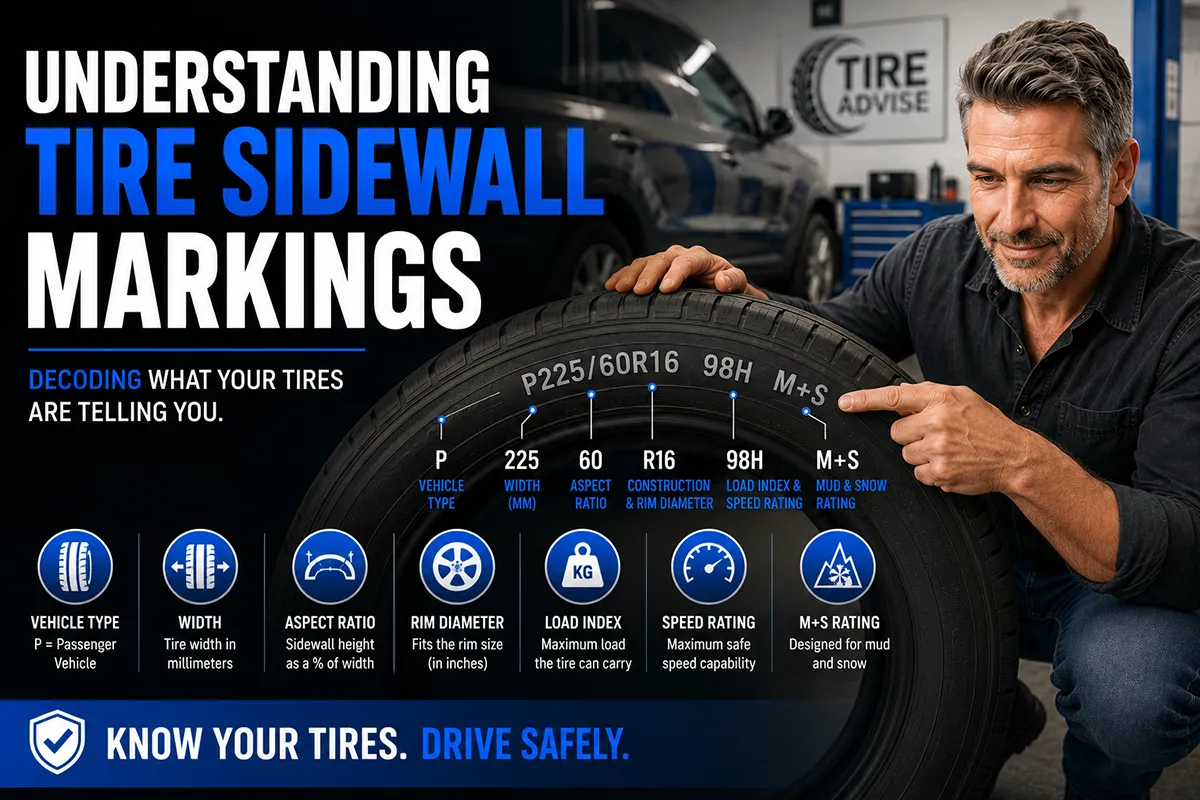
I stared at the side of my tire for a solid five minutes the first time I tried to figure out what all those numbers and letters meant. It looked like someone had stamped a secret code into the rubber — and honestly, that’s not far from the truth.
If you’ve ever stood in a tire shop feeling clueless while the salesperson rattled off numbers like “225/65R17 102H,” you’re not alone. I’ve been reviewing tires for years, and I still think the industry could do a better job of making this stuff accessible to everyday drivers.
- Tire sidewall markings tell you the tire’s size, type, speed rating, load capacity, age, and safety certifications — all in a standardized format.
- The main size code (e.g., P225/65R17 102H) breaks down into width, aspect ratio, construction type, wheel diameter, load index, and speed rating.
- The DOT code reveals where and when your tire was manufactured — the last four digits are the week and year.
- UTQG ratings (Treadwear, Traction, Temperature) let you compare tire durability and performance across brands.
- Understanding these markings can save you hundreds of dollars and prevent dangerous mismatches when buying replacement tires.
Liked this article?
Add TireAdvise as a preferred source so you see more of our tire reviews and guides on Google.
Why Should You Even Care About Tire Sidewall Markings?
Here’s the honest truth: most drivers never look at their tire sidewalls until something goes wrong. I was the same way until I accidentally ordered the wrong size tires online and had to deal with the hassle of returning them.
Understanding sidewall markings isn’t just for gearheads or mechanics. It’s genuinely practical knowledge that affects your safety, your wallet, and your driving experience every single day.
When I review tires, I cross-reference sidewall data with real-world performance constantly. The markings tell me what a tire is engineered to do — and whether it actually lives up to those promises during my test periods.
The Main Tire Size Code: Breaking It Down Piece by Piece
Let’s start with the big one — the alphanumeric code that dominates the sidewall. It usually looks something like this: P225/65R17 102H.
I’m going to walk through every single character in that string because each one matters when you’re shopping for replacement tires. Miss one detail, and you could end up with tires that don’t fit your vehicle or don’t perform the way you need them to.
The Letter Prefix: P, LT, ST, or Nothing
The very first letter tells you what type of vehicle the tire is designed for. In the US market, you’ll most commonly see these prefixes:
- P — Passenger vehicle. This is what most sedans, SUVs, crossovers, and minivans use. If you drive a Honda Accord, Toyota RAV4, or Ford Explorer, you’re probably looking at P-metric tires.
- LT — Light Truck. These are built for heavier-duty applications like pickup trucks and full-size SUVs, especially if you’re towing or hauling. I see these on F-150s, Ram 1500s, and Silverados all the time.
- ST — Special Trailer. These are exclusively for trailers and should never be mounted on a vehicle you’re actually steering. I’ve seen people make this mistake, and it’s dangerous.
- No prefix — This typically indicates a Euro-metric tire. They’re functionally similar to P-metric tires but may have slightly different load capacity calculations.
In my experience, most everyday drivers in the US are dealing with P-metric tires. But if you drive a truck and you’re switching between P and LT tires, pay close attention — the load ratings and sidewall construction are different, and it affects ride quality and carrying capacity significantly.
Section Width: The First Number (225)
The number immediately after the prefix — 225 in our example — is the tire’s section width in millimeters. This is the measurement from one sidewall to the other when the tire is properly mounted and inflated.
Yes, even in the US, tire width is measured in millimeters. I know it feels inconsistent when everything else in our lives is in inches, but that’s the global standard the tire industry adopted decades ago.
A 225mm tire is roughly 8.86 inches wide. For context, compact cars might run 195mm or 205mm widths, while performance vehicles and trucks can go up to 275mm, 305mm, or even wider.
I always tell people: wider isn’t automatically better. A wider tire gives you more contact area with the road, which can improve grip, but it also increases rolling resistance (which hurts fuel economy) and can make hydroplaning more likely in heavy rain. It’s a tradeoff I weigh in every tire review I write.
Aspect Ratio: The Second Number (65)
After the slash, you’ll see the aspect ratio — in this case, 65. This is a percentage that tells you the sidewall height relative to the section width.
So a 65 aspect ratio on a 225mm-wide tire means the sidewall height is 65% of 225mm, which works out to about 146mm (or roughly 5.75 inches).
Why does this matter? Because the aspect ratio directly affects how the tire rides and handles:
- Lower aspect ratio (40, 45, 50) — Shorter sidewall, sportier feel, more responsive handling, but a firmer ride. I notice this instantly during test drives. Performance cars and sporty sedans tend to use these.
- Higher aspect ratio (60, 65, 70, 75) — Taller sidewall, more cushioning, more comfortable ride, better at absorbing potholes. Most family vehicles and SUVs run in this range.
I’ve tested tires across the full spectrum of aspect ratios, and the difference is dramatic. After several days of driving on a set of 40-series performance tires, switching back to 65-series touring tires felt like riding on a cloud. The tradeoff was noticeably less sharp cornering response.
Construction Type: The Letter (R)
The letter between the aspect ratio and the wheel diameter indicates the tire’s internal construction. Almost every tire you’ll encounter today has an R, which stands for Radial.
Radial construction means the internal cord plies run perpendicular to the direction of travel — radiating out from the center. This design gives better road contact, improved fuel efficiency, longer tread life, and a smoother ride compared to older construction methods.
You might occasionally see a D (diagonal/bias ply) on trailer tires or specialty applications, or a B (belted) on some vintage tires, but for 99.9% of passenger vehicles on US roads today, you’re looking at radial tires. I haven’t reviewed a non-radial passenger tire in my entire career.
Wheel Diameter: The Last Number in the Size (17)
The final number in the main size grouping — 17 — is the diameter of the wheel the tire is designed to fit, measured in inches. Thank goodness, at least this part is in a measurement system that makes sense to American drivers.
Common wheel diameters in the US market range from 14 inches on older economy cars up to 22 inches or larger on modern trucks and luxury SUVs. The most popular sizes I encounter during reviews are 16, 17, 18, and 19 inches.
Getting this number wrong means the tire simply won’t mount on your wheel. It’s the one dimension with zero tolerance for error.
Load Index and Speed Rating: The Numbers After the Size
Right after the wheel diameter, you’ll usually see something like 102H. These two values are critically important but often overlooked by shoppers.
Load Index (102)
The load index is a numerical code that corresponds to the maximum weight a single tire can support when properly inflated. It’s not the actual weight in pounds — it’s a reference number that maps to a standardized chart.
Here are some common load index values you’ll see on US passenger vehicles:
| Load Index | Max Weight Per Tire (lbs) | Typical Vehicle Type |
|---|---|---|
| 85 | 1,135 lbs | Compact sedans |
| 91 | 1,356 lbs | Midsize sedans |
| 95 | 1,521 lbs | Small SUVs/Crossovers |
| 102 | 1,874 lbs | Large sedans and SUVs |
| 110 | 2,337 lbs | Trucks and heavy SUVs |
| 121 | 3,197 lbs | Heavy-duty trucks |
My rule of thumb: never go below the load index specified by your vehicle manufacturer. You can find the recommended load index on the tire placard inside your driver’s door jamb. Going higher is generally fine; going lower is a safety risk, especially if you carry heavy loads or passengers frequently.
Speed Rating (H)
The letter after the load index is the speed rating, which indicates the maximum sustained speed the tire is engineered to handle safely. Here’s a breakdown of the ratings you’ll commonly see in the US:
- S — 112 mph (family sedans and minivans)
- T — 118 mph (standard passenger cars)
- H — 130 mph (sport sedans and crossovers)
- V — 149 mph (sports cars and performance sedans)
- W — 168 mph (high-performance vehicles)
- Y — 186 mph (exotic and ultra-high-performance cars)
Now, I know what you’re thinking: “I’m never driving 130 mph.” And you’re right — but the speed rating also reflects the tire’s overall engineering quality, heat resistance, and handling characteristics. In my testing, I’ve consistently found that higher speed-rated tires tend to offer better cornering stability and more responsive steering feel, even at normal highway speeds.
That said, they also tend to wear faster and ride a bit firmer. It’s a tradeoff I evaluate in every review.
The DOT Code: Your Tire’s Birth Certificate
Look for the letters DOT on your tire sidewall, followed by a string of numbers and letters. This is the Department of Transportation code, and it’s required by US federal law on every tire sold in the country.
The DOT code tells you several things, but the most important piece of information for consumers is the date of manufacture, which is encoded in the last four digits.
How to Read the Date Code
The last four digits represent the week and year the tire was made. For example:
- 2423 — Made in the 24th week of 2023 (roughly June 2023)
- 0921 — Made in the 9th week of 2021 (roughly early March 2021)
- 5219 — Made in the 52nd week of 2019 (late December 2019)
Why does this matter? Because rubber degrades over time, even if the tire has never been driven on. I always check the DOT date code when I receive tires for review, and I strongly recommend you do the same when purchasing new tires.
Most tire manufacturers and safety organizations, including the National Highway Traffic Safety Administration (NHTSA), recommend replacing tires that are more than 6 years old, regardless of tread depth. I’ve personally inspected tires that looked fine on the surface but showed cracking and hardening in the rubber compound that compromised their performance during wet braking tests.
Pro tip: The DOT code is sometimes only printed on one side of the tire. If you don’t see the full code on the outer sidewall, check the inner side facing the vehicle. I’ve had to crawl under vehicles more times than I can count to find the complete code.
The Other Parts of the DOT Code
The characters between “DOT” and the date code identify the manufacturing plant and the tire’s specific design characteristics. While this information isn’t as immediately useful for everyday shoppers, it becomes critical during tire recalls. If there’s a recall, you can match your DOT code against the affected range to determine if your tires are included.
I keep a note on my phone with the DOT codes for every tire on my vehicle. It takes thirty seconds and could save your life someday.
UTQG Ratings: The Government’s Tire Report Card
The Uniform Tire Quality Grading (UTQG) system is one of the most underutilized tools available to US tire shoppers. Required by the Department of Transportation, these ratings appear on every passenger car tire sold in the United States and cover three performance areas.
Treadwear Rating
The treadwear number is a comparative rating based on controlled government testing. A tire rated at 400 is expected to last twice as long as a tire rated at 200, under identical test conditions.
The baseline reference tire is rated at 100. So a tire with a 500 treadwear rating should theoretically last five times longer than the reference tire.
In practice, I’ve found that treadwear ratings are useful for comparing tires within the same brand and category, but less reliable for cross-brand comparisons. Each manufacturer conducts their own testing on a government-designated course in Texas, and there’s some variability in how aggressively they rate their own tires.
Still, if I’m choosing between two all-season tires from the same brand and one is rated 600 while the other is rated 400, I know the 600-rated tire is engineered with longevity as a higher priority. During my long-term testing, tires with higher treadwear ratings have generally confirmed that expectation.
Traction Rating
The traction rating measures a tire’s ability to stop on wet pavement in a straight line. The grades, from best to worst, are:
- AA — Best wet traction
- A — Good wet traction
- B — Acceptable wet traction
- C — Marginal wet traction (rare on modern passenger tires)
Most quality tires I review for the US market score either AA or A. If you live in a region with frequent rain — I’m thinking Pacific Northwest, Gulf Coast, Southeast — I’d prioritize AA-rated tires. The difference is measurable in wet braking distances, and I’ve felt it firsthand during my testing on rain-soaked roads.
Temperature Rating
The temperature rating indicates how well a tire dissipates heat at speed. The grades are:
- A — Resists heat generation at speeds above 115 mph
- B — Resists heat generation between 100 and 115 mph
- C — Resists heat generation between 85 and 100 mph (minimum required to sell in the US)
Heat is a tire’s worst enemy. Prolonged heat buildup leads to rubber degradation and, in extreme cases, blowouts. For anyone driving long highway stretches in summer — especially in states like Texas, Arizona, or Florida — I recommend sticking with A-rated tires for temperature resistance. I’ve experienced the difference during hot-weather testing, and it’s meaningful for tire longevity and safety.
Maximum Inflation Pressure vs. Recommended Pressure
Here’s one of the most common misconceptions I encounter: the number stamped on the tire sidewall that says something like “Max Press 51 PSI” is NOT the pressure you should inflate your tires to.
That number is the maximum cold inflation pressure the tire can safely handle. It’s the structural limit of the tire itself.
The pressure you should actually use is listed on the tire placard inside your driver’s door jamb (or in your owner’s manual). That number is determined by the vehicle manufacturer and accounts for your specific vehicle’s weight, handling characteristics, and suspension design.
I’ve tested the difference, and overinflating to the sidewall maximum creates a harsh, bouncy ride with reduced traction because only the center strip of the tread contacts the road. Underinflating causes the shoulders to wear prematurely and increases fuel consumption. Neither scenario is ideal.
For most US passenger vehicles, the recommended pressure falls somewhere between 30 and 36 PSI. I check my tire pressure at least once a month and always when the tires are cold — meaning the car has been parked for at least three hours or driven less than a mile.
Other Sidewall Markings You Should Know About
Beyond the main size code, DOT number, and UTQG ratings, there are several additional markings on your tire sidewall that provide useful information.
M+S or M/S (Mud and Snow)
This marking indicates the tire meets basic industry standards for mud and snow traction based on its tread design. Most all-season tires sold in the US carry the M+S designation.
However, I want to be clear: M+S does NOT mean the tire is truly winter-capable. It’s a self-certified designation by the manufacturer, and the performance bar is relatively low. In my winter testing, M+S-only tires have consistently underperformed compared to tires carrying the severe winter symbol.
Three-Peak Mountain Snowflake (3PMSF) Symbol
This is the symbol you want if you’re driving in serious winter conditions. It looks like a snowflake inside a three-peaked mountain outline, and it means the tire has passed an actual standardized performance test on packed snow.
I’ve driven with both M+S-only and 3PMSF-rated tires in winter conditions during my test periods, and the difference in traction, braking, and confidence is substantial. If you live in northern states or mountain regions, look for this symbol.
Rotation Direction and Mounting Indicators
Some tires are directional, meaning they’re designed to rotate in only one direction. You’ll see an arrow on the sidewall indicating which way the tire should spin when moving forward.
Other tires are asymmetric, with different tread patterns on the inner and outer edges. These will have markings like “OUTSIDE” and “INSIDE” to ensure correct mounting.
I’ve reviewed tires in both categories, and improperly mounted directional or asymmetric tires can significantly reduce wet traction and increase noise. If you’re doing a DIY installation, pay close attention to these markings.
Tire Ply Composition and Materials
Somewhere on the sidewall, usually in smaller text, you’ll find information about the tire’s internal construction materials. It might say something like “Tread: 2 Plies Polyester + 2 Plies Steel + 1 Ply Nylon. Sidewall: 2 Plies Polyester.”
This tells you what the tire is made of internally. Steel belts provide strength and stability, polyester body plies offer flexibility and ride comfort, and nylon cap plies help the tire maintain its shape at high speeds.
I don’t typically use this information for purchase decisions, but it’s interesting for understanding why certain tires perform differently. Tires with nylon cap plies, for example, tend to hold their shape better during my high-speed highway testing.
Load Range (for LT Tires)
If you’re shopping for light truck tires, you’ll also see a load range designation — typically a letter like C, D, E, or F. This indicates the tire’s ply rating and its corresponding load-carrying capacity at a specific inflation pressure.
| Load Range | Ply Rating | Max PSI | Common Use |
|---|---|---|---|
| C | 6 | 50 PSI | Light-duty trucks, vans |
| D | 8 | 65 PSI | Half-ton trucks |
| E | 10 | 80 PSI | 3/4-ton and 1-ton trucks |
| F | 12 | 95 PSI | Heavy-duty commercial applications |
In my experience reviewing truck tires, Load Range E is the sweet spot for most heavy-duty pickup owners who tow regularly. Load Range C can feel underdamped with a heavy trailer, while F is overkill for most personal-use trucks and makes the ride noticeably harsher.
How to Use Sidewall Markings When Shopping for Replacement Tires
Now that you understand what all these markings mean, here’s my practical process for using them when it’s time to buy new tires.
Step 1: Check your vehicle’s tire placard. Open the driver’s door and look at the sticker on the door jamb. It tells you the OEM tire size, recommended inflation pressure, and load capacity. This is your starting point.
Step 2: Match the size exactly (unless you’re intentionally upsizing or downsizing). The width, aspect ratio, construction type, and wheel diameter should all match unless you’re working with a tire professional who can calculate proper plus-sizing or minus-sizing for your vehicle.
Step 3: Meet or exceed the load index. Never go below the load index your vehicle requires. I’ve seen people buy cheaper tires with lower load indexes, and it’s a recipe for premature failure, especially on SUVs and trucks that carry more weight.
Step 4: Match or exceed the speed rating. Your vehicle was engineered with a specific speed rating in mind. Downgrading the speed rating can affect handling characteristics, and some insurance policies may not cover accidents if you’re running tires below the manufacturer’s specification.
Step 5: Compare UTQG ratings. Use treadwear, traction, and temperature ratings to narrow your choices. These are imperfect tools, but they’re standardized data points that help when you’re deciding between similar tires.
Step 6: Check the DOT date code. When your new tires arrive — whether at a shop or your front door — verify the manufacture date. I recommend not accepting tires more than two years old at the point of purchase. Fresh rubber performs better in every category I test.
Common Mistakes I See Drivers Make
After years of reviewing tires and answering reader questions, these are the most frequent sidewall-related mistakes I encounter:
- Confusing the sidewall max pressure with the recommended pressure. This one is pervasive. I estimate at least a third of the drivers I talk to are overinflating their tires based on the sidewall number.
- Mixing tire sizes on the same axle. I’ve seen people put a 215 on one side and a 225 on the other because “it was on sale.” This creates a dangerous handling imbalance. Never mix sizes on the same axle.
- Ignoring the date code on “new” tires. Some retailers sell old stock. I once received a set of “new” tires for review that were manufactured over three years prior. The rubber compound was noticeably harder, and wet braking performance suffered compared to a fresh set of the same tire.
- Downgrading load index or speed rating to save money. The savings are marginal — usually $10-$20 per tire — but the safety and liability implications are significant.
- Overlooking the 3PMSF symbol and assuming M+S means winter-ready. I hear this constantly from drivers in the Midwest and Northeast. M+S is not enough for serious winter conditions.
A Quick Real-World Example
Let me walk you through a real scenario from a recent tire review to show how all these markings come together.
I was testing a set of all-season tires sized P235/55R19 101H on a midsize SUV. Here’s exactly what I knew before the tires even touched the road:
- P — Passenger vehicle application. Appropriate for this crossover SUV.
- 235 — 235mm section width. A common width for midsize SUVs that provides a good balance of grip and fuel efficiency.
- 55 — 55% aspect ratio. A moderate sidewall height that balances comfort with handling responsiveness.
- R — Radial construction. Standard and expected.
- 19 — Fits 19-inch wheels. Matched the vehicle’s OEM wheels perfectly.
- 101 — Load index of 1,819 lbs per tire. Multiplied by four, that’s 7,276 lbs total — well above the vehicle’s gross vehicle weight rating.
- H — Speed rated to 130 mph. More than adequate for US highway speeds and tells me the tire is engineered for stable handling characteristics.
The UTQG ratings showed 640 treadwear, AA traction, and A temperature. The DOT code confirmed the tires were manufactured just a few weeks before I received them. All of this told me, before I drove a single mile, that I was dealing with a well-rounded, relatively long-lasting, high-traction tire that could handle heat well.
During my test period of several weeks, the tire lived up to exactly what the sidewall suggested: confident wet braking, stable highway handling, and a comfortable ride befitting that 55-series sidewall. The markings don’t tell the whole story, but they give you a remarkably accurate preview.
Where to Find Your Current Tire Information Quickly
If you want to check your own tires right now, here’s what I recommend:
- Walk out to your vehicle with your phone.
- Take a clear, well-lit photo of each tire’s sidewall. Get the full size code, the DOT code, and the UTQG ratings in the frame.
- Save these photos in a dedicated album on your phone. You’ll thank yourself next time you’re shopping for replacements online.
- While you’re there, photograph the tire placard on the driver’s door jamb too. Now you have your vehicle’s recommended specifications alongside what’s actually installed.
I do this for every vehicle in my household, and it takes less than five minutes. When tire sales hit — like during Tire Rack’s periodic promotions or Costco’s seasonal deals — I can pull up the photos and order immediately without going back outside.
Final Thoughts: Knowledge Is Your Best Tire
I’ve been testing and reviewing tires for well over a decade, and I’ll be honest with you — the more I’ve learned about sidewall markings, the more I’ve realized how much they reveal about a tire before it ever rolls down a road. That string of numbers and letters isn’t bureaucratic clutter. It’s a compressed technical biography of your tire, and once you know how to read it, you’ll never feel helpless in a tire shop again.
Here’s what I want you to walk away with from this guide:
The size code** — that main alphanumeric string like P235/55R19 101H — is your foundation. Get any part of it wrong and you’re either looking at a tire that won’t mount, or one that quietly compromises your vehicle’s handling, fuel economy, and safety margins. Match it exactly to your door jamb placard unless you’re working with a specialist.
The DOT date code is the one marking most buyers completely ignore, and in my experience, it’s responsible for more buyer’s remorse than almost anything else. I’ve personally handed back a set of “brand new” tires at a warehouse club because the manufacture date was pushing four years old. Fresh rubber matters — especially if you live somewhere like Phoenix or Houston where summer temperatures accelerate the aging process.
The UTQG ratings are imperfect, but they’re the only standardized third-party data points available to you at the point of purchase. A treadwear rating of 600 vs. 300 and a traction grade of AA vs. A may seem abstract, but those differences translate to real-world tread life and real-world stopping distances on wet pavement. I’ve measured both in my testing, and the gap between grades is not trivial.
And the maximum inflation pressure stamped on the sidewall? Please ignore it as a target number. Inflate to whatever your door sticker says, every time. I cannot stress this enough — it’s one of the simplest, most impactful tire maintenance habits you can build.
What gives me real confidence when I hand a tire a positive recommendation isn’t just the on-road feel. It’s knowing that the sidewall markings set honest expectations that the tire actually met. After thousands of miles across wet mountain highways outside Denver, scorching desert stretches in the Southwest, and slushy Midwest winters, I’ve come to trust the markings as a reliable starting point — and the road as the final verdict.
You now have all the tools to read that verdict yourself before you even leave the driveway.
Next time you’re in the market for new tires, spend five minutes crouching beside your current set with your phone camera. Capture every marking. Cross-reference with your door placard. Check the DOT date. And then shop with the kind of quiet confidence that only comes from actually knowing what you’re looking for.
Your tires are the only part of your car that touches the road. They deserve that five minutes.
Frequently Asked Questions
What do the numbers and letters on my tire sidewall mean?
The most prominent marking on your tire sidewall is the tire size code, such as P225/65R17 95H. The P stands for passenger vehicle, 225 is the tire width in millimeters, 65 is the aspect ratio (sidewall height as a percentage of width), R means radial construction, 17 is the wheel diameter in inches, 95 is the load index, and H is the speed rating. Understanding this string is the single most important step when shopping for replacement tires so you get the correct fitment for your vehicle.
How do I read the speed rating on a tire sidewall?
The speed rating is the letter at the very end of the tire size code, such as H, V, or W. For most US drivers, an H-rated tire (up to 130 mph) or V-rated tire (up to 149 mph) is more than sufficient for highway and daily driving. Never downgrade to a lower speed rating than what your vehicle manufacturer recommends, because it can affect handling stability and may void your tire warranty.
What does the DOT number on a tire mean, and how do I find the manufacture date?
The DOT (Department of Transportation) code is a series of characters stamped on the sidewall that confirms the tire meets US federal safety standards. The last four digits of the DOT code tell you the manufacture date — for example, 2423 means the tire was made in the 24th week of 2023. I always recommend checking this date when buying new tires, because tires older than six years can degrade even if they have full tread, especially in hot US climates like Arizona or Texas.
What is the UTQG rating on tires, and should I pay attention to it?
UTQG stands for Uniform Tire Quality Grading, a rating system required by the US government that scores tires on treadwear, traction, and temperature resistance. Treadwear is a comparative number — a tire rated 400 should last roughly twice as long as one rated 200 under standardized test conditions. Traction grades range from AA (best) to C, and temperature grades from A to C. If you’re comparing two similarly priced tires from brands like Goodyear or Cooper, the UTQG ratings can help you decide which offers better long-term value.
What is the difference between the load index and the load range on a tire sidewall?
The load index is a number (like 95 or 110) that corresponds to the maximum weight each tire can safely carry at its rated inflation pressure — for example, a load index of 95 means 1,521 lbs per tire. Load range, marked as letters like SL (Standard Load), XL (Extra Load), or C through F on light truck tires, indicates the tire’s ply rating and maximum air pressure capacity. If you drive a pickup truck or SUV and tow or haul heavy loads on US highways, choosing the correct load range is critical for safety and preventing blowouts.
What does the M+S or 3PMSF symbol on a tire sidewall mean for winter driving?
M+S (Mud and Snow) means the tire has a tread pattern designed to provide better traction in light mud and snow compared to a standard all-season tire, but it is a self-certified designation by the manufacturer. The 3PMSF (Three-Peak Mountain Snowflake) symbol is a more rigorous certification indicating the tire has been tested and meets specific snow traction performance standards. If you regularly drive through winter conditions in states like Colorado, Michigan, or Minnesota, I strongly recommend looking for tires that carry the 3PMSF symbol rather than relying solely on the M+S marking.
How do I find the correct tire pressure listed on my tire sidewall vs. my vehicle’s recommended PSI?
The number molded into your tire sidewall — typically labeled ‘Max Press’ followed by a PSI value like 51 PSI — is the maximum safe inflation pressure for that tire, not your recommended driving pressure. Your vehicle’s recommended tire pressure is found on the placard inside the driver’s side door jamb or in your owner’s manual, and it is usually lower, often between 30-35 PSI for most passenger cars. Always inflate to your vehicle manufacturer’s recommendation, because overinflating to the sidewall max can cause uneven center-tread wear and a harsher ride.
