

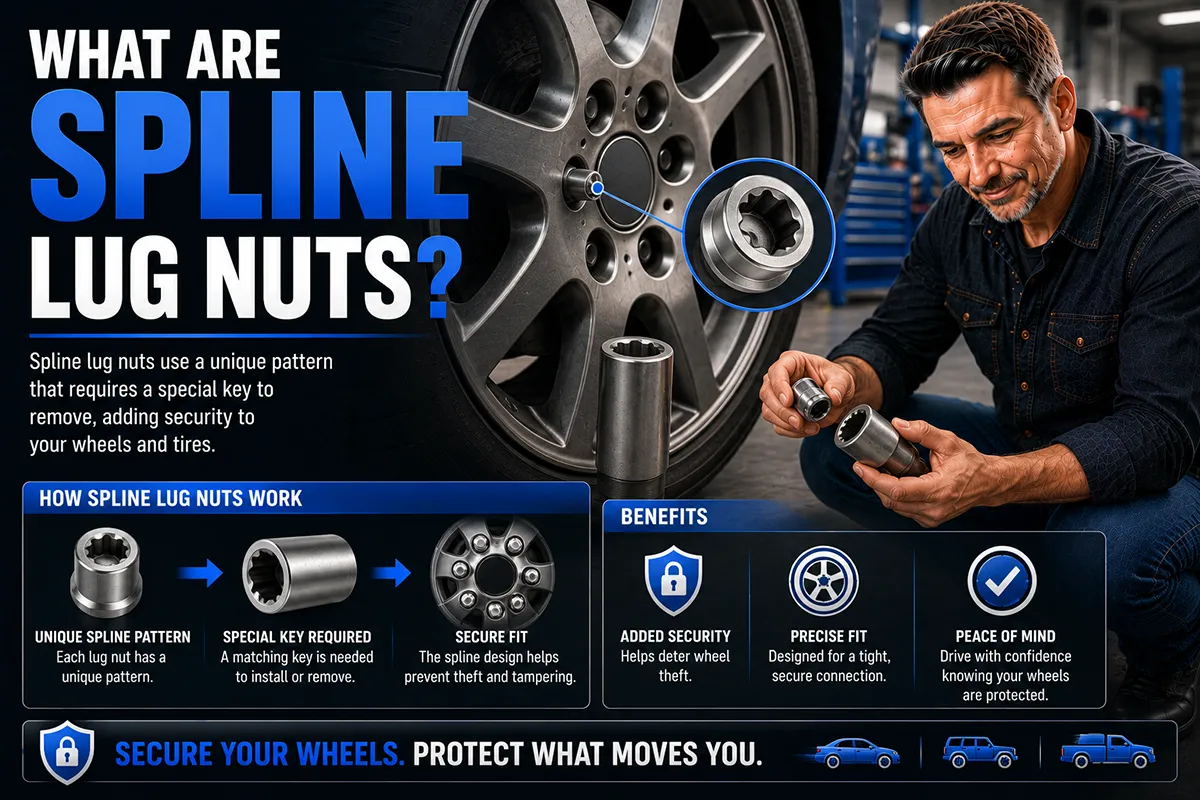
I was halfway through a wheel swap in my garage last summer when I grabbed the wrong socket and realized the lug nuts on my buddy’s aftermarket wheels looked completely different from anything I’d used before. They were slim, had tiny grooves cut into them, and required a special tool I didn’t have in my toolbox.
That was my introduction to spline lug nuts — and honestly, it’s a moment a lot of us run into when we upgrade our wheels or buy a new set of tires.
If you’ve ever stared at a wall of lug nuts at AutoZone or scrolled through Amazon wondering what the difference is between hex, conical, and spline styles, this guide is for you. I’ve spent years working on my own vehicles and helping friends install aftermarket wheels, and I’m going to break down everything you need to know about spline lug nuts in plain English.
- Spline lug nuts have a narrow, cylindrical profile with external grooves (splines) instead of a standard hex shape.
- They require a special spline drive socket or key for installation and removal.
- They’re popular with aftermarket wheels because they fit narrow lug holes and look cleaner.
- They offer mild theft deterrence since standard sockets won’t work on them.
- Prices typically range from $25 to $80 for a full set in the US market.
- Always keep the spline key in your vehicle — without it, roadside tire changes become a nightmare.
Liked this article?
Add TireAdvise as a preferred source so you see more of our tire reviews and guides on Google.
What Exactly Are Spline Lug Nuts?
Spline lug nuts are a specialized type of wheel fastener that uses a series of small, evenly spaced grooves — called splines — cut around the outside of the nut instead of a traditional six-sided (hex) head. They’re designed to be installed and removed with a matching spline drive socket or key, rather than a standard lug wrench.
Think of the difference like this: a regular hex lug nut has six flat sides, just like a bolt you’d find on almost anything. A spline lug nut has dozens of tiny ridges running vertically along its surface, creating a pattern that only a specifically shaped tool can grip.
The result is a sleeker, more compact nut that sits flush or nearly flush with the wheel surface. This is why they’ve become incredibly popular in the aftermarket wheel community — they solve a real fitment problem while also looking great.
The Anatomy of a Spline Lug Nut
Let me walk you through the key parts of a spline lug nut so you understand what you’re looking at when you shop for them.
The **body** is the main cylindrical portion. Unlike hex nuts, spline nut bodies are typically round when viewed from above, with the spline grooves cut into the exterior surface.
The **seat** is the bottom portion that makes contact with the wheel. This is critical — spline lug nuts come in conical (tapered/acorn), flat, and ball seat designs, just like standard lug nuts. You must match the seat type to your specific wheel.
The **thread** is the interior portion that screws onto the wheel stud. Common US thread sizes include M12x1.5 and M12x1.25, though trucks often use M14x1.5 or M14x2.0.
Finally, there’s the **spline pattern** itself. Most aftermarket spline lug nuts use a standardized pattern, but some brands use proprietary designs. This matters because it determines which key tool will work.
How Are Spline Lug Nuts Different from Regular Lug Nuts?
I get this question all the time, and the comparison is actually straightforward. Here’s a side-by-side breakdown of the most common lug nut types you’ll encounter in the US market.
| Feature | Standard Hex Lug Nut | Spline Drive Lug Nut | Locking Lug Nut |
|---|---|---|---|
| Shape | Six-sided hex head | Cylindrical with external splines | Varies — unique pattern per set |
| Tool Required | Standard lug wrench or socket | Spline drive socket/key | Unique key specific to the set |
| Profile Size | Larger — wider head | Smaller — narrow, compact | Similar to hex, varies |
| Theft Deterrence | None | Moderate | High |
| Aftermarket Wheel Compatibility | May not fit narrow lug holes | Designed for narrow lug holes | Varies by brand |
| Typical US Price (set of 20) | $15 – $40 | $25 – $80 | $30 – $60 (set of 4 locks) |
| Aesthetic Appeal | Basic, utilitarian | Clean, low-profile look | One per wheel, mixed look |
The biggest practical difference, in my experience, is size. Spline lug nuts have a significantly smaller outer diameter than hex nuts. This is the number one reason people buy them — their aftermarket wheels have narrow lug nut holes that simply won’t accommodate a bulky hex nut and a socket around it.
Why Do People Use Spline Lug Nuts?
In my years of helping friends and family install aftermarket wheels, I’ve seen four primary reasons people switch to spline lug nuts. Let me walk through each one.
1. Aftermarket Wheel Fitment
This is the big one. Many aftermarket wheel brands — Enkei, Konig, XXR, Motegi Racing, and others popular in the US — design their wheels with smaller lug nut holes to maximize spoke surface area and achieve certain aesthetic designs.
When you try to fit a standard hex lug nut into these holes, you’ll find the socket physically can’t reach the nut because the hole is too narrow. I’ve seen this frustrate people at tire shops more times than I can count.
Spline lug nuts solve this problem entirely. Their slim profile slips right into narrow lug holes, and the thin-walled spline socket fits in after them with room to spare.
2. Cleaner Aesthetic
Let’s be honest — looks matter when you’re investing in a nice set of wheels. Spline lug nuts sit lower and more evenly in the wheel surface compared to hex nuts.
They’re available in a wide range of finishes — black, chrome, gunmetal, blue, red, neon, and even titanium. When all twenty lug nuts match and sit flush, the overall wheel presentation goes up a notch.
I personally run black spline lugs on my daily driver’s aftermarket wheels, and the difference compared to the chunky chrome hex nuts I had before is night and day.
3. Mild Theft Deterrence
I want to be upfront here: spline lug nuts are not true locking lug nuts. A determined thief with access to a universal spline socket — which you can buy for about $8 at any auto parts store — can remove them.
However, they do provide a basic level of deterrence against opportunistic theft. Your average person walking by with a standard lug wrench in their trunk cannot remove spline lug nuts. That small barrier is enough to make some thieves move on to easier targets.
If you’re serious about wheel security, I recommend combining spline lug nuts with one or two true wheel locks per wheel. That layered approach has served me well.
4. Weight Reduction (Minimal)
Some spline lug nuts, particularly those made from 7075-T6 aluminum, are lighter than steel hex nuts. The weight savings per nut is small — we’re talking fractions of an ounce — but across all twenty lugs, it can add up to a slight reduction in unsprung weight.
I’ll be honest, though: unless you’re tracking your car, this benefit is largely theoretical for everyday driving. I wouldn’t buy spline lug nuts for weight savings alone.
The Spline Drive Key: Your Most Important Tool
Here’s the thing about spline lug nuts that trips people up more than anything else — you absolutely, positively need the spline drive key to install or remove them. Lose the key, and you’re stuck.
The spline drive key (or spline socket) is a thin-walled socket with internal grooves that match the external splines on the lug nut. Most aftermarket spline lug nut sets come with one key included. Some sets include two, which is nice.
My #1 Tip: Buy a Backup Key
In my experience, the number one complaint people have about spline lug nuts isn’t the nuts themselves — it’s losing the key. I’ve personally been in a situation where a friend had a flat tire on the side of I-95 and couldn’t change it because the spline key was sitting on his workbench at home.
Here’s what I recommend:
- Keep one spline key in your vehicle’s glove box or tire tool kit at all times.
- Buy a second key and keep it in your garage.
- If you frequently visit a tire shop, let them know you have spline lugs so they can have the right tool ready.
Replacement spline keys are cheap — usually $5 to $12 on Amazon or at AutoZone. There’s no excuse not to have a spare.
Will a Tire Shop Have the Right Tool?
Most reputable tire shops, including Discount Tire, Tire Rack’s recommended installers, Costco Tire Center, and major chains like Firestone and Pep Boys, have universal spline drive sockets in their toolkits. However, I’ve run into smaller independent shops that didn’t have one on hand.
My recommendation is simple: whenever you go for a tire rotation, flat repair, or tire replacement, bring your spline key with you. Hand it directly to the technician. Don’t assume they have one — it saves everybody time and prevents potential damage to your lug nuts.
How to Choose the Right Spline Lug Nuts for Your Vehicle
Buying spline lug nuts isn’t as simple as grabbing any set off the shelf. There are several specifications you need to match to your vehicle and wheels. I’ve seen people make costly mistakes here, so let me walk you through it step by step.
Step 1: Determine Your Thread Size
Your wheel studs have a specific thread diameter and pitch. Using the wrong thread size will either not thread on at all or — worse — cross-thread and damage the stud. Here are the most common thread sizes for US vehicles:
- M12x1.5 — Honda, Toyota, Lexus, Mazda, Ford (many models), Chevrolet (many models), Hyundai, Kia
- M12x1.25 — Nissan, Infiniti, Subaru, some older Mitsubishi models
- M14x1.5 — Many newer Ford trucks/SUVs, GM trucks, Ram 1500, Dodge Challenger/Charger, some VW/Audi
- M14x2.0 — Ford F-150 (certain years), some GM heavy-duty applications
Check your owner’s manual or look up your specific vehicle on a lug nut fitment guide. Sites like Discount Tire and Tire Rack often have this information in their wheel accessory sections.
Step 2: Match the Seat Type
This is where I see the most mistakes. The seat type must match the shape of the lug nut hole in your wheel. There are three common types:
- Conical (tapered/acorn) seat — The most common type for aftermarket wheels. The nut has a 60-degree tapered end that wedges into a matching conical hole in the wheel.
- Ball (radius) seat — Common on European vehicles, especially BMW, Mercedes, and Audi using OEM wheels. The seat is rounded.
- Flat (mag) seat — Has a flat washer-like surface. Common on some Toyota and Lexus OEM wheels and certain aftermarket applications.
Using a conical nut on a flat-seat wheel — or any other mismatch — is dangerous. The nut won’t seat properly, and the wheel can loosen while driving. I cannot stress this enough: always verify your seat type before purchasing.
Step 3: Check the Overall Length
Spline lug nuts come in different lengths, and this matters more than you might think. If the nut is too short, it won’t engage enough threads on the stud, creating a safety hazard. If it’s too long, it could bottom out or interfere with your brake components or wheel hub.
A general rule I follow: you want a minimum of six to eight full thread engagements between the stud and the nut. Most lug nut manufacturers specify the ideal stud length range for their product.
If you’re running wheel spacers, you may need extended wheel studs paired with longer spline lug nuts. This is a common setup I’ve seen on Subarus and Hondas with aggressive wheel fitments.
Step 4: Choose Your Material
Spline lug nuts are typically available in two materials:
- Steel (often chrome-plated or black-coated) — The go-to choice for most drivers. Steel is strong, durable, and affordable. Chrome plating can corrode over time in harsh climates (I’ve seen this firsthand in northeastern US winters), but black oxide or DLC-coated steel nuts hold up much better.
- Aluminum (typically 7075-T6) — Lighter and available in vibrant anodized colors. However, aluminum lug nuts are softer than steel and can strip more easily if over-torqued. I generally don’t recommend them for daily drivers — they’re better suited for show cars or weekend track toys.
For most US drivers, I recommend steel spline lug nuts with a quality coating. They’ll handle road salt, heat cycles, and repeated removals without issue.
Step 5: Open-End vs. Closed-End
Open-end spline lug nuts have a hollow center — you can see through them. Closed-end nuts have a solid cap on top.
Closed-end nuts look cleaner and protect the stud from moisture and road grime. I prefer them for this reason. However, if your studs are particularly long (common on some trucks), you may need open-end nuts to accommodate the extra stud length.
How to Properly Install Spline Lug Nuts
I’ve installed dozens of sets of spline lug nuts over the years, and the process is straightforward if you follow these steps. Here’s my recommended approach.
What You’ll Need
- Your spline lug nut set with the included spline drive key
- A torque wrench (½” drive recommended)
- A jack and jack stands (or a lift if you have access)
- A small amount of anti-seize compound (optional but recommended)
- A wire brush for cleaning wheel studs
Installation Steps
1. Safely lift and support the vehicle. Never work under a car supported only by a jack. Use jack stands.
2. Remove the old lug nuts and wheels. If you’re doing a wheel swap, set the old hardware aside.
3. Clean the wheel studs. Use a wire brush to remove any rust, corrosion, or debris from the studs. This ensures smooth thread engagement with the new spline lug nuts.
4. Apply a thin layer of anti-seize to the stud threads (optional). I do this on all my vehicles. It makes future removal much easier, especially in salt-belt states. Some manufacturers advise against anti-seize because it can affect torque readings — if you use it, reduce your torque value by about 10% or follow the specific product instructions.
5. Mount the wheel and hand-thread the spline lug nuts. Start each nut by hand to ensure it threads on straight. If you feel resistance, stop and realign. Cross-threading a lug nut is a costly mistake.
6. Snug the nuts in a star (criss-cross) pattern. Using the spline key and a ratchet, snug each nut following a star pattern to ensure the wheel seats evenly against the hub.
7. Lower the vehicle and torque to spec. With the tires on the ground, use your torque wrench with the spline key to bring each nut to the manufacturer’s recommended torque specification. For most passenger cars, this is typically between 80 and 100 ft-lbs. Trucks are often higher, around 120 to 140 ft-lbs. Always check your specific vehicle’s specification.
8. Re-torque after driving. I always re-check my lug nut torque after a few days of driving. This is good practice regardless of what type of lug nuts you use, but it’s especially important with a new set.
Common Mistakes to Avoid with Spline Lug Nuts
Over the years, I’ve seen — and occasionally made — several mistakes with spline lug nuts. Here are the most common ones so you can avoid them.
Using an Impact Gun Without Care
Impact guns are fast and convenient, but they can easily over-torque spline lug nuts, especially aluminum ones. If you use an impact, set it to a low torque setting and always finish with a hand torque wrench to the correct spec.
I’ve seen stripped spline lug nuts at tire shops because a technician hit them with a full-blast impact gun. It’s not pretty, and it’s expensive to fix.
Forgetting the Key at Home
I already mentioned this, but it bears repeating. If you have a flat tire on the highway and your spline key is in your garage, you’re calling a tow truck. Keep a key in the car. Always.
Mixing Seat Types
I once helped a friend who had installed conical spline lug nuts on a set of wheels that required a flat seat. The wheels looked fine at first glance, but after a few days of driving, the car developed a shimmy. When we pulled the wheels off, the lug nuts hadn’t been seating properly, and the wheels had been shifting microscopically on the hub. It was a safety disaster waiting to happen.
Not Accounting for Stud Length
If you switch from a shorter OEM lug nut to a longer spline lug nut, make sure there’s enough thread engagement and that the nut doesn’t bottom out on the stud. Conversely, if your studs are long and you use a closed-end nut that’s too short, the stud will hit the inside cap before the nut seats properly.
Popular Spline Lug Nut Brands in the US Market
I’ve used products from several brands over the years. Here are the ones I trust and recommend to friends.
Gorilla Automotive
Gorilla is probably the most well-known lug nut brand in the US. Their spline lug nut sets are widely available at AutoZone, O’Reilly, and Amazon. They offer both steel and aluminum options in a variety of finishes. I’ve used their small-diameter spline lug nuts on two different vehicles, and they’ve held up well over time. A set of 20 with a key typically runs $35 to $55.
Muteki / WORK
Muteki is popular in the enthusiast community. Their open-end spline lug nuts come in eye-catching anodized colors and are made from forged aluminum. They look fantastic, but I’d reserve them for cars that aren’t daily-driven in harsh conditions. Expect to pay $50 to $80 for a set.
McGard
McGard is the gold standard for wheel security products. While they’re better known for their locking lug nuts, they also make spline drive sets. McGard products are used by several OEMs, which speaks to their quality. They’re on the pricier side, but you’re paying for precision engineering.
DPAccessories
This is a great budget-friendly option I’ve recommended to several people. DPAccessories sells on Amazon and offers steel spline lug nut sets with a key for under $30. For everyday driving, they get the job done. I installed a set on my neighbor’s Honda Civic, and after several months, they still look good and torque correctly.
Wheel Accessories Parts Set (WAPS)
Another solid mid-range brand available through Amazon and eBay. They offer a wide range of thread sizes and seat types, which makes them a good option if you have a less common fitment.
Spline Lug Nuts vs. Wheel Locks: Do You Need Both?
This is a question I get asked a lot, and my answer is: it depends on where you live and what wheels you’re running.
Spline lug nuts provide a baseline level of inconvenience for would-be thieves. But as I mentioned earlier, universal spline drive sockets are cheap and widely available. A knowledgeable thief won’t be stopped by spline lugs alone.
True wheel locks, like those from McGard or Gorilla, use a unique, randomized key pattern. Each set comes with a one-of-a-kind key, making it significantly harder to remove without the matching tool.
If you’re running expensive aftermarket wheels in an urban area, I strongly recommend using a combo approach: spline lug nuts for the majority of your lugs (four per wheel) and one wheel lock per wheel. This gives you the fitment benefits of spline lugs plus genuine security from the lock.
In lower-risk areas — suburban neighborhoods, gated communities — spline lug nuts alone are usually sufficient in my experience.
Can You Use Spline Lug Nuts on OEM Wheels?
Technically, yes — as long as the thread size and seat type match. However, there’s usually no practical reason to do so.
OEM wheels are designed with lug holes large enough for standard hex lug nuts. Swapping to spline lugs on OEM wheels is purely cosmetic. It won’t hurt anything if the specs match, but you’re adding the inconvenience of needing a special key without solving any real fitment problem.
That said, I have seen people use spline lug nuts on OEM wheels for the mild theft-deterrent factor, and that’s a valid reason if it gives you peace of mind.
What Happens If You Lose Your Spline Key?
Real talk — this happens. And when it does, here’s what your options look like.
Option 1: Buy a replacement key. Most spline lug nut brands use a standard spline pattern. A universal spline drive socket from Gorilla or another brand will likely fit. Check your local AutoZone, O’Reilly, or order one on Amazon. They’re usually under $15 and ship within a day or two with Prime.
Option 2: Visit a tire shop. As I mentioned, most professional shops have universal spline tools. They can remove your lug nuts and either sell you a replacement key or swap you over to hex lug nuts if you’re fed up with the spline setup.
Option 3: Use an extractor socket. In a worst-case scenario, a bolt extractor socket (the kind designed for rounded-off bolts) can grip the splines tightly enough to remove them. I’ve done this once — it works, but it can damage the lug nut in the process.
The bottom line: losing your key is inconvenient but not catastrophic. Still, save yourself the headache and keep a backup handy.
Final Thoughts: Are Spline Lug Nuts Worth It?
After years of using spline lug nuts on multiple vehicles, here’s my honest take.
If you’re running aftermarket wheels with narrow lug holes, spline lug nuts aren’t just a nice-to-have — they’re often a necessity. Standard hex nuts simply won’t fit, and trying to force them or use a thin-wall socket that barely clears the hole is asking for problems.
Even if fitment isn’t an issue, spline lug nuts offer a cleaner look and a small security upgrade over standard hex nuts. For $30 to $60, that’s a worthwhile investment when you’ve already spent hundreds or thousands on a nice set of wheels and tires.
The only real downside is the special key requirement. But as long as you keep one in the car and one in the garage, it’s a non-issue. I’ve been doing it this way for years without a single problem.
If you’re shopping for new tires and wheels and the wheel manufacturer recommends spline lug nuts, don’t overthink it — just get a quality set from a trusted brand, match your specs carefully, and torque them properly. Your wheels will look better, fit right, and stay secure for the long haul.
Frequently Asked Questions
What are spline lug nuts and how are they different from standard lug nuts?
Spline lug nuts are a type of wheel fastener that features a thin, multi-splined external pattern instead of the traditional hex shape found on standard lug nuts. They require a special spline lug nut key or socket for installation and removal, which makes them more compact and slightly more secure against theft. I recommend them if you’re running aftermarket wheels with smaller lug nut holes, since their narrow profile fits where bulky hex nuts won’t.
Do I need a special tool to remove spline lug nuts?
Yes, spline lug nuts require a dedicated spline drive key or socket that matches the specific spline pattern on the nut. Most spline lug nut sets sold in the US come with the matching key included, but if you lose it, replacements typically cost between $8 and $20 at auto parts stores like AutoZone or O’Reilly. I always keep a spare key in my glove box because without it, even a roadside tire change becomes impossible.
Are spline lug nuts better than regular lug nuts for theft prevention?
Spline lug nuts offer a moderate level of theft deterrence because they can’t be removed with a standard socket wrench, but they’re not true locking lug nuts. Since spline keys are widely available and many patterns are universal, a determined thief can still remove them. If wheel theft is a real concern in your area, I’d suggest using a set of spline lug nuts combined with at least one dedicated wheel lock per wheel for better protection.
Will spline lug nuts fit my aftermarket wheels?
Spline lug nuts are specifically designed to work with aftermarket wheels that have narrow or recessed lug nut seats where standard hex nuts won’t fit. Before buying, you need to verify the thread pitch (such as M12x1.5 or M12x1.25), seat type (conical or ball), and the overall length to make sure they’re compatible with your vehicle and wheel combination. Most US retailers like Discount Tire or Tire Rack list fitment details by vehicle make and model to make this easier.
How much do spline lug nuts cost and where can I buy them in the US?
A full set of 20 spline lug nuts with a key typically costs between $25 and $80 depending on the material and brand, with popular options from Gorilla Automotive, McGard, and Muteki. You can find them at major US auto parts retailers like AutoZone, Advance Auto Parts, and Amazon, or through wheel and tire shops like Discount Tire. I’d avoid the cheapest no-name sets since low-quality materials can corrode quickly, especially if you drive in states that use road salt during winter.
Can I torque spline lug nuts the same as regular lug nuts?
Yes, spline lug nuts should be torqued to your vehicle manufacturer’s specified lug nut torque rating, which is typically between 80 and 100 ft-lbs for most passenger cars and up to 140 ft-lbs for trucks and SUVs. The only difference is that you’ll use the spline key adapter between your torque wrench and the lug nut. I always recommend re-torquing after the first 50 to 100 miles of driving on newly installed wheels to ensure everything stays properly seated.
Do spline lug nuts rust or seize over time in harsh US weather?
Spline lug nuts can rust and seize just like any other lug nut, especially if you drive in northern US states where road salt and moisture are constant during winter. Chrome-plated spline nuts tend to swell and flake over time, so I recommend going with black chrome, stainless steel, or cold-forged steel options for better long-term durability. Applying a thin coat of anti-seize compound to the threads during installation helps prevent them from seizing to the wheel studs.
