

I was cruising down I-95 in heavy traffic when I heard that unmistakable flapping sound — a flat tire, right in the middle lane, with no shoulder in sight for at least half a mile.
That experience shook me. And it’s exactly the kind of scenario that makes run flat tires so appealing to millions of American drivers.
But after spending years testing tires across every major category, I can tell you that run flat technology isn’t a simple “better or worse” story. It’s a trade-off, and whether it’s worth it depends entirely on how you drive, where you live, and what you prioritize behind the wheel.
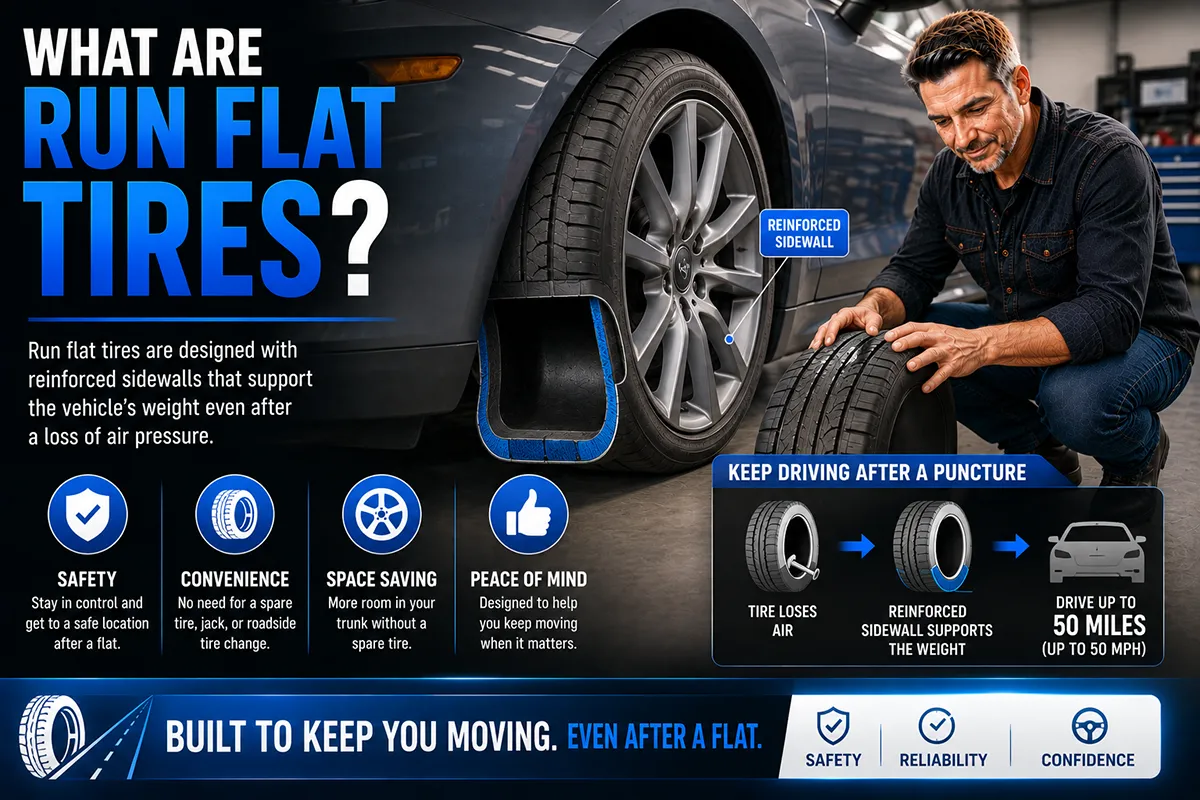
- Run flat tires have reinforced sidewalls that support the vehicle even after a complete loss of air pressure.
- Most run flats allow you to drive approximately 50 miles at up to 50 mph after a puncture — enough to reach a tire shop safely.
- They eliminate the need to carry a spare tire, saving trunk space and reducing vehicle weight.
- Trade-offs include a firmer ride, higher replacement cost (typically $30–$80 more per tire), and limited availability in some sizes.
- Run flats are best suited for city and suburban drivers who prioritize safety and convenience over ride comfort.
- They require a Tire Pressure Monitoring System (TPMS) since you often can’t feel when air is lost.
Liked this article?
Add TireAdvise as a preferred source so you see more of our tire reviews and guides on Google.
What Exactly Are Run Flat Tires?
Run flat tires are engineered to keep functioning after a puncture or complete loss of air pressure. Unlike conventional tires that go limp and deform immediately when they lose air, run flats are designed with reinforced internal structures — most commonly thickened, heat-resistant sidewalls — that physically support the weight of your vehicle even when the tire is completely deflated.
In my experience, the simplest way to think about it is this: a run flat tire is a regular tire with a built-in safety net. When air escapes, the reinforced sidewall steps in as a temporary load-bearing structure, allowing you to keep driving at reduced speed until you can get to a service station.
The concept has been around since the 1980s, but it really entered the mainstream when BMW started equipping many of its vehicles with run flat tires as standard equipment in the early 2000s. Today, you’ll find them as original equipment on vehicles from BMW, MINI, Mercedes-Benz, Lexus, and several other brands sold across the US market.
How Do Run Flat Tires Work? The Technology Explained
There are three primary types of run flat tire technology, though the first one dominates the consumer market by a wide margin. I’ve had the chance to work with all three, and understanding the differences helps you know what you’re buying.
1. Self-Supporting Run Flat Tires (Most Common)
This is the type you’ll encounter in almost every tire shop in America. Self-supporting run flats use reinforced sidewall rubber that’s significantly thicker and stiffer than a conventional tire’s sidewall. When I’ve held a standard tire and a run flat side by side, the weight difference is immediately noticeable — and that extra mass comes from the dense rubber compound packed into the sidewall.
When the tire loses pressure, these rigid sidewalls prevent the tire from collapsing. The vehicle’s weight is temporarily supported by the sidewall structure itself rather than by air pressure. It’s an elegant solution, though it comes with consequences I’ll discuss later.
2. Self-Sealing Run Flat Tires
Self-sealing tires take a different approach. Instead of reinforced sidewalls, these tires have a layer of sealant material lining the inside of the tread area. When a nail or screw punctures the tread, the sealant automatically flows into the hole and plugs it before significant air loss occurs.
I’ve tested self-sealing tires from Continental and Michelin, and they work surprisingly well for small tread punctures. However, they won’t help with sidewall damage or large gashes, which limits their usefulness compared to self-supporting designs.
3. Auxiliary-Supported (Support Ring) Systems
This type uses a hard rubber or metal ring attached to the wheel that supports the tire if it deflates. It’s primarily found in military and specialty vehicles, and I don’t recommend spending any time thinking about this option for a standard passenger car — you won’t encounter it at your local Discount Tire or Tire Rack order.
What Happens When a Run Flat Tire Goes Flat?
This is where real-world experience matters, because the textbook explanation and the actual driving sensation are two different things.
During one of my test periods, I deliberately drove on a run flat tire that had been depressurized (in a controlled setting, of course) to understand exactly what the driver experiences. Here’s what I noticed:
- The transition was subtle. Unlike a conventional tire blowout, which is dramatic and often terrifying, losing air in a run flat felt more like a gentle shift in handling. The steering got slightly heavier, and the car pulled very mildly to the affected side.
- The TPMS warning was the real alert. Honestly, without the Tire Pressure Monitoring System light on the dashboard, I might not have noticed the pressure loss for several minutes. This is exactly why a functioning TPMS is absolutely mandatory with run flat tires.
- Driving felt stable but different. At the recommended reduced speed (50 mph or below), the car remained composed and predictable. It didn’t feel dangerous, but it definitely didn’t feel normal either.
- The 50-mile range felt adequate. Most run flat manufacturers specify approximately 50 miles of extended mobility at up to 50 mph. In urban and suburban areas across the US, that’s almost always enough to reach a tire service location.
Run Flat Tires vs. Regular Tires: A Complete Comparison
I’ve driven on both run flats and conventional tires across dozens of vehicles over the years, and the differences are real and measurable. Here’s how they compare across every factor that matters to you as a driver.
| Factor | Run Flat Tires | Conventional Tires |
|---|---|---|
| Safety After Puncture | Can drive ~50 miles at 50 mph | Must stop immediately; spare or roadside assistance needed |
| Ride Comfort | Firmer, less forgiving over bumps | Generally smoother and more compliant |
| Price Per Tire | $150–$350+ (varies by size and brand) | $100–$250+ (wider range available) |
| Weight | Heavier (reinforced sidewalls add mass) | Lighter |
| Spare Tire Needed? | No — saves trunk space | Yes — full-size or compact spare recommended |
| Tread Life | Comparable to standard tires; varies by model | Comparable; wider selection of long-lasting options |
| Road Noise | Slightly louder in many models | Quieter options widely available |
| Repairability | Limited — many shops won’t repair them | Can be patched/plugged for tread punctures |
| Availability | Fewer options; some sizes are limited | Vast selection in almost every size |
| TPMS Required? | Absolutely mandatory | Required by law since 2007, but less critical for detecting flats |
The Real Advantages of Run Flat Tires
Let me walk through the benefits I’ve personally experienced and why they genuinely matter for certain drivers.
You Never Have to Change a Tire on the Side of the Road
This is the number one advantage, and I don’t think it can be overstated. Changing a tire on a busy highway shoulder is one of the most dangerous things an average driver does. According to the AAA, approximately 100,000 roadside tire changes happen every year in the US, and being struck by a passing vehicle is a real risk.
With run flat tires, you simply keep driving — carefully, at reduced speed — until you reach safety. For drivers who frequently travel on busy interstates, especially in areas like the Northeast Corridor, the LA freeway system, or the Dallas–Fort Worth metroplex, this alone can justify the extra cost.
No Spare Tire Means More Cargo Space
I was genuinely surprised by how much space a spare tire and jack take up when I compared the trunk of a BMW 3 Series (which comes with run flats and no spare) to a similar sedan that carries a full-size spare. The difference is significant, especially for compact vehicles and SUVs where every cubic foot of cargo space matters.
Automakers also save weight by eliminating the spare, which can marginally improve fuel efficiency. It’s not a dramatic difference, but it’s a legitimate engineering benefit.
Peace of Mind in Bad Conditions
During a test period in the winter, I drove on run flats through areas of Pennsylvania where road conditions were particularly rough — potholes, construction zones, and debris-strewn shoulders. Knowing that a puncture wouldn’t leave me stranded in freezing weather added a genuine layer of confidence.
This benefit extends to anyone who drives late at night, in isolated rural areas, or in neighborhoods where stopping might not feel safe.
The Real Disadvantages of Run Flat Tires
I believe in being completely transparent about limitations, because the tire industry has a tendency to oversell technology. Here’s what I don’t love about run flats.
The Ride Quality Penalty Is Real
This is the complaint I hear most often, and I completely agree with it. The reinforced sidewalls that make run flat technology possible also make the tire significantly stiffer than a comparable conventional tire. Over several days of back-to-back testing — driving the same routes with run flats and then with standard all-season tires — the difference was unmistakable.
Bumps, expansion joints, and rough pavement surfaces all felt more pronounced with run flats. On smooth highways, the difference faded. But on the kind of beat-up secondary roads that are common across much of the US, the ride quality downgrade was noticeable and, for some passengers, uncomfortable.
They Cost More — And You’ll Likely Replace Them More Often
Run flat tires typically cost $30 to $80 more per tire than their conventional counterparts in the same size. For a set of four, you’re looking at an extra $120 to $320. That’s not insignificant, especially when many drivers need to replace their tires on a budget.
Additionally, in my experience, some run flat models don’t wear quite as evenly as their conventional siblings. The stiffer sidewall changes how the tire interacts with the road surface, and I’ve seen cases where the inner or outer edges of the tread wore faster than expected. Regular rotation and alignment checks are essential.
Repairs Are Complicated — Or Impossible
Here’s a frustration I’ve encountered firsthand: many tire shops in the US will refuse to repair a run flat tire, even for a simple nail puncture in the tread area. The reasoning is that once a run flat has been driven on at zero pressure, the internal sidewall structure may be compromised in ways that aren’t visible from the outside.
Some manufacturers, like Bridgestone and Michelin, state that their run flat tires can be repaired under specific conditions (puncture in the tread area, tire wasn’t driven at zero pressure, etc.). But in practice, the shop may not take the risk. This means a repairable $10 puncture on a conventional tire becomes a $200+ tire replacement on a run flat.
Fewer Choices in the Market
When I browse Tire Rack or visit a local Discount Tire location, the selection of run flat tires is dramatically smaller than the conventional tire selection. If you drive a vehicle with a common size like 225/45R17 or 225/50R17, you’ll have reasonable options. But if your vehicle requires a less common size, your choices narrow quickly.
This limited selection means you may not be able to get the exact performance characteristics or brand you prefer. With conventional tires, I might have 30+ options in a given size. With run flats, that might drop to 8 or 10.
Popular Run Flat Tires I Recommend for US Drivers
Based on my testing across multiple vehicles and seasons, here are the run flat tires I’d point you toward in 2024 and 2025. These are models I’ve personally driven on and feel confident recommending.
Bridgestone DriveGuard Plus
This is my top overall pick for everyday drivers. Bridgestone redesigned the DriveGuard line to address the most common complaint about run flats — ride comfort — and I can tell you the improvement is real. After several days of driving on the DriveGuard Plus, I found the ride significantly more refined than older-generation run flats. Wet traction is solid, tread life is competitive, and pricing is reasonable for the category, usually landing between $140 and $190 per tire depending on size.
One major advantage: the DriveGuard Plus is available as an aftermarket run flat option for vehicles that didn’t originally come with run flat tires. So if your car has a conventional setup but you want to switch to run flats, this is one of the best ways to do it.
Michelin Pilot Sport All Season 4 ZP
If you drive a performance sedan or sport coupe and want a run flat that doesn’t completely kill the driving experience, this is the tire. I tested it on a BMW 3 Series over several weeks, and the grip levels — both dry and wet — were genuinely impressive for a run flat. The ZP (Zero Pressure) designation is Michelin’s run flat branding.
Expect to pay a premium — these often run $200 to $300 per tire — but the performance justifies it for enthusiast drivers who need run flat capability.
Continental PureContact LS (Self-Sealing)
Continental’s ContiSeal technology takes the self-sealing approach, and I think it’s an underrated option for comfort-focused drivers. The ride quality is essentially identical to a standard tire because there’s no reinforced sidewall — just the internal sealant layer. I found it handled small tread punctures effectively during my test period.
The caveat is that self-sealing won’t help with sidewall damage or blowouts, so it’s not a true run flat in the traditional sense. But for drivers whose primary concern is tread punctures from road debris, it’s an excellent compromise.
Pirelli Cinturato P7 All Season Run Flat
Pirelli’s run flat offering has been a solid performer in my experience, particularly on luxury sedans. It delivers a good balance of comfort, noise levels, and wet-weather grip. I noticed it ran slightly louder than the Michelin and Bridgestone options on coarse-textured highway surfaces, but the difference was minor.
Pricing is typically competitive at $160 to $240 depending on size, making it a mid-range option that doesn’t sacrifice too much in any one area.
Can You Put Run Flat Tires on Any Car?
Technically, yes — as long as the tire size is available in a run flat version and your vehicle has a functioning TPMS. But there are important caveats I want to address based on questions I receive frequently.
Your vehicle must have TPMS. Since 2007, all new vehicles sold in the US are required to have Tire Pressure Monitoring Systems. If your car is newer than 2007, you’re covered. If you’re driving an older vehicle, you would need to install an aftermarket TPMS before running run flat tires — and I strongly advise it, because you genuinely cannot tell a run flat is losing air by feel alone.
Your suspension may need to be considered. Vehicles that come from the factory with run flat tires often have suspension tuning that accounts for the stiffer sidewall. If you retrofit run flats onto a vehicle designed for conventional tires, the ride may feel harsher than expected because the suspension wasn’t calibrated for that stiffness.
Never mix run flats with conventional tires. I’ve seen this mistake more than once, and it’s dangerous. The handling characteristics are different enough that mixing them on the same axle — or even on the same vehicle — can create unpredictable behavior. If you switch, switch all four.
Can You Switch From Run Flat Tires to Regular Tires?
Yes, and many drivers do. This is a question I get asked constantly by BMW, MINI, and Mercedes owners who are tired of the stiff ride and high replacement costs of their factory run flat tires.
If you switch to conventional tires, here’s what you need to do:
- Buy a spare tire and jack. Your vehicle likely didn’t come with one. OEM compact spares are available from dealerships and online, usually for $100–$200. Aftermarket kits exist as well.
- Ensure your TPMS still works. It will — TPMS monitors tire pressure regardless of tire type.
- Accept the trade-off. You gain ride comfort and lower replacement costs but lose the ability to drive safely on a flat tire.
- Consider carrying an emergency tire repair kit. A plug kit and portable 12V air compressor can bridge the gap for minor tread punctures. I keep one in every vehicle I drive.
In my experience, switching from run flats to conventional tires on a BMW 328i transformed the ride quality. It felt like a different car — smoother, quieter, and more comfortable over every surface. The trade-off was worth it for that particular driver, but everyone’s priorities differ.
How Long Do Run Flat Tires Last?
This is where I see a lot of misinformation online, so let me share what I’ve actually observed. Run flat tires generally last about as long as comparable conventional tires — roughly three to five years of typical driving, or until the tread wears to the legal minimum of 2/32″ depth.
However, there are factors that can shorten their lifespan. The stiffer sidewall means the tire absorbs less impact energy, which gets transferred to the tread and carcass instead. Over time, this can accelerate wear, particularly if your vehicle’s alignment isn’t perfect or if you frequently drive on rough roads.
I always recommend checking tread depth and overall condition regularly — at least monthly and before any long road trip. And follow your vehicle manufacturer’s rotation schedule religiously. With run flats, skipping a rotation has more consequences than with conventional tires because the wear patterns can become uneven faster.
Are Run Flat Tires Safe?
Absolutely — in fact, I’d argue they’re safer than conventional tires in one critical scenario: a sudden puncture at highway speed. Because the reinforced sidewall prevents immediate collapse, the vehicle remains more stable and controllable. There’s no sudden jerk of the steering wheel, no dramatic loss of control. The driver often doesn’t even realize a puncture has occurred until the TPMS alert appears.
I’ve seen crash data suggesting that tire-related accidents could be reduced if more vehicles used run flat technology, though it’s hard to isolate variables. What I can say from personal experience is that the controlled, gradual nature of a run flat puncture feels dramatically safer than a conventional blowout.
That said, run flat safety depends on the driver respecting the limitations. Driving faster than 50 mph or farther than the rated distance on a deflated run flat is dangerous. The reinforced sidewall is a temporary measure, not a permanent fix. I’ve seen tires that were driven too far at zero pressure, and the internal structure was completely destroyed — heat buildup from the flexing sidewall eventually breaks down the rubber compound.
Who Should Buy Run Flat Tires?
After all my testing and experience, here’s my honest assessment of who benefits most from run flat technology — and who should probably stick with conventional tires.
Run Flat Tires Are a Great Fit If You:
- Commute on busy highways where stopping for a flat tire is dangerous or impractical
- Drive frequently at night or in isolated areas
- Don’t know how to change a tire (and don’t want to learn — no judgment)
- Value trunk space and want to eliminate a spare tire
- Drive a vehicle that came equipped with run flats from the factory (the suspension is already tuned for them)
- Prioritize safety and peace of mind over ride comfort
Conventional Tires Are Probably Better If You:
- Prioritize ride comfort and a quiet cabin above all else
- Are on a tight budget for tire replacement
- Drive primarily on rough, potholed roads where the stiff ride becomes tiring
- Want the widest possible selection of tire brands and models
- Are comfortable changing a tire or carrying a repair kit
- Drive in very rural areas where the nearest tire shop might be more than 50 miles away (ironic, but run flats actually become less useful in this scenario)
Run Flat Tire Myths I Want to Debunk
Over the years, I’ve heard every run flat tire myth imaginable. Let me clear up the most persistent ones.
“Run flat tires are bulletproof.” No. They can still be punctured, damaged by potholes, and worn down by poor alignment — just like any tire. The “run flat” label refers only to their ability to operate temporarily without air pressure.
“You can drive as far as you want on a flat run flat.” Absolutely not. Most are rated for approximately 50 miles at 50 mph. Exceeding these limits risks catastrophic tire failure and potential vehicle damage. I recommend treating these numbers as maximums, not targets — get to a tire shop as soon as possible.
“Run flat tires can’t be used in winter.” They can, and several winter run flat models exist — like the Bridgestone Blizzak LM005 DriveGuard and the Michelin X-Ice line in ZP variants. However, the selection is even more limited than all-season run flats, so finding your exact size can be challenging.
“All run flat tires ride horribly.” This was more true a decade ago than it is today. Modern run flat tires like the Bridgestone DriveGuard Plus and Michelin Pilot Sport series have made significant strides in comfort. They’re still firmer than conventional tires, but the gap has narrowed considerably.
My Final Take on Run Flat Tires
After years of testing, comparing, and driving on run flat tires across various vehicles and conditions, here’s what I genuinely believe: run flat tires are a smart safety technology that makes perfect sense for certain drivers, but they’re not universally superior to conventional tires.
If you drive in urban or suburban America, commute on crowded highways, and value the security of never being stranded with a flat — run flats are worth the investment. The ride comfort penalty has shrunk with each new generation, and the peace of mind is real.
If you prioritize a plush ride, want maximum tire selection, and don’t mind carrying a spare or learning to use a plug kit — save your money and go conventional. There’s no shame in that choice, and you’ll likely be happier with the daily driving experience.
Whatever you choose, make sure your TPMS is functioning, check your tire pressure monthly, and replace your tires before they’re worn beyond safe limits. That advice transcends the run flat debate — it’s just good tire ownership.
Frequently Asked Questions
What are run flat tires and how do they work?
Run flat tires are specially engineered tires with reinforced sidewalls that can support your vehicle’s weight even after a complete loss of air pressure. The stiffened sidewall construction allows you to continue driving at reduced speeds, typically up to 50 mph, for approximately 50 miles after a puncture. This means you can safely reach a tire shop or get off a busy highway without needing to change a tire on the side of the road.
Can I replace regular tires with run flat tires on my car?
In most cases, yes, you can switch from regular tires to run flat tires as long as you choose the correct size and your vehicle is equipped with a tire pressure monitoring system (TPMS). A TPMS is essential because run flat tires look normal even when flat, so you need the dashboard alert to know you have a puncture. Keep in mind that you should never mix run flat and conventional tires on the same vehicle, so plan on replacing all four at once.
How much do run flat tires cost compared to regular tires?
Run flat tires typically cost 20% to 40% more than comparable conventional tires. For example, a standard all-season tire might run $130–$170 per tire, while the run flat version of the same model could cost $180–$240. Brands like Bridgestone, Michelin, and Continental all offer run flat options for the US market, and prices vary depending on tire size and performance rating.
How long do run flat tires last compared to standard tires?
Run flat tires generally last between 25,000 and 50,000 miles, which is slightly less than many conventional tires of similar quality. The reinforced sidewall adds weight, which can lead to marginally faster tread wear under normal US driving conditions. I recommend checking the manufacturer’s treadwear warranty before purchasing and rotating them every 5,000–7,500 miles to maximize their lifespan.
What are the disadvantages of run flat tires I should know about?
The main downsides of run flat tires are a firmer ride quality, higher replacement cost, and limited repairability. Because of the reinforced sidewalls, you’ll feel more road imperfections, which is especially noticeable on rough US highways and pothole-heavy city streets. Most tire shops will not repair a run flat tire once it has been driven on while flat, meaning a single nail could require a full tire replacement at $180 or more.
Can you repair a run flat tire after it goes flat?
It depends on the situation. If your TPMS alerted you immediately and you drove less than a mile at low speed, some tire shops may patch a small tread puncture. However, if you drove any significant distance on a deflated run flat tire, the internal sidewall structure is likely compromised and the tire must be replaced. I always recommend having a technician inspect the interior of the tire before assuming a repair is safe.
Which cars come with run flat tires as standard equipment?
Many BMW, Mini, and Mercedes-Benz models sold in the US come equipped with run flat tires from the factory, and some Chevrolet Corvette and Cadillac models do as well. These vehicles are designed without a spare tire to save weight and trunk space, relying on the run flat capability instead. If your car originally came with run flats, sticking with them during replacement ensures your vehicle handles and performs as the manufacturer intended.
